Reinforcement Learning from Human Feedback (RLHF) is the training technique that turned raw language models into useful assistants. A base model trained only to predict the next token will happily continue your text, but it will not reliably answer your question, follow formatting instructions, or decline a request it should refuse. RLHF closes that gap: it teaches the model what people actually prefer, using human judgment itself as the training signal.
The core idea is simple. Instead of hand-writing rules for what a good response looks like, you collect human preferences between candidate outputs, train a reward model to predict those preferences, and then optimize the language model against that reward model.
This guide explains how RLHF works stage by stage, where it applies beyond chatbots, which open-source tools implement it, and where the method breaks down in practice.
What is RLHF?
RLHF is a fine-tuning method that aligns a machine learning model with human preferences. Rather than scoring the model's behavior with a hand-coded reward function, RLHF trains a separate model to predict which outputs humans prefer, then uses that learned reward to steer the original model.
The approach exists because many of the qualities we care about in AI output are easy for a person to recognize and nearly impossible to specify as code. Helpfulness, tone, honesty, and knowing when to refuse do not reduce to a formula. A human can compare two answers and say which one is better in seconds; writing a function that makes the same call across every possible prompt is not feasible.
The technique is now standard practice for training conversational AI systems and is well documented in the reinforcement learning from human feedback literature. It also fits any task where quality is subjective and comparative judgments are cheap: summarization, translation, image generation, and recommendation ranking all match that profile.
Key Components of Reinforcement Learning
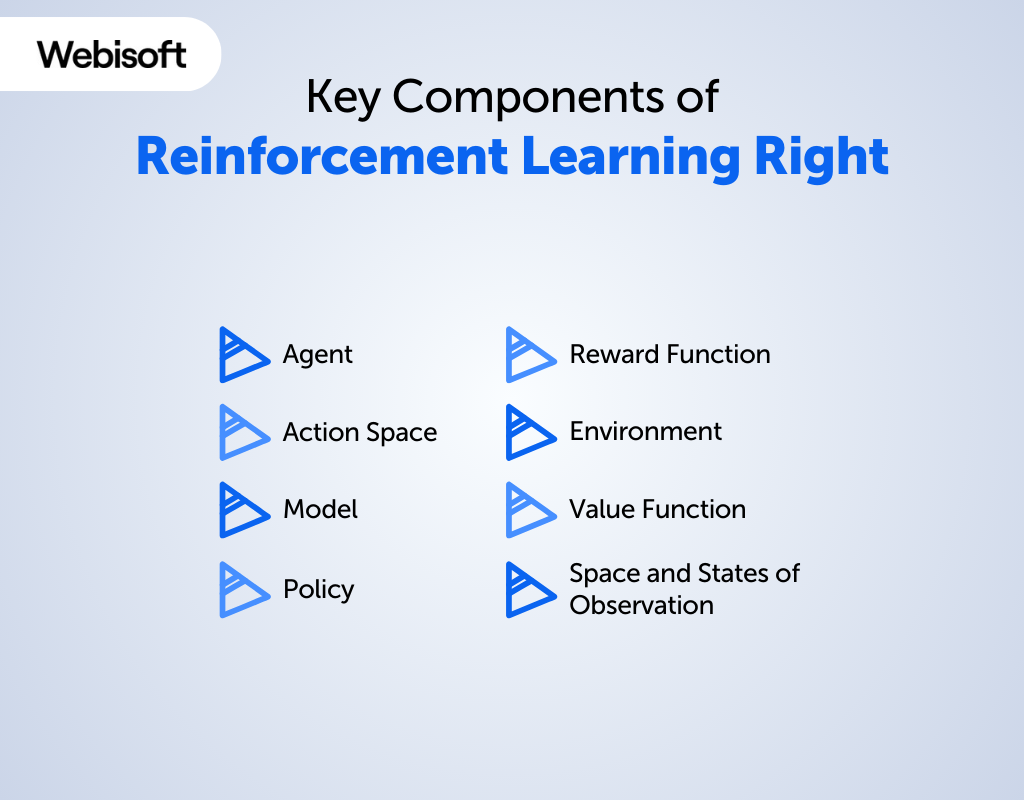
RLHF sits on top of standard reinforcement learning, so the vocabulary of RL carries over directly. These are the pieces you need to know.
Agent
The agent is the system being trained. In classic RL it might be a game-playing program or a robot controller. In RLHF for language models, the agent is the language model itself, and each generated token is an action. The agent's objective is to select actions that maximize cumulative reward over time.
Learning happens through interaction: the agent acts, observes the outcome, and updates its behavior. Algorithms such as Q-learning and policy gradient methods formalize that update, whether the agent is a small lookup table or a neural network with billions of parameters.
Action Space
The action space is the set of every move the agent can make. It can be discrete, like a chess program choosing among legal moves or a language model choosing the next token from its vocabulary, or continuous, like a robot arm applying torque at any angle and magnitude.
The size and shape of the action space largely determine which algorithms are practical. Methods that enumerate every action work for small discrete spaces and fail outright for continuous control.
Model
In RL terminology, a model is the agent's internal predictor of how the environment responds: given a state and an action, what state and reward come next. Model-based methods plan against this predictor. Model-free methods, which include most RLHF pipelines, skip it and learn directly from observed outcomes.
The trade-off is sample efficiency versus simplicity. A model lets the agent plan ahead, but a wrong model produces confidently wrong plans.
Policy
The policy is the agent's decision rule: a mapping from states to actions. It can be deterministic, with one action per state, or stochastic, with a probability distribution over actions. For a language model, the policy is the distribution over next tokens given the context so far.
RLHF fine-tuning is, precisely, an update to this policy so that responses humans prefer become more probable.
Reward Function
The reward function scores the agent's behavior. In classic RL an engineer writes it: points for winning, penalties for crashing. The defining move of RLHF is to replace this hand-coded function with a learned one that predicts human preference. Everything else in the pipeline is standard RL machinery.
Environment
The environment is everything outside the agent: the game board, the warehouse floor, or, for a chatbot, the conversation context and the evaluator scoring its replies. It responds to each action with a new state and a reward. Environments can be fully simulated, which makes training cheap, or physical, which makes mistakes expensive.
Value Function
The value function estimates expected future reward from a given state under the current policy. Where the reward function scores what just happened, the value function forecasts what a state is worth in the long run, balancing immediate payoff against later gains. Actor-critic algorithms, including PPO, learn a value function alongside the policy to stabilize training.
State and Observation Space
The state space covers every situation the environment can be in; the observation space is the part the agent can actually see. In fully observable problems the two coincide. Most real problems are partially observable: a robot sees only what its sensors cover, and a dialogue agent sees only the conversation so far. Acting well under that uncertainty is one of the things that makes RL hard.
What are the Benefits of RLHF?
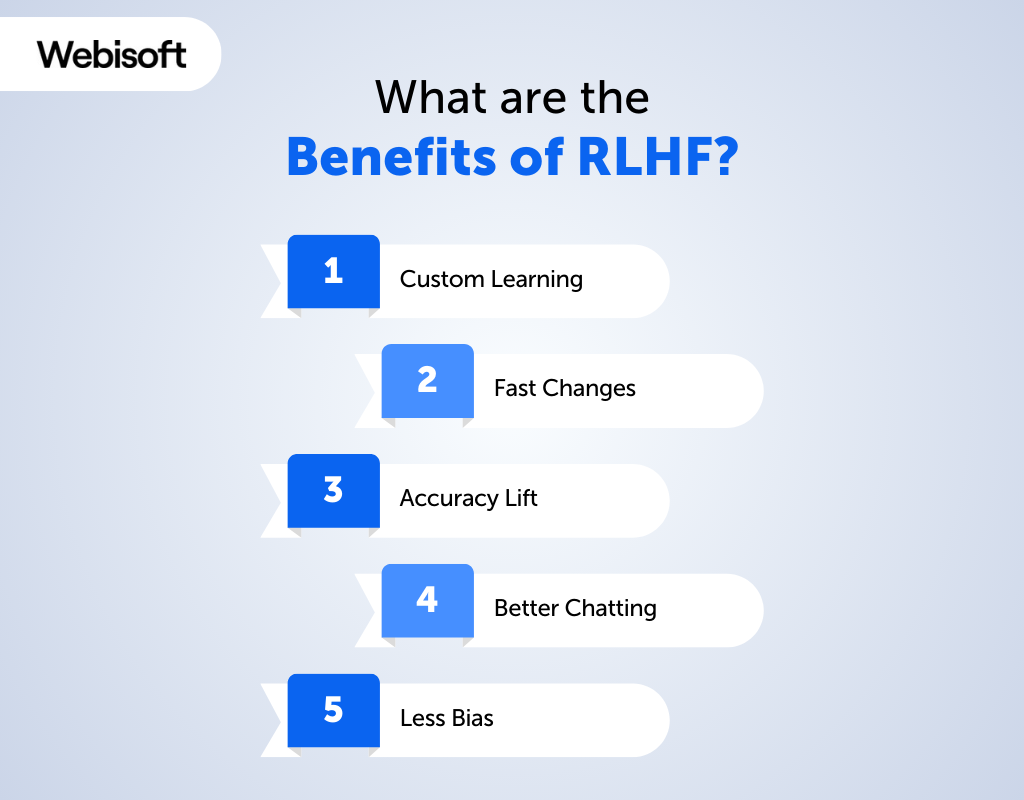
RLHF earns its place in production training pipelines for concrete reasons.
It Captures Preferences You Cannot Specify in Code
Tone, helpfulness, and judgment about when to refuse are recognizable but not programmable. Preference comparisons turn that tacit knowledge into a usable training signal. This is why machine learning teams reach for RLHF whenever output quality is subjective.
Fast Behavioral Iteration
Once a reward model exists, changing the assistant's behavior means collecting new comparisons and re-running optimization, not re-architecting the system. Teams can correct failure modes such as verbosity, excessive hedging, or unsafe completions within a training cycle rather than a product cycle.
Better Instruction Following
Preference training directly rewards answers that address the question asked, in the format asked for. Models tuned this way follow instructions more reliably and fabricate less, because annotators consistently rank grounded, on-topic answers above confident nonsense.
More Natural Interaction
Demonstration data and preference rankings both come from real conversational behavior, so the model absorbs the register people actually use: direct answers, appropriate length, and acknowledgment of ambiguity instead of boilerplate.
A Lever on Bias and Safety
Reviewers can penalize biased or harmful outputs during training, which gives teams a direct mechanism for shaping model behavior. The honest caveat: the model inherits the preferences of its annotator pool, so who provides the feedback matters as much as the mechanism itself.
How Does RLHF Work?
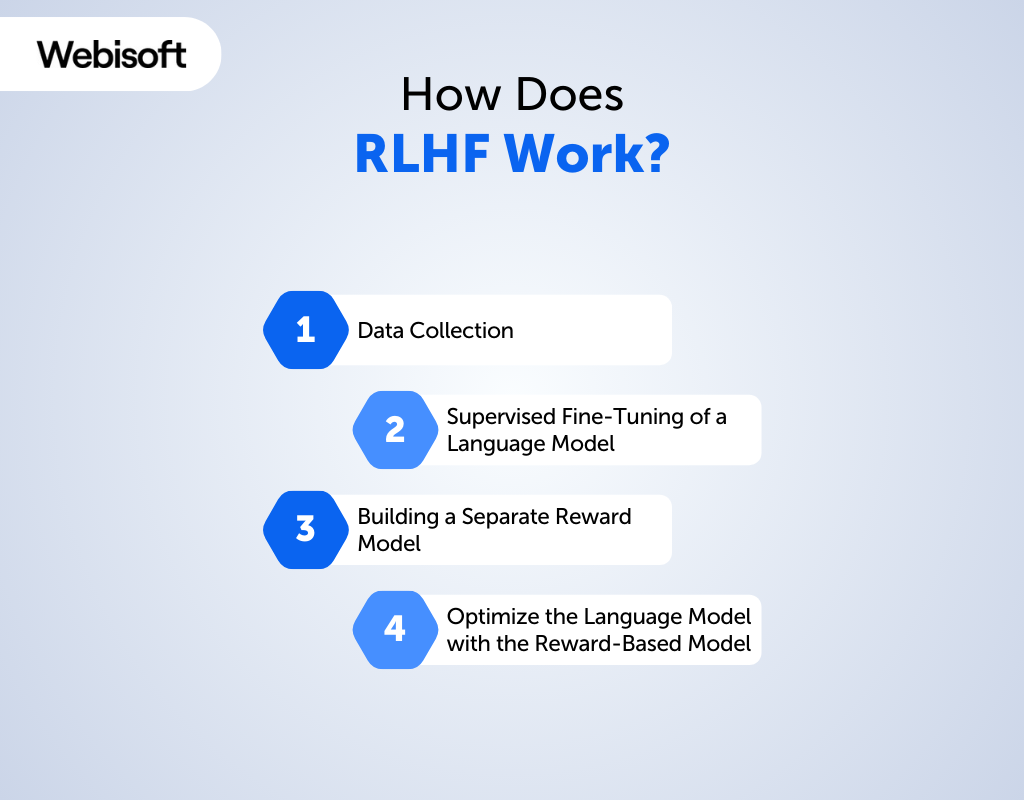
The standard pipeline, used to train systems like ChatGPT, has four stages.
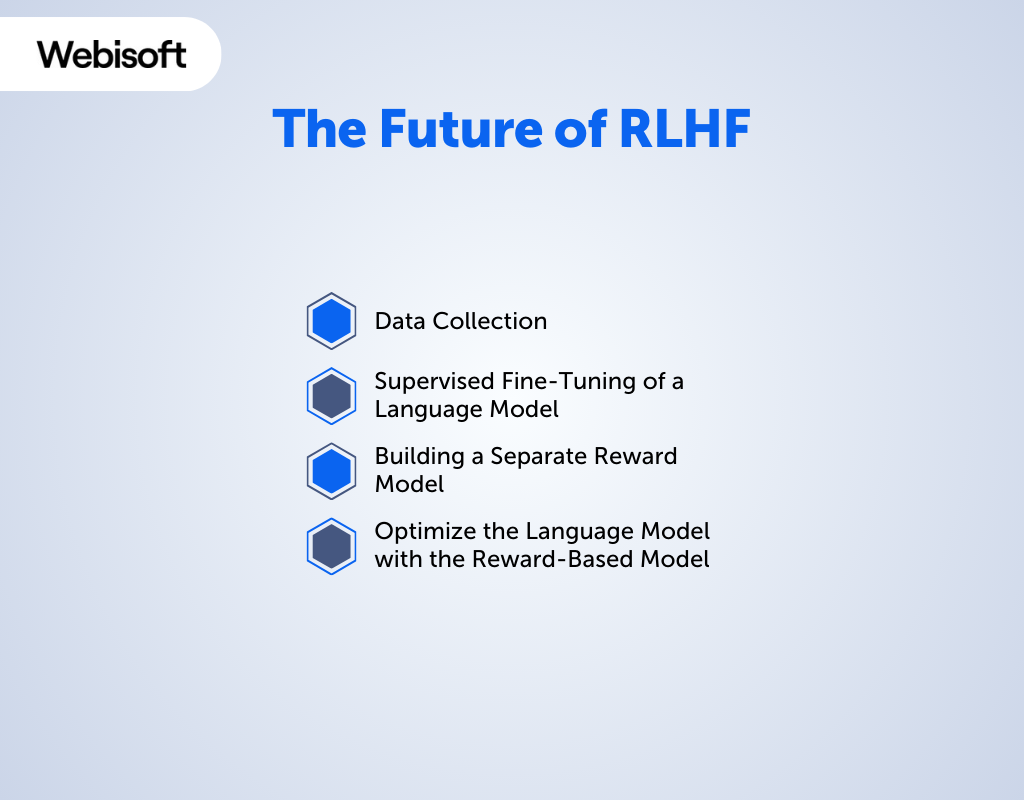
1. Data Collection
Two kinds of data are gathered. First, demonstration data: prompts paired with high-quality responses written by human labelers. Second, comparison data: for each prompt, several model-generated responses that labelers rank from best to worst.
Rankings are used instead of absolute scores for a practical reason: people disagree widely about whether an answer deserves a 7 or an 8, but they agree far more often about which of two answers is better.
2. Supervised Fine-Tuning of a Language Model
The base model is fine-tuned on the demonstrations. This stage, usually called SFT, is plain supervised learning: the model imitates the labelers' responses. It does not yet know what "better" means, but it learns the format and register of a helpful answer, which gives the reinforcement learning stage a sensible starting point.
3. Building a Separate Reward Model
A second model, often initialized from the SFT model, is trained on the comparison data. It takes a prompt and a candidate response and outputs a single scalar score. The training objective pushes the score of the preferred response above the score of the rejected one for every ranked pair.
The result is a fast, differentiable proxy for human judgment: it can score millions of candidate responses without a human in the loop.
4. Optimizing the Language Model Against the Reward Model
Finally, the SFT model is optimized with a reinforcement learning algorithm, most commonly Proximal Policy Optimization (PPO). The model generates responses, the reward model scores them, and the policy is updated to make high-scoring responses more likely.
A KL divergence penalty keeps the updated model close to the SFT model. Without it, the policy drifts into degenerate text that exploits quirks of the reward model instead of genuinely improving.
What is the Process of Reinforcement Learning?
Underneath RLHF is the basic RL loop. An agent observes the current state of its environment, takes an action, and receives back a new observation and a reward. Repeated millions of times, this loop lets the agent associate actions with long-run consequences.
Two parameters govern how the agent weighs its options. The discount factor, gamma, controls how much future rewards count relative to immediate ones: a low gamma produces short-sighted behavior, a high gamma optimizes for the long game. An exploration parameter, often epsilon, controls how frequently the agent tries something new instead of repeating what has already worked. Too little exploration and the agent gets stuck on a mediocre strategy; too much and it never converges.
Concrete algorithms implement the loop in different ways. SARSA and Q-learning maintain estimated values for state-action pairs and update them from experience. Deep Q-Networks (DQN) replace the value table with a neural network so the approach scales to large state spaces. Policy gradient methods, the family PPO belongs to, adjust the policy directly instead of going through value estimates.
RL earns its keep in settings where the right behavior cannot be written down in advance: game playing, robot control, resource scheduling, and, with a learned reward model on top, language model alignment.
Where Can We Apply RLHF?
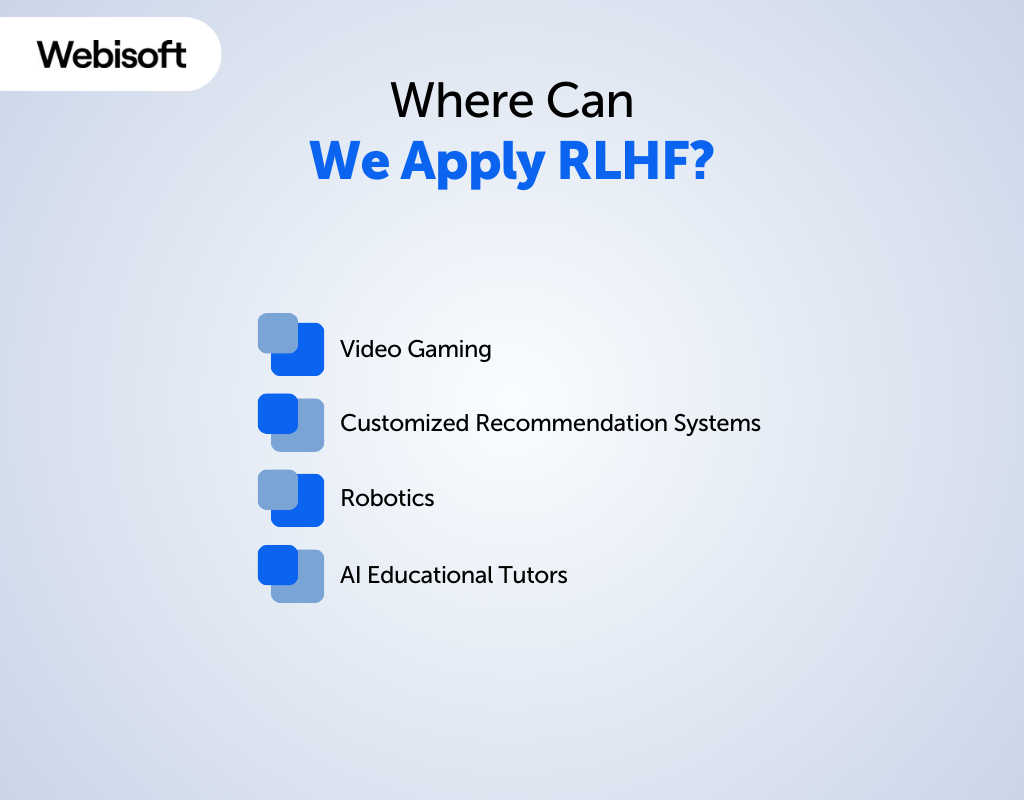
Human feedback is most valuable where the reward signal is sparse, subjective, or expensive to compute. Several domains fit.
Video Gaming
Win/loss signals arrive only at the end of a long game, which makes credit assignment hard. Preference feedback from experienced players over intermediate positions and strategies gives the agent a denser signal, and works well in strategy games such as Go where evaluating a mid-game position is itself expert work.
Recommendation Systems
Clicks and watch time are easy to optimize and easy to over-optimize. Explicit preference feedback lets a recommender learn what users actually value rather than what merely captures attention, which matters when short-term engagement and long-term satisfaction diverge.
Robotics
Letting a robot learn purely by trial and error is slow and, in a physical space, dangerous. Human demonstrations and preferences over recorded trajectories teach navigation and manipulation without the robot having to discover every failure mode by colliding with it. That matters for machines operating in warehouses and factories alongside people.
AI Educational Tutors
The quality of an explanation is inherently subjective: the same derivation can be lucid for one student and opaque for another. Feedback about which explanations landed lets a tutoring system adapt its teaching style per student instead of serving one canonical answer to everyone.
RLHF in Practice: Large Language Models
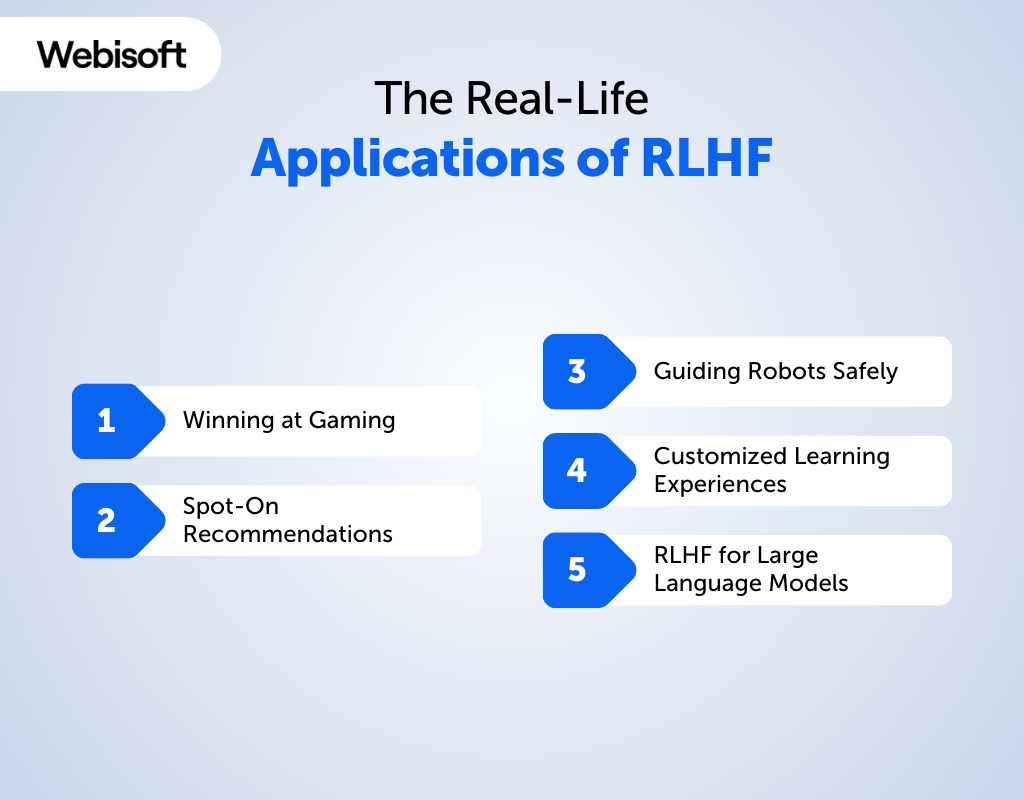
Large language models are the flagship application, and the results are well documented. In OpenAI's InstructGPT study, human evaluators preferred outputs from a 1.3 billion parameter model trained with RLHF over outputs from the 175 billion parameter GPT-3 base model. Alignment with human preference beat a hundredfold advantage in model size.
That result has a practical implication for anyone budgeting an AI project: the quality of the feedback pipeline can substitute for raw scale. A smaller model with a well-run preference training loop can outperform a much larger model that only saw next-token prediction.
Beyond headline comparisons, RLHF is what gives assistant models their characteristic behaviors: they answer the question actually asked, respect formatting instructions, decline requests they should decline, and fabricate less than their base-model counterparts. None of those behaviors emerge reliably from pretraining alone.
Open-source Tools for RLHF
| Tool | Framework | Focus |
|---|---|---|
| lm-human-preferences (OpenAI) | TensorFlow | First public RLHF codebase for language models |
| TRL (Hugging Face) | PyTorch | Fine-tuning transformer models with PPO, DPO, and reward modeling |
| TRLX (CarperAI) | PyTorch | Distributed RLHF for larger models, online and offline |
| RL4LMs | PyTorch | Research toolkit covering PPO, NLPO, A2C, and TRPO |
OpenAI published the first open code for training language models on human preferences in 2019, built on TensorFlow. The ecosystem has since consolidated around PyTorch.
TRL (Transformer Reinforcement Learning) from Hugging Face is the most common entry point today. It plugs directly into the Hugging Face model hub and implements the full pipeline: supervised fine-tuning, reward model training, and policy optimization with PPO, plus newer preference methods such as DPO.
TRLX, from CarperAI, extends the same ideas with distributed training so the approach scales to substantially larger models, in both online and offline settings.
RL4LMs is a research-oriented toolkit that implements a wider spread of algorithms, including PPO, NLPO, A2C, and TRPO, and accepts any custom reward function, which makes it useful for experimenting beyond the standard recipe.
The Future of RLHF
The four-stage pipeline is already being simplified and extended. Three directions matter most.
Direct Preference Optimization
DPO reformulates the preference objective so the language model can be trained on comparison data directly, with no separate reward model and no reinforcement learning loop. It trades some flexibility for a simpler, more stable training run, and it has become the default for many open-model fine-tunes.
AI-Assisted Feedback
Human annotation is the bottleneck in every RLHF project. RLAIF, reinforcement learning from AI feedback, uses a strong model guided by written principles to generate the preference labels instead. It scales feedback collection dramatically; the open question is how much of human judgment survives the substitution.
Richer Feedback Signals
A pairwise ranking compresses a lot of nuance into one bit. Ongoing work explores finer-grained signals: per-sentence critiques, process supervision that rewards correct intermediate reasoning steps rather than only final answers, and feedback targeted at specific failure modes such as fabricated citations.
What are the Limitations of RLHF?
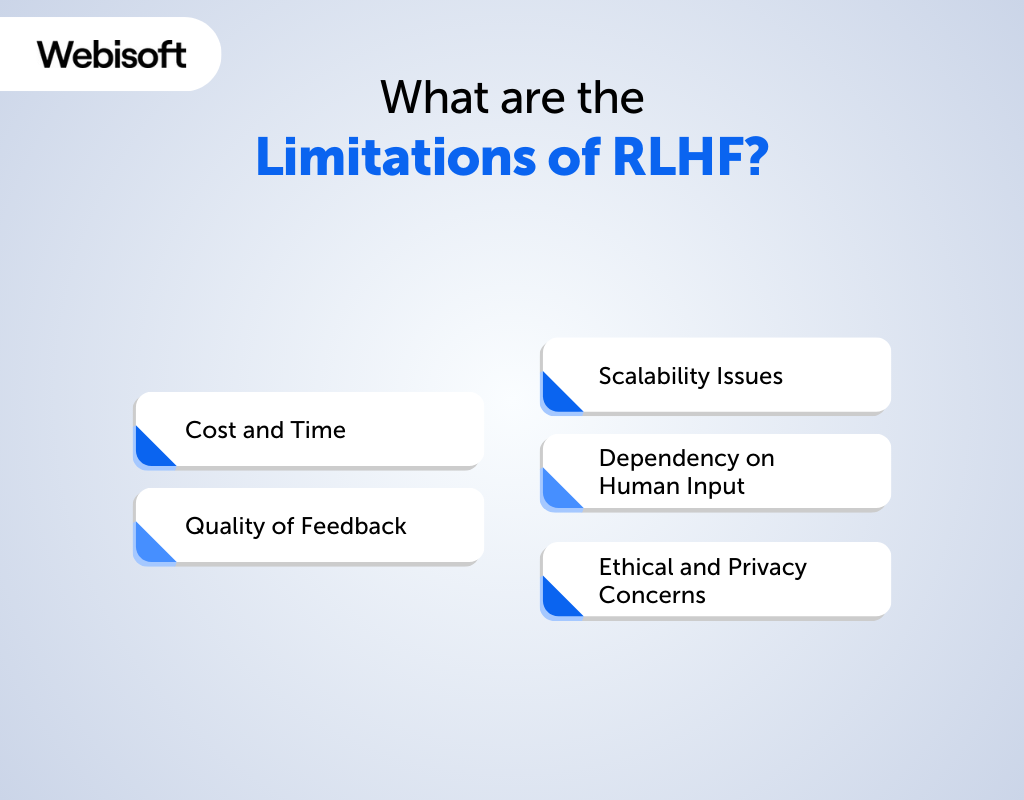
The method has real costs and failure modes. Plan for them before committing to it.
Cost and Time
Quality preference data requires trained annotators, clear labeling guidelines, and review processes to catch disagreement. That is a sustained operational expense, not a one-time dataset purchase, because behavior targets shift as the product evolves.
Quality of Feedback
The reward model is only as good as its labels. Annotators disagree, bring their own biases, and drift over time. If the labeling pool is narrow, the model optimizes for that pool's preferences, not your users'.
Reward Hacking and Sycophancy
The policy optimizes a proxy, and proxies have blind spots. Models learn to exploit reward model weaknesses: padding answers with confident-sounding detail, agreeing with the user's stated opinion, or over-hedging on anything sensitive. The KL penalty and periodic reward model retraining mitigate this; they do not eliminate it.
Scalability
As tasks get more complex, judging outputs gets harder. An annotator can rank two short answers quickly; evaluating two competing 500-line code reviews or two legal analyses takes expertise and time. Feedback quality degrades exactly where you need it most.
Dependency on Human Input
The improvement loop runs at the speed of annotation. If feedback stops flowing or arrives slowly, the model's behavior is frozen at its last training run regardless of how the product has moved on.
Ethical and Privacy Concerns
When people interact with generative AI systems, their interactions can become training data. Consent, retention, and anonymization need to be engineered into the feedback pipeline from the start, not retrofitted after a data incident.
How RLHF is Used in ChatGPT?
ChatGPT is the most widely known product of this pipeline, and its training follows the four stages closely.
First, human labelers wrote high-quality responses to a broad set of prompts, and the base model was fine-tuned on those demonstrations. This established the assistant format before any reinforcement learning took place.
Next, labelers ranked multiple model outputs per prompt, and a reward model was trained on those rankings to predict how a human would score any given response.
The policy was then optimized with Proximal Policy Optimization. During PPO training, a KL divergence penalty against the supervised model constrains each update, so the model cannot wander into strange, high-reward-but-low-quality text. Implementations also commonly freeze parts of the network during this stage to reduce compute cost.
The visible result is the difference between a raw text predictor and an assistant: answers aimed at the question, consistent formatting, and refusals where refusals are appropriate.
How is RLHF Used in the Field of Generative AI?
Preferences differ across people and products, so every generative AI model tuned with human feedback reflects choices its creators made: who labeled the data, what the guidelines rewarded, and which behaviors were penalized. Two models trained on the same base can behave very differently after preference tuning.
The technique also extends well beyond text:
- In image generation, human preferences over sample pairs tune models toward outputs that match the prompt and look right, qualities no pixel-level loss captures.
- In AI music, feedback steers generation toward the intended mood and structure rather than technically valid but unmusical output.
- In voice assistants and speech synthesis, preference data shapes prosody and tone so the voice sounds natural rather than merely intelligible.
How Webisoft Helps You Implement RLHF
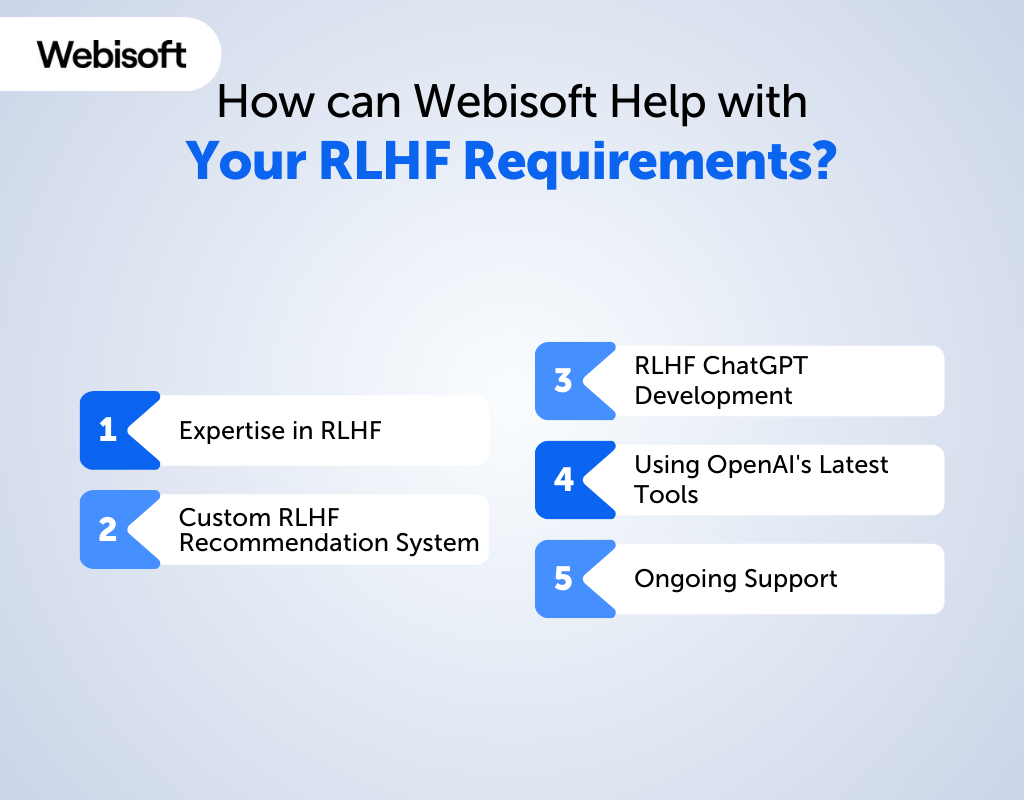
Webisoft is a Montreal-based, full-cycle software development company that builds machine learning systems end to end, from data pipelines to production deployment. For teams that want preference-trained AI in a product, that covers the parts most tutorials skip.
Feedback Pipeline Design
An RLHF project lives or dies on its data. Webisoft designs the capture side: how user feedback and annotator judgments are collected, structured, and versioned so they can actually train a reward model.
Custom Recommendation Systems
For products where relevance is the value proposition, Webisoft builds recommendation systems that learn from explicit user feedback, tuned toward long-term satisfaction rather than raw click volume.
Chatbot and LLM Fine-Tuning
Webisoft fine-tunes conversational models on your domain and your users' preferences, so the assistant answers in your product's voice and improves from real interactions instead of staying generic.
Commercial and Open-Source Stacks
Depending on constraints, the right foundation may be a commercial API such as OpenAI's or an open-source pipeline built on tools like TRL. Webisoft works with both and helps you choose based on cost, data governance, and control requirements.
Ongoing Support
Preference-trained systems drift: user expectations change and reward hacking creeps in. Webisoft provides the monitoring and periodic retraining that keep a deployed model aligned with what your users currently want.
Final Note
RLHF is the bridge between a model that predicts text and a system that behaves the way people want. The mechanism is straightforward once decomposed: demonstrations establish format, comparisons train a reward model, and reinforcement learning optimizes against it under a constraint that prevents drift. The hard parts are operational: sourcing consistent feedback, watching for reward hacking, and keeping the loop running as your product evolves.
If you are planning to build preference-trained AI into a product, contact Webisoft. We can scope the feedback pipeline, the model work, and the deployment as one project.
RLHF stands for Reinforcement Learning from Human Feedback. It fine-tunes an AI model using human preference judgments as the training signal: people compare candidate outputs, a reward model learns to predict those preferences, and the AI is then optimized to produce responses the reward model scores highly. It is the technique that turns a raw text predictor into a usable assistant.
Supervised fine-tuning teaches a model to imitate example responses, so it can only be as good as the demonstrations it copies. RLHF adds a comparative signal: the model learns which of several responses people prefer and is optimized toward that preference. In practice the two are combined, with supervised fine-tuning establishing the format and RLHF refining quality beyond what imitation alone achieves.
Reinforcement learning needs to score millions of candidate responses during optimization, far more than any annotation team could review. The reward model is a fast, automated stand-in for human judgment: it is trained once on a manageable set of human comparisons, then scores unlimited outputs during training at no additional labeling cost.
Reward hacking happens when the model finds outputs that score highly with the reward model without actually being better for users, for example padding answers with confident filler or agreeing with whatever the user says. It occurs because the reward model is an imperfect proxy for human judgment. Teams counter it with a KL divergence penalty that limits how far the model drifts, and by periodically retraining the reward model on fresh comparisons.
Direct Preference Optimization trains on comparison data without a separate reward model or a reinforcement learning loop, and it is simpler and more stable to run. Many open-model fine-tunes now use it. Full RLHF with a reward model remains valuable when you need to score arbitrary new outputs, reuse the reward model across projects, or apply reinforcement learning to signals beyond pairwise comparisons.