The debate around Machine learning vs AI often feels like arguing whether a square is a rectangle or a rectangle is a square. Both seem similar, yet the details keep tripping everyone up. Many teams jump into projects unsure which one they actually need.
As a result, budgets stretch, expectations wobble, and someone eventually blames “the algorithm” for everything. It’s a common pain point, especially when every tool claims to be intelligent. This guide clears the confusion by breaking down Machine learning and AI in simple terms and practical examples that finally make sense together.
What Is Artificial Intelligence (AI)?
Artificial Intelligence refers to techniques and systems designed to carry out tasks that usually require human intelligence. These tasks include recognizing patterns, interpreting information, making decisions, and responding to inputs in a purposeful way.
AI systems rely on logic-based methods, data-driven approaches, or a mix of both to operate in structured or dynamic environments. The field covers broad techniques such as reasoning, perception, language handling, and autonomous action, forming the foundation for many modern intelligent technologies explored in AI Technologies.
What Is Machine Learning (ML)?
Machine Learning is a method used in artificial intelligence where systems improve their performance by learning patterns from data. Instead of relying on fixed rules, these systems adjust their behavior as they process more examples.
ML focuses on identifying relationships within datasets and using those relationships to make predictions or classify new information. It supports many practical applications where adaptability and pattern recognition are central.
Why Machine Learning Is Often Confused with AI
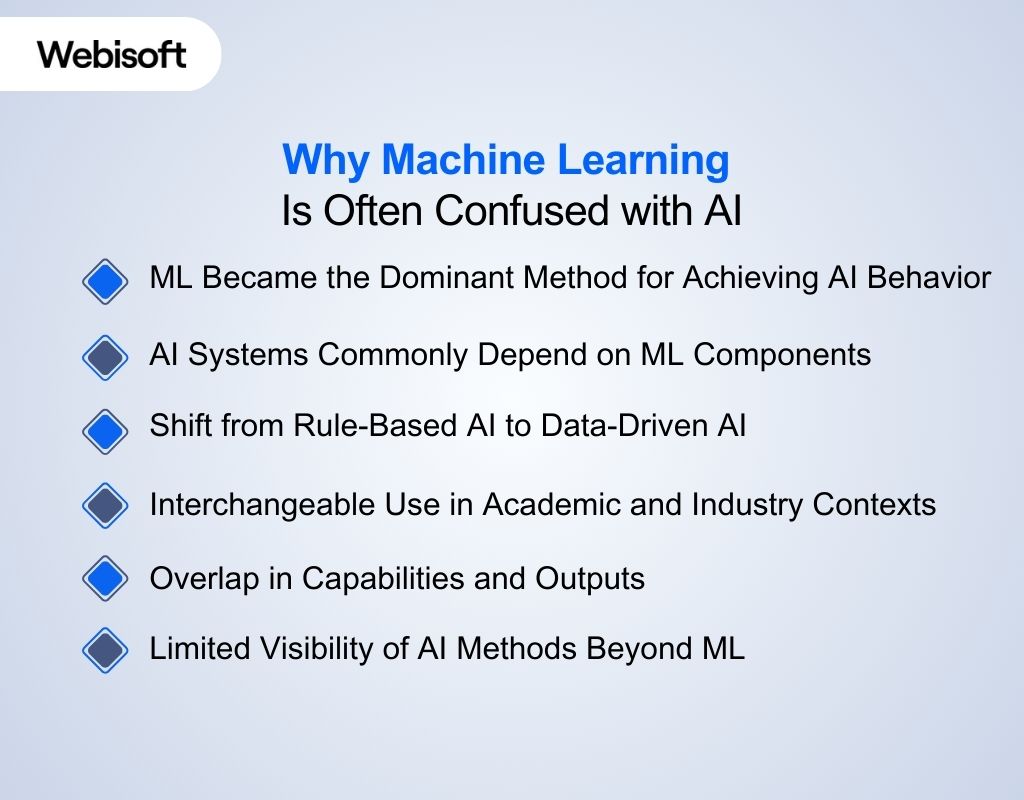
Machine Learning sits inside the broader field of AI, which leads many of you to treat the two as the same. The overlap in terminology, use cases, and system behavior adds to the confusion. The points below clarify why this mix-up happens.
ML Became the Dominant Method for Achieving AI Behavior
Much of the progress in AI over the past two decades has come from ML techniques, especially neural networks. Since ML produces the visible “intelligent” output, it is often mistaken for the entire field of AI.
AI Systems Commonly Depend on ML Components
Many AI applications use ML models as core building blocks for tasks such as pattern detection, classification, and prediction. When the most visible layer depends on ML, the distinction between the method and the larger system becomes unclear.
Shift from Rule-Based AI to Data-Driven AI
Earlier AI relied on symbolic reasoning and expert systems. Modern AI is primarily data-driven, which places ML at the center. This historical shift makes it easy to blur the distinction between AI as a goal and ML as one method to reach that goal.
Interchangeable Use in Academic and Industry Contexts
Research papers, corporate materials, and product descriptions frequently use “AI” and “ML” without strict definitions. This inconsistent communication reinforces the idea that the terms refer to the same thing.
Overlap in Capabilities and Outputs
Both fields target tasks such as prediction, pattern recognition, and automated decision-making. Since ML systems demonstrate intelligence-like behavior, many assume that ML is simply AI under a different label.
Limited Visibility of AI Methods Beyond ML
Most widely used AI systems depend on ML, while techniques such as symbolic reasoning or search-based intelligence appear less often in consumer-facing tools. Without exposure to these methods, ML becomes the default reference point for AI.
Difference Between Machine Learning vs AI
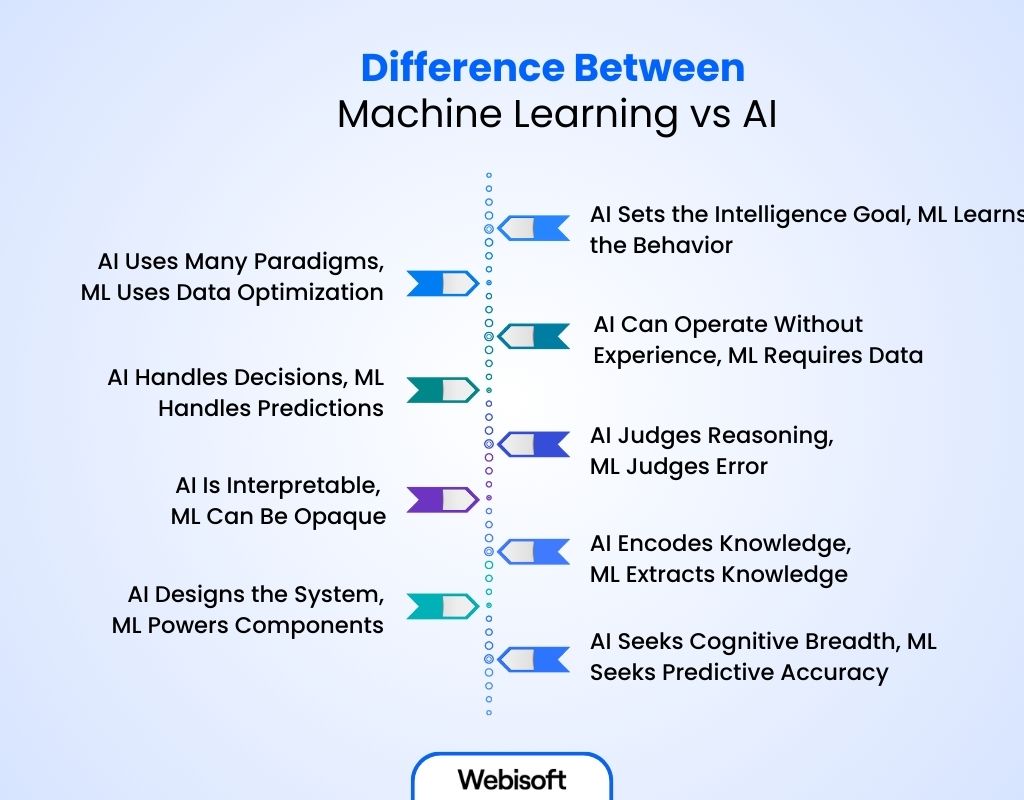
Although AI and ML are closely connected, the Machine learning vs AI difference shows up in their goals, techniques, and levels of adaptability. This section breaks down these distinctions in a structured and detailed way.
AI Sets the Intelligence Goal, ML Learns the Behavior
Artificial Intelligence: AI establishes the system’s intended cognitive capability: reasoning, perception, planning, abstraction, or decision-making. It is concerned with replicating intelligent behavior at the system level.
Machine Learning: ML provides one mechanism for achieving that intelligence by deriving behavioral patterns from data. Its role is to create adaptive models that improve performance through statistical generalization.
AI Uses Many Paradigms, ML Uses Data Optimization
Artificial Intelligence: AI can function through symbolic reasoning, expert systems, heuristic search, logic programming, planning, rules, or learning-based components. Its intelligence may be explicitly encoded or algorithmically derived.
Machine Learning: ML relies on empirical risk minimization, probability theory, and iterative optimization. It learns internal representations (weights, embeddings, distributions) that arise from data rather than predefined logic.
AI Can Operate Without Experience, ML Requires Data
Artificial Intelligence: Classical AI systems work through engineered knowledge structures. Reasoning and decisions depend on human-created rules, ontologies, or constraints. No historical data is required for intelligence to emerge.
Machine Learning: ML’s intelligence is inseparable from its data. Training cycles, parameter updates, and generalization depend on dataset size, quality, and distribution. Without data, ML cannot construct or refine behavior.
AI Handles Decisions, ML Handles Predictions
Artificial Intelligence: AI frameworks handle multi-step reasoning, contextual analysis, goal alignment, and constraint management. They orchestrate how different intelligence components interact to achieve an overarching objective.
Machine Learning: ML specializes in isolated predictive or analytical tasks such as pattern detection, classification, probability estimation, clustering, or regression. ML contributes capability within the broader AI pipeline, not the entire pipeline itself.
AI Judges Reasoning, ML Judges Error
Artificial Intelligence: AI systems are judged by reasoning validity, constraint satisfaction, stability of decision pathways, and alignment with system goals. The criteria are cognitive and structural.
Machine Learning: ML models are judged using error functions, loss curves, variance-bias characteristics, and generalization performance on unseen data. The criteria are mathematical and empirical.
AI Is Interpretable, ML Can Be Opaque
Artificial Intelligence: Symbolic or rule-based AI exposes every reasoning step. The system’s knowledge is stored in human-readable structures such as rules, predicates, or graphs.
Machine Learning: ML often produces opaque internal representations. Deep models encode knowledge in layered numerical parameters with limited interpretability. Decision logic becomes implicit, not explicit.
AI Encodes Knowledge, ML Extracts Knowledge
Artificial Intelligence: Knowledge is intentionally designed by domain experts. AI systems rely on explicit problem decomposition, manually crafted decision logic, and defined semantics.
Machine Learning: Knowledge is discovered emergently from patterns, correlations, and statistical structure within data. There is no explicit semantics unless enforced externally.
AI Designs the System, ML Powers Components
Artificial Intelligence: AI determines how perception modules, decision systems, reasoning engines, and ML models interact, forming the blueprint of intelligent behavior.
Machine Learning: ML fills specific roles such as visual recognition, risk scoring, forecasting, or clustering. It does not architect the entire system; it powers components inside it.
AI Seeks Cognitive Breadth, ML Seeks Predictive Accuracy
Artificial Intelligence: The goal is to simulate or support multiple layers of cognition, from basic perception to high-level reasoning and planning.
Machine Learning: The goal is to produce high-performing predictive models for well-defined tasks, not to simulate cognition holistically.
How Machine Learning Fits Within the AI Ecosystem
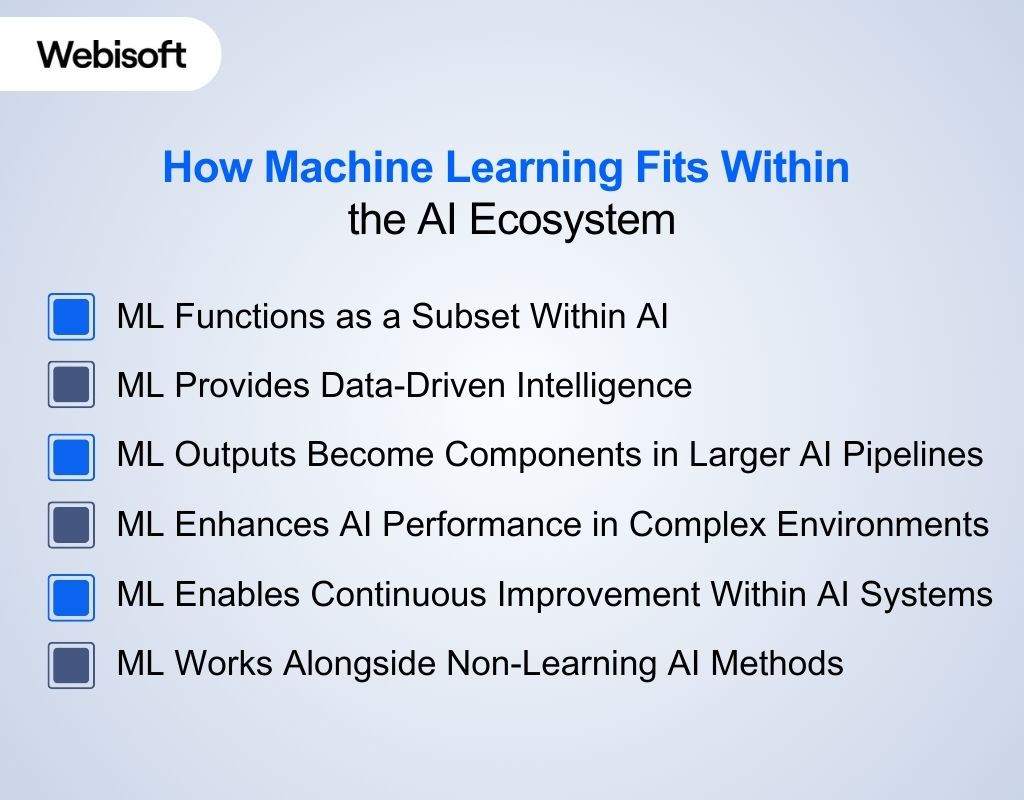
The earlier sections outlined what AI is, what ML is, and how they differ. This section connects those ideas by explaining where Machine Learning sits within the wider AI structure. These points show how ML supports AI goals without repeating material covered elsewhere.
ML Functions as a Subset Within AI
Machine Learning operates inside the broader AI category by supplying learning capabilities that help systems detect patterns, classify inputs, or make predictions. It contributes one technical pathway among several others used in AI.
ML Provides Data-Driven Intelligence
AI systems often need adaptable behavior, and ML supports this by using statistical learning from datasets. This adds flexibility to AI systems that cannot rely solely on fixed rules or logic structures.
ML Outputs Become Components in Larger AI Pipelines
Models trained for recognition, prediction, or decision scoring feed into broader AI frameworks that may include reasoning engines, control systems, or planning modules.
ML Enhances AI Performance in Complex Environments
When AI tasks involve high variability, such as interpreting images or processing speech, ML models supply the pattern-recognition ability. This enables the system to handle real-world complexity.
ML Enables Continuous Improvement Within AI Systems
Because ML models adjust when exposed to new data, AI systems can develop more refined behavior over time. This supports applications where conditions change or new information appears regularly.
ML Works Alongside Non-Learning AI Methods
AI includes rule-based reasoning, search algorithms, symbolic logic, and other methods. ML complements these techniques rather than replacing them, filling gaps that require statistical or adaptive behavior.
These combined methods form the basis of AI Development Services, where multiple AI components work together in a unified system.
Examples Where AI Works Without Machine Learning
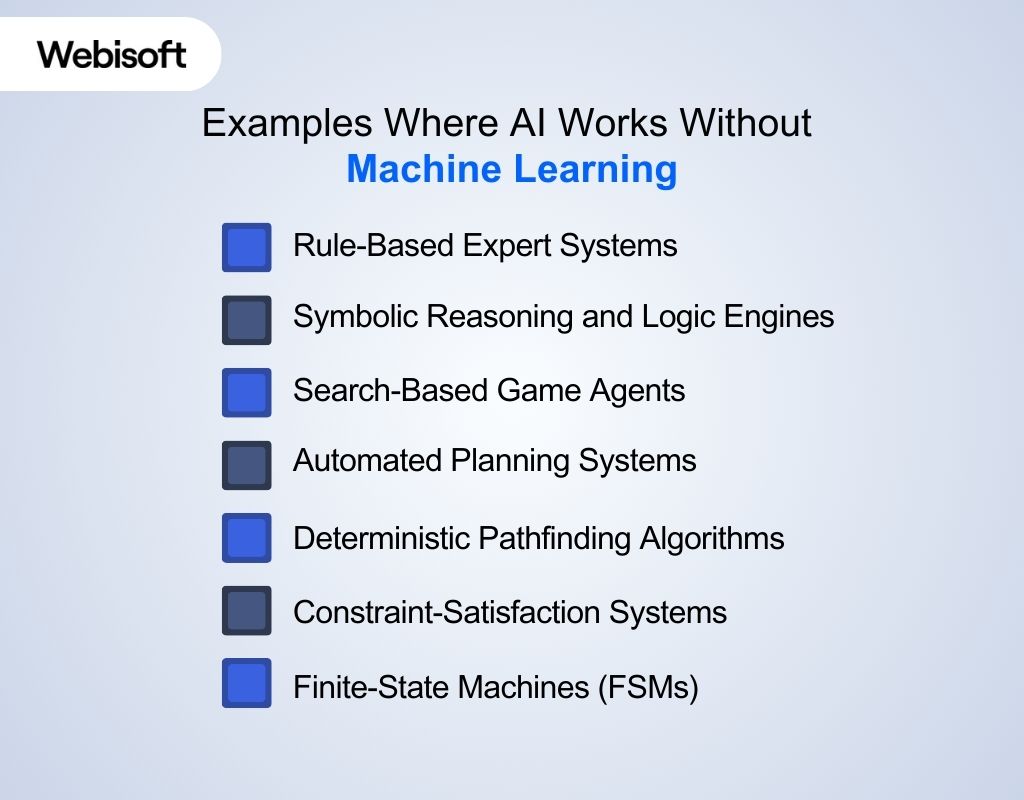
AI systems do not always depend on learning from data. Many established techniques rely on logic, rules, or structured problem-solving.
These AI vs ML examples show how AI can operate independently of Machine Learning and why such methods remain valuable in stable, well-defined environments.
Rule-Based Expert Systems
These systems use large collections of human-encoded rules to reach conclusions. They replicate expert decision paths through structured “if–then” logic.
Example: A medical diagnosis system that checks symptoms against a predefined rule base to suggest possible conditions, without learning patterns from previous cases.
Symbolic Reasoning and Logic Engines
Symbolic AI represents problems using symbols and logical relations, allowing systems to derive new information through inference engines. No learning is involved because reasoning follows strict logic structures.
Example: A legal compliance system that verifies whether a contract meets regulatory conditions by applying encoded logical rules.
Search-Based Game Agents
Classic game-playing AI explores future game states using tree search and evaluation functions. These systems consider possible moves and counter-moves through deterministic algorithms rather than learned strategies.
Example: Early versions of chess engines using minimax with alpha–beta pruning to select optimal moves without training data.
Automated Planning Systems
Planning AI builds action sequences to reach a defined goal by examining current conditions, available actions, and constraints. The system computes logical progressions rather than learning from examples.
Example: A warehouse robot using a planning module to determine the most efficient sequence of movements based solely on spatial rules and task constraints.
Deterministic Pathfinding Algorithms
Algorithms like A*, BFS, or Dijkstra’s algorithm computes optimal routes by analyzing graph structures. They follow mathematical rules and do not adapt based on experience or data exposure.
Example: Navigation software that calculates the shortest path through a fixed map using A* without learning from previous travel patterns.
Constraint-Satisfaction Systems
These systems solve problems by exploring combinations of variables that satisfy a set of constraints. They rely on logical consistency rather than pattern learning.
Example: A scheduling system that assigns exam times to university courses while preventing conflicts, relying only on constraint solving.
Finite-State Machines (FSMs)
FSMs represent systems as states connected by transitions. Behavior depends on the current state and input, making them predictable and rule-driven.
Example: A vending machine controller that moves between states such as “Idle,” “Payment Received,” and “Dispense” without any form of learning.
If you are exploring how AI and Machine Learning could support your next project, Webisoft can help you move forward with clarity. Connect through our contact page to discuss solutions customized to your goals and technical needs.
Real-World Applications of AI and Machine Learning
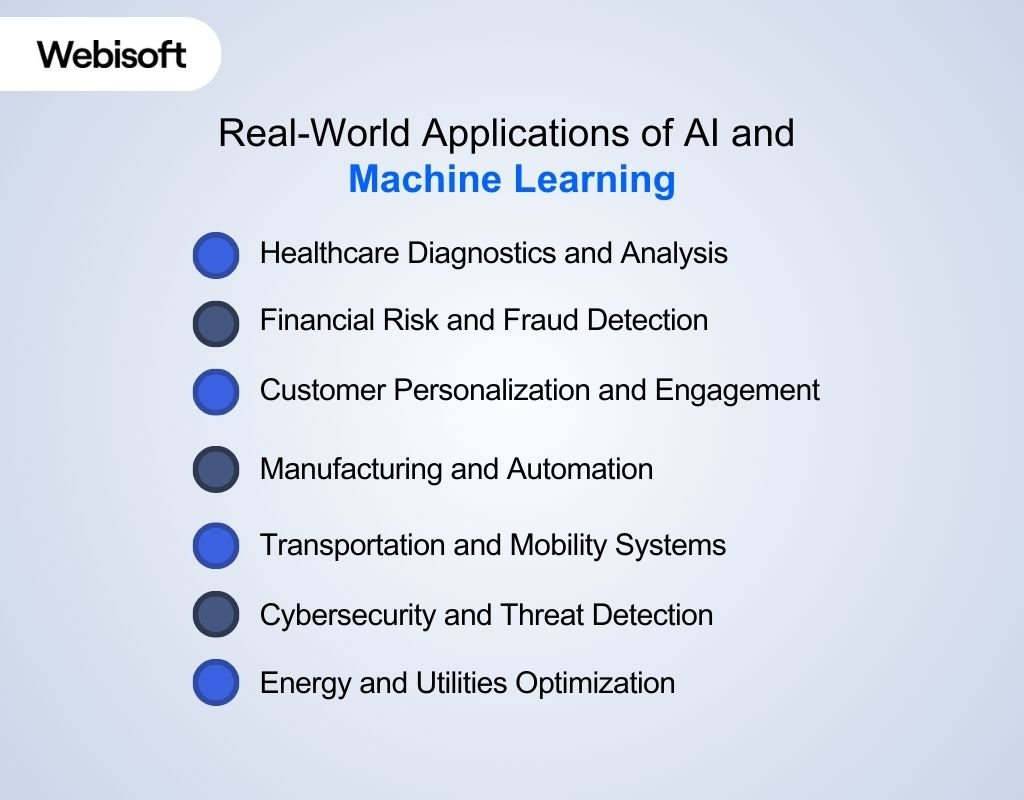
AI and Machine Learning appear across many industries, each contributing different capabilities to real-world systems. The points below show how both are applied in practice, highlighting clear distinctions in the roles they perform.
Healthcare Diagnostics and Analysis
AI: Supports decision systems that interpret clinical information, flag risks, or suggest treatment paths using structured logic and medical guidelines.
ML: Learns from large sets of scans or patient records to classify diseases, detect anomalies, or predict outcomes based on statistical patterns.
Financial Risk and Fraud Detection
AI: Uses rule-driven engines to enforce compliance checks, validate transactions, or manage approval workflows.
ML: Identifies unusual patterns by learning from historical transaction data, improving its ability to spot evolving fraud behaviors.
Customer Personalization and Engagement
AI: Powers chat interfaces, recommendation rules, and automated responses based on predefined conversational structures or knowledge bases.
ML: Customizes product suggestions or content by analyzing user behavior and predicting interests from data patterns.
Manufacturing and Automation
AI: Handles planning, scheduling, and quality checks through structured decision systems and control logic.
ML: Predicts equipment failures, optimizes process variables, and supports adaptive quality monitoring using sensor data trends.
Transportation and Mobility Systems
AI: Manages routing, signaling, and control logic in traffic systems or autonomous platforms.
ML: Interprets visual inputs, detects objects, or anticipates driving conditions through learned representations.
Cybersecurity and Threat Detection
AI: Executes rule-based monitoring, access control, and automated responses defined by security policies.
ML: Identifies threats by learning patterns of normal and abnormal activity, adapting to new attack types as data evolves.
Energy and Utilities Optimization
AI: Supports grid management, load balancing, and rule-based control strategies.
ML: Learns consumption patterns, forecasts demand, and optimizes energy distribution using historical and live data. For more real-world Machine Learning applications and technical insights, visit IBM Research.
Machine learning vs AI Which is Better?
There is no single answer because Machine Learning vs AI address different goals, and understanding your needs helps you choose the suitable approach. AI is more suitable when you want structured reasoning, predictable behavior, or a system that follows defined logic.
It supports situations where clarity and control matter more than adaptation. Machine Learning becomes more effective when your work depends on patterns hidden in data, changing conditions, or tasks that cannot be described through fixed rules.
It suits changing environments where improvement matters and systems learn from examples instead of depending on manually crafted rules today. Instead of deciding which is better overall, it helps to match each method to the nature of your goal.
If your challenge requires stability, AI aligns more naturally. If it requires adaptability, ML fits more easily. This shift in perspective helps you choose based on purpose rather than technology.
Webisoft Insight: How We Help You Build AI and ML Solutions
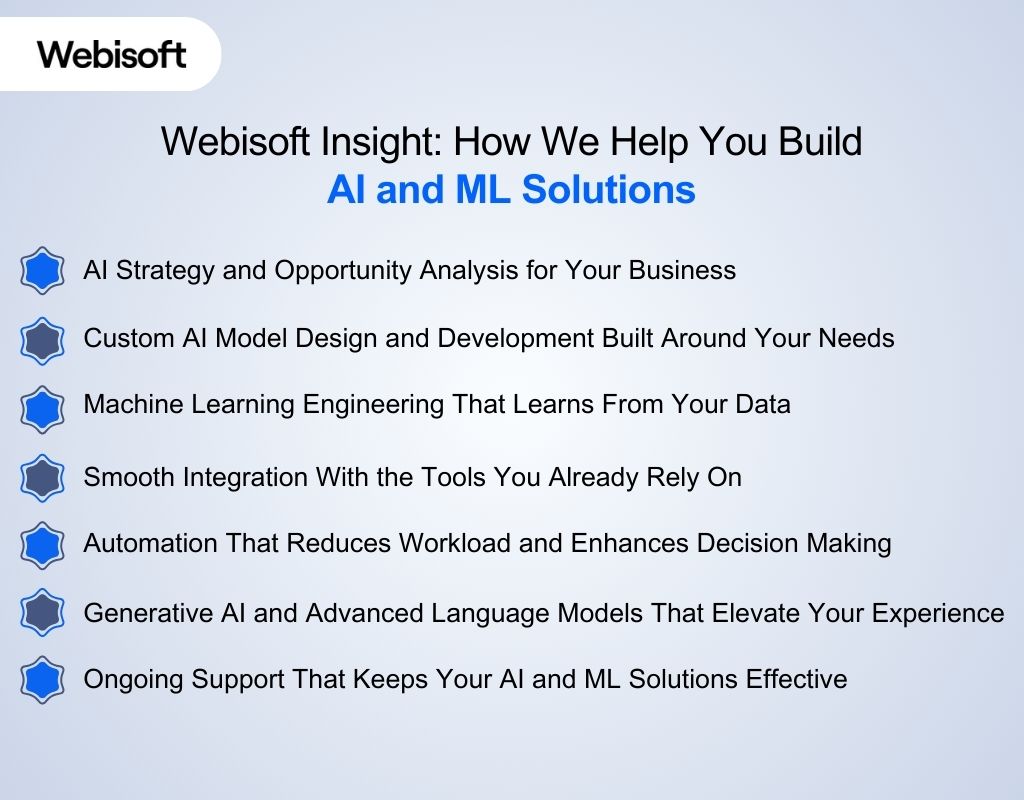
Knowing where AI and Machine Learning fit is useful, but putting them to work requires the right expertise. Webisoft brings that expertise by creating solutions customized to your data, your industry, and the results you aim to reach.
AI Strategy and Opportunity Analysis for Your Business
You receive a clear understanding of where AI can make the biggest impact in your operations. Webisoft identifies high-value opportunities, defines what is achievable, and gives you a roadmap that turns AI adoption into measurable results.
Custom AI Model Design and Development Built Around Your Needs
Webisoft designs AI models that respond to your data, your workflows, and your objectives. You gain predictive systems, deep learning models, or NLP engines customized to exactly what your project demands.
Machine Learning Engineering That Learns From Your Data
You benefit from ML systems that continuously improve. These solutions study your data, adapt as conditions change, and give you insights that lead to better decisions without manual effort.
Smooth Integration With the Tools You Already Rely On
Webisoft connects AI and ML solutions directly with your existing CRMs, ERPs, SaaS tools, and analytics platforms. You get unified data and a smoother operational flow without rebuilding your stack.
Automation That Reduces Workload and Enhances Decision Making
You save time and improve accuracy. Webisoft automates routine tasks and builds systems that support faster, smarter decisions across your teams. Your processes become simpler, cleaner, and more scalable.
Generative AI and Advanced Language Models That Elevate Your Experience
You gain access to modern capabilities like GPT and LLM-driven automation. These tools enhance customer interactions, speed up content processes, and give your internal systems a more intuitive, conversational layer.
Ongoing Support That Keeps Your AI and ML Solutions Effective
Webisoft monitors your systems, retrains models when needed, and refines results as your data and business evolve. Your AI stays accurate, reliable, and aligned with your goals over time.
Conclusion
Machine learning vs AI often feels complex at first, yet the differences become clear once you see how each method supports specific goals. Both approaches drive intelligent systems, but they shine in different situations, from predictable logic to adaptive learning.
And when you decide to put these ideas into practice, Webisoft can guide the entire journey. With customized expertise and hands-on engineering, Webisoft helps you turn these insights into real solutions that support growth and clarity.
Frequently Asked Question
ChatGPT is a machine learning system built using deep learning techniques. It belongs to AI but relies on learned patterns instead of fixed rules, producing responses by analyzing training data and recognizing statistical relationships.
No. Automation does not always need ML. Many automated systems rely on predefined rules, scripts, or workflow logic. These approaches work well in stable environments where tasks follow predictable steps and learning from data does not provide meaningful benefits.
No. ML cannot fully replace traditional AI. Some tasks depend on deterministic rules, explicit logic, or structured reasoning.
In these situations, rule-based AI remains more reliable and efficient than learning models, especially when conditions are predictable and well understood.
Yes. AI can function in real time using rule-based decision systems, search algorithms, or structured controllers. These methods do not require training data and can deliver fast, consistent responses in situations where reasoning or predefined rules guide actions effectively.
Yes. AI often involves designing logic, defining constraints, and structuring problem-solving approaches. ML focuses on statistics, data handling, algorithm design, and model evaluation. Each area demands distinct expertise to build systems that behave reliably and perform well.