Artificial intelligence vs machine learning is a distinction many people struggle to explain, even while using both terms daily. They are often used interchangeably in discussions about big data, AI automation, and digital transformation.
That confusion is understandable, but it creates real problems when systems are designed or evaluated incorrectly. Artificial intelligence refers to the broader goal of enabling machines to perform tasks that require human judgment. Machine learning focuses on how systems learn from data to improve specific outcomes.
One defines purpose, while the other improves performance. As organizations adopt these technologies at scale, the difference becomes practical, not academic.
Misunderstanding their roles can lead to poor expectations, weak implementations, and wasted investment. This article explains where they differ, how they connect, and how they function in real systems.
Artificial Intelligence Explained
Artificial intelligence refers to systems designed to perform tasks that typically require human judgment. These tasks include understanding language, recognizing patterns, analyzing information, and making decisions based on context. AI is not a single algorithm or product.
It is a system-level approach that combines logic, data processing, and decision rules to act with a degree of autonomy. What separates artificial intelligence from basic automation is decision making. An AI system does not simply follow fixed instructions.
It evaluates inputs, applies reasoning, and determines the most appropriate action within defined constraints. When a system can respond differently based on changing conditions, it begins to qualify as artificial intelligence. This intelligence exists across the entire system rather than within isolated features.
For example, a voice assistant processes speech, interprets intent, selects a response, and executes an action as one coordinated flow. Each component supports a single objective, which is completing the task without human intervention.
AI systems can be built using predefined rules or data-driven learning methods. Rule-based systems rely on logic written by humans, while learning-based systems adjust behavior using data, often through machine learning. Both approaches fall under artificial intelligence because the system still makes independent decisions.
In practice, most artificial intelligence today is narrow in scope. These systems perform specific tasks extremely well but cannot generalize beyond their intended use. Human-level intelligence across unrelated domains does not exist in deployed systems today. Understanding these boundaries helps you evaluate AI capabilities realistically.
Machine Learning Explained
Machine learning is a subset of artificial intelligence that focuses on learning from historical data. Instead of being programmed with explicit rules, a machine learning system analyzes past examples to identify patterns. Those patterns are then used to make predictions or decisions when new data appears.
The process starts with model training. Algorithms are exposed to data, compare predictions with actual outcomes, and adjust internal parameters to reduce errors. The result is a trained model that can generalize from previous experience.
Performance improves when training data is relevant, accurate, and sufficiently large. At its foundation, machine learning is statistical rather than cognitive. The system does not understand meaning or intent. It calculates probabilities and correlations based on observed data.
When similar conditions appear again, the model applies what it has learned to produce an output. Machine learning methods typically fall into three categories. Supervised learning relies on labeled data to predict known outcomes. Unsupervised learning identifies hidden structure in unlabeled data.
Reinforcement learning improves behavior through trial, error, and feedback from an environment. Despite its effectiveness, machine learning has clear limitations. It cannot define goals, reason abstractly, or operate without suitable data.
Its outputs are constrained by the patterns it has already seen. This is why machine learning enables artificial intelligence but does not function as intelligence on its own.
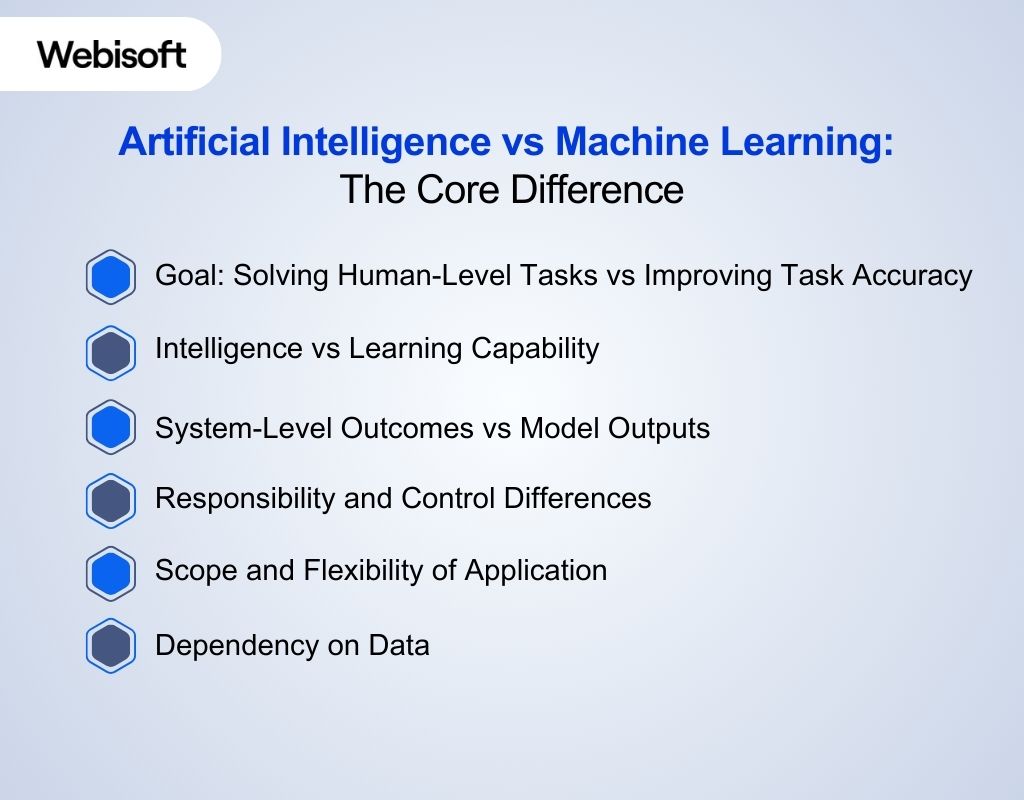
Artificial Intelligence vs Machine Learning: The Core Difference
Before comparing artificial intelligence vs machine learning in depth, it is important to frame the discussion correctly. These are not competing technologies.
One defines the system’s purpose, while the other supports how parts of that system improve over time. The difference between artificial intelligence and machine learning becomes clear when you examine goals, outputs, control, and scope.
Goal: Solving Human-Level Tasks vs Improving Task Accuracy
Artificial intelligence is built to solve a task that normally requires human judgment. The goal is completion, not prediction. An AI system exists to replace or assist a human decision process end to end, which is central to any AI vs ML comparison. Machine learning serves a narrower goal.
It improves how accurately a system performs a specific function. The focus is not task ownership, but on performance optimization within a defined boundary, which highlights the machine learning vs artificial intelligence distinction.
This is why AI is measured by usefulness and outcomes. Machine learning is measured by accuracy, error reduction, and confidence scores, a common theme in any AI vs ML explained discussion.
Intelligence vs Learning Capability
Artificial intelligence simulates intelligence at the system level. It can combine perception, reasoning, and action to behave purposefully. The system decides what to do based on inputs and objectives, reinforcing the artificial intelligence definition. Machine learning does not simulate intelligence.
It learns statistical relationships from historical data, aligning with the machine learning definition. The system does not understand meaning or intent.
It identifies patterns that are likely to repeat. Learning improves performance, but it does not create understanding. That distinction defines the artificial intelligence and machine learning difference.
System-Level Outcomes vs Model Outputs
AI systems produce outcomes that are directly usable. Machine learning focuses on optimizing predictive accuracy, whereas the surrounding AI architecture ensures that every decision is structured, traceable, and explainable to a human manager, in practice.
Machine learning systems produce model outputs. These outputs are predictions, classifications, or probabilities. Another layer must decide how to apply them, which shows how artificial intelligence uses machine learning.
For example, predicting traffic congestion is not the same as deciding your commute. The prediction supports the decision, but it does not make it, a core idea in the relationship between AI and machine learning.
Responsibility and Control Differences
Artificial intelligence controls the decision flow. It determines when to act, which inputs matter, and how outputs affect behavior. AI systems can self-correct using logic, rules, or learning signals, supporting broader AI decision making vs ML prediction use cases.
Machine learning does not control behavior. It responds to training data and returns results. Control remains with the AI system or human operators, reinforcing the machine learning subset of artificial intelligence concept. When a machine learning model fails, the system does not know why. When an AI system fails, architecture and logic must be revisited.
Scope and Flexibility of Application
Artificial intelligence has a broad scope. It can work across structured, semi-structured, and unstructured data. It adapts to different environments by design, which explains why artificial intelligence examples vary widely.
Machine learning has a limited scope. It performs well in narrow, data-rich problems, which is clear in most machine learning examples.
Outside those boundaries, performance degrades quickly. This is why AI systems often combine multiple techniques. Machine learning is one tool among many, including deep learning in artificial intelligence.
Dependency on Data
AI systems are not always dependent on large datasets. Rule-based logic, heuristics, and domain knowledge can still drive intelligent behavior, which matters in AI vs ML vs deep learning discussions. Machine learning depends entirely on data quality and quantity.
Poor data produces poor models. No amount of tuning fixes missing context. This dependency explains why ML projects fail more often than AI systems as a whole.
How Artificial Intelligence and Machine Learning Work Together
Artificial intelligence and machine learning are closely connected, but they serve different roles inside a system. Artificial intelligence defines what a system should accomplish and how decisions are executed. Machine learning supports that goal by improving how specific parts of the system perform over time.
This relationship between AI and machine learning is structural, not competitive. In practice, machine learning fits inside artificial intelligence as a learning component. The AI system sets objectives, enforces constraints, and determines final actions.
Machine learning analyzes historical data and supplies predictions or classifications that inform those actions. Without AI, machine learning lacks direction. Without machine learning, many AI systems remain static. As data flows through the system, learning cycles form naturally.
Inputs are collected, processed, and passed to machine learning models. Those models generate outputs based on learned patterns. The AI layer then evaluates those outputs and decides whether to act, delay, or escalate. Control stays at the system level.
Over time, feedback tightens this loop. When outcomes succeed or fail, that information feeds back into model training. Machine learning updates improve accuracy, while the AI system controls when updates affect behavior. This separation protects stability while allowing improvement.
That is why most real-world systems combine artificial intelligence and machine learning. AI provides structure, accountability, and purpose. Machine learning provides adaptability and performance gains. Used together, they produce systems that act intelligently while learning from experience.
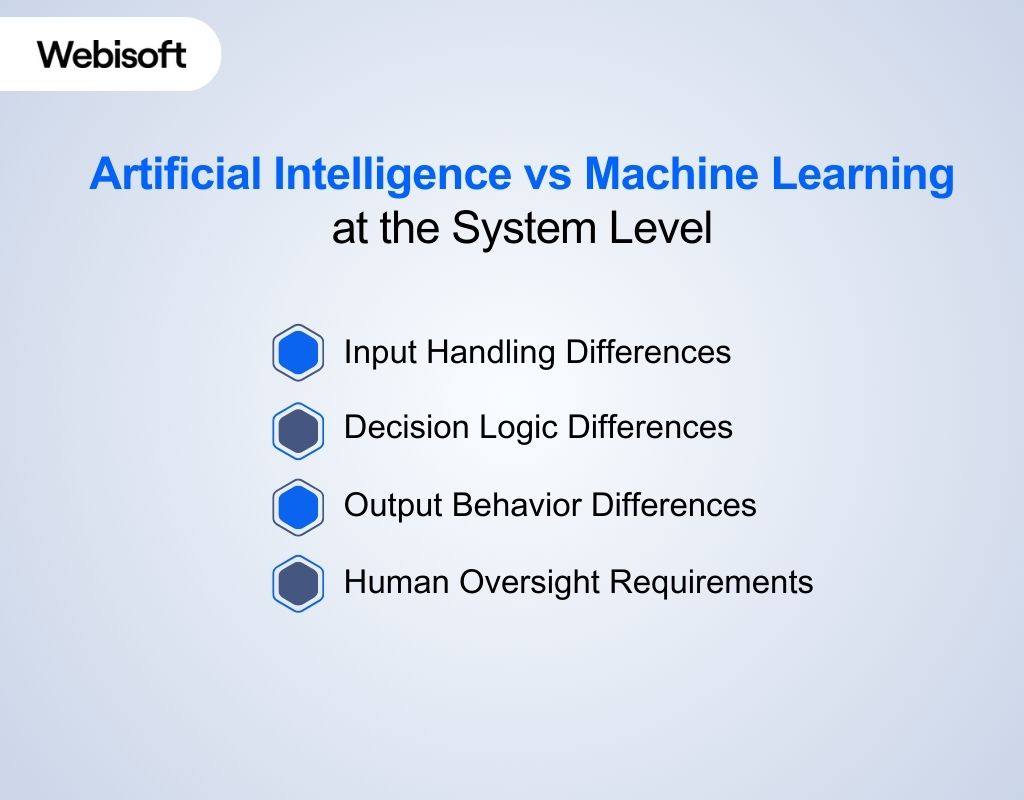
Artificial Intelligence vs Machine Learning at the System Level
At a high level, artificial intelligence and machine learning may appear interchangeable. The difference becomes clear when you examine how complete systems are designed and operated. Looking at inputs, decision logic, outputs, and oversight shows where intelligence lives and where learning simply supports it. Let’s discuss artificial intelligence vs machine learning at the system level:
Input Handling Differences
At the system level, artificial intelligence handles inputs broadly. It can combine text, images, sensor data, rules, and contextual signals. The AI system decides which inputs matter based on the task and current conditions. Machine learning handles inputs narrowly.
It consumes data that matches a training objective and ignores everything else. The model only processes what it was designed to learn from, nothing more.
Decision Logic Differences
Decision logic sits with artificial intelligence. The AI system determines what should happen next and why. It may rely on rules, logic trees, or outputs from learning models to reach a decision. Machine learning does not make decisions. It generates predictions, classifications, or probability scores. Another layer must interpret those outputs before any action occurs.
Output Behavior Differences
Artificial intelligence systems produce outcomes that are directly usable. These include actions, responses, or automated decisions that complete a task. Responsibility for the result sits with the system. Machine learning systems produce model outputs only. These outputs describe likelihoods or patterns. They do not change behavior unless an AI system applies them.
Human Oversight Requirements
Artificial intelligence systems are designed with control and accountability in mind. Engineers define when humans can intervene and how decisions can be overridden.
Oversight focuses on behavior and outcomes. Machine learning systems require oversight earlier in the process. Humans manage data quality, training, and validation. Once deployed, models follow learned patterns without understanding consequences.
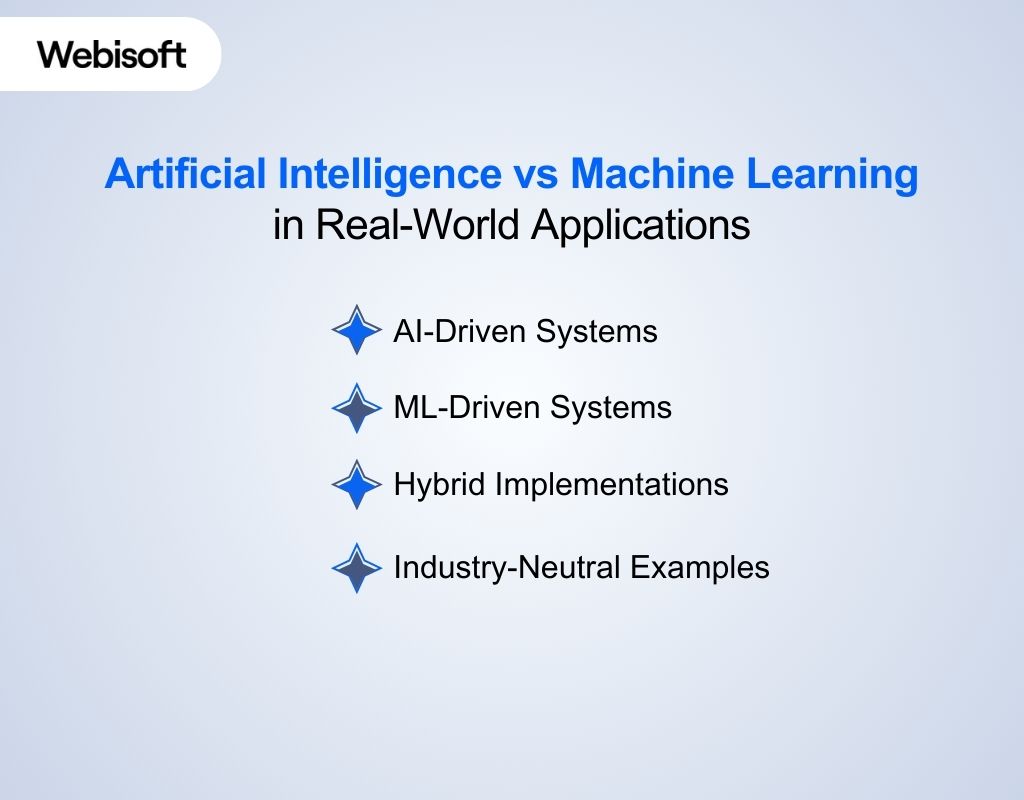
Artificial Intelligence vs Machine Learning in Real-World Applications
78% of companies worldwide use AI in at least one business function in 2025, whereas about 72% of US enterprises report that machine learning is now part of standard operations.
The artificial intelligence and machine learning difference becomes clear when you examine what drives the system, what it learns from data, and what ultimately takes action. In this section, we will discuss artificial intelligence vs machine learning in real-world applications:
AI-Driven Systems
AI-driven systems are built to handle complete tasks that require coordination, judgment, and sequencing. These systems decide what should happen next, not just what is likely to happen. This behavior defines many real artificial intelligence examples used in production environments.
Autonomous vehicles are a clear case. The AI system manages navigation, safety rules, and route planning. Machine learning supports perception, but the system owns the decision.
This distinction sits at the center of any serious artificial intelligence vs machine learning discussion. Virtual assistants follow the same pattern. The AI layer interprets intent, manages dialogue, and executes actions. Predictions help, but intelligence controls the workflow.
ML-Driven Systems
ML-driven systems focus on learning patterns from data and producing accurate outputs. These systems do not manage workflows or decisions. They exist to optimize prediction quality, which defines most practical machine learning examples.
Spam detection is a typical case. The model classifies messages using learned patterns. It does not decide how the user responds. That separation reflects the machine learning vs artificial intelligence boundary. Recommendation engines behave similarly. The model predicts preferences. Another system determines presentation and action.
Hybrid Implementations
Most production systems combine artificial intelligence and machine learning. AI defines goals and constraints. Machine learning improves accuracy within specific components, reflecting the relationship between AI and machine learning.
In healthcare, AI systems coordinate diagnostic workflows. Machine learning analyzes medical images and patient records. The AI layer decides when to alert clinicians or escalate risk, illustrating how artificial intelligence uses machine learning.
Manufacturing systems show the same structure. AI manages operations. ML predicts failures. Control and learning remain separate.
Industry-Neutral Examples
Across industries, the pattern holds. In finance, AI systems automate risk handling while ML detects anomalies. In retail, AI manages experience flows while ML forecasts demand. In telecommunications, AI optimizes networks while ML predicts traffic loads.
These systems highlight AI decision making vs ML prediction in real operations. Artificial intelligence provides structure and the framework for accountability. Machine learning provides learning and accuracy. Together, they enable scalable intelligence.
How Webisoft Integrates AI and Machine Learning into Your Company?
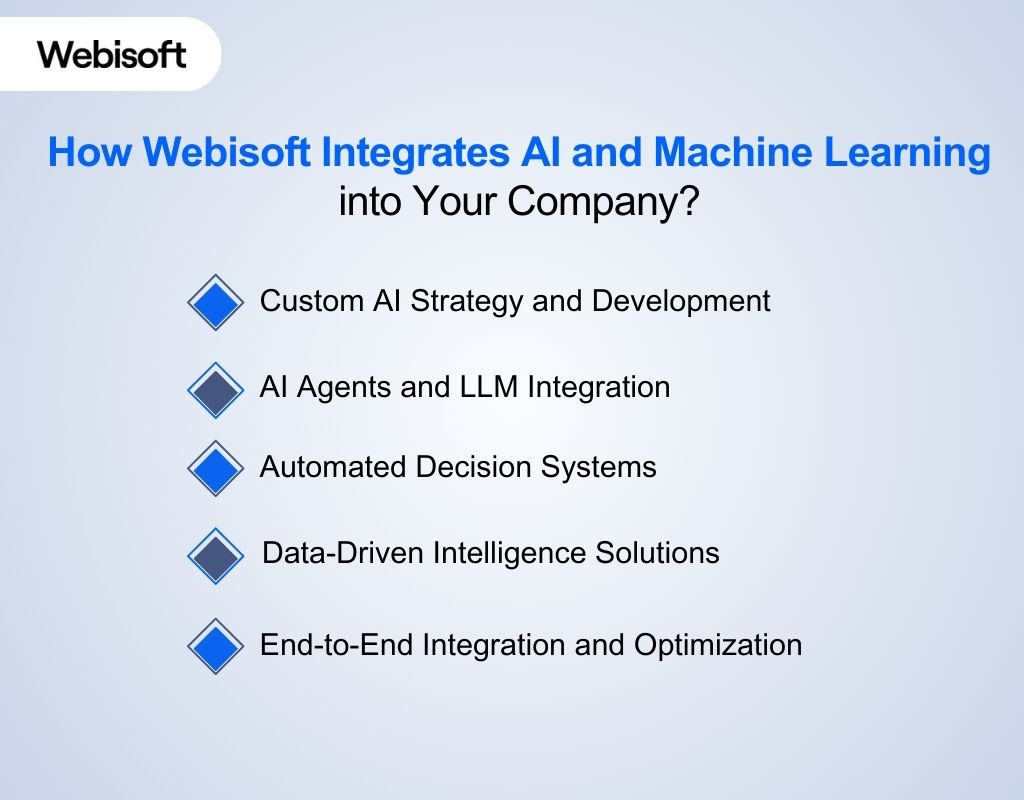
Webisoft integrates artificial intelligence and machine learning by treating them as operational systems, not standalone tools. The focus stays on solving real business problems through careful design, controlled deployment, and long-term scalability.
This practical approach reflects how artificial intelligence vs machine learning should be applied in real organizations, with each technology serving a clear role. Each engagement aligns AI and ML capabilities with existing workflows, data maturity, and business goals.
Custom AI Strategy and Development
Webisoft begins by analyzing how your organization operates today. This includes workflows, data sources, and decision points.
Based on this assessment, Webisoft designs custom AI and machine learning solutions that match business objectives instead of generic use cases, addressing the real difference between artificial intelligence and machine learning at the system level.
The strategy phase defines where intelligence should exist, what learning is required, and how success will be measured. This clarity helps teams understand the artificial intelligence and machine learning difference before development begins.
AI Agents and LLM Integration
Webisoft builds AI agents that operate inside your existing tools and platforms. These agents connect with systems like CRM, HR, and IT environments to automate tasks such as lead handling, ticket routing, and internal support, demonstrating how artificial intelligence uses machine learning in daily operations.
Large language models are integrated where contextual understanding is required. This allows systems to work with unstructured data and supports advanced AI vs ML explained use cases without disrupting workflows.
Automated Decision Systems
For data-intensive operations, Webisoft implements automated decision systems that act in real time. These systems analyze incoming data streams and trigger actions based on predefined logic and learned patterns, highlighting AI decision making vs ML prediction in practice.
Machine learning models improve accuracy, while the AI layer controls when and how decisions occur. This separation reinforces the machine learning subset of artificial intelligence concept.
If your organization needs AI systems that act reliably in real time, Webisoft delivers the required technical depth. Our team deploys these systems without disrupting existing processes.
Data-Driven Intelligence Solutions
We help companies turn raw data into usable insights. Machine learning models are applied to forecasting, natural language processing, computer vision, and document processing, forming practical machine learning examples inside larger AI systems.
This includes OCR-based digitization for documents and records. Extracted insights feed into AI systems that support planning, monitoring, and operational decisions, expanding real-world artificial intelligence examples.
End-to-End Integration and Optimization
Integration does not stop at deployment. Our experts manage the full lifecycle, including system integration, monitoring, retraining, and optimization. Models are updated as data changes and business needs evolve, reflecting the ongoing relationship between AI and machine learning.
Security, governance, and reliability are addressed throughout the process. This ensures AI and machine learning systems remain effective, scalable, and aligned with company growth.
Conclusion
Understanding artificial intelligence vs machine learning is not about choosing one over the other. It is about knowing how each contributes to real systems. Artificial intelligence defines goals, controls decisions, and delivers outcomes.
Machine learning improves accuracy by learning from data within those systems. When these roles are misunderstood, expectations break down. Teams overestimate what models can do or underestimate the effort required to build intelligent systems.
Clear distinction helps you design better architectures, set realistic goals, and evaluate AI initiatives with confidence. This is where experienced implementation matters. Webisoft approaches AI and machine learning as system-level solutions, not isolated tools.
By aligning strategy, data, and integration from the start, Webisoft helps companies apply these technologies in ways that scale, remain controllable, and deliver measurable value.
FAQs
Deep learning is a subset of machine learning, which itself is part of artificial intelligence. It uses large neural networks to learn complex patterns from data at scale.
Artificial intelligence focuses on building systems that make decisions and complete tasks. Machine learning focuses on learning patterns from data to improve specific predictions within those systems. AI defines the goal, ML improves performance.
Neither is better on its own. Artificial intelligence defines what the system should do, while machine learning helps it do parts of that task better. Effective systems usually combine both.
Yes. Machine learning is a subset of artificial intelligence. It is one method AI systems use to learn from data, but AI can also use rules and logic.
Generative AI is artificial intelligence built using machine learning models. It relies on ML for training, but its behavior is governed by an AI system layer.