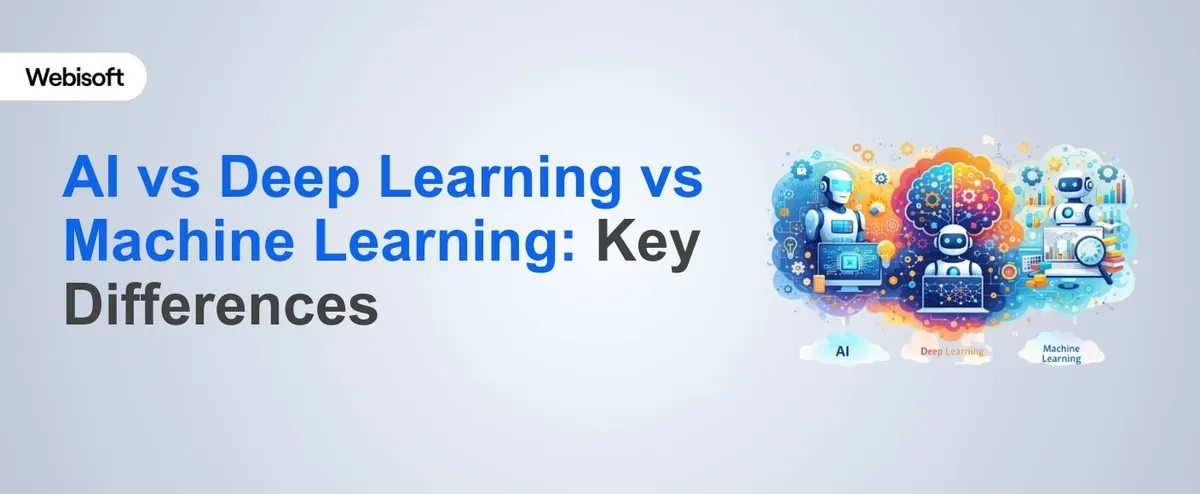
AI, deep learning, and machine learning are often used like they mean the same thing, but they don’t. In simple terms, AI is the umbrella field, machine learning is a method that learns from data, and deep learning is a more advanced form of ML.
That’s the core difference between AI vs deep learning vs machine learning. Most projects don’t fail because teams don’t know the definitions.
They fail because they pick the wrong approach. Someone forces deep learning onto a spreadsheet problem, or builds a rule-based system for messy human language, then wonders why accuracy collapses.
This guide fixes that. You’ll learn the real differences that impact results, such as data size, labeling effort, compute cost, deployment complexity, and explainability.
What Is Artificial Intelligence (AI)?
Artificial Intelligence (AI) is a broad field of computer science focused on building systems that can do tasks that normally require human intelligence. That could mean understanding language, spotting patterns, making decisions, or solving problems.
The key point is this: AI is the umbrella term. It includes many approaches, not just one. When people say “AI,” they often picture robots. But in real life, AI is usually software making smart decisions behind the scenes.
What AI Systems Actually Do
Most AI systems do one or more of these three jobs:
| AI Function | What it means | Example |
|---|---|---|
| Perception | AI understands inputs like images, speech, video, or text. | Recognizing a face in a photo or converting speech into text. |
| Reasoning | AI uses rules, knowledge, or learned patterns to decide what to do. | Diagnosing a problem, recommending a solution, or routing a request. |
| Decision-making | AI produces an output like a classification, recommendation, or automated response. | Approving a loan, recommending a product, or prioritizing support tickets. |
AI without ML (rule-based AI example)
AI does not always need machine learning. Some AI systems are built using rules written by humans. This is called rule-based AI. It works well when the problem is predictable and rules don’t change much. Example: a basic customer support bot might work like this:
- If the message contains “refund” → show refund policy
- If the message contains “delivery” → show tracking instructions
- If the message contains “password” → send password reset steps
Rule-based AI is usually:
- Faster to build
- Easier to control
- Easier to explain
But it also breaks quickly when the situation becomes messy or the user writes something unexpected. That’s where machine learning starts to matter.
What Is Machine Learning (ML)?
Machine learning (ML) is a part of AI where computers learn patterns from data instead of following fixed, hand-written rules. You train a model using examples, and it learns how to predict outcomes or classify new inputs.
ML is especially useful when rules are hard to define, like detecting spam emails, predicting customer churn, or spotting fraud in transactions.
Types of Machine Learning
There are three main types of machine learning you’ll see most often:
- Supervised learning: You train the model using labeled data (input + correct answer). Example: predict if an email is spam.
- Unsupervised learning: The model finds patterns without labels. Example: group customers into segments based on behavior.
- Reinforcement learning: The model learns by trial and error using rewards and penalties. Example: training an AI agent to play a game.
Supervised learning is the most common for business problems because it directly supports prediction. If you want to know which type suits your business goal, consult with a machine learning expert at Webisoft for more insight!
Machine Learning Workflow Explained
A typical machine learning workflow is a repeatable pipeline that converts raw data into features, trains a predictive model, validates performance on unseen data, and keeps the machine learning model reliable. Here is how it looks like:
- Data collection: gather transactions, clicks, logs, or sensor data
- Data cleaning: fix missing values, remove duplicates, handle noise
- Feature engineering: convert raw data into meaningful signals
- Model training: train an algorithm to learn patterns from examples
- Model evaluation: test performance on unseen data
- Deployment: use the model to predict outcomes in real systems
- Monitoring + retraining: track drift and update the model over time
So, the workflow flows as: data → features → model → prediction
What Is Deep Learning (DL)?
Deep learning is a type of machine learning that uses neural networks with many layers to learn patterns from data. In the AI vs deep learning vs machine learning comparison, deep learning is the most advanced subset because it can learn features automatically instead of relying on manual feature engineering.
Early layers detect simple signals like edges or sounds, while deeper layers combine them into meaning like faces, objects, or sentences. This is why deep learning performs best on unstructured data such as images, video, speech, and text.
Why Deep Learning Needs More Data and Compute
Deep learning doesn’t learn only a few patterns. It learns thousands of tiny patterns and stacks them into meaning, layer by layer. That’s why deep learning usually demands more data, more computation, and more training time than classic machine learning. Here’s what’s happening behind the scenes:
- More data: deep models need lots of examples to learn reliable patterns without guessing.
- More computation: training involves millions or billions of calculations across many layers.
- More memory: large neural networks store huge weight matrices and activations.
- Longer training time: the model must process the dataset many times (epochs).
- Hardware needs: GPUs/TPUs speed up training because they handle parallel math well.
Common Deep Learning Architectures
Different deep learning tasks require different network designs. The table below breaks down the most common deep learning architectures:
| DL Architecture | Best for | Common real-world examples |
|---|---|---|
| CNNs (Convolutional Neural Networks) | Image + video understanding | Cats vs dogs classification, medical imaging, defect detection |
| RNNs / LSTMs | Sequential/time-based data | Stock/time-series forecasting, speech sequences, older NLP systems |
| Transformers | Text + language understanding (modern NLP) | ChatGPT, translation, summarization, GenAI apps |
Quick Table: AI vs Deep Learning vs Machine Learning Differences
Before you get into the detailed differences between AI vs deep learning vs machine learning, take a look at the following table for initial ideas:
| Factor | AI | Deep Learning | Machine Learning |
|---|---|---|---|
| Goal | Intelligent action | Learn from raw data | Predict from data |
| How it works | Rules/logic or learning | Multi-layer neural nets | Statistical training |
| Input type | Mostly structured | Unstructured (image/text/audio) | Structured (tables/logs) |
| Features | Defined manually | Learned automatically | Often engineered manually |
| Explainability | High | Low | Medium |
| Data needed | Low/none | High | Medium |
| Labeling effort | Low | High | Medium |
| Compute | Low | High | Medium |
| Training time | None | Long | Moderate |
| Inference speed | Fast | Slower unless optimized | Fast |
| Deployment | Easy | Hard | Moderate |
| Maintenance | Update rules | Retrain + monitor | Monitor + retrain |
| Scalability | Good until rules grow | Infra-dependent | Strong |
| Ethical risk | Rule bias | Black-box + hallucinations | Data bias |
| Tools | Rule engines, code | PyTorch, TensorFlow | scikit-learn, XGBoost |
Detailed Comparison Between AI vs Deep Learning vs Machine Learning
To understand AI vs machine learning vs deep learning differences, you need more than definitions. You need to compare how each approach works, what data it needs, and what it costs to deploy. This section breaks down AI vs deep learning vs machine learning in a practical and comprehensive discussion:
Functional and Structural Differences
What Each Approach Is Trying to Achieve
The goal of AI is broad. It focuses on building systems that can act intelligently, whether that intelligence comes from rules, logic, search, or learning. If the system can make a smart decision or take the right action, it can fall under AI.
Machine learning has a narrower goal. It learns patterns from historical data so it can predict outcomes on new data. In business, this often means classification or prediction, like churn detection, fraud scoring, etc.
Deep learning goes further by learning complex patterns directly from raw data like images, audio, and text. It’s best when the signals aren’t obvious and need to be learned automatically.
How They Work
AI can work in two ways: it can follow rules written by humans, or it can learn from data. That’s why AI includes both rule-based systems and advanced assistants that adapt to new inputs. Deep learning also trains on data, but it relies on deep learning neural networks with multiple layers.
Each layer learns a deeper pattern, moving from simple signals to meaning. In contrast, machine learning works through training. You feed it labeled or unlabeled data, and it learns statistical patterns that help it predict outcomes. The key idea is simple: ML learns from examples instead of fixed logic.
Input Type
AI can work with almost any input type, but traditional AI systems are often built around structured inputs like forms, checklists, and predefined rules. Deep learning shines with unstructured data such as images, audio, video, and raw text.
It can still use structured data, but its biggest advantage appears when the input is complex and messy, and you want the model to learn directly from it.
On the other hand, ML performs best with structured data, meaning clean rows and columns, like spreadsheets, transaction logs, or customer records. This is where ML models can spot patterns fast and reliably.
Feature Handling
AI feature handling depends on the approach. In rule-based AI, features are basically the inputs you define in advance, like keywords, thresholds, and conditions.
Deep learning works very differently. It learns features automatically. It identifies patterns through layers and builds meaning from raw input, which is why it dominates tasks like image recognition and language processing.
In contrast, machine learning sits somewhere in between. It often requires manual feature engineering. You create signals like “average spend,” “sessions per week,” or “failed logins,” and the model learns patterns from those signals.
Interpretability
Rule-based AI is usually the easiest to explain because every decision follows visible logic. If something goes wrong, you can trace it back to the exact rule. Deep learning is the hardest to explain.
Its decisions come from many layers of learned patterns, which makes it powerful but often “black-box,” especially in regulated industries where trust and auditability matter.
Machine learning is often moderately explainable, depending on the model. Some models are easy to interpret, while others are harder but still manageable with explanation tools.
Engineering and Business Differences
Data Requirement (Quantified Ranges)
Data volume is one of the most practical differences in ai vs deep learning vs machine learning, because each approach “learns” in a very different way.
AI can work with little or no training data. You mainly need clear rules and enough examples to test edge cases. Deep learning usually needs large datasets because it learns features directly from raw inputs.
That’s why the data requirements for deep learning are higher than classic ML. In many projects, you’ll want:
- 10,000+ samples for a basic proof of concept
- 100,000+ samples for strong performance
- Millions of samples for high-accuracy models (vision, speech, LLM-scale tasks)
On the contrary, ML often works well with smaller datasets because it learns from engineered features. Many ML models can perform strongly with:
- a few hundred to a few thousand rows for early models
- 10,000 to 100,000 rows for stable production results
A good rule is that if you’re working with structured business data (tables), ML usually wins early. If you’re working with images, voice, or raw text, deep learning becomes worth it as data scales.
Data Labeling Effort
AI (rule-based) usually needs little to no labeling. You’re writing logic, so the main work is defining rules and testing edge cases. In contrast, deep learning often needs heavy labeling, especially for images, video, and speech. For example, image classification requires correct labels, while object detection requires drawing bounding boxes.
That makes labeling slower and more expensive. Machine learning, on the other hand, sits in the middle. Many ML problems use structured data where labels already exist, like “fraud/not fraud,” “churned/not churned,” or “approved/denied.” That’s why ML is often the fastest to launch in business settings.
Compute Requirement
AI (rule-based) has the lowest compute needs because it runs on fixed logic, not training. A CPU is enough, and performance stays predictable. Deep learning has the highest compute demand because training adjusts millions to billions of parameters using heavy matrix math across many layers.
GPUs, TPUs, or NPUs are common. Inference can also be costly if the model is large or needs real-time responses. Machine learning is usually the most practical middle ground.
Many ML models train well on CPUs, and they run fast in production on structured data. Compute becomes a real issue mainly when the dataset is huge, the model must retrain frequently, or the latency targets are strict.
Training Time
Training time is another key difference in ai vs deep learning vs machine learning, because each approach learns at a different pace. Rule-based AI doesn’t train at all. Once the logic is written, it works instantly, and updates are just rule edits.
Machine learning training is usually measured in minutes to hours, depending on data size and model type. It’s fast enough for frequent retraining.
Deep learning takes longer because neural networks learn through repeated passes over large datasets. Training can run for hours, days, or even weeks, especially for vision models or large language models.
Inference Speed and Latency
AI systems can respond extremely fast because many AI solutions rely on direct logic or lightweight decision rules. That keeps latency predictable, which matters in real-time workflows like ticket routing or instant approvals.
Deep learning, meanwhile, can be slower at inference since the model must run many layers of computation before producing an output. Larger vision and language models often need GPUs or optimization methods like quantization to meet strict response-time goals.
Machine learning tends to be the most balanced option. Most ML models run quickly on CPUs with structured data, so they’re ideal for high-volume scoring tasks where milliseconds matter.
Deployment Complexity
AI is often the easiest to deploy because many AI systems are just logic, rules, or decision flows running inside your app. Updates are straightforward since changes usually mean adjusting code, thresholds, or workflows. Deep learning raises the deployment difficulty fast.
Models are heavier, runtime dependencies are stricter, and performance often depends on specialized hardware. If you’re targeting low latency or edge devices, you’ll likely need optimization steps like quantization, pruning, or model conversion.
Machine learning deployment is more operational than complex. You ship the model plus the feature pipeline, then manage versioning, monitoring, and retraining so predictions stay reliable.
Maintenance Effort
AI maintenance is usually straightforward because behavior is controlled by logic. When results look wrong, you update rules, thresholds, or decision paths, then retest edge cases.
Deep learning needs heavier maintenance because models can drift as real-world data changes. You also have to watch for performance drops, dataset bias, and silent failures. Retraining often requires fresh labeled data, compute time, and careful validation.
Machine learning maintenance is more predictable but still ongoing. You monitor accuracy, track drift, refresh features, and retrain on updated data. If your feature pipeline breaks, the model output becomes unreliable even if the model itself is fine.
Scalability
AI scales well when logic stays stable, since rule-based decisions run fast and don’t need heavy infrastructure. If rules grow too complex, managing them becomes the bottleneck. Deep learning can scale massively, but only with strong infrastructure.
Training large models needs distributed compute, and serving them at scale often requires GPUs or optimized runtimes. Machine learning scales efficiently for most business use cases. With clean pipelines and monitoring, ML can handle high-volume predictions without the heavy cost of deep models.
Ethical Risks
AI can produce unfair outcomes when rules reflect biased assumptions, even if the logic is consistent. If the rule is wrong, the system repeats that mistake at scale. Deep learning raises higher ethical risk because decisions are harder to explain and can hide bias inside learned patterns.
In GenAI, hallucinations and unsafe outputs add another layer of risk. Machine learning often inherits bias from training data. If historical decisions were unfair, the model learns that behavior. That’s why audits, fairness checks, and monitoring matter.
Tools/Frameworks
When you compare AI vs deep learning vs machine learning, the toolset changes based on what you’re building. AI tools depend on the system type. For automation and decision logic, teams use rule engines, workflow tools, and custom code.
For conversational systems, you may add NLP libraries and retrieval layers. Deep learning is typically built with PyTorch or TensorFlow, then deployed using runtimes like ONNX Runtime and TensorFlow Lite for edge inference. Training often relies on CUDA GPUs.
In contrast, machine learning is commonly developed with scikit-learn, XGBoost, LightGBM, and CatBoost for structured-data modeling.
Common Misconceptions About AI, ML, and Deep Learning
A big reason people struggle with AI terms is because the internet mixes definitions and oversimplifies comparisons. That’s why AI vs deep learning vs machine learning examples often confuse readers instead of helping them. Let’s clear up those common misconceptions:
- Deep Learning is always better than ML: Deep learning can outperform ML on unstructured data like images and text, but ML often wins on structured business data because it’s cheaper, faster, and easier to explain.
- AI means robots: Most AI isn’t physical. It’s software running behind the scenes in search engines, recommendations, fraud systems, and customer support.
- ML = neural networks: Neural networks are only one part of ML. Many ML systems use decision trees, regression, XGBoost, or SVMs with no neural networks involved.
- AI must learn from data: AI can be rule-based too. If a system uses logic to make decisions, it can still be AI even without training.
- Deep Learning works without data cleaning: Deep learning is powerful, but bad data still breaks it. You still need clean labels and balanced datasets to avoid garbage predictions.
One Real Example Solved 3 Ways (Cats vs Dogs Image Recognition)
You have a folder of pet photos. Your goal is simple: the system should look at a new image and output cat or dog. This is a perfect test case because images are unstructured.
Pixel values don’t come with obvious rules like “if weight > 70kg.” To solve it, you can approach the same problem in three different ways: AI rules, ML models, or deep learning. For example:
Approach 1: AI Solution (Manual Rules)
A basic AI approach tries to hard-code what makes a cat look like a cat. For example:
- Detect edges → find ear shapes
- Detect textures → whisker-like patterns
- Use thresholds → “if ear angle is sharp, predict cat”
This breaks in real life because lighting, camera angles, and fur patterns vary too much. You spend more time fixing exceptions than improving accuracy.
Approach 2: Machine Learning Solution (Feature Extraction and Classifier)
Machine learning improves this by separating the problem into two steps: feature extraction and classification. Pipeline:
- Extract features (edges, texture, histogram, HOG/SIFT-like descriptors)
- Train a classifier (SVM, logistic regression, random forest)
- Predict cat vs dog
This can work decently, but performance depends heavily on feature quality. If the features don’t capture the right visual signals, accuracy stalls.
Approach 3: Deep Learning Solution (CNN Learns Features Automatically)
Deep learning solves the biggest weakness in ML: manual feature design. A CNN learns directly from pixels, such as:
- Early layers learn edges and shapes
- Middle layers learn parts (ears, eyes, snout)
- Deeper layers learn full concepts (cat vs dog)
This is why deep learning dominates computer vision. It learns the right features without you guessing them.
Which One to Choose Between AI vs Deep Learning vs Machine Learning (Decision Guide)
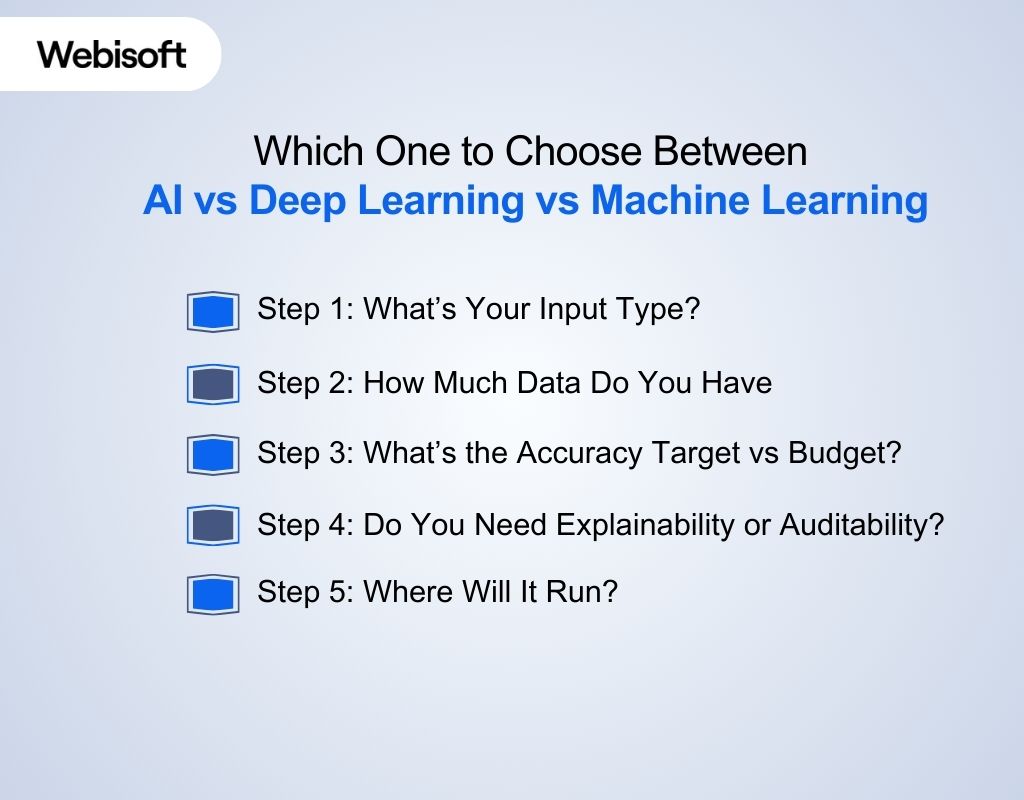
If you’re trying to choose between AI, machine learning, and deep learning, don’t start with what sounds “most advanced.”
Start with what you actually have: your data type, dataset size, labeling ability, accuracy needs, and deployment limits. This guide breaks down AI vs deep learning vs machine learning in a practical way so you can pick the right approach:
Step 1: What’s Your Input Type?
Your input type is the fastest way to choose the right approach because it tells you what kind of intelligence you actually need. Some problems are rule-friendly. Others require prediction. And some need perception, meaning the system must “see,” “hear,” or “read” raw data. Here’s the simple breakdown:
- Rules / forms / dropdowns → AI or ML
Example: eligibility checks, loan policy rules, routing support tickets based on selected categories.
- Tables / logs / transactions → ML
Example: predicting churn from customer activity, scoring fraud risk from transaction history, forecasting sales using past performance.
- Images / audio / video / raw text → DL
Example: classifying cats vs dogs in photos, speech-to-text, detecting defects in manufacturing images, analyzing sentiment from raw customer reviews.
Step 2: How Much Data Do You Have (and Can You Label It)?
Data size alone doesn’t decide everything. What really matters is whether your data is usable for training, meaning you can label it consistently and at scale. A small labeled dataset can beat a huge messy one. Use these ranges to make a fast decision:
- 0 to 100 examples: AI rules. Best when logic is clear and edge cases are limited.
- 100 to 10k rows: ML baseline. Great for structured business problems like churn or fraud scoring.
- 10k to 100k samples: strong ML, possible DL with transfer learning. Deep learning can work here if you use pre-trained models.
- 100k to millions: DL becomes practical. This is where deep learning starts to dominate, especially for images, speech, and text.
Now add the labeling reality check:
| Labeling difficulty | What it means | Example |
|---|---|---|
| Easy | labels already exist | fraud/not fraud, churned/not churned |
| Medium | labels need manual review | support ticket categories, sentiment |
| Hard | expert labeling required | medical images, object detection boxes |
Step 3: What’s the Accuracy Target vs Budget?
This is where your decision becomes real. If you need results fast and can’t afford heavy infrastructure, ML is usually the best choice. It delivers strong accuracy on structured data without high cost. If accuracy must be pushed to the limit, especially on images or text, deep learning is worth it, but only when you can fund data, compute, and iteration time. If correctness and control matter more than learning, AI rules are safer.
| Option | Cost | Time-to-deploy |
|---|---|---|
| AI | Low | Fast |
| Machine learning | Medium | Medium |
| Deep learning | High | Slow |
Step 4: Do You Need Explainability or Auditability?
If your system affects money, safety, or access, explainability isn’t optional. In regulated industries like banking, insurance, and healthcare, you may need to justify why a decision was made, not just show that it was accurate. That’s why AI rules and many ML models are preferred in these environments.
You can trace decisions, audit inputs, and defend outcomes. Deep learning is harder to approve because it’s less transparent. You should only use it when the performance gain is clearly worth it, and you have monitoring in place to detect drift, bias, and unexpected behavior in production.
Step 5: Where Will It Run?
Where your system runs can completely change the best choice. In the cloud, you have flexible compute, so both ML and deep learning are realistic options. But edge devices are a different world. Mobile apps, IoT sensors, and embedded boards have limited memory, power, and processing speed.
That’s why ML is usually the safer option there. If you still want deep learning on-device, the model must be compressed using techniques like quantization and pruning, then deployed for on-device inference using tools like TensorFlow Lite or TensorFlow Lite Micro.
How Webisoft Help with AI and Machine Learning Service
If you’re planning to use AI in your product, the hardest part isn’t choosing between AI, ML, or deep learning. It’s building a system that works in production, stays accurate over time, and fits your budget.
That’s where Webisoft helps you move faster with less risk. Our team understands your goals, maps the best solution, and explains the full execution plan clearly. Here’s what you get with our AI and machine learning development service:
- AI strategy and roadmap: Clear guidance on what to build, what to avoid, and what delivers ROI
- Data preparation and pipeline setup: Cleaning, structuring, and building reliable data flows for training and inference
- Machine learning model development: Predictive models for churn, fraud, recommendations, and forecasting
- Deep learning solutions: Computer vision and NLP systems for unstructured data like images and text
- Deployment and monitoring: Production-ready model serving, drift tracking, and retraining workflows
- Edge AI and TinyML support: Lightweight on-device inference using TensorFlow Lite/Lite Micro
Want to discuss your use case? Reach out to Webisoft for a consultation and get a clear AI implementation plan.
Conclusion
To sum up, AI vs deep learning vs machine learning have many differences but the are less about which is “best” and more about what fits your data, budget, and goals. AI works well for clear logic and controlled decisions.
Machine learning is ideal for structured data and reliable predictions. Deep learning shines with unstructured inputs like images and text when accuracy matters most. Choose based on real constraints, not hype, and you’ll build smarter systems faster.
FAQs
Here are some commonly asked questions regarding AI vs deep learning vs machine learning:
Yes. AI can be rule-based, using logic and decision rules without training on data. Many automation systems and expert systems work this way.
ChatGPT is AI powered by deep learning. It uses transformer-based neural networks trained on large datasets to generate human-like text responses.
Machine learning includes many model types like trees and regression. Neural networks are one ML type, mainly used in deep learning for complex patterns.
Yes, but models must be optimized. Tools like TensorFlow Lite and Lite Micro enable compressed deep learning models to run on low-power devices.