Share


AI Software Development Process: Step-by-Step Guide

- BLOG
- Artificial Intelligence
- October 18, 2025
The AI software development process is a structured approach to building intelligent applications that learn, adapt, and improve over time. It merges human expertise with machine intelligence to create faster, smarter, and more reliable digital solutions.
In 2025, this process is essential for businesses seeking automation, scalability, and data-driven innovation. Engineers use AI to enhance accuracy, optimize workflows, and reduce development time without compromising quality.
This article breaks down the eight core stages of AI software development and how they redefine the traditional SDLC, offering insights that align with a structured AI SaaS workflow. It also highlights the key benefits of AI-driven engineering. Understanding this process helps teams build intelligent software that continuously evolves and delivers long-term value.
Contents
- 1 What Is the AI Software Development Process?
- 2 Step-by-step AI Software Development Process
- 2.1 Step 1: Requirement Analysis and Problem Framing
- 2.2 Step 2: Data Collection and Preparation
- 2.3 Step 3: Solution Architecture and Design
- 2.4 Step 4: Model Selection and Algorithm Design
- 2.5 Step 5: Development and Integration
- 2.6 Step 6: Testing and Quality Assurance
- 2.7 Step 7: Deployment and Monitoring
- 2.8 Step 8: Maintenance and Continuous Learning
- 3 Unlock the power of AI with Webisoft today!
- 4 How AI Transforms the Traditional SDLC
- 4.1 1. Planning → Intelligent Project Estimation
- 4.2 2. Design → Adaptive System Architecture
- 4.3 3. Development → Automated Coding and Refactoring
- 4.4 4. Testing → Predictive and Autonomous QA
- 4.5 5. Deployment → Self-Healing Systems and Continuous Delivery
- 4.6 6. Maintenance → Continuous Learning and Optimization
- 5 Benefits of the AI Software Development Process
- 6 Challenges of the AI Software Development Process
- 7 How Webisoft Mitigates These Challenges?
- 8 Frequently Asked Questions (FAQ)
- 9 Unlock the power of AI with Webisoft today!
- 10 Conclusion
What Is the AI Software Development Process?
The AI software development process refers to a structured sequence where humans and intelligent systems collaborate to design, train, and deploy applications capable of autonomous reasoning or prediction. Unlike conventional software built through fixed instructions, AI-based solutions continuously learn from data and adapt their behavior over time.
In contrast, the AI-driven development lifecycle introduces an iterative model where algorithms are trained on vast datasets, validated through performance metrics, and improved using continuous learning loops, providing a clearer path to Understanding AI development. You can also explore our AI Developer Roadmap to understand how these iterative learning cycles shape modern AI development workflows.
Step-by-step AI Software Development Process
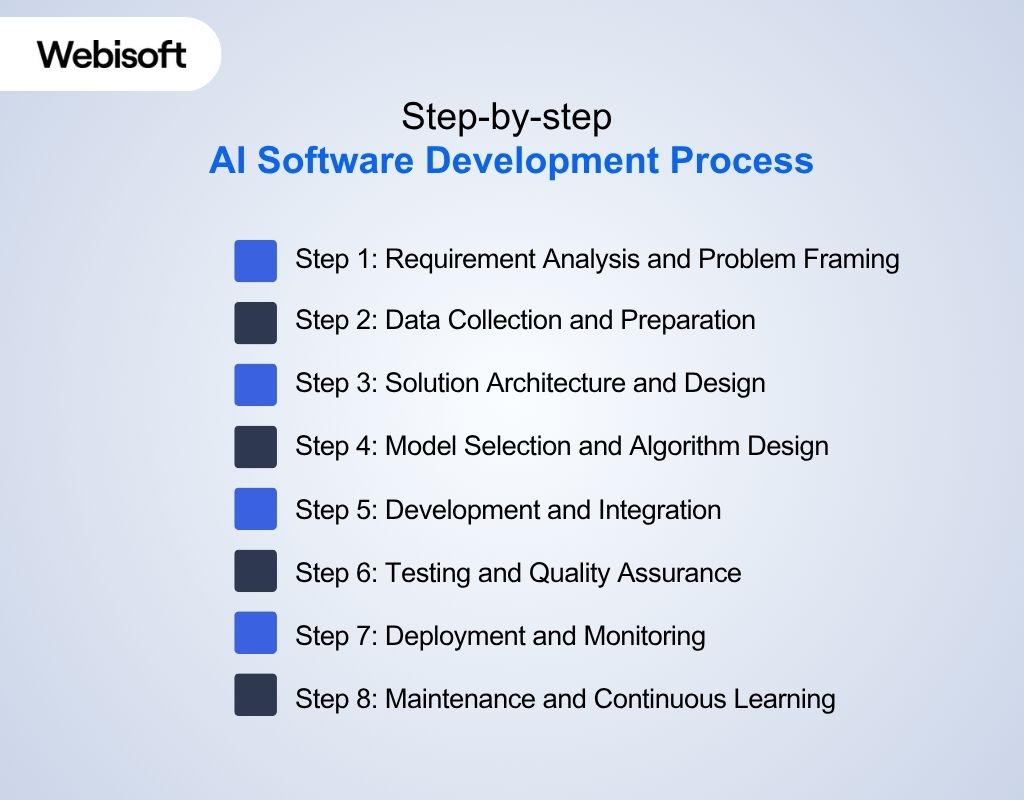 The AI software development process follows a systematic step structure designed to ensure accuracy, scalability, and continuous improvement. Each stage builds on the previous one to create intelligent software that learns, adapts, and performs efficiently, similar to our AI tool development process, which helps teams structure AI initiatives more effectively within a clear AI software workflow.
Step 1: Requirement Analysis and Problem Framing
Identify the business problem that AI will solve. Define the project scope, success metrics, and data requirements early to align the solution with business goals. Setting clear KPIs at this stage prevents unnecessary model training and ensures the AI system targets specific, measurable outcomes within a structured AI strategy for businesses. You can explore our AI system development process to better understand how each stage contributes to successful AI implementation.
Step 2: Data Collection and Preparation
Gather all relevant structured and unstructured data needed for training. Clean, label, and organize it to ensure accuracy and consistency. Split the data into training, validation, and test sets to prevent data leakage and support objective model evaluation. Since machine learning software development depends heavily on data quality, teams must address data bias, remove noise, and comply with privacy regulations before proceeding, which is a critical part of the AI app process.
Step 3: Solution Architecture and Design
Plan the technical framework that supports the AI model. This includes backend development, database connections, APIs, and front-end design for user interaction. Integrating AI in software engineering workflows at this stage ensures seamless communication between intelligent modules and traditional application components, which is essential when outlining how to develop AI-based products, especially if you are exploring a clear AI Development Path.
Step 4: Model Selection and Algorithm Design
Select the most suitable learning approach, supervised, unsupervised, or reinforcement, based on the problem type. Design and test multiple model architectures to find the best-performing one. Use frameworks such as TensorFlow or PyTorch for experimentation, and perform hyperparameter tuning for optimization with AI app builder software. Teams studying the AI avatar creation process often follow similar experimentation practices when refining model choices.
The chosen algorithm and model architecture must align with the project’s business objectives, performance metrics, and ethical guidelines.
Step 5: Development and Integration
Begin coding and integrate the AI model with other software components. MLOps pipelines are introduced to manage model training, deployment, and updates automatically. These AI application development steps create modular, flexible architectures that simplify scaling and ongoing maintenance, especially when following structured AI Algorithm Development
practices, as outlined in our AI trading bot guide.
Step 6: Testing and Quality Assurance
Perform AI-powered software testing to detect errors and performance issues before deployment. Automated tools like Testim and Mabl assist in running regression and anomaly tests. Continuous testing ensures model reliability, accuracy, and compliance with business and technical requirements, which is especially useful for anyone following a DIY AI tool guide.
Step 7: Deployment and Monitoring
Deploy the validated AI model in cloud or hybrid environments to maximize performance and scalability. Monitor the model for performance drift and reliability issues. Implement robust version control, rollback options, and security checks to protect both data and system functionality.
Step 8: Maintenance and Continuous Learning
Regularly retrain the model using new data and feedback to maintain its accuracy over time. Introduce improvements, fix performance issues, and scale infrastructure as user demand grows. Integrating this stage into the broader AI-driven development lifecycle keeps systems adaptive, efficient, and aligned with evolving business needs, especially for enterprise-level AI applications.


Unlock the power of AI with Webisoft today!
Book a free consultation. Learn, build, and scale intelligent AI-driven solutions effortlessly.
How AI Transforms the Traditional SDLC
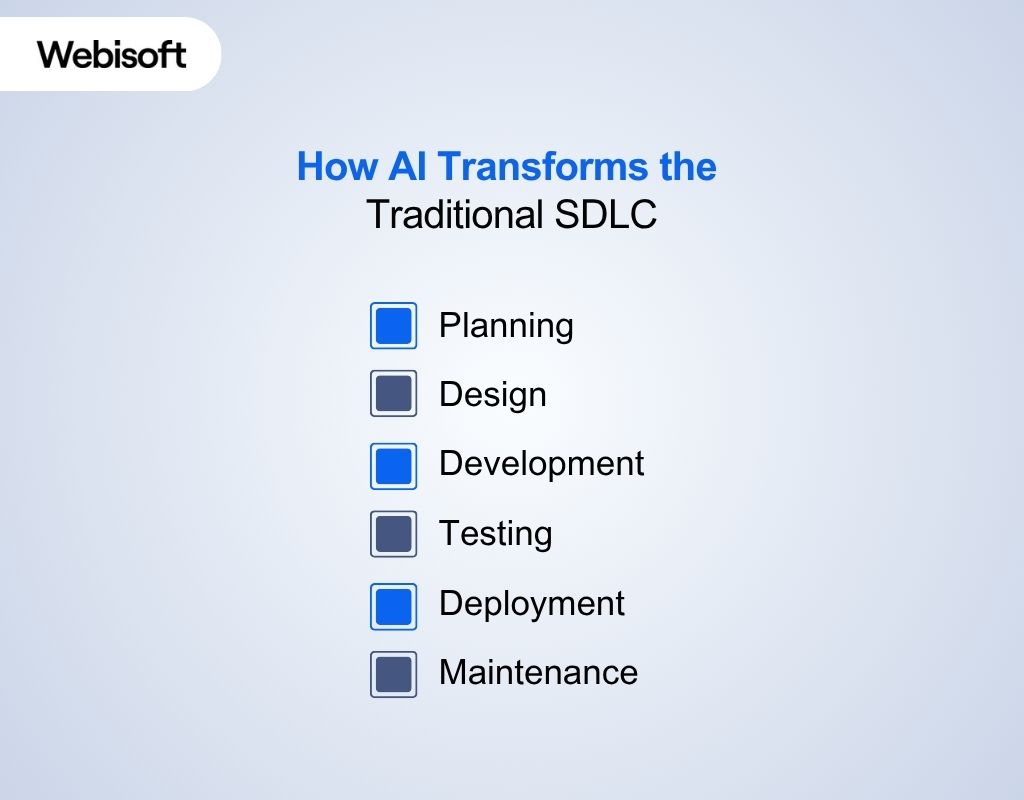 Through predictive analytics, automation, and adaptive learning, AI optimizes planning, coding, testing, and deployment, ultimately making software creation faster, more reliable, and insight-driven. This transformation reflects the growing maturity of AI in software engineering, where intelligent tools now complement human expertise across every development layer.
1. Planning → Intelligent Project Estimation
In traditional SDLC, planning relies on human judgment and past experience. AI enhances this by analyzing historical project data to predict timelines, costs, and risks. Intelligent estimation tools can identify potential bottlenecks before execution begins.
For example, AI-based project management software like Jira’s Advanced Roadmaps or ClickUp AI can forecast resource allocation with precision based on prior project metrics. You can consult with Webisoft for free to make your planning even better.
2. Design → Adaptive System Architecture
Conventional design phases depend on static documentation and manual reviews. With AI, system design becomes dynamic and adaptive. Tools using generative models can suggest optimized architectures, simulate different design scenarios, and evaluate performance outcomes. This makes early-stage architectural decisions more accurate and reduces rework later in the process.
3. Development → Automated Coding and Refactoring
Traditionally, developers write and debug code manually. Now, AI-assisted coding tools such as GitHub Copilot and Amazon CodeWhisperer use natural language inputs to generate code snippets, detect bugs, and suggest improvements instantly. These AI pair programmers accelerate the build phase while maintaining code consistency, significantly reducing human error and development time.
4. Testing → Predictive and Autonomous QA
Manual testing has long been one of the most time-intensive SDLC stages. AI now automates test generation, regression checks, and anomaly detection. Predictive testing tools analyze historical defect data to forecast high-risk areas and focus QA efforts where issues are most likely to occur, similar to structured learning approaches in our AI bot tutorial guide.
5. Deployment → Self-Healing Systems and Continuous Delivery
In conventional workflows, deployment involves manual checks and scheduled rollouts. AI-powered DevOps introduces automated CI/CD pipelines, self-healing infrastructure, and performance monitoring.
These systems detect anomalies post-deployment, trigger auto-rollbacks if needed, and optimize resource scaling in real time. For instance, predictive DevOps platforms like Harness use AI to automate canary deployments and reduce production failures.
6. Maintenance → Continuous Learning and Optimization
Maintenance once meant reactive bug fixes and manual updates. Today, AI enables proactive, data-driven optimization. Models monitor performance trends, retrain automatically with new data, and predict upcoming issues. This self-learning approach allows systems to evolve independently, extending software lifespan and improving operational efficiency.
Benefits of the AI Software Development Process
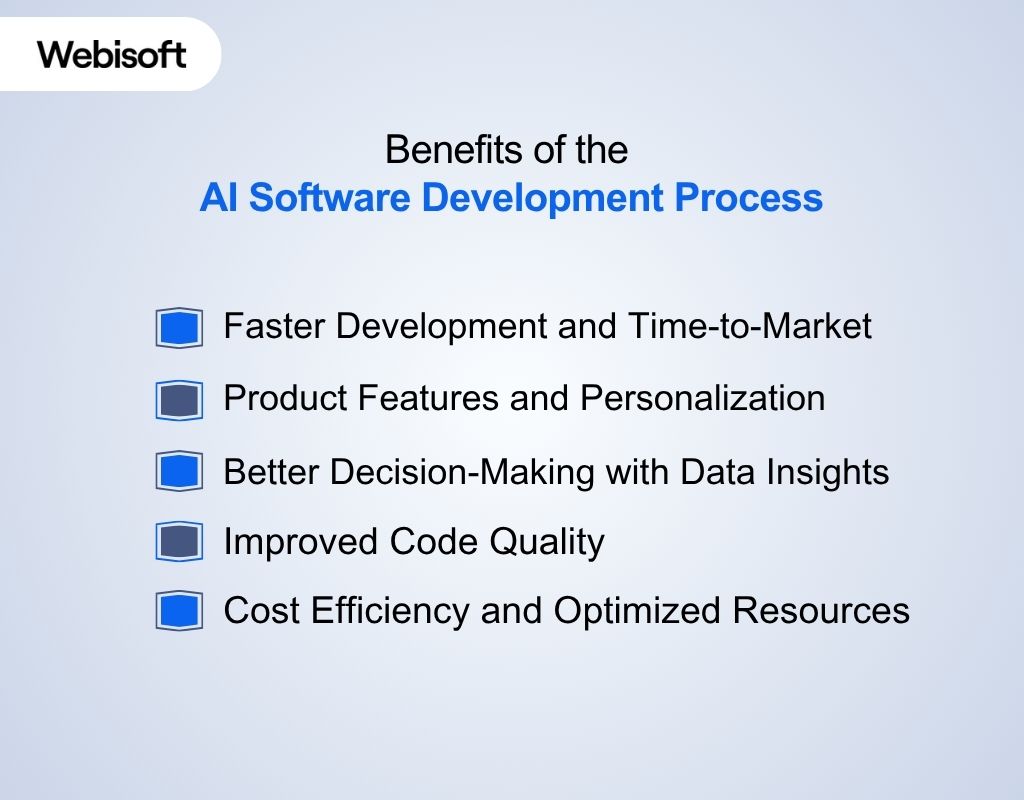 According to McKinsey, around 78% of companies now use generative AI in at least one business function. By embedding AI in software engineering, organizations achieve better performance, shorter delivery cycles, and improved decision-making. Below are five strategic benefits that define how AI-driven workflows enhance business and technical outcomes across projects.
1. Faster Development and Time-to-Market
Automation accelerates every phase from requirement analysis to deployment. AI tools assist in auto-coding, predictive scheduling, and regression testing, allowing teams to meet deadlines with greater consistency. This advantage makes the AI-driven development lifecycle ideal for projects requiring rapid innovation and frequent updates without sacrificing quality or precision.
2. Enhanced Product Features and Personalization
AI enables highly adaptive user experiences through advanced analytics and behavioral learning models. In machine learning software development, systems continuously analyze user data to personalize features such as recommendations, voice recognition, and predictive text. This adaptability results in more relevant and engaging software that evolves alongside user preferences.
3. Better Decision-Making with Data Insights
AI-based analytics frameworks transform raw information into actionable insights. By applying AI application development steps correctly, data gathering, modeling, and validation teams can forecast trends, predict maintenance needs, and guide product evolution strategically. This data intelligence supports both tactical decisions and long-term product planning.
4. Improved Code Quality
Intelligent validation systems powered by AI-powered software testing identify bugs, vulnerabilities, and performance bottlenecks faster than traditional QA methods. These systems run continuous tests, ensuring higher code reliability and reducing the time spent on debugging. The outcome is cleaner, more maintainable code that strengthens software stability.
5. Cost Efficiency and Optimized Resources
AI optimizes both human and computational resources by automating redundant processes and balancing workloads dynamically. Integrated monitoring and forecasting capabilities within AI integration in SDLC frameworks ensure that infrastructure, manpower, and time are utilized effectively. This leads to sustainable cost reduction and long-term operational resilience.
Challenges of the AI Software Development Process
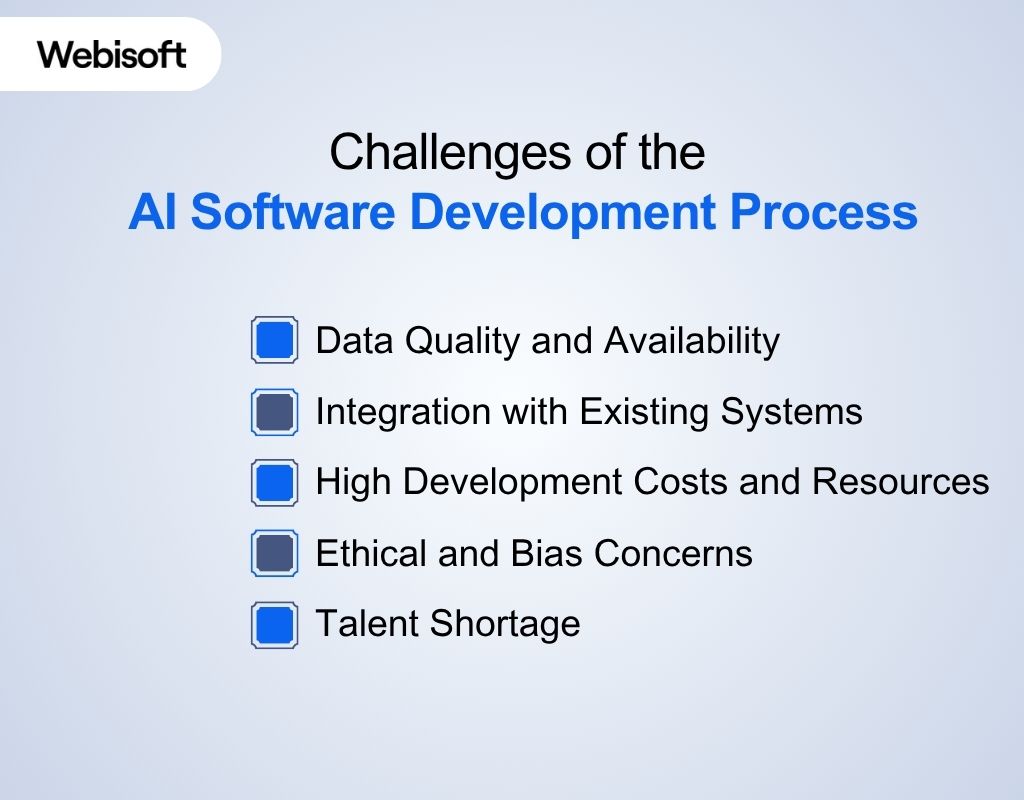 While the AI software development process offers significant advantages, it also introduces unique challenges that require technical precision, ethical foresight, and strategic planning.
1. Data Quality and Availability
AI models depend entirely on data accuracy, consistency, and relevance. Poor-quality datasets can produce unreliable or biased outputs, limiting the model’s usefulness. Collecting diverse, well-labeled data is both time-consuming and resource-intensive.
Teams must also address issues such as missing data, noise, and duplication while ensuring compliance with privacy regulations like GDPR. Without robust data management, even the most advanced algorithms fail to deliver accurate predictions.
2. Integration with Existing Systems
Integrating AI with legacy infrastructure is one of the most difficult aspects of AI in software engineering. Traditional systems often lack compatibility with modern AI frameworks, leading to scalability and performance challenges. Seamless AI integration in SDLC requires re-architecting APIs, databases, and workflows so the AI components function cohesively within the broader software ecosystem.
3. High Development Costs and Resources
Building and maintaining AI models demands substantial computational power, high-end GPUs, and specialized human expertise. The AI-driven development lifecycle involves multiple iterations of data processing, model training, and validation, all of which require extensive resources.
Small and mid-sized businesses often struggle with infrastructure costs, which can escalate rapidly if models are retrained frequently. Careful resource allocation and cloud optimization are essential to control expenditures.
4. Ethical and Bias Concerns
AI systems can unintentionally learn and amplify human biases embedded in the training data. These biases lead to unfair or discriminatory decisions, especially in sectors like finance, recruitment, or healthcare.
Developers must design ethical frameworks and implement AI-powered software testing to identify potential biases before deployment. Transparent model explainability, audit trails, and continuous oversight are necessary to ensure fairness and accountability.
5. Talent Shortage
The demand for skilled professionals in machine learning software development far exceeds the current supply. Finding experienced data scientists, MLOps engineers, and AI ethicists can be difficult, especially for organizations just beginning their AI journey. As technology evolves rapidly, maintaining a skilled workforce requires ongoing training and collaboration between academia and industry.
How Webisoft Mitigates These Challenges?
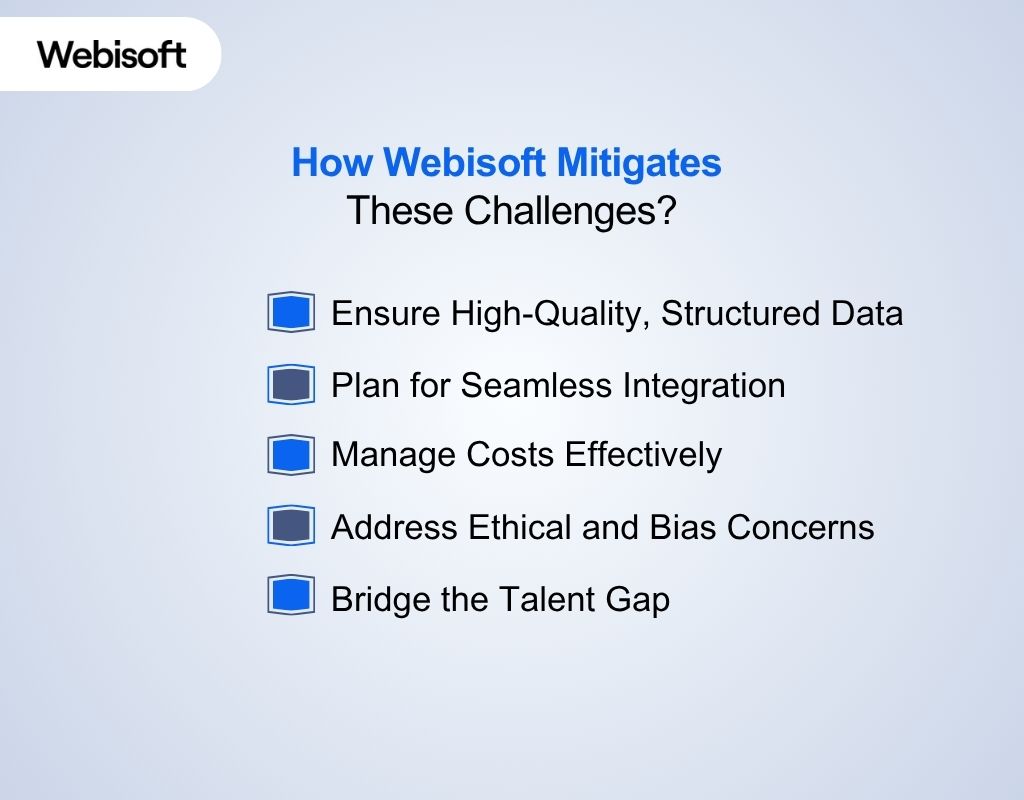 Webisoft approaches the AI software development process as a comprehensive engineering process that unites strategy, architecture, and innovation. Our team ensures every project overcomes the most common AI challenges through structured methodologies and technical precision.
1. Ensure High-Quality, Structured Data
Webisoft’s advisory and fractional CTO services focus on data readiness before any model is built. Our teams assess data pipelines, clean and structure datasets, and establish scalable data flows that align with business objectives. This foundation ensures that every AI solution is trained and deployed using dependable, high-quality input.
2. Plan for Seamless Integration
We design and build an AI system builder that integrates effortlessly with existing infrastructures. By combining enterprise software engineering with modular architecture and robust API design, Webisoft ensures that new AI components communicate smoothly with legacy systems. This approach minimizes downtime and maintains system performance across the full software ecosystem.
3. Manage Costs Effectively
Webisoft helps clients control costs through structured development phases. By starting with MVPs and prototypes, we validate functionality before committing to large-scale builds. Our teams use cloud-native technologies, containerization, and automation to optimize infrastructure costs while maintaining flexibility and performance at every stage.
4. Address Ethical and Bias Concerns
Ethical integrity is embedded in Webisoft’s engineering practices. Our development lifecycle includes built-in feedback loops, transparency protocols, and compliance checks to identify and prevent bias early. We prioritize responsible AI design that aligns with both business ethics and international data governance standards.
5. Bridge the Talent Gap
Webisoft maintains a high-performing team of senior engineers, AI specialists, and data scientists with extensive cross-industry experience. This structure eliminates skill shortages within active projects and ensures consistent technical leadership.
Our collaborative development model also supports continuous knowledge transfer between teams and clients. Through these principles, Webisoft transforms AI development challenges into structured opportunities for innovation, ensuring that every product we build is scalable, ethical, and future-ready.
Frequently Asked Questions (FAQ)
How long does it take to build AI-powered software?
The development time for AI-powered software depends on its complexity, data availability, and required features. On average, small projects or MVPs take 3–4 months, while enterprise-grade AI solutions may require 6–12 months. Proper data preparation and model training are key to accurate timelines.
Can AI replace software engineers?
AI cannot replace software engineers; it complements them. Intelligent tools automate repetitive coding, testing, and debugging, allowing developers to focus on creative problem-solving, architecture design, and innovation. The AI software development process enhances human efficiency rather than eliminating technical expertise.
What tools are best for AI model development?
Popular frameworks include TensorFlow, PyTorch, Keras, and Scikit-learn. For workflow automation, developers use MLOps platforms such as MLflow, Kubeflow, or Vertex AI. The right toolset depends on project goals, data type, and scalability requirements.
What industries benefit most from AI-driven development?
AI-driven development is revolutionizing industries such as healthcare, fintech, e-commerce, manufacturing, and education. From predictive analytics and automation to personalization and process optimization, AI enhances productivity and decision-making across every digital ecosystem.
Unlock the power of AI with Webisoft today!
Book a free consultation. Learn, build, and scale intelligent AI-driven solutions effortlessly.
Conclusion
A structured AI software development process ensures consistency, scalability, and precision at every stage of innovation. When followed systematically, it transforms complex data and algorithms into intelligent, high-performing software that learns and adapts over time. As AI continues to reshape industries, companies that invest in disciplined AI development gain a lasting competitive edge. Partner with Webisoft to accelerate your AI software development journey.
