Share


How To Build AI Products: Expert Guide

- BLOG
- Artificial Intelligence
- October 14, 2025
With rapid technological advancements, AI-powered products are shaping the future of every industry. From smarter healthcare tools to intelligent customer support, these innovations are driving efficiency and growth like never before.
Businesses now have the chance to create products that not only solve problems but also learn and evolve over time. You define a real use case, collect clean data, build a baseline, and align it with measurable business goals, all while keeping users and ethics in focus. This guide covers every step on how to build AI products clearly and practically. Start reading below.
Contents
- 1 Tools & Stack Recommendations to Build AI Products
- 2 Step-by-Step Guide on How to Build AI Products?
- 2.1 Step 1: Identify and Validate the Problem
- 2.2 Step 2: Define Clear Objectives and Success Metrics
- 2.3 Step 3: Data Collection and Preparation
- 2.4 Step 4: Choose the Right Model and Build a Baseline
- 2.5 Step 5: Model Development and Training
- 2.6 Step 6: Model Evaluation and Validation
- 2.7 Step 7: Deployment and Integration
- 2.8 Step 8: Integrate, Monitor, and Iterate
- 2.9 Step 9: Ethics, Compliance, and Safety
- 3 Build Smarter. Ship Faster. Grow Confidently
- 4 Case Studies: Developing AI products
- 4.1 1. BetterUp’s AI Career Coaching BetterUp, a virtual coaching company, developed BetterUp Grow, an AI-based coaching tool aimed at making professional development more accessible, especially in hybrid and remote work environments.
- 4.2 2. Walmart’s Trend-to-Product AI Tool Walmart introduced “Trend-to-Product,” an AI tool designed to accelerate the rollout of fashionable clothing items.
- 4.3 3. Altair’s AI in Engineering Altair revolutionized engineering simulations by integrating AI into its platform, HyperWorks®. Tools like PhysicsAI™ utilize geometric deep learning to deliver simulation results up to 1,000 times faster than traditional methods.
- 4.4 4. Amazon’s AI Shopping Assistant, Rufus Amazon launched Rufus, an AI shopping assistant, in February 2024. Rufus aids customers in product searches and recommendations, contributing to an anticipated indirect operating profit of over $700 million in 2025.
- 4.5 5. Google’s AI Collaboration with Mattel Google’s AI technology assisted Mattel in analyzing feedback on a Barbie Dreamhouse product.
- 5 Common Mistakes to Avoid for a Successful AI Product Development
- 6 Best Practices for Building AI Products
- 7 Is AI Product Building Worth Investing In?
- 8 The Future of AI Product Development
- 9 Webisoft: Your Trusted Partner in Building Scalable AI Products
- 10 In Closing
- 11 Frequently Asked Questions
Tools & Stack Recommendations to Build AI Products
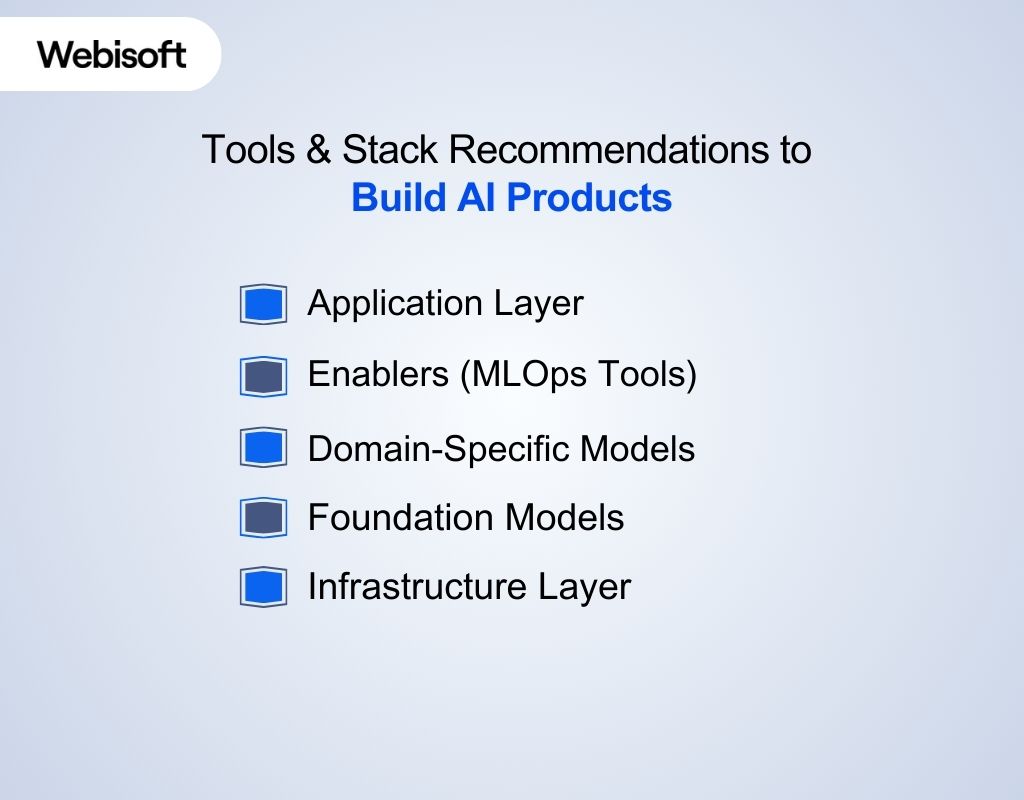 The AI stack is layered, each part plays a role in turning raw data into usable, intelligent applications. Choosing the right tools ensures better performance, scalability, and faster development within a structured AI system process.
Application Layer
This is the user-facing part of your AI product. It includes interfaces like chatbots, dashboards, or APIs that interact with users. Tools here focus on delivering AI results to real-world workflows.
Enablers (MLOps Tools)
MLOps tools manage model training, testing, and deployment pipelines. They help automate workflows, monitor performance, and version models. Popular tools include MLflow, Weights & Biases, and Kubeflow.
Domain-Specific Models
These models are trained for niche areas like legal, medical, or financial data. They reduce development time by offering pre-tuned intelligence for industry-specific needs.
Foundation Models
Foundation models are large-scale pretrained models like GPT or LLaMA. They can be fine-tuned for various tasks and reduce the need for building models from scratch.
Infrastructure Layer
This includes the computing power and storage needed to run AI systems. Cloud platforms (AWS, Azure, GCP) offer scalable infrastructure for training, deploying, and maintaining models privacy efficiently.
Step-by-Step Guide on How to Build AI Products?
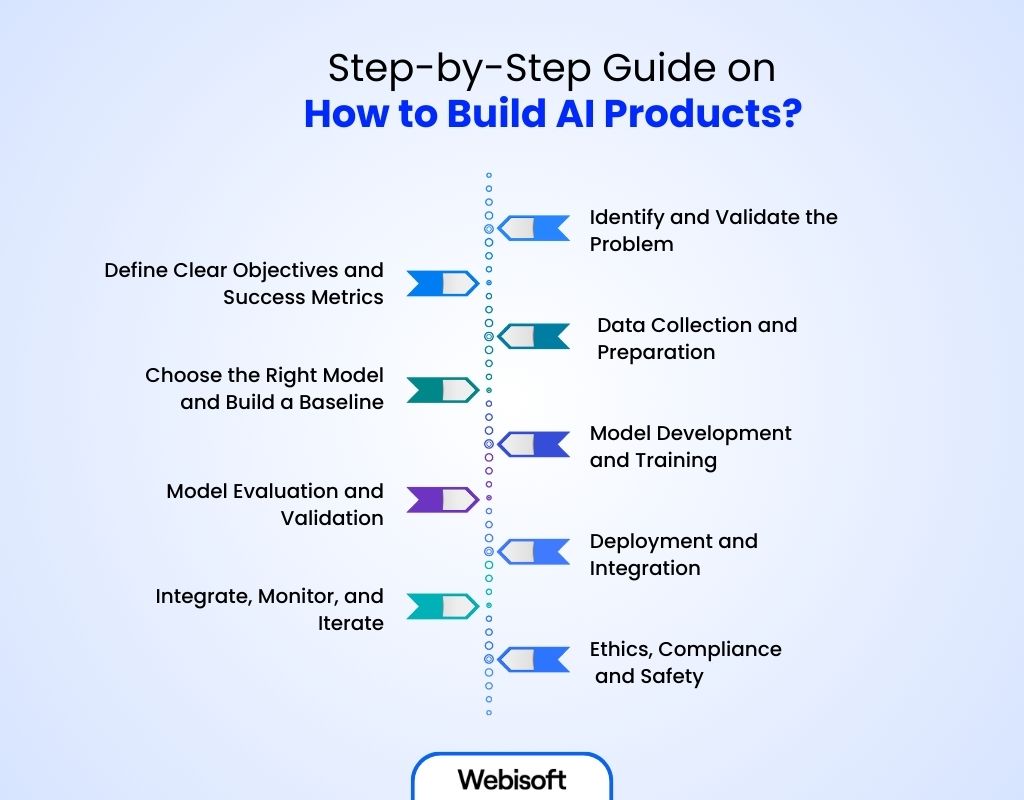 Building AI products requires a structured approach. Each step plays a critical role, from defining the problem to maintaining the solution in production environments.
Step 1: Identify and Validate the Problem
Before you get into how to build AI products, it’s critical to define a specific, high-impact problem worth solving. This is not about choosing an AI technique. It’s about understanding what users or business operations genuinely struggle with. Start by engaging with stakeholders: product managers, end users, and domain experts. Review system logs, customer feedback, or performance data to uncover pain points. Ask: Is this problem repetitive, time-consuming, or reliant on judgment? If yes, it may be a candidate for AI. Validation requires evidence. Look for measurable inefficiencies, cost overruns, or bottlenecks. Avoid automating weak processes. Instead, use AI to improve and streamline them.
Step 2: Define Clear Objectives and Success Metrics
Once the problem is validated, set clear goals for what the AI product should achieve. These goals must be measurable, realistic, and directly tied to business value or user experience. Start by defining the desired output of the AI system. For example, classify documents, detect anomalies, or recommend content. Next, identify key performance indicators (KPIs) such as accuracy, precision, recall, response time, or cost savings. Choose metrics that reflect both technical performance and real-world outcomes. Avoid vague targets like “improve efficiency.” Instead, quantify success, such as “reduce processing time by 40%” or “achieve 90% classification accuracy.”
Step 3: Data Collection and Preparation
High-quality data is the foundation of any successful AI product. Without the right data, even the best algorithms will fail. Start by identifying what data is needed to solve the problem you defined earlier. Next, explore existing sources: internal databases, CRM systems, web logs, or third-party providers. Make sure the data is relevant, consistent, and representative of real-world conditions. Once collected, data must be cleaned and prepared. This includes:
- Removing duplicates and errors
- Handling missing values
- Normalizing formats and scales
- Labeling for supervised learning tasks
In AI, data quality matters more than data volume. Poor preparation leads to bias, inaccuracies, and failed deployments.
Step 4: Choose the Right Model and Build a Baseline
Once your data is ready, the next step is selecting a suitable model. The model should match the task, like classification, prediction, generation, or detection, and align with your data type and volume. Start by building a simple baseline model. This is a basic version that helps you measure progress. It’s about establishing a reference point. A logistic regression or decision tree, for example, is often enough to benchmark early results. Example: If you’re creating a tool to categorize customer support tickets, start with a simple text classifier using scikit-learn. It won’t be perfect, but it gives you a reliable benchmark for future improvements. Use open-source libraries or prebuilt APIs from trusted platforms. Avoid starting with complex architectures unless your problem demands it. Focus on speed, interpretability, and consistent outputs at this stage, meaning gradually scaling AI for success.
Step 5: Model Development and Training
This stage transforms your data into intelligence. Model development begins with selecting the right algorithm for the task: classification, prediction, clustering, or language processing. The choice should match both your goal and the type of data you have. Before training, divide your dataset into three parts:
- Training set – used to teach the model
- Validation set – helps tune it during development
- Test set – evaluates how it performs in real-world conditions
Tools like PyTorch, TensorFlow, or scikit-learn help streamline this workflow. Throughout training, monitor core metrics like loss, accuracy, and error rate. Watch for overfitting where the model memorizes the data but doesn’t generalize well.
Step 6: Model Evaluation and Validation
Before deploying, you must evaluate how well the model performs in real-world conditions. This step helps identify weaknesses and ensures the model meets your success metrics. Use your test dataset to check for accuracy, precision, recall, and other key metrics. Choose the right metric based on your goal, use recall for fraud detection, where catching all cases matters most. Validation techniques like cross-validation help test reliability. It also reveals overfitting. Overfitting occurs when the model performs well on training data but poorly on test or validation sets. If a model performs well on test data but fails in live environments, the issue is likely data drift or distribution shift, not overfitting. You may also conduct A/B testing with actual users to compare AI vs. human output. Rigorous evaluation reduces risk before launch.
Step 7: Deployment and Integration
Once the model is validated, it’s time to move from development to production. This means integrating the model into your product’s backend or frontend systems. There are two main deployment options:
- Batch deployment: Runs on a schedule (e.g., daily reports)
- Real-time deployment: Responds instantly to user inputs (e.g., AI assistants)
Use APIs or containerized environments (like Docker) to make the model scalable and maintainable. Ensure your infrastructure supports the latency and availability requirements of your product. Deployment isn’t the finish line. It’s the beginning of live testing and optimization. Choose your stack with monitoring and updates in mind.
Step 8: Integrate, Monitor, and Iterate
Deployment is just the start. A model in production must be monitored continuously to ensure it stays accurate and aligned with user needs. Track metrics like:
- Drift detection: Identify changes in input data
- Latency tracking: Monitor user response times
- Error logging: Record and classify failures
- User feedback loop: Capture corrections and suggestions
- Scheduled retraining: Periodically update the model
Set up automated monitoring dashboards. Use logs, alerts, and performance audits to catch problems early. Collect user feedback and create a loop to retrain the model as needed. AI systems degrade if not maintained. Iteration keeps your product reliable, relevant, and competitive.
Step 9: Ethics, Compliance, and Safety
Ethics and safety are essential in every stage of AI product development. A product that performs well but violates trust or regulations will not survive long-term. Focus on:
- Bias mitigation – ensure fairness across demographics
- Explainability – users should understand how predictions are made
- Data privacy – follow standards like GDPR, HIPAA, or CCPA
Establish internal review processes for high-impact use cases. Document your model’s decisions and limitations. Still stuck figuring out how to build scalable AI products? Let Webisoft’s expert team guide you from idea to execution. Whether it’s an AI agent development solutions, automation tool, or a custom AI-powered platform, we help you build it right..


Build Smarter. Ship Faster. Grow Confidently
Get a free AI consultation and see how your idea can come to life.
Case Studies: Developing AI products
 Artificial intelligence (AI) is transforming industries by enhancing efficiency, personalization, and innovation. Below are several real-world case studies that demonstrate how to build AI products that deliver real business value.
1. BetterUp’s AI Career Coaching BetterUp, a virtual coaching company, developed BetterUp Grow, an AI-based coaching tool aimed at making professional development more accessible, especially in hybrid and remote work environments.
Launched in January 2025, the platform combines machine learning and behavioral science to provide personalized coaching tailored to individual roles and company cultures. Early adopters reported high satisfaction, with 95% expressing positive feedback and 16% noting improved workplace confidence.
2. Walmart’s Trend-to-Product AI Tool Walmart introduced “Trend-to-Product,” an AI tool designed to accelerate the rollout of fashionable clothing items.
This innovation reduced the product development timeline from six months to six weeks, enabling Walmart to respond swiftly to emerging fashion trends. The tool reflects Walmart’s broader strategy to leverage AI for enhanced competitiveness and productivity.
3. Altair’s AI in Engineering Altair revolutionized engineering simulations by integrating AI into its platform, HyperWorks®. Tools like PhysicsAI™ utilize geometric deep learning to deliver simulation results up to 1,000 times faster than traditional methods.
This integration allows engineers to focus on strategic tasks, boosting innovation without compromising accuracy.
4. Amazon’s AI Shopping Assistant, Rufus Amazon launched Rufus, an AI shopping assistant, in February 2024. Rufus aids customers in product searches and recommendations, contributing to an anticipated indirect operating profit of over $700 million in 2025.
The assistant exemplifies Amazon’s commitment to enhancing customer experience through AI.
5. Google’s AI Collaboration with Mattel Google’s AI technology assisted Mattel in analyzing feedback on a Barbie Dreamhouse product.
Utilizing Google’s BigQuery AI tool, Mattel could make informed decisions to improve its product offerings.
Common Mistakes to Avoid for a Successful AI Product Development
Even well-funded AI initiatives fail when critical missteps are overlooked. Below are some of the most common and costly mistakes teams make when learning how to build AI products effectively.
- Teams often begin with tools or models instead of user pain points. This leads to low adoption and unclear value.
- Training on biased, outdated, or incomplete data results in inaccurate predictions and weak product performance.
- Without feedback loops during development, the product may solve the wrong problem or miss critical context.
- Teams jump into complex architectures without proving a baseline. This slows progress and increases maintenance costs.
- Many assume that once deployed, the AI system will keep working. In reality, performance drifts over time without active tracking.
- Failure to address bias, privacy, and transparency can lead to regulatory risk and damaged trust.
Best Practices for Building AI Products
 Building successful AI products requires more than model performance. It demands thoughtful planning, continuous learning, and user-centered execution. Below are proven practices followed by leading AI product teams.
Start small, then scale
Begin with a narrow use case to test feasibility. Expanding too early adds risk. Refine your baseline before scaling to more complex features or user segments.
Design with users in mind
Involve users early in the process. Good ai and product design ensure that the AI output is understandable, usable, and trustworthy across all experience levels.
Build interpretable systems
Avoid black-box solutions when possible. Product design AI should allow users to understand and challenge predictions, especially in regulated or high-stakes environments.
Plan for retraining and updates
AI is never “done.” Schedule regular reviews to update models, especially when user behavior or data sources evolve. Automate retraining pipelines when possible.
Document everything
Keep detailed records of data sources, model versions, assumptions, and evaluation results. This helps with compliance, handoffs, and future improvements in how to develop AI products.
Is AI Product Building Worth Investing In?
Investing in an AI product build and development can yield substantial returns, but it requires careful consideration of costs and potential ROI. Initial expenses include technology infrastructure, data acquisition, and skilled personnel. However, the benefits often outweigh these costs, leading to enhanced efficiency, innovation, and competitive advantage. For example,
- Unilever implemented AI-powered automation in its supply chain, resulting in a 10% reduction in inventory costs and a 7% decrease in transportation expenses.
- Similarly, Siemens utilized AI for production planning, achieving a 15% reduction in production time and a 12% decrease in costs.
So overall, AI product development can deliver measurable ROI when done right. To make the investment worthwhile, start with a focused use case, ensure high-quality data, build a reliable baseline, and monitor performance continuously. Aligning these steps with real business needs is what turns AI from cost to value.
The Future of AI Product Development
AI is moving fast, from automation to intelligent decision-making. AI development companies require awareness of key trends shaping the next generation of scalable, ethical, and profitable AI products.
- AI is now creating text, images, and even code. These models enable faster prototyping, content generation, and smarter personalization across industries.
- Future systems will combine text, image, video, and audio inputs. This will create more natural and intuitive user interactions.
- Running models on devices instead of servers reduces latency. It’s key for wearables, robotics, and automotive applications.
- AI will soon monitor and tune itself using feedback loops. This minimizes manual updates and improves long-term reliability.
- Global standards will enforce transparency, fairness, and accountability. Compliance won’t be optional. It’ll shape how products are built.
- New roles and team structures will emerge, blending product, data, and ML expertise for end-to-end ownership.
Webisoft: Your Trusted Partner in Building Scalable AI Products
Building AI products takes more than code. It requires a deep understanding of business needs, scalable architectures, and responsible AI practices. At Webisoft, we guide you through every step, ensuring your AI product delivers measurable results and long-term value. Our AI product development process includes:
- Discovery & Opportunity Mapping – We align business objectives with AI potential through in-depth analysis.
- Custom AI Strategy – From model selection to data infrastructure, we craft a plan unique to your product vision.
- Prototype & Validation – Rapid prototyping helps you test, validate, and improve before full-scale investment.
- End-to-End Development – We build robust AI systems that integrate seamlessly into your tech stack.
- Post-Launch Optimization – Continuous improvement through performance monitoring, user feedback, and retraining.
With Webisoft, you get a reliable partner committed to innovation, transparency, and results, turning ideas into intelligent AI solutions.
In Closing
Building successful AI products takes more than just good code. It requires the right mindset, clear objectives, high-quality data, and continuous iteration. Teams that approach AI with structure and purpose unlock real value, faster. As the field evolves, staying informed and aligned with best practices will be key to sustainable success. If you’re ready to explore how to build AI products designed for your business, Webisoft can help. Our team specializes in crafting custom AI agent solutions that drive real-world results, built around your needs, not off-the-shelf limitations.
Frequently Asked Questions
Do I need to know how to code AI to build an AI product?
No. You can use no-code or low-code platforms for early prototypes. However, understanding the logic helps in making better product and team decisions.
How long does it take to build a working AI product?
Timelines vary, but an MVP usually takes 8–12 weeks. Complexity, data readiness, and model choice all affect how fast you can launch.
Can I create your own AI without a data science team?
Yes, with pre-trained models and managed services, it’s possible. Start small, focus on a narrow use case, and scale as your needs and resources grow.
What are the biggest risks when launching an AI product?
Poor data quality, unclear objectives, and lack of monitoring are top risks. Ethical gaps and regulatory non-compliance can also lead to serious business setbacks.
