You’ve heard that AI can boost efficiency, cut costs, and give your business a competitive edge. But when it comes to actually implementing it, you can find it challenging to know where to begin.
So, how do you implement AI in business? To implement AI in business, start by identifying a clear use case, assessing your data quality, choosing the right tools or partners, and running a small pilot project. From there, measure results, refine your approach, and gradually scale across operations.
In this guide, you’ll learn about types of AI you can use for business, what you need to get started, and exactly how to implement AI step by step in 7 steps.
Types of AI for Business Implementation
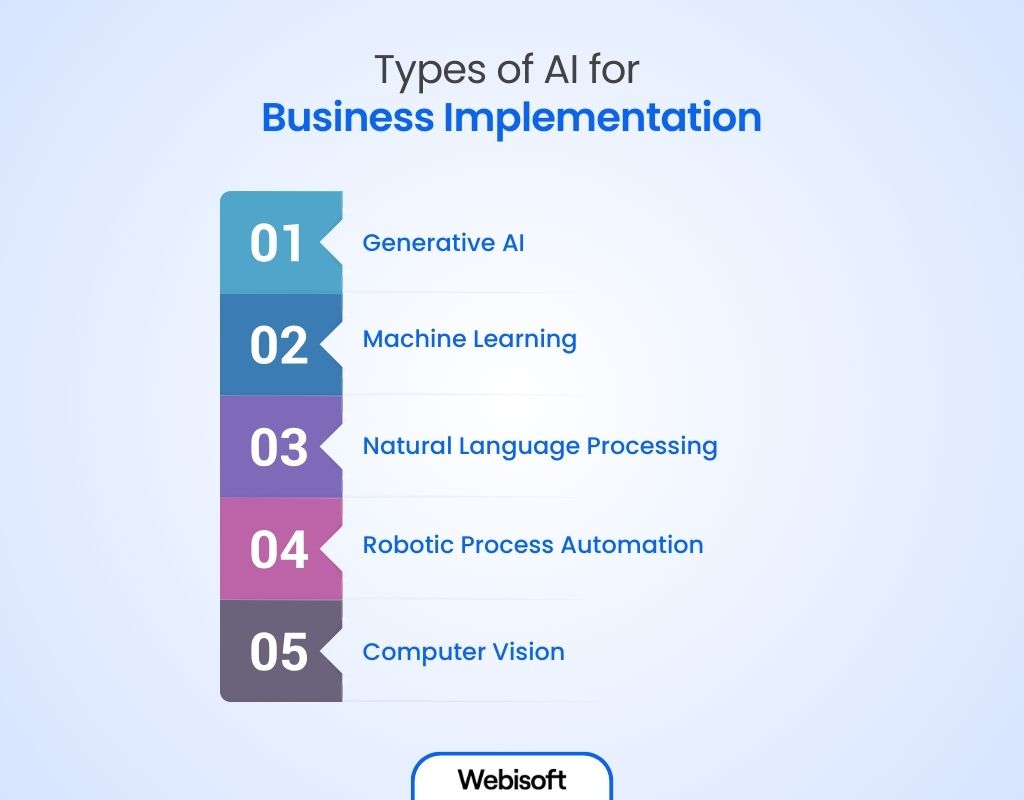
Different types of AI technology are advancing business rapidly. Let’s break down the main types of AI you’ll actually use in business and why you’d bother with each one:
1. Generative AI
Ever wish you could clone your best writer or designer? Generative AI is the next best thing. It creates fresh content- emails, blog posts, product images, even code on demand.
If you’re drowning in content needs or want to personalize marketing at scale, this is your secret weapon. It’s not about replacing creativity but about scaling it so your team can focus on strategy and big ideas.
2. Machine Learning (ML)
Machine learning is the ultimate pattern-spotter. It chews through mountains of data and finds trends you’d never notice on your own. Businesses use ML for everything from predicting sales to catching fraud before it happens.
If you want to stop guessing and start making decisions based on real numbers, ML is the way to go. It’s the backbone of any serious AI implementation strategy.
3. Natural Language Processing (NLP) & Large Language Models (LLMs)
You know those chatbots that actually sound human? That’s NLP and LLMs at work. They help businesses understand and respond to customer questions, sort through emails, or even analyze social media chatter.
If you want to boost customer service without burning out your team, or you need to make sense of tons of feedback, NLP is a lifesaver.
4. Robotic Process Automation (RPA)
Think of RPA as your digital assembly line. It’s perfect for those mind-numbing, repetitive tasks, like data entry or invoice processing, that eat up hours every week.
RPA bots don’t get tired, make fewer mistakes, and let your people focus on work that actually moves the needle.
5. Computer Vision
If your business deals with images or video, computer vision is a game changer. It can spot defects on a production line, track inventory with a camera, or even analyze how people move through your store.
This type of AI turns visual data into actionable insights, helping you catch problems early and improve operations.
What You Really Need Before Bringing AI Into Your Business
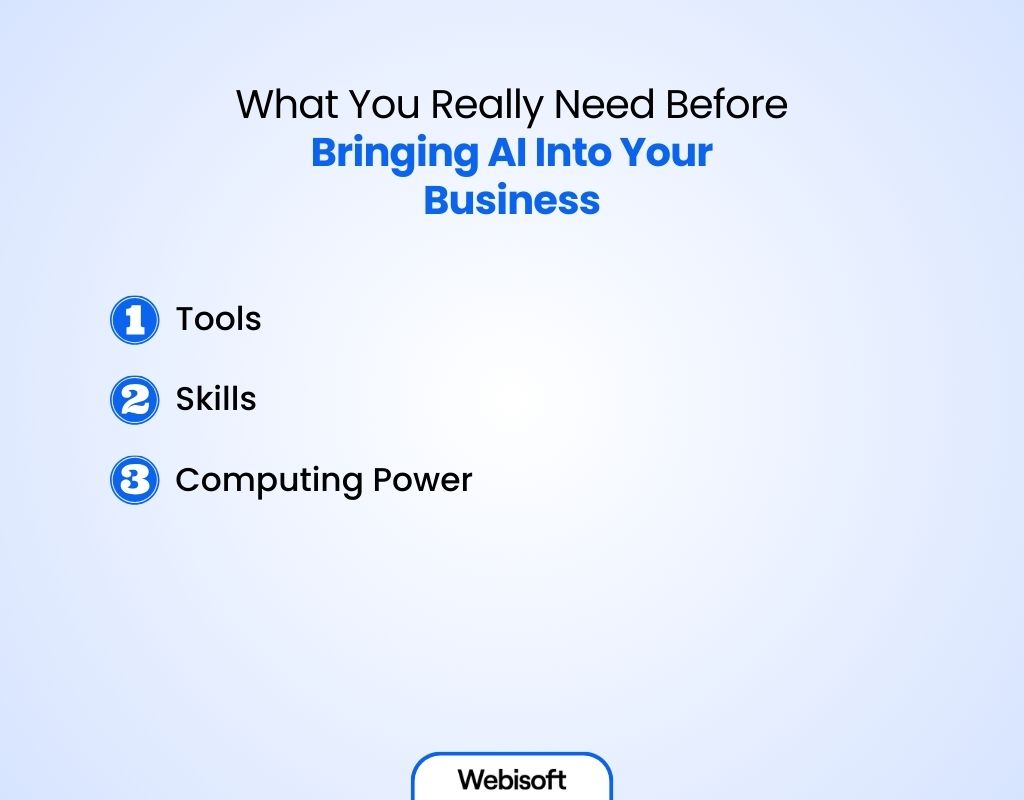
Before you jump into the steps of how to implement AI in business strategy, you need to know what you need to get started. There are three essentials you need to work together to implement AI:
1. Tools
You’ll need data analytics platforms (like Power BI or Tableau), cloud services (AWS, Azure, or Google Cloud), and AI development frameworks (TensorFlow, PyTorch).
For automating repetitive tasks, RPA tools like UiPath are key. If you’re aiming for content generation, generative AI tools like ChatGPT should be on your list.
2. Skills
You need people who can handle data, write Python code, and understand your business goals. Someone should also be able to manage projects and connect the dots between tech and business.
3. Computing Power
AI needs strong computers or access to cloud servers with high-performance GPUs. Most businesses rent this power from cloud providers instead of buying expensive hardware.
If you’re not sure where to start or want these pieces handled by experts, Webisoft can help you set up the right tools, bring in the skills, and manage the tech so you can focus on results.
Which Businesses are in Demand for AI Implementation
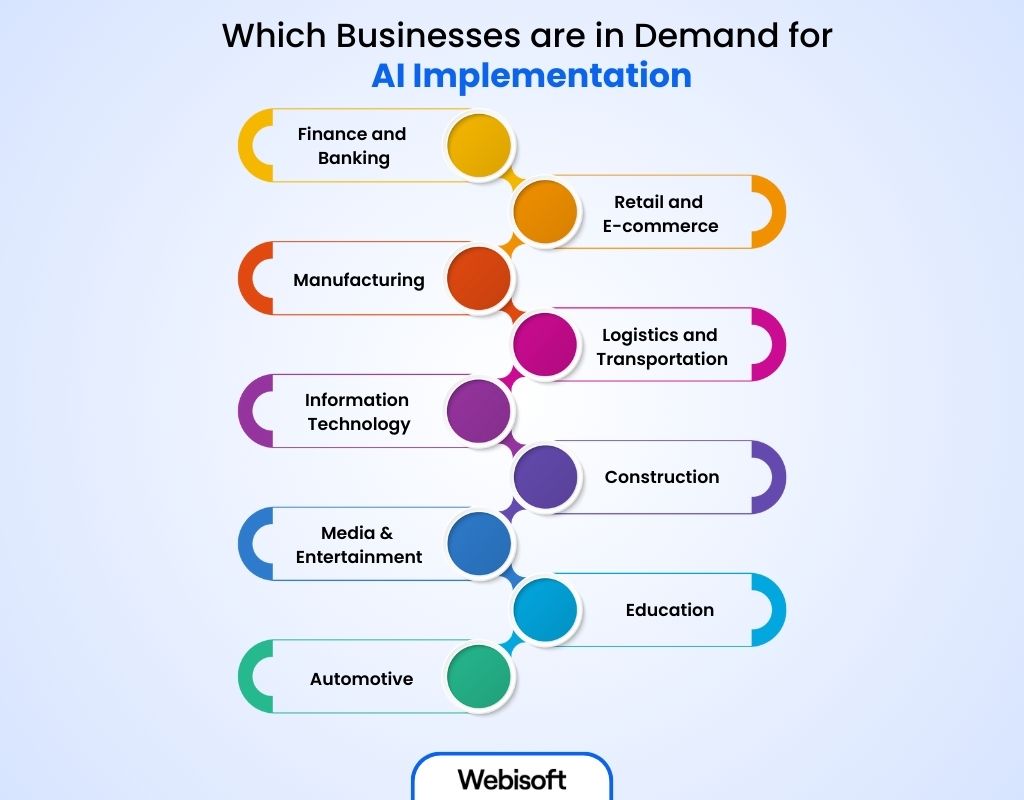
AI has taken a lot of repetitive work off, making daily tasks easier and less stressful for employees. As a result, more businesses are adapting to AI. The industries seeking AI solutions the most right now include —
Finance and Banking
Banks and financial services are all over AI for fraud detection, risk management, customer service chatbots, and personalized banking experiences.
AI is also automating asset management and helping with compliance, which saves time and reduces errors.
Retail and E-commerce
Retailers want AI for customer service, inventory management, personalized recommendations, and smarter marketing. AI helps them predict demand, avoid overstock, and create better shopping experiences, both online and in-store.
Manufacturing
Factories are using AI for predictive maintenance, quality control, supply chain optimization, and robotics. This means fewer breakdowns, less waste, and more efficient production lines.
Logistics and Transportation
Shipping companies, warehouses, and delivery services use AI for route planning, demand forecasting, and fleet management. AI makes supply chains faster, cheaper, and more reliable.
Information Technology (IT)
IT firms use AI for cybersecurity, software development, and data analysis. They’re also leveraging AI to improve cloud computing and user experience.
Construction
Builders and contractors are starting to use AI for project planning, risk management, and safety monitoring. It helps them run projects more smoothly and avoid costly mistakes.
Media & Entertainment
Streaming platforms, publishers, and content creators use AI for personalized recommendations, content creation, and audience analytics. This keeps users engaged and helps businesses tailor their offerings.
Education
Schools and online learning platforms are adopting AI for personalized learning, automating grading, and providing intelligent tutoring systems.
Automotive
Car manufacturers are implementing AI for autonomous driving, predictive maintenance, and personalized in-car experiences.
How to Implement AI in Business (A Step-by-Step Guide)
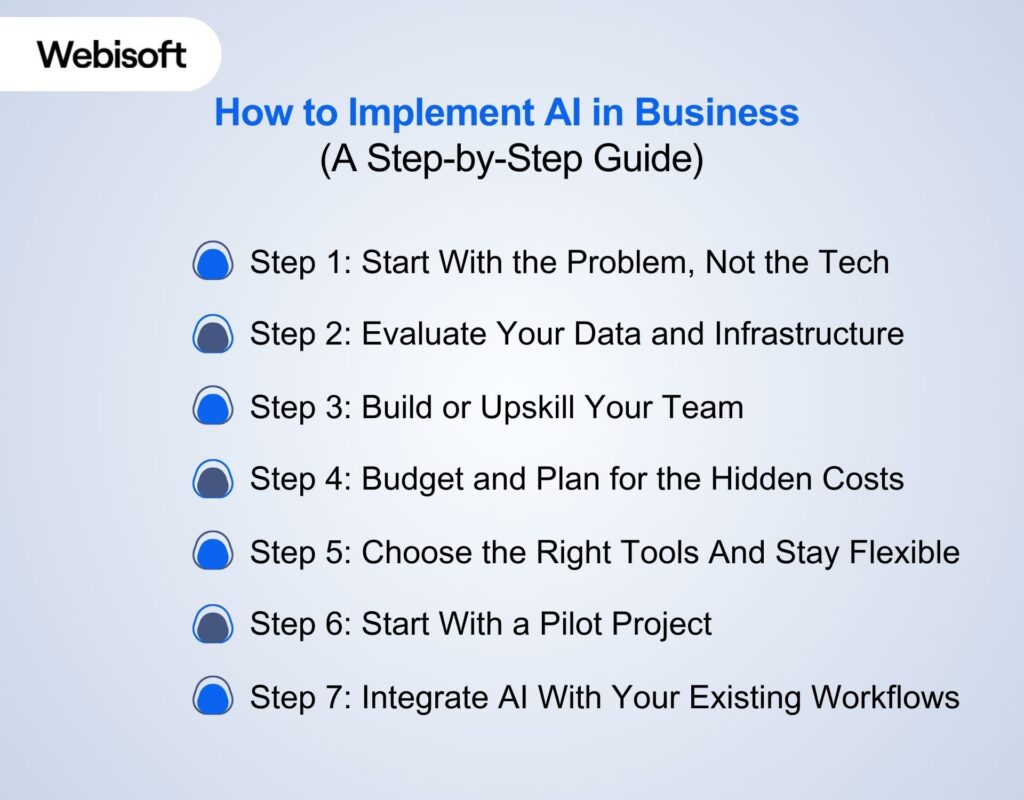
So ready to bring AI into your business? Here’s how to implement AI in business development in a step-by-step guide:
Step 1: Start With the Problem, Not the Tech
Don’t jump in just because AI is trending. Hence, the first step of how to use AI in business is to figure out the main problem.
What’s slowing you down right now? Maybe it’s sorting through mountains of invoices, figuring out what’s going to sell next, or just trying to keep up with customer questions.
If you can’t explain your goal in one clear sentence, you’re not ready to implement AI in your business yet. Set clear KPIs so you know what success looks like.
Step 2: Evaluate Your Data and Infrastructure
AI is only as good as the data you feed it. Audit your data: Is it accurate, current, and accessible? Are there silos between departments?
Clean up messy data and make sure your systems can support AI. Sometimes that means upgrading your tech stack or moving to the cloud. Here are some effective ways of assessing your audience data:
- Identify Key Stakeholders
- Internal (employees, department heads, IT, executives)
- External (customers, partners, vendors)
- Understand Pain Points
- Interview or survey departments to discover repetitive tasks, inefficiencies, or bottlenecks
- Look for areas with high volume or complexity (e.g., customer support, finance, HR)
- Segment Your Audience
- Group by function, AI literacy, or role (decision-makers, users, impacted teams)
- Customize solutions and communication based on each group’s needs
- Assess Digital Maturity
- How comfortable is your audience with automation and analytics?
- Do they currently use any AI-powered tools?
- Gauge Readiness for Change
- Are people open to AI adoption, or resistant due to fear of job displacement or complexity?
- Identify change champions within teams
- Map User Journeys
- Analyze how users interact with systems and where AI can fit in (e.g., chatbots for inquiries, recommendation engines)
- Define Success Metrics for Each Group
- What does success look like for a support agent vs. a CFO?
- Align AI goals with what matters to them (speed, cost savings, insights)
- Establish Communication and Training Plans
- Plan how you’ll onboard different user groups with tools, FAQs, or live sessions
- Customize support based on audience comfort with tech
Step 3: Build or Upskill Your Team
You don’t need a room full of geniuses; you need some specific people who can help you in individual sectors. Bring together business leaders, data scientists, and people who know your day-to-day operations.
If you’re missing expertise, either invest in training or bring in a partner like Webisoft to fill the gaps and keep you on track with business development.
Step 4: Budget and Plan for the Hidden Costs
AI isn’t a one-off expense. You need to calculate a budget for various factors, such as costs for data cleaning, integration, training, and ongoing support.
Don’t forget about those sneaky cloud bills, software licenses, and the time it takes to get your team up to speed. Here’s an approximate budget list without the hidden cost:
| Category | Estimated Cost Range |
|---|---|
| Data Preparation & Cleaning | $5,000 – $25,000+ |
| Software/Platform Licenses | $1,000 – $15,000/month |
| AI Development or Integration | $15,000 – $100,000+ (one-time) |
| Cloud Infrastructure | $500 – $10,000/month |
| Training & Upskilling | $2,000 – $20,000 |
| External Consultants/Vendors | $10,000 – $50,000+ (optional) |
| Maintenance & Support | $1,000 – $8,000/month |
| Change Management & Communication | $1,000 – $10,000 |
Step 5: Choose the Right Tools And Stay Flexible
Don’t just grab the most popular AI tool on the market. Think about what you actually need solved when planning AI app development. For example:
- Need better business insights? Try an AI business advisor like DreamHost’s AI Business Advisor for recommendations and decision support.
- Looking to streamline project management? Asana AI or RingCentral AI Assistant can summarize meetings, automate status updates, and keep your team in sync without endless emails and check-ins.
- Need to optimize operations or supply chain? Platforms like SAP Leonardo AI or Google Cloud AI can analyze your data, predict inventory needs, and automate repetitive tasks.
- Want to boost customer service? AI chatbots and virtual assistants can handle routine questions around the clock, freeing up your human team for more complex issues.
Whatever your business challenge, there’s an AI tool built for it. Not sure where to start or which tool is right for your business? That’s where Webisoft comes in. They’ll help you sort through the options and integrate the best-fit AI into your workflow.
Step 6: Start With a Pilot Project
Don’t try to use AI everywhere right away. A pilot project is a low-risk way to test AI in one specific part of your business before scaling. It helps you prove value, fix issues early, and build internal buy-in. What to check in this step:
- Pick the Right Use Case: Choose a repetitive, measurable task like invoice approvals, lead scoring, or support automation.
- Set Clear Goals: Define what success looks like (e.g., 30% faster processing, 90% accuracy).
- Build a Small Team: Involve IT, end users, and one AI expert or vendor. Assign a project lead.
- Prepare the Data: Ensure you have clean, accessible, and relevant data for the use case.
- Choose the Right Tools: Use lightweight AI platforms or APIs to avoid over-engineering.
- Run & Monitor: Deploy in a controlled environment. Track KPIs and user feedback closely.
- Review & Decide: If it works, plan to scale. If not, refine and try again with insights gained before integrating it into your business.
Step 7: Integrate AI With Your Existing Workflows
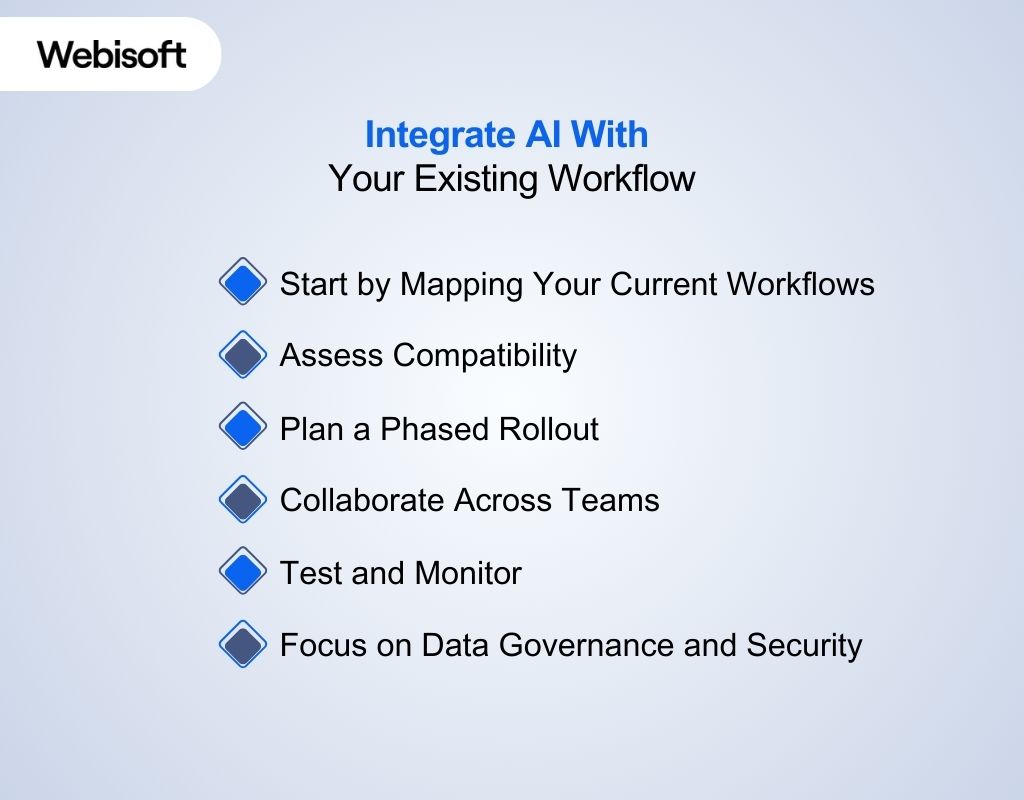
Integration isn’t just plugging in a new tool and hoping for the best. You need to go through the above steps to work on the AI app development workflow and implementation of AI.
Once you’re ready, here’s how you actually get AI working smoothly inside your business:
Start by Mapping Your Current Workflows
Look at how your processes run right now. Where are the bottlenecks or repetitive steps? This helps you spot where AI will have the biggest impact.
Assess Compatibility
Check if your current software and systems can “talk” to the AI tools you want to use. Look for solutions that offer APIs or standardized connectors to make integration much easier and reduce tech complications.
Plan a Phased Rollout
Don’t flip the switch everywhere at once. Integrate AI into one process or department first. It lets you test, adjust, and make sure everything works before scaling up.
Collaborate Across Teams
Just like assessing data, integration isn’t just an IT job. Bring in people from operations, finance, and any department that will use or be affected by the new AI. This cross-team approach helps you catch issues early and makes adoption smoother.
Test and Monitor
After testing the AI tool during the pilot project, you need to test it again before going live; run practical tests. Fix bugs, check that data flows correctly, and make sure the AI’s output is accurate.
After launch, keep monitoring performance and gather feedback from your team so you can keep improving.
Focus on Data Governance and Security
Make sure your data stays accurate, secure, and compliant with any regulations. Set up rules for who can access what, and keep an eye on how data moves between systems.
If there is something new, you need to feed it to your AI section so that the new data can reach people or services.
How Webisoft Can Help You Implement AI in Business
Now that you’ve got ideas on how to implement AI in business analysis, it’s obvious it isn’t a task for just two or three people. If you want things done smoothly and professionally, you’ll eventually need a team with the right mix of skills.
In this regard, Webisoft can help you in many ways. They’ve worked on various successful projects of AI implementation in business. Thus, their experts can get it right the first time.
The aspects Webisoft can help you with are as follows:
- The complete process of how to implement AI in business
- Vendor lock-in and data ownership
- Post-launch support and maintenance
- Realistic timelines
- Team structure
- Small business perspective
- Customer communication
- AI-specific security risks
- Change management tactics
- Budgeting and hidden costs
Conclusion
In conclusion, how to implement AI in business starts with a clear vision, the right data, and a strong execution plan.
But real success comes from aligning AI with your operations, people, and long-term goals. Whether you’re aiming to streamline processes, improve customer experiences, or drive innovation, a trusted partner can accelerate your journey.
Connect with Webisoft to get expert support in planning, building, and scaling AI that delivers measurable impact.
FAQs
Here are some commonly asked questions regarding how to implement AI in business —
Yes. Small businesses can start with tools like AI chatbots, automation platforms, or analytics tools. Cloud-based AI services have made implementation more accessible and affordable.
A pilot project can take 4–12 weeks. Full implementation and scaling across the business may take several months, depending on complexity, data integration, and internal readiness.
Not always. Many platforms now offer low-code or no-code AI tools. However, for complex use cases or custom models, hiring or partnering with AI experts is recommended.