Blockchain is best known as the ledger behind Bitcoin, but the underlying design pattern matters well beyond cryptocurrency. A blockchain is a distributed, append-only database: every participant holds a copy of the record, and a consensus protocol decides what gets written next. Most of the technology's practical advantages follow from that one architectural decision.
Webisoft builds this for clients through our blockchain development services. If you are planning a project, we can help you scope and deliver it.
The main advantages of blockchain are tamper-evident records, transparency between parties that do not fully trust each other, lower transaction and reconciliation costs, and automation through smart contracts. The trade-offs are lower throughput than a conventional database, harder key management, and immutability that applies to your mistakes as much as your data.
This guide walks through the features that make blockchain useful, the business advantages that follow, the situations where it is the wrong tool, and the industries where it has proved itself. If you are evaluating a build, Webisoft's blockchain development team in Montreal handles this work end to end, from architecture through audited smart contracts.
What Are the Features of Blockchain?
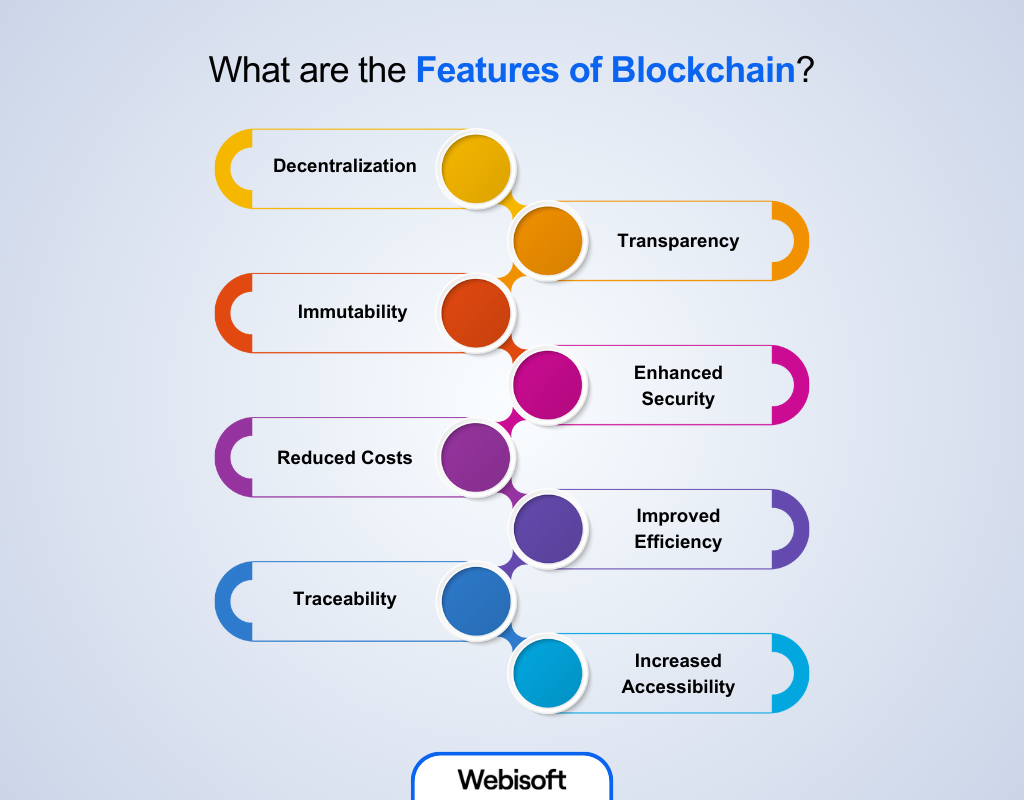
Every advantage of blockchain traces back to a small set of design properties. Here is the summary, followed by what each property means in practice.
| Feature | Description |
|---|---|
| Decentralization | No single operator controls the ledger; independent nodes reach consensus on every write. |
| Transparency | All permitted participants see the same verifiable transaction history. |
| Immutability | Hash-linked blocks make any change to historical records detectable. |
| Cryptographic security | Public-key signatures authenticate every transaction. |
| Reduced costs | Fewer intermediaries and less cross-party reconciliation. |
| Improved efficiency | Settlement in minutes and automation through smart contracts. |
| Traceability | A continuous audit trail for assets, goods, and documents. |
| Increased accessibility | Open participation for anyone with an internet connection. |
Decentralization
A blockchain runs on many independent nodes rather than one central server. No single operator can rewrite the record, censor a transaction, or take the system offline, because every change must be accepted by the network's consensus rules.
The benefit is resilience: no single point of failure, and no single administrator whose compromise breaks the system. The cost is coordination overhead, since every write is agreed by consensus instead of committed by one database engine. That trade is worth making when the parties involved do not want to trust a single operator.
Transparency
On a public chain, every transaction is visible and independently verifiable by any participant. That visibility is what lets strangers transact without a trusted middleman: you do not have to take anyone's word for the state of the ledger, you can check it yourself.
Enterprises rarely want fully public data, which is why permissioned chains exist. They restrict who can read and write while preserving the property that matters: a shared, verifiable history that no single member can quietly edit.
Immutability
Each block contains a cryptographic hash of the previous block. Altering any historical record changes its hash, which invalidates every block after it, so tampering is immediately visible to the whole network.
For a business, that means an audit trail that stands up to scrutiny: signed, timestamped records that nobody can retroactively edit. It also means errors are corrected by appending a reversing entry rather than deleting the mistake, which is how accountants have handled ledgers for centuries.
Cryptographic Security
Every transaction is signed with the sender's private key and verified against their public key, so the network can confirm who authorized what without a central authenticator. To forge history on a well-distributed chain, an attacker would need to control a majority of the network's validating power, not one server.
One caveat belongs in any honest assessment: the chain protects the ledger, not your keys. Most real losses come from stolen private keys and bugs in application-level smart contracts, which is why key management design and independent contract audits are mandatory parts of a serious deployment.
Reduced Costs
Multi-party processes pay twice today: fees to intermediaries who sit between the parties, and the internal cost of reconciling each party's separate records after the fact. A shared ledger attacks both. Participants transact directly, and reconciliation largely disappears because everyone is already reading the same record.
Costs shift rather than vanish: you take on node infrastructure, development, and audits. Our breakdown of blockchain development costs covers what to budget for.
Improved Efficiency
Settlement that takes days through correspondent banks or escrow agents can finalize in minutes on-chain, on a network that does not close on weekends. Smart contracts remove the manual handoffs in between: funds release when delivery is confirmed, without an operations team pushing paperwork.
Traceability
Because every state change is recorded in order and cannot be edited afterward, a blockchain provides a continuous chain of custody. This is the core value in supply chain and manufacturing applications: any unit can be traced from origin to end customer, which supports recalls, provenance claims, and regulatory compliance.
Increased Accessibility
Public blockchains are open infrastructure. Anyone with an internet connection can hold assets and transact, with no account approval process. That matters most in regions with thin banking coverage, where a phone becomes a functional financial account.
Why Is Blockchain Important?
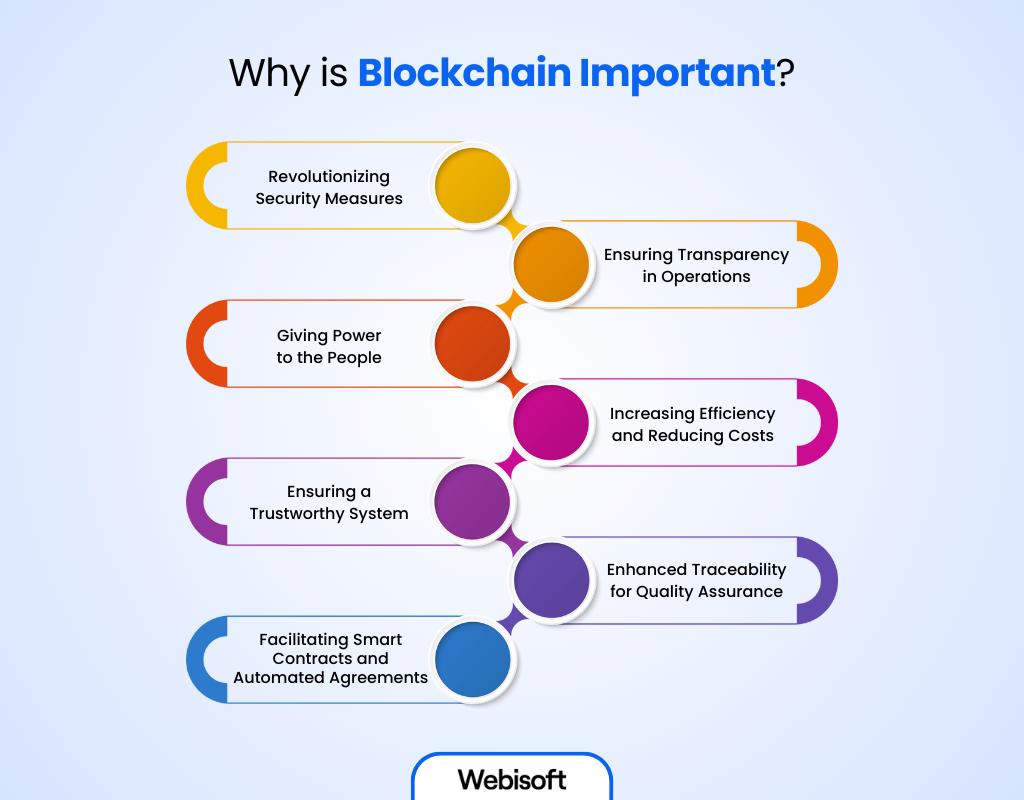
Databases already store records cheaply and quickly, so the honest question is what blockchain adds. It earns its complexity in one specific situation: several organizations need to agree on shared state, and none of them wants to hand control of the master record to another party or pay a middleman to hold it.
A Shared Source of Truth Between Organizations
Inside one company, a database with an administrator works fine. Between companies, the administrator question becomes political: whoever runs the master record can change it. Blockchain resolves that standoff by giving every party the same record and requiring consensus to change it. Trade finance, interbank settlement, and multi-party supply chains all reduce to this problem.
Fewer Intermediaries
Many intermediaries exist purely to be the trusted third party: clearing houses, escrow agents, registries. When the ledger itself provides the trust, some of those roles shrink or disappear, and their fees and delays go with them.
Programmable Agreements
Because the ledger is also an execution environment, agreements can be written as smart contracts: code that holds funds and releases them when verifiable conditions are met. That turns contract enforcement from a legal process into a software guarantee for the cases the code can express.
Where Blockchain Is the Wrong Tool
A serious evaluation includes the failure cases. Blockchain is usually the wrong choice when:
- One trusted operator is acceptable. If every party is comfortable with a single administrator, a conventional database is faster, cheaper, and simpler to run.
- You need high throughput on-chain. Public chains process far fewer transactions per second than a tuned relational database. High-volume systems keep bulk data off-chain and anchor proofs on-chain.
- Data must be deletable. Immutability conflicts with privacy rules that grant deletion rights, so personal data belongs off-chain, with only hashes on the ledger.
- Users cannot manage keys. A lost private key means lost access, with no password reset. Custody design is a product decision, not an afterthought.
What Are the Advantages of Blockchain Technology?
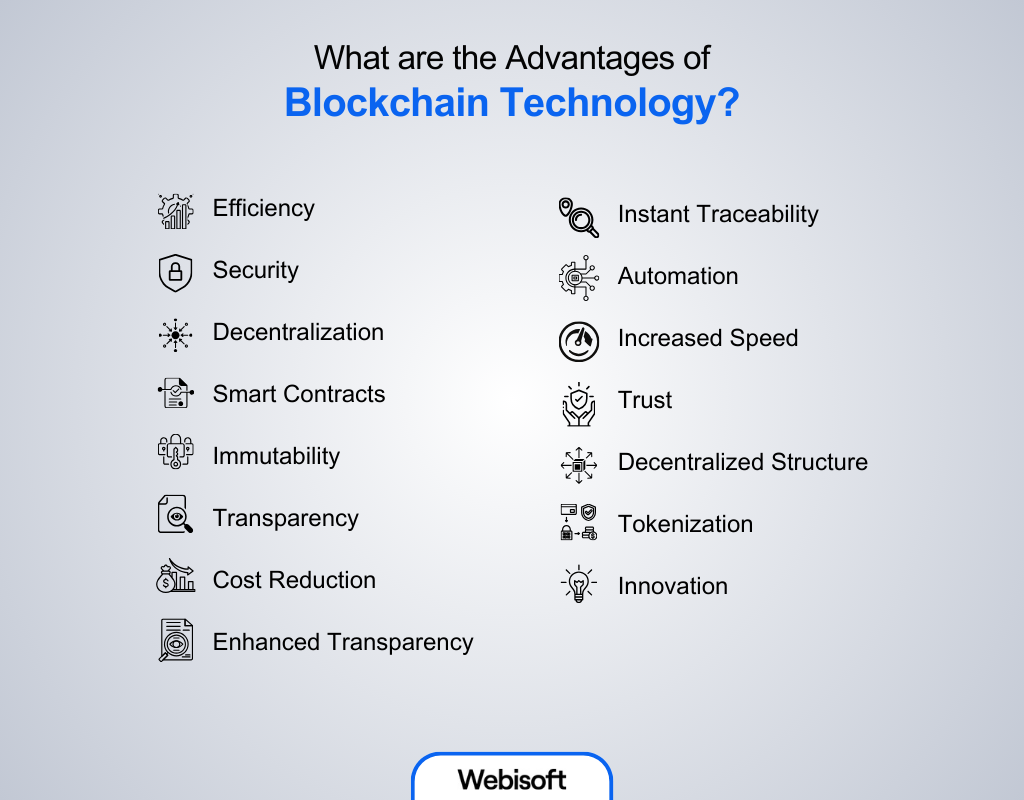
With the mechanics established, the advantages read as business outcomes rather than buzzwords.
A Stronger Security Model
Compromising a traditional system means breaching one server or one administrator account. Compromising a distributed ledger means overpowering the majority of a network simultaneously. For records worth attacking, that asymmetry is the point.
Auditability and Compliance
Every transaction is signed, timestamped, and permanent, so the audit trail builds itself. For regulated industries, this reduces the cost of proving what happened and when, and it removes entire categories of dispute about whose records are correct.
Lower Transaction and Reconciliation Costs
Direct peer-to-peer settlement cuts intermediary fees, and a shared record eliminates most reconciliation work between counterparties. The savings compound in processes with many hops, such as cross-border payments and trade documentation.
Faster Settlement
On-chain settlement is final in minutes and available around the clock. For treasury operations and international transfers, that shortens working-capital cycles and removes the risk of waiting days for finality.
Fraud Resistance and Provenance
An unforgeable history makes several fraud patterns structurally harder: double-selling the same asset, backdating records, or passing off counterfeits as originals. Provenance becomes a property of the data rather than a claim on a label.
Automation Through Smart Contracts
Escrow, milestone payments, royalty splits, and insurance payouts can execute automatically against verifiable conditions. Fewer manual steps means fewer errors, fewer disputes, and lower operating cost.
Tokenization of Assets
Representing an asset as an on-chain token makes it divisible, transferable, and tradable at any hour. This enables fractional ownership of previously illiquid assets and lets software manage rights that used to require registries and paperwork.
Resilience and Availability
A ledger replicated across many independent nodes has no single point of failure. Individual nodes can fail or be attacked without interrupting the network, which is a meaningful availability guarantee for critical shared infrastructure.
Industries That Benefit from Using Blockchain
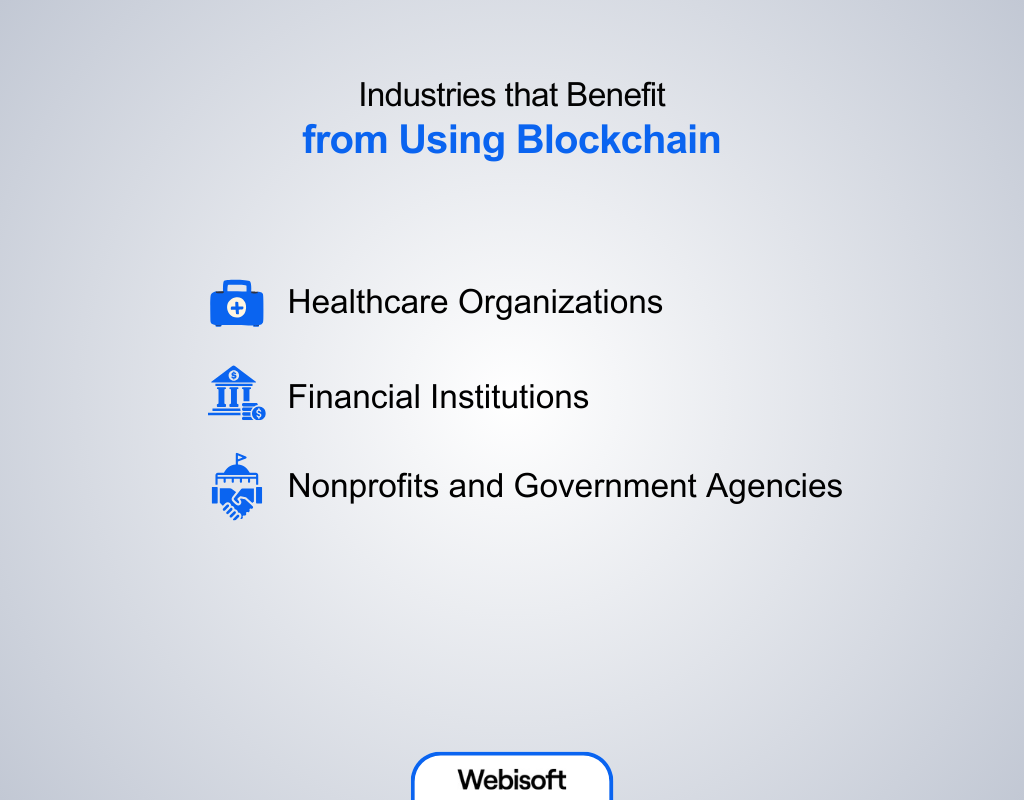
The pattern repeats across sectors: wherever several parties keep separate records of the same process, a shared tamper-evident ledger removes cost and dispute. Here is how that plays out.
Healthcare Organizations
Patient data lives in silos across providers, labs, and insurers, and moving it between them is slow and error-prone. A blockchain-backed record gives each patient a consistent, access-controlled history that any authorized provider can verify, while an immutable access log shows exactly who touched the record and when. Sensitive data itself stays off-chain; the ledger holds pointers and proofs.
Financial Institutions
Banks run on reconciliation: every counterparty keeps its own books, and back-office teams make them agree. Shared ledgers collapse that work, speed up settlement, and give regulators a clean audit trail. The same rails enable new products, from tokenized deposits to decentralized finance integrations.
Nonprofits and Government Agencies
Donors and citizens want proof that funds went where they were promised. An immutable record of disbursements provides it without requiring trust in the institution's own reporting. For government agencies, the strongest use cases are registries: land titles, licenses, and identity credentials that must be verifiable and resistant to quiet alteration.
Pharmaceutical Companies
Counterfeit drugs enter supply chains through gaps between manufacturers, distributors, and pharmacies. Serializing products on a shared ledger closes those gaps: each unit's journey is recorded at every handoff, so a pharmacy can verify provenance before dispensing. The same integrity properties protect clinical trial data, where an unalterable record of protocols and results deters selective reporting.
Insurance Companies
Claims processing is slow because verification is manual. Smart contracts enable parametric policies that pay out automatically when a verifiable trigger occurs, such as a flight delay or a weather event crossing a defined threshold. A shared claims ledger also makes duplicate claims across insurers visible, which is a structural check on fraud.
Blockchain Implementations
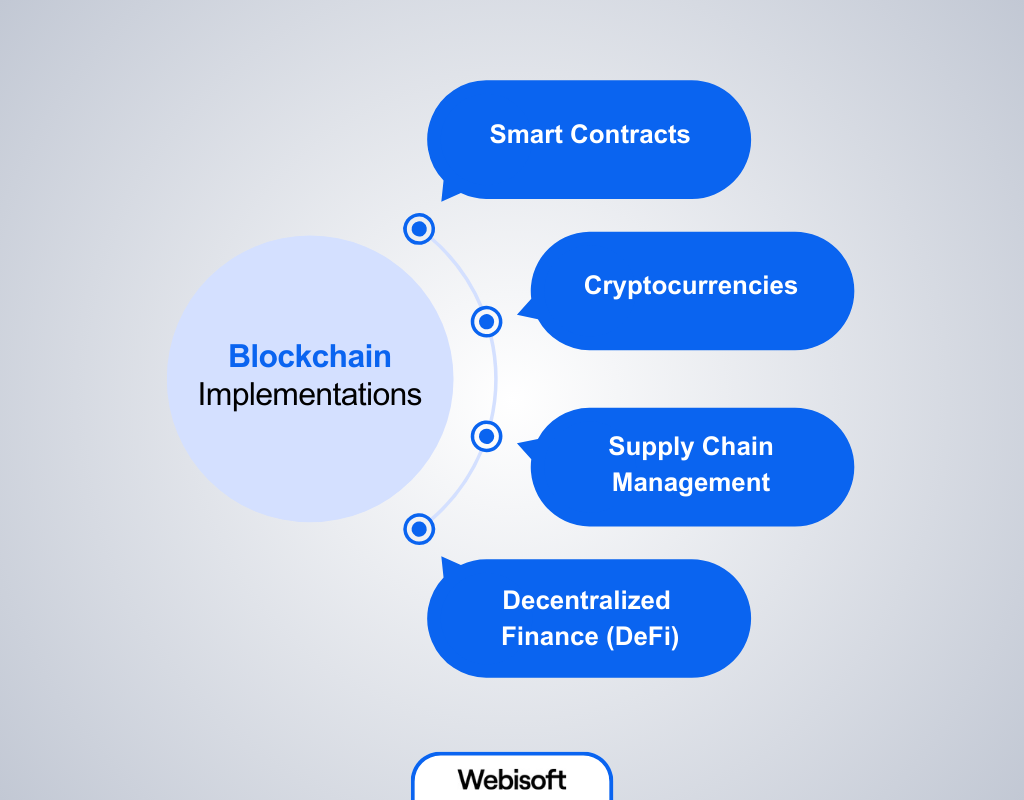
These are the implementation patterns that have moved past pilots into production use.
Smart Contracts
Self-executing code that holds and transfers value based on conditions. Production uses include escrow, automated market making, subscription payments, and multi-signature treasury controls. The discipline required: contract code is effectively immutable once deployed, so testing and independent audits happen before launch, not after.
Cryptocurrencies
Bitcoin and Ethereum demonstrated that a monetary network can run without a central issuer. Beyond speculation, the durable use cases are cross-border transfers, dollar-denominated stablecoins in unstable currency environments, and settlement infrastructure for the applications above.
Supply Chain Management
Recording each handoff on a shared ledger gives every participant real-time visibility from production to delivery, and gives auditors a provable chain of custody. We cover architectures and vendor approaches in our guide to blockchain in supply chain management.
Decentralized Finance (DeFi)
DeFi rebuilds financial primitives such as lending and exchange as open smart contract protocols that anyone can access and any developer can compose. It is also a live demonstration of the risk side: protocol exploits are common enough that security engineering, not feature count, separates durable projects from casualties.
How Webisoft Helps You Put Blockchain to Work
Webisoft is a Montreal-based software engineering firm that builds blockchain systems end to end: architecture and chain selection, smart contract development and audit preparation, wallet and key-management design, and integration with your existing back-office systems.
The hardest part of a blockchain project is rarely the chain itself. It is deciding what belongs on-chain, what stays in a conventional database, and how the two remain consistent. Getting that split right at the architecture stage is the difference between a system that ships and a pilot that stalls.
If you are weighing a build, start with our blockchain consulting services, or contact Webisoft to scope the project.
Frequently Asked Questions
Tamper-evident shared records. Once written, transactions cannot be quietly altered, and every permitted participant can verify the same history. This lets organizations that do not fully trust each other transact directly, with less reconciliation and fewer intermediaries.
Lower throughput than a conventional database, the burden of key management (a lost private key means lost access), immutability of deployed smart contract bugs, and integration complexity. Public proof-of-work chains also carry high energy costs, though proof-of-stake networks have largely addressed that.
A public chain is open: anyone can run a node, read the ledger, and transact. A private or permissioned chain restricts reading and writing to approved members, which suits consortiums that want a shared verifiable ledger without public data exposure. Public chains maximize neutrality; permissioned chains trade some decentralization for privacy, throughput, and governance control.
When one operator everyone trusts can run the system, when data must be editable or deletable, or when throughput requirements are high. Blockchain pays off specifically where multiple parties need a shared record that none of them controls.
Finance and banking (settlement and auditability), supply chain and manufacturing (traceability), healthcare and pharma (record integrity and drug provenance), insurance (automated claims), and government (registries and identity). The common thread is multi-party processes with expensive reconciliation or fraud exposure.