Webisoft builds blockchain systems for enterprises and founders from our studio in Montreal, so we read lists like this one with a practitioner's eye. Our blockchain development services run from smart contracts and protocol work to full product delivery, which means we know from the inside what a capable development company looks like.
With that on the table, this guide plays it straight. Here is an honest overview of blockchain technology development companies, what each is known for, and how to judge which one fits your project.
Blockchain technology development companies are not interchangeable. Some run deep protocol engineering teams, some resell white-label token platforms, and some are generalist agencies that added "blockchain" to the services page. The difference shows up after launch: an unaudited smart contract cannot be patched the way a web app can, and a chain chosen for the wrong reasons locks you into its fee model, tooling, and security assumptions for years.
Picking the wrong partner costs more than a missed deadline. Smart contracts hold funds and execute autonomously, so a defect in production is a financial event, not a bug ticket. That is why the evaluation criteria for a blockchain vendor differ from ordinary software procurement: audit practice, key management discipline, and post-launch support matter as much as development speed.
This guide profiles seven blockchain technology development companies with distinct strengths, then walks through the selection criteria you can apply to any shortlist.
Quick List: Blockchain Technology Development Companies
- Webisoft
- SoluLab
- LeewayHertz
- PixelPlex
- Infograins
- ChainSafe
- Peiko
Comparison Table
| Company | Specializations | Core Services | Strengths |
|---|---|---|---|
| Webisoft | Custom blockchain systems, smart contracts | dApps, private and public chains, smart contracts, audits | Full-cycle engineering, enterprise integration |
| SoluLab | dApp development, enterprise blockchain | Smart contracts, NFT platforms, supply chain blockchain | Custom solutions, security focus |
| LeewayHertz | Enterprise blockchain, Web3 | Smart contracts, token development, AI plus blockchain | Scalable enterprise applications |
| PixelPlex | Private and public blockchain | dApps, blockchain security, smart contracts | Security and customization |
| Infograins | Web3, metaverse, smart contracts | NFT development, private blockchain, dApps | Smart contract auditing |
| ChainSafe | Multi-chain protocol engineering | Cross-chain infrastructure, open-source tooling | Open-source protocol expertise |
| Peiko | Custom blockchain applications | Secure dApps, blockchain infrastructure, smart contracts | Quality-focused custom builds |
Best Blockchain Technology Development Companies: Overviews
1. Webisoft
Webisoft is a Montreal-based software engineering firm that builds blockchain products end to end: architecture, smart contracts, the application layer, and the infrastructure underneath. The team treats a blockchain project as a systems problem rather than a token launch, which changes what gets prioritized. Contract code is written against a test suite, deployed to testnets before mainnet, and reviewed for the failure modes that matter on-chain: reentrancy, access control gaps, oracle manipulation, and unchecked upgrade paths.
Webisoft works across both permissioned and public networks. For enterprises that need auditability without exposing data publicly, that usually means a private or consortium chain integrated with existing back-office systems. For products that need open participation and composability, it means Ethereum-compatible public chains with the tooling and wallet flows users expect. The team's blockchain development services cover the full path from architecture decision to production operation.
What Does Webisoft Offer?
- Custom blockchain solutions: bespoke systems designed around the business process, not a template, including chain selection, data model, and integration with existing operations.
- Smart contract development: contracts written, tested, and deployed with explicit attention to gas cost, upgradeability strategy, and failure handling.
- Decentralized application (dApp) development: full-stack dApps for finance, logistics, and healthcare use cases, from wallet connection to backend indexing.
- Private and public blockchain networks: permissioned deployments for internal operations and public-chain products for open ecosystems.
- Blockchain security reviews: assessments that identify vulnerabilities in contract code and infrastructure before they reach production.
Pros
- Full-cycle team: the same firm handles architecture, contracts, frontend, and DevOps
- Strong security and integration engineering
- Enterprise-grade delivery with documented handover
Cons
- Pricing sits above offshore-only competitors
- Complex custom builds take longer than template deployments
Webisoft's User Reviews
- "Webisoft was quick to provide high-quality work." Timothy Garrity, Chief Technology Officer at Arcade2Earn
- "They knew what to do as soon as I asked them for something." Ronak Desai, CTO and Co-Founder, Payment Labs
2. SoluLab

SoluLab builds custom blockchain applications for startups and enterprises, with a portfolio that spans decentralized applications, NFT marketplaces, and supply chain systems. The firm's supply chain work is a useful signal of its enterprise orientation: those projects require integrating on-chain records with ERP systems, scanners, and logistics providers, which is harder than deploying a token contract.
SoluLab also covers tokenization, DeFi applications, and Web3 technologies, and offers consulting for teams that have a use case but no chain strategy yet.
What Does SoluLab Offer?
- dApp development: decentralized applications for finance, healthcare, and supply chain management.
- NFT marketplace development: trading platforms with minting, royalties, and custody flows built in.
- Supply chain blockchain: traceability systems that anchor shipment and provenance data on-chain.
- Smart contract development and consulting: contract engineering plus advisory on where blockchain actually fits.
Pros
- Accessible pricing for startups
- Security-conscious delivery process
- Experience across multiple blockchain platforms
Cons
- Small engagements get less attention than large accounts
- Response times can stretch during busy periods
SoluLab's User Reviews
- "I was particularly impressed by SoluLab's outstanding professionalism and organization from the beginning to the end." Sivan Michaeli-Roimi, VP Marketing at Pynt
- "The most important is their experience in delivering complex blockchain projects." Michael J. Lawrence, Founder of Bloqwork
3. LeewayHertz
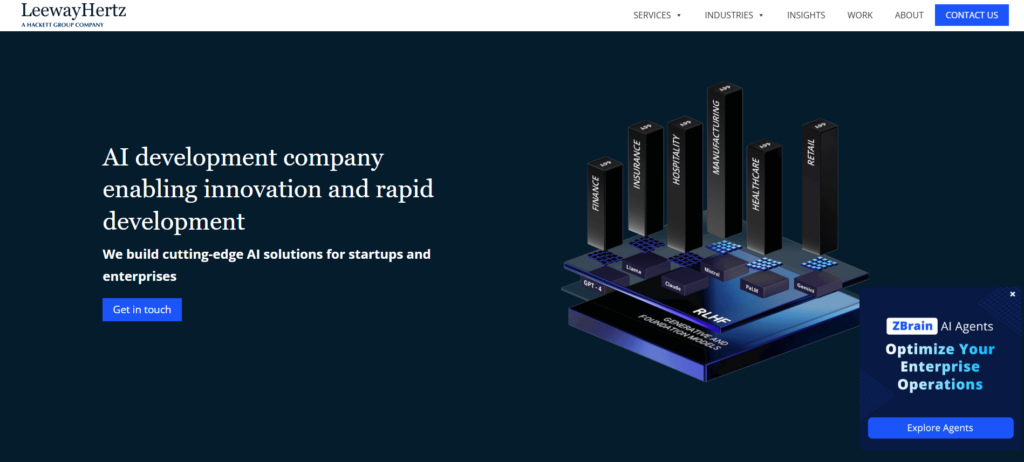
LeewayHertz is an enterprise-focused development firm that pairs blockchain engineering with AI work. That combination is more than marketing: several practical blockchain problems, such as anomaly detection on transaction flows and document verification in trade finance, benefit from machine learning layered on top of the ledger. LeewayHertz builds for regulated industries including finance and healthcare, where compliance requirements shape the architecture from day one.
The firm works with the major enterprise blockchain networks and delivers tokenization, custom token development, and Web3 applications alongside conventional enterprise integration.
What Does LeewayHertz Offer?
- Enterprise blockchain development: scalable permissioned and public-chain networks for business use.
- AI plus blockchain applications: machine learning integrated with on-chain data for automation and analysis.
- Token development and Web3 solutions: custom tokens, NFTs, and decentralized applications.
- Smart contract engineering: development, testing, and deployment of self-executing contracts.
Pros
- Deep enterprise blockchain experience
- Secure, scalable application architecture
- AI integration capability in-house
Cons
- Cost structure suits enterprises better than small businesses
- Custom projects carry longer timelines
LeewayHertz's User Reviews
- "They have a very effective development process and are knowledgeable and experienced." Strategy Project Manager, Electronic Manufacturer
- "Working with LeewayHertz has been wonderful. LeewayHertz has been a great business partner." President, GetThereReferral.com
4. PixelPlex
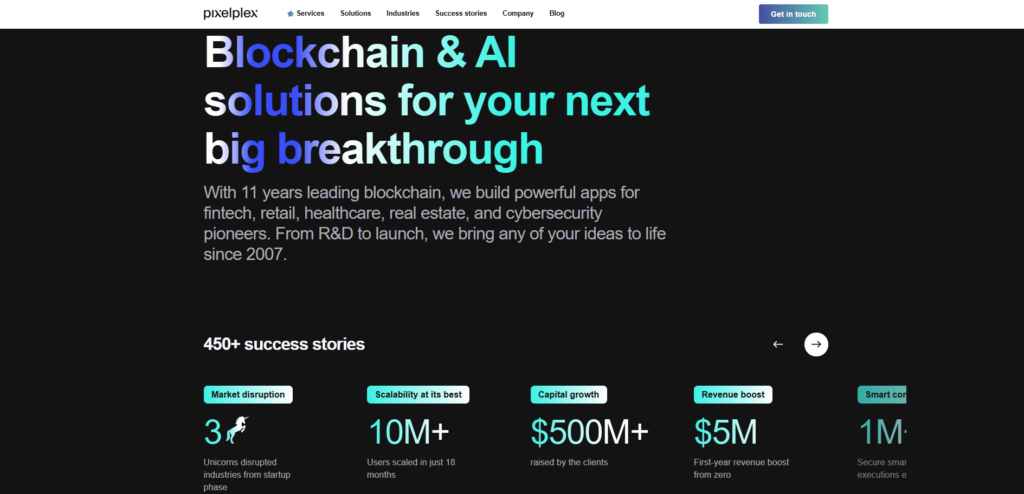
PixelPlex leads with security. The firm develops decentralized applications, smart contracts, and private blockchain networks, and runs security audits as a distinct service line rather than an afterthought. For DeFi work in particular, that matters: the highest-value attacks in the space exploit contract logic, not infrastructure, so a vendor that audits code professionally tends to write more defensive code as well.
PixelPlex serves businesses that need blockchain infrastructure across both permissioned and public networks, with customization as the default rather than the exception.
What Does PixelPlex Offer?
- Private and public blockchain development: permissioned networks for internal operations and decentralized systems for open ecosystems.
- Custom dApp development: applications built around specific business workflows.
- DeFi applications: platforms for on-chain lending, trading, and asset management.
- Blockchain security audits: structured assessments that surface vulnerabilities before deployment.
Pros
- Security is a core competency, not a checkbox
- Strong customization capability
- Proven DeFi delivery experience
Cons
- Less suited to early-stage startups with small budgets
- Some solutions require extensive customization effort
PixelPlex's User Reviews
- "PixelPlex did a great job keeping us up to date on the project's progress." Founder, Blockchain Startup
5. Infograins
Infograins concentrates on Web3, metaverse, and NFT work, with smart contract auditing as a supporting discipline. The firm builds NFT marketplaces, DeFi applications, and private blockchain networks for clients in finance, gaming, and supply chain. Its audit practice is worth noting for buyers: a shop that reviews other teams' contracts for vulnerabilities develops a sharper eye for the mistakes that drain funds, such as unchecked external calls and flawed access control.
What Does Infograins Offer?
- Web3 solutions: decentralized applications built on Web3 frameworks with wallet-native user flows.
- Metaverse and NFT development: virtual environments and NFT platforms with minting, trading, and royalty logic.
- Smart contract auditing: security reviews that identify vulnerabilities and optimize contract performance.
- Private blockchain development: permissioned networks tailored to specific business requirements.
Pros
- Current with emerging Web3 and NFT patterns
- Genuine smart contract security capability
- Broad blockchain service range
Cons
- Enterprise blockchain offering is thinner than the Web3 side
- Costs can be high for smaller businesses
Infograins' User Reviews
- "Infograins Group has found high-quality resources that fit well within their assigned internal teams. The team offers responsive and personable project management." Roshanne Green, Director at Summit Legal Group
- "We were impressed with their quality and timely delivery." Pat Haro, CTO at Personal Sommeliers
6. ChainSafe
ChainSafe is a different kind of entry on this list: a protocol engineering firm known for open-source infrastructure rather than client application work. The team maintains clients and tooling for major blockchain networks and specializes in cross-chain interoperability, the hard problem of moving assets and messages between chains that were never designed to talk to each other.
That positioning makes ChainSafe the right call for teams building at the protocol layer: bridges, chain clients, decentralized storage integrations, and gaming SDKs. It is a less natural fit for a business that wants a turnkey application, because ChainSafe's center of gravity is infrastructure, and its open-source codebase means you can inspect the quality of its engineering directly on GitHub before you ever sign a contract.
What Does ChainSafe Offer?
- Cross-chain interoperability: frameworks for asset transfers and messaging between distinct blockchain networks.
- Blockchain infrastructure development: node software, protocol implementations, and high-performance architectures.
- Web3 consulting and integration: strategy and engineering support for teams moving into decentralized systems.
- Decentralized identity: privacy-focused identity systems that keep credentials under user control.
Pros
- Deep protocol-level engineering, verifiable through public repositories
- Recognized cross-chain and multi-chain expertise
- Open-source, community-driven development culture
Cons
- Oriented toward protocol and research work, not turnkey business applications
- Working with its stack demands in-house technical depth
7. Peiko
Peiko builds blockchain software for startups and enterprises with an emphasis on performance and code quality. Its work covers secure decentralized applications, smart contracts, tokenization, and the infrastructure that supports them. Peiko also provides consulting for teams earlier in the process; if you are still deciding how to start blockchain development, that advisory layer helps scope the build before committing budget.
What Does Peiko Offer?
- Custom blockchain application development: applications engineered around specific operational requirements.
- Secure dApp development: decentralized applications with security controls designed in from the start.
- Enterprise blockchain solutions: private and public chain frameworks for business data and transactions.
- Tokenization services: creation and management of digital assets for token-based products.
Pros
- High development quality standards
- Scalable architecture choices
- Comfortable with both startup and enterprise contexts
Cons
- Pricing can stretch small-business budgets
- Fully custom builds take longer than off-the-shelf options
Peiko's User Reviews
- "Our experience with Peiko was highly positive. They understood our goals from the start and delivered a secure, gamified educational platform on time." Taras Oliinyk, CEO at U1CORE
- "Peiko delivered a secure, user-friendly NFT platform on time, showcasing reliability and excellence." Pavel Tseluyko, CEO at Merge Rocks
How to Choose a Blockchain Technology Development Company
The profiles above give you candidates. These criteria give you a way to rank them for your specific project.
1. Verifiable blockchain experience, not claimed experience
Ask for contract addresses of systems the firm has deployed to mainnet, links to public repositories, and audit reports from past projects. On-chain work is unusually verifiable: deployed contracts are public, and you can confirm they exist, hold value, and have transaction history. A vendor that cannot point to anything on-chain has not shipped.
2. Security and audit practice
Deployed contract code is effectively immutable, so defects must be caught before launch. Look for a written testing methodology, testnet deployment as a standard stage, and a policy of commissioning independent third-party audits for anything that will custody funds. A firm that audits its own code and calls that sufficient is a red flag for high-value contracts.
3. Chain selection reasoning
A good partner can argue the trade-offs: public chains buy composability and neutrality at the cost of fees and public data; permissioned chains buy privacy and throughput at the cost of decentralization; layer 2 networks reduce fees but add bridge and withdrawal complexity. If a vendor recommends the same chain for every project, they are selling familiarity, not fit.
4. Industry-specific delivery
Finance, healthcare, and logistics each impose different constraints on data residency, privacy, and integration. A firm that has shipped in your industry already knows which records can go on-chain, which must stay off-chain with only hashes anchored, and which regulators will ask questions.
5. Scalability and cost modeling
Transaction fees and throughput limits are architectural inputs, not surprises to discover after launch. Ask candidates how they model gas costs at your projected volume and what happens to the design if usage grows tenfold. The answer reveals whether they think past the demo.
6. Post-launch support and handover
Blockchain systems need ongoing operation: node maintenance, contract monitoring, key rotation, and incident response. Confirm what the engagement includes after deployment, who holds the deployer and admin keys at handover, and that you own the code and the infrastructure accounts outright.
Conclusion
Blockchain rewards careful engineering and punishes shortcuts more brutally than most software domains, because deployed contracts cannot be quietly patched. The seven firms in this list earn their places in different ways: ChainSafe for protocol-layer infrastructure, PixelPlex and Infograins for security-led application work, SoluLab, LeewayHertz, and Peiko for custom builds across industries.
Webisoft's position is full-cycle delivery: one Montreal-based team that handles architecture, smart contracts, application development, and production operation, for both permissioned enterprise networks and public-chain products. If you are scoping a blockchain project and want an engineering-first assessment of what to build and where, contact Webisoft to talk through the architecture before you commit to a direction.
A shortlist only gets you so far. The fastest way to judge a blockchain development company is to put your project in front of one and see how it responds. Tell us what you are building and we will map out the architecture, timeline, and team through our blockchain development services.
It designs and builds blockchain-based systems: smart contracts, decentralized applications, tokenization platforms, and private or public network infrastructure. Good firms also handle the surrounding work that determines success, including chain selection, integration with existing systems, security audits, and post-launch operation.
Cost depends on scope. A single audited smart contract is a much smaller engagement than a full decentralized application with custom infrastructure, and enterprise integrations with legacy systems add further effort. Rather than comparing hourly rates, compare what each proposal includes: testing, third-party audits, documentation, and post-launch support are where cheap bids usually cut corners.
Public chains suit products that need open participation, composability with other protocols, or credible neutrality. Private and consortium chains suit internal business processes where data privacy, throughput, and access control matter more than decentralization. A competent development partner will justify the choice against your requirements instead of defaulting to one answer.
Ask for mainnet contract addresses, public code repositories, and audit reports from past projects. Deployed contracts are publicly visible, so you can confirm they exist and have real transaction history. Client references matter too, but on-chain evidence is harder to fake than a portfolio page.
Deployed contract code is effectively immutable and often holds funds directly, so a defect in production is a financial loss rather than a routine bug fix. An independent audit checks for known failure classes such as reentrancy, access control gaps, and oracle manipulation before the code goes live, when problems can still be fixed cheaply.