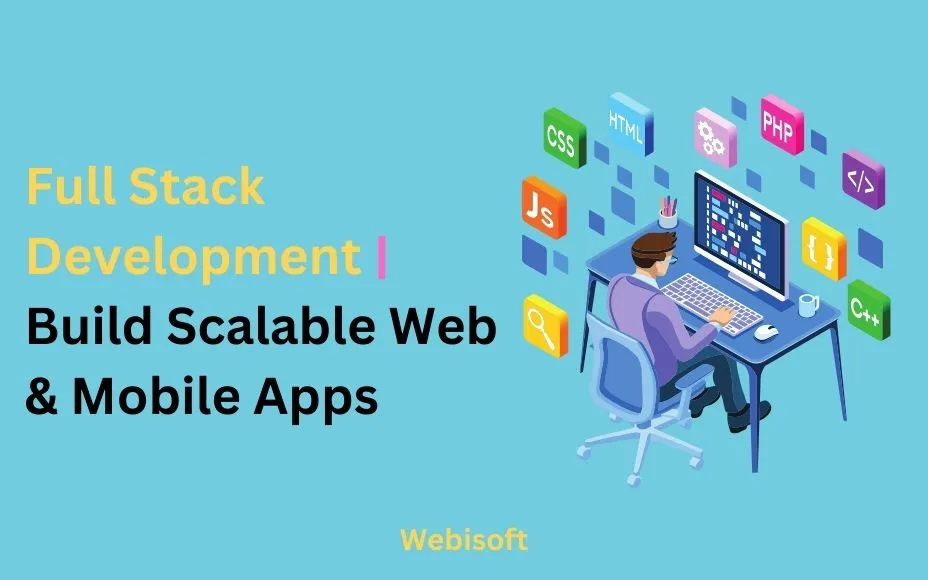
A full-stack developer handles both frontend and backend systems in a single project. This means they can own the entire technical flow from a user's browser (what they interact with) to the server and database (where data lives and logic runs). For organizations building custom software, this reduces dependencies across teams and simplifies communication.
Frontend and Backend: What Separates Them
Frontend is the user-facing layer: HTML, CSS, JavaScript. It runs in the browser and handles what users see and click on. Responsive design, form validation, and interactive elements live here.
Backend is the server-side logic: databases, APIs, business logic. When a user submits a form, the backend validates it, stores it, and returns a response. A full-stack developer needs to understand both layers and how data flows between them.
Core Technical Skills
Frontend technologies: HTML5, CSS3, JavaScript. Modern frameworks like React, Vue, or Angular help structure complex UIs. Understanding responsive design, accessibility (WCAG), and browser compatibility is essential.
Backend languages: Node.js/JavaScript, Python, PHP, Java, or Go. The choice depends on your project's scale and team expertise. Python excels at rapid iteration; Go handles high concurrency; Java works for large enterprise systems.
Databases: SQL (PostgreSQL, MySQL) or NoSQL (MongoDB, DynamoDB). Understand query optimization, indexing, and data modeling. Know when to normalize (SQL) and when to denormalize (NoSQL).
DevOps basics: Docker, Git version control, CI/CD pipelines. Deploying to AWS, Azure, or Google Cloud. Logging and monitoring systems in production.
Technology Stack Examples
MERN Stack
MongoDB (document database), Express.js (backend framework), React (UI library), Node.js (runtime). Allows one language (JavaScript) across the stack. Fast for teams comfortable with JavaScript.
Django + React
Python backend for rapid development and strong ORM (Django). React frontend for interactive UIs. Good separation of concerns and many libraries available for both.
Rails + React
Ruby on Rails provides scaffolding, built-in ORM, and convention-over-configuration. React handles the modern frontend. Strong for startups where speed to market matters.
Spring Boot + Vue
Java backend with enterprise-grade libraries. Vue frontend for simpler interactive features than React. Used when Java shops need to add modern frontends to existing systems.
Database Design and Persistence
Choose SQL if your data has clear relationships and you need ACID guarantees (consistent transactions). Use NoSQL for high-volume, unstructured, or rapidly evolving data schemas.
Understand indexing. A missing index on a frequently queried field turns a 10ms query into a 1000ms query. Profile before optimizing.
Know your cache layer. Redis caches hot data in memory; memcached does the same. This reduces database hits on frequently accessed data.
API Design and Integration
RESTful APIs follow HTTP conventions: GET for reading, POST for creating, PUT/PATCH for updating, DELETE for removing. Use proper HTTP status codes (200 OK, 400 Bad Request, 401 Unauthorized, 500 Server Error).
GraphQL is an alternative: clients request exactly the fields they need, reducing over-fetching. Trade-off: more complex to implement, harder to cache.
Authentication and authorization matter. Use JWT tokens for stateless authentication or sessions for stateful. Never send passwords in plain text. Validate and sanitize all input.
Deployment and Operations
Containerization (Docker) packages your code and dependencies. Orchestration (Kubernetes) runs and scales containers. Cloud platforms (AWS, Vercel, Heroku) handle infrastructure for you.
Monitor your application: uptime, response times, error rates, database performance. Set up alerts for anomalies. Log errors with context (user ID, request ID) for debugging.
Automate deployments. CI/CD pipelines run tests, build artifacts, and deploy on every commit. This catches bugs early and reduces manual errors.
Soft Skills
Communication across the stack is crucial. Frontend developers need to understand why a backend choice matters; backend developers need to know frontend constraints (latency, bundle size). Avoid building systems the other side can't integrate with.
Code review. Read others' code regularly. This exposes you to patterns and catches bugs before production.
Learn by building. Small projects, side projects, and contributions to open-source teach more than tutorials. Deploying something real teaches you what tutorials skip.
When to Hire a Full-Stack Developer
Small to mid-size projects where one developer needs to ship features end-to-end. Startups where rapid iteration matters more than specialized expertise. Legacy system maintenance where one person needs to understand the entire codebase.
Not ideal: massive systems with separate frontend and backend teams, or highly specialized domains (image processing, machine learning) where depth matters more than breadth.
Final Words
Full-stack development is not about being equally expert at everything. It's about understanding the entire system well enough to make tradeoffs, ship features, and debug across layers. Master one stack (MERN, Rails, Django) deeply, then learn others. The patterns transfer.
Full stack developers often use a combination of technologies such as HTML, CSS, and JavaScript (for front-end) and languages like Python, Ruby, and Node.js with databases like MongoDB or MySQL (for back-end).
Yes, by hiring a full stack developer, businesses can streamline processes and reduce costs since a single developer or team can handle the complete development cycle, eliminating the need for separate specialists.
Not necessarily. While they have knowledge across various technologies, many full stack developers possess deep expertise in specific areas while maintaining a competent understanding of the entire development process.
Full stack development involves handling both the front-end (user interface) and the back-end (server, database) of a web application, ensuring seamless functionality from start to finish.
While front-end developers focus on the visual aspects and user interactions, and back-end developers work on the server and database side, a full stack developer is skilled in managing both ends of the spectrum.