Custom AI development has moved from experiment to operating requirement. Companies that deploy models against their own data, their own workflows, and their own decision points get compounding returns: faster cycle times, fewer manual handoffs, and systems that improve as usage data accumulates. Off-the-shelf tools rarely get there, because most of the value sits in the integration layer, not in the model itself.
San Francisco concentrates more AI research talent, tooling, and venture-backed infrastructure than any other city. The right AI development company in San Francisco does more than write model code. It architects the data pipelines, evaluation loops, and deployment infrastructure that keep an intelligent system reliable once it is in production and under real load.
This guide covers eight firms serving the San Francisco market: what each one does well, where each one has trade-offs, and how to match a partner to your project instead of choosing on reputation alone.
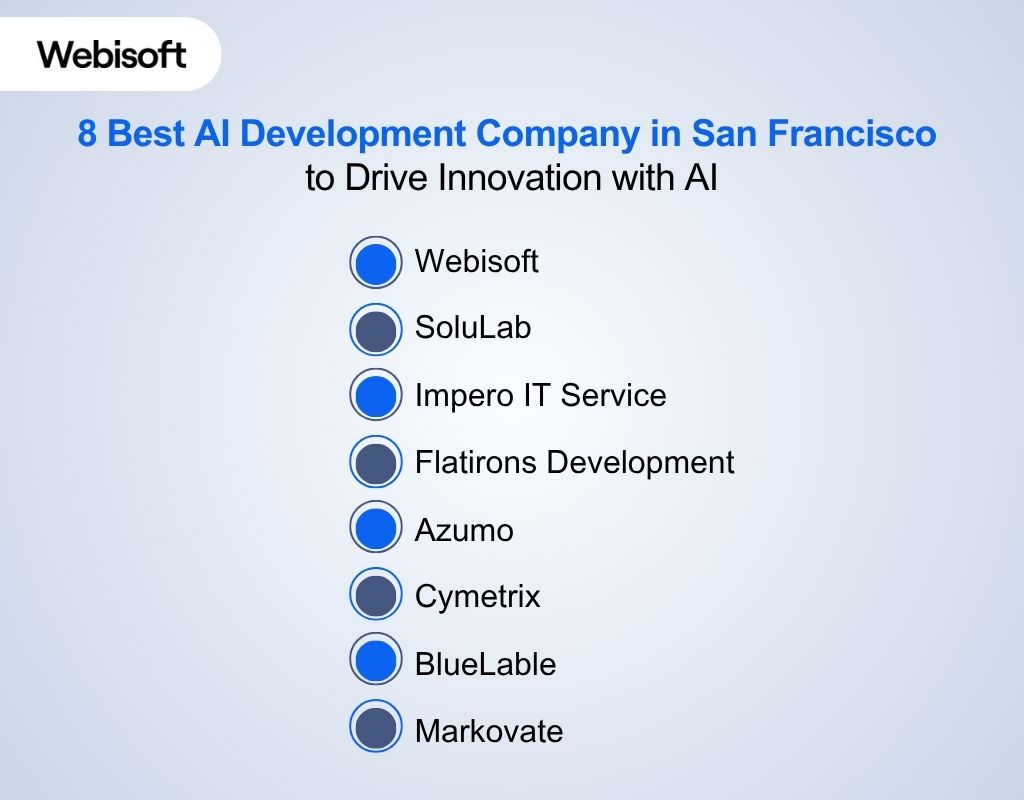
8 Best AI Development Companies in San Francisco to Drive Innovation with AI
1. Webisoft
- Company Name: Webisoft
- Founded: 2017
- Clutch Rating: 4.9
- Core Services: Advisory, Blockchain, Product Development, Enterprise Software, Artificial Intelligence (AI)
Webisoft is a Montreal-based, full-cycle software engineering firm that builds custom AI systems for clients across North America, including the San Francisco market. The team's focus is integration: connecting large language models to the systems where your data actually lives, rather than shipping a standalone chatbot that nobody uses.
Typical engagements include LLM and GPT integration for internal tooling and customer-facing products, automated decision systems that act on live operational data, and document digitization through OCR that turns paper records into structured, searchable assets. Webisoft also builds Model Context Protocol (MCP) servers, which give an AI assistant controlled, auditable access to an organization's internal data sources and tools instead of relying on copy-paste context.
Projects run from initial prototype through production deployment, with the same engineering team owning architecture, evaluation, and scaling. See the broader landscape of AI services USA for how this model compares nationally.
Key Strengths
What sets Webisoft apart in AI development:
- Custom AI model integration built around each client's data and workflows
- Real-time decision systems that process high-volume operational data
- OCR pipelines for accurate document digitization at scale
- Model Context Protocol server development for secure internal-data access
- End-to-end delivery from prototype to production, with one accountable team
The firm is a strong fit for both startups validating an AI concept and mid-sized companies scaling a proven one. Its AI expertise covers early experiments and full production deployment under the same roof.
2. SoluLab
- Company Name: SoluLab
- Founded: 2014
- Clutch Rating: 4.9
- Core Services: Blockchain, AI & ML, Generative AI, Software Development, IoT, Tokens, Smart Contracts, Cryptocurrency, NFT, Web3, DeFi, Metaverse
SoluLab works across a wide model portfolio, integrating GPT-family models, DALL·E, Stable Diffusion, and Whisper into client applications. The team builds chatbots, predictive analytics systems, and computer vision solutions, with most of its casework in healthcare, finance, and e-commerce.
On the engineering side, SoluLab develops custom machine learning models and NLP applications using TensorFlow, PyTorch, and Keras. Its delivery process includes structured model evaluation before launch and continuous monitoring after deployment, which matters because model performance degrades silently as real-world data drifts away from the training distribution.
Key Strengths
SoluLab stands out with capabilities that match specific AI needs:
- Broad multi-model experience across text, image, and speech
- Structured data preparation, including normalization and augmentation
- Cross-validation testing with accuracy, precision, and F1 score metrics
- Real-world validation and bias identification testing before release
- Feedback collection loops for continuous model improvement
Consideration
SoluLab operates multiple global offices, which can create coordination overhead for projects that need frequent in-person collaboration. Expect time zone gaps to affect real-time communication during critical development phases.
3. Impero IT Services
- Company Name: Impero IT Services
- Founded: 2011
- Clutch Rating: 4.7
- Core Services: AI Web Development, Software Development, Mobile App Development, iOS App Development, Ecommerce App Development, Full Stack Development, Application Modernization
Impero IT Services differentiates on explainable AI (XAI). Instead of black-box models, the team builds glass-box systems that expose how a prediction was reached, which is a hard requirement in regulated industries like finance and healthcare where a model's output must survive an audit.
The firm also specializes in on-device and edge AI processing, which keeps sensitive data local rather than routing it through cloud inference endpoints. Its compliance practice covers California AI regulation, CCPA obligations, and bias mitigation audits from project kickoff rather than as a pre-launch afterthought.
Key Strengths
Impero IT Services delivers capabilities that match compliance-sensitive projects:
- Transparent cost breakdowns with defined pricing tiers
- MLOps tooling for model drift tracking and performance monitoring
- Ethical AI governance frameworks with user opt-out policies
- AR/VR convergence work for immersive retail and training applications
- Offices across the USA, UK, Switzerland, Oman, India, and Ireland
Consideration
Impero IT Services operates from Westmont, Illinois rather than from San Francisco itself. Plan for virtual meetings rather than same-day, in-person sessions during urgent project phases.
4. Flatirons Development
- Company Name: Flatirons Development
- Founded: 2018
- Clutch Rating: 5.0
- Core Services: Artificial Intelligence, Web Development, Mobile Development, Software Support
Flatirons Development focuses on HIPAA-compliant AI work, which makes it a practical shortlist candidate for healthcare products. The team builds healthcare data analytics platforms, AI-powered diagnostic applications, and telehealth systems with EHR integration, and it offers rapid prototyping so stakeholders can evaluate an AI concept before committing to full development.
Its stack centers on GPT and OpenAI APIs, Python, Node.js, and Next.js, deployed on AWS, Google Cloud, and Azure. Flatirons pays particular attention to deployment for real-time inference, where latency and cost per request decide whether a model is usable in production. Client work spans fintech, healthcare, and real estate.
Key Strengths
Flatirons Development delivers capabilities that match most product builds:
- Staff augmentation and project outsourcing engagement models
- End-to-end service from AI strategy through deployment and maintenance
- Senior teams with long average tenure per engineer
- API and back-end architecture designed for scale from day one
- Data visualization dashboards that make model output actionable
Consideration
Flatirons serves multiple cities nationwide, which dilutes its San Francisco-specific focus. Expect generalized delivery patterns rather than an approach tuned to Bay Area industry dynamics.
5. Azumo
- Company Name: Azumo
- Founded: 2016
- Clutch Rating: 4.9
- Core Services: Software Staffing, Dedicated Teams, Project Management, Virtual CTO, Artificial Intelligence, Data Engineering, AI Chatbots, Cloud Services, Custom Software Development
Azumo pairs SOC 2 certified AI development with nearshore delivery from Latin America, so teams work in U.S. time zones at lower blended rates than Bay Area staffing. Its portfolio includes custom machine learning implementations, generative AI voice assistants, and semantic search systems, with named clients including Meta and Discovery Channel.
What distinguishes Azumo operationally is team composition: engagements come with VP Engineering and CTO-level oversight plus project management, rather than individual freelancers. Pre-kickoff technical reviews align architecture and tooling decisions before any code is written, which is where most AI project rework originates.
Key Strengths
Azumo stands out with capabilities that accelerate delivery timelines:
- Daily standups and weekly sprint reviews with proactive management
- Bench strength protocol, with backup engineers already familiar with your application
- Multi-framework expertise across Anthropic, LangChain, PyTorch, and TensorFlow
- Virtual CTO consulting available across all delivery models
- Full-stack teams including QA engineers, data analysts, and DevOps specialists
Consideration
Azumo's delivery model is built on Latin American nearshore talent. Time zone alignment and English proficiency are strong, but expect a short adjustment period on communication style for hands-on collaborative work.
If you want to avoid those coordination trade-offs entirely and keep one accountable team through the full AI app development cycle, contact Webisoft for scoping and execution.
6. Cymetrix
- Company Name: Cymetrix
- Founded: 2016
- Clutch Rating: 4.9
- Core Services: Artificial Intelligence, Data Analytics, Marketing Automation
Cymetrix approaches AI/ML consulting business-first: the engagement starts from an operational problem and works backward to the model, rather than starting from a technology and searching for a use case. Its solutions span predictive analytics, NLP, and reinforcement learning systems.
The firm has a notable Salesforce specialization, building Agentforce AI agents that handle real-time customer interactions across channels inside the Salesforce ecosystem. Delivery includes continuous model monitoring and MLOps pipelines, so deployed models get retrained as data shifts instead of quietly decaying.
Key Strengths
Cymetrix delivers capabilities that match industry-specific requirements:
- AI readiness assessments with tailored implementation roadmaps
- Computer vision and OCR technology development
- Reinforcement learning for self-adaptive automation systems
- Hyperparameter optimization for model performance tuning
- Sector depth in pharma, healthcare, manufacturing, and fintech
Consideration
Cymetrix runs development teams in India and the UK alongside its U.S. presence. Projects that need intensive onsite collaboration or immediate access to San Francisco-based engineers will face coordination overhead during critical deployment phases.
7. BlueLabel
- Company Name: BlueLabel
- Founded: 2009
- Clutch Rating: 4.7
- Core Services: AI Strategy Development, RAG AI Development, AI Agent Workflows, Conversational AI, AI Product Development, Data & LLM Engineering
BlueLabel has built products for over a decade and now concentrates on agentic AI: multi-agent systems, generative AI applications, and retrieval-augmented generation (RAG) pipelines that ground model output in a company's own documents instead of relying on what the model memorized in training.
Its SPRINT framework structures adoption around fast pilots and a strategic roadmap, so enterprises validate value on a narrow workflow before committing budget to a platform build. Services run from AI strategy design through data and LLM engineering.
Key Strengths
Known for structured delivery and rapid execution:
- SPRINT framework for fast, scoped AI pilots
- Expertise in agentic and RAG architectures
- Pilot-to-roadmap process focused on measurable ROI
- Strong enterprise client portfolio
- Human-centric design tied to measurable KPIs
- Deep data and LLM engineering capability
Consideration
BlueLabel's enterprise-scale focus may not suit startups looking for budget-friendly or smaller experimental AI projects.
8. Markovate
- Company Name: Markovate
- Founded: 2015
- Clutch Rating: 5.0
- Core Services: AI Blueprint Classifier, AI Voice Agents, Agentic AI Assistants
Markovate builds enterprise-ready AI solutions designed to slot into existing workflows rather than replace them. The team works across generative AI, agentic assistants, conversational AI, and computer vision, with most engagements in healthcare, insurance, and manufacturing.
Its delivery model starts with a proof of concept measured in weeks, not quarters, which lets stakeholders evaluate a working system against real data before funding a full build. Compliance coverage includes HIPAA, GDPR, and SOC 2, and deployments are structured to avoid disrupting ongoing operations.
Key Strengths
Focused on business-aligned AI with a documented delivery process:
- Four-to-six week proof of concept model
- Generative and agentic AI expertise
- Full-stack AI delivery pipeline
- HIPAA, GDPR, and SOC 2 compliance
- Documented cross-industry case studies
- Strong integration with enterprise workflows
Consideration
Markovate's focus on large-scale, compliance-heavy projects means smaller businesses may find the engagement scope broader than what they immediately need.
How to Choose the Best AI Development Company in San Francisco?
San Francisco leads the world in AI innovation. The city hosts engineers and researchers from OpenAI, Anthropic, Scale AI, and Databricks, which keeps the local talent pool unusually deep in both research and production engineering.
The stakes of the choice are rising with the market: the global AI market was valued at roughly $638 billion in 2024 and is projected to grow to $3.68 trillion by 2034. Choosing the right AI consulting services partner determines whether that growth works for you or for your competitors. Evaluate candidates on four dimensions:
- Technical depth: Look for teams that can explain when to use RAG versus fine-tuning, how they evaluate model output before launch, and how they handle drift after it. Vague answers here predict expensive rework later.
- Proven case studies: Ask for outcomes in your industry, and for the failure modes they hit along the way. A partner who can describe what went wrong on past projects is more credible than one who only shows highlight reels.
- Compliance and security standards: Prioritize partners fluent in HIPAA, GDPR, and SOC 2 practices where they apply to you, plus data-handling specifics: where training data lives, who can access it, and what leaves your environment during inference.
- Customization and post-deployment support: A strong partner tailors the system to your workflows rather than reselling a generic template, and stays engaged for monitoring, retraining, and optimization. AI systems are not fire-and-forget; budget for the operating phase, not just the build.
Two more questions worth asking before signing: who owns the model weights, prompts, and pipeline code at the end of the engagement, and what happens to your data if you switch vendors. The answers separate partners from landlords.
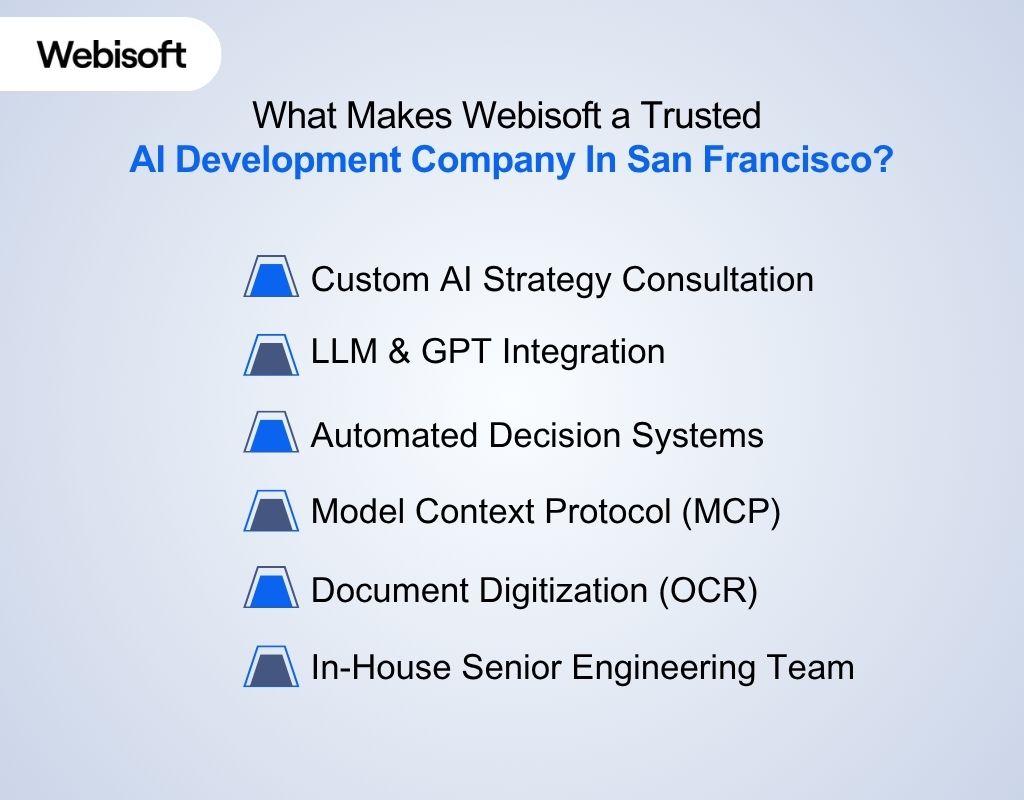
What Makes Webisoft a Trusted AI Development Company in San Francisco?
Most businesses struggle to turn complex data into decisions. Legacy systems slow the work down, and disconnected tools force people to shuttle information between them by hand. Webisoft builds context-aware AI systems that adapt to your operations instead of forcing your operations to adapt to the software.
The work centers on simplifying workflows, digitizing information, and automating decisions without disrupting the structure you already run on. Here is what that looks like in practice:
- Custom AI strategy consultation: AI roadmaps designed around your business model and operational goals, so each project has a measurable target before development starts.
- LLM and GPT integration: Language models wired into your automation, customer engagement, and data interpretation workflows, with evaluation in place before launch.
- Automated decision systems: AI engines that process real-time data and improve accuracy and speed across business functions.
- Model Context Protocol (MCP): MCP servers give AI systems secure, controlled access to your internal data and tools, which improves answer quality without exposing raw databases.
- Document digitization (OCR): OCR pipelines that eliminate manual data entry by converting physical records into searchable, actionable digital assets.
- In-house senior engineering team: No outsourcing layers. The engineers who scope the project build it, which keeps communication direct and quality consistent.
Final Thoughts
The AI development company you choose in San Francisco shapes your competitive position for years. The eight firms above all ship production systems, but they optimize for different things: compliance, nearshore economics, Salesforce depth, agentic architectures, or full-cycle ownership.
Match the partner to the problem. If your priority is a custom system built around your data and workflows by one accountable engineering team, from first prototype to production, contact Webisoft to scope the project.
Cost depends on scope more than location. A narrow proof of concept, such as a RAG assistant over one document set, sits at the low end; a production system with custom model work, integrations, and compliance requirements costs several times more. Most reputable firms scope a paid discovery phase first so the build estimate is grounded in your actual data and infrastructure rather than a template.
Local presence matters less than process. AI development work is delivered through repositories, staging environments, and sprint reviews, all of which work remotely. What actually predicts success is a partner with a structured evaluation process, clear data-handling practices, and senior engineers on your project. Several firms on this list, including Webisoft, serve San Francisco clients from other cities without friction.
A scoped proof of concept typically takes four to eight weeks. A production deployment, including data pipeline work, evaluation, security review, and integration with existing systems, usually runs three to six months. Timelines stretch when source data is messy or fragmented, so an honest partner will assess data readiness before committing to dates.
Retrieval-augmented generation (RAG) feeds relevant documents to the model at query time, so answers stay current as your data changes and you can trace every response to a source. Fine-tuning retrains the model itself, which suits stable, specialized tasks like a fixed output format or domain-specific tone. Most business use cases start with RAG because it is cheaper to update and easier to audit; fine-tuning is added later if needed.
Ask how they evaluate model output before launch, how they detect and handle model drift after deployment, where your data lives during training and inference, and who owns the prompts, pipeline code, and model artifacts when the engagement ends. Weak answers on ownership and evaluation are the most reliable early warning signs.