Share


12 AI Automation Examples Transforming Business Operations

- BLOG
- Artificial Intelligence
- October 19, 2025
AI automation examples demonstrate how intelligent systems are transforming everyday business operations. From automating customer service responses to streamlining finance and HR processes, these real-world cases show how companies replace repetitive manual work with adaptive, data-driven solutions.
Each example highlights how artificial intelligence improves speed, accuracy, and scalability while reducing costs and human error. By learning from data and optimizing workflows, AI automation helps teams focus on strategy and innovation instead of routine tasks.
The following AI automation examples reveal how organizations in various industries are already using AI to enhance performance, improve decision-making, and achieve measurable growth through smarter, more efficient operations.
Contents
- 1 What is AI Automation?
- 2 Turn AI automation examples into results!
- 3 12 AI Automation Examples Maximizing Efficiency Across Industries
- 3.1 1. Customer Support Chatbots
- 3.2 2. AI Automation in Email Marketing
- 3.3 3. AI Sales Automation
- 3.4 4. Intelligent Document Processing
- 3.5 5. Finance Automation
- 3.6 6. Manufacturing Automation
- 3.7 7. AI for Human Resource Management
- 3.8 8. AI in Healthcare
- 3.9 9. Logistics and Supply Chain
- 3.10 10. AI-Driven Content Creation
- 3.11 11. Fraud Detection
- 3.12 12. AI for Sentiment Analysis
- 4 How Webisoft Can Help You Scale with Custom AI Automation
- 5 Turn AI automation examples into results!
- 6 Conclusion
- 7 Frequently Asked Questions
What is AI Automation?
AI automation combines machine learning and NLP to analyze data, recognize patterns, and make logical decisions autonomously. It handles repetitive tasks like data entry and complex processes like dynamic pricing and inventory management. Unlike traditional automation, following fixed rules, AI systems adapt and improve over time through learning.
Machine learning analyzes historical data to predict patterns while natural language processing understands human language. These systems learn from experience, adjusting their actions to deliver increasingly accurate and relevant results.


Turn AI automation examples into results!
Partner with Webisoft to transform operations.
12 AI Automation Examples Maximizing Efficiency Across Industries
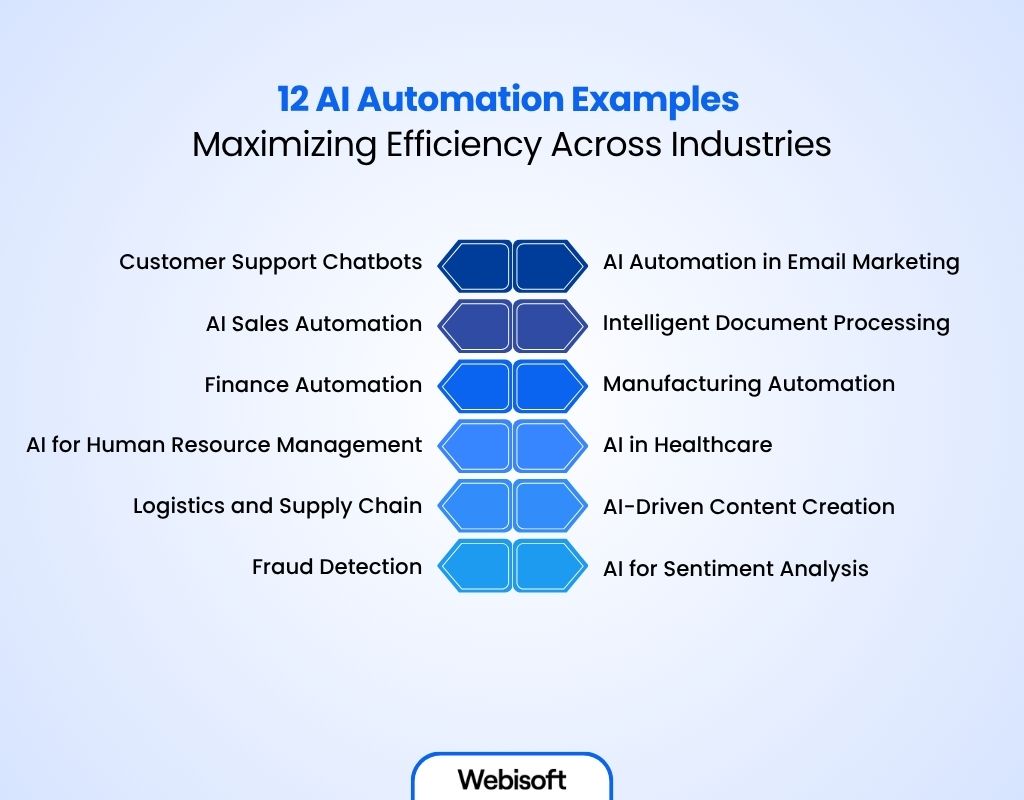 From finance to manufacturing, AI automation transforms how work gets done. Here are proven AI automation examples showing measurable efficiency gains across different industries.
1. Customer Support Chatbots
Your customers don’t wait for business hours, and neither should your support. AI chatbots transform customer service from a cost center into a competitive advantage. Powered by Natural Language Processing and Machine Learning, they don’t just follow scripts.
They understand context and get smarter with every conversation. One bot can handle thousands of interactions simultaneously, something a human team could never match. No hold times. No delays. Just instant, accurate responses 24/7/365.
It is crucial to meet the needs of global customers across different time zones. They can be integrated with your existing systems, such as CRM platforms, to personalize the customer experience even further. As the bot continues to learn from each interaction, it refines its accuracy, making future conversations more seamless and efficient.
Key Benefits:
- Efficiency: Automates routine customer queries, reducing response time and improving throughput.
- Cost-effective: Reduces the need for large support teams, driving down operational costs.
- 24/7 Availability: Ensures customers receive continuous support, enhancing service availability.
- Scalability: Can manage an increasing volume of inquiries without additional resources.
Real-World Example:
Zendesk’s Answer Bot integrates AI to handle common customer service inquiries. It reduces response times by 30% and frees up agents to address more complex issues.
2. AI Automation in Email Marketing
The world of email marketing is on the cusp of a revolution, and automation AI is leading the charge. With over 4 billion email users worldwide, businesses are turning to artificial intelligence to personalize and optimize their email campaigns.
AI uses technologies like machine learning (ML), predictive analytics, and natural language processing (NLP) to automate segmentation, optimize send times, and personalize content. As a result, companies are experiencing significant improvements in open rates, click-through rates (CTR), and conversion rates.
In fact, research shows that businesses using AI in email marketing see a 22% increase in open rates and a 32% boost in CTR. The global email marketing market is expected to reach $36.3 billion market value by 2033.
Key Benefits:
- Automated Segmentation: AI analyzes customer data to segment audiences based on behavior, preferences, and demographics, ensuring more precise targeting.
- Personalized Content: Customize emails to individual preferences, resulting in higher engagement.
- Efficiency: Reduces manual work and streamlines campaign management, saving time and resources.
Real-World Example:
Mailchimp utilizes AI to automate A/B testing and optimize send times. Businesses can increase engagement for their clients by ensuring emails reach the right people at the right time.
3. AI Sales Automation
Did you know that sales professionals spend just 37% of their time actually selling? The rest is spent on manual tasks, like data entry, scheduling meetings, and following up with leads. But here’s the good news: AI sales automation is changing the game.
By using AI-powered tools like lead scoring algorithms, automated email sequencing, and predictive sales analytics, AI helps sales teams eliminate the busywork and focus on closing deals. For example, AI can automatically rank leads based on their behavior and engagement.
By this, your team can prioritize the most promising prospects. With AI-powered CRM systems, sales teams can nurture leads, send personalized emails, and even predict which customers are most likely to convert. Research shows that AI-driven automation can boost lead conversion rates by 50% and reduce sales cycles by 40%.
Key Benefits:
- Automated lead scoring: AI analyzes customer behavior and ranks leads by their likelihood to convert.
- Faster, smarter follow-ups: AI automatically sends reminders, emails, and schedules meetings, ensuring no lead goes cold.
- Streamlined workflows: By eliminating time-consuming administrative tasks, sales reps can focus on closing deals and driving growth.
Real-World Example:
HubSpot’s AI-powered sales automation helps businesses automate lead qualification and outreach. It offers higher sales productivity by streamlining routine tasks. The time is now to implement these game-changing AI automation examples in your business.
4. Intelligent Document Processing
Are you tired of spending hours sorting through documents? AI-powered document automation can solve that problem by automating repetitive tasks like data entry, document sorting, and content extraction.
By using technologies like Optical Character Recognition (OCR) and Robotic Process Automation (RPA), AI can read documents, extract key data, and organize it without any manual intervention. This saves your team valuable time and cuts down on errors.
In fact, AI in document automation is set to grow from $1.51 billion in 2023 to $14.03 billion by 2032 as businesses seek faster, more accurate ways to handle paperwork. With AI, documents are processed 90% faster, and errors are dramatically reduced. source
Key Benefits:
- Faster processing: AI speeds up data extraction and document classification.
- Reduced errors: Automated systems ensure higher accuracy, preventing costly mistakes.
- Improved efficiency: AI sorts and routes documents to the right people automatically, saving time.
Real-World Example:
Kofax deployed AI to automate document workflows and cut review time by 75%. That’s three out of every four hours reclaimed from tedious manual processing. The automation handles what machines do best: scanning, categorizing, and validating documents at lightning speed.
5. Finance Automation
AI is rewriting the rules of finance and the numbers prove it. The AI-powered finance market is exploding from $1.4 billion in 2022 to a projected $248.53 billion by 2032. This isn’t hype. It’s finance teams worldwide ditching spreadsheets for intelligent automation.
What AI automation handles in finance? Invoice processing. Fraud detection. Cash flow forecasting. Payment validation. All the repetitive tasks that once consumed hours now happen in seconds. Machine learning algorithms analyze massive datasets, spot patterns humans miss, and predict trends before they become problems.
Real-time insights replace gut feelings. Data-driven decisions replace guesswork. Finance teams stop drowning in data entry and start driving strategy. Forecasts become more accurate. Risks get flagged instantly. And every automated workflow frees capacity for work that actually requires human judgment.
Key Benefits:
- Increased efficiency: Automates routine tasks, saving time for more valuable strategic work.
- Smarter decision-making: AI analyzes vast amounts of data and generates actionable insights to drive financial decisions.
- Cost savings: By reducing manual efforts, AI cuts operational costs, especially in high-volume tasks like invoice processing and fraud detection.
- Reduced human error: AI minimizes mistakes in critical processes, ensuring accurate data for better outcomes.
- Improved risk management: AI identifies financial risks in real-time, helping businesses mitigate losses before they occur.
- Faster financial forecasting: AI allows companies to predict future cash flow and market trends with high accuracy, aiding in proactive decision-making.
Real-World Example:
Take JPMorgan Chase’s COIN platform, for example. It cut legal document analysis from 360,000 hours a year to just seconds. Tools like Kofax are also streamlining invoice processing, reducing errors, and speeding up workflows.
6. Manufacturing Automation
Waiting for machines to break costs you money. In manufacturing, downtime equals lost revenue. AI automation flips the script from reactive repairs to proactive prevention. Computer vision catches what human eyes miss. AI-powered systems scan products in real time, detecting defects instantly.
No more quality issues slipping through. No more costly recalls. Just consistent, reliable output at production speed. Predictive maintenance stops problems before they start. Machine learning analyzes equipment data to forecast failure days or weeks in advance.
Maintenance happens during planned downtime, not mid-production. Efficiency stays high. Emergency repairs become rare. The competitive edge in manufacturing comes from working smarter, not harder. AI automation handles the monitoring, prediction, and precision while teams focus on optimization and innovation.
Key Benefits:
- Faster production: AI optimizes workflows, reducing bottlenecks and accelerating output.
- Higher quality: Automated quality checks identify defects early, ensuring top-tier products.
- Reduced downtime: Predictive maintenance detects issues before they cause problems, improving machine lifespan.
- Cost savings: By automating repetitive tasks and reducing human error, AI helps manufacturers save money in production.
- Better inventory management: AI optimizes inventory levels, helping prevent overstocking or shortages.
- Improved safety: By automating dangerous tasks and monitoring for safety issues, AI helps create a safer work environment.
Real-World Example:
Siemens uses AI-powered computer vision systems on their assembly lines to detect defects in products during production. This system ensures that quality checks are done in real-time, improving product consistency and speeding up the inspection process.
7. AI for Human Resource Management
Human resources (HR) is a cornerstone of every business, but let’s be honest. It’s also time-consuming. Are your HR teams bogged down by repetitive tasks? What if AI could take care of the mundane tasks, freeing your HR professionals to focus on what really matters? With AI-powered HR automation, you can streamline recruitment, onboard employees faster, and even personalize training for each new hire.
AI tools also help improve employee retention by analyzing feedback and predicting turnover, allowing HR to address concerns before they escalate. This isn’t just about saving time; it’s about transforming HR into a more efficient and proactive function.
Key Benefits:
- Faster recruitment: Automate resume screening and initial assessments, so your HR team can focus on high-priority tasks.
- Smarter onboarding: AI helps new hires get up to speed quickly, personalizing the learning experience based on individual needs.
- Improved employee retention: AI analyzes feedback and predicts turnover, enabling you to address issues proactively.
- Efficient performance management: AI helps monitor employee progress and spot areas for improvement, leading to better employee engagement.
Real-World Example:
Unilever is already using AI to optimize recruitment. Their AI tools scan resumes, identify top candidates, and assist HR teams with more strategic hiring decisions. By reducing the time spent on initial screenings, HR can invest more time in interviewing and final selections.
If you want to take your HR processes to the next level, take advantage of our AI-powered services today. Webisoft expert team guides you to transform the way your team recruits, engages, and retains top talent.
8. AI in Healthcare
Healthcare is evolving rapidly, and AI automation is playing a key role in this transformation. Think of your team not spending hours manually sifting through patient records or waiting on test results. AI systems can analyze patient data, such as medical histories, test results, and imaging, helping doctors identify conditions that might otherwise go unnoticed.
For example, AI can read X-rays or MRI scans with incredible precision, detecting signs of illnesses like cancer or heart disease long before they become critical. AI isn’t just about improving diagnoses. It also takes the load off administrative tasks. Appointment scheduling, medical record management, and billing are all streamlined by AI.
Key Benefits:
- Improved diagnostics: AI identifies patterns in patient data, helping detect conditions early and with greater accuracy.
- Time savings: Automates administrative tasks, freeing up more time for patient care.
- Better decision-making: AI aids clinicians by analyzing complex patient data and providing tailored treatment recommendations.
- Continuous improvement: Machine learning models learn from past data, improving future predictions and outcomes.
- Personalized care: AI helps develop treatment plans based on individual patient data, ensuring better care.
Real-World Example:
Cleveland Clinic uses ambient AI technology to streamline clinical documentation. The AI listens to patient consultations, automatically generating detailed medical notes, which doctors can review and approve before adding them to patient records.
9. Logistics and Supply Chain
Remember how supply chain collapses disrupted everything from businesses to daily life? AI automation ensures that panic never happens again. While competitors react to disruptions, automated systems help you adapt in real time. Warehouse robots work smarter, not harder.
AGVs and AMRs optimize routes, manage inventory flow, and operate 24/7 without breaks. Manual bottlenecks disappear. See problems before they hit. AI analyzes your supply chain patterns to predict disruptions. It demands spikes, supplier delays, and inventory gaps, early enough to act.
Forecasting gets sharper. Costs drop. Track everything, everywhere. IoT sensors give you real-time visibility across shipments and equipment. Delays get caught immediately. Breakdowns trigger alerts before causing shutdowns. You get a supply chain that bends without breaking when chaos hits.
Key Benefits:
- Improved operational efficiency: Automating routine tasks increases speed and reduces errors.
- Cost reduction: AI-driven tools optimize inventory management and reduce stock imbalances.
- Increased safety: Automation reduces manual handling, lowering workplace injuries.
- Predictive insights: AI helps forecast disruptions and optimize resources, improving decision-making.
- Real-time visibility: IoT and digital twins enhance monitoring and tracking across the supply chain.
Real-World Example:
DP World implemented AI-powered predictive analytics within its CARGOES system. It improves container handling and reduces unnecessary movements by 350,000 annually
10. AI-Driven Content Creation
Your content team is drowning in deadlines. These AI automation examples show what’s possible: Content demands never stop, like blog posts, social campaigns, email sequences, SEO optimization. The numbers back the shift: 35% of companies already use AI in their workflows, with another 42% actively exploring it.
AI handles keyword research, SEO optimization, and first-draft generation in minutes. Tools like Jasper and GPT-3 create blog content, while Smartwriter.ai personalizes email outreach with custom subject lines and product descriptions.
Just as Yahoo used AI to generate personalized fantasy football recaps in real-time back in 2013, modern teams now produce SEO-optimized content without expanding headcount. Grammarly ensures polished copy.
Moz and SEMrush handle research. Your team focuses on strategy and brand voice, the human elements machines can’t replicate. The shift turns content production from a bottleneck into a competitive advantage.
Key Benefits:
- Faster content production: Automates repetitive tasks like content research and writing, dramatically reducing time spent on each piece.
- SEO optimization: AI tools optimize content for search engines, ensuring it ranks well and attracts more organic traffic.
- Improved personalization: AI can personalize content for different audience segments, increasing engagement and conversions.
- Cost savings: By automating content creation, businesses reduce the need for large teams of content creators and editors, lowering operational costs.
Real-World Example:
Copy.ai is an AI-powered tool that automates content generation for businesses. It can create blog posts, email subject lines, product descriptions, and more, all in a matter of seconds. By utilizing Copy.ai, businesses can scale their content production without having to hire additional staff.
11. Fraud Detection
AI automation monitors transactions in real time, processing millions of data points to identify anomalies that human teams would take hours to catch. Machine learning algorithms analyze spending patterns, flag location mismatches, and detect account takeover attempts instantly.
When threats emerge, automated systems block suspicious transactions and trigger alerts, with no manual review delays. Your security team investigates only genuine risks while AI handles the noise. Businesses reduce fraud losses, maintain regulatory compliance, and scale security without expanding headcount. Protection happens at machine speed.
Key Benefits:
- Faster detection: AI analyzes transactions in real time to spot fraud as it happens.
- Proactive prevention: AI not only detects fraud but also predicts and prevents it before it occurs.
- Seamless customer experience: Automated actions like blocking suspicious transactions or notifying users help maintain security without disrupting user experience.
- Reduced fraud losses: AI reduces the impact of fraud by catching fraudulent activities early and blocking them.
- Regulatory compliance: AI systems log and audit all actions, ensuring compliance with security and fraud prevention regulations.
Real-World Example:
Mastercard uses its Decision Intelligence Platform to analyze user activity in real time. The AI-powered system flags unusual behavior, helping Mastercard spot and prevent fraudulent transactions much faster.
12. AI for Sentiment Analysis
AI is transforming how businesses understand their customers through sentiment analysis automation. With machine learning algorithms, AI analyzes vast amounts of data from social media, reviews, and surveys to instantly categorize feedback as positive, negative, or neutral.
This automated process allows businesses to quickly identify what customers like, dislike, or feel indifferent about, providing actionable insights to improve products and services. Whether it’s tracking real-time reactions to a product launch or monitoring ongoing brand perception, AI makes it possible to stay ahead of customer needs.
Key Benefits:
- Real-time insights: Automate the process of gathering and analyzing customer feedback in minutes.
- Proactive customer engagement: Quickly identify and address issues before they escalate.
- Enhanced decision-making: Tailor marketing, product development, and customer service based on current sentiment.
- Efficient resource allocation: Focus efforts on areas with the most significant impact, saving time and costs.
Real-World Example:
T-Mobile utilized sentiment analysis to identify customer pain points and improve service quality, reducing complaints by 73%. This allowed them to enhance their offerings and significantly boost customer satisfaction.
How Webisoft Can Help You Scale with Custom AI Automation
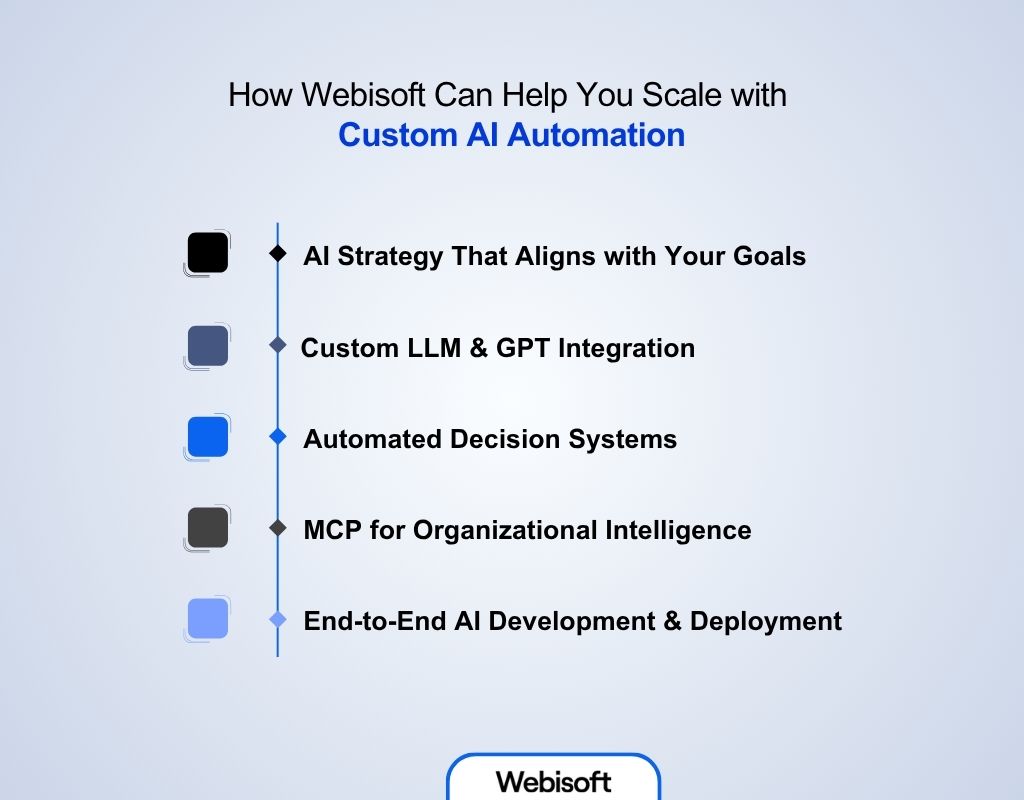 Generic AI tools break your workflows. Custom solutions take months you don’t have. Your competitors automate while you’re stuck choosing between bad options. Here’s how we make it happen:
1. AI Strategy That Aligns with Your Goals
We analyze your operations to identify high-impact automation opportunities. No generic playbooks. Just strategic roadmaps that connect AI capabilities to your specific business objectives and existing infrastructure.
2. Custom LLM & GPT Integration
We integrate advanced language models directly into your workflows. Like customer support, document processing, data analysis. Your teams get AI assistance that understands your industry terminology, brand voice, and operational context.
3. Automated Decision Systems That Work at Scale
Real-time data processing meets intelligent automation. We build systems that analyze massive datasets, flag anomalies, trigger actions, and provide insights, all without human intervention slowing things down.
4. MCP for Organizational Intelligence
Your company’s unique data becomes accessible to AI systems through custom MCP servers. Employees and users get contextual AI assistance powered by your proprietary knowledge, workflows, and business logic.
5. End-to-End AI Development & Deployment
From prototype to production, we handle the complete lifecycle. Robust development, seamless integration with existing systems, and continuous improvement ensure your AI solutions evolve with your business needs.
Turn AI automation examples into results!
Partner with Webisoft to transform operations.
Conclusion
All listed AI automation examples above solves problems you’re likely handling manually right now. The gap between automated businesses and manual operations grows wider each quarter. Webisoft closes that gap with custom AI solutions.
We build automation systems designed for your specific workflows, from strategy through deployment. All ensure seamless integration with existing infrastructure. Don’t wait for the perfect moment to automate. Partner with Webisoft to implement AI automation solutions that scale your efficiency today.
Frequently Asked Questions
How long does it take to implement AI automation in a business?
Simple integrations like chatbots deploy in weeks. Enterprise-wide systems require 3-6 months for strategy, integration, training, and optimization. Custom solutions take longer upfront but deliver better long-term results than off-the-shelf AI automation software.
What ROI can businesses expect from AI automation?
Companies typically see 20-40% cost reductions and 50-75% faster task completion. Financial services report 30-50% improvements in fraud detection. Manufacturing achieves 25-35% reductions in downtime through predictive maintenance.
Do businesses need specialized technical expertise to maintain AI automation systems?
Not necessarily. Well-designed systems require minimal internal technical maintenance. Complexity happens during initial setup. Businesses partner with AI development firms for implementation, then manage operations through user-friendly interfaces with periodic updates through managed services.
