Healthcare systems are running against hard constraints. The World Health Organization projects a shortfall of 10 million health workers by 2030, and the clinicians who remain spend a growing share of every shift on documentation, prior authorizations, and inbox management instead of patient care. AI agents for healthcare target exactly that gap: software that handles triage, clinical documentation, monitoring, and administrative workflows so clinical staff can spend their time on clinical work. This guide explains what these agents are, which capabilities actually matter, the main categories in production use today, and ten platforms worth evaluating in 2025.
What Are AI Agents for Healthcare?
An AI agent for healthcare is software that perceives its environment (patient messages, EHR data, device telemetry, clinical conversations), reasons about what it sees, and takes action toward a defined goal with limited human intervention. That is what separates an agent from a static model. A diagnostic model returns a prediction when queried. An agent watches a data stream, decides when something matters, and acts: drafting a clinical note, routing a critical imaging finding to the on-call specialist, or escalating a deteriorating patient to the care team.
In practice, a healthcare agent combines several components: speech recognition or NLP to interpret unstructured input, a reasoning layer (increasingly a large language model constrained by clinical protocols), integration adapters that read and write EHR data through HL7 or FHIR interfaces, and a human review loop. That last component is not optional. In regulated care settings, agents draft, flag, and recommend; licensed clinicians approve. The systems that survive contact with a real hospital are the ones designed around that boundary rather than trying to erase it.
Core Capabilities of Healthcare AI Agents
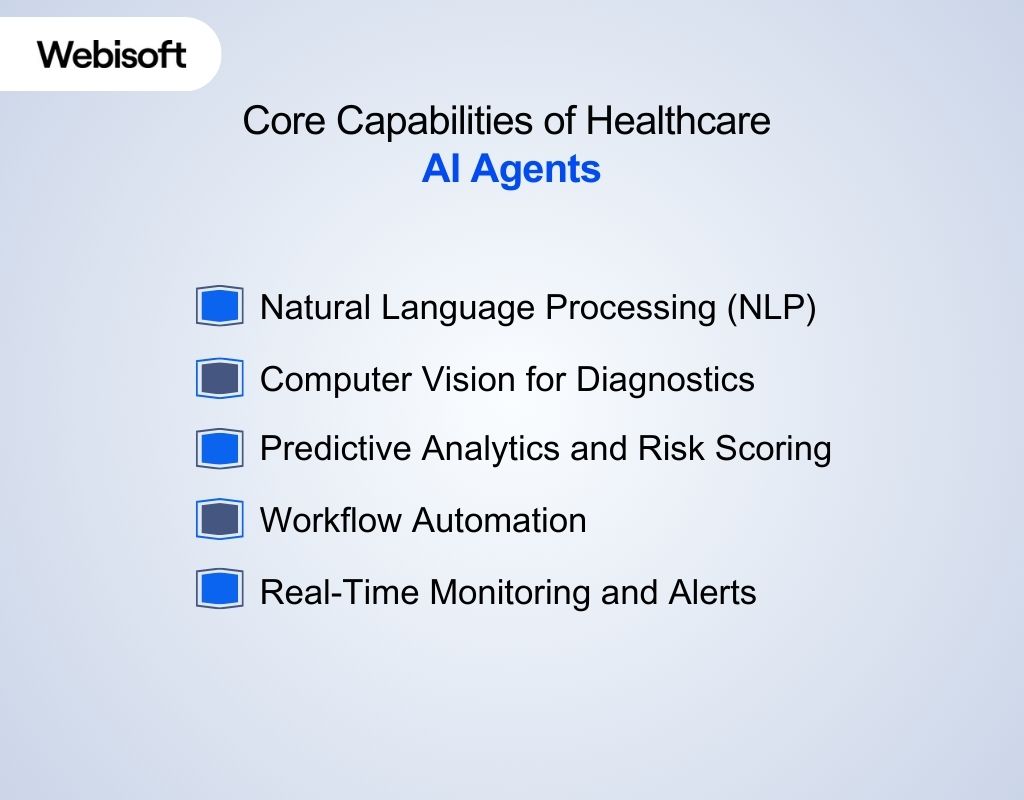
Capabilities vary widely between vendors. These five determine whether an agent produces measurable workflow gains or becomes one more login your staff ignores.
Natural Language Processing
NLP lets an agent read clinical notes, referral letters, and patient messages, then extract structured facts: diagnoses, medications, allergies, follow-up commitments. The hard part is not transcription but entity mapping, linking a phrase like "shortness of breath on exertion" to the right clinical concept and the right field in the chart. Mature systems map extracted entities to standard vocabularies such as SNOMED CT and ICD-10 so downstream systems can act on them, not just display them.
Computer Vision for Diagnostics
Imaging agents analyze CT, MRI, X-ray, and pathology slides to flag suspected findings such as intracranial hemorrhage or pulmonary embolism. In the United States these tools are regulated as medical devices and require FDA clearance, most commonly as triage aids that reprioritize the radiologist's worklist rather than render diagnoses on their own. The clinical value is speed: a critical finding surfaces in minutes instead of waiting its turn in a long reading queue.
Predictive Analytics and Risk Scoring
Risk-scoring agents combine patient history, lab results, and live vitals to estimate the probability of deterioration, readmission, or sepsis. The engineering challenge is calibration. A model that over-alerts trains staff to ignore it, and alarm fatigue is a documented patient-safety hazard in its own right. Good deployments tune thresholds per unit, suppress duplicate alerts, and attach context to every alert: what changed, and what to check.
Workflow Automation
Automation agents execute multi-step administrative processes end to end: eligibility checks, prior authorization packets, referral processing, claims status. Under the hood they combine API and HL7/FHIR integration with robotic process automation (RPA) for systems that expose no API. The trade-off to evaluate is brittleness. RPA-driven steps break when a payer portal changes its layout, so ask vendors how failures are detected, logged, and queued for human handling.
Real-Time Monitoring and Alerts
Monitoring agents consume device telemetry and EHR feeds continuously and alert when values cross thresholds or trends turn negative. Trend detection matters more than raw thresholds: a heart rate drifting upward over six hours can signal trouble while every individual reading is still technically in range. Escalation logic should reach the right clinician through the channels your teams already use, not another dashboard nobody opens.
Types of AI Agents Used in Healthcare
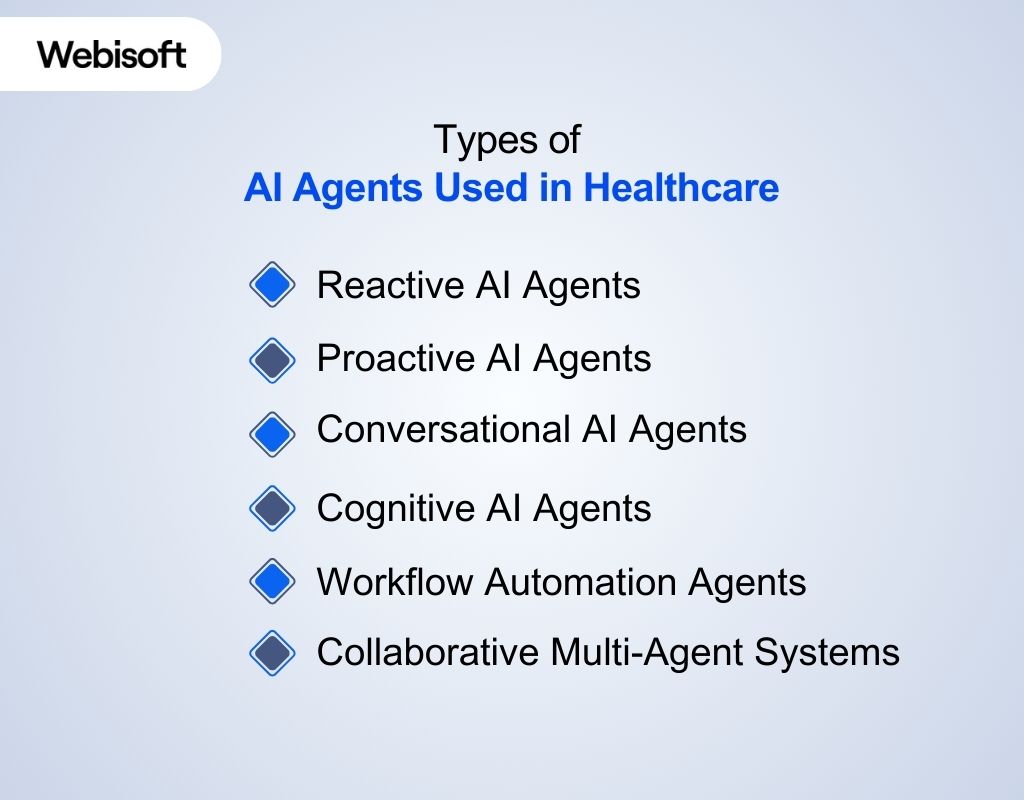
Different problems call for different agent architectures. Here are the main types of AI agents as they appear in healthcare, with examples that are actually in production.
Reactive AI Agents
Reactive agents respond to an input with no memory of past interactions. Symptom checkers are the canonical example: a user enters symptoms, the agent walks a decision tree or probabilistic model, and returns guidance on the appropriate level of care. They are cheap to run, straightforward to validate, and safe by construction because they act only when asked. Examples:
- Ada Health: a symptom-assessment app that returns a ranked list of likely causes and a care recommendation.
- Buoy Health: a web-based triage chatbot that routes patients to the right care setting based on reported symptoms.
Proactive AI Agents
Proactive agents monitor data streams and initiate action on their own. Instead of waiting for a query, they watch vitals, lab trends, or medication adherence signals and escalate when a pattern warrants attention. Remote patient monitoring and hospital-at-home programs are built on this pattern. Examples:
- Current Health: continuous home vitals monitoring with clinician alerts when a patient's condition deteriorates.
- Biofourmis: wearable-driven analytics that flag physiological decline before it becomes an emergency.
Conversational AI Agents
Conversational agents interact through voice or text. On the patient side they handle booking, pre-visit instructions, and health questions. On the clinician side, ambient documentation agents listen to the visit and draft the note, which has become the fastest-adopted agent category in medicine. Examples:
- Microsoft Dragon Copilot (formerly Nuance DAX): listens during appointments and drafts structured clinical notes.
- Sensely: an avatar-based assistant for symptom checks and care navigation.
Cognitive AI Agents
Cognitive agents support complex clinical decisions. They synthesize patient data, imaging, and medical literature to surface diagnostic suggestions, flag risks, or propose treatment options for clinician review. These carry the highest regulatory and validation burden, and the highest payoff when done well. Examples:
- Aidoc: flags critical findings in medical imaging, such as strokes and pulmonary embolisms, and reprioritizes radiology worklists.
- Google Med-PaLM 2: a medical large language model piloted for clinical question answering and documentation support.
Workflow Automation Agents
These agents take over repetitive administrative work: registration, coding, billing, prior authorization, referral processing. They run in the background across EHR and payer systems. This category also carries a lesson in vendor diligence: Olive AI, once one of the best-funded companies in the space, shut down in 2023. Evaluate financial durability alongside the product demo. Examples:
- Notable: automates intake, scheduling, authorizations, and referrals across EHR and payer systems.
- Qventus: applies AI to hospital operations such as OR scheduling and discharge planning.
Collaborative Multi-Agent Systems
Multi-agent systems assign specialized agents to different steps of a care process (intake, monitoring, documentation, discharge) and coordinate them through shared state. This is the architecture behind the more ambitious "digital workforce" platforms, and it typically requires full-stack AI product development: an orchestration layer, shared data contracts, per-agent evaluation, and audit logging. Examples:
- Qventus: coordinates multiple operational agents across patient flow, from admission through discharge planning.
- Hippocratic AI: builds constellations of task-specific patient-facing agents for follow-up calls, medication checks, and care coordination.
10 Best AI Agents for Healthcare
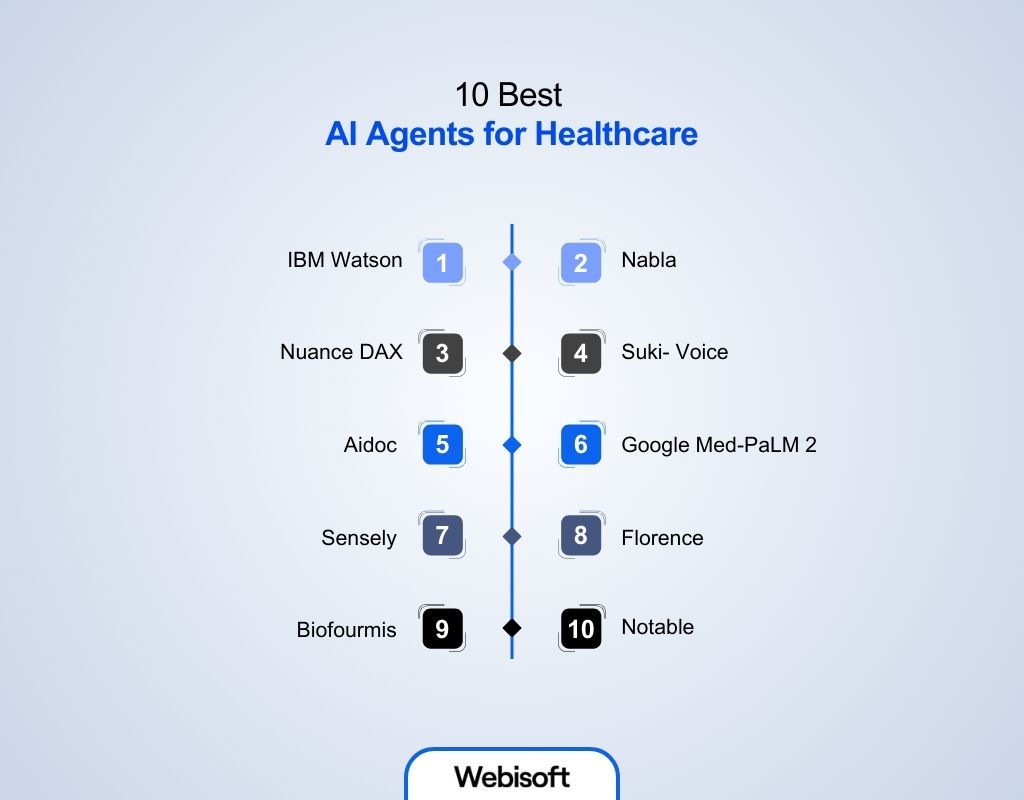
The platforms below cover the major agent categories: ambient documentation, imaging triage, patient engagement, remote monitoring, and administrative automation. For each, we note who it serves and what to weigh before committing.
1. IBM watsonx: Governed AI Assistants (For Health Systems)
IBM's healthcare AI story has changed shape. The original Watson Health division was sold in 2022 and now operates independently as Merative. What health systems deploy from IBM today is watsonx: a platform for building governed AI assistants and analytics on enterprise data. In healthcare it is used for patient-access chatbots, insurance and benefits Q&A, and internal knowledge assistants, with the governance tooling (access controls, model monitoring, audit trails) that regulated organizations require. It is a build platform rather than a turnkey clinical product, which makes it a fit for systems with in-house or partner engineering capacity.
Features:
Conversational Assistants for Patients and Staff
watsonx Assistant powers chatbots that handle appointment scheduling, insurance questions, and routine patient queries around the clock, reducing call-center load.
Enterprise Data Integration
Connectors link the platform to EHRs, CRMs, and data warehouses so assistants answer from your actual records rather than generic knowledge.
Model Governance and Auditability
watsonx.governance tracks which model produced which output, monitors for drift and bias, and maintains the audit trail compliance teams ask for.
Workflow Automation
Assistants can trigger downstream actions such as claim status checks, follow-up scheduling, and document routing instead of only answering questions.
2. Nabla: Ambient Clinical Notes (For Doctors)
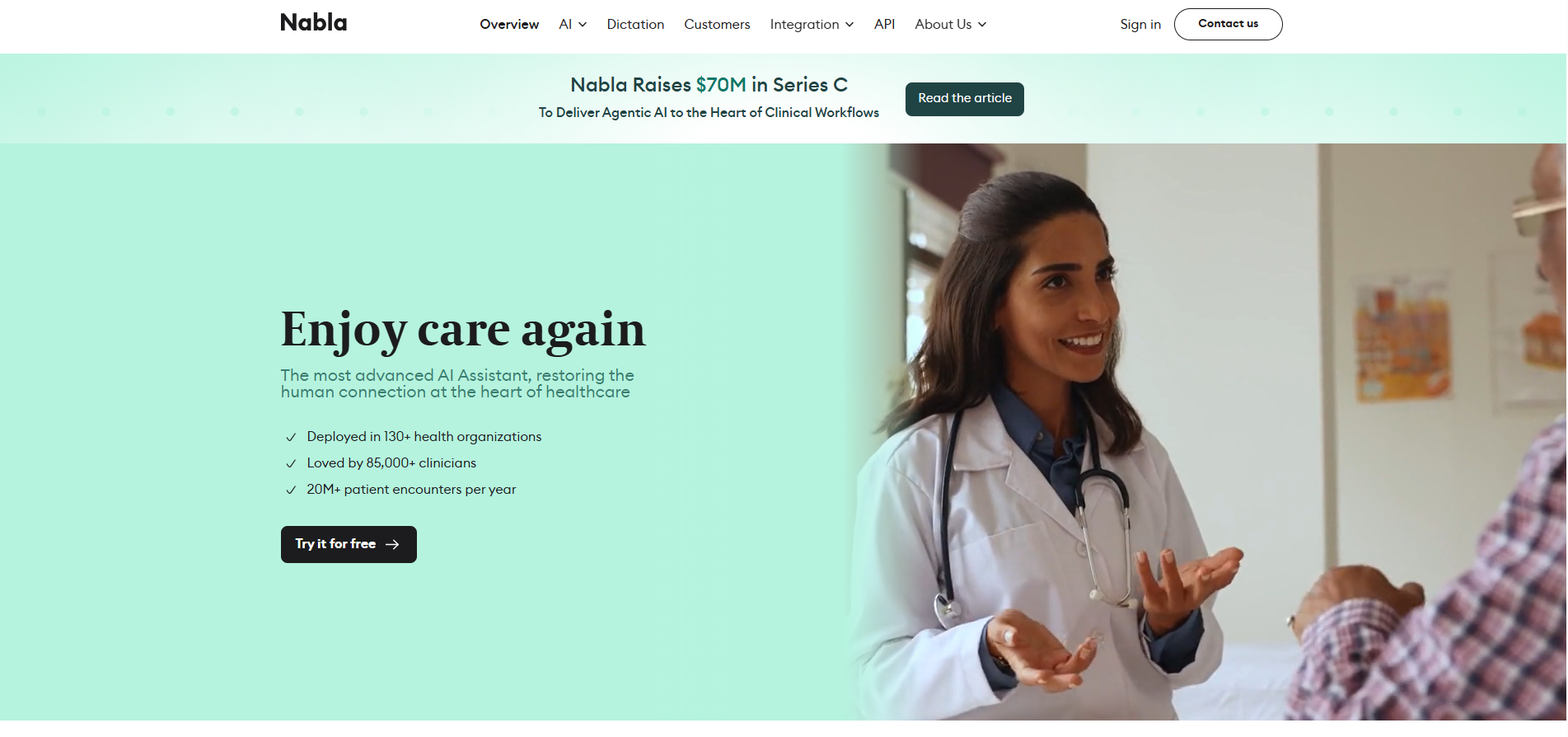
Nabla is an ambient AI assistant that captures the clinical conversation during a visit and turns it into a structured note within seconds of the encounter ending. The clinician reviews, edits, and signs; nothing enters the chart without approval. Nabla is deployed across a wide range of specialties and integrates with major EHR systems including Epic, Oracle Health (Cerner), athenahealth, and NextGen. Its architecture is notable for what it does not keep: audio is processed and discarded rather than stored, which simplifies the privacy conversation with compliance teams. The company operates under HIPAA with SOC 2 and ISO 27001 certifications.
Features:
Ambient Capture Without Prompting
Nabla listens to the natural flow of the conversation. There are no wake words or dictation conventions to learn, so it works on day one.
Medical Entity Structuring
Beyond transcription, it identifies symptoms, medications, and plans, then formats them into SOAP or narrative note structures ready for the chart.
Pre-Visit Context
The agent scans prior records and surfaces what matters before the visit starts, so the clinician walks in already oriented.
Background Compliance Checks
As notes are generated, Nabla checks completeness and billing relevance, reducing downstream audit and coding friction without adding clicks.
3. Microsoft Dragon Copilot (Nuance DAX): Ambient Charting at Scale (For Doctors)
Nuance DAX Copilot, folded into Microsoft's Dragon Copilot after the Nuance acquisition, is the incumbent in ambient clinical documentation. It listens during patient visits and produces structured notes, after-visit summaries, and referral letters, all subject to clinician review before signing. Built on Microsoft Azure and operated under HIPAA, it integrates with a large catalog of EHR systems, which matters most for multi-site health systems running heterogeneous environments. Its main advantages are specialty coverage and enterprise support; its main consideration is cost, so pilot it against measured documentation-time baselines before a system-wide rollout.
Features:
Specialty-Specific Language Understanding
The model is trained across specialties such as cardiology, orthopedics, and pediatrics, so terminology and workflow context are captured accurately rather than generically.
Context-Aware Summarization
Rather than transcribing word for word, it captures clinical meaning and intent, turning natural dialogue into a usable note instead of a raw transcript.
Adapts to Provider Style
The system learns whether you prefer narrative notes, bullet points, or SOAP format and adjusts output to match over time.
Voice Commands for Post-Visit Actions
Clinicians can order labs, schedule follow-ups, or send referrals by voice, completing care actions without leaving the room or the workflow.
4. Suki: Voice-Enabled Documentation (For Doctors)
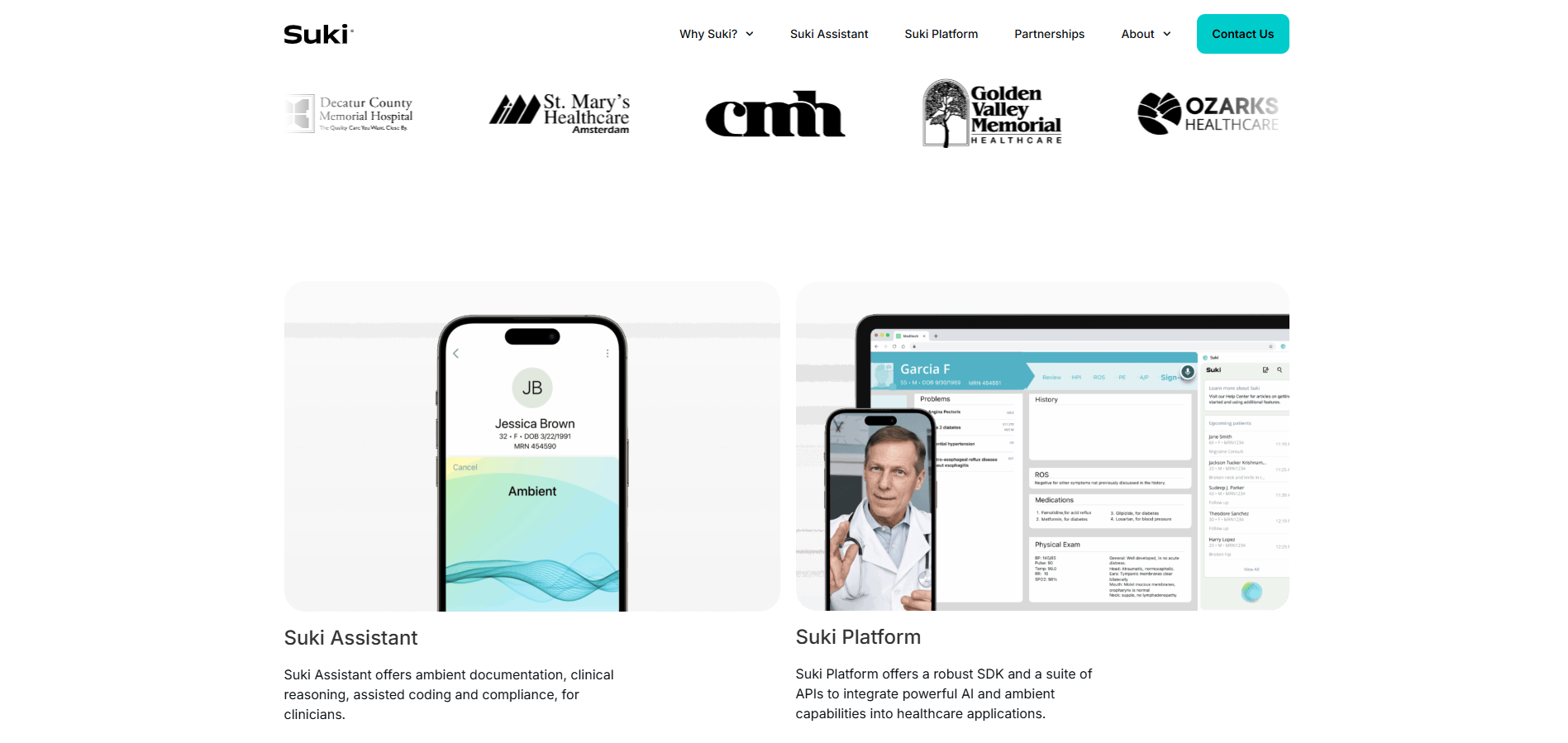
Suki Assistant is an AI voice assistant built around clinical documentation. It generates notes from ambient conversation or dictation, and adds a retrieval layer on top: clinicians can ask questions like "latest medications?" and get an immediate answer pulled from the record. It integrates with Epic, Oracle Health (Cerner), athenahealth, and MEDITECH so notes and orders flow into the EHR without copy-paste steps. Suki competes on price and flexibility against the larger ambient players, which makes it a common choice for independent practices and mid-size groups.
Features:
Cross-Device Access
Suki runs on desktop, mobile, and tablet, including inside the EHR interface, so clinicians can dictate or review notes in the exam room, on rounds, or remotely.
Custom Voice Commands
Personalized shortcuts such as "insert asthma plan" drop prewritten care instructions into the note, cutting repetitive typing.
Specialty Templates
Documentation templates adapt to cardiology, dermatology, orthopedics, and other fields rather than assuming primary care.
Usage Analytics
Reporting on time saved and feature use lets clinics measure impact instead of guessing whether the tool pays for itself.
5. Aidoc: Radiology and Emergency Triage (For Doctors and Nurses)
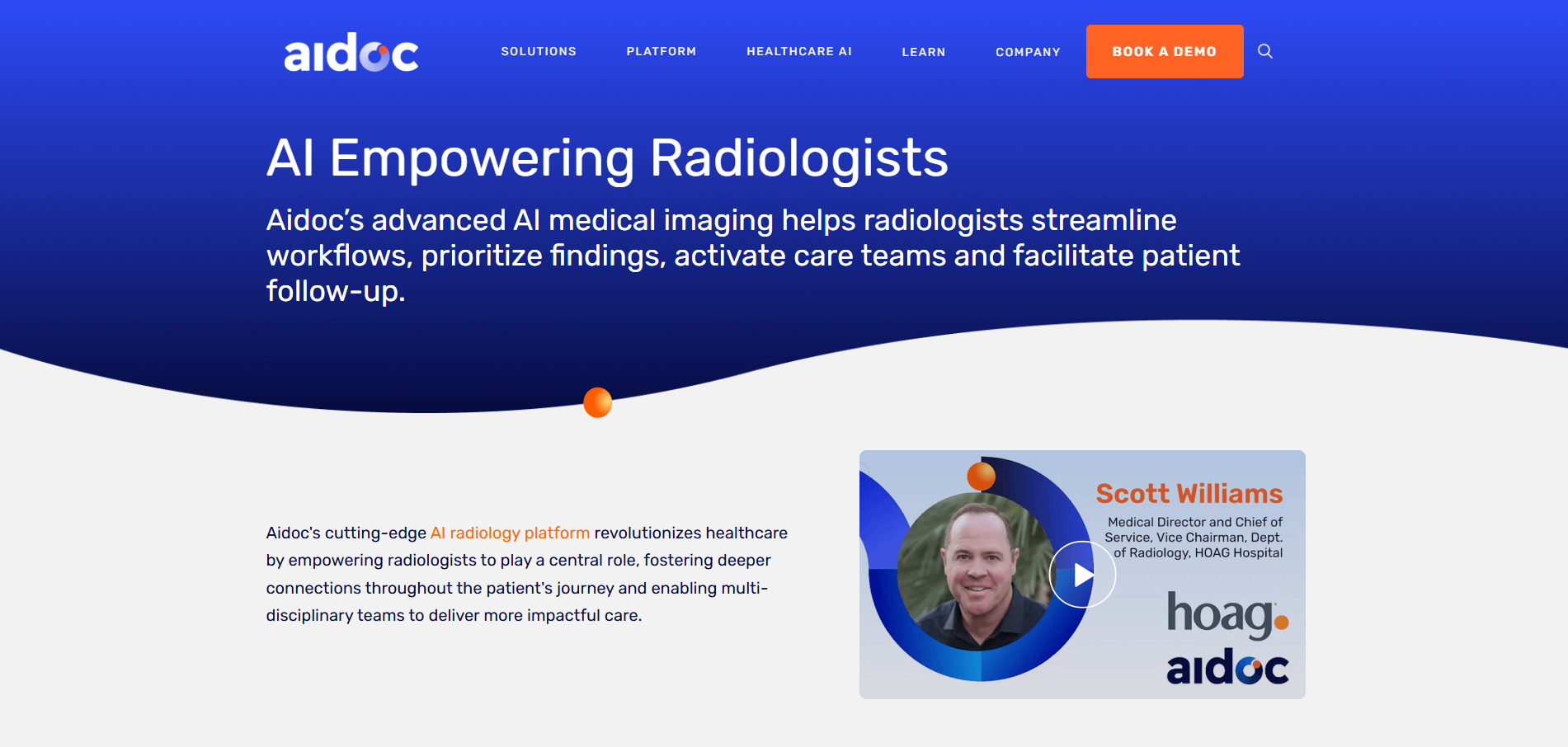
Aidoc is an imaging AI platform that analyzes CT, MRI, and X-ray studies in the background and flags suspected critical findings, such as intracranial hemorrhage or pulmonary embolism, the moment a scan lands. Flagged studies jump the reading queue and the relevant care team is notified, which compresses the time between scan and intervention. Built on its aiOS platform, Aidoc runs a portfolio of FDA-cleared algorithms and integrates with PACS and EHR systems. Its position is deliberately narrow and deep: it does not diagnose, it triages, and that regulatory posture is exactly why hospitals can deploy it.
Features:
Always-On Analysis Layer
aiOS runs continuously across imaging feeds, detecting and triaging findings without anyone needing to activate it per study.
Care Team Coordination
Critical findings route directly to the right specialists, cutting the delay between detection and treatment decision in stroke and PE pathways.
Condition-Specific Modules
Hospitals deploy modules matched to their case volume, such as stroke, pulmonary embolism, or brain bleed, rather than buying a monolith.
Performance Analytics
Alert-to-response times and workflow metrics show where the AI is changing outcomes and where adoption needs tuning.
6. Google Med-PaLM 2: Clinical Question Answering (For Doctors)
Med-PaLM 2 is Google's medical large language model, fine-tuned for healthcare terminology and clinical reasoning. It scored 86.5% on the MedQA benchmark of USMLE-style questions, a level competitive with expert human performance on that test. In practice it handles clinical Q&A, diagnosis reasoning, and documentation support, and is available in controlled access through Google Cloud rather than as a consumer product. The important caveat applies to every medical LLM: benchmark performance is not clinical validation, and deployments keep a clinician between model output and patient care.
Features:
Exam-Level Medical Reasoning
The model reasons through clinical prompts rather than retrieving facts, which is what makes it useful for differential-style questions.
Multimodal Direction
Google has been extending the Med-PaLM line toward image inputs such as X-rays alongside text, broadening what a single query can cover.
Fine-Tuning for Organizations
Through Google Cloud, health organizations can adapt the model to their own workflows, patient-education content, or specialty domains.
Safety Evaluation Framework
Built-in evaluation for bias, hallucination, and unsafe responses supports human review before any output reaches real-world care.
7. Sensely: Virtual Triage and Patient Navigation (For Patients)
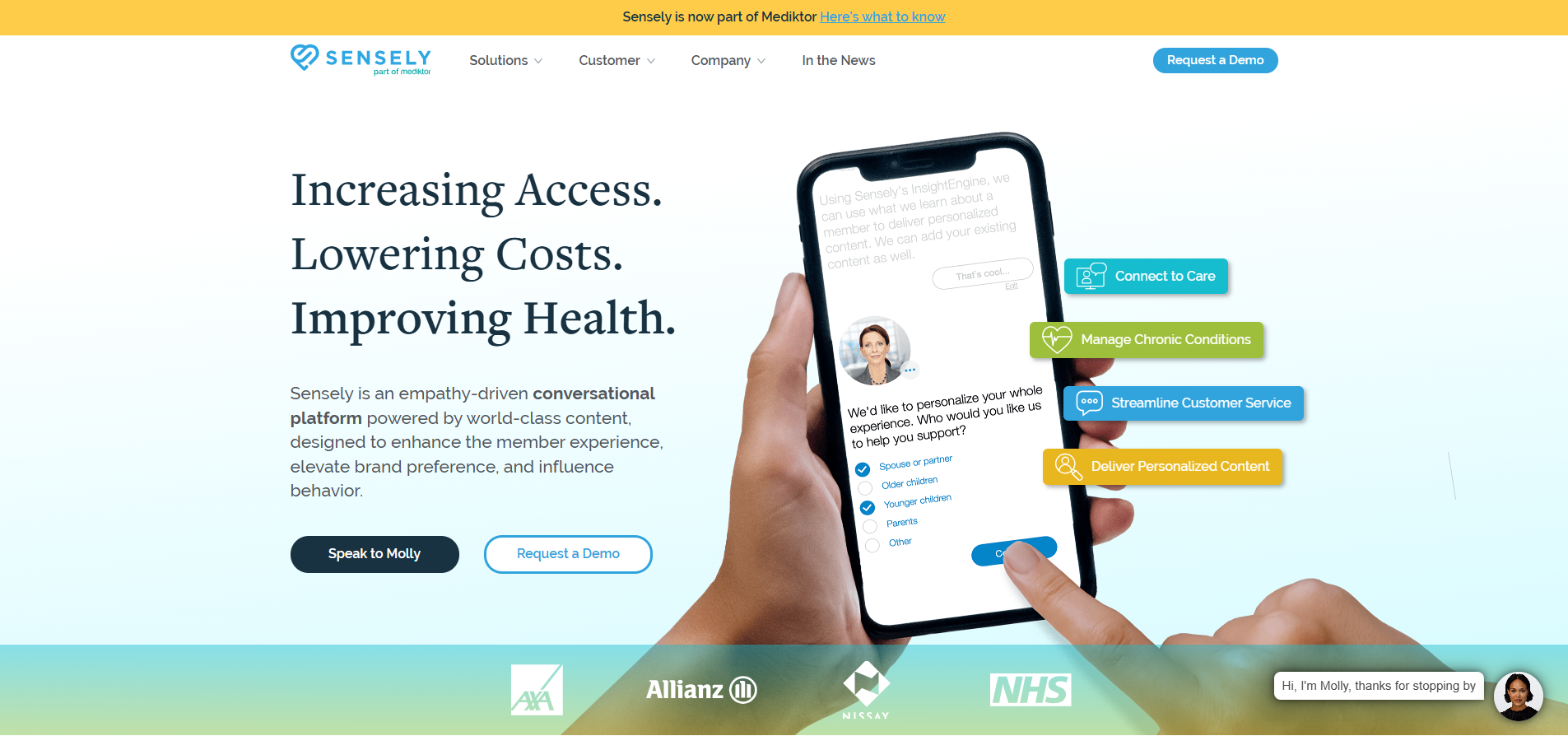
Sensely is a conversational AI platform fronted by an empathetic avatar ("Molly") that guides patients through symptom checks, care navigation, and chronic-condition check-ins. Assessments follow clinical protocols, and structured patient-reported data flows back to the EHR for clinician review, so the agent extends the care team's reach rather than operating in a silo. Its health content draws on established sources such as the Mayo Clinic and the NHS, and the platform supports multilingual interactions, which matters for systems serving diverse patient populations.
Features:
Multi-Platform Delivery
Sensely runs in mobile apps, web portals, and call-center integrations, meeting patients on whatever channel they already use.
Insurance and Benefits Navigation
Beyond clinical triage, it helps users check coverage, understand benefits, and find in-network providers, cutting administrative back-and-forth.
API Integration
Flexible APIs connect the assistant to EHRs, CRM tools, and remote monitoring platforms so conversations produce structured, usable data.
Regulatory Posture
The platform is designed around HIPAA and GDPR requirements, making it deployable in regulated environments across multiple countries.
8. Florence: Medication Reminders and Check-Ins (For Patients)
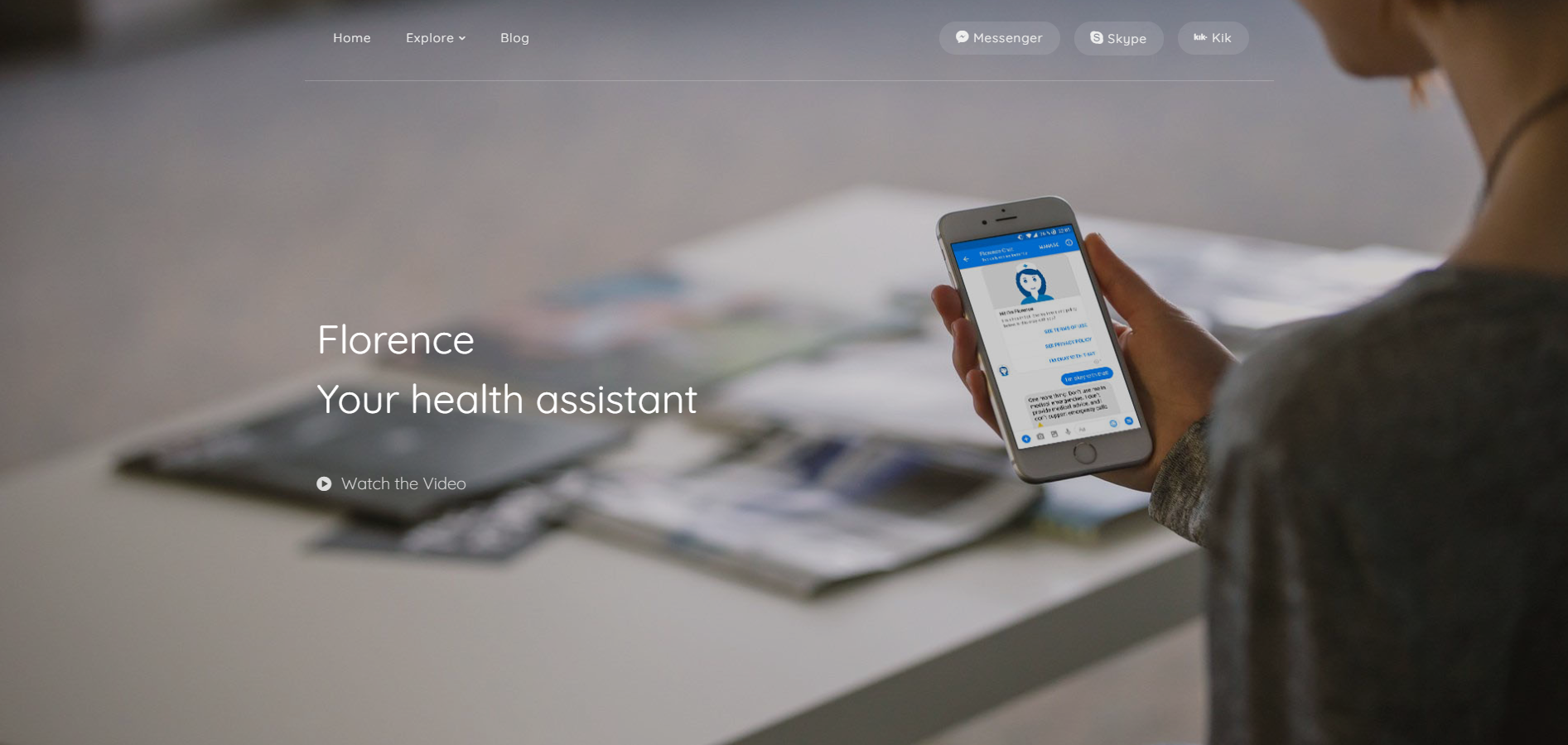
Florence ("Florence.chat") is a deliberately lightweight patient-facing agent that works over messaging channels patients already have: SMS, WhatsApp, and Facebook Messenger. It sends medication reminders, tracks self-reported measures like mood or weight, and delivers clinician-approved health education over time. Its design principle is worth copying even if you never use the product: no app install, low bandwidth requirements, and escalation to a human only when a patient's reports warrant it. That combination drives adherence in exactly the populations that complex portals fail to reach.
Features:
No App Required
Everything happens over standard messaging platforms, which removes the install barrier for older patients and low-tech-comfort users.
Behavior Change Nudges
Motivational-interviewing-style prompts support adherence around medication, diet, exercise, and smoking cessation.
Customizable Care Journeys
Care teams design automated plans with schedules, check-ins, and reminders matched to a condition or recovery stage.
Symptom Escalation Triggers
Worsening reports or missed check-ins trigger alerts to a care manager, keeping a human in the loop where it counts.
9. Biofourmis: Remote Monitoring and Risk Alerts (For Nurses)
Biofourmis extends monitoring beyond the hospital with wearable sensors feeding FDA-cleared predictive analytics. The platform tracks vitals such as heart rate and respiratory data, models each patient's physiological baseline, and alerts clinicians when the trend deviates, often before deterioration is obvious on any single reading. It underpins hospital-at-home programs and chronic-care pathways, consolidating device data into one dashboard for the clinical team. For nursing teams, the practical difference is alert quality: escalations arrive with trend context rather than as raw threshold breaches, which is what keeps alarm fatigue in check.
Features:
Predictive Clinical Insights
AI converts continuous vitals into risk forecasts for events like heart failure decompensation, giving teams time to intervene early.
Configurable Care Pathways
Preset algorithms plus patient-specific rules let teams manage chronic conditions and post-discharge follow-up across whole patient groups.
Multi-Device Connectivity
The platform ingests data from a range of wearables and Bluetooth sensors, collecting from patients' homes without disrupting routines.
Outcome Dashboards
Trajectory, readmission, and intervention-effectiveness views let programs measure clinical ROI instead of asserting it.
10. Notable: Administrative and Workflow Automation (For Nurses and Admins)
Notable automates the administrative machinery around care: patient intake, appointment scheduling, insurance authorizations, and referral processing. Its agents read and write across EHRs, payer platforms, and CRM systems using APIs, HL7, and RPA, and a low-code Flow Builder lets operations teams design or adjust workflows without engineering tickets. The governance layer matters as much as the automation: every flow is versioned and logged, so when an auditor asks why a prior authorization went out the way it did, there is an answer.
Features:
Low-Code Flow Builder
Clinical and operations staff assemble AI-powered workflows visually, taking automations like referral processing live in hours instead of quarters.
Pre-Built Agent Library
Out-of-the-box agents cover registration, scheduling, authorizations, and HCC chart review, and can be adapted to local workflows.
Deep Integrations
API, RPA, and HL7 connectivity lets agents read and write data across departments and external payer systems.
Governance Controls
Role-based access, change tracking, and full flow logging support enterprise-scale rollout with auditability built in.
How Webisoft Helps You Build AI Agents for Healthcare
Buying a platform solves a category problem. Most healthcare organizations also have workflow problems no vendor covers: a triage flow specific to their intake model, an internal knowledge assistant over their own protocols, an agent that bridges two systems that were never meant to talk. That is where Webisoft, a Montreal-based full-cycle software development firm, comes in.
Custom AI Agent Development
Webisoft builds healthcare AI agents customized to your workflows: chatbots, symptom checkers, documentation assistants, and monitoring agents that fit how your organization actually runs, instead of forcing your processes into a vendor's template.
Integration with Healthcare Systems
A new agent should not break your current setup. Webisoft integrates with EHRs, scheduling tools, and CRMs using the standards the industry runs on, HL7 and FHIR, so data flows between systems without manual re-entry and both staff and patients get a consistent experience.
Compliance and Security by Design
Healthcare AI lives or dies on trust. Webisoft builds with regulatory requirements such as HIPAA in scope from the architecture stage: role-based access, encryption in transit and at rest, and audit trails, designed in rather than bolted on, and structured to scale as your deployment grows.
End-to-End Product Development
Webisoft covers the full cycle: scoping, design, build, testing, and launch. The goal is not a model demo but a production system that clinicians will actually use, with the human review loops and failure handling that real care settings demand.
Real-Time Data and Predictive Capability
Where the use case justifies it, Webisoft builds agents that work on live data streams: predicting patient risk, spotting operational bottlenecks, and surfacing issues early enough that your team can act on them rather than report on them.
Final Thoughts
AI agents in healthcare have crossed from experiment to infrastructure, the same shift AI agents are driving in business broadly. The pattern across every successful deployment is consistent: the agent absorbs the repetitive work, the clinician keeps the judgment, and the integration and review loops are engineered, not assumed. Start with one measurable workflow, baseline it, pilot against that baseline, and expand on evidence. If you want to build AI agents matched to real healthcare workflows, contact Webisoft to scope a secure, compliant, production-grade build.
An AI agent in healthcare is software that monitors data such as patient messages, EHR records, or device telemetry, reasons about it, and takes action toward a clinical or administrative goal: drafting a note, flagging a critical scan, or escalating a deteriorating patient. Unlike a static model that only answers when queried, an agent acts on its own within defined limits, with clinicians reviewing and approving its output.
No. Production healthcare agents are built around a human review loop: they draft documentation, triage findings, and automate administrative steps, while licensed clinicians make the decisions and sign off. Their value is returning time to clinical staff, not substituting for them.
Through healthcare interoperability standards, primarily HL7 and FHIR APIs, supplemented by vendor-specific integrations for platforms like Epic and Oracle Health. Where a system exposes no API, robotic process automation fills the gap, though it is more brittle and needs failure monitoring.
Compliance depends on the deployment, not just the vendor. Serious platforms operate under HIPAA with business associate agreements, encryption, access controls, and audit logging, and many hold SOC 2 or ISO 27001 certifications. Verify how audio and patient data are stored, who can access them, and how long they are retained.
Cost is driven by scope: the number of workflows covered, the depth of EHR integration, regulatory requirements, and whether the agent needs real-time monitoring or fine-tuned models. A focused single-workflow agent is a much smaller build than a multi-agent platform. Baseline the workflow you want to improve, then scope the build against that measurable target.
Start where ROI is easiest to measure and clinical risk is lowest: ambient documentation or administrative automation. Both have short pilot cycles, clear time-saved metrics, and keep clinicians fully in control of decisions. Diagnostic and predictive agents come later, once integration and governance foundations are in place.