Imagine a digital assistant that doesn’t just respond to prompts, but plans your week, makes decisions, and improves the more you use it. That’s what a personalized AI agent is doing in 2025.
They learn your habits, connect to your tools, and work across apps to handle real tasks, without needing constant direction. Companies like Microsoft, Google, and Amazon are already rolling them into everyday products.
In this blog, we’ll break down what these agents can do, how they work, and why businesses are building them.
What Is a Personalized AI Agent?
A personalized AI agent is an intelligent software system designed to operate independently based on your specific goals, preferences, and workflows.
Unlike traditional AI assistants that require constant prompting, a personalized agent takes a single instruction and carries it forward, planning, deciding, and executing tasks on your behalf.
It learns from your behavior, adapts to your evolving needs, and integrates seamlessly with your existing tools. Such as CRMs, project management platforms, or communication apps.
Over time, it builds memory from past interactions, which allows it to improve performance and deliver increasingly accurate results with the help of a Beginner’s guide to AI agents .
You may also like: How do AI Agents Work: Everything You Need to Know
How Do Personalized AI Agents Work?
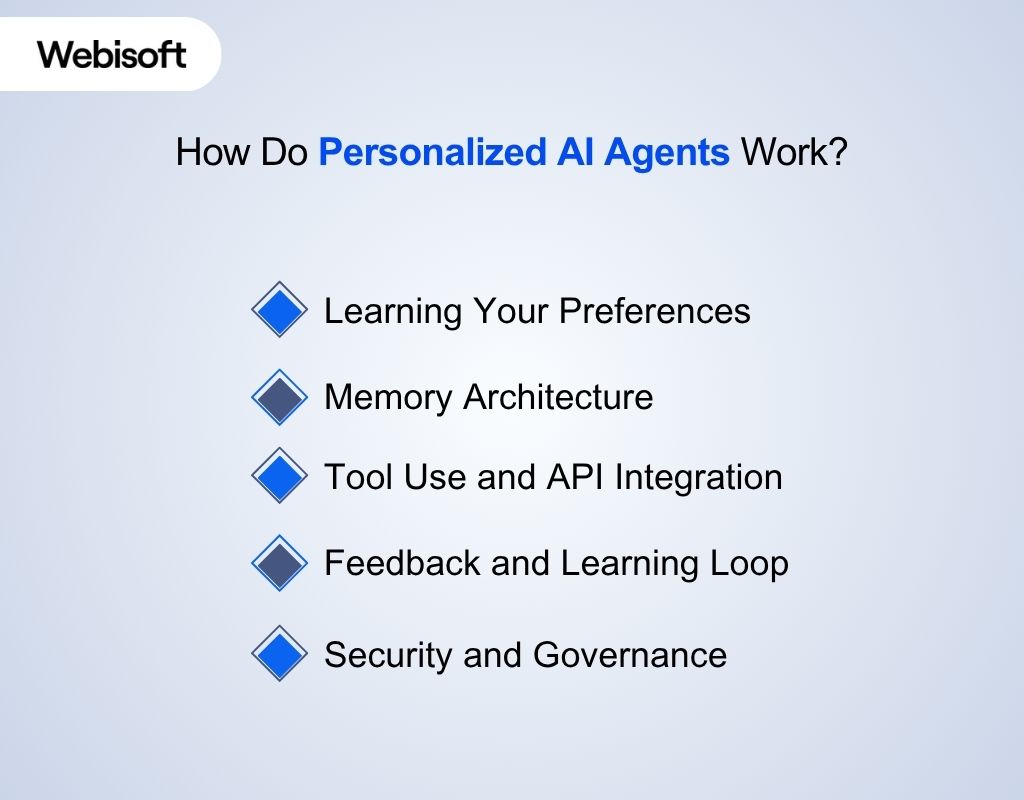
While they may feel seamless on the surface, personalized AI agents operate through a layered architecture built to think, remember, and act. They combine large language models with real-time memory, tool integration, and your data to deliver a fully autonomous experience, which represents the basics of AI development.
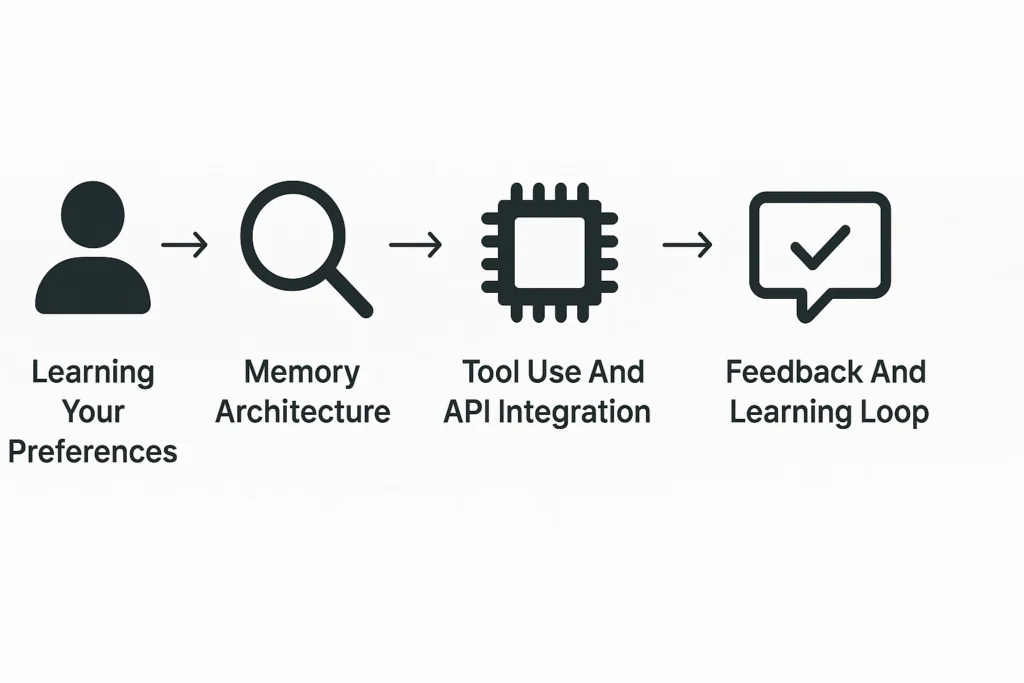
This is how personal AI agents work:
1. Learning Your Preferences
Personalized agents start by learning how you operate. They pick up on your writing tone, scheduling habits, and tool usage patterns by observing your day-to-day actions.
This learning can be bootstrapped with data from tools like:
- Google Calendar
- Slack
- Gmail
As they observe more interactions, they adjust their behavior and responses to suit your style, without needing constant input.
2. Memory Architecture
Unlike basic AI tools, personal agents use multi-level memory:
- Short-term: What you just discussed or did
- Mid-term: Recent projects or repeated workflows
- Long-term: User preferences, tone, goals, and contextual history
This memory is powered by vector databases like Pinecone, Weaviate, or Chroma, which store contextual embeddings for fast recall.
Agents often run on frameworks such as:
- LangGraph for building multi-agent workflows
- MemoryOS is designed to simulate structured memory
- PersonaAgent for personalized LLM behavior
This setup helps agents remember who you are, what you care about, and how you’ve interacted with them before.
3. Tool Use and API Integration
This is where agents really set themselves apart.
A modern personal AI agent doesn’t just talk, it acts. Using tools like LangChain’s Tool Use, it can execute commands and interact with:
- APIs (e.g., Stripe, Google Maps, OpenAI, or internal tools)
- CRMs (like HubSpot or Salesforce)
- Browsers (via Selenium or headless browser automation)
- Codebases, documents, or spreadsheets
For example:
- “Book a meeting” → The agent checks your calendar, finds open time slots, and schedules the invite
- “Summarize this document”. → It reads a PDF and sends a custom summary to your inbox
This functionality turns agents into operators, not just responders.
4. Feedback and Learning Loop
Personal agents don’t stay static. They learn what works by monitoring your reactions, what you approve, edit, or ignore.
This feedback loop allows them to refine decisions, communication tone, and task execution automatically. Over time, the agent becomes more accurate, more aligned, and more valuable.
5. Security and Governance
As agents gain deeper access to tools and data, governance becomes critical.
Enterprise-ready agents follow best practices like:
- Audit trails for all actions
- Scoped permissions for API and platform access
- Localized data processing (for on-device privacy)
Security principles from platforms like Coalfire and frameworks like NIST AI Risk Management help guide how these systems are built in high-trust environments.Whether deployed inside your stack or hosted on platforms like AWS Marketplace, agents can be governed according to your security and compliance needs.
At Webisoft, we help teams bring all of these layers together into real, working agents. If you’re ready to move from generic AI to personalized performance, let’s talk.
Why Businesses Are Building Their AI Agents?
Most off-the-shelf AI copilots, like ChatGPT, Gemini, or Claude, offer general-purpose support. They’re powerful, but they don’t know your business. They don’t speak in your tone, understand your workflows, or adapt to your goals over time.
That’s where personalized AI agent come in.
These agents are designed to align with how your business thinks and operates. They offer a level of context and autonomy that generic assistants simply can’t provide.
Here’s why more organizations are adopting them:
- They speak your language: Personalized agents communicate in your tone and use the terminology your team already knows.
- They understand your domain: Trained on your data, they grasp industry-specific needs, constraints, and workflows.
- They connect to your stack: Whether it’s your CRM, Slack, Notion, or internal APIs, these agents integrate where the work happens.
- They learn from usage patterns: Over time, they adapt to your team’s behavior and improve performance without manual updates.
- They deliver faster ROI: By combining automation with business-specific intelligence, they reduce busywork and enhance output quality.
Webisoft helps startups and enterprises build AI agents that fit their workflows, so they can scale productivity without sacrificing control.Similar Read: How to Build a Custom AI Agent: A Complete Guide in 2025
Industries That Use Personalized AI Agents
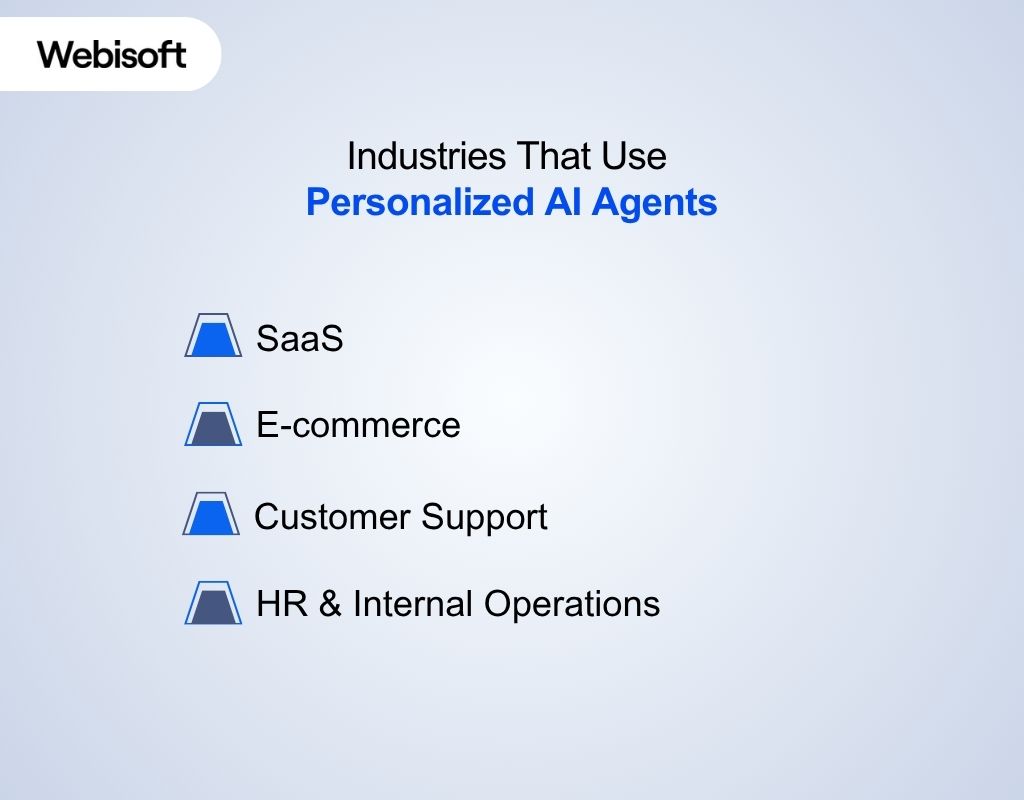
Personalized AI agent are quickly becoming essential across industries. These agents adapt to your business, learn from your data, and work within your tools. That makes them useful in ways that generic AI simply isn’t.
Here’s how different industries are using personalized AI agents to drive efficiency, reduce workload, and create better experiences:
SaaS
Product-led SaaS companies often struggle with user onboarding and support at scale. Personalized AI agent in Saas fill that gap. They’re trained on your documentation, support tickets, changelogs, and FAQs.
When a new user signs up, the agent can walk them through setup, answer product-specific questions, and even highlight features based on usage patterns.
E-commerce
Personalized AI agents in e-commerce act like digital sales associates. But smarter. They can recall past purchases, track browsing habits, and recommend products that actually make sense for each customer.
For example, if someone regularly shops for eco-friendly products, the agent can prioritize those in future interactions across chat, email, or even SMS.
Customer Support
Support teams are constantly flooded with repetitive tickets, shipping questions, login issues, and refund requests. A personalized AI agent can handle the majority of these without any human involvement.
These agents are trained specifically on your policies, tone, and escalation rules. That means responses are accurate, aligned with your brand, and context-aware.
You get faster resolution, fewer escalations, and happier customers without burning out your support team.
HR & Internal Operations
In fast-growing companies, internal processes often slow people down. HR and ops teams spend hours answering the same questions or managing simple requests.
With a personalized AI agent in Slack or Teams, employees can instantly ask about PTO balance, request time off, check holiday calendars, or get answers to policy questions.
We’ve built personalized AI agents like these. Let’s talk if you’re thinking about one for your team.
Benefits of Using Personal AI Agents in 2025
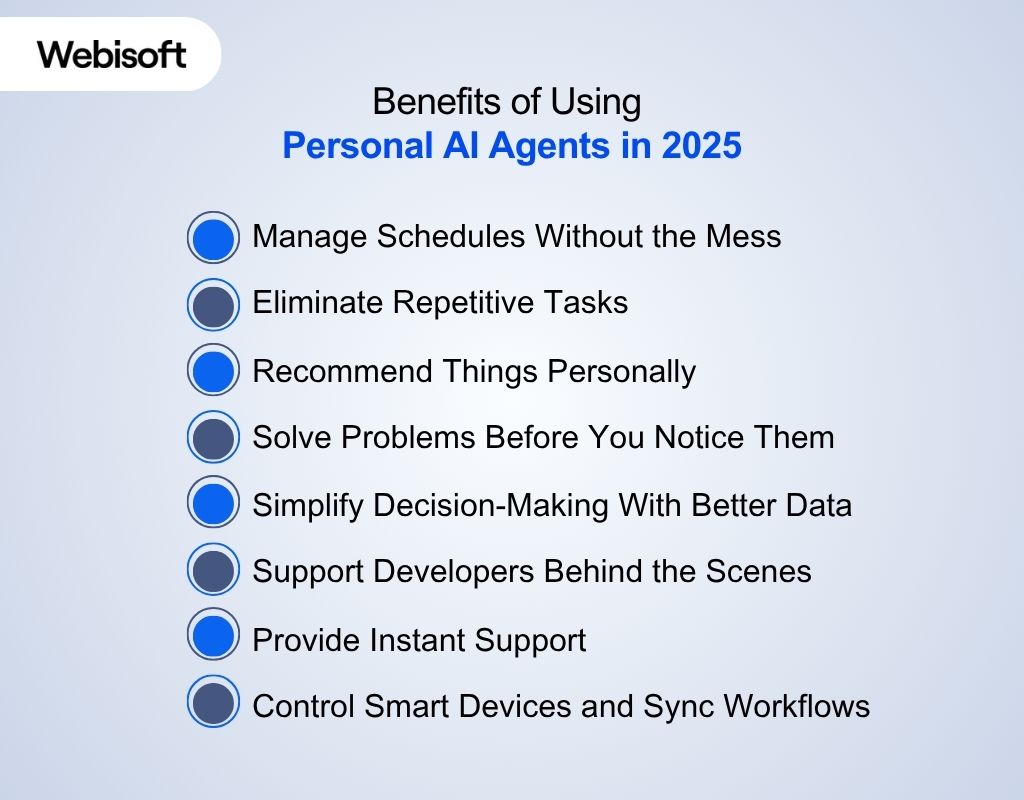
The personal AI agent space is no longer experimental. It’s here, and it’s already reshaping how people work, plan, and manage daily life. In 2025, businesses and users alike are relying on these agents to do more than automate.
Major tech companies have already made that shift part of their product roadmaps:
- Amazon’s Alexa+ relaunched as an autonomous agent capable of handling multi-step tasks, like planning an entire trip or running your home, without needing a string of prompts.
- Google’s Gemini 1.5 now includes context memory across sessions and media types, making it well-suited for continuous agent workflows.
- Honor introduced an on-device agent that can see what’s on your phone screen and act directly, without sending anything to the cloud.
- Microsoft’s Copilot Agents, integrated across Office, GitHub, and Windows, now manage behind-the-scenes tasks. These are summarizing meetings, generating documentation, and even refactoring code.
And it’s not just big tech. According to Deloitte, more than 25% of GenAI adopters are already piloting personal AI agents in 2025. Especially in HR, customer support, and developer workflows.
So what are the benefits of personalized AI agent?
Manage Schedules Without the Mess
Personal AI agents are now running calendars with almost no oversight. They resolve conflicts, account for time zones, and even build in breaks to avoid burnout. Some studies show that this kind of intelligent scheduling can free up nearly a month of work time per year.
Eliminate Repetitive Tasks
They handle the mindless stuff, email replies, data entry, and form fills. If you work in finance, they can extract invoice data and populate reports. In marketing or operations, they automate status updates and move projects forward without a nudge.
Recommend Things Personally
Because they understand your behavior and goals, personal AI agents now deliver tailored suggestions. It can be a product, a budget tool, or a travel itinerary. This isn’t just basic personalization. These systems continuously learn and refine recommendations as your preferences evolve.
Solve Problems Before You Notice Them
The best AI agents are proactive. If they detect overlapping meetings, they reschedule. If traffic is building on your usual route, they’ll suggest a better option. If a document is missing a signature, they’ll flag it before it becomes a blocker.
Simplify Decision-Making With Better Data
Decision fatigue is real. Agents now process large data sets, identify key patterns, and surface the most actionable insights, especially in areas like marketing, product, or finance. They help you focus on what matters instead of chasing details.
Support Developers Behind the Scenes
In software teams, personal AI agents are handling code reviews, helping with test coverage, suggesting improvements, and even writing documentation. Microsoft’s Copilot is already doing this across GitHub and Windows, and that’s just the beginning.
Provide Instant Support
Whether it’s customers asking product questions or employees checking their PTO policy, agents are handling 24/7 support. And because they’re trained on your internal data and policies, their responses feel accurate, fast, and human.
Control Smart Devices and Sync Workflows
From home thermostats to Slack notifications, these agents work across environments. They control smart home systems and integrate into enterprise stacks, pulling info from CRMs, databases, calendars, and messaging tools to create smooth, end-to-end workflows.
How Webisoft Builds Personalized AI Agents
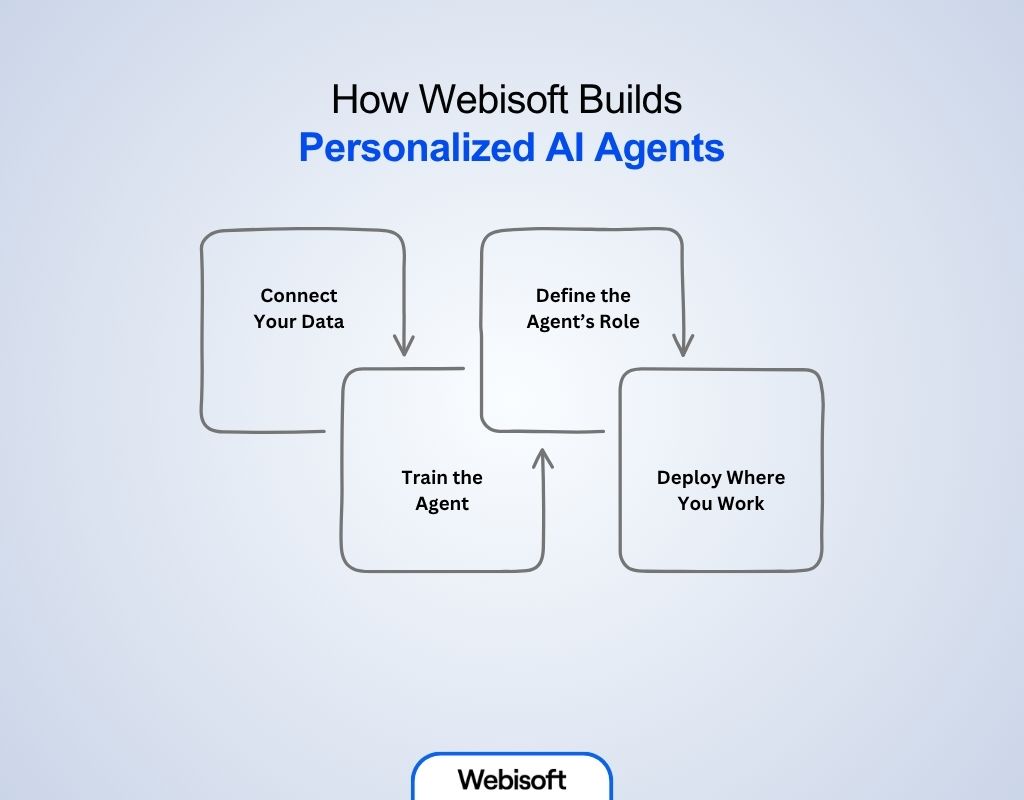
At Webisoft, we don’t build one-size-fits-all AI. We build personalized AI agents that understand your business, how it works, what matters, and where it’s wasting time.
Step 1: Connect Your Data
The first thing we do is connect your agent to your real data, across your CRM, database, product logs, or internal tools.
We use that to build a relational graph that mirrors how your business runs. Customers, actions, product usage, support tickets, all of it becomes part of the agent’s context.
This gives your agent structure and depth out of the gate. You don’t need to manually explain how everything connects. The system maps it automatically.
Step 2: Define the Agent’s Role
Not every agent needs to write content or answer customer questions. Some need to automate onboarding. Others need to triage internal tickets. We work with you to define precise goals, then translate those into measurable outcomes.
We don’t just ask “what do you want it to do?” We ask:
- What would this agent free your team from?
- Where are humans spending time that software could handle?
- What’s the fastest way to prove it works?
That clarity is how we avoid generic, aimless AI builds.
Step 3: Train the Agent
You don’t need to tune hyperparameters or mess with weights. We use neural architecture search to train the agent on your data and goals, automatically.
We work with frameworks like:
- LangGraph for multi-step workflows
- Vector DBs like Pinecone or Weaviate for persistent memory
- Private RAG pipelines to keep your data secure and searchable
- Custom APIs and tool-use layers for action-taking
Your agent doesn’t just learn, it acts. It reads documents, books meetings, pulls numbers, and talks in your tone.
Step 4: Deploy Where You Work
You pick the environment. We handle the build.
Whether that’s a Slack agent for your ops team, a support agent inside your product, or a browser extension that runs on top of your dashboard, your AI shows up where your team needs it.
We support cloud-native deployment via:
- Web apps
- Slack/Teams integrations
- Snowflake Native Apps
- Databricks Lakehouse deployments
- Private-hosted Docker containers for sensitive workflows
And yes, everything is fully permissioned, logged, and secure by default.
Want to build one that delivers value, not just cool demos? Talk to Webisoft. We’ll build it with you, end to end.
Conclusion
As more businesses adopt personalized AI agent, the focus must shift from novelty to strategy: building agents that align with real goals, use trusted data, and integrate into the tools people already use.
At Webisoft, we don’t build generic bots. We build agents that learn your systems, match your voice, and get work done. Ready to build yours? Let’s talk.
Frequently Asked Questions
Agents can connect to CRMs like Salesforce or HubSpot, messaging platforms like Slack or Teams, databases, APIs, and cloud tools like Snowflake or Databricks.
Yes, if built right. At Webisoft, we follow secure architecture practices, role-based access, audit logging, and data governance frameworks like NIST AI RMF to ensure your data stays protected.
A regular AI assistant responds to prompts. A personalized AI agent, on the other hand, learns your goals, remembers past interactions, and takes action independently, making it far more proactive and tailored to your workflow.
It learns from your behavior over time, how you communicate, when you work, and the tools you use. It can also be bootstrapped with existing data from tools like Google Calendar, Slack, or your CRM.
Yes. Businesses across SaaS, e-commerce, HR, and support already use these agents to manage workflows, automate tasks, and improve customer experience. Webisoft builds agents that integrate directly into your stack.
