Share


How do AI Agents Work: Everything You Need to Know

- BLOG
- Artificial Intelligence
- October 10, 2025
Today, machines don’t just follow orders, they can think and act like people. This happens because of AI agents, which are smart programs that learn and make choices by themselves.
But how do AI agents work? Simply, they watch what’s happening around them, understand information, and decide what to do next. They use ways like learning from data and following rules to get better over time.
However, this blog will break down how they work and what makes them smart and autonomous.
Contents
- 1 What is an AI Agent?
- 2 Types of AI Agents
- 3 How do AI agents work? Step by Step Guide
- 4 Build Smarter AI Agents with Webisoft Today!
- 5 Key Features of an AI Agent
- 6 Examples of AI Agents You’re (Probably) Already Using
- 7 Steps for Building AI Agents
- 8 Common Challenges and Solutions of using AI agents
- 9 Difference Between AI Agents, AI Assistants, and Bots
- 10 Benefits of Using AI Agents
- 11 Use Cases for AI Agents
- 12 How Webisoft Supports You in Building AI Agents
- 13 Conclusion
- 14 Frequently Asked Questions
What is an AI Agent?
An AI agent is a software entity that perceives its environment, processes information, and takes actions to reach a specific goal. In simple terms, it’s like a smart program that can look around, think, and do things on its own, often learning and improving over time.
Types of AI Agents
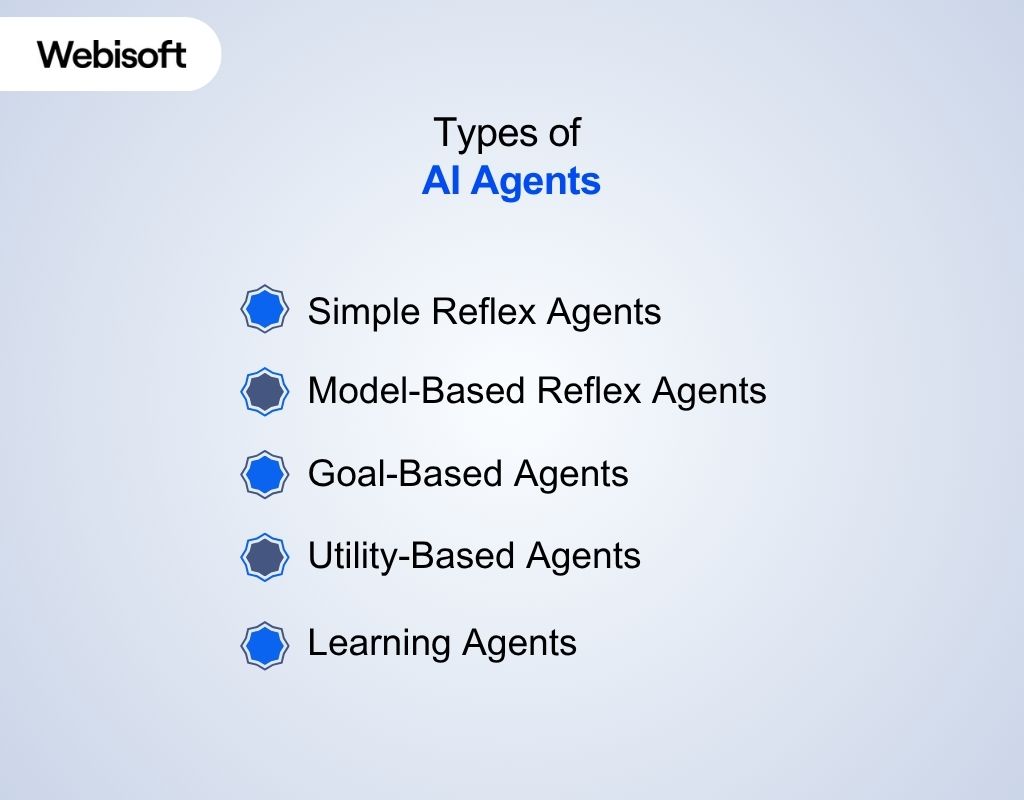
In artificial intelligence, understanding how do AI agents work starts with knowing their different types and architectures. These designs shape how agents perceive, reason, and act based on the task and environment complexity. Each type uses a different method to make decisions, adapt, and perform.
Simple Reflex Agents
Simple reflex agents look only at what is happening right now. They follow fixed rules to decide what to do based on current input. They do not remember past information or think about what might happen next. This way of working allows them to react very fast but limits their ability to handle new or changing situations.
Some key points about them are:
- Respond instantly to current inputs without delay
- Follow straightforward rules that are easy to design
- Work well in environments where everything is clear and does not change
- Do not keep track of what happened before
- Not able to handle complex problems or unexpected changes
Model-Based Reflex Agents
Model-based reflex agents keep a simple memory of what has happened or parts of the environment that they cannot see now. This memory creates an internal picture or “model” of the world. Using this model, they can make better choices even when the environment is partly hidden or changes over time.
Important features include:
- Remember parts of the environment that are not visible at the moment
- Use past information to understand the current situation better
- Update their internal model as they receive new data
- Can work in situations where the environment changes or is not fully known
- Need more computer power and memory than simple reflex agents
Goal-Based Agents
Goal-based agents think about what they want to achieve before acting. They have clear goals and choose actions that bring them closer to those goals. They can plan a series of steps and change their actions if the situation changes or if they are not making progress.
These agents:
- Focus on reaching specific goals instead of just reacting
- Plan actions ahead to achieve their targets
- Change plans if needed to keep moving toward their goals
- Solve problems that require thinking ahead and strategy
- Use more computing resources because of planning
Utility-Based Agents
Utility-based agents measure how good each possible result is. Instead of just working toward a goal, they choose the option that brings the highest value or benefit overall. This approach allows them to handle difficult decisions, especially when different goals compete or situations are uncertain.
They work by:
- Assigning scores that show how useful or valuable each outcome is
- Choosing the option with the highest overall score
- Balancing between different goals or needs
- Taking uncertainty into account when deciding
- Performing well in complex situations where trade-offs exist
Learning Agents
Learning agents refine their performance by learning from experience. They adjust their behavior based on what worked or did not work before. This ability lets them adapt to new situations without needing a programmer to rewrite their instructions.
They function by:
- Changing actions after receiving feedback or new information
- Finding patterns and updating knowledge automatically
- Managing situations where rules are not clear or complete
- Reducing the need for manual programming of all behaviors
- Becoming better over time through continuous learning
How do AI agents work? Step by Step Guide
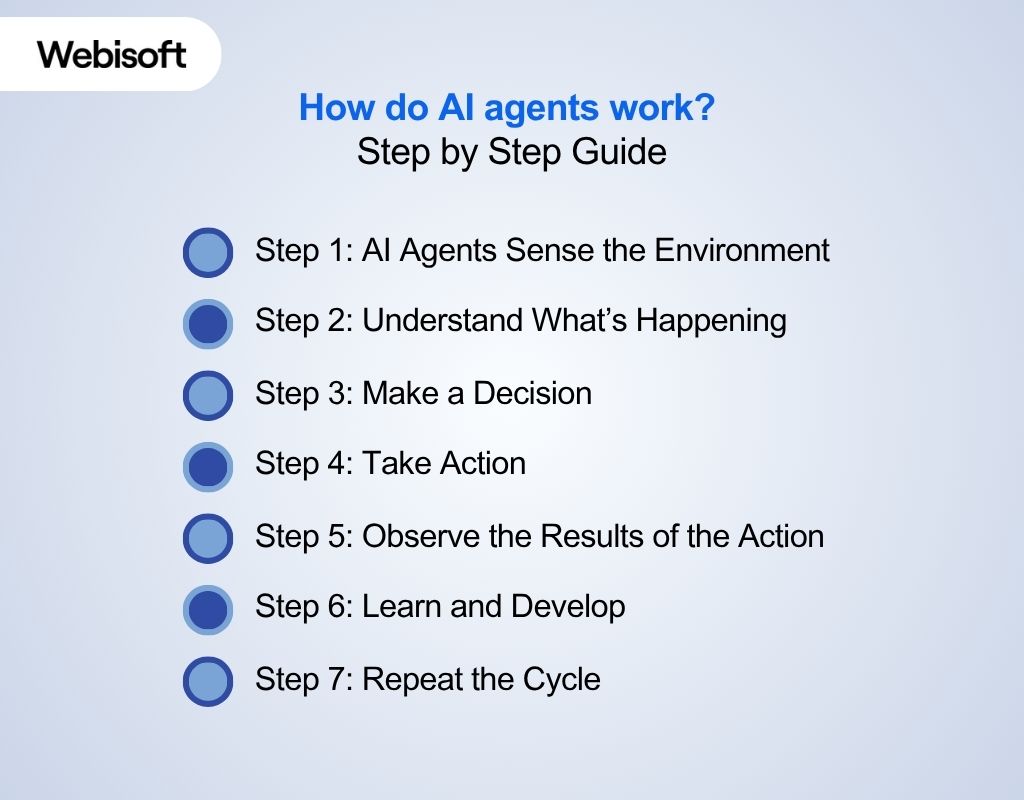
To understand how do AI agents work, we need to look at the steps they follow. AI agents first gather information, then make decisions based on what they learn, and finally take actions to complete their tasks. This process lets them solve problems and reach their goals on their own.
Step 1: AI Agents Sense the Environment
AI agents start by collecting information from their surroundings. This environment could be anything, a website, a chat conversation, a camera feed, or even the physical world through sensors.
The agent uses tools like microphones, cameras, or software inputs to “sense” what is happening. This is the first step where the agent becomes aware of its situation so it can decide what to do next.
Step 2: Understand What’s Happening
After collecting data, the agent needs to understand it. This part is called perception. The raw input is processed using AI techniques like:
- Natural Language Processing (NLP) to understand language
- Computer Vision to understand images or videos
- Machine Learning to find patterns in numbers or behavior
This understanding lets the agent know the current state of the environment. Once the agent understands the situation, it can move to the next step: deciding what to do.
Webisoft uses GPT and AI tools so your system can understand words, images, and patterns like reading, listening, or watching with meaning.
Step 3: Make a Decision
With a clear view of the environment, the AI agent now thinks about what action to take. It uses logic, learned models, or predefined rules to choose the best move. Depending on the type of agent, this decision-making may involve:
- Following simple if-else rules (for basic agents)
- Using a trained model (for learning agents)
- Planning several steps ahead (for smart or goal-based agents)
Once a decision is made, the agent prepares to act based on its choice.
Webisoft builds smart tools that help AI choose the best step quickly, even when things change, by using your data and goals.
Step 4: Take Action
Now, the AI agent performs the selected action. This action could be:
- Answering a user’s question
- Clicking a button in a software system
- Moving a robot arm
- Recommending a product
This step changes something in the environment based on the decision the agent made. The action is meant to support the agent reach its goal, like solving a task or assisting a user.
Step 5: Observe the Results of the Action
After taking an action, the agent watches to see what happened. Did the user respond well? Did the robot succeed in moving something? The agent checks the new environment state. This observation let the agent learn what worked and what didn’t. That’s especially important for agents that upgrade over time.
Whether it’s answering a question or showing a product, Webisoft’s AI tools help your system do the next step.
Step 6: Learn and Develop (Optional but Powerful)
Some AI agents also learn from their past actions. This is done using feedback or results. For example, if the agent made a mistake, it remembers that and tries not to repeat it. If it succeeds, it strengthens that behavior. This learning usually happens through:
- Reinforcement Learning (learning from trial and error)
- Supervised Learning (learning from labeled data)
- Unsupervised Learning (finding patterns on its own)
This ability to learn lets agents get smarter and work better over time, which is an important part of how to build a custom AI agent that can grow and develop.


Build Smarter AI Agents with Webisoft Today!
Connect with our experts for a free AI consultation.
Step 7: Repeat the Cycle
The AI agent doesn’t just do this once, it repeats the cycle:
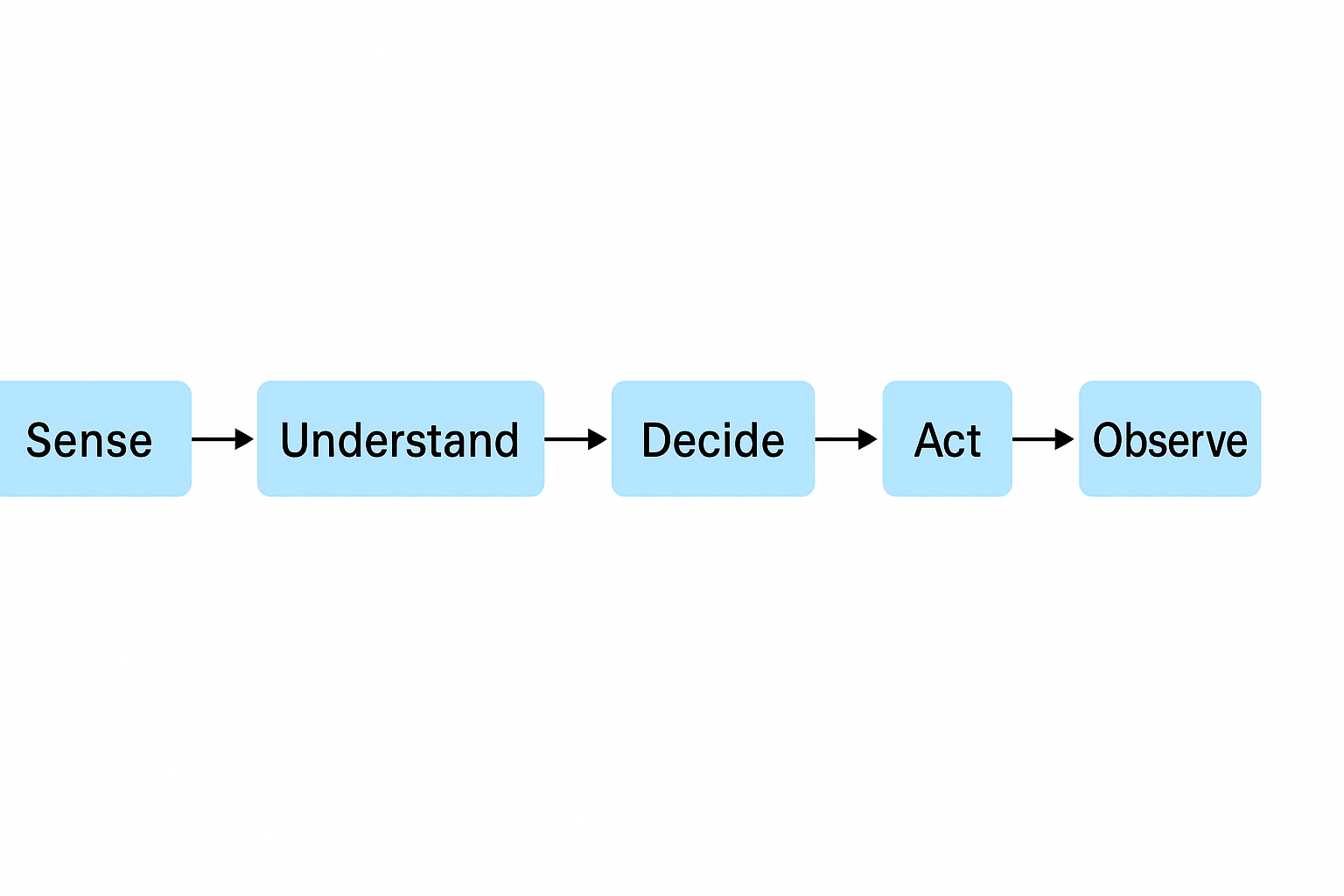
Each time, it gets better at reacting to changes and solving problems. The goal is to behave more intelligently with each interaction.
Key Features of an AI Agent
To understand how do AI agents work better, it’s important to know their key features. These features let them sense, decide, and act smartly to reach their goals even when things are uncertain.
Key features include:
- Autonomy: The ability to work on its own, making decisions and taking actions without needing someone to guide it all the time.
- Perception: Constantly gathering and understanding information from the surroundings to know what is going on.
- Reactivity: Changing actions quickly when the environment changes or when unexpected events happen.
- Proactiveness: Taking charge by planning ahead and starting actions that move closer to the goal, instead of only reacting after things happen.
- Goal-Directed Behavior: Always focusing on clear goals and choosing actions that allow reaching those goals.
- Communication: Talking or sharing information with other agents or systems to work together better.
- Persistence: Staying focused on goals over time, even when facing problems or when the environment changes a lot.
These features combine to give AI agents the power to act smartly, stay flexible, and perform well in many different situations.
Examples of AI Agents You’re (Probably) Already Using
AI agents aren’t some far-off sci-fi fantasy anymore. They’re here, they’re working behind the scenes, and chances are, you’ve interacted with one today without even knowing it.
Below are some familiar examples- smart, practical, and already part of everyday life.
ChatGPT
The most obvious one. It understands your questions, reasons through them, and responds like it actually gets you. From writing emails to solving math problems, it’s more than a chatbot, it’s a productivity co-pilot.
Self-Driving Car Systems
Think Tesla Autopilot. These agents process live visual input, make real-time decisions, and keep you in your lane (literally). Their goal? Safety, efficiency, and making driving optional.
Game-Playing Bots (like AlphaGo)
These agents don’t just play, they learn. By training on thousands of moves, they master games like Go, chess, and StarCraft, often beating world champions. Not bad for a few lines of code and some serious reinforcement learning.
Voice Assistants (Siri, Alexa, etc.)
Ask them to play music, set reminders, or dim your lights. These agents understand spoken commands, take action, and improve over time, turning your home into something that actually listens.
Trading Bots
They never sleep. These agents monitor stock or crypto markets, scan through trends and indicators, and make buy/sell decisions in milliseconds. While you’re reading this, one might already be making a profit.
Smart Vacuums (like Roomba)
These home agents do more than clean. They map your floor, avoid obstacles, and adjust their route on the fly. You hit “Go”, they take care of the rest.
Customer Support Chatbots
They handle FAQs, reset your password, and help you return those pants that didn’t fit, all without a human in the loop. You’ve probably chatted with one today and didn’t even realize it.
Steps for Building AI Agents
AI agents bring smart technology to many areas, but setting them up takes careful planning and clear steps. Following a good process assists to make sure the AI agent works well and solves the right problems. Each step is important to build a learning agent in AI that can think, learn, and act on its own in real life.
- Identify the Problem: First, clearly understand the problem or task the AI agent should focus on. Knowing the exact goal helps plan all the next steps carefully. Webisoft can assist in shaping a clear plan for your AI agent by offering expert AI strategy consultations.
- Gather Data: Collect the information and examples the AI agent will need to learn. This data acts as the agent’s learning material to make good decisions.
- Choose the Model: Pick the right AI method or algorithm that fits the problem. Different tasks require different approaches for the AI to work well.
- Select Tools and Frameworks: Choose the software tools and frameworks to build the AI agent. For example, TensorFlow or PyTorch for building models, OpenAI Gym for training in simulated environments, or Rasa for chatbot creation.
- Build the Agent: Use the selected tools to write the code and train the AI agent with the collected data. This step teaches the agent how to perform its task using the examples.
- Test and Evaluate: Test the AI agent in different situations to see how well it works. Use tools like unit testing frameworks or simulation environments to find errors and upgrade performance.
- Deploy the Agent: Launch the AI agent into the real world where it will start doing its job with actual users or data. Platforms like cloud services or edge devices can be used to deploy the agent.
- Monitor and Update: Continuously watch how the agent performs after deployment. Collect new data and update the model regularly using the same tools to keep it accurate and useful as conditions change.
Common Challenges and Solutions of using AI agents
So, you’ve now gathered a clear idea of how to Ai agents work and also how to build an AI agent. But using AI agents in real and complex situations can bring many problems.
To make sure AI agents work well, it’s important to solve these problems carefully. Good solutions let AI agents stay reliable, adjust quickly, keep data safe, and treat users fairly. This makes the system stronger and more trustworthy.
| Common Challenges | Solutions |
| Data is often incomplete, noisy, or too little, which lowers accuracy. | Clean the data well, add more varied examples, and prepare data carefully. |
| AI agents have trouble when the environment changes fast or unexpectedly. | Let agents keep learning and update themselves using new information. |
| Complex calculations need a lot of computer power, causing delays. | Make algorithms simpler and faster, use smaller models, and run AI near where data is collected. |
| Many agents working together can have communication and task-sharing problems. | Create clear ways for agents to talk and divide tasks smartly. |
| AI decisions are hard for people to understand, reducing trust. | Use explainable AI tools that show how decisions are made. |
| AI systems can be attacked or tricked by bad data. | Protect AI with strong security and watch for strange activity. |
| AI can make unfair or biased decisions from bad data. | Check and fix bias regularly, and follow ethical rules. |
| It’s hard to connect AI agents with old software or hardware. | Design AI with parts that can easily connect and follow common standards. |
Webisoft’s artificial intelligence service assists solve these AI challenges with smart tools that clean your data, protect your systems, and help your agents learn faster.
Difference Between AI Agents, AI Assistants, and Bots
AI agents, AI assistants, and bots are all computer programs, but they work in different ways. They vary in how much they can think on their own, how they interact, and how complex their tasks are. Understanding these differences also helps explain how do AI agents work compared to assistants and bots.
| Aspect | AI Agents | AI Assistants | Bots |
| Purpose | Work on their own to complete tasks and reach goals, often in changing situations | Support people by answering questions or doing tasks through talking or typing | Do simple, repeated jobs based on fixed rules or commands |
| Autonomy | Work independently, making decisions and planning actions | Need some instructions from users but can do many things on their own | Follow set instructions and have little freedom to decide |
| How They Communicate | Talk to other systems or environments in different ways, not just with people | Mainly talk or write to users to assist them | Usually chat or respond through fixed messages or commands |
| Learning Ability | Can learn and change how they work by getting new information | Learn a little by improving answers over time | Usually do not learn or change; stick to programmed tasks |
| Task Complexity | Handle complex jobs that need thinking and planning | Handle medium jobs focused on helping users easily | Handle simple jobs that don’t need much thinking |
| Examples | Robots that drive themselves, smart home control systems | Siri, Google Assistant, Alexa | Website chatbots, automatic reply messages |
Benefits of Using AI Agents
AI agents are widely used across industries to automate tasks, make faster decisions, and handle complex operations with minimal human input. Their ability to learn, adapt, and operate in real-time makes them valuable tools in both digital and physical environments.
From advanced agents to helpful assistants, Webisoft creates AI tools that match your needs, simple or smart.
Key Benefits:
- Saves time by making decisions faster than humans.
- Reduces errors through consistent and precise actions.
- Cuts costs by automating repetitive and complex tasks.
- develops user experience by personalizing responses.
- Increases safety by handling dangerous or high-risk operations.
- Boosts productivity with 24/7 availability and no downtime.
- Enables better forecasting and planning through simulations.
- Supports scalability by managing large volumes of data or tasks.
- Frees humans to focus on creative and strategic work.
- Accelerates learning and adaptation to changing environments.
- Strengthens decision-making with real-time data analysis.
- Promotes collaboration by coordinating multiple agents or systems.
- Expands capabilities in areas where human skills are limited.
Use Cases for AI Agents
AI agents are smart because they can understand complex problems, make decisions, and take action by themselves. They are useful in many areas. These agents can learn, plan, and solve problems, which assists in many real-life situations and shows how do AI agents work in the real world.
| Use Case Area | What They Do | Example |
| Healthcare | Watch over patients, give health advice, and support doctors | Checking patient health from far away, virtual health helpers |
| Self-Driving Cars | Drive cars by themselves, avoid accidents, and follow traffic rules | Driverless cars and flying delivery drones |
| Customer Service | Answer questions, guide people, and fix common problems | Chat systems for banks or online shops |
| Smart Homes | Control home devices like lights and temperature automatically | Voice control for lights, smart heaters |
| Finance | Find fake transactions, manage money, and give advice | Systems to stop fraud, robot money advisors |
| Education | Teach students in ways that fit them and track learning progress | AI tutors and learning apps that adjust to students |
| Environment | Watch weather and animals, predict disasters, and manage natural resources | Weather forecasts and animal tracking |
How Webisoft Supports You in Building AI Agents
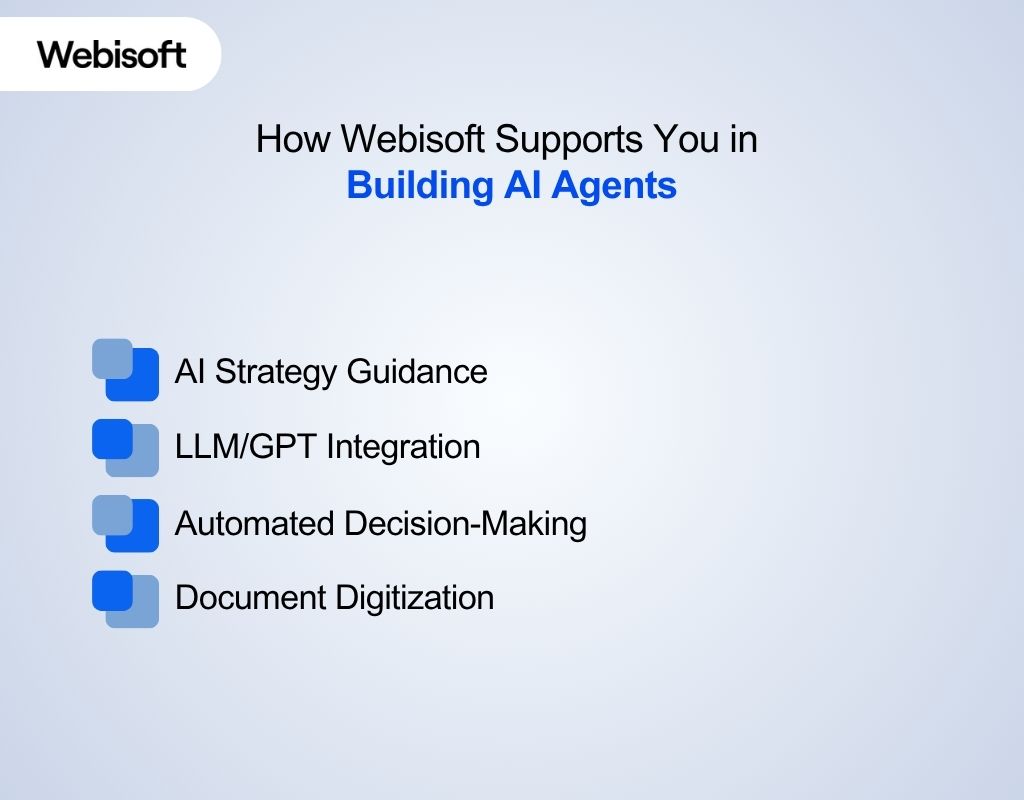
Creating an AI agent may seem complicated, but with the right guidance and technology, it becomes much easier. Webisoft provides advanced AI tools and expertise to develop AI agents that can understand information, make decisions, and perform tasks for you.
Here’s what Webisoft offers to build your AI agent:
- AI Strategy Guidance: Expert advice to design AI solutions tailored specifically to your business goals.
- LLM/GPT Integration: Implementation of advanced language models like GPT to develop conversational agents and smart chatbots.
- Automated Decision-Making: AI systems that analyze large amounts of data quickly and assist in making efficient, data-driven decisions.
- Document Digitization (OCR): Converting physical documents into digital formats to make information accessible for your AI agent.
Conclusion
Knowing how do AI agents work helps us understand how they can do tasks on their own and make smart choices. These agents keep learning from the information they get and can work without needing people all the time.
As AI grows, it’s important to have expert assistance to use it well. Webisoft is a trusted partner that can assist you use AI agents for your business or projects. With the right knowledge and support, AI agents can bring big improvements and make work easier.
Frequently Asked Questions
Can AI agents improve their performance over time through experience?
Yes, many AI agents can get better over time by learning from their experiences. When they interact with users or their environment, they collect data and use it to improve their decisions. This is called learning. Some AI agents are designed to update their knowledge after each task or over time, which helps them become smarter and more helpful.
Are all AI agents reactive, or can some plan ahead?
Not all AI agents are reactive. Reactive agents only respond to what is happening right now. But some AI agents can plan ahead by thinking about future steps before acting. These agents use techniques like goal-setting or prediction to decide what to do next. Planning helps them make better choices, especially in complex situations.
How do AI agents handle uncertainty or incomplete information?
AI agents often face situations where they don’t have all the information. To handle this, they use tools like probability, guessing based on past data, or making safe choices until they learn more. Some AI models are trained to deal with unclear or missing data and can still make reasonable decisions even when things are uncertain.
How do AI agents make decisions under time constraints?
When AI agents have limited time, they use faster methods to make decisions. They may choose a solution that is “good enough” instead of perfect. Some agents are designed to act quickly by using simpler models or shortcuts. The goal is to respond in time while still making useful decisions, even if they are not the best ones.
