Businesses face complex challenges that demand smarter, faster solutions. Artificial intelligence (AI) offers powerful capabilities to automate tasks, extract insights, and enhance decision-making. But how to create your own AI system?
However, creating your own AI system requires careful planning and execution to ensure it meets your specific needs and delivers real value.
Start by clearly defining the problem, acquiring and preparing high-quality data, choosing an appropriate model, and fine-tuning it to your needs. Finally, deploy it with ongoing performance monitoring.
These technologies help you code, train, test, and deploy AI models efficiently from programming languages to cloud platforms while building essential AI development skills. For organizations looking to accelerate this process, partnering with AI development services can help you move from concept to production faster.
Required Tools and Technologies to Make an AI System?
To build your own AI system, you need the right tools. These technologies help you code, train, test, and deploy AI models efficiently from programming languages to cloud platforms
| Tool/Technology | Purpose |
|---|---|
| Python/R, Java, JavaScript, or C++ | Choose a programming language depending on the specific task or system architecture. |
| TensorFlow | A popular open-source framework for building AI models. |
| PyTorch | A flexible AI framework is preferred for research and production. |
| Jupyter Notebook | An interactive environment for coding and testing AI projects. |
| Pandas | Library for efficient data cleaning and manipulation. |
| Scikit-learn | Provides classic machine learning algorithms and tools. |
| OpenAI API | Access to advanced pretrained models and prompt tuning. |
| Docker | A tool for containerizing applications for consistent deployment. |
| AWS / Google Cloud / Azure | Cloud platforms offer scalable resources for AI training and deployment. |
Step-By-Step Guide on How to Create Your Own AI System
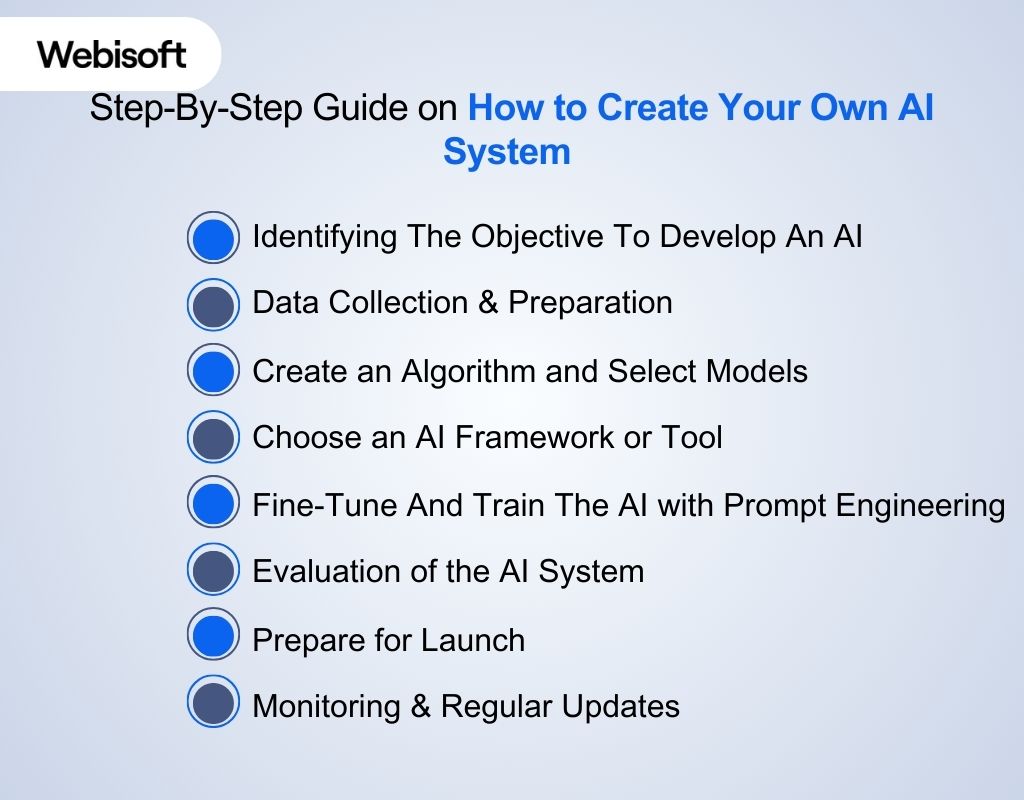
Creating an AI system may seem complex if you are not taking help from the best AI development company, but breaking the process into clear, manageable steps makes it achievable, manageable steps makes it achievable, especially when following a structured AI engineering process.
This guide walks you through each critical phase from defining the problem and gathering quality data to selecting models and deployment.
Step 1: Identifying The Objective To Develop An AI
Begin by analyzing your current business processes or challenges. Look for repetitive tasks, bottlenecks, or areas needing better insights. Ask yourself what specific problem you want the AI to solve or what goal it should achieve.
Talk with your team and stakeholders to gather different perspectives.
Use SMART criteria (Specific, Measurable, Achievable, Relevant, and Time-bound) to shape your objective.
This clarity will guide every next step, from data collection to model training, ensuring your AI system delivers actionable results.
Step 2: Data Collection & Preparation
Now that you've clearly defined your objective, the next critical step is gathering and preparing the right data. AI systems learn from data, so quality matters more than quantity.
Start by identifying relevant data sources this might be internal databases, APIs, or public datasets.
Then, focus on cleaning and organizing the data to ensure it's reliable.
Here's a quick table on where to source data and what to secure from each:
| Data Source | What to Secure |
|---|---|
| Internal Databases | Clean, structured data relevant to your goal |
| Public Datasets | Verified, well-documented datasets |
| APIs (e.g., social media, CRM) | Consistent and updated data feeds |
| User-generated Data | Properly labeled and anonymized data |
For example, if you're building an AI to improve customer support, you might pull chat logs from your CRM (an API source).
Clean and anonymize them to protect privacy, then label conversations based on issue type.
This way, you can train models that understand and categorize customer queries effectively. Also, use tools like Pandas to automate cleaning and labeling. Research shows that poor data quality costs businesses an average of 15% to 25% in revenue each year.
Step 3: Create an Algorithm and Select Models
After defining your objective and preparing your data, the next step is to choose the right AI algorithm and model to solve your problem effectively.
Choose models that align with your use case. Common options include:
| Model Type | Use Case Examples | Description |
|---|---|---|
| Linear Regression | Predicting numerical values | Simple, interpretable model for regression |
| Decision Trees | Classification, regression | Tree-based model, easy to interpret |
| Support Vector Machine (SVM) | Classification tasks | Effective for high-dimensional data |
| Convolutional Neural Networks (CNN) | Image and video analysis | Specialized neural nets for spatial data |
| Recurrent Neural Networks (RNN) | Sequence data like text, speech | Models temporal dependencies |
Step 4: Choose an AI Framework or Tool
Once you have selected your AI model and algorithm, the next crucial step is to pick the right AI framework or tool to build, train, and deploy your system efficiently. It is likely the backbone of your AI development process and provides the necessary libraries, APIs, and infrastructure support.
Different frameworks specialize in different types of AI work. For example, use TensorFlow or PyTorch for deep learning and neural networks, and Scikit-learn for traditional machine learning algorithms.
Pick frameworks with good documentation, tutorials, and active communities. Also, it should support your hardware (CPUs, GPUs, TPUs) and integrate well with your cloud platform or local environment
Step 5: Fine-Tune And Train The AI with Prompt Engineering
After selecting your model and framework, the next step is to fine-tune and train the AI system to perform well on your specific task.
This involves two complementary approaches: fine-tuning the model's parameters and using prompt engineering to guide its behavior. For this,
- Model Selection: Choose a pre-trained foundation model that aligns with your task complexity and domain requirements. It is important to balance the performance and resource constraints.
- Fine-tuning Configuration: Define key hyperparameters such as learning rate, batch size, and epochs. Then initiate fine-tuning using robust AI frameworks or managed APIs.
- Training, Monitoring, and Validation: Continuously monitor training metrics (loss, accuracy) and rigorously validate model performance on holdout datasets to prevent overfitting.
Step 6: Evaluation of the AI System
Evaluating an AI system is essential to ensure it performs accurately, fairly, and reliably in real-world conditions. Start by defining clear evaluation objectives aligned with your AI's purpose and business goals.
Use a combination of performance metrics such as accuracy, precision, recall, and fairness to measure effectiveness.
Also, it's important to test the model on diverse and representative datasets to identify any biases or weaknesses early on.
| For example, a financial institution implements an AI model for fraud detection to evaluate its performance using precision and recall. This helps ensure the system accurately identifies fraudulent transactions and minimizes false alarms on legitimate ones. They also test the model on data from different regions and customer segments to ensure consistent performance and fairness. It helps prevent bias against any group. |
Step 7: Prepare for Launch
As you approach launch, focus on finalizing your AI system's readiness from both technical and compliance perspectives.
Ensure your deployment environment whether cloud, on-premises, or hybrid is fully optimized for the model's compute, storage, and security requirements.
Verify that identity and access management controls are in place to protect sensitive data and restrict system access to authorized users only.
Use the containerization tools like Docker to create consistent, reproducible deployment environments, reducing risks during rollout.
Step 8: Monitoring & Regular Updates
Finally, set up continuous monitoring and feedback loops to track model performance, fairness, and reliability post-launch.
Incorporate user feedback channels and automated alerting systems to detect anomalies early and enable rapid iteration.
Best Practices for AI Development
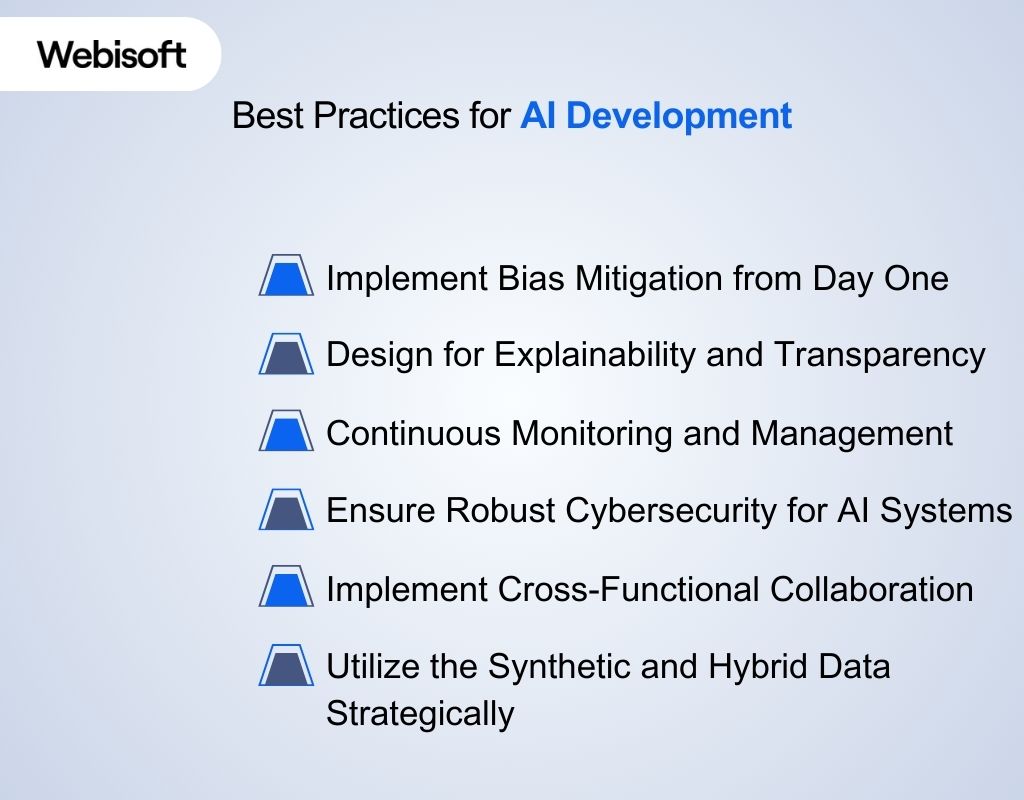
Follow best practices to build reliable and ethical AI. Focus on scalability and security. Balance innovation with responsibility for lasting results.
Implement Bias Mitigation from Day One
Actively identify and reduce biases in your training data and models using fairness-aware algorithms and diverse datasets. This prevents discriminatory outcomes and builds user trust.
Design for Explainability and Transparency
Use interpretable models or explainability tools like SHAP or LIME to make AI decisions understandable to stakeholders. It is even easier for debugging and regulatory compliance.
By 2025, 75% of organizations will require explainability tools like SHAP or LIME to understand AI decisions and reduce debugging time by 40%
Adopt Continuous Monitoring and Model Management
Set up real-time monitoring to detect model drift, performance degradation, or emerging biases. Automate alerts and schedule regular retraining to keep AI aligned with evolving data and business goals.
Ensure Robust Cybersecurity for AI Systems
Protect AI pipelines and data with encryption, access controls, and vulnerability assessments. Secure model endpoints against adversarial attacks to maintain system integrity.
Implement Cross-Functional Collaboration
Involve domain experts, data scientists, ethicists, and business leaders throughout development to ensure AI solutions are technically sound, ethically responsible, and aligned with strategic objectives.
Utilize the Synthetic and Hybrid Data Strategically
Use synthetic data to augment scarce or sensitive datasets while validating with real-world data and expert input to maintain model accuracy and privacy compliance.
Types of AI You Can Build for Your Specific Industries
Understanding the types of AI helps you choose the right system for your industry. Each offers different capabilities, from task-specific to human-like intelligence.
Artificial Narrow Intelligence (ANI)
ANI excels at performing specific tasks, such as voice recognition or recommendation engines. It's the most common form of AI today and powers many industry applications without a true understanding.
Artificial General Intelligence (AGI)
AGI represents AI with human-level cognitive abilities, capable of understanding, learning, and reasoning across diverse tasks. While it promises flexibility, AGI remains a long-term research goal.
Artificial Superintelligence (ASI)
ASI refers to AI that surpasses human intelligence in every field, including creativity and emotional intelligence. Its development raises profound ethical and safety concerns, making it a subject of debate.
Why Building an AI System Matters in 2025
With the technological advancements in 2025, AI systems are essential for staying competitive.
They automate tasks, improve decision-making, and unlock new opportunities.
Boost Efficiency and Productivity
AI automates repetitive and time-consuming tasks such as scheduling, reporting, and customer support. You can ensure that your employees are focused on complex, high-value work.
This leads to significant productivity gains. Studies show AI can improve performance by up to 66% on complex tasks.
Make Smarter Decisions
AI analyzes vast amounts of data quickly, providing insights that support accurate and timely decisions.
By 2025, the global datasphere is expected to grow to 175 zettabytes, a 430% increase from 2020, highlighting the importance of AI in processing this data
Optimize AI Infrastructure for Long-Term Success
Developing your own AI system enables control over the technology stack and helps in continuous optimization of models and infrastructure.
It ensures sustained ROI and adaptability to evolving business needs. Organizations can shift focus from experimentation to maximizing AI's value.
Enhance Customer Experience
AI-powered systems offer personalized support and faster responses. By 2025, AI is expected to handle up to 70% of customer interactions without human intervention. You can improve the customer satisfaction level by 30%
Challenges to Overcome to Build an Efficient Artificial Intelligence
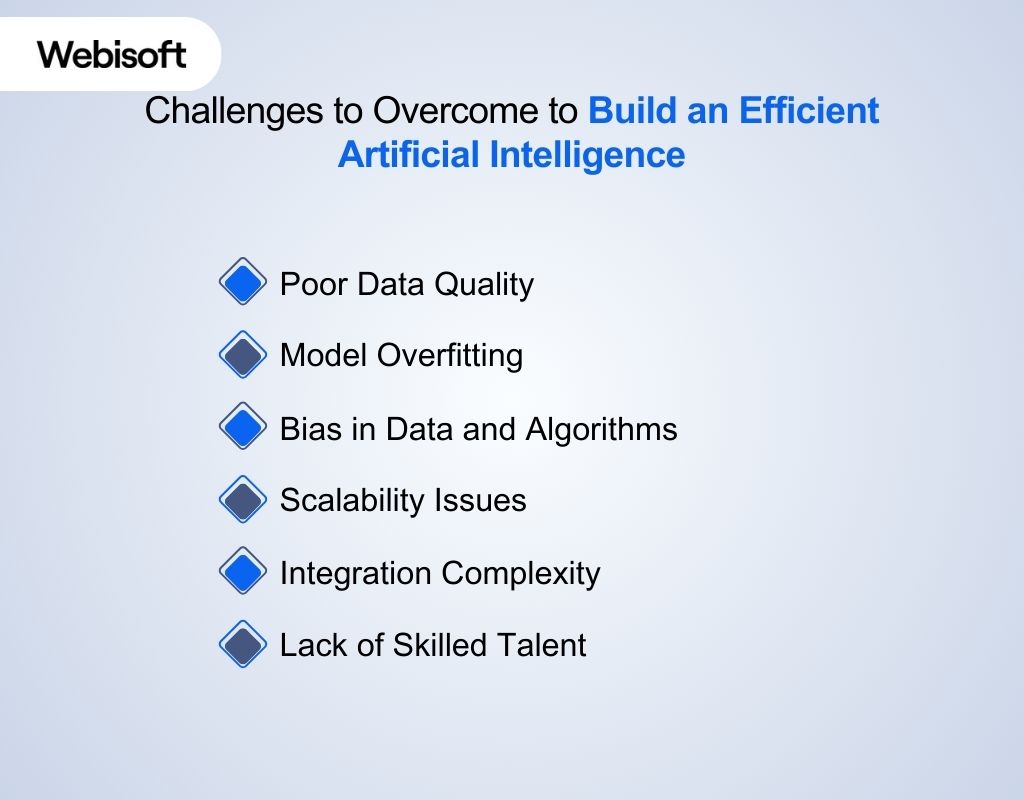
Building efficient AI is rewarding but complex. You'll face challenges from data quality to model bias. Understanding these hurdles and solutions helps you create reliable AI systems.
1. Poor Data Quality
Inaccurate or incomplete data leads to unreliable AI outcomes. To fix this, implement strict data validation and cleaning processes. Tools like Pandas help automate preprocessing and ensure quality.
2. Model Overfitting
Overfitting happens when your AI performs well on training data but poorly on new inputs. Avoid this by applying regularization techniques and cross-validation to improve model generalization.
3. Bias in Data and Algorithms
Biases in training data can cause unfair or skewed decisions. Regularly audit datasets and use fairness-aware algorithms to reduce bias and promote equitable AI behavior.
4. Scalability Issues
AI systems often struggle as data volume or user load grows. Use scalable cloud infrastructure such as AWS or Google Cloud and optimize your model architecture to handle increasing demands.
5. Integration Complexity
Integrating AI into existing workflows or systems can be difficult. Design modular AI components and utilize APIs to ensure smooth and flexible integration with current tools.
6. Lack of Skilled Talent
Finding AI development experts is often a challenge. Invest in training your team or partner with specialized AI developers and consultancies to bridge the skills gap.
Real-World Applications of Custom AI
Here are 5 real-world examples of companies thriving with custom AI systems in 2025:
1. IBM Watson Health
IBM Watson Health uses AI to analyze vast medical data, improving diagnosis accuracy and personalized treatment plans. This has enhanced patient outcomes and streamlined healthcare workflows significantly.
2. Amazon
Amazon utilizes AI for demand forecasting, inventory management, and personalized recommendations. Their AI-driven supply chain optimization reportedly boosts sales and reduces delivery times, maintaining their competitive edge.
3. Telstra
Telstra developed AI tools using Azure OpenAI Service that 90% of employees use daily, reducing customer follow-up contacts by 20% and improving service efficiency. Their AI solutions have transformed customer support workflows.
4. Urban Company
Urban Company's AI chatbots resolve 85-90% of customer queries, raising customer satisfaction by 5% and achieving audit accuracy above 80%. This has streamlined customer service and operational efficiency
In Closing
AI systems are transforming how businesses operate, innovate, and compete. From improving productivity and customer experience to enabling smarter decision-making, AI offers tangible benefits across industries.
However, building an effective AI system requires clear objectives, quality data, the right tools, and continuous evaluation to ensure reliability and fairness.
At Webisoft, we specialize in developing tailored AI and blockchain solutions that drive real business value.
Our expert team leverages cutting-edge technologies to create scalable, secure, and future-proof AI systems aligned with your unique goals.
Frequently Asked Questions
Building an AI varies—simple models can take weeks, but complex systems require months of coding, data cleaning, model tuning, and testing to ensure reliable performance.
While basic Python helps, effective AI development demands an understanding of algorithms, data structures, and frameworks like TensorFlow or PyTorch to customize and optimize models.
The amount depends on model complexity. Deep learning requires large, labeled datasets, whereas simpler algorithms perform well with smaller, cleaner data.
Yes. Cloud platforms like AWS and Google Cloud provide GPU and TPU resources on demand, eliminating the need for expensive local machines.
Use tools like Git for code and model versioning platforms (e.g., DVC) to track datasets and trained models, enabling reproducibility and collaboration.
Test with unseen data, perform cross-validation, monitor for bias, and evaluate performance metrics to ensure your model generalizes well in real scenarios.