Every growing business depends on fast, accurate access to knowledge. Yet in many organizations, critical information remains buried in documents, tools, and inboxes. This slows execution and weakens decisions.
Generative AI changes that reality by transforming scattered knowledge into clear, usable intelligence. With the global generative AI market projected to reach $126 billion by 2026, enterprise leaders are taking notice.
The focus has moved beyond basic automation to intelligence orchestration. Generative AI ensures your business moves as fast as the market. Read our complete blog on generative AI knowledge management to learn how to scale your corporate intelligence today.
Understanding Knowledge Management
Knowledge Management is how organizations gather, organize, share, and analyze information. Think of it as your company’s brain. It moves the right information to the right people at the right time. This includes everything employees need:
➔Training materials
➔Technical resources
➔Onboarding manuals
➔Product roadmaps
➔Compliance guidelines
➔Standard operating procedures
What‘s more notable is that employees spend approximately 1.8 hours per day searching for relevant information. That’s nearly 25% of their workday wasted. But with an effective knowledge based system, you can reduce this search time by up to 35 percent.
Even research shows robust KM systems boost organization-wide productivity by 20 to 25 percent. Top-tier companies are already utilizing it and see measurable results.
- Ford used web-based knowledge management to raise initial quality by 18 percent.
- The company also reduced warranty costs by $1.2 billion through better knowledge sharing.
- Similarly, Pratt & Whitney saved over $25 million by systematizing and centralizing knowledge across their firm.
Note: Globally, the knowledge management market was valued at about $20.15Bn in 2024 and is projected to grow to over $62.15Bn by 2033, at a CAGR of 13.6% from 2025 to 2033 as demand rises.
What Is Generative AI in Knowledge Management?
Generative AI (GenAI) is a subset of artificial intelligence that creates new content, such as text, images, or code, by learning patterns from massive datasets. In Knowledge Management, it acts as an “intelligent layer” over your company’s data.
Unlike traditional systems that only store files, GenAI understands the context within them. It uses Natural Language Processing (NLP) and Large Language Models (LLMs) to turn static documents into a conversational partner.
This technology connects to your knowledge base through Retrieval-Augmented Generation (RAG). RAG ensures the AI pulls answers directly from your trusted internal sources rather than the public internet.
It transforms fragmented silos into a unified, searchable “brain.” Instead of clicking through folders, employees simply ask questions in plain English. This shift moves organizations from manual data retrieval to instant, automated insight generation
Note: Global leaders are already proving generative AI technology’s worth. Mercedes-Benz and General Motors (GM) now use conversational layers in their systems. GM’s OnStar service integrated Google Cloud’s conversational AI to better recognize driver intent. This move replaced rigid, frustrating menu-based interactions with fluid dialogue.
How Generative AI Works in Knowledge Management
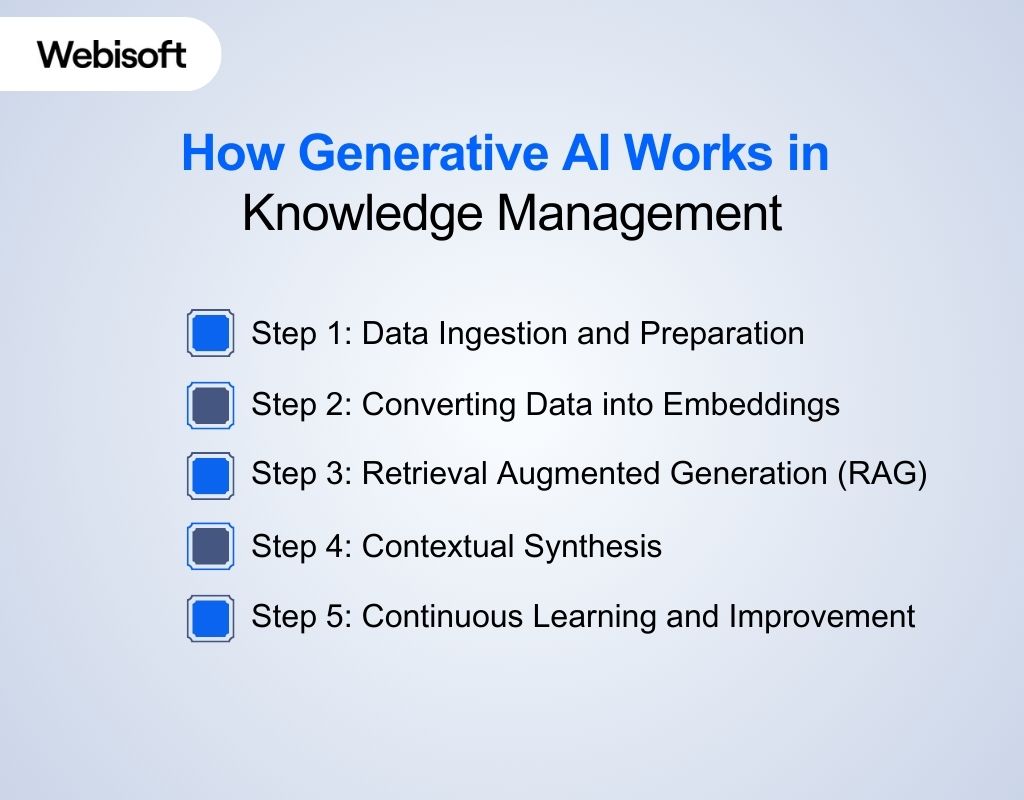
To build a truly intelligent knowledge base, you must bridge the gap between static files and active intelligence. Generative AI transforms your raw data into a conversational partner using a specific, high-tech pipeline. Here is how it works:
Step 1: Data Ingestion and Preparation
The system gathers documents like PDFs, manuals, and emails. It breaks this massive text into smaller, manageable “chunks” to ensure the AI stays focused. Small chunks prevent the system from getting overwhelmed or losing the specific context of your query.
Step 2: Converting Data into Embeddings
A specialized AI model converts these text chunks into numerical “vectors.” This process plots your data on a mathematical map based on its meaning, not just keywords. It allows the system to understand that “staff” and “employees” refer to the same concept.
Step 3: Retrieval Augmented Generation (RAG)
When you ask a question, RAG references an authoritative knowledge base before generating a response. The system performs vector similarity search on your query. It finds the most relevant documents instantly. RAG combines the precision of traditional search with generative AI intelligence. These grounds are answered in your actual company data.
Step 4: Contextual Synthesis
The AI combines your original question with the retrieved internal facts. It then uses a Large Language Model (LLM) to write a clear, natural response. You get an accurate answer that is fully grounded in your company’s specific, private information.
Step 5: Continuous Learning and Improvement
AI models learn from new data and interactions continuously. The system improves accuracy over time. Organizations can update knowledge without retraining the underlying model. This keeps information current without massive overhead.
Real-World Use Cases of Generative AI Knowledge Management
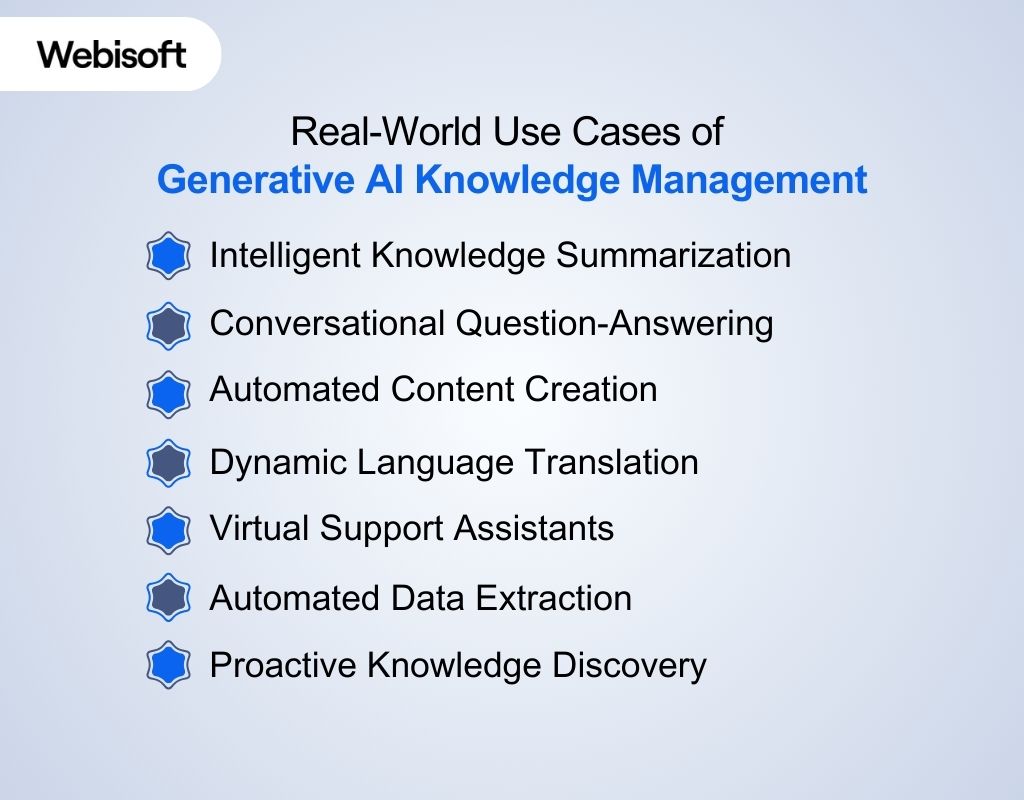
Modern organizations aren’t just collecting data anymore. Rather, you’re expected to use it, act on it, and move faster because of it. Generative AI helps you turn scattered information into answers, decisions, and outcomes, exactly when you need them. Instead of digging through folders, PDFs, or dashboards, you ask a question and get a clear response. That’s the real shift.
Intelligent Knowledge Summarization
If you’ve ever skipped reading a 200-page document because there wasn’t time, this solves that. AI instantly turns long manuals, research papers, or meeting transcripts into clear executive summaries. Teams can understand the core ideas in seconds, not hours. Tools like Notion AI already let teams summarize complex project docs with one click, so decisions don’t get delayed.
Conversational Question-Answering
Searching internal documents shouldn’t feel like a scavenger hunt. Systems like Morgan Stanley’s AI Assistant allow staff to query over 100,000 internal documents using plain English. Because of this, advisors find the right “source of truth” without any manual searching. This platform increased document retrieval efficiency from 20% to 80%. Ultimately, it turns a static archive into a live conversational partner.
Automated Content Creation
Writing SOPs, reports, or internal guides often eats up valuable time. AI helps you turn existing knowledge into polished content while keeping your brand voice consistent. Marketing, legal, and operations teams can move faster without starting from a blank page, freeing you up to focus on strategy, not formatting.
Dynamic Language Translation
If your teams or customers span multiple countries, language shouldn’t slow you down. Companies like Klarna use AI to translate entire knowledge bases into 35+ languages instantly. Their AI agent now handles two-thirds of customer chats, the workload of 700 agents. For global teams, this removes language barriers and keeps everyone aligned.
Virtual Support Assistants
AI support bots handle routine questions so your people don’t have to. At GM, OnStar uses AI to understand driver intent and resolve non-emergency requests in under two minutes. That same speed translates to faster internal help desks and happier customers.
Automated Data Extraction
Manual data entry is slow and error-prone. Generative AI pulls structured data from PDFs, invoices, and contracts automatically. Finance, legal, and logistics teams get clean data instantly, so you can analyze information instead of typing it.
Proactive Knowledge Discovery
The best systems don’t wait for you to search. AI can recommend relevant documents, training, or past work based on what you’re doing right now. That turns your knowledge base into a smart assistant, helping you find what you didn’t even know you needed.
How to Use Generative AI for Knowledge Management in Practice?
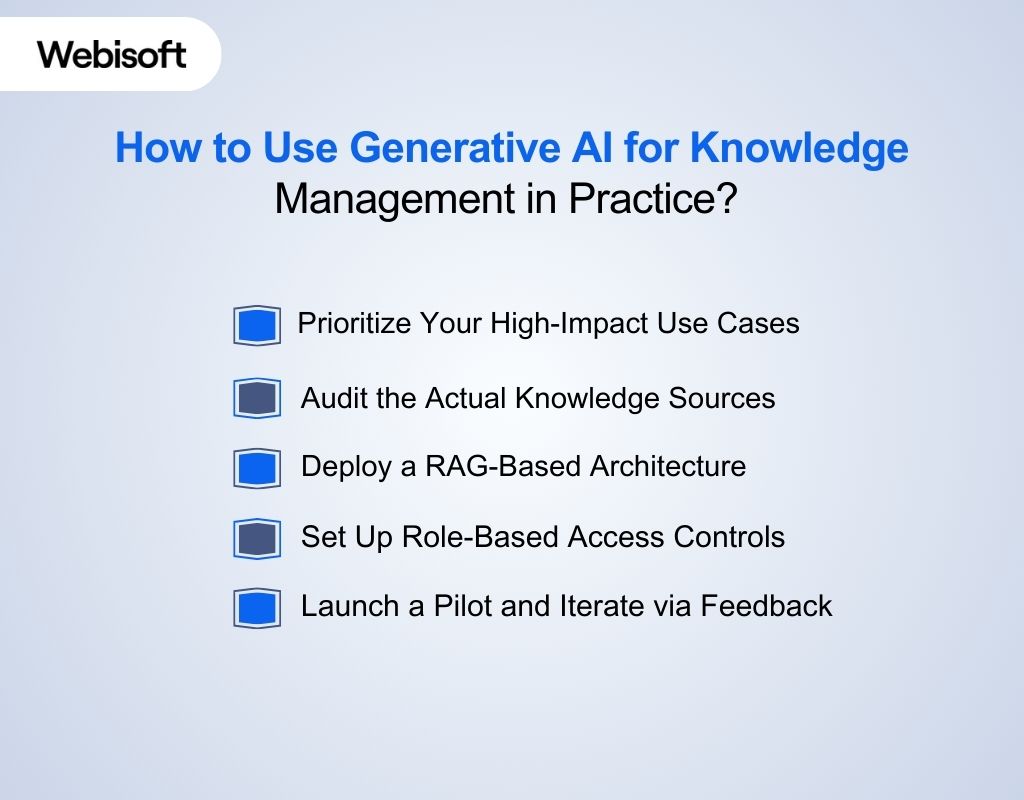
Prioritize Your High-Impact Use Cases
Instead of trying to automate everything at once, focus on a single department with a heavy documentation load. For instance, your customer support or legal teams often spend hours finding old files. By targeting these “friction points” first, you secure a quick win and prove the value of the tech. Consequently, you build internal momentum for a wider rollout.
Audit the Actual Knowledge Sources
AI is only as smart as the data you give it; therefore, you must remove outdated or conflicting files before indexing. If your knowledge base contains three different versions of a “Refund Policy,” the AI will struggle to give a straight answer. You should appoint “Data Owners” to verify that every document is accurate and current. This step ensures your AI provides reliable facts rather than “hallucinating” old information.
Deploy a RAG-Based Architecture
You don’t need to build a custom AI model from scratch; instead, you should use Retrieval-Augmented Generation (RAG). This setup connects a ready-made model (like GPT-4 or Claude) directly to your private, secure database. Because the AI “reads” your files to answer questions, it stays grounded in your specific business reality. This approach is much cheaper and more secure than traditional AI training methods.
Set Up Role-Based Access Controls
Security is paramount, so you must ensure your AI respects your existing permission levels. For example, a junior intern should not be able to ask the AI for “the CEO’s salary details” just because that data exists in the system. You can integrate the AI with your current identity providers like Microsoft Azure AD or Okta. This keeps sensitive data locked away while still helping employees with their daily tasks.
Launch a Pilot and Iterate via Feedback
Once the pilot delivers consistent, measurable results, expand the system to additional teams and higher-impact workflows. Introduce more complex knowledge sources and decision-critical use cases gradually.
Because AI capabilities and business priorities change, review model performance and knowledge coverage regularly. Update prompts, data sources, and governance rules as needed. This disciplined scaling approach transforms an initial deployment into a durable, organization-wide capability that delivers long-term operational advantage.
Note: Implementing Generative AI for knowledge management is rarely simple for first-time teams. If you need expert guidance, partner with Webisoft’s experienced AI practitioners to accelerate the results while avoiding costly missteps.
Why Organizations Are Adopting GenAI for Knowledge Management? [Find the Business Value]
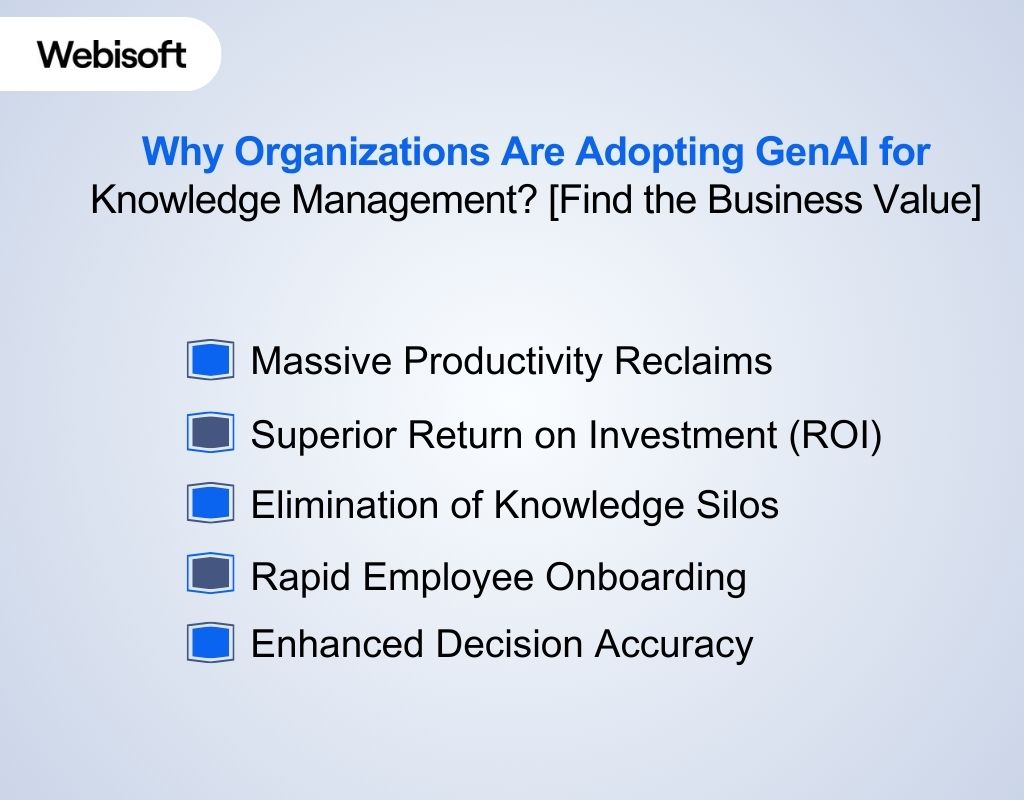
Adopting Generative AI is no longer a luxury for forward-thinking firms; it is a survival strategy. Organizations are racing to turn their stagnant archives into a high-speed engine for growth and efficiency.
Massive Productivity Reclaims
The average employee spends nearly 20% of their work week just looking for information. AI-driven systems can slash this search time by up to 50%, allowing your team to focus on high-value projects. This recovery of lost hours acts as an immediate “digital promotion” for every staff member.
Superior Return on Investment (ROI)
Recent data suggests companies see an average return of $3.70 for every $1 invested in Generative AI. High performers in financial services report even higher gains, reaching a 4.2x return. This makes GenAI one of the most profitable tech investments available in 2026.
Elimination of Knowledge Silos
Fragmented data costs businesses an average of $19,732 per information worker annually due to lost productivity. AI bridges these gaps by connecting your CRM, cloud drives, and local files into one unified brain. Consequently, your employees always have the most current “source of truth” at their fingertips.
Rapid Employee Onboarding
New hires often struggle with “information overload” during their first 90 days. GenAI creates personalized learning paths and answers complex policy questions instantly. Because of this, companies can reduce ramp-up time by nearly 35%, making new team members productive much faster.
Enhanced Decision Accuracy
Human error in data retrieval can lead to costly strategic mistakes or legal non-compliance. AI systems grounded in Retrieval-Augmented Generation (RAG) ensure every answer is backed by verified internal documents. This minimizes “hallucinations” and gives leadership the confidence to make data-driven decisions in real-time.
Note: Realizing these benefits requires more than tools alone. Partnering with experienced Generative AI specialists, like Webisoft, helps organizations design secure, scalable knowledge systems that deliver measurable business value faster.
Potential Drawbacks of Generative AI Knowledge Management
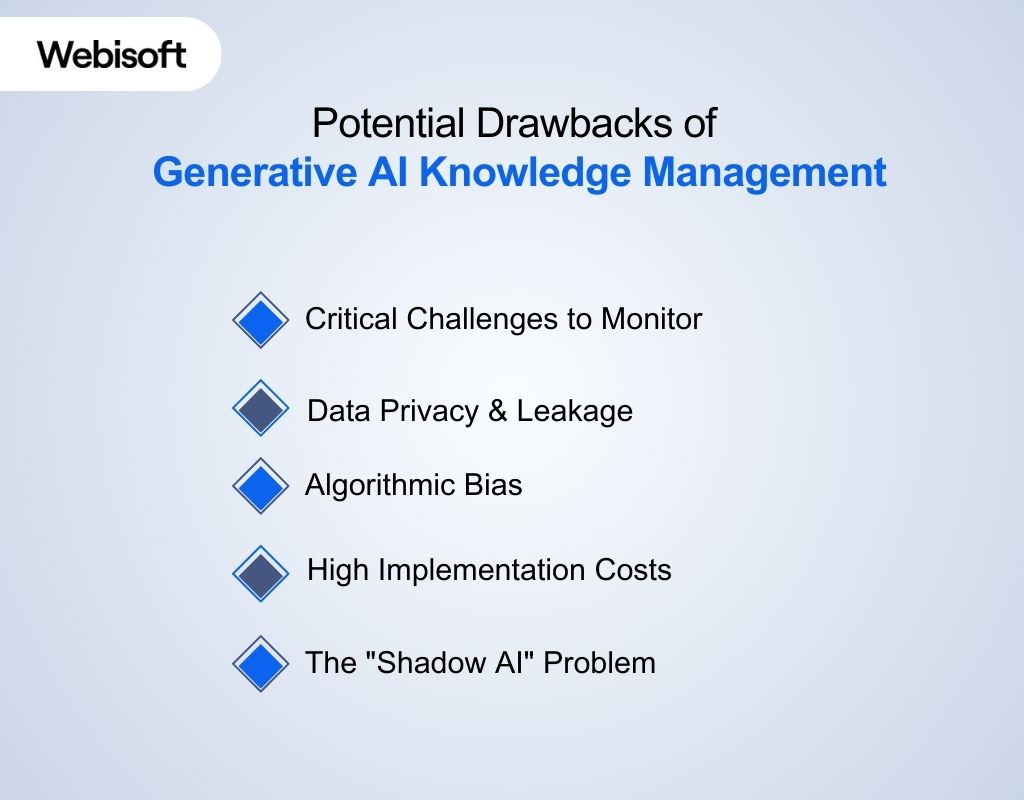
While Generative artificial intelligence offers immense power, it is not a magic wand. As a professional, you must acknowledge the serious risks that come with these systems.
Critical Challenges to Monitor
The Hallucination Risk AI can confidently state false facts as if they were true. Studies indicate hallucination rates of 3% to 5% in top-tier models. Consequently, always verify AI-generated answers against your verified sources.
Data Privacy & Leakage
Using public AI tools can expose your private secrets. Organizations now record over 200 GenAI-linked data violations monthly. Therefore, use private enterprise environments to keep your data internal and secure.
Algorithmic Bias
AI often mimics past human prejudices hidden in your files. For example, Amazon famously scrapped a hiring tool that penalized resumes containing the word “women’s.” You must audit data to ensure fair, neutral outputs.
High Implementation Costs
Building a professional brain is expensive. Enterprise programs can range from $400,000 to $1 million. While the ROI is high, you must budget for significant upfront and maintenance costs.
The “Shadow AI” Problem
Employees often use unapproved AI tools to work faster. This creates security holes that traditional firewalls can’t see. Specifically, provide safe internal alternatives to prevent risky, unvetted AI usage.
How Webisoft Supports Generative AI Knowledge Management Initiatives?
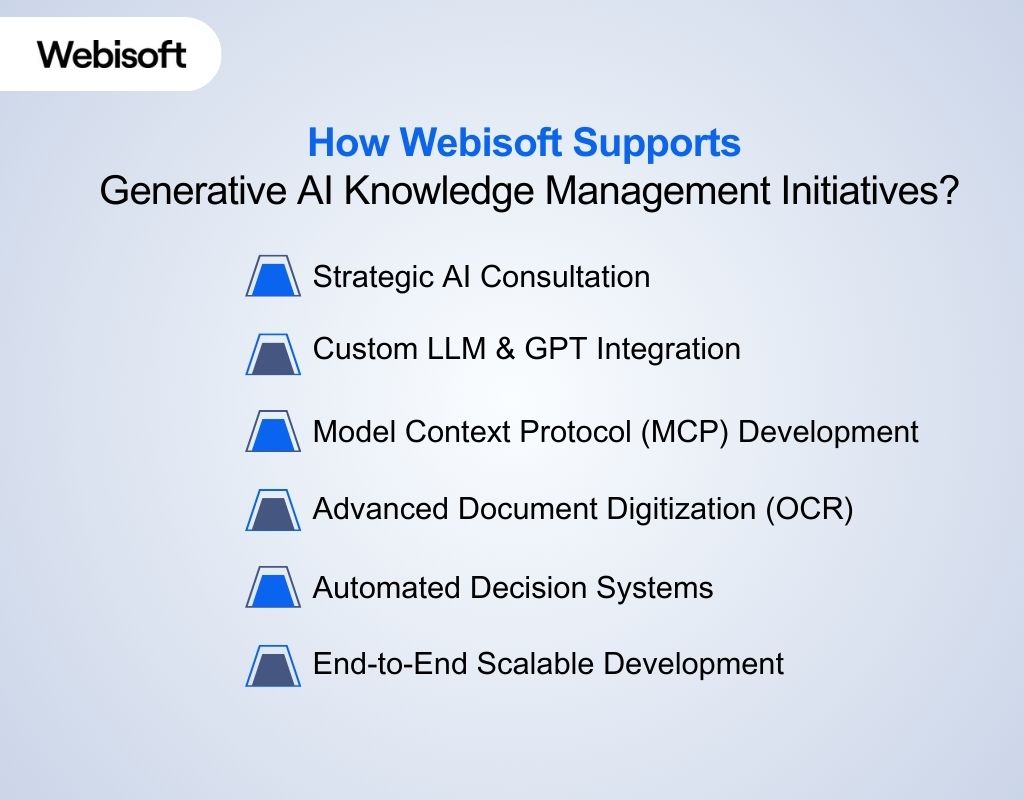
Webisoft transforms your static corporate data into a dynamic, AI-powered intelligence engine. Our elite engineering team bridges the gap between complex AI research and practical, high-impact enterprise applications. Our Core AI Implementation Strengths:
Strategic AI Consultation
We begin by identifying your unique “knowledge bottlenecks” to design a custom roadmap. Our fractional CTOs ensure your AI strategy aligns perfectly with your long-term business goals and operational needs.
Custom LLM & GPT Integration
Our senior engineers integrate advanced language models directly into your existing ecosystem. We connect these models to your private data, creating a conversational interface that understands your specific company “language.”
Model Context Protocol (MCP) Development
We build custom MCP servers to give your AI models secure, real-time access to your organization’s unique workflows. This specialized protocol ensures your AI has the deep context required for accurate decision-making.
Advanced Document Digitization (OCR)
Webisoft converts messy physical archives and unstructured PDFs into searchable, high-quality digital assets. This process turns “dark data” into usable fuel for your Generative AI knowledge management system.
Automated Decision Systems
We deploy AI-powered tools that process massive datasets in real-time to automate routine choices. This shift allows your leadership team to focus on strategy while the AI handles high-volume, data-driven tasks.
End-to-End Scalable Development
From initial prototypes to full-scale production, we ensure your AI infrastructure is robust and secure. Our North American team provides continuous maintenance and optimization as your knowledge base grows and evolves.
In Closing
In summary, Generative AI Knowledge Management is no longer an optional upgrade. It is a survival requirement for 2026. By centralizing fragmented data and automating complex workflows across every department, your organization can eliminate the “information tax” and operate with unmatched speed.
Ready to transform your business data into actionable intelligence? [Contact Webisoft today] to build your custom Generative AI solution.
Frequently Asked Questions
Traditional search returns documents. Generative AI delivers direct, contextual answers synthesized from multiple sources. This reduces reading time and improves decision speed.
Yes. Most implementations integrate with existing tools like SharePoint, CRM systems, and cloud drives. A RAG-based setup avoids data migration or system replacement.
Common metrics include reduced search time, faster onboarding, higher answer accuracy, and employee adoption rates. These indicators show operational impact quickly.
No. It captures and scales expert knowledge but does not replace judgment. Human validation remains essential for governance, accuracy, and strategic decisions.