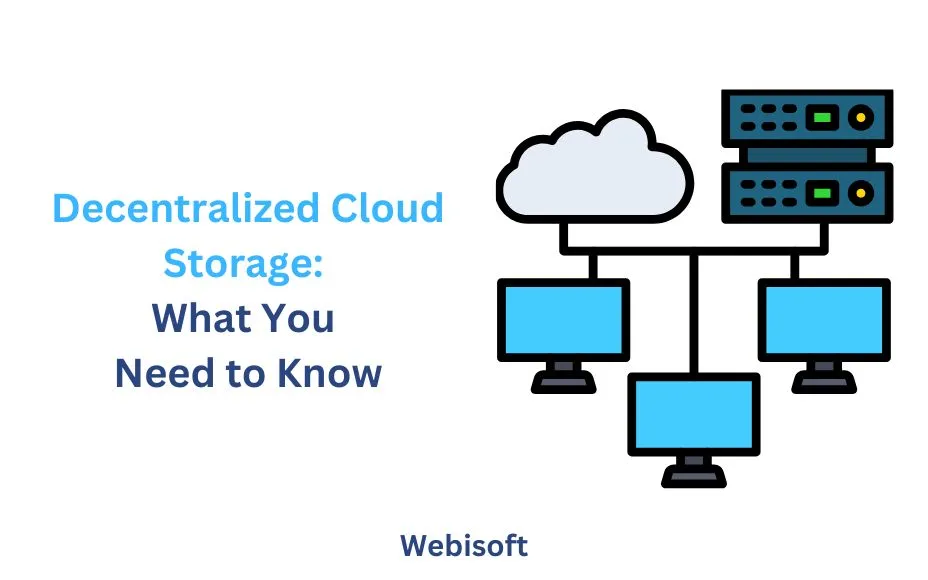
Cloud storage centralization creates real business risks. When data sits in a single vendor's data center, failures there directly affect you, and you have limited visibility into who can access your information. Decentralized cloud storage addresses these constraints by distributing data across a network of independent nodes rather than trusting a single provider.
How Centralized Storage Works and Why It Fails
In centralized storage (AWS S3, Google Cloud, Dropbox), your data lives at specific geographic locations controlled by the provider. The provider handles encryption, backups, and access control. This simplicity comes with real downsides: you depend on their uptime, their security decisions, and their willingness to grant you data access.
If that provider experiences an outage or a breach, your recovery options are limited. You also face vendor lock-in; migrating off is operationally expensive.
Decentralized Storage: Distribution Over Location
Decentralized storage systems (IPFS, Sia, Storj) flip the model. Instead of storing a file at a fixed address, the system breaks it into blocks, encrypts each block, and spreads them across many machines. The file is located not by URL but by its content hash: a unique fingerprint computed from the data itself.
This approach has three immediate consequences:
- No single point of failure. If one node goes offline, your file remains retrievable from other nodes holding fragments.
- No centralized gatekeeper. The network enforces the protocol; no company decides whether you can access your data.
- Provider-agnostic. Nodes can be run by individuals, small businesses, or large providers. You're not betting your storage on one vendor's longevity.
Erasure Coding and Redundancy
Decentralized systems use erasure coding to balance redundancy against storage cost. In typical implementations (like Storj), a file is split into 80 pieces, and you need only 29 of them to reconstruct the original. This means:
- Redundancy without duplication. Instead of storing 3 full copies, you store 80 fragments where any 29 suffice. Storage overhead is lower.
- Fault tolerance by design. Up to 51 pieces can disappear before you lose access. Single-node outages don't matter.
- Trade-off clarity. Adding more pieces improves resilience but increases bandwidth and coordination cost on retrieval.
Content Addressing vs. Location Addressing
Centralized systems use location addressing: a URL points to a server. If the content moves or the server changes, the URL breaks. Content addressing uses a cryptographic hash of the data itself as the address. If the data hasn't changed, the hash never changes, and any node holding that data can serve it.
This matters for longevity. A link to an IPFS-hosted file remains valid indefinitely as long as any node replicates it. A link to a web server becomes a 404 if the server moves or the company shuts down.
Encryption and Trust Model
Decentralized storage systems encrypt data before distributing it. Only you hold the decryption key. This means the storage nodes themselves cannot read your data, even if compromised. No single operator can unilaterally revoke your access.
The trade-off: you control the key, so you also own the responsibility for safeguarding it. Lost or compromised keys may mean permanent data loss or unauthorized access. Backup and key management become your operational burden.
Economics and Node Incentives
For a decentralized network to remain healthy, storage nodes need economic incentive to stay online. Storj and Sia pay node operators in their native token based on storage capacity and retrieval frequency. This creates a market for spare disk space.
The benefit is low cost per gigabyte (typically 1/10th to 1/5th of cloud providers). The catch: token value fluctuates, node operators may leave if rewards drop, and you depend on that token maintaining value and liquidity.
Real-World Implementation Challenges
Decentralized storage works best for data with loose latency requirements. Document archives, backups, and media libraries fit well. Real-time database replication does not; reconstructing a file from 29 pieces across a geographically distributed network takes longer than reading from a local replica.
Node selection and placement matter. If all your erasure-coded pieces end up on nodes in the same geographic region, or on nodes operated by a related party, you've regressed toward centralization. Quality implementations randomize placement.
Bandwidth costs for retrieval can exceed expectations if many nodes are slow or frequently offline. You pay per-byte, so reconstructing a large file from scattered pieces may be more expensive than the storage itself.
When to Use Decentralized Storage
Decentralized storage makes sense when:
- Vendor independence matters more than performance. You're storing long-term archives or compliance-sensitive data where provider lock-in is a real risk.
- Geographic distribution is required by regulation or resilience policy. Your data must survive regional outages.
- Cost is the primary driver and latency is flexible. Backups, cold storage, and historical records fit here.
- You operate your own storage nodes. Operating a node gives you direct control and eliminates provider dependency entirely.
Decentralized storage is not a drop-in replacement for cloud storage APIs. It's a different primitive with different trade-offs, useful when those trade-offs align with your requirements.
Blockchain’s principles of decentralization and encryption are foundational to DCS, ensuring data integrity and trustworthiness.
Like any technology, DCS is evolving. Current challenges might include ensuring consistent speed and further refining data retrieval processes.
Transitioning requires some setup, but many DCS providers offer tools and support to facilitate the migration process.
Yes, from startups to large enterprises, any business prioritizing data security and accessibility can benefit from DCS.