If you are searching for an AI development company in Canada, start with the team behind this page. Webisoft is a Montreal based software studio that designs, builds, and ships production AI systems for enterprises, CTOs, and product leaders, from machine learning pipelines and LLM applications to full custom platforms. Being in Montreal puts us inside one of the world's most respected AI research hubs, with direct access to the talent that ecosystem produces. You can see exactly what we build on our AI development services page.
That said, we know a serious buyer compares options before committing. So below is an honest look at the Canadian AI development market, who the notable firms are, what they focus on, and how to judge which one fits your project. Use it to make an informed decision, then come talk to us.
Canada punches above its weight in artificial intelligence. It was the first country to publish a national AI strategy, it hosts three of the world's most influential machine learning research institutes (Mila in Montreal, the Vector Institute in Toronto, and Amii in Edmonton), and its universities trained many of the researchers who built modern deep learning. That academic base has matured into a dense commercial ecosystem of AI product companies, applied ML studios, and full-cycle development firms.
If you are planning to bring AI into your business, choosing the right AI development company in Canada is the decision that determines whether you end up with a working production system or an expensive prototype that never ships. This guide ranks seven firms worth shortlisting, explains how they differ from one another, and gives you a practical checklist for vetting any of them.
What Makes Canada a Global Hub for AI Development
The concentration of AI development firms in Canada is not an accident. Several structural advantages make the country a strong place to buy AI work.
- Federal investment in compute: The Canadian government has pledged up to CAD $300 million through an AI Compute Access Fund, part of a broader federal package to build domestic AI compute capacity. Cheaper access to training and inference infrastructure lowers project costs for the firms you hire.
- A publicly funded research pipeline: The Pan-Canadian AI Strategy, administered by CIFAR, has funded research chairs and graduate training at Mila, Vector, and Amii since 2017. Development firms recruit directly from that pipeline, which is why mid-sized Canadian shops can staff projects with genuinely research-literate engineers.
- R&D tax incentives: The SR&ED program refunds a substantial portion of eligible research and development spending. Vendors doing experimental work in Canada can offset costs that firms in most other markets absorb into their rates.
- A mature privacy regime: Canadian firms build under PIPEDA and, for Quebec-based teams, Law 25. If your project touches personal data, a vendor that already operates under strict consent, residency, and breach-notification rules is a lower-risk partner than one retrofitting compliance later.
To see how these capabilities translate into business outcomes, read AI Technologies: Advancing Business & Everyday Life.
How We Rank the Best AI Development Company in Canada
Canada has hundreds of firms that describe themselves as AI developers. To separate genuine builders from resellers of thin API wrappers, we scored candidates against five criteria:
- Technical depth and specialization: Does the firm demonstrate real capability in machine learning, NLP, computer vision, or generative systems, proven through shipped implementations rather than marketing pages?
- Production evidence: We favour firms that can point to systems running in live operations, with monitoring, retraining, and support, over firms that only show demos and proofs of concept.
- Scalability and lifecycle support: Can they handle growing load, model retraining, evaluation, and long-term maintenance after handover?
- Trust and compliance: Transparent data practices and compliance with PIPEDA (and Quebec's Law 25 where relevant) earned higher consideration.
- Industry versatility: We looked at how well each company applies AI across sectors such as healthcare, finance, retail, manufacturing, and logistics.
Top 7 AI Development Companies in Canada (2025 Edition)
The table below summarizes how the seven firms differ. One important distinction: most entries are services firms you hire to build for you, while Cohere is primarily a model provider whose products your team (or another vendor on this list) integrates.
| Company | Base | Core strength | Best fit |
|---|---|---|---|
| Webisoft | Montreal | Full-cycle custom AI, LLM integration, automation | Businesses that want one team from strategy to production |
| Cohere | Toronto | Enterprise LLMs and retrieval models | Enterprises buying models and platform, not services |
| AltaML | Edmonton | Applied ML co-development | Organizations that want to build internal AI capability |
| Osedea | Montreal | Human-centred design plus computer vision and robotics | Industrial and operations-heavy use cases |
| Architech | Toronto | Cloud-native product engineering with AI integration | Modernization programs that add AI to existing platforms |
| Diligence Technologies | Canada | Generative AI, chatbots, AI app development | Conversational and content-generation builds |
| deltAlyz | Canada | Custom ML modeling and analytics integration | Data-heavy firms adding prediction to existing systems |
1. Webisoft
Webisoft is a Montreal-based software engineering firm that delivers AI development end to end: opportunity analysis, data preparation, model selection, integration, and production rollout. The distinguishing trait is that Webisoft treats AI as software engineering, not as a data science exercise. Models ship with the pipelines, APIs, monitoring, and infrastructure needed to run reliably in your environment, which is where most AI projects actually fail.
The team combines machine learning work with deep backend and systems experience, so integrations with ERPs, CRMs, and internal databases are handled by the same people who build the models. Every system is designed to be retrained and extended as your data and requirements change.
Features:
- Strategy to deployment: Webisoft handles the full AI lifecycle, from feasibility analysis through production rollout and support.
- LLM and GPT integration: Retrieval-augmented pipelines and language model integrations built on your own documents and data.
- Automated decision systems: Real-time systems that take data inputs and produce actionable outputs inside your workflows.
- Document digitization (OCR): Conversion of large volumes of paper or scanned documents into structured, queryable data.
- Model Context Protocol (MCP): Custom context servers that expose your domain data to language models in a controlled, auditable way.
Client Industries Served:
Retail, Finance, Healthcare, Logistics, and Manufacturing. Ready to scope a project? Contact Webisoft to discuss an AI solution built around your data and goals.
2. Cohere
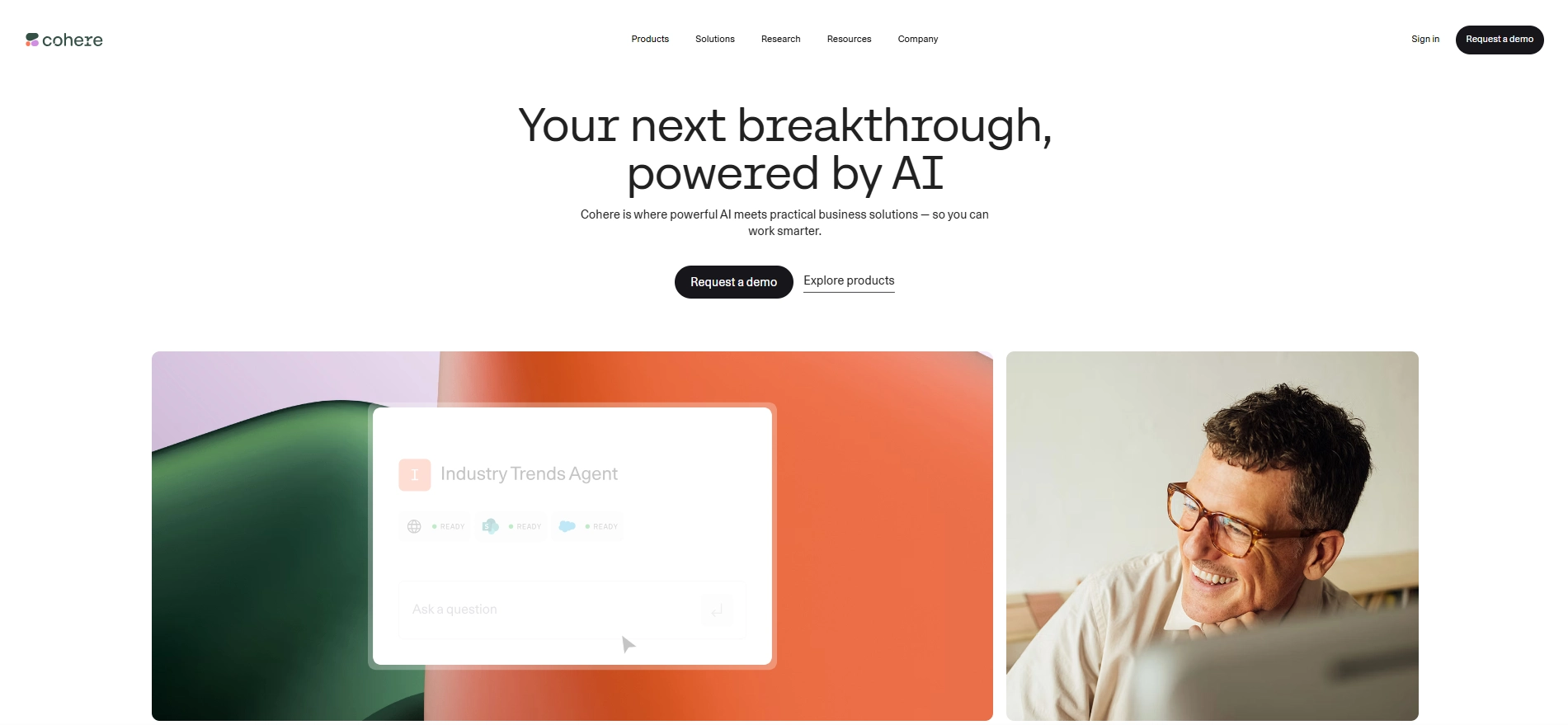
Cohere, headquartered in Toronto, is Canada's flagship large language model company. It belongs on this list with a caveat: Cohere is a model and platform provider, not a services firm. You will not hire Cohere to build your application; you will license its Command family of generation models, its Embed and Rerank retrieval models, and its enterprise platform, then integrate them with your own team or a development partner.
Where Cohere stands out is deployment flexibility. Its models can run as SaaS, inside your private cloud (VPC), or fully on-premise, which matters for banks, healthcare organizations, and public-sector buyers that cannot send data to a shared API. For regulated Canadian enterprises that want strong language models without surrendering data control, it is the default domestic option.
Features:
- Enterprise-ready LLMs with customization: Command and Aya model families with fine-tuning options on your own data.
- Semantic retrieval and reranking: Embed and Rerank models that power context-aware search and grounded generation.
- Hybrid deployment flexibility: SaaS, private cloud, or on-premise installation with strong data governance controls.
- Workplace AI products: North, Cohere's secure agent platform for internal workflows and knowledge retrieval.
Client Industries Served:
Technology, Financial Services, Healthcare and Life Sciences, Manufacturing, Energy and Utilities, Public Sector.
3. AltaML
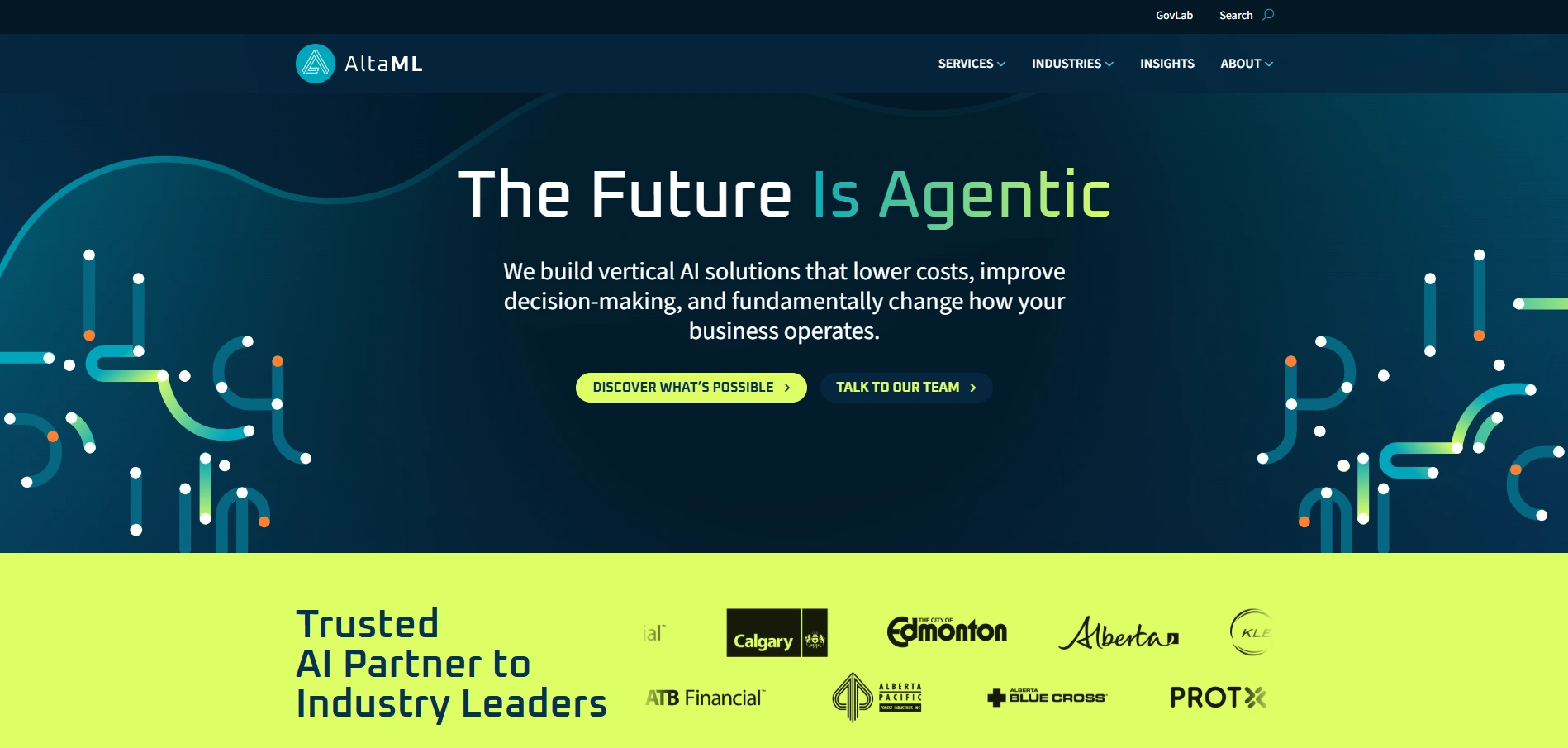
Edmonton-based AltaML is one of Canada's largest applied machine learning firms. Its model is co-development: rather than delivering a finished black box, AltaML embeds its data scientists alongside your team, so your organization builds internal AI literacy while the system gets built. That approach suits enterprises and public-sector organizations that intend to run many AI initiatives, not just one.
AltaML is also disciplined about feasibility. Engagements start with an assessment of whether the data, the business case, and the operational owner actually exist before committing to a build, which reduces the failure mode of modeling projects that were never viable.
Features:
- Agentic development on AltaForge: A platform for building and operating autonomous AI agents inside business workflows.
- Feasibility-first assessments: Structured evaluation of data readiness and business value before full development begins.
- Vertical specialization: Deep applied work in finance, energy, healthcare, and manufacturing.
- Applied AI Lab co-development: Your team participates directly in pilots and model development with AltaML's practitioners.
Client Industries Served:
Financial Services, Energy and Resources, Healthcare, Manufacturing, and Public Sector.
4. Osedea
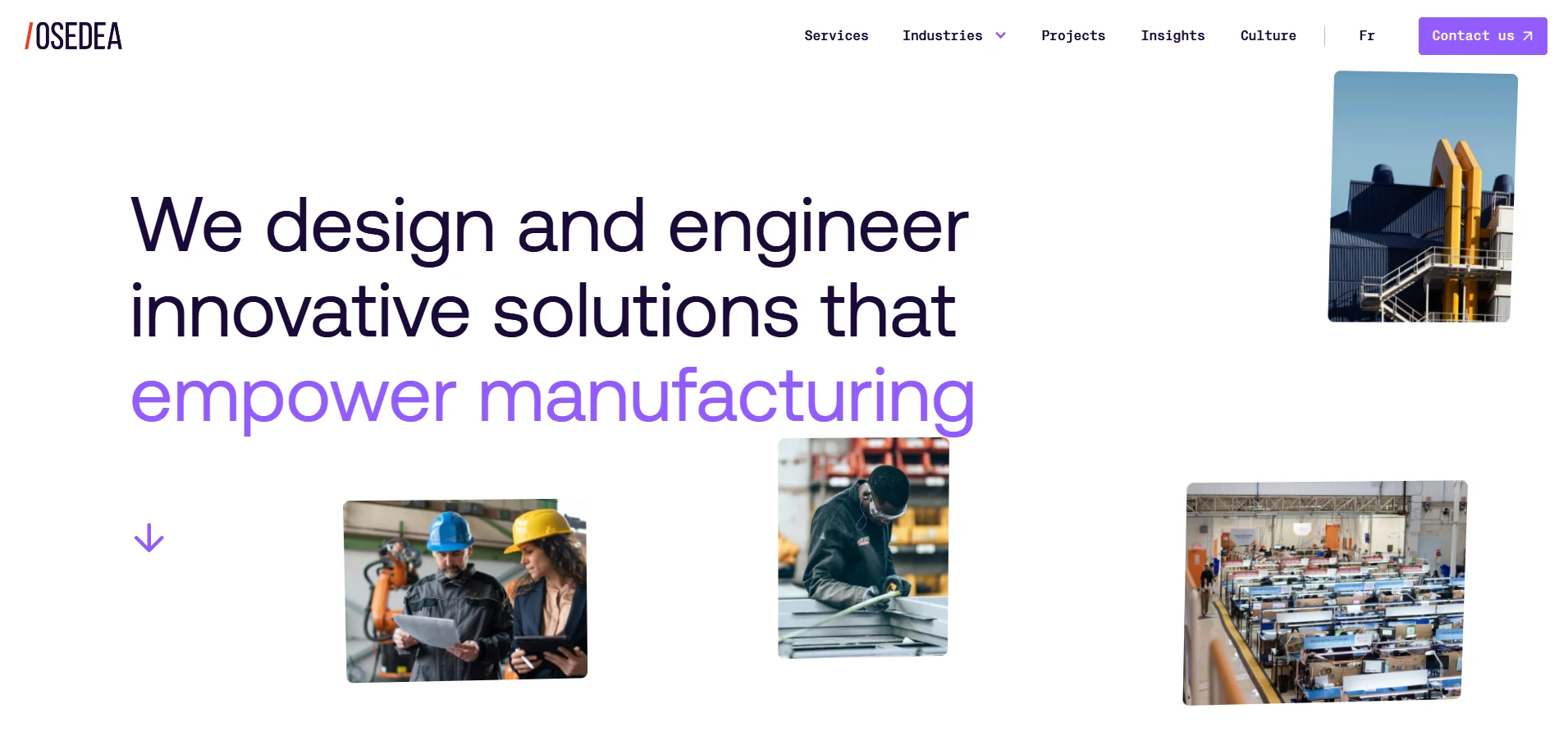
Montreal-based Osedea combines human-centred design with solid engineering, and it is one of the few Canadian firms with real experience taking AI beyond screens into physical operations: robotics, computer vision on factory floors, and anomaly detection in industrial processes.
Osedea's process starts with an audit and feasibility workshop before any build, which protects you from paying for a system the data cannot support. Delivered systems come as complete applications, with the ingestion pipelines, interfaces, and deployment infrastructure needed to run in production.
Features:
- Custom AI pipelines: Purpose-built workflows from data ingestion through deployment.
- Agentic and orchestration systems: Agent architectures built on LangGraph, Semantic Kernel, or custom logic.
- Vision and anomaly detection: Computer vision for quality inspection and process automation in industrial settings.
- AI project auditing and ROI planning: Workshops and audits that validate feasibility before full build-out.
Client Industries Served:
Manufacturing, Mining, Automation, Healthcare, Construction, and Public Sector.
5. Architech
Toronto-based Architech is a software consultancy that approaches AI from the product engineering side. Its background is cloud-native application development and platform modernization, which makes it a strong choice when the real project is not "build a model" but "modernize a legacy platform and add intelligent features along the way."
That framing matters. Many AI initiatives stall because the surrounding software estate cannot support them: data is locked in monoliths, APIs do not exist, deployment is manual. A firm that fixes the platform and integrates AI in the same engagement removes the most common blocker.
Features:
- AI integration and automation: AI modules integrated into existing systems to automate tasks and workflows.
- Custom software development: Intelligent applications built around your business logic, not a template.
- Generative tools and models: Solutions for content, conversational, and media generation use cases.
- Cloud-native modernization: Replatforming and API work that makes AI adoption practical on older systems.
Client Industries Served:
Education, HR and Recruitment, SaaS, Enterprise Tools, and Business Services.
6. Diligence Technologies Inc.
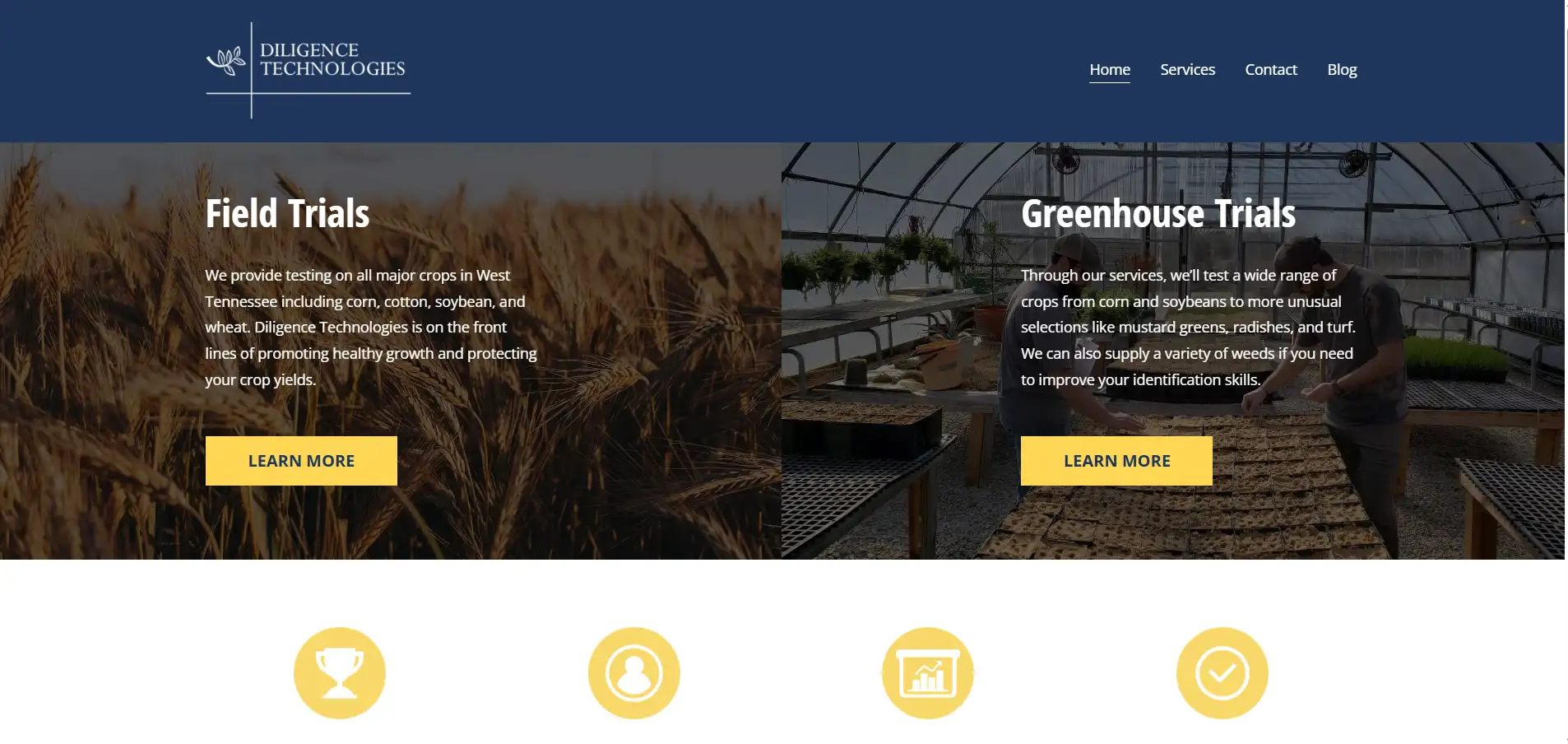
Diligence Technologies positions itself around embedding AI into core business operations rather than bolting on surface-level automation. Its portfolio spans generative AI builds, conversational agents, and AI-enabled mobile and web applications, with an emphasis on integrating models into the systems a business already runs.
The firm is a reasonable shortlist candidate when your primary need is a conversational or content-generation system delivered as part of a broader application, rather than heavy custom modeling.
Features:
- Generative AI development: Content and media generation systems adapted to your data.
- AI agent and chatbot design: Conversational agents that automate support and internal tasks.
- AI app development: Predictive, NLP, and vision models embedded in mobile and web applications.
- AI integration services: Model integration into existing systems and workflows.
- AI automation tooling: Pipelines for decision support and repetitive task automation.
Client Industries Served:
Healthcare, Insurance, Education, Retail, Manufacturing, and EdTech.
7. deltAlyz
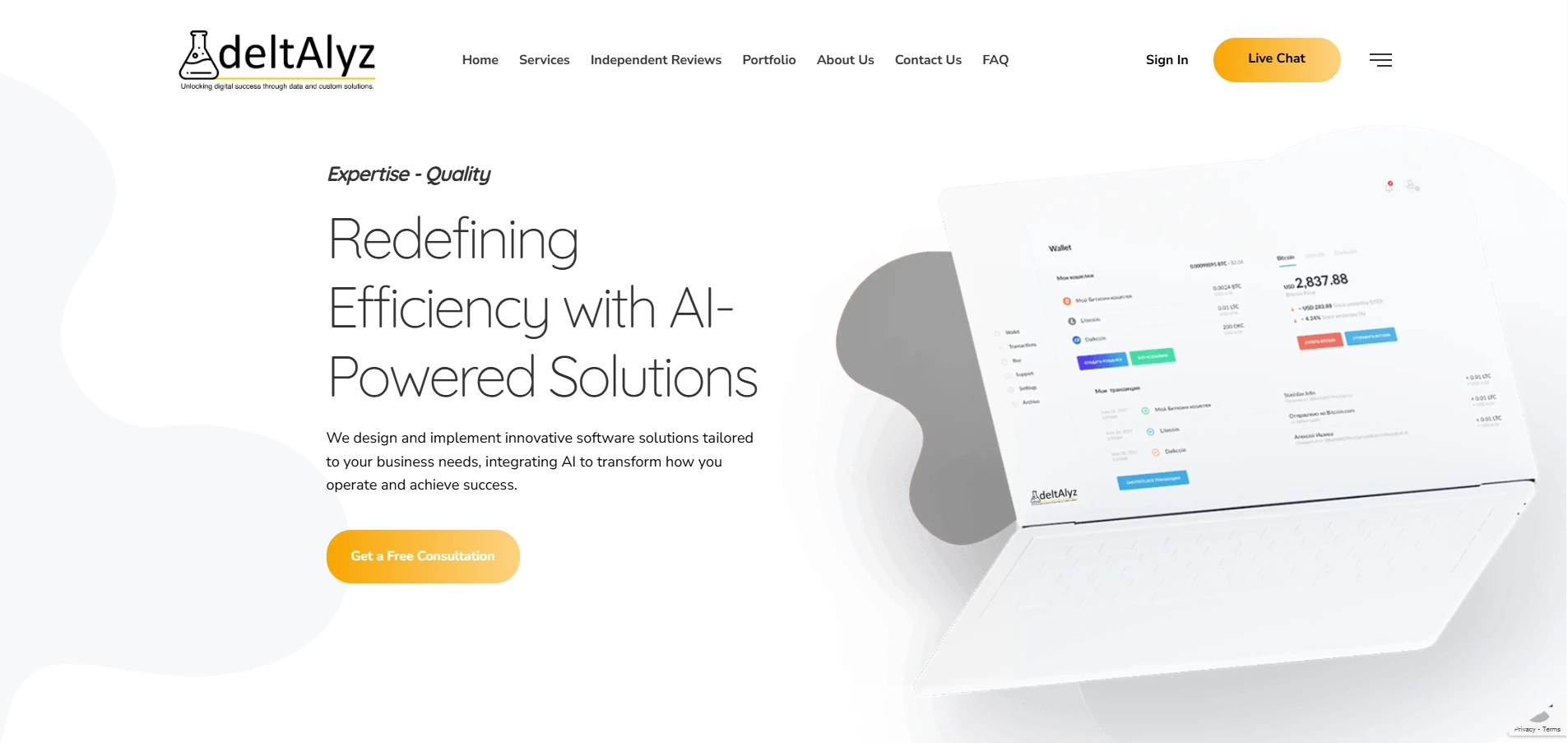
Founded in 2019, deltAlyz builds custom AI and machine learning systems with a focus on integration: its solutions are designed to plug into the ERP, BI, and operational systems a client already uses rather than requiring a parallel stack. That makes it a practical option for mid-market companies that want predictive capability inside their existing dashboards and workflows.
The firm's work spans autonomous agents, tailored ML models, and analytics, with delivery experience across industrial and education sectors.
Features:
- Agentic AI and autonomous agents: Systems that act on your data with minimal human direction.
- Custom AI and ML modeling: Algorithms fitted to your workflows instead of generic off-the-shelf models.
- Systems integration and AI pipelines: Embedding of AI into the software you already operate.
- Advanced analytics and BI: Predictive insight and trend modeling delivered inside your dashboards.
Client Industries Served:
Education, Manufacturing, Retail, Mining, and Construction.
How to Choose the Best AI Development Company in Canada
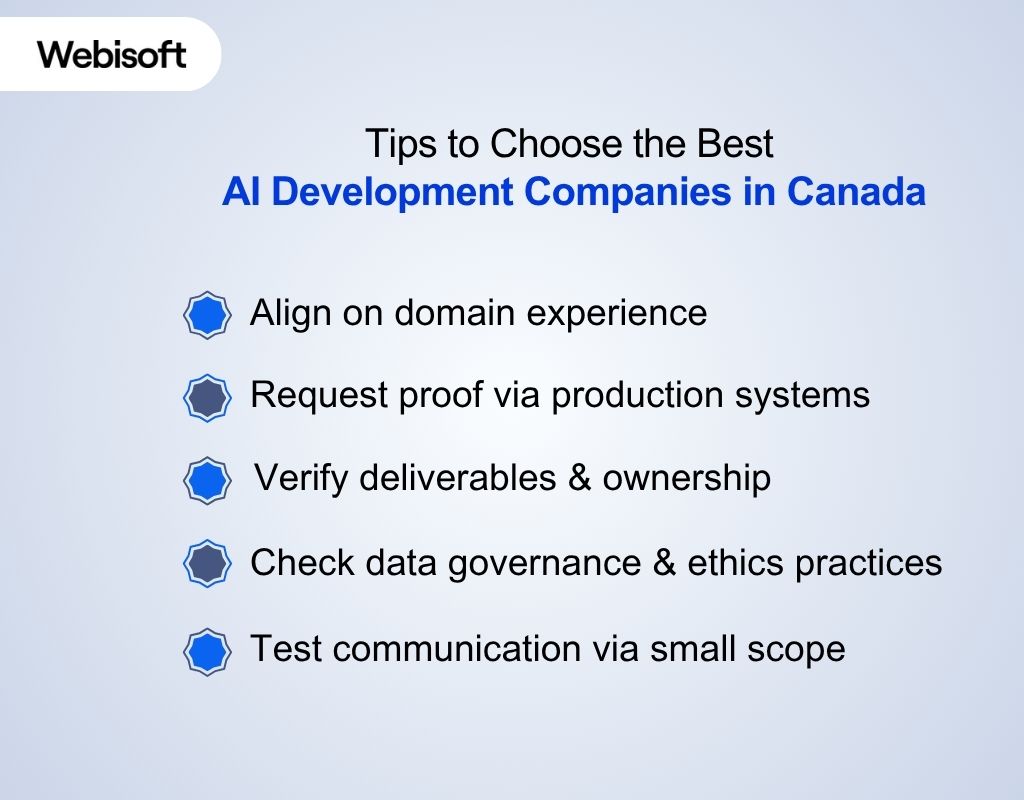
A ranked list narrows the field; the vetting process picks the winner. Use these checks before signing with any AI development company in Canada:
- Align on domain experience: Prefer firms with delivered work in industries close to yours (healthcare, finance, logistics) so they already understand your data constraints and regulatory context.
- Demand production evidence, not demos: Ask to see systems running in live operations, and ask how they are monitored, evaluated, and retrained. A demo proves a model can work once; production proves it works every day.
- Verify deliverables and ownership: Your contract should give you the model weights, source code, prompts, evaluation sets, and data pipelines. If a vendor retains the model, you are renting a capability, not building an asset.
- Check data governance: Confirm the vendor can meet PIPEDA, Quebec's Law 25 where applicable, and any data-residency requirements you carry. Ask specifically where training data and inference logs are stored.
- Probe MLOps maturity: Ask how they handle model drift, evaluation harnesses, rollback, and versioning. Firms without answers here deliver systems that silently degrade.
- Understand total cost of ownership: The build is only part of the cost. Get estimates for inference, hosting, monitoring, and retraining so the operating budget does not surprise you a year in.
- Start with a bounded pilot: A small, fixed-scope proof of concept tests communication, velocity, and honesty before you commit to a full build.
Work With Webisoft: Your AI Development Company in Canada
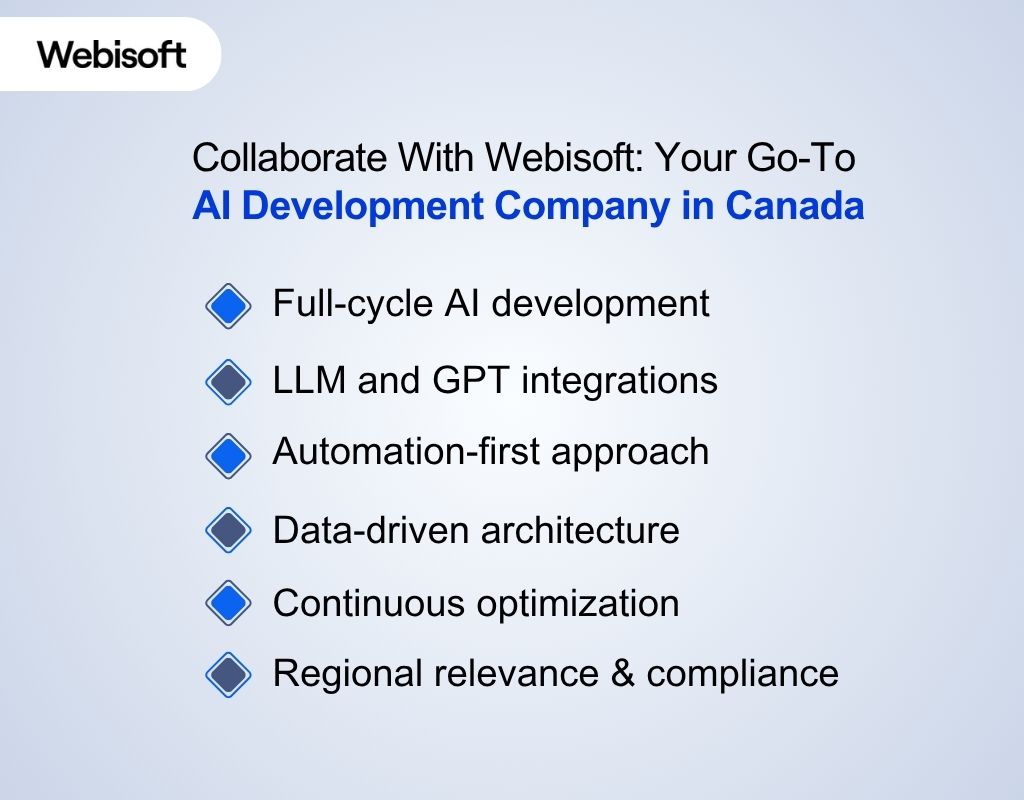
If you want a partner that carries a project from first analysis to a monitored production system, Webisoft builds AI solutions designed to run reliably and scale with your business. The same team also serves clients across the border; see our overview of AI development services in the USA.
- Full-cycle AI development: Strategy, data work, custom modeling, integration, and deployment handled by one accountable team.
- LLM and GPT integrations: Language model systems grounded in your own documents and data, with retrieval and context engineering done properly.
- Automation-first design: Systems built to remove manual steps and improve decisions, with measurable before-and-after baselines.
- Data-driven architecture: Models trained, tested, and tuned on clean, validated datasets, with evaluation built into delivery.
- Continuous optimization: Retraining and refinement after launch so accuracy holds as your data changes.
- Canadian compliance context: A Montreal-based team that works under PIPEDA and Quebec's Law 25 daily, and designs data flows accordingly.
Conclusion
Canada offers one of the strongest environments anywhere to buy AI development: publicly funded research institutes feeding the talent pool, federal investment in compute, and a legal regime that forces good data practice. Every AI development company in Canada on this list has earned its place, but they solve different problems: Cohere sells the models, AltaML teaches you to build, Osedea takes AI onto the factory floor, and Webisoft delivers complete production systems end to end.
Match the firm to the shape of your problem, insist on production evidence and ownership of the deliverables, and start with a bounded pilot. If you want a single team that takes an idea from feasibility analysis to a system your business runs every day, contact Webisoft.
Frequently Asked Questions
Ready to move from shortlist to shipped product? Talk to a Montreal based team that builds AI systems for a living. Tell us what you are trying to automate, predict, or launch, and we will tell you plainly what it takes. Explore our custom AI development services and book a conversation with our engineers today.
Canada combines publicly funded research institutes (Mila, Vector, Amii) that feed the talent pool, federal investment in AI compute, and a strict privacy regime under PIPEDA and Quebec's Law 25. The result is a deep bench of firms with research-literate engineers who are used to building under real data governance constraints.
They solve different problems. A model provider such as Cohere sells the language models and platform; you still need engineers to integrate them into your systems. A development firm such as Webisoft delivers the complete working system: data pipelines, model integration, interfaces, and deployment. Many projects use both, with the development firm building on the provider's models.
Your contract should transfer the source code, model weights or fine-tunes, prompts, evaluation sets, and data pipelines to you. If the vendor retains the model, you are renting a capability rather than building an asset, and switching vendors later becomes expensive.
PIPEDA governs how private-sector organizations collect, use, and disclose personal information across most of Canada, and Quebec's Law 25 adds stricter consent, transparency, and residency obligations for data about Quebec residents. Any AI vendor handling personal data should be able to explain where training data and inference logs are stored and how consent is managed.
Start with a feasibility assessment of your data before committing to a build, insist on production evidence rather than demos when selecting a vendor, and run a bounded, fixed-scope pilot first. Also budget for the full lifecycle: monitoring, evaluation, and retraining are what keep a model accurate after launch.
Webisoft is a Montreal-based firm that handles the full AI lifecycle: strategy and feasibility analysis, custom model development, LLM and GPT integration, document digitization (OCR), automated decision systems, Model Context Protocol servers, and ongoing retraining and support after deployment.