Key takeaways
- Adaptive AI describes systems that revise their own behavior after deployment, retraining or fine-tuning on new data on a schedule or in near real time without a full manual rebuild.
- Traditional models are trained once and frozen, so their accuracy erodes quietly as customer behavior, fraud patterns, or supply conditions drift away from the training data.
- Adaptive systems fix that failure mode by building the learning loop into the running system, treating deployment as the start of learning rather than the end.
- Feedback loops feed new observations back into the model, keeping predictions accurate as live data changes in production.
- Gartner has named adaptive AI a key trend, and it has moved from research into mainstream enterprise planning.
- The full guide covers how adaptive AI works technically, its core components, where it outperforms static models, practical use cases, and what production implementation takes.
At Webisoft, we build adaptive AI systems for real businesses, software that learns from live data and adjusts its behavior in production instead of going stale after launch. It is one of the most requested capabilities we engineer for enterprises, CTOs, and product teams, and one of the most misunderstood.
This guide is the practical explanation we give our own clients. It covers what adaptive AI actually is, how it differs from traditional machine learning, where it creates real business value, and what it takes to build a system that keeps improving after deployment.
Most production machine learning systems degrade quietly. A model trained on last year's data meets this year's customers, fraud patterns, or supply conditions, and its accuracy erodes without anyone changing a line of code. Adaptive AI addresses that failure mode directly. Instead of freezing a model at training time, it builds the learning loop into the running system, so the model updates as the data changes.
This guide covers how adaptive AI works at a technical level, the components behind it, where it outperforms static models, practical adaptive AI use cases, and what it takes to implement adaptive AI solutions in production.
What is Adaptive AI?
Adaptive AI describes systems that revise their own behavior after deployment. New observations flow back into the model through feedback loops, and the system retrains or fine-tunes itself, on a schedule or in near real time, without a full manual rebuild. Traditional models are trained once, validated, and shipped; whatever they learned is fixed until an engineer retrains them. An adaptive system treats deployment as the start of learning, not the end.
The idea has moved from research into mainstream enterprise planning. Gartner named adaptive AI one of its top strategic technology trends for 2023, predicting that enterprises adopting AI engineering practices to build and manage adaptive systems would outperform peers in operationalizing models by at least 25 percent by 2026.
The practical payoff is resilience. Fraud tactics change weekly, demand curves move with seasons and shocks, and user preferences drift. A system that keeps learning stays calibrated to the environment it actually operates in. A static one is only accurate for the world it was trained on.
How Adaptive AI Works
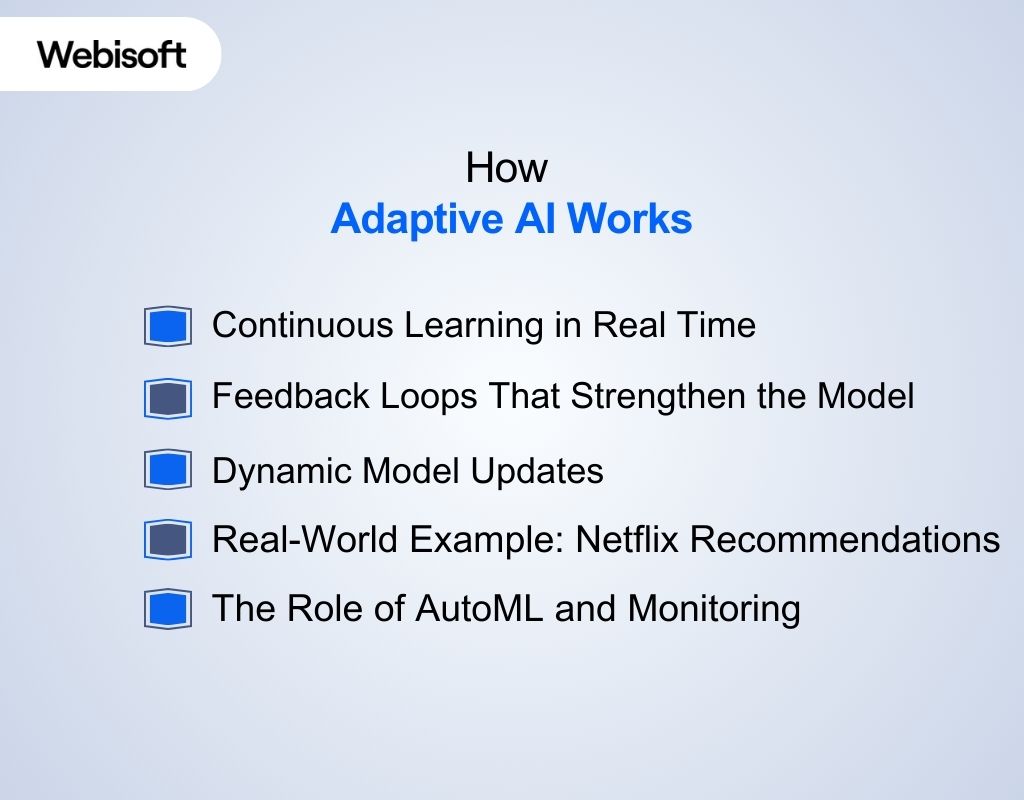
Under the hood, an adaptive system is a closed loop with five stages. Each stage is an engineering problem in its own right, and the quality of the whole system depends on the weakest one.
Outcome Capture
Every prediction is logged alongside what actually happened: the transaction flagged as fraud that a human analyst confirmed or overturned, the recommendation that was clicked or ignored, the forecast compared against realized demand. Without reliable ground-truth labels flowing back, there is nothing to learn from. This is usually the hardest part to get right, because labels often arrive late, partially, or with their own biases.
Drift Detection
The system continuously compares live input distributions and prediction accuracy against training baselines, using statistical tests such as population stability index or Kolmogorov-Smirnov checks. When the data the model sees no longer resembles the data it learned from, that is concept drift, and it is the trigger for adaptation rather than a fixed calendar.
Model Update
Depending on the algorithm, the update is either incremental (online learning methods that adjust weights on each new batch) or a full retrain on a refreshed window of data. Incremental updates are cheap and fast but risk catastrophic forgetting, where the model loses older patterns it still needs. Full retrains are safer but slower and more expensive. Most production systems blend both.
Evaluation Gates
A candidate model never replaces the live one on faith. It is scored against holdout data, checked against fairness and business guardrails, and typically run in shadow mode, receiving live traffic and making predictions that are recorded but not acted on. A champion and challenger setup keeps the current model in place until the new one demonstrably beats it.
Controlled Deployment and Monitoring
Promotion happens through canary releases, a small slice of traffic first, then progressively more. Monitoring then restarts the loop. Automated machine learning (AutoML) tooling often orchestrates the retraining and candidate selection steps, so the pipeline can propose, test, and promote models with limited human intervention.
A Familiar Example: Streaming Recommendations
Netflix's recommendation engine is one of the most visible adaptive AI examples. It adjusts suggestions as viewers watch, abandon, or rewatch content, so two accounts with similar starting profiles diverge quickly based on behavior. The same loop structure, capture, evaluate, update, sits behind fraud scoring at a bank or demand forecasting at a retailer.
Webisoft builds adaptive systems with this full loop in place, not just the model. See our adaptive AI development services for how we design, deploy, and operate continuously learning systems.
Key Components of Adaptive AI
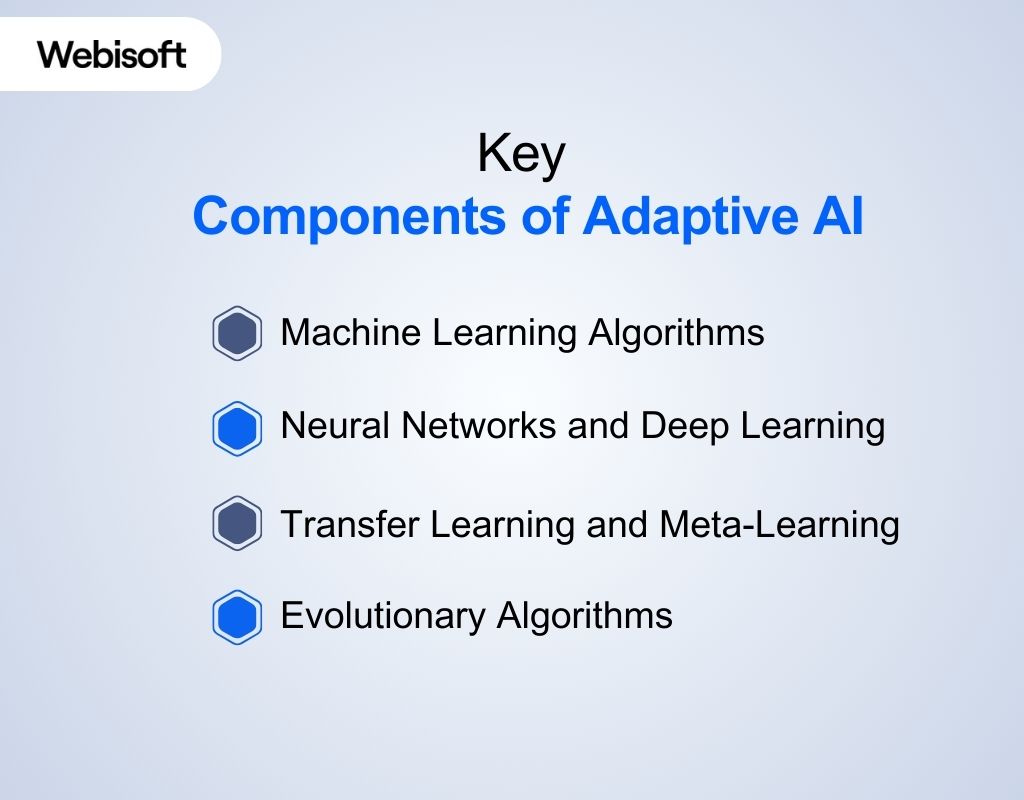
A workable adaptive AI architecture combines several techniques. Which ones you need depends on the problem, but most production systems draw on the following.
Machine Learning Algorithms with Online Capability
The base layer is a model family that supports incremental updates: online gradient descent, streaming variants of gradient boosting, or periodically fine-tuned neural networks. Supervised learning handles labeled outcomes, unsupervised methods surface new clusters and anomalies in unlabeled streams, and the choice constrains how fast and how cheaply the system can adapt.
Neural Networks and Deep Learning
For unstructured inputs such as text, images, and speech, deep networks provide the representation power. In an adaptive setting they are rarely retrained from scratch; instead the later layers are fine-tuned on recent data while earlier layers, which encode general features, stay frozen. That keeps update costs manageable.
Transfer Learning and Meta-Learning
Transfer learning reuses knowledge from one task to bootstrap another, which matters when a new market or product line has little historical data. Meta-learning goes a step further: the system learns how to learn, optimizing its own adaptation strategy so it needs fewer examples to adjust to a new pattern.
Reinforcement Learning
Where the system takes actions and observes rewards, pricing, bidding, routing, dialogue, reinforcement learning fits naturally. The agent improves its policy from consequences rather than labels, which is exactly the adaptive loop expressed as a training objective. The trade-off is that exploration has a real cost in production, so guardrails on what the agent may try are essential.
Evolutionary Algorithms
Evolutionary methods maintain a population of candidate solutions, score them, and recombine the best performers. They are useful for optimizing model architectures and hyperparameters over time, especially where the search space is too irregular for gradient methods.
Drift Monitoring and Data Infrastructure
The least glamorous component carries the most weight: versioned data pipelines, a feature store that serves identical features to training and inference, and monitoring that distinguishes data drift (inputs changed) from concept drift (the relationship between inputs and outcomes changed). Teams that skip this layer end up with adaptive models learning from broken data.
Benefits of Adaptive AI
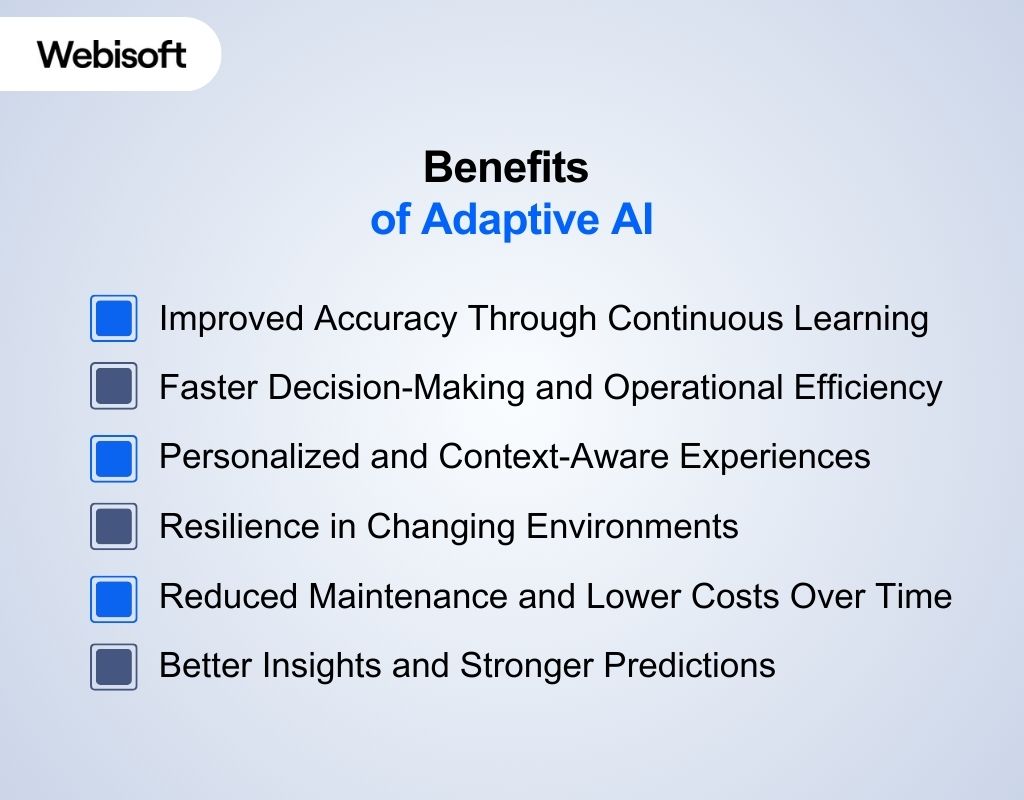
The benefits of adaptive AI follow directly from the loop described above. Compared with static models, the differences show up in accuracy over time, operating cost, and how the system behaves when the environment shifts.
Accuracy That Holds Up Over Time
Static models are most accurate on day one and decay from there. Adaptive models track the data, so accuracy in month twelve looks like accuracy in month one, or better, because the system has accumulated more labeled outcomes. In domains like fraud detection and demand forecasting, that difference compounds.
Faster Response to New Conditions
When a new fraud pattern, supply disruption, or customer segment appears, an adaptive system starts incorporating it within hours or days instead of waiting for the next quarterly retraining project. Decisions stay aligned with current reality rather than the last training snapshot.
Personalization That Improves With Use
Because the model updates on individual behavior, recommendations, content, and interfaces become more relevant per user over time. This is the mechanism behind effective personalization in e-commerce, media, education, and healthcare, and it cannot be replicated by a model that treats preferences as fixed.
Lower Maintenance Burden
Manual retraining is a recurring engineering project: pull data, retrain, validate, redeploy. An adaptive pipeline automates that cycle, so the team's effort shifts from repetitive retraining to monitoring and governance. Over a system's lifetime that is a substantial cost reduction, though it is not free: the monitoring and evaluation infrastructure must be built and maintained.
Resilience in Volatile Environments
Finance, logistics, and retail operate under constant change. Adaptive systems degrade gracefully when conditions shift because adjustment is built in, whereas static systems fail silently until someone notices the numbers are off.
Earlier Detection of New Patterns
A system that continuously compares live data against expectations surfaces emerging trends and anomalies as a side effect. That makes adaptive systems useful not just for automation but for decision intelligence: they tell you when the world has changed.
Traditional AI vs Adaptive AI
Traditional AI models operate on fixed training data and stable assumptions. They perform well when the environment matches the training distribution and degrade when it does not. Adaptive artificial intelligence trades additional infrastructure complexity for the ability to track a moving target.
Key Differences Between the Two Approaches
| Feature | Traditional AI | Adaptive AI |
|---|---|---|
| Learning Method | Static learning from historical data | Continuous learning from live data |
| Adaptability | Fixed after deployment | Updates as conditions change |
| Maintenance | Manual retraining projects | Automated retraining pipeline |
| Performance Over Time | Decays as data drifts | Holds or improves with more data |
| Handling Uncertainty | Fails silently on unexpected change | Detects and adjusts to drift |
| Governance | Simple: one model, one audit | Harder: model changes continuously |
| Use Case Fit | Stable, rule-bound tasks | Dynamic, high-variation tasks |
When Adaptive AI Is the Right Choice
Adaptive AI is not universally superior. If the underlying process is stable, a static model is cheaper to build, easier to audit, and simpler to certify for regulators. Choose adaptive AI when the data-generating process itself changes: fraud, markets, consumer behavior, equipment wear, traffic. The rule of thumb is simple: if yesterday's model is measurably worse than today's would be, you need the loop.
Adaptive AI Use Cases
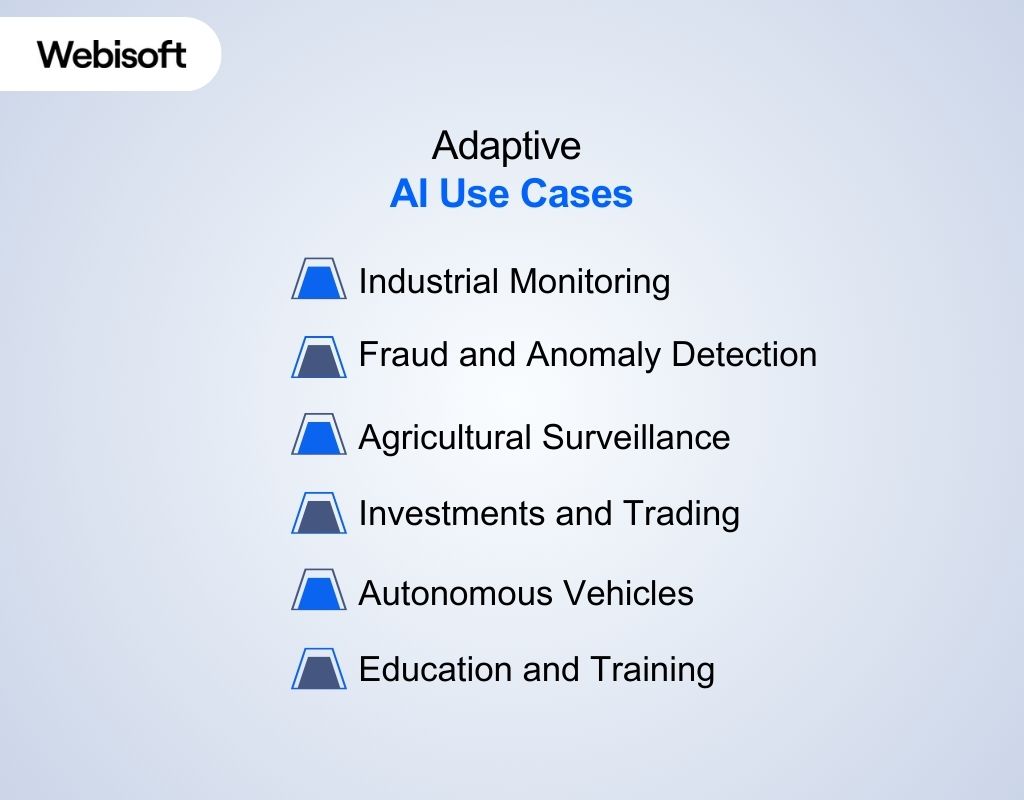
These adaptive AI use cases share a common trait: the environment changes fast enough that a static model would need constant manual retraining to stay useful.
Fraud and Anomaly Detection
Fraud is adversarial by definition: attackers probe the model and change tactics when blocked. Adaptive scoring incorporates confirmed fraud outcomes within hours, closing the window in which a new tactic works. Static rules, by contrast, are reverse-engineered and bypassed.
Industrial and Predictive Maintenance
Sensor baselines shift as equipment ages, is serviced, or runs under new loads. Adaptive monitoring recalibrates what "normal" means per machine, which cuts false alarms and catches genuine degradation earlier than fixed thresholds.
Supply Chain and Demand Forecasting
Demand responds to promotions, weather, competitor moves, and macro shocks that no historical training set anticipates. Continuously updated forecasts shorten the lag between a shift in demand and a corrected plan for inventory and logistics.
Investments and Trading
Market regimes change, and a strategy fitted to one regime loses money in the next. Adaptive models re-estimate relationships between signals and returns as new data arrives, and flag when confidence should drop because the current regime looks unfamiliar.
Autonomous Vehicles and Robotics
Vehicles and robots operate in environments that cannot be fully enumerated in advance. Fleet learning aggregates edge cases encountered in the field, retrains centrally, and pushes improved models back out, so every unit benefits from what any unit encounters.
Personalized Recommendations
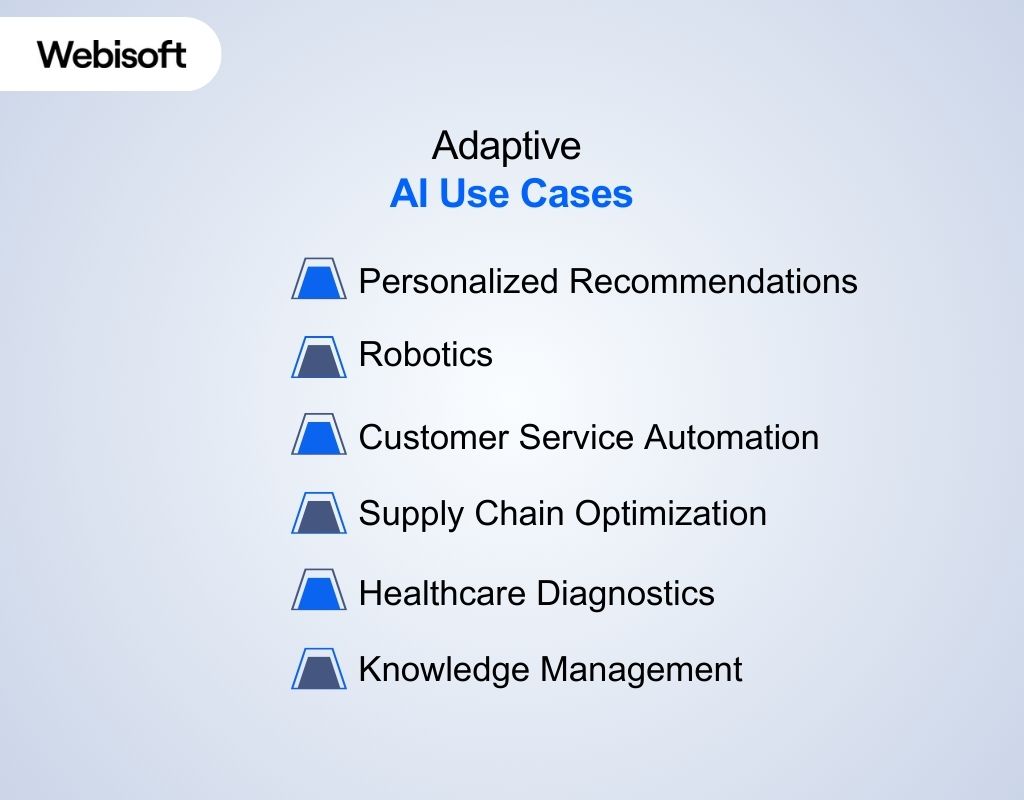
Streaming platforms, marketplaces, and social apps update per-user models on every session. Relevance improves with each interaction, which drives engagement and retention in a way batch-trained recommenders cannot match.
Customer Service Automation
Adaptive assistants learn from resolved conversations which answers actually close tickets, improving routing and response quality over time instead of repeating the same scripted failures.
Education and Training
Adaptive learning platforms adjust difficulty, pacing, and content per student based on demonstrated mastery, rather than pushing every learner through the same sequence.
Healthcare Diagnostics
Diagnostic models improve as they accumulate confirmed cases, and adaptive calibration helps a model trained at one institution stay accurate on another institution's patient population and equipment. Regulatory oversight makes update governance especially important here.
Agricultural Monitoring
Crop and field models adapt to local soil, weather history, and disease pressure, turning generic agronomy models into farm-specific ones that flag stress and disease earlier.
Knowledge Management
Enterprise search and classification systems learn from which results users actually open and reuse, steadily improving retrieval relevance across large document sets.
How to Implement Adaptive AI
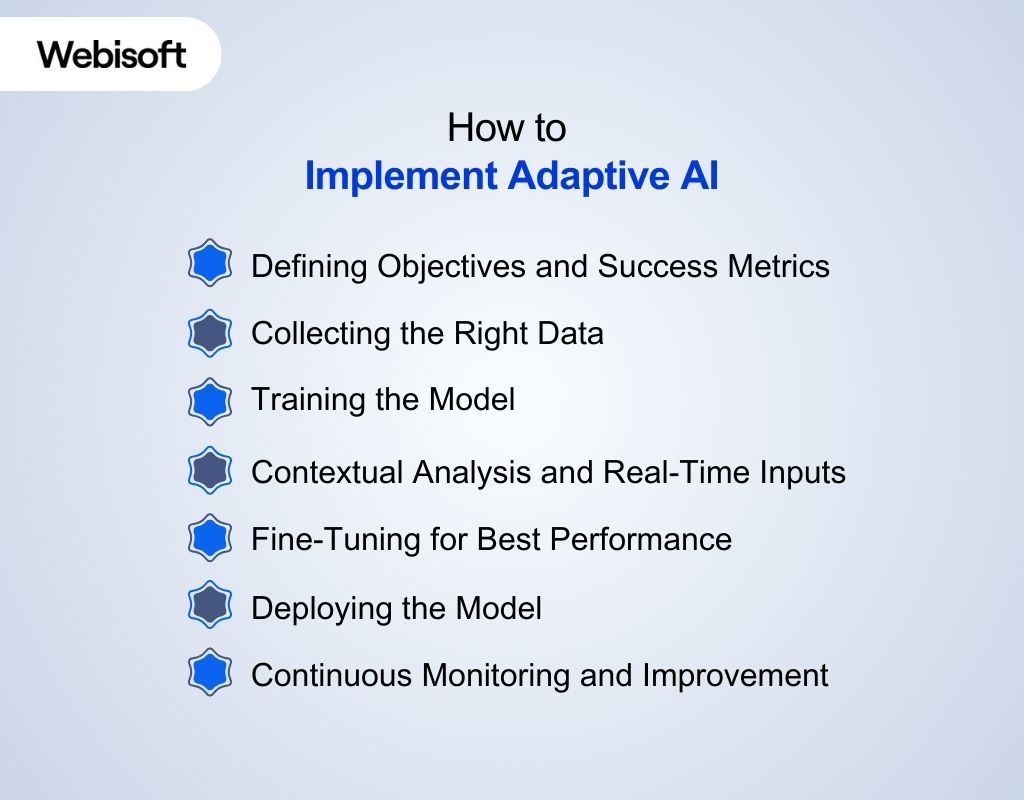
Implementing adaptive AI is as much a data-engineering project as a modeling one. The sequence below reflects how production systems actually get built.
Define Objectives and Success Metrics
Pick one decision the system will improve (fraud approval, reorder quantity, next-best content) and define the metric that proves it: precision at a fixed false-positive rate, forecast error, conversion lift. Also define the guardrails, the metrics the system must never degrade, because the evaluation gates will enforce them automatically.
Build the Data and Label Pipeline First
Before any model, establish the flow of outcomes back into the system: what counts as ground truth, how long labels take to arrive, and how they are stored and versioned. Late or unreliable labels are the most common reason adaptive projects stall.
Train and Validate a Baseline Model
Start with a conventionally trained model and measure it honestly on held-out data. The baseline defines what the adaptive loop must beat, and it becomes the first champion in a champion and challenger setup.
Add Real-Time Context
Feed the model the freshest signals available, current session behavior, live sensor readings, recent transactions, through a feature store so the same features serve training and inference identically. Mismatched features between the two are a classic silent failure.
Wire the Adaptation Loop
Add drift detection, automated retraining triggered by drift or schedule, and evaluation gates with shadow deployment. Decide deliberately between incremental updates and periodic full retrains based on how fast your data moves and how expensive training is.
Deploy With Rollback
Promote new models through canary releases with automatic rollback on metric regression. Every model version, its training data window, and its evaluation results should be recorded so any decision can be traced to the model that made it.
Monitor and Improve Continuously
Track accuracy, drift indicators, latency, and fairness metrics on dashboards with alerts. The loop runs itself, but humans own the thresholds, the guardrails, and the judgment calls when the system flags something unfamiliar.
Best Practices for Adaptive AI Implementation
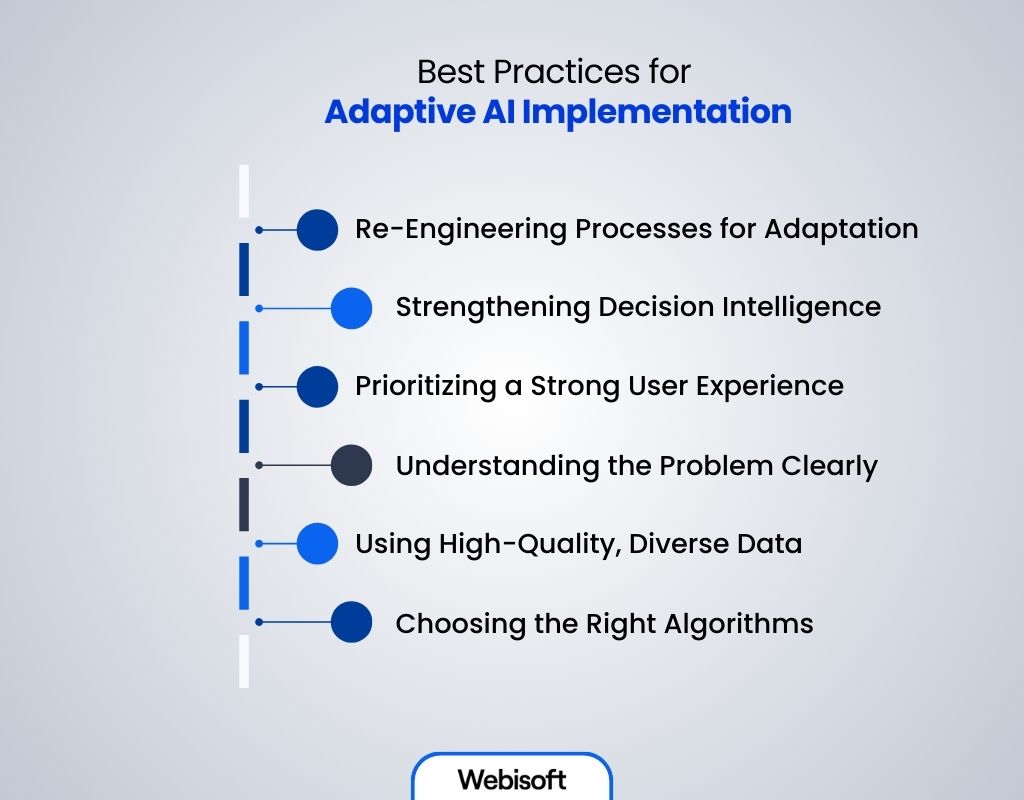
Teams that succeed with adaptive AI solutions treat the following as requirements, not options.
Design Workflows Around the Loop
Adaptation fails if human processes fight it. If analysts correct model outputs in a spreadsheet the model never sees, the feedback loop is broken. Route corrections, overrides, and outcomes back into the training data as a first-class part of the workflow.
Handle Concept Drift Proactively
Do not wait for accuracy to fall. Monitor input distributions and prediction confidence so drift is detected before it becomes a business incident, and rehearse the retraining path so it is routine rather than an emergency.
Guard Against Feedback Loop Failure
Adaptive systems can amplify their own mistakes: a recommender that only learns from what it already showed users narrows over time, and a fraud model that never reviews declined transactions cannot learn it was wrong. Reserve a slice of traffic for exploration and audit the loop for these self-reinforcing patterns.
Test Beyond the Happy Path
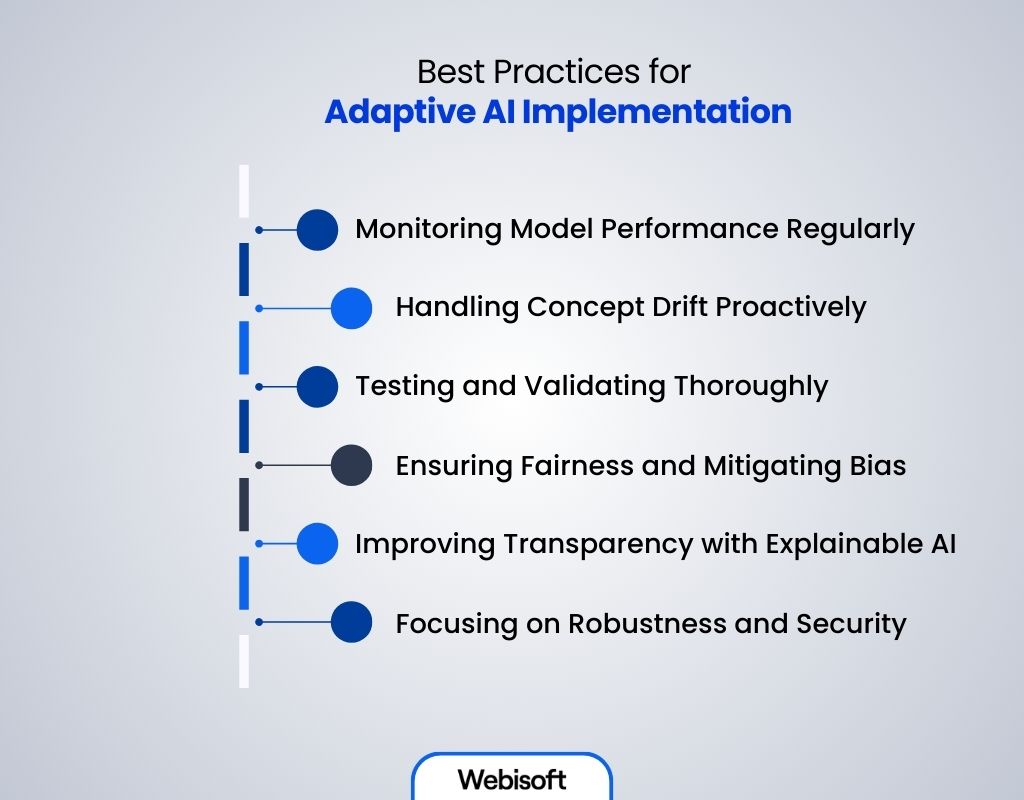
Validate candidate models against edge cases, stress scenarios, and deliberately shifted data, not just random holdouts. An adaptive system will eventually meet inputs no one anticipated; the evaluation suite should approximate that day.
Make Fairness a Gate, Not an Afterthought
Because the model changes continuously, a one-time bias audit is insufficient. Encode fairness checks into the evaluation gates so a candidate model that degrades outcomes for any group is rejected automatically.
Invest in Explainability
Feature attribution and decision explanations matter more in adaptive systems because behavior changes over time. When a model's decisions shift, the team needs to see why, both to debug and to answer customers and regulators.
Secure the Learning Path
The training pipeline is an attack surface. Data poisoning, feeding the system manipulated inputs so it learns the wrong behavior, is specific to systems that learn from live data. Validate and sanitize incoming data, rate-limit any single source's influence on training, and monitor for suspicious input patterns.
Ethical Considerations and Challenges of Adaptive AI
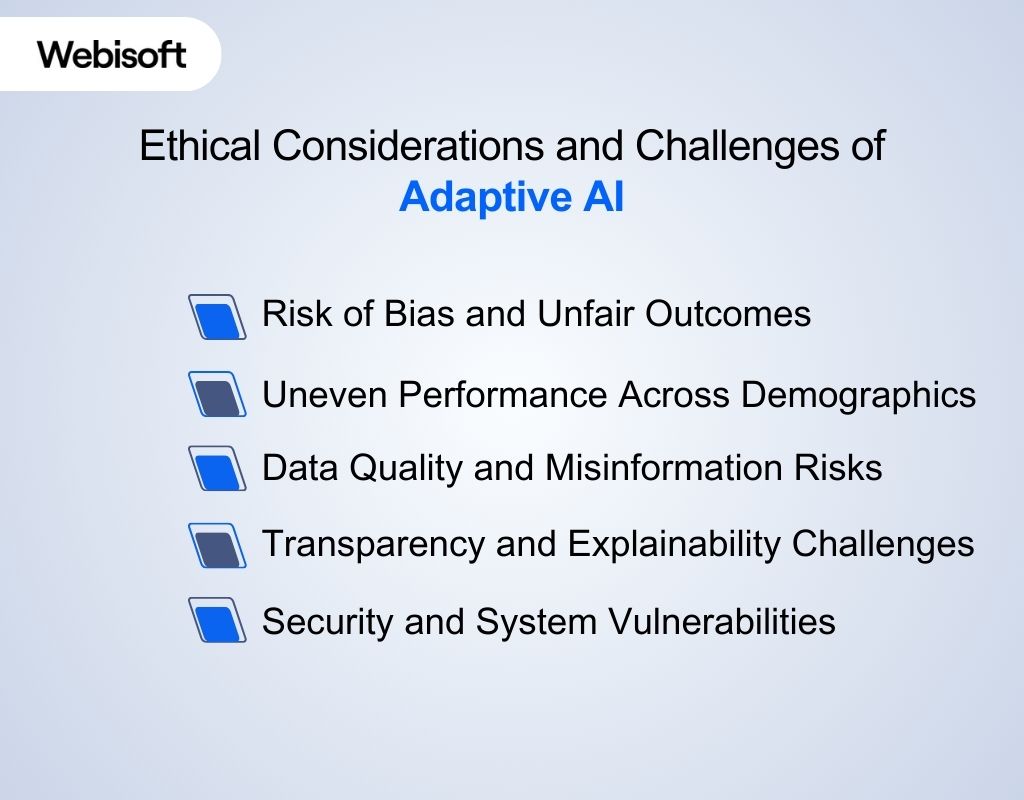
A system that updates itself inherits every bias in the data it learns from, and it can acquire new ones after deployment. That makes governance harder than for static models, where a single pre-launch audit covers the model's whole life.
Bias That Enters Through the Loop
Amazon famously scrapped an experimental hiring model after discovering it penalized resumes associated with women, because it had learned from a historically male-dominated applicant pool. The adaptive lesson is sharper: even a model that launches fair can drift into bias if the outcomes it learns from are themselves skewed. Continuous fairness monitoring is the only durable answer.
Uneven Performance Across Groups
Facial recognition research, including evaluations by the U.S. National Institute of Standards and Technology, has documented accuracy differences across demographic groups tied to unrepresentative training data. Adaptive systems must track subgroup performance over time, not just aggregate accuracy, so that adaptation does not improve the majority case at a minority's expense.
Learning From Bad Data
An adaptive model exposed to low-quality, mislabeled, or manipulated data learns wrong lessons quickly. Strict data governance, validation at ingestion, and quarantine procedures for suspect data are prerequisites, particularly in finance, healthcare, and security.
Transparency and Auditability
When the model changes weekly, "which model made this decision and why" becomes a hard question. Version every model, log every prediction with its model version, and apply explainability tooling so decisions remain traceable months later. This is increasingly a regulatory expectation, not just good practice.
Adversarial Pressure
Systems that learn from user behavior invite manipulation: coordinated fake engagement to steer a recommender, or probing inputs to map a fraud model's blind spots. Treat the learning mechanism itself as a security-critical component with monitoring and abuse detection.
How Webisoft Helps You Implement Adaptive AI
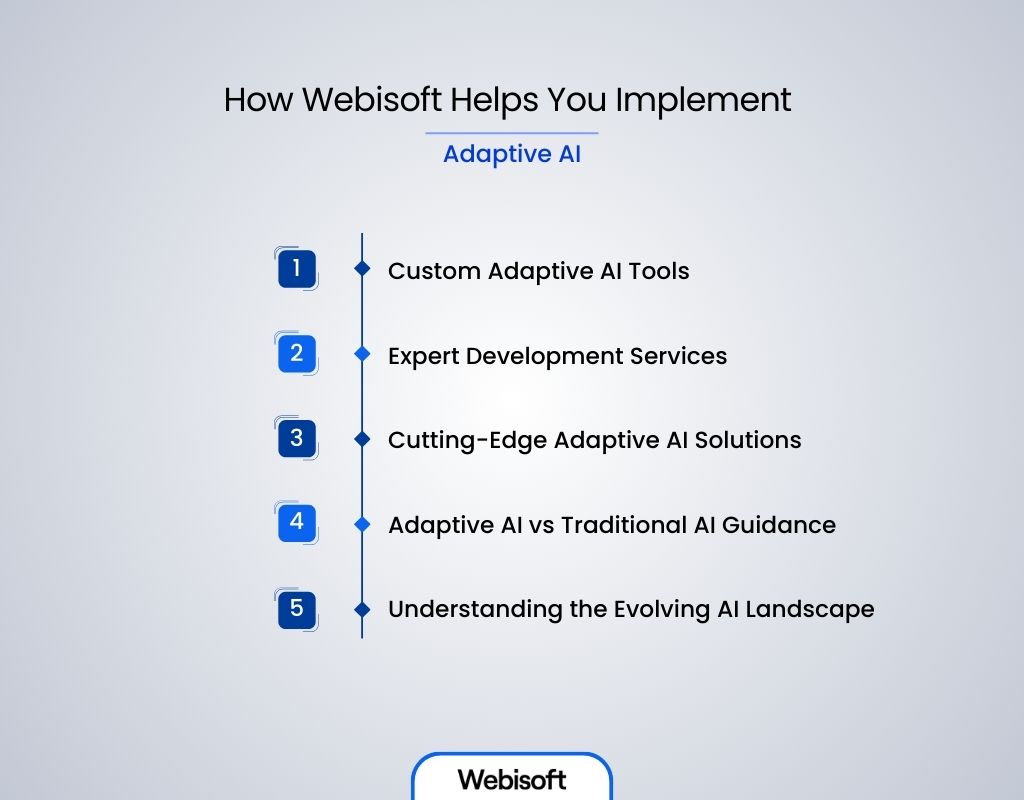
Most adaptive AI projects fail on infrastructure, not algorithms: missing label pipelines, no drift detection, no safe deployment path. Webisoft, a Montreal-based software engineering firm, builds the full system: the model, the data pipeline, the adaptation loop, and the monitoring that keeps it honest.
Custom Adaptive Systems, Not Generic Models
We design the architecture around your specific decision: what the ground truth is, how fast labels arrive, how quickly the data drifts, and what the evaluation gates must protect. The result is a system tuned to your operating reality rather than a demo that degrades in production.
End-to-End Engineering
Our team delivers the complete stack: data ingestion and feature pipelines, model training and drift-triggered retraining, shadow and canary deployment, and dashboards for accuracy, drift, and fairness. It integrates with your existing systems instead of standing beside them.
Honest Guidance on Adaptive vs Static
Not every problem needs an adaptive system, and we will tell you when a simpler static model is the better investment. Where adaptation is justified, we scope the loop to the drift you actually face, so you are not paying for infrastructure you do not need.
Long-Term Operation
Adaptive systems are operated, not just shipped. We set up the monitoring, retraining policies, and governance documentation your team needs to run the system confidently, and we stay available as your data and requirements evolve. Get in touch to discuss where adaptive intelligence fits in your operations.
Final Thoughts
Adaptive AI is the difference between a model that was accurate once and a system that stays accurate. The mechanics are demanding: reliable outcome capture, drift detection, gated retraining, and continuous governance. But for any business whose data moves, fraud, demand, markets, behavior, that investment converts model decay from a recurring crisis into a solved problem.
The right starting point is small and measurable: one decision, one metric, one feedback loop, built on infrastructure that can grow. Static models will keep their place in stable domains. Everywhere else, the systems that learn continuously will simply outperform the ones that do not.
If you want an AI system that keeps learning after it ships, that is what we build. Explore our adaptive AI development services and talk to our engineering team about what an adaptive system would look like for your product.
Adaptive AI is a machine learning system that keeps learning after deployment. It feeds real outcomes back into the model and retrains automatically, so its accuracy tracks changing conditions instead of decaying the way a one-time trained model does.
A traditional model is trained once and stays fixed until an engineer retrains it, so performance degrades as data drifts. An adaptive system detects that drift, retrains on fresh data, validates the candidate model against guardrails, and promotes it automatically. The trade-off is extra infrastructure: outcome capture, drift monitoring, and gated deployment.
Problems where the environment changes faster than a manual retraining cycle: fraud detection, demand and supply chain forecasting, personalized recommendations, predictive maintenance, trading, and customer service automation. If yesterday's model is measurably worse than one trained today, the use case justifies an adaptive loop.
The modeling is usually the easy part. The hard parts are engineering: a reliable pipeline of ground-truth outcomes, drift detection, evaluation gates with shadow deployment, and rollback-safe releases. Teams that build the data and label pipeline first, and start with one decision and one metric, get to production far faster.
No. The loop automates retraining and promotion, but humans set the guardrails, review fairness and drift alerts, and handle situations the system flags as unfamiliar. Because the model changes continuously, governance matters more than for static models, not less.
Yes. Even a model that launches fair can drift into bias if the outcomes it learns from are skewed, or if its own decisions shape the data it sees next. Continuous subgroup monitoring and fairness checks built into the evaluation gates are the standard mitigations.