
Most blockchains operate as islands. Ethereum cannot natively read state from Bitcoin, and an application on one chain cannot call a contract on another without a trusted intermediary. Polkadot was designed to remove that constraint: it connects independent, purpose-built blockchains, called parachains, under one shared security model and lets them exchange messages and assets natively.
For smart contract developers, that architecture raises the ceiling on what a contract can do. Logic deployed on one chain in the ecosystem can interact with assets and applications on another, and with external networks like Ethereum through Polkadot bridges.
This guide covers how smart contracts fit into Polkadot's architecture, which execution environments are available, how to choose between them, and the concrete steps to build, test, and deploy your first contract with ink! and Substrate.
What is Polkadot?
Polkadot is a layer 0 protocol: it provides security, consensus, and cross-chain messaging for other blockchains rather than hosting applications directly. The Polkadot network was founded by Dr. Gavin Wood, Robert Habermeier, and Peter Czaban under the Web3 Foundation. Wood co-founded Ethereum, created the Solidity language, and founded Parity Technologies, the company that maintains much of Polkadot's core tooling.
The design goal is practical: let teams launch specialized blockchains without recruiting a validator set of their own. A parachain inherits the economic security of the full relay chain validator pool from its first block, which removes the hardest bootstrapping problem in launching a new chain.
Polkadot Architecture: The Pieces That Matter for Contracts
Where a contract runs, and what it can reach, follows from four components.
- Relay chain. The central chain coordinates consensus through Nominated Proof of Stake and finalizes blocks for every connected parachain. It is deliberately minimal: it handles staking, governance, and parachain validation, and it does not execute smart contracts.
- Parachains. Independent blockchains with their own state, logic, and token economics, validated by relay chain validators. Each parachain is a sovereign runtime, so one can be optimized for DeFi, another for identity, another for gaming.
- Coretime. Polkadot originally allocated parachain slots through auctions, with parathreads as a pay-per-block alternative. The network has since moved to Agile Coretime, where teams purchase blockspace monthly or on demand instead of locking DOT in a multiyear slot auction. This lowers the cost of entry for new chains considerably.
- Bridges and XCM. Parachains communicate with each other through XCM, Polkadot's cross-consensus messaging format. Bridges extend that reach to external networks such as Ethereum, so value and data can move beyond the ecosystem's boundary.
DOT, the native token, serves three roles: governance voting, staking to secure the network, and paying for coretime.
What are Polkadot Smart Contracts?

A Polkadot smart contract is self-executing code with predetermined rules, deployed on a chain within the Polkadot ecosystem. One architectural detail surprises developers arriving from Ethereum: the relay chain does not run contracts at all. Contract execution happens on parachains that include a contract environment in their runtime.
Two production routes exist today:
- Wasm contracts with ink!. ink! is a Rust-based embedded domain specific language built by Parity. Contracts compile to WebAssembly and run on the contracts pallet, a Substrate runtime module. Parachains such as Astar support this environment. Rust's ownership model and type system catch whole categories of memory and logic errors at compile time, before the code ever holds funds.
- EVM contracts with Solidity. Parachains such as Moonbeam expose a full Ethereum-compatible environment. Existing Solidity contracts, Hardhat and Foundry workflows, and wallets like MetaMask work with minimal changes, which makes this the shortest migration path for Ethereum teams.
Parity is also building native smart contract support for Polkadot Hub through PolkaVM, a RISC-V based virtual machine designed to run Solidity contracts directly on Polkadot's system chain. Check the official Polkadot wiki for the current rollout status before committing an architecture to it.
Choosing an Execution Environment
The right route depends on your team's stack and on how much chain-level control the product needs.
| Route | Language and tooling | Best fit | Trade-offs |
|---|---|---|---|
| ink! on the contracts pallet | Rust, cargo-contract, Contracts UI | New builds that want Rust's safety guarantees and Wasm performance | Smaller ecosystem and audit pool than Solidity; fewer battle-tested libraries |
| EVM parachain (Moonbeam) | Solidity, Hardhat, Foundry, MetaMask | Migrating existing Ethereum contracts or reusing Solidity talent | Inherits EVM limitations; less access to Substrate-native features |
| Hybrid (Astar) | Both Wasm and EVM environments | Products that need to serve both contract ecosystems | Two environments to secure, test, and maintain |
| Custom runtime pallet | Rust, Polkadot SDK | Logic that needs full chain control, custom fees, or its own governance | You are building a chain, not a contract: more engineering and operational load |
The last row is a genuine architectural fork. Contracts are sandboxed and metered, which protects the chain from bad code but limits what the code can touch. If your application needs to control block execution, transaction ordering, or fee logic, build it as a runtime pallet on a Substrate blockchain instead of forcing it into a contract.
Why Build Smart Contracts on Polkadot?

Shared Security Without Running Validators
Contracts deployed on a parachain inherit security from the relay chain validator set. On a standalone chain, a contract is only as safe as that chain's own validator economics, and a small chain with a small stake is cheap to attack. Polkadot removes that variable: every parachain block is validated by the same pool.
Interoperability by Default
Through XCM, a contract on one parachain can interact with assets and applications on another without a centralized bridge operator. Cross-chain transfers and calls are protocol-level features rather than bolted-on infrastructure.
Choice of Language and Virtual Machine
Teams can write Rust with ink!, keep Solidity on an EVM parachain, or combine both on a hybrid chain. Few ecosystems let you compare execution environments like for like under a single security model.
Forkless Upgrades
Substrate chains store their runtime as WebAssembly on chain, so the parachain hosting your contract can upgrade its logic through governance without a hard fork. At the contract level, ink! supports code replacement patterns that let you upgrade a deployed contract's logic while preserving its address and storage, provided you design for upgradability from the start.
The Honest Trade-Offs
The ink! developer pool is smaller than Solidity's, which affects hiring and audit availability. Liquidity and users are spread across parachains rather than concentrated on one chain. And choosing a contract parachain ties your product to that chain's token economics and roadmap. None of these are blockers, but they belong in the decision, not in the postmortem.
Essential Tools for Polkadot Smart Contract Development
- Polkadot SDK (Substrate): the Rust framework for building blockchains in the ecosystem. The relay chain itself is built with it, and it provides the contracts pallet that executes ink! contracts.
- cargo-contract: the command line tool for scaffolding, compiling, and interacting with ink! contracts.
- substrate-contracts-node: a prebuilt local development node with the contracts pallet configured, so you can deploy and test without assembling a chain.
- Contracts UI: a browser interface maintained by Parity for uploading, instantiating, and calling contracts on any chain that runs the contracts pallet.
- Polkadot-JS Apps and API: the ecosystem's explorer, wallet interface, and JavaScript library for programmatic interaction with nodes and contracts.
- ink! documentation: the official guides, examples, and API references live at use.ink.
For EVM development on Moonbeam or Astar, your existing Ethereum toolchain (Hardhat, Foundry, ethers.js) carries over directly. If your build extends to Rust beyond contracts, our overview of Rust in blockchain development covers the wider landscape.
How to Build and Deploy an ink! Smart Contract, Step by Step
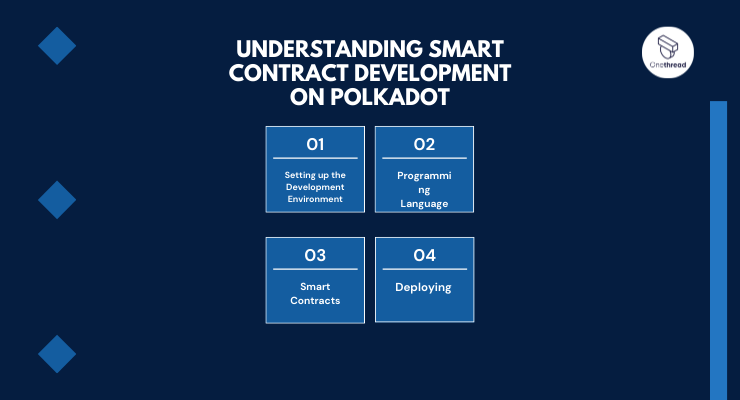
The walkthrough below takes the standard first project, a contract called Flipper, from an empty machine to a deployed instance on a local node. Flipper stores a single boolean and exposes two functions: flip() toggles the value and get() reads it. It is deliberately trivial so that the toolchain, not the logic, is what you learn.
1. Set Up the Rust Toolchain
ink! contracts are Rust programs, so start with rustup, the official Rust toolchain installer available at rustup.rs. On Linux you will also want a C toolchain and OpenSSL headers (clang, curl, git, and your distribution's SSL development package). On macOS, install openssl through Homebrew.
With rustup in place, configure the toolchain and add the WebAssembly compilation target:
rustup default stablerustup updaterustup target add wasm32-unknown-unknownrustup component add rust-src
2. Install cargo-contract and a Local Node
Install the contract build tool through cargo:
cargo install cargo-contract
Add the force and locked flags if you are upgrading an existing installation. For a local chain, download a prebuilt substrate-contracts-node binary from Parity's GitHub releases, or build it from source with cargo. It ships with the contracts pallet preconfigured, which saves you from assembling a runtime just to test a contract.
3. Scaffold the Project
cargo contract new flipper
This creates a flipper directory with three files that matter:
- lib.rs: the contract source, including the storage struct, constructors, messages, and unit tests.
- Cargo.toml: Rust dependencies and ink! configuration.
- .gitignore: build artifacts excluded from version control.
4. Run the Tests Off Chain
The generated project includes unit tests that run in ink!'s off-chain environment, no node required:
cargo test
Both generated tests should pass. As contracts grow, keep unit tests for logic and add end-to-end tests that exercise the contract against a running node, because some failures, such as gas exhaustion and cross-contract call errors, only appear on chain.
5. Compile to WebAssembly
cargo contract build
The build produces three artifacts in the target folder:
- flipper.wasm: the contract bytecode the chain executes.
- metadata.json: the contract's interface definition, covering its constructors, messages, events, and types. Front ends and tools read this file to know how to call the contract, the same role an ABI plays on Ethereum.
- flipper.contract: a bundle of bytecode plus metadata. This is the file you upload when deploying.
6. Start a Local Development Node
substrate-contracts-node
The node starts producing blocks locally and prefunds development accounts such as Alice and Bob, so you can deploy immediately without acquiring tokens.
7. Upload and Instantiate the Contract
Deployment on the contracts pallet is a two-step process, and the distinction is worth understanding because it differs from Ethereum:
- Upload stores the contract bytecode on chain once, under a code hash.
- Instantiate creates a contract account, with its own address, storage, and balance, that points at the code hash.
Many instances can share one uploaded code blob. Deploying the same token contract a hundred times on Ethereum stores the same bytecode a hundred times; on the contracts pallet it is stored once and instantiated a hundred times, which keeps chain state smaller and repeat deployments cheaper.
The simplest way to deploy is the Contracts UI: connect it to your local node, choose Add New Contract, upload the flipper.contract file, pick a development account such as Alice, accept the default constructor parameters, and instantiate. Once the transaction lands in a block, the UI opens an interaction page where you can call flip() and read the value back with get().
8. Prepare for Production
- Audit before mainnet. Contract bugs on chain are permanent in effect even when the code is upgradable. Commission a smart contract audit before any deployment that will hold real value.
- Rehearse on a testnet. Deploy to the public testnet of your target parachain, measure real fees and weights, and run the full user flow.
- Design the upgrade path early. Decide whether the contract is immutable or upgradable, and if upgradable, who controls the upgrade and through what process.
- Plan monitoring. Subscribe to contract events through the Polkadot-JS API so failures surface in your systems, not in user reports.
Polkadot Development Services at Webisoft
Webisoft is a Montreal-based software engineering firm that builds blockchain products end to end, from architecture through deployment and maintenance. On Polkadot, our work covers:
- Smart contracts: smart contract development in ink! and Solidity, including cross-chain logic built on XCM.
- Parachain and runtime engineering: custom Substrate runtimes and pallets for products that need more control than a contract allows.
- Bridges and integrations: connecting Polkadot-based systems to Ethereum and to off-chain infrastructure.
- Decentralized applications: full-stack Polkadot dApps, from contract logic to front end.
- NFT marketplaces and wallets: cross-chain marketplaces and custom wallet integrations on Polkadot infrastructure.
If you are weighing ink! against an EVM parachain, or deciding whether your product should be a contract or a chain, that architectural call is where an experienced partner saves the most time and budget. Contact Webisoft to talk through the options before you commit engineering effort.
Wrapping Up
Polkadot's contribution to smart contract development is structural. Contracts run on specialized parachains, inherit relay chain security, and reach across chains through XCM instead of trusting external bridge operators. The toolchain is mature enough for production work: rustup and cargo-contract on the build side, substrate-contracts-node and the Contracts UI on the deployment side, and Rust's compiler standing between entire classes of bugs and your users' funds.
The Flipper walkthrough covers mechanics. The decisions that determine whether a Polkadot build succeeds, choosing between ink! and the EVM, contract versus runtime pallet, and which parachain's economics to build on, deserve at least as much attention as the code.
No. The relay chain is intentionally minimal and handles consensus, staking, and governance. Smart contracts run on parachains that include a contract execution environment, such as Astar for ink! and Wasm contracts or Moonbeam for Solidity and the EVM.
Rust through ink! is the native route for Wasm contracts on the contracts pallet. Solidity works on EVM-compatible parachains such as Moonbeam and Astar, with standard Ethereum tooling like Hardhat and Foundry.
Yes. Moonbeam provides an Ethereum-compatible environment where most Solidity contracts deploy with minimal changes, and existing tools and wallets continue to work. Plan a testnet deployment and an audit pass to catch environment-specific differences before moving real value.
Parachains exchange messages and assets through XCM, Polkadot's cross-consensus messaging format, so a contract on one parachain can act on assets and applications on another. Bridges extend that reach to external networks such as Ethereum.
Run the unit tests in ink!'s off-chain environment with cargo test, then run end-to-end tests against a local substrate-contracts-node, and finally rehearse on a public testnet. For contracts that will hold real value, add an independent security audit before mainnet.