Most blockchains slow down under pressure. When activity spikes, confirmations lag, fees rise and your product’s experience suffers. You’ve likely felt that pain if you’ve tried building anything interactive on traditional networks.
The Sui blockchain takes a different path. It has recorded over 65 million transaction-blocks in a single day, showing that its architecture can handle intense activity without clogging. Its focus on objects and parallel execution helps applications respond the moment users act.
This guide walks you through how the Sui blockchain achieves this level of performance and the design decisions behind it. You’ll also see how these strengths help you build smoother, more dynamic Web3 experiences.
What is the Sui Blockchain?
The Sui Blockchain is a permission-less Layer 1 smart-contract platform built to handle high transaction volumes with speed and low cost. It was developed by Mysten Labs, a team of former engineers from Meta’s Diem project.
The goal is to support real-world applications such as DeFi, NFTs, gaming and digital assets. What sets Sui apart is its novel architecture.
Instead of purely account-based models, it uses an object-centric data model and parallel transaction execution to deliver near-instant finality and high throughput. Sui is built for modern Web3 applications that need speed, scalability, and real-time interaction. It focuses on performance and responsive user experiences.
How the Sui Blockchain Works
When you engage with the Sui Blockchain, you’re entering a system engineered for modern Web3 demands: rapid finality, high throughput and efficient asset handling. In this section you’ll understand its core mechanisms and how it achieves performance at scale.
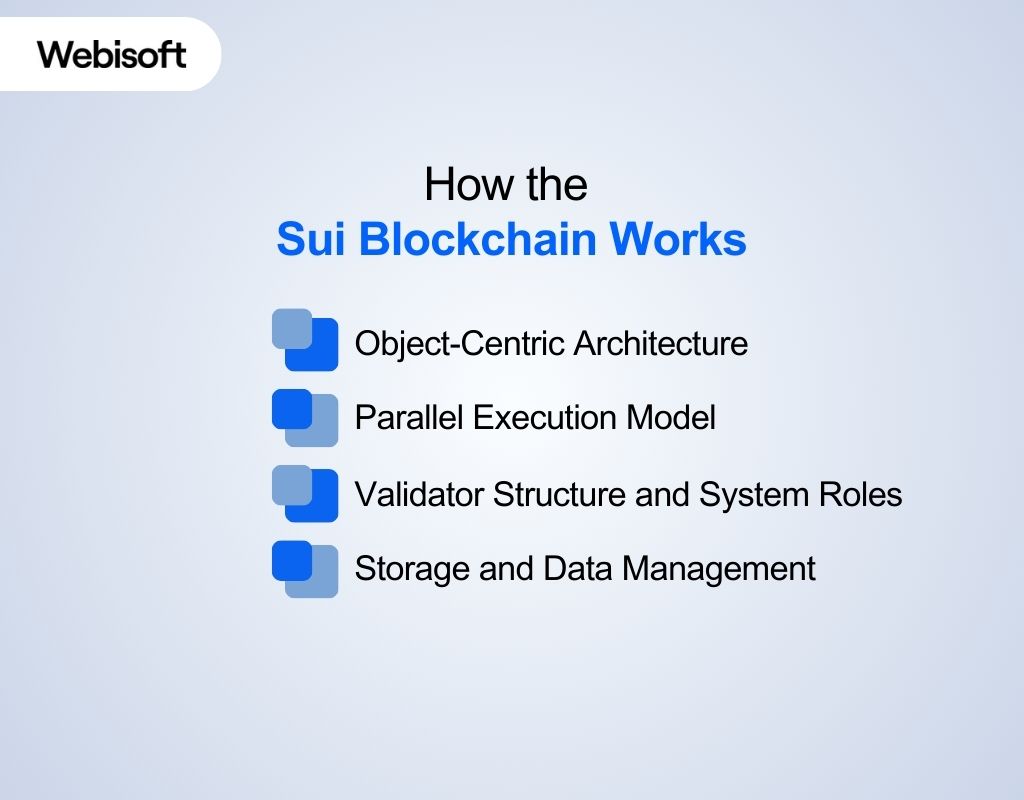
Object-Centric Architecture
Sui is built around an object-centric structure that treats every asset or data point as its own defined object with unique properties and ownership. This structure allows the network to process many operations without locking a global account state, which removes common bottlenecks found in traditional blockchains.
Parallel Execution Model
Because objects exist independently, Sui can identify transactions that do not interact with the same objects and process them at the same time. This parallel execution approach lets you achieve high throughput even when many users are active at once. Only transactions that touch shared objects require coordinated ordering, while the rest are finalized quickly through a simplified path.
Validator Structure and System Roles
The network’s validator set maintains the system by verifying transactions, storing object states and ensuring that ownership transitions follow defined rules. You benefit from predictable performance because most basic transfers or interactions can be processed without waiting for system-wide coordination.
Storage and Data Management
Sui also integrates a storage model that separates one-time storage costs from ongoing computation. This helps reduce long-term state bloat and keeps operational expenses stable for users and developers. Combined with the Move execution engine, the system supports safe, clear handling of objects and their interactions.
How Sui Processes Transactions: Narwhal, Bullshark and Mysticeti Explained
After understanding how Sui structures objects and executes them in parallel, you can look at how it finalizes your transactions. In this section you’ll see how Sui uses Narwhal, Bullshark and Mysticeti to confirm activity efficiently.
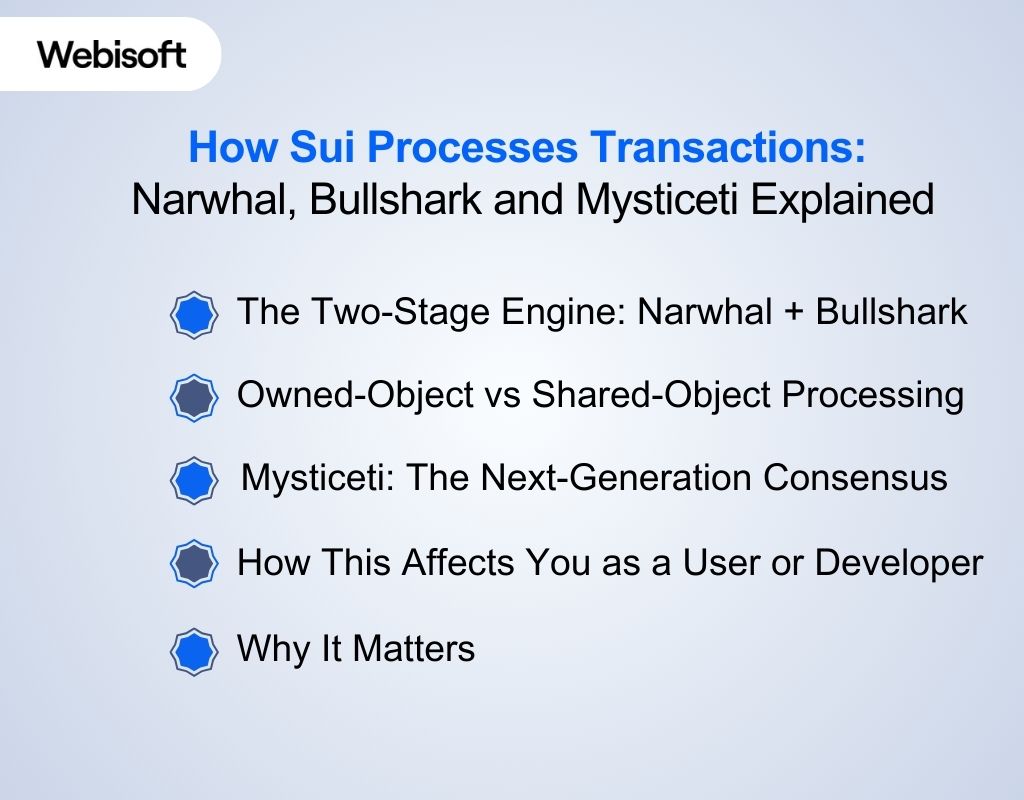
The Two-Stage Engine: Narwhal + Bullshark
The original Sui transaction engine consisted of two key layers. First is Narwhal, which collects, batches and distributes transaction data among validators ensuring data availability.
Second is Bullshark, a DAG-based consensus protocol that orders transactions when necessary, particularly for “shared-object” transactions that might conflict. By separating data-availability from transaction-ordering, Sui allows many transactions that don’t share objects to bypass consensus entirely and finalize quickly.
Owned-Object vs Shared-Object Processing
In Sui’s model, transactions touching only “owned objects”, those exclusively controlled by a single user can be executed in parallel without waiting for full consensus. Transactions involving shared objects require Bullshark to produce a consistent global order, preventing conflicts when multiple users interact with the same shared asset state.
In contrast, transactions involving “shared objects” are handled differently. They require the Bullshark layer to establish a consistent global order and prevent conflicting state changes. This design keeps high-volume, simple operations fast, while still preserving safety and correctness for more complex interactions.
Mysticeti: The Next-Generation Consensus
In 2024, Sui upgraded its consensus engine to Mysticeti, a DAG-based protocol that builds on the Narwhal/Bullshark stack to reduce latency and boost throughput. Mysticeti allows validators to propose blocks in parallel and requires fewer message rounds to commit transactions, leading to sub-second finality in many scenarios.
Because Sui’s architecture already supports parallel execution, Mysticeti helps scale even further by cutting down the time for ordering and committing shared-object transactions.
How This Affects You as a User or Developer
- If you trigger a simple transfer or interaction with an owned object, you experience near-instant confirmation and low cost because consensus is bypassed or minimized.
- For more complex dApp actions involving shared assets, your transaction still goes through an efficient consensus path (via Mysticeti). And also achieves strong finality guarantees without long delays.
- For developers building on Sui: designing your system to favour owned-object operations (where possible) can unlock maximum performance. If shared objects are needed, you still get a fast and reliable system.
Why It Matters
This model of transaction processing: separating data availability, ordering, and state changes tackles longstanding throughput and latency bottlenecks in many blockchains. Sui’s split-engine design means you get faster finality and scalable performance without sacrificing the correctness or security essential for real-world Web3 applications.
The Move Programming Language on Sui
Now that you’ve seen how Sui’s architecture processes objects and parallel transactions, you’ll appreciate the language that powers those interactions. Here, you’ll explore Move, the programming language behind Sui and how it enables secure, efficient asset-centric dApps.
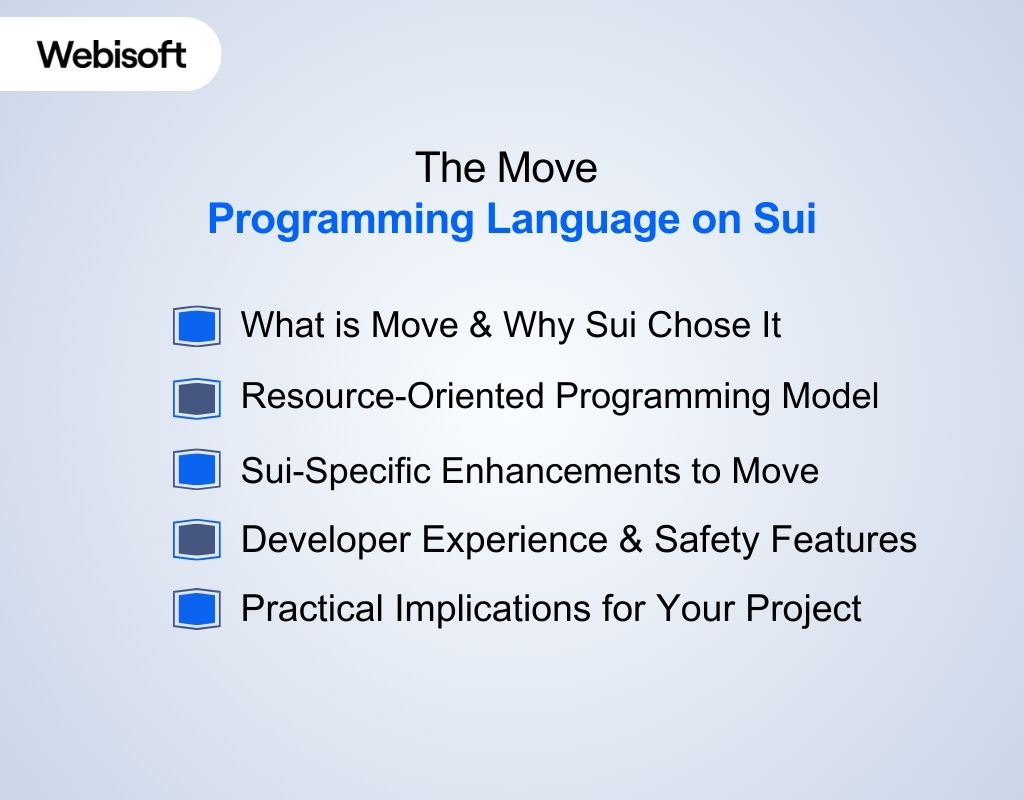
What is Move & Why Sui Chose It
Move was originally developed for the Diem Blockchain project and is built around resources, ownership, and safe manipulation of on-chain assets. On Sui, Move has been enhanced and adapted to work with Sui’s object-centric architecture, enabling contracts that directly map to programmable objects.
Resource-Oriented Programming Model
In Move, digital assets (such as tokens, NFTs, game items) are treated as resources, objects that cannot be inadvertently copied, discarded or misused. This ensures that assets on Sui follow strict ownership rules and cannot be duplicated or lost due to programming errors.
Sui-Specific Enhancements to Move
On Sui, Move introduces features unique to its architecture:
- Every object gets a unique identifier (UID) so that ownership and state are unambiguous.
- The address type represents both object IDs and account IDs on Sui, simplifying the model.
- Entry functions (marked with entry) allow scripts to define public entry points safely.
- The capabilities of Move align with Sui’s parallel execution engine: by knowing input object IDs ahead of time, Sui can schedule transactions non-conflictingly.
These enhancements allow your Move smart contracts on Sui to tap into its high throughput and low latency infrastructure.
Developer Experience & Safety Features
Move’s type system on Sui prevents common vulnerabilities: it restricts copying or dropping resources, prevents re-entrancy attacks and ensures safe transitions of ownership.
Developers on Sui benefit from tooling such as the Move Prover, Move Book, CLI tools and integrated frameworks. For you as a user, this means fewer exploitable contracts, fewer surprises and more predictable behavior from dApps built on Sui.
Practical Implications for Your Project
When building on Sui using Move:
- You define modules and resources representing objects (coins, NFTs, tokenized assets), which form the foundation of blockchain app development on Sui.
- You design transactions that operate on object IDs, so your contract logic directly maps to Sui’s architecture.
- You gain from Sui’s parallel transaction execution because your code clearly separates independent objects and operations.
- You align your design with Sui’s strengths (high throughput, object ownership, safe assets) instead of being constrained by legacy smart-contract models.
Tokenomics of the Sui Blockchain: How the SUI Token Works
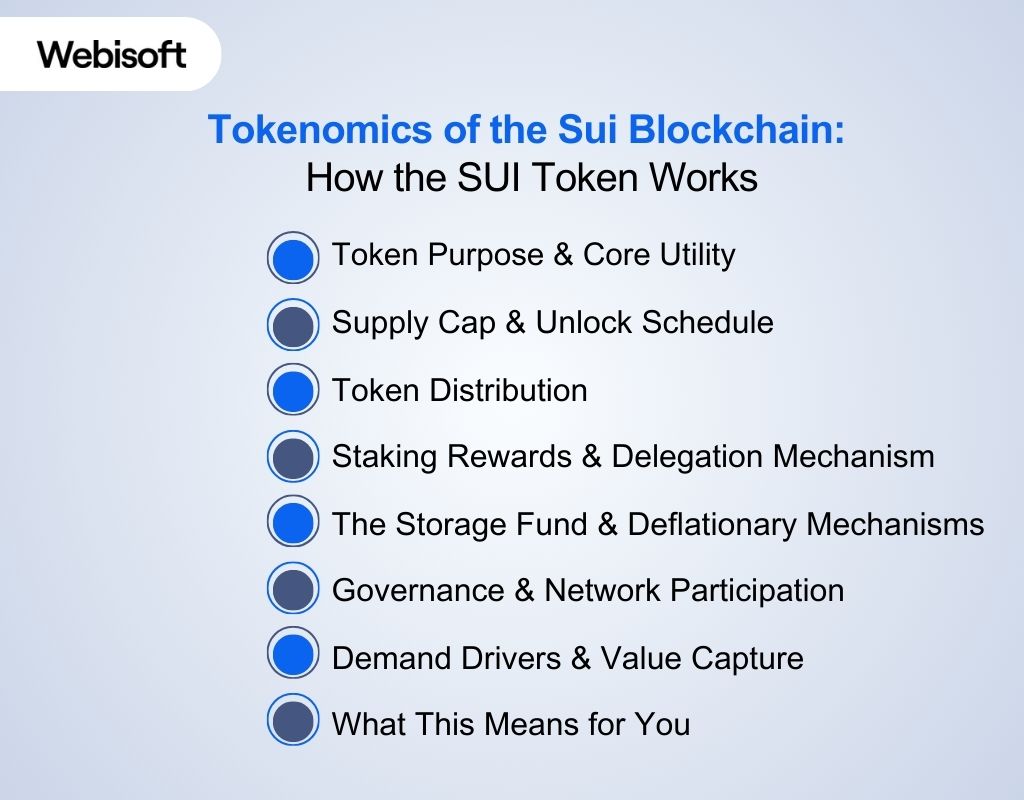
As a user or stakeholder in the Sui Blockchain, you’ll want to understand how the SUI token underpins the entire ecosystem. In this section you’ll discover how supply, staking, usage and rewards work together to support network economics.
Token Purpose & Core Utility
The native coin on the network is the SUI blockchain token. It serves four main roles within the network: (1) Paying for transaction computation and data-storage fees (2) Staking to support network security (3) Participating in governance decisions (4) Acting as a medium of exchange, unit of account and utility asset within dApps.
In your use-case scenarios, that means whenever you trigger a transaction or store data on Sui, SUI is the token you use. And if you hold SUI, you can delegate to validators, participate in governance voting, and benefit from network growth.
Supply Cap & Unlock Schedule
The total supply of SUI is capped at 10 billion tokens. Not all of this is in circulation immediately, large portions remain locked under predefined schedules to prevent early supply dumping and support long-term network health. For example, at Mainnet launch only a small percentage was circulating, and unlocks occur gradually in future years.
Token Distribution
The allocation of SUI tokens was structured to balance stakeholders and ecosystem needs:
- A large portion (more than half) is reserved for community reserves and ecosystem incentives.
- Other allocations include early contributors, investors, staking subsidies, and foundation/trusteeship.
This distribution helps ensure that network participants, developers and ecosystem builders are aligned long-term.
Staking Rewards & Delegation Mechanism
You can stake your SUI tokens by delegating them to validators who operate the network. At the end of each epoch (typically ~24 hours) rewards are distributed to validators and delegators based on stake and network activity.
Importantly, unlike some networks where slashing can burn your principal, Sui handles slashing differently. Delegators risk losing only rewards, not their principal stake, which lowers risk for you when participating.
The Storage Fund & Deflationary Mechanisms
One of the most notable features in Sui’s tokenomics is the storage fund. Whenever you create or mutate on-chain data (objects) you pay storage fees which feed into this fund. Part of the fees may remain locked or effectively removed from active circulation.
This reduces available supply as usage grows, creating built-in deflationary pressure. As the ecosystem scales, more data stored means higher fund contributions, so the model rewards long-term usage and helps maintain token value.
Governance & Network Participation
Holding and staking SUI also gives you governance rights: you can vote on protocol upgrades, parameter changes, and governance matters. This means your participation as a token holder is more than passive, you help shape the network’s future. Because of this governance angle, the tokenomics design aligns incentives between holders, builders and the network infrastructure.
Demand Drivers & Value Capture
Several factors drive demand for SUI:
- Transaction fees: as the network processes more volume, more SUI is used for gas and storage fees.
- Staking: more demand if many users delegate to secure the network.
- Ecosystem growth: dApps, gaming, NFTs, DeFi built on Sui will demand SUI for interaction and utility.
- Deflationary supply: as parts of SUI are locked or removed via storage fund mechanisms, scarcity improves which may positively affect value. (See: “fixed cap + mechanism to reduce circulating supply”.)
What This Means for You
- If you hold SUI, you’re not just holding a token, you’re participating in network security, governance and value growth.
- If you’re building or using dApps on Sui, expect to pay SUI for gas and storage and potentially benefit from ecosystem growth if usage increases.
- If you contribute to growth (by building apps or encouraging adoption) you help increase demand for SUI, which aligns your interest with network success.
Key Features & Advantages of the Sui Blockchain
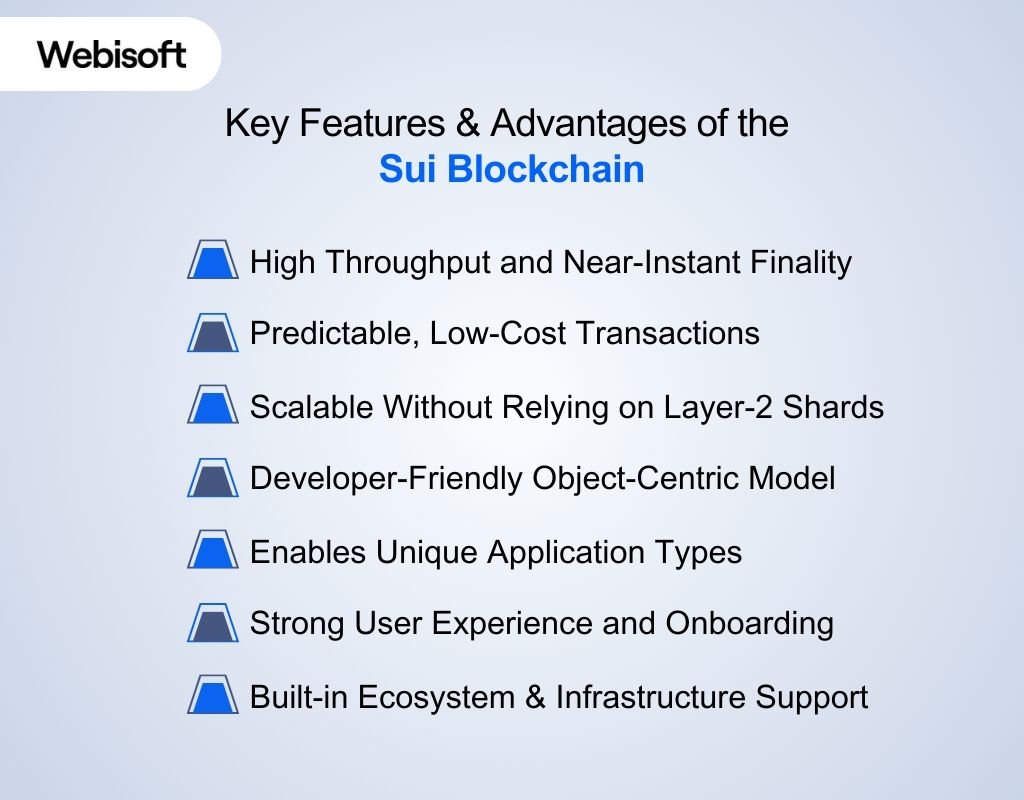
The Sui Blockchain offers several capabilities that set it apart from traditional Layer 1 networks. You’ll learn about the performance, flexibility and design advantages that help you build or use applications more efficiently on the platform.
High Throughput and Near-Instant Finality
The Sui network is built for performance. By using its object-centric model and parallel execution engine, it achieves significantly higher throughput and lower latency compared to many traditional blockchains. Transactions that affect independent objects can finalise quickly because they don’t wait for global ordering, giving you rapid confirmation times.
Predictable, Low-Cost Transactions
Because Sui decouples data storage from transaction execution and optimises for parallel paths, it can keep transaction fees both low and predictable. For you, this means fewer surprises in cost and less user friction when deploying or interacting with apps.
Scalable Without Relying on Layer-2 Shards
Unlike many blockchains that depend heavily on Layer-2 scaling solutions or sharding, Sui is designed to scale horizontally via its object model and validator structure. This allows you to launch high-traffic applications (gaming, NFTs, DeFi) without worrying immediately about moving to secondary chains or facing congestion.
Developer-Friendly Object-Centric Model
Sui’s architecture simplifies development by making asset ownership explicit, aligning smart contracts with its object-based model, and allowing independent transactions that reduce overall complexity. As a developer or project lead, this translates into faster builds, fewer unexpected edge-cases, and clearer logic for asset behaviour.
Enables Unique Application Types (Dynamic Assets, Real-Time Gaming)
Sui’s structure and performance make it well suited for dynamic, composable assets, including game items, virtual identities, tokenised goods and real-time interactive applications scenarios. If your focus is a game, metaverse, or high-frequency dApp, Sui gives you meaningful benefits over general-purpose chains.
Strong User Experience and Onboarding
Sui’s emphasis on performance and accessible asset flows also supports superior UX: fewer delays, smoother asset transfers, better interactivity. For you building or selecting a platform, this means a higher likelihood of user retention, fewer support issues, and smoother growth.
Built-in Ecosystem & Infrastructure Support
Backed by Sui Foundation and Mysten Labs, Sui is supported by strategic grants, ecosystem development programs and tooling that simplify your go-to-market. This helps your project launch faster, with access to resources, partnerships and a developer support network.
Real-World Use Cases of the Sui Blockchain
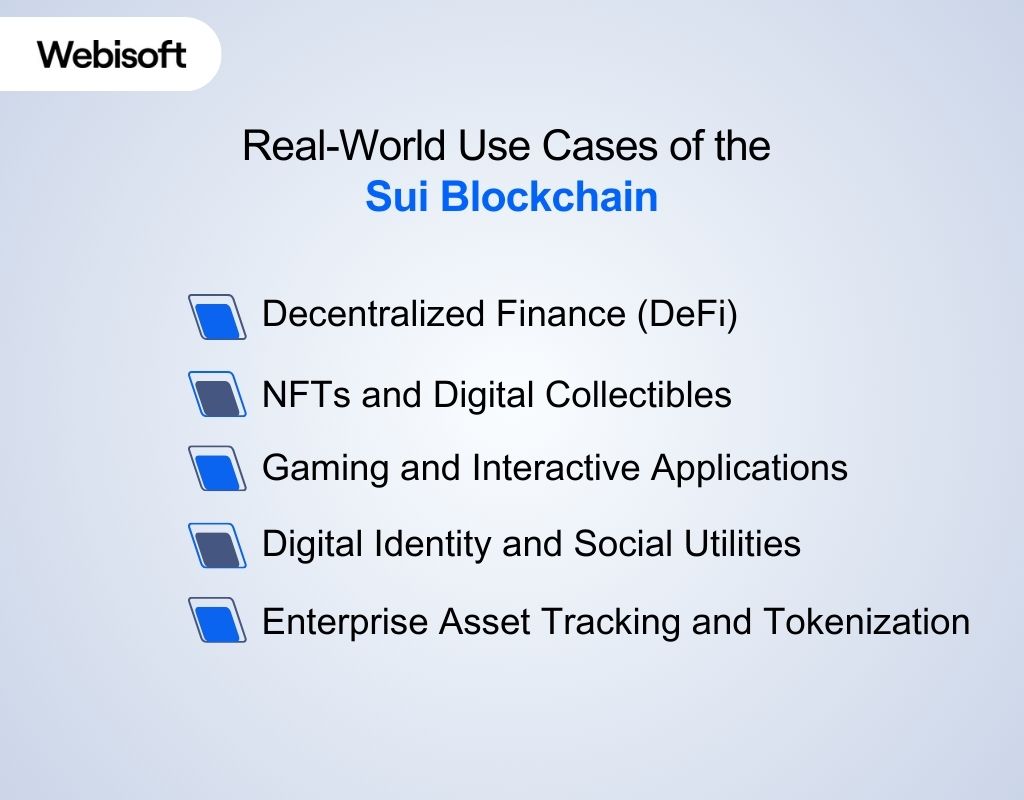
If you want to understand how the Sui Blockchain performs in real environments, you can look at the applications already adopting it. Here you’ll see how Sui supports practical use cases across finance, gaming, identity and enterprise needs.
Decentralized Finance (DeFi)
Sui’s high throughput and low fees make it suitable for DeFi platforms such as trading, lending and liquidity protocols. You benefit from fast settlement and predictable costs, which help builders create responsive financial applications.
NFTs and Digital Collectibles
Because Sui treats assets as individual objects, it works well for NFTs, dynamic collectibles and evolving digital items. This allows creators and marketplaces to offer richer asset behavior at lower cost.
Gaming and Interactive Applications
Sui’s parallel execution and quick finality support real-time gameplay, digital items, in-game trading and user-driven economies. As a game developer, you can build smoother, more interactive experiences without waiting on slow block confirmations.
Digital Identity and Social Utilities
Sui enables identity assets, verification tools and domain systems that rely on secure ownership. This supports social apps, Web3 accounts and credential systems that need reliable, low-friction asset handling.
Enterprise Asset Tracking and Tokenization
Sui’s object model fits business use cases like asset tokenization, supply chain tracking and provenance systems, as explained in the official Sui documentation. Each asset can evolve with clear history and ownership, helping enterprises manage data more effectively.
Sui Blockchain vs Other Layer-1 Platforms
When choosing a Layer-One blockchain, you need to compare technology, costs and developer experience. Below, you’ll gain a clear comparison between Sui and other leading networks so you can judge where your project or use-case fits best.
| Feature | Sui Blockchain | Other Layer-1 Platforms* |
|---|---|---|
| Execution & Ordering Model | Uses object-centric data model + parallel execution of independent transactions, with consensus only when needed. | Most rely on traditional account-based ledger and sequential transaction processing, limiting parallelism and throughput. |
| Throughput & Finality | Designed for high throughput and near-instant finality on many transactions thanks to its execution model. | Many chains struggle with congestion; some require Layer-2 solutions or sharding for scaling. |
| Asset Model & Developer Experience | Assets are treated as first-class “objects” with explicit ownership and lifecycle, aligning with its smart-contract model. | Classic account-based models treat assets more generically, limiting certain kinds of composable asset behaviours. |
| Cost & Predictability | Because many transactions bypass heavy consensus, cost and latency are more predictable for you. | Costs can spike under load; throughput is often constrained unless secondary layers are used. |
| Ecosystem & Adoption | Newer entrant but growing quickly; emphasis on gaming, dynamic assets and Web3 apps. | Some have mature ecosystems (large TVL, many dApps) but face legacy constraints or scaling trade-offs. |
| Use-Case Fit | Best for applications that need dynamic assets, low latency and interactive real-time behaviours. | Better known for broader use-case coverage and established infrastructure but may require more design trade-offs. |
Validator and Staking Model of the Sui Blockchain
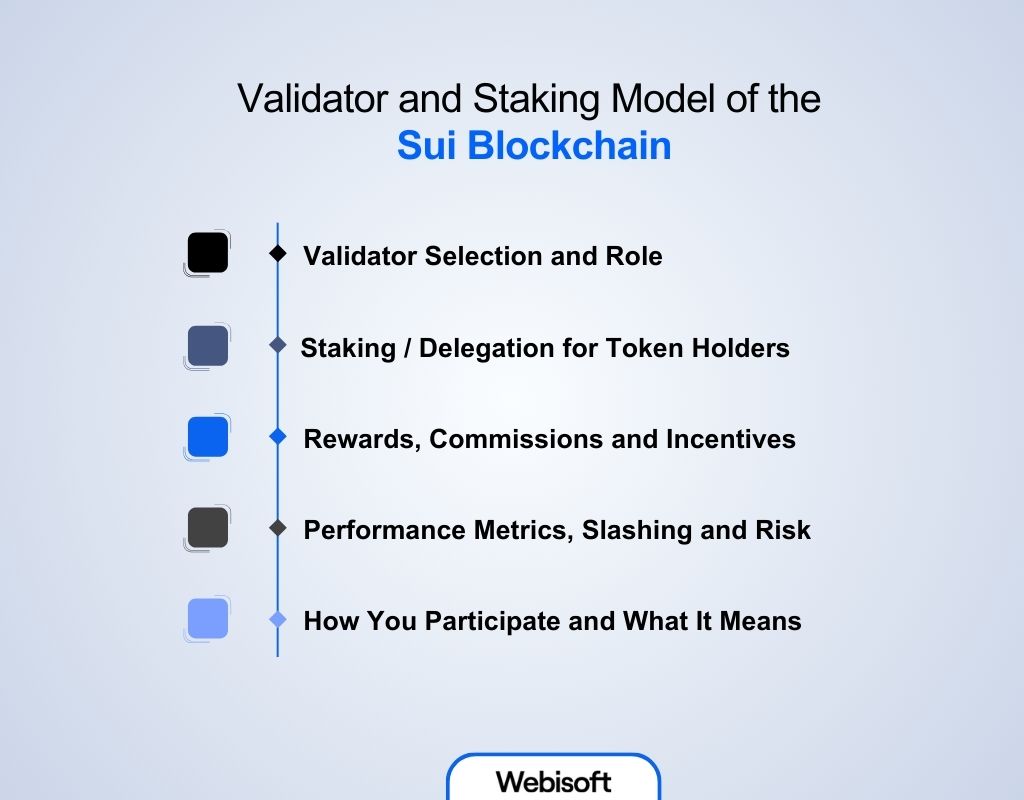
As you work with the Sui Blockchain, understanding how validators and staking operate helps you see how the network stays secure. This part gives you a clear view of how your participation supports performance and earns rewards.
Validator Selection and Role
On the Sui network, validators operate nodes that process transactions, store object states, and participate in consensus when required. The network uses a Delegated Proof-of-Stake model where you delegate SUI to validator pools, supported by insights from protocol development when designing network-level logic.
To become an active validator, a candidate must accrue at least 30 million SUI of total stake (including delegations from token holders) and maintain activity, uptime, and performance metrics.
Staking / Delegation for Token Holders
If you hold SUI, you don’t need to run a node, you can delegate your tokens to a validator and earn part of the rewards. When you delegate, your stake is locked for the current epoch, which lasts roughly 24 hours. Your rewards are calculated based on the validator’s performance, the size of the pool and the gas fees collected.
Rewards, Commissions and Incentives
Validators earn rewards from two main sources: (1) transaction and storage fees paid by users, and (2) stake subsidies early in the network’s lifecycle. A validator typically charges a commission fee on rewards earned by delegators; choosing a validator with a strong performance record and low commission improves your yield.
Performance Metrics, Slashing and Risk
Validators must uphold uptime, low latency, and correct behaviour. Poor performance may lead to fewer rewards, and under-performance may remove a validator from the set. As a delegator, your principal stake is generally safe even if your validator under-performs, but you risk lower rewards. This model encourages you to select reliable validators.
How You Participate and What It Means
- You allocate SUI to a validator; your stake contributes to the validator’s power and helps secure the network.
- Your rewards grow as the validator processes transactions efficiently and remains online.
- You are free to redelegate to another validator at the start of a new epoch if you wish, giving you flexibility and control.
How to Get Started with the Sui Blockchain
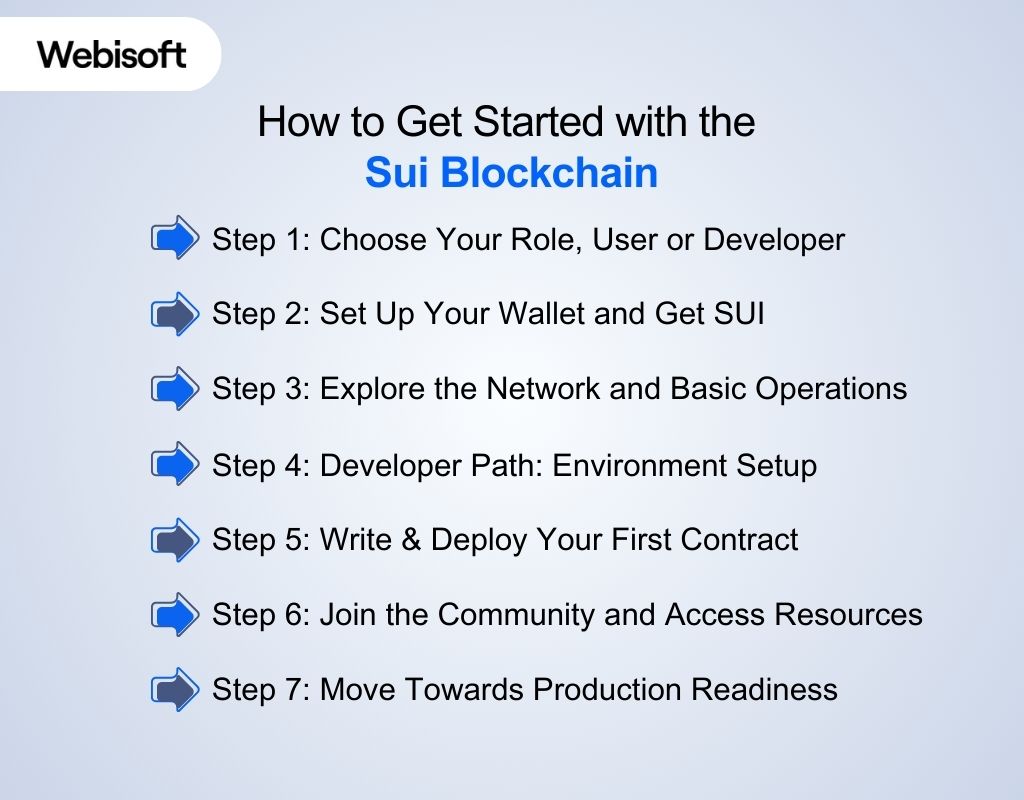
You’re ready to engage with the Sui Blockchain either as a user or a developer. Here’s a clear, step-by-step guide on how to set up your account, explore the network, and begin building or interacting with Sui.
Step 1: Choose Your Role: User or Developer
Decide whether you’re entering Sui as a user (interacting with dApps, holding SUI, transferring assets) or a developer (building apps, deploying Move modules). This will guide your next actions and the tools you’ll use.
Step 2: Set Up Your Wallet and Get SUI
- Install a Sui-compatible wallet (such as the official Sui Wallet or other supported options).
- Once your Sui blockchain wallet is connected to Devnet or Testnet, you can request test tokens and try basic actions safely.
- Request test SUI tokens from the Sui faucet to interact with the network and test basic functions.
- For Mainnet usage, acquire SUI via a supported exchange and transfer it to your wallet.
Step 3: Explore the Network and Basic Operations
- Send a simple transaction: transfer an object or token, check your wallet balance, and view transaction history.
- Use the Sui CLI or SDK to query object states and on-chain data.
- Experiment with metadata and object ownership: create or receive assets to understand how Sui handles objects.
Step 4: Developer Path: Environment Setup
If you’re building on Sui:
- Install the Sui CLI and SDKs.
- Install prerequisites (Rust toolchain if necessary, as Sui is built in Rust).
- Create a new Move package and build your first contract.
- Publish your package to Devnet/Testnet and test interactions before moving to Mainnet.
Step 5: Write & Deploy Your First Contract
- Define modules in Move that map to assets or objects on Sui.
- Compile, build and publish your package using the Sui CLI or SDK.
- Interact with the contract: call methods, inspect state, send transactions that modify objects.
Step 6: Join the Community and Access Resources
- Access the official documentation and guides (such as the “Getting Started” section) to deepen your knowledge.
- Join developer forums, Discord/Telegram channels, and hackathons to connect with other Sui builders and users.
Step 7: Move Towards Production Readiness
- On Mainnet, ensure you adhere to best practices: secure key management, thorough testing, and monitoring of transactions and fees.
- If building a project: plan architecture, security audits, performance testing, and a deployment roadmap aligning with Sui’s object-centric model and parallel execution engine.
If you need expert help getting started on Sui, Webisoft can guide you through setup, development and launch. Reach out to our blockchain team to explore how we can support your project.
Limitations, Risks and Challenges of Sui
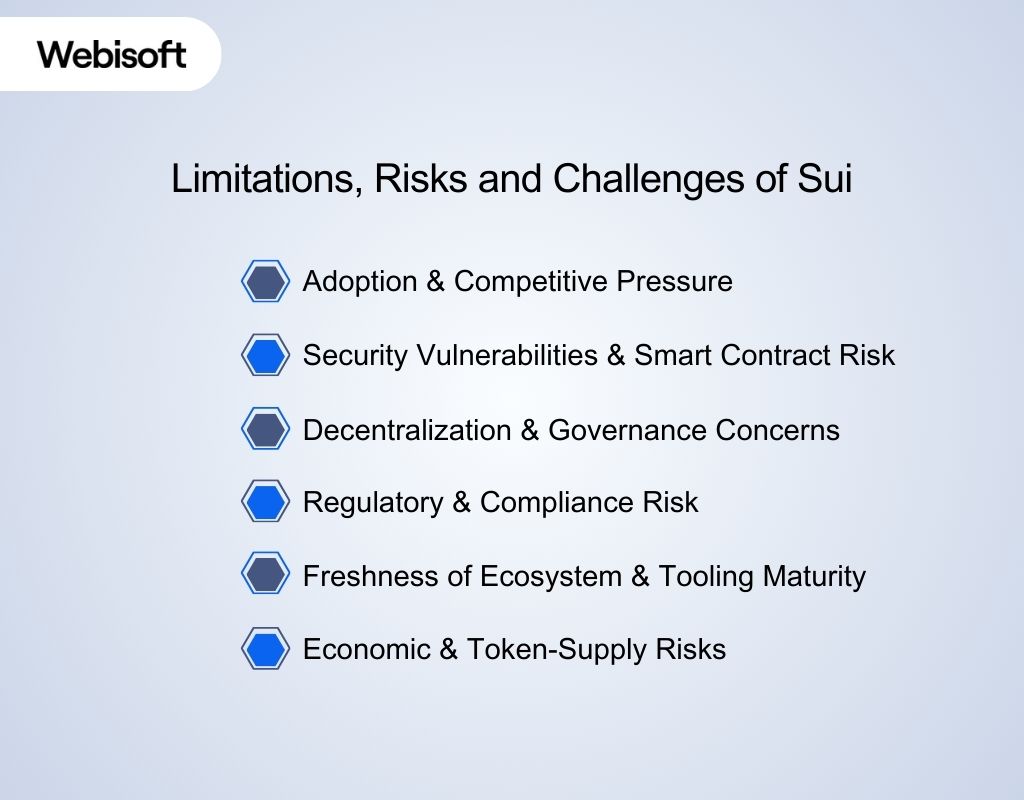
While the Sui Blockchain introduces impressive innovations, it is not without its challenges. You’ll learn about risks around adoption, security, regulation and decentralization so you can make informed decisions when engaging with the network.
Adoption & Competitive Pressure
As a relatively new Layer-1 network, Sui must catch up in ecosystem size, developer adoption and network liquidity compared to established platforms. Its success depends on widespread dApp deployment, user traction and meaningful TVL growth to justify its architectural advantages.
Security Vulnerabilities & Smart Contract Risk
Despite the strength of the Move language and object-centric model, Sui still faces security risks. For example, a major incident involving a large exploit on a decentralized exchange (DEX) operating on Sui, resulting in millions of dollars in loss, highlighted exposure to protocol-level vulnerabilities and the need for robust smart contract auditing.
Decentralization & Governance Concerns
Critics raise questions about how decentralized Sui truly is. Token distribution, foundation influence, and validator concentration may concentrate power in fewer hands, which contradicts the ideal of trustless networks. If you’re building or investing, this is a governance risk to factor in.
Regulatory & Compliance Risk
Regulatory ambiguity looms large for Sui. Token classification, validator KYC or AML rules and regional restrictions may affect how dApps are built, how tokens trade and where users can participate. Regulation changes might lead to platform mandates or limitations on certain activities.
Freshness of Ecosystem & Tooling Maturity
While Sui’s architecture is advanced, its ecosystem is still emerging. The range of tools, integrations, developer frameworks and third-party services is less mature compared to long-standing chains. This means you may face slower go-to-market or fewer off-the-shelf solutions.
Economic & Token-Supply Risks
A substantial portion of the SUI token supply remains locked or will unlock in future years, which may affect liquidity, inflation expectations and value dynamics. For a stakeholder or builder, this means modelling carefully how token supply might evolve and how that affects incentives.
How Webisoft Supports Sui Blockchain Projects
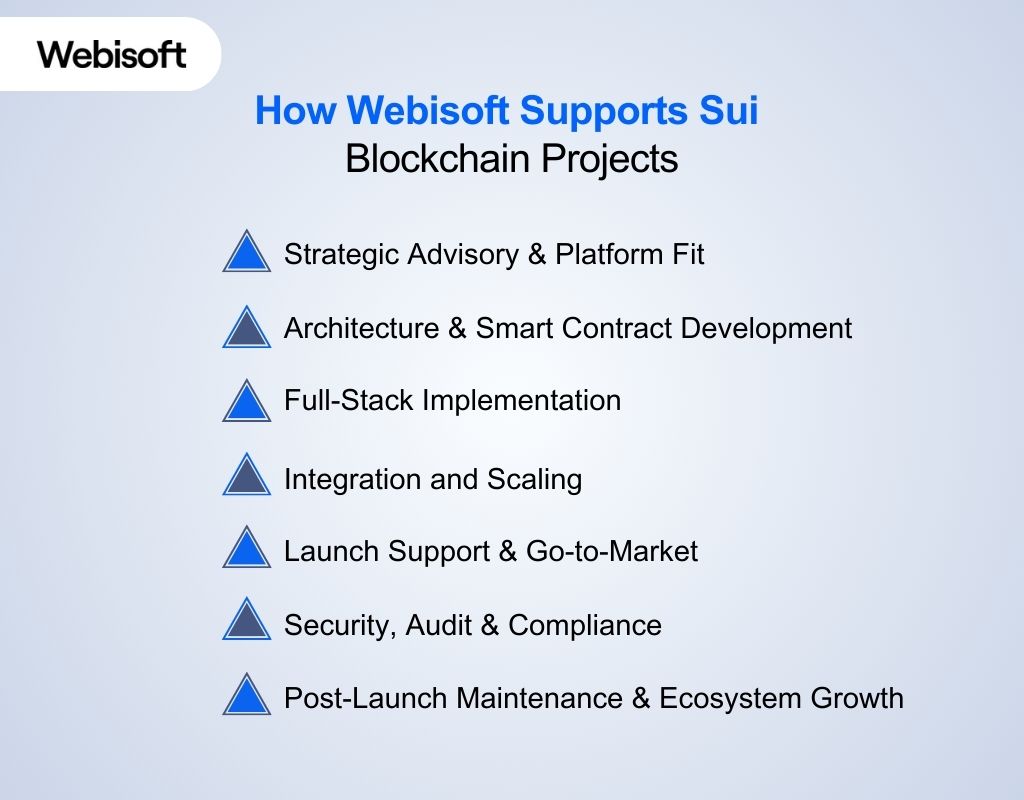
When you explore building on the Sui Blockchain, having the right technical partner makes a major difference. Webisoft supports you with clear guidance, solid engineering and end-to-end delivery so your Sui project moves from idea to reality smoothly.
Strategic Advisory & Platform Fit
Webisoft begins by helping you identify whether Sui Blockchain is the right platform for your project. Our blockchain consulting service evaluates your business model, target users and performance needs to decide whether Sui’s object-centric architecture and parallel execution fit your goals.
Architecture & Smart Contract Development
Our team has proven expertise in multiple programming environments and Web3 frameworks, strengthened by full-stack blockchain development. Along with deep experience in Sui blockchain development, covering Rust, Move, Solidity, CosmWasm, Zero-Knowledge Proofs and more.
For your Sui project, we design and implement Move-based smart contracts, object models and application logic customized to Sui’s transaction and object ownership semantics. We build secure contracts, code review and integrate them with the Sui Blockchain ecosystem.
Full-Stack Implementation
Beyond smart contracts, Webisoft supports the full stack needed for a Sui solution:
- Wallet and asset-ownership layers that map to Sui’s object model.
- Front-end and back-end integration with APIs, SDKs and Sui’s developer tooling.
- Deployment and infrastructure setup across DevNet/TestNet/MainNet, ensuring compliance with Sui’s parallel execution and object-handling approach.
Integration and Scaling
One of Webisoft’s strengths is in enterprise blockchain solutions. These services include enterprise blockchain implementation and private or custom-chain design, relevant if your Sui project evolves into hybrid or permissioned models.
We can support you as you scale, handle increasing user volume, integrate third-party systems and ensure performance remains efficient. A key advantage when using Sui’s high-throughput capabilities.
Launch Support & Go-to-Market
Webisoft also guides you through deployment and launch phases: from user onboarding, wallet integrations, testnet migration, to MainNet launch. Our process includes structured project management, ongoing support, and optimization for responsive user experience. If you’re building a Sui-based game, NFT platform or DeFi app, Webisoft positions you for success in market entry and operational readiness.
Security, Audit & Compliance
Given Sui’s relative maturity and ecosystem growth, Webisoft assists with smart contract audits, security reviews, regulatory readiness and best-practice governance. Our blockchain advisory includes risk assessment and strategic planning. This ensures your Sui-based system is strong, compliant and prepared for enterprise-level deployment.
Post-Launch Maintenance & Ecosystem Growth
Webisoft remains your partner beyond launch: monitoring, performance tuning, version upgrades, community integration and ecosystem expansion. We also support tokenization, asset lifecycle management and ongoing development as your Sui project grows. Our long-term client reviews highlight responsive project management and consistent technical quality.
Conclusion
The Sui blockchain brings together speed, structure and real-time interaction in a way that pushes Web3 forward. After exploring its architecture, features and uses, you now have a clear view of what it can offer and where it can take your project.
If you choose to build on Sui, Webisoft is here to support you with clarity and hands-on expertise. We help you turn your idea into a polished, production-ready solution and end your journey with a product you’re proud to launch.
Frequently Asked Questions
Storage fees on Sui are generally low and paid only once when data is created or updated. These fees contribute to a storage fund, which offsets long-term network costs and helps maintain sustainable on-chain data management over time.
Sui reaching $100 would require massive ecosystem growth, significant demand for the SUI token and broad adoption across applications. While possible long-term, such projections are speculative and depend on market cycles, utility expansion and overall blockchain adoption.
In a Sui blockchain vs Solana comparison, Sui’s object-centric design and parallel execution support dynamic, high-interaction apps. Solana offers a mature ecosystem and stronger liquidity. Each chain excels in different areas, so the best choice depends on your project needs.