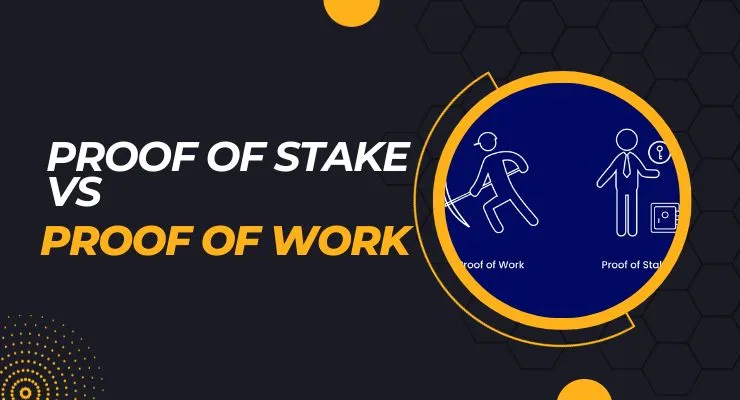
Proof of Work (PoW) and Proof of Stake (PoS) are competing consensus mechanisms that solve the same problem: how do nodes agree on the valid transaction order when no central authority exists? They use fundamentally different approaches with different trade-offs.
\nHow Proof of Work Functions
\nThe Basic Mechanism
\nBitcoin uses PoW. Miners bundle pending transactions into a candidate block. They then search for a hash value that meets a target difficulty (for example, a hash starting with a certain number of zeros). This search requires trying billions of hash values. The first miner to find a valid hash broadcasts the block to the network. Other nodes verify the block and add it to their copy of the ledger. The winning miner receives a block reward (newly created bitcoins) plus transaction fees.
\nSecurity Model
\nAn attacker wanting to alter a past transaction must re-mine all subsequent blocks faster than the honest network. Bitcoin requires 51% of the network's computing power to consistently rewrite history. The computational cost is enormous: Bitcoin's network consumes approximately 150 terawatts annually (per Cambridge University estimates). This high cost deters attacks.
\nLimitations
\n- Energy consumption: Every block requires computational work, whether the network is under attack or operating normally.
- Centralization pressure: Large mining pools earn rewards more consistently than solo miners, pushing the network toward fewer, larger mining operations.
- Hardware arms race: Miners continuously upgrade to faster equipment, creating hardware waste and economic pressure to mine continuously to justify capital investment.
- Finality latency: Bitcoin considers a transaction final after 6 block confirmations (approximately 60 minutes). Ethereum PoW had similar latencies.
How Proof of Stake Functions
\nThe Basic Mechanism
\nEthereum switched to PoS (The Merge, September 2022). Validators lock up their own ether (the staking deposit) as collateral. A smart contract randomly selects validators to propose and attest to new blocks. If a validator proposes an invalid block, they lose a portion of their stake (slashing). If they attest to conflicting blocks, they lose stake. This creates an economic incentive to follow the rules: your own money is at risk.
\nSecurity Model
\nAn attacker wanting to rewrite history must control 51% of the staked ether and be willing to lose it all as a punishment. The economic barrier is high: currently, 32 million ether is staked on Ethereum (approximately 100 billion USD at 2024 prices). Attacking the network means burning that capital. The cost is concentrated at a single point in time (the attack) rather than ongoing (as in PoW).
\nAdvantages Over PoW
\n- Energy efficiency: No computational puzzle solving required. Ethereum PoS consumes approximately 0.0026 terawatts annually, roughly 99.95% less than PoW.
- Faster finality: Blocks are confirmed within 12 seconds. Transactions are considered final after one epoch (6.4 minutes).
- Reduced centralization pressure: Mining pools are unnecessary; solo stakers compete fairly with large operators.
- Monetary efficiency: PoW destroys energy value every block. PoS redirects that value to validators who perform useful work (securing the network).
Limitations and Risks
\n- Wealth concentration: Users with more ether earn more rewards, potentially widening wealth gaps over time.
- Slashing risk: Validators face penalties for being offline or misbehaving. This introduces operational complexity and financial risk.
- Governance attacks: If a token is traded openly, a wealthy actor can purchase 51% and vote to change protocol rules in their favor. PoW faces the same problem but the capital requirement (buying mining hardware) is different than buying tokens.
- Nothing-at-stake problem (theoretical): Validators could theoretically sign multiple competing blocks with no cost. Modern PoS designs (Casper) penalize this explicitly via slashing.
Direct Comparison
\n| Attribute | Proof of Work | Proof of Stake |
| Entry cost | Specialized hardware (ASICs, GPUs) | 32 ETH to become a validator (~100k USD) |
| Energy per block | ~1400 kWh (Bitcoin) | ~0.5 kWh (Ethereum) |
| Block time | 10 min (Bitcoin), 15 sec (Ethereum PoW) | 12 sec (Ethereum PoS) |
| Finality | Probabilistic (6 blocks = 99.9% certainty) | Economic finality (reorg costs attacked's entire stake) |
| Attack cost | Rent or purchase 51% of network hash power | Own or purchase 51% of staked tokens; face slashing |
| Validator scaling | Difficulty adjusts; roughly 1 block creator per 10 min | Thousands of validators per block |
Which Is Better?
\nNeither is universally superior. The choice depends on priorities:
\nChoose PoW if: You prioritize proven, battle-tested security over energy efficiency. PoW has secured Bitcoin for 15+ years with no successful attacks. You accept ongoing energy costs as the price of decentralization.
\nChoose PoS if: You need energy efficiency, fast finality, or lower capital barriers to entry. PoS is newer and has less real-world history but is increasingly deployed (Ethereum, Cardano, Polkadot).
\nHybrid systems also exist: some chains use PoW for security initially, then transition to PoS. Others use alternatives like Delegated PoS (stakers delegate to validators) or Proof of Authority (trusted nodes validate blocks).
\nCurrent Adoption
\nBitcoin remains PoW (and plans to remain so indefinitely). Ethereum transitioned to PoS in 2022. Most newer blockchain projects use PoS or variants. Adoption reflects a shift in priorities: new chains optimize for efficiency and fast finality over absolute decentralization of hardware requirements.
What the network makes attackers pay with. Proof of Work secures the ledger with computation: miners spend hardware and electricity to produce blocks, so rewriting history requires out-computing the whole network. Proof of Stake secures it with capital: validators lock up the network's currency as collateral, and the protocol destroys that stake if they sign conflicting history.
Mature PoS networks are considered comparably secure, but through different economics. A PoW attacker needs a majority of hashrate; a PoS attacker needs a majority of staked coins, which is expensive to acquire, gets slashed once the attack is detected, and can be forked out by the community. Security under either model scales with network size, and small chains are attackable under both.
Primarily energy and future scalability. The September 2022 upgrade known as the Merge replaced mining with staking and, per the Ethereum Foundation, cut the network's energy consumption by roughly 99.95%. The switch also introduced explicit finality checkpoints and laid the groundwork for later scaling upgrades built around the validator set.
There is no credible plan to. Bitcoin's community treats Proof of Work's energy expenditure as the foundation of its security and monetary credibility, and the protocol's governance is deliberately resistant to changes of that magnitude. Assume Bitcoin remains PoW indefinitely.
In principle, yes: with a majority of the staked supply an attacker can censor or reorder transactions. In practice the attack capital must be bought on the open market, which raises the price against the attacker, the stake is slashed once equivocation is detected, and finalized history cannot be reverted without destroying at least a third of all stake. It is a far less practical attack than renting hashpower against a small PoW chain, which has actually happened.
Usually neither PoW nor open PoS. When validators are known organizations, permissioned mechanisms such as Proof of Authority or BFT-style consensus provide fast, deterministic finality without a token-based security budget, which is why enterprise platforms in the Hyperledger family use them.
