Many artists and creators struggle when their work is copied without permission whether it’s Instagram reposts, Etsy knockoffs, or GitHub code grabs. They know ownership is theirs, yet they often lack the proof needed to defend it.
According to Cybersecurity Ventures, cybercrime (including IP theft) costs $10.5T annually by 2025. This is where blockchain in intellectual property becomes useful to prevent this crime. It lets you record your work with a secure timestamp as a clear proof.
Even some courts accept blockchain proof as evidence of ownership. In this guide, you will learn how blockchain supports that proof, how it fits alongside legal requirements, and where its limitations appear. So, keep reading below!
Briefly Understanding Importance of Blockchain in Intellectual Property
If you create anything online, you know how fast people can copy your work. A design you share today can appear on someone else’s page tomorrow. To prevent people from stealing your creativity, there are intellectual property laws. Intellectual property is the set of legal rights that protect the things you create. It treats your ideas as assets you can own, use, or license. For example:
- Copyright covers creative work
- Trademark covers brand signals
- Patent covers new ideas
- Trade secret protects information you keep private
These rights help, though they move slower than the people waiting to copy from you. Groups like WIPO, which guides global IP standards, try to keep these rights consistent across countries, but the pace of online copying still creates gaps. That is why many creators use blockchain technology intellectual property systems to record when their work was made and strengthen their proof.
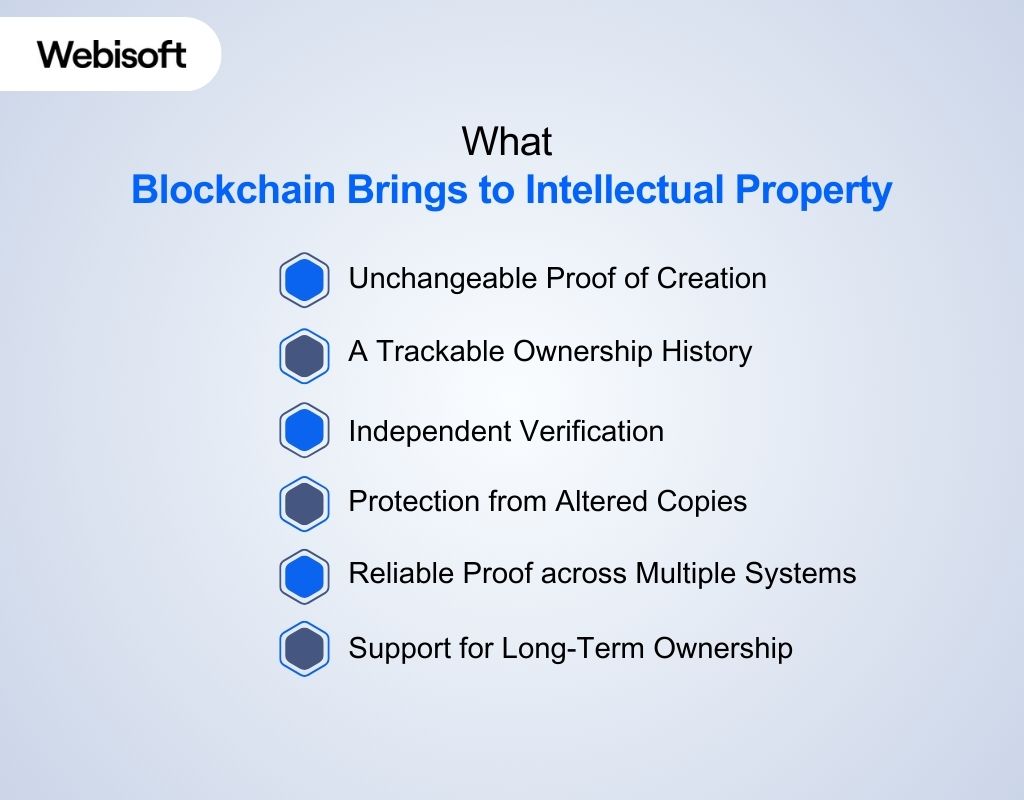
What Blockchain Brings to Intellectual Property
You want proof that holds up when someone questions your ownership. Blockchain gives you proof that traditional systems cannot match. Here are the benefits that matter most:
Unchangeable Proof of Creation
Recording your work on blockchain creates a tamper-proof timestamp, locking in evidence of origin that cannot be altered or erased. This makes your claim stronger in disputes over creation dates.
A Trackable Ownership History
All transfers, licenses, or uses get logged transparently on the ledger, forming a clear chain of custody. Creating smart contracts in blockchain systems automates these processes, simplifying enforcement and reducing conflicts.
Independent Verification
People can confirm your record without relying on your personal files or screenshots. This builds trust in business conversations and creative partnerships.
Protection from Altered Copies
If someone copies your work and claims it as their own, your original entry helps you show which version came first.
Reliable Proof across Multiple Systems
Your evidence is not tied to one website or storage provider. Decentralized storage ensures your records persist beyond any single platform’s failure. Global access supports cross-border protection without intermediaries.
Support for Long-Term Ownership
Your entry remains accessible years later. That helps when older work becomes valuable or gets pulled into a legal or business review.
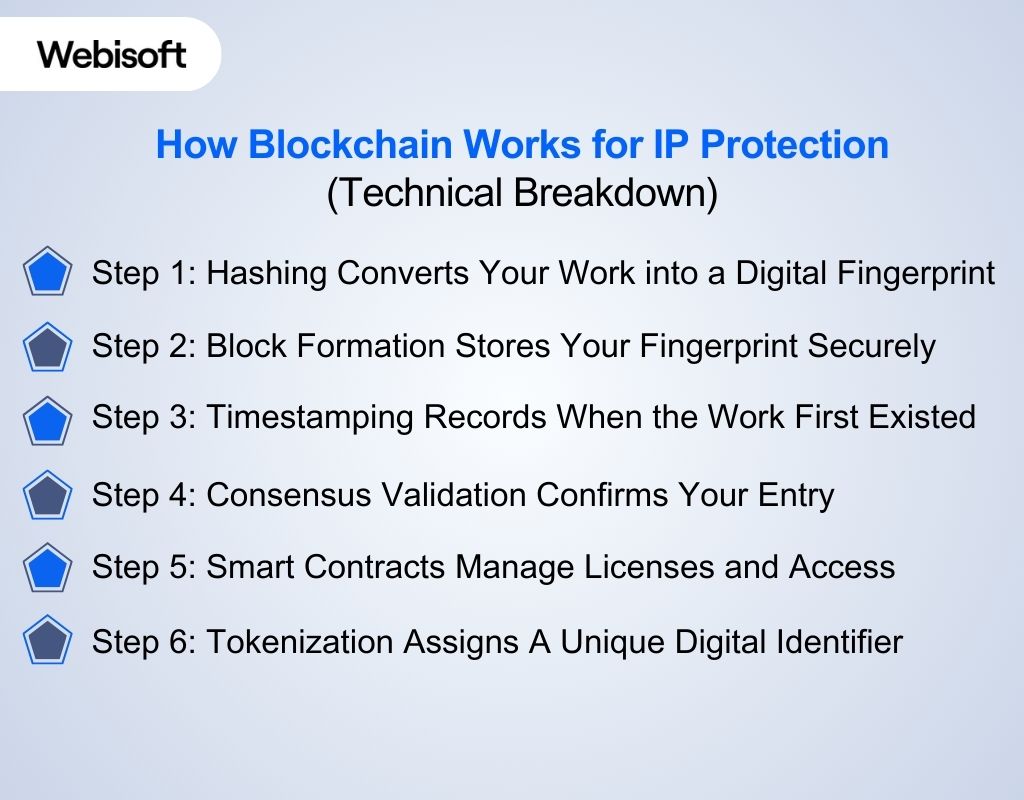
How Blockchain Works for IP Protection (Technical Breakdown)
If you want to understand how can blockchain be used in intellectual property, you should know the working process of blockchain in IP. The system follows a series of steps that lock in your proof and make ownership easier to defend. For example:
Step 1: Hashing Converts Your Work into a Digital Fingerprint
The system of blockchain in intellectual property creates a hash of your file. This hash is generated through cryptographic math that produces the same result only if the file stays untouched. If someone changes even a single piece of your work, the hash changes completely. That is how the system knows which version is the original.
Step 2: Block Formation Stores Your Fingerprint Securely
Your hash, a short description, and a few technical details are packaged together. The block uses a linked structure that connects it to previous blocks. That connection is what keeps older entries safe, because changing one block breaks the entire chain.
Step 3: Timestamping Records When the Work First Existed
The moment the block is created, the network marks the exact time. This timestamp is generated automatically through the block creation process. It becomes a trusted point in your timeline when someone questions who made the work first.
Step 4: Consensus Validation Confirms Your Entry
Before the block is added, different nodes check the entry. This step of blockchain in intellectual property follows a shared set of rules and confirms that the hash and timestamp match what the system expects. This agreement, also known as consensus, keeps the record honest without relying on a single authority.
Step 5: Smart Contracts Manage Licenses and Access
If you want to automate how people use your work, you can attach rules wrapped in code. The blockchain executes these rules only when conditions are met. It avoids confusion and helps you keep a consistent process for permissions and payments.
Step 6: Tokenization Assigns A Unique Digital Identifier
Blockchain uses token standards to turn your IP into a traceable marker. This step is part of blockchain based intellectual property management, and it helps you follow your work as it moves across platforms or owners.
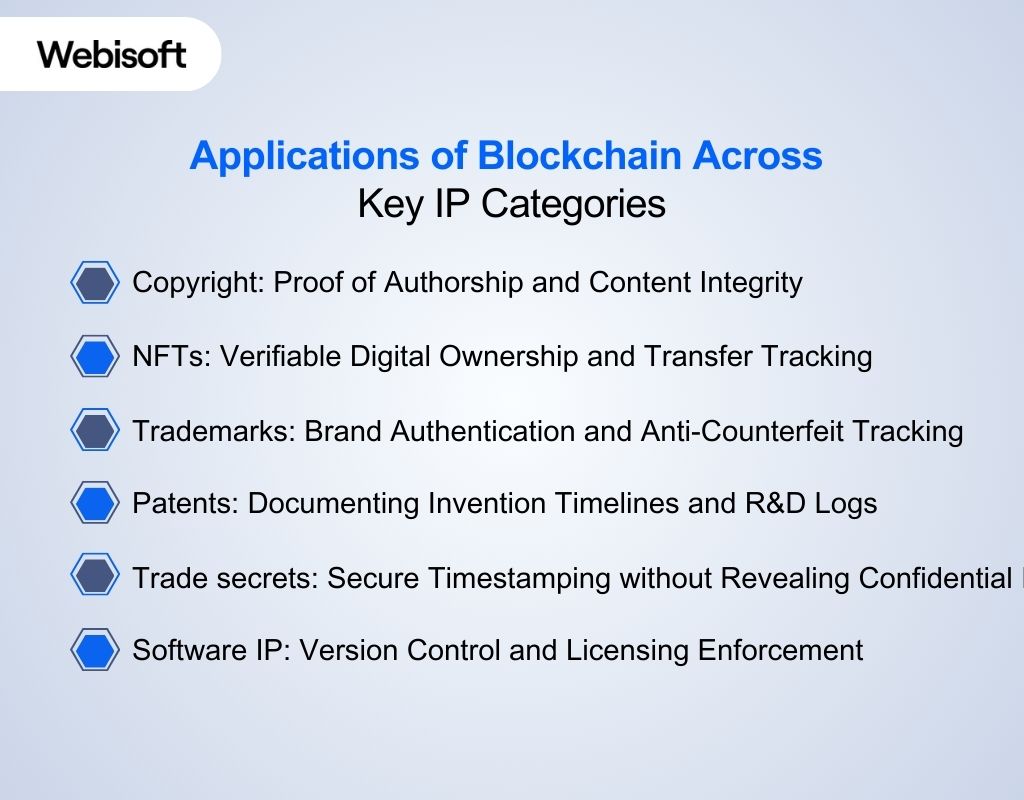
Applications of Blockchain Across Key IP Categories
You can use blockchain in different parts of your creative or technical work. Each category of intellectual property gains something slightly different from the system, especially when you want stronger blockchain intellectual property rights without dealing with messy ownership disputes.
Copyright: Proof of Authorship and Content Integrity
Creative work spreads fast online, and screenshots rarely help you prove anything. A blockchain in intellectual property entry gives you a reliable record of when your work existed. If someone reposts or edits it, you still have a clean reference point.
NFTs: Verifiable Digital Ownership and Transfer Tracking
NFTs give digital creators a unique token that represents the original version of their work. Each transfer is recorded on blockchain, creating a public trail of ownership that helps distinguish authentic creations from copies.
Trademarks: Brand Authentication and Anti-Counterfeit Tracking
Counterfeit products and fake listings are common issues for brands. Blockchain in intellectual property helps you record product details and brand identifiers that customers or partners can verify. It becomes easier for people to tell the real version from a copy.
Patents: Documenting Invention Timelines and R&D Logs
Inventors handle a lot of early drafts and private notes. Timestamping these stages helps you support your development timeline. This is useful when questions come up about who reached an idea first.
Trade secrets: Secure Timestamping without Revealing Confidential Information
Sensitive information never goes on the chain. Only a fingerprint of the file is stored. This way, you can show your secret existed at a certain time without exposing the content itself.
Software IP: Version Control and Licensing Enforcement
Code changes often, and version tracking can get messy. Blockchain keeps a clear record of how your software evolves. Some teams also attach licensing rules to make access and usage stay consistent. This works well when your software moves across platforms that check a blockchain record for verification.
Legal Reality: What Blockchain Can Help With and What It Cannot Replace
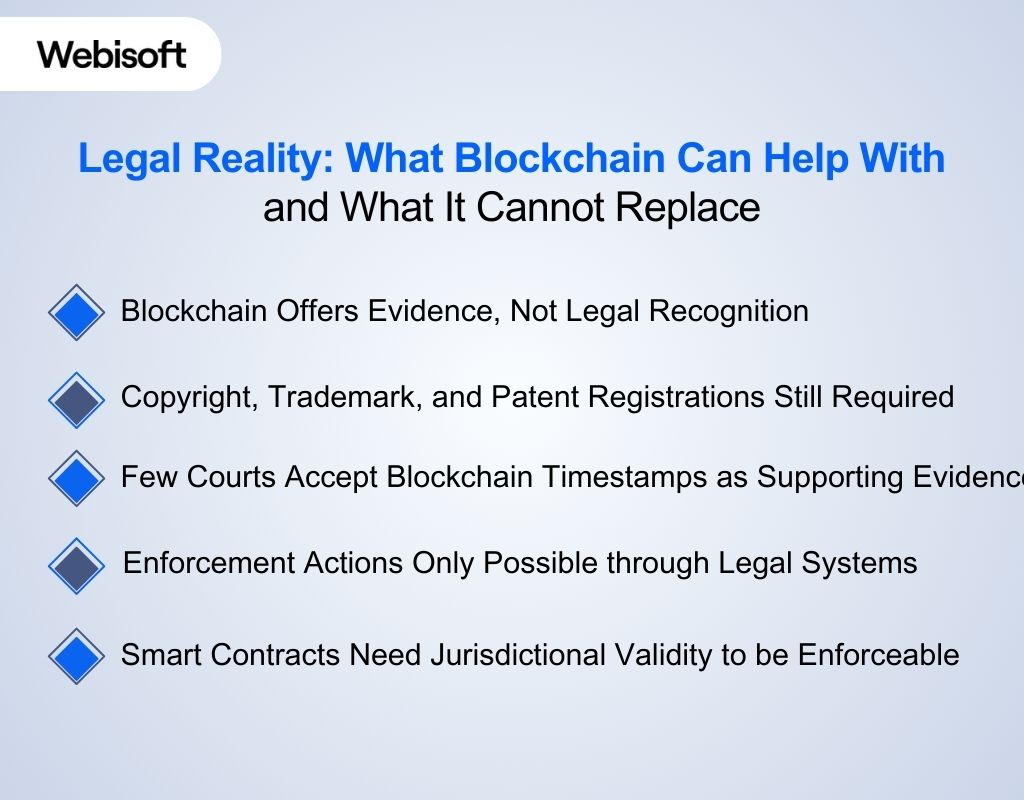
When you first learn about blockchain in intellectual property, it may sound like the system replaces lawyers, courts, and entire government offices. But, in reality, it does not. Blockchain helps you prove your timeline, but the law is still what turns your work into a recognized right. Here’s what blockchain in IP is capable and not capable of:
Blockchain Offers Evidence, Not Legal Recognition
You can record your work on a chain, though that record alone doesn’t create any legal ownership. It supports your story, but it doesn’t give you official rights.
Copyright, Trademark, and Patent Registrations Still Required
Governments handle the legal part. You must still file registrations when you want full control over your work. Blockchain cannot replace those steps.
Few Courts Accept Blockchain Timestamps as Supporting Evidence
A timestamp in the blockchain system helps you show when your work first existed. Judges can look at it, though it only supports your claim. It cannot stand in place of formal filings. For example, French courts (2025 Marseille ruling) accept blockchain timestamps as supporting evidence.
Enforcement Actions Only Possible through Legal Systems
If someone steals your work, only the law can remove the copy. Blockchain cannot take down a website or stop someone from using your creation.
Smart Contracts Need Jurisdictional Validity to be Enforceable
Smart contracts can automate licensing, but they still need to align with blockchain and intellectual property law to count as real agreements. Without legal backing, they function more like automated instructions than enforceable contracts in intellectual property policies and rights.
Blockchain Evidence vs Legal Recognition in Intellectual Property
Blockchain and legal systems often get mixed together, but they do two very different jobs. Blockchain gives you a record that shows when your work existed and whether it stayed unchanged. Legal recognition defines the rights you actually hold.
One builds proof. The other decides ownership. When you talk about legal recognition in IP, you are talking about the rights granted by governments through copyright certificates, trademark filings, and patent registrations.
Courts rely on these filings, not just timestamps, when making decisions. It means the law is still the final source of power when ownership is challenged. Here is a quick way to see the difference between law and blockchain in intellectual property:
| What You Get | Blockchain | Law |
|---|---|---|
| What it gives you | Proof your work existed | Official ownership rights |
| What it records | Timestamp and integrity | Registration tied to your identity |
| What it cannot do | Replace filings or stop theft | Record creative timelines automatically |
| What courts use it for | Supporting evidence | Final decision on rights |
| What happens if you rely on it alone | You have proof, but no enforcement | You can enforce, remove copies, and claim damages |
Note: Blockchain records work anywhere in the world, but IP laws do not. When disputes cross borders, each country applies its own rules, which means your blockchain proof must still fit the legal requirements of the region handling the case.
Limitations of Blockchain When Protecting IP
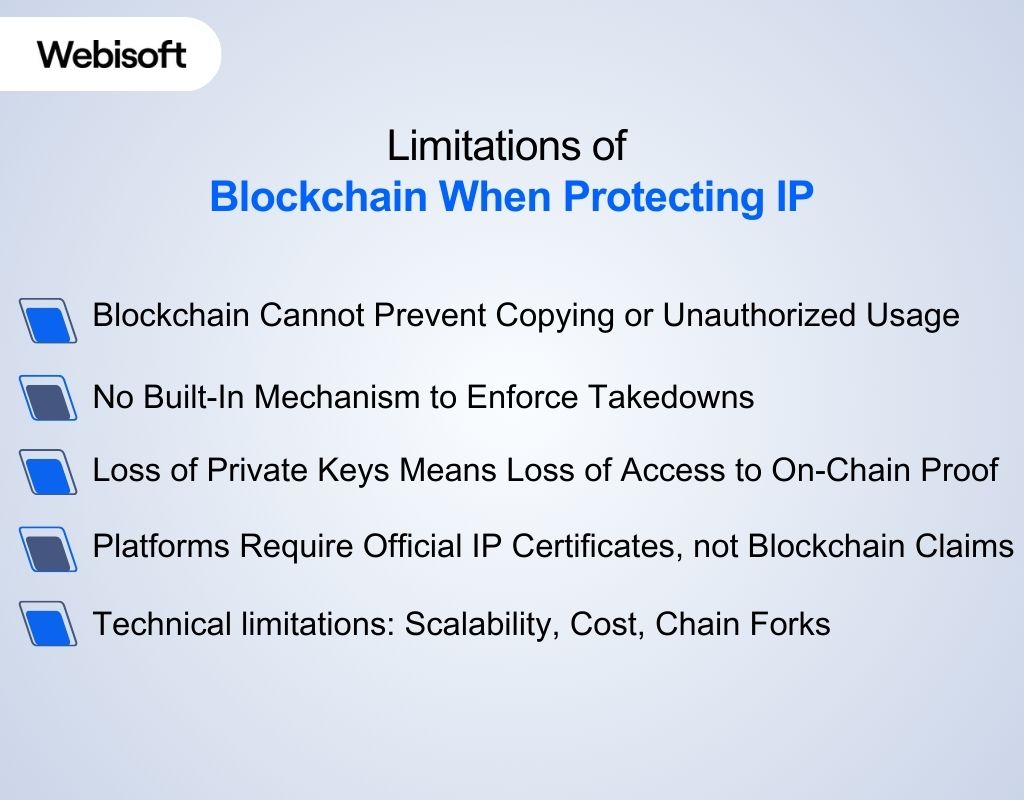
You get real value from blockchain in intellectual property, but there are limits you should keep in mind. These limits of blockchain in intellectual property are:
Blockchain Cannot Prevent Copying or Unauthorized Usage
Someone can still screenshot, download, or repost your work in social media or on their own website. The chain doesn’t block theft but only gives you proof afterward.
No Built-In Mechanism to Enforce Takedowns
Blockchain doesn’t remove stolen content from websites, Instagram, X, or other social platforms. Only legal processes or platform policies can do that.
Loss of Private Keys Means Loss of Access to On-Chain Proof
If you lose the key tied to your record, you lose access to your entry. There is no reset button or support team to recover it.
Platforms Require Official IP Certificates, not Blockchain Claims
Websites that handle disputes want government-issued proof. A blockchain entry helps, though it cannot replace a formal registration when you file a complaint.
Technical limitations: Scalability, Cost, Chain Forks
Some chains slow down during heavy usage or become expensive to write to. Forks can also complicate which version of the chain holds your record. These technical shifts do not erase your proof, but they can make the system harder to trust long term if you choose the wrong chain.
WIPO’s Role in Shaping Blockchain Adoption for Intellectual Property

WIPO guides global IP rules, so its work helps decide how countries might treat blockchain systems. When you use blockchain in intellectual property, its value increases when legal systems understand and accept how the technology works. Here are more details:
What WIPO is and Why It Matters
WIPO runs UN treaties for copyrights, trademarks, and patents in about 194 countries. It pushes global standards so your IP holds up worldwide. Still, online theft outpaces these rules; you need faster proof like blockchain.
WIPO’s Blockchain Initiatives
WIPO is testing blockchain in practical ways instead of treating it as a theoretical upgrade. Its recent projects show how global IP systems may adapt to new technology. For example:
- WIPO formed a Blockchain Task Force that focuses on real use cases for blockchain inside IP offices, including record exchange and verification.
- The organization released a detailed white paper in 2022 titled “Blockchain technologies and IP ecosystems” that explains how blockchain could support registration, timestamping, and information sharing.
- WIPO gathered input from many IP offices and industry groups worldwide, which shows that many regions are evaluating blockchain for long term IP operations.
Why WIPO Driven Global Alignment is Critical for Future IP Protection
Without consistent rules, every blockchain entry risks being judged differently from one country to another. WIPO’s work helps reduce those gaps. Global alignment gives creators and businesses confidence that blockchain records will be treated fairly regardless of where a dispute arises.
Privacy and Practical Framework for Using Blockchain in IP Protection
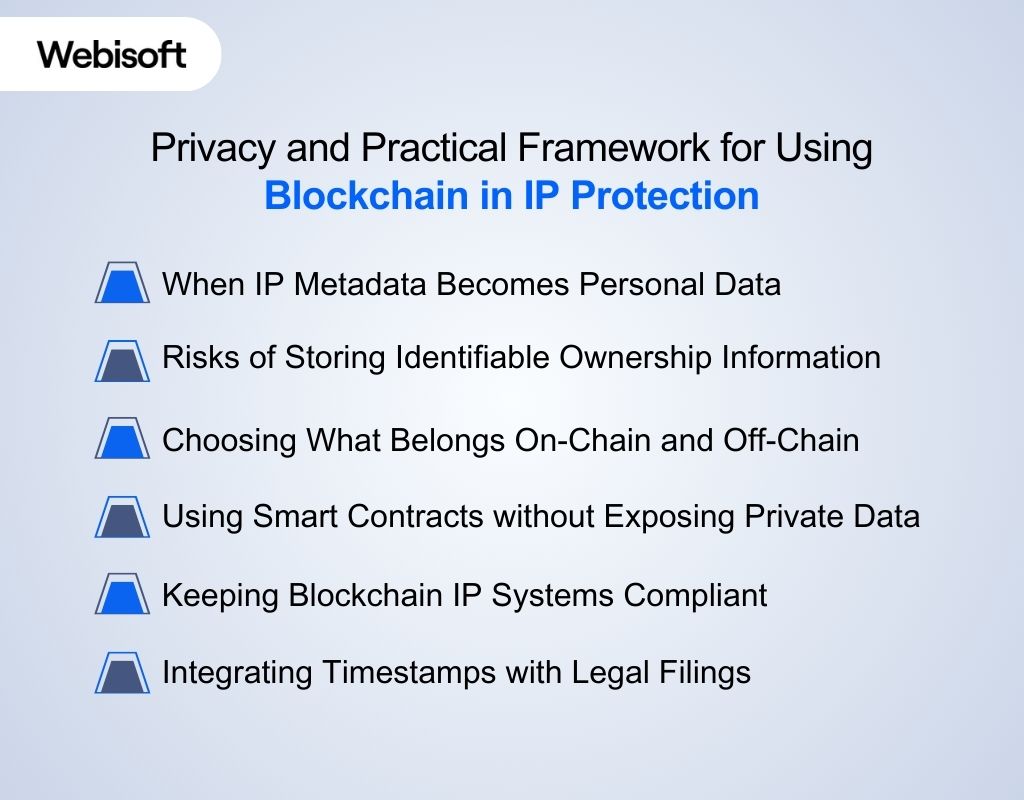
When you secure your work with blockchain, you want strong proof without exposing information you never meant to share. Privacy and practical setup go hand in hand, especially with IP records. Here’s way you need to know:
When IP Metadata Becomes Personal Data
Your name, file details, or identifying information can turn into personal data when added to a record. Once stored, it becomes part of the permanent chain, which is difficult to change later.
Risks of Storing Identifiable Ownership Information
A public chain can reveal more than you expect. If your identity connects directly to your work, someone might trace your activity, ownership, or release patterns.
Choosing What Belongs On-Chain and Off-Chain
You should never store full files or sensitive content directly on the chain. Keep those off-chain and store only short fingerprints or references. This reduces risk while keeping proof intact.
Using Smart Contracts without Exposing Private Data
You can set licensing or access rules through smart contracts, but they should be designed to keep personal details out of the public record. Only the logic should be visible, not your private information. If you need smart contract development service from professionals for your blockchain in intellectual property, contact Webisoft to book your quote!
Keeping Blockchain IP Systems Compliant
A good setup uses encryption, off-chain storage, and metadata minimization. This keeps your IP system aligned with privacy requirements while maintaining verifiable proof.
Integrating Timestamps with Legal Filings
Your blockchain timestamp supports your timeline, but you should still complete official filings. The combination makes your proof stronger during disputes.
Practical Examples of Blockchain Improving IP Protection
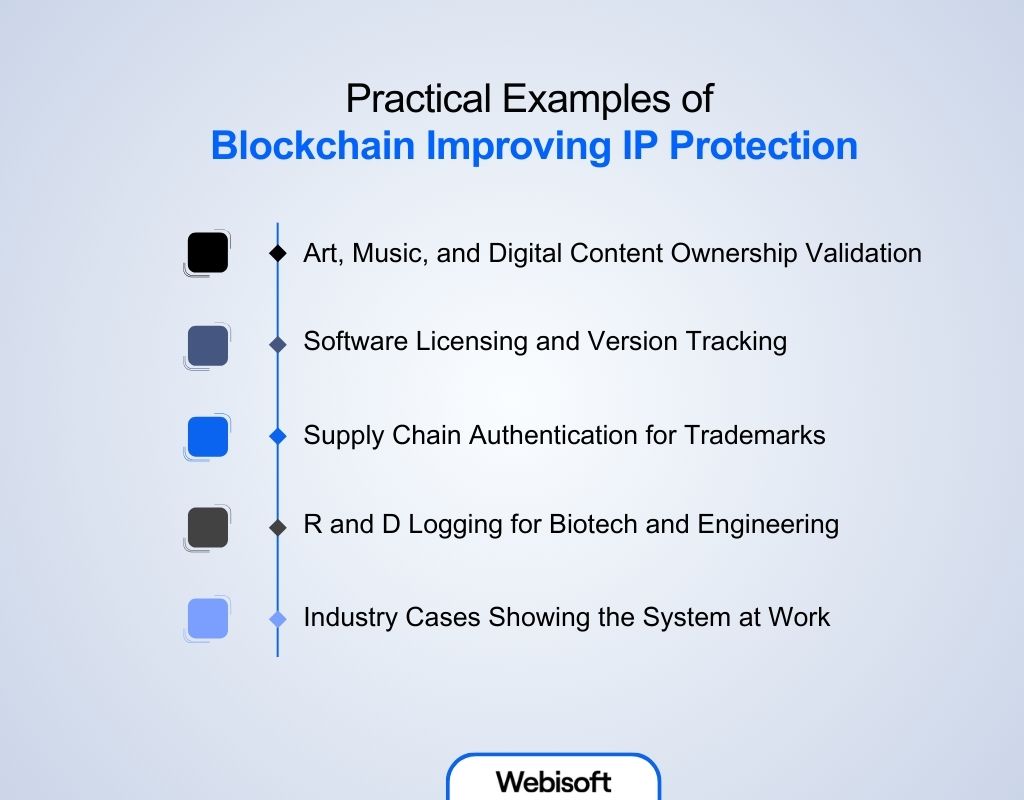
You see the real value of blockchain when you look at how different industries already use it. These examples show how blockchain intellectual property protection works in practice, not just in theory.
Art, Music, and Digital Content Ownership Validation
Creators record their work to prove authorship. When someone reposts or edits a piece, the original timestamp helps settle disputes quickly.
Software Licensing and Version Tracking
Teams use blockchain to track code changes and prove which version shipped first. Licensing rules can also run through smart contracts to keep usage consistent.
Supply Chain Authentication for Trademarks
Brands log product data so partners and customers can verify items before buying. This reduces confusion created by counterfeit goods.
R and D Logging for Biotech and Engineering
Researchers timestamp early notes, experiments, and prototype updates. The record helps support invention timelines when questions appear later.
Industry Cases Showing the System at Work
Media companies, software vendors, manufacturing firms and even legal services use blockchain to keep cleaner records. They rely on clear timelines when dealing with audits, disputes, or new partnerships.
How Webisoft Helps Businesses with Blockchain for IP

If you plan to use blockchain in intellectual property, Webisoft helps you in several ways that protect your work with reliable, long term records. If you want guidance before starting, you can book a free consultation for available options. Here’s how Webisoft can help you:
Custom Blockchain Systems for Secure IP Records
Webisoft designs private or hybrid blockchain architecture that store your IP data with strict control. These systems handle how your records are written, who can access them, and how long they remain verifiable. This way Webisoft can give you a secure environment for timestamping, ownership logs, and sensitive IP entries through custom blockchain development service.
Smart Contracts for Licensing and Rights Management
You can automate licensing terms, file access, or payment triggers through smart contracts. This reduces manual work and helps you avoid confusion when you work with clients or partners. Contact Webisoft today to get started with the process!
DApps for registering, tracking, and managing creative work
Once the blockchain foundation is in place, Webisoft creates the tools you use every day. These DApps support tasks like submitting new work, reviewing ownership history, approving access, or managing licensing requests. The apps turn the complex blockchain system processes into simple actions.
Blockchain for Media and Content Production
For media creators, agencies, and production teams, Webisoft offers enterprise blockchain systems that help to improve copyright management, validate authorship, track edits, and manage files across multiple contributors.
Scalable Infrastructure and Long Term Support
Your IP records need to stay accessible for many years. Webisoft provides blockchain infrastructure, monitoring, and updates so your network stays reliable even as your catalog grows.
Security reviews for sensitive IP data
Webisoft performs technical audits to identify weak points in your blockchain setup. This is useful when you store early drafts, prototypes, or confidential material on private networks.
Conclusion
To wrap up, blockchain in intellectual property offers a reliable method to record creation times, track ownership, and back your legal claims. While it doesn’t replace formal registration, combining blockchain proof with official filings strengthens your protection.
With the right system, you can protect your creative and technical assets, manage licenses smoothly, and confidently follow your ideas. If you need more information, you can contact Webisoft for professional help.
FAQs
Here are some commonly asked questions regarding the blockchain in intellectual property:
Yes. Blockchain records a fingerprint of your work, not the file format itself. Even if the software used to open your original file becomes outdated, the fingerprint stays valid.
You should avoid placing full files, private drafts, confidential details, or personal information on a chain. After recording, it becomes permanent and visible to anyone on that network. Most creators store only a fingerprint of the work and keep the actual content off-chain.
It can be. Every update can be recorded as a separate entry, which creates a clear development trail. This helps you show how your work evolved and helps during audits or when you need to show that a concept existed before someone else released a similar idea.