
Traditional real estate methods cost you money in ways you don’t even see. You price properties based on gut feeling and outdated comparables. Meanwhile, ML-powered competitors analyze 500+ variables instantly and price with precision.
You spend weeks qualifying leads manually while AI systems score them accurately in seconds. You react to market shifts after everyone else already capitalized on them. Machine learning in real estate changes everything. It spots profitable opportunities 18 months before they become obvious to traditional investors.
The industry evolved rapidly, and institutional leaders now demand AI-driven analytics as standard practice. The time to adapt is now. Read this complete guide on machine learning in real estate and discover how it transforms property valuation, predicts market trends, and automates lead generation.
What Is Machine Learning for Real Estate Owners?
Machine learning in real estate is a technology that uses algorithms to analyze vast property data and predict market outcomes. It acts as a high-speed digital brain for modern property owners. This system learns from every transaction, tax change, and economic shift in real-time.
Owners use it to predict future property values with high precision. It identifies up-and-coming neighborhoods before they peak or trend. By 2026, ML automates about 37% of routine property tasks. It removes guesswork and turns raw data into clear wealth-building maps.
Machine Learning vs Traditional Real Estate Analysis
Machine learning outperforms traditional analysis by processing non-linear relationships and massive datasets in real-time.
In contrast, traditional methods rely on static historical “comparables” and limited human-selected variables. The following table compares these two approaches across the essential factors driving the 2026 market:
| Feature | Traditional Analysis | Machine Learning (ML) |
|---|---|---|
| Data Scope | Limited to 3–5 manual comparables. | Millions of data points (deeds, listings, social, imagery). |
| Processing Speed | Typically, 3–7 days per report. | Instant, real-time results in seconds. |
| Valuation Accuracy | 10%–15% median error rate. | 3%–5% median error rate in 2026. |
| Market Outlook | Reactive: Focuses on past sales. | Predictive: Forecasts future trends and risks. |
| Primary Variables | Fixed traits (sq. ft., beds, baths). | Dynamic traits (foot traffic, sentiment, ESG signals). |
| Human Bias | High; subjective and dependent on the analyst. | Low; driven by algorithmic logic and large datasets. |
| Image Recognition | None; requires manual photo review. | Analyzes images to assess condition, layout, and quality. |
| Scalability | 1–2 properties analyzed per day. | Thousands of properties are analyzed per minute. |
| Risk Assessment | Static; relies mainly on debt-to-income ratios. | Dynamic; predicts default and risk using market shifts and behavior. |
| Adaptability to Market Changes | Slow; updates infrequently. | High; continuously learns from new data. |
| Decision Consistency | Varies by individual expertise and judgment. | Highly consistent across markets and property types. |
| Upfront Cost | Low; primarily professional labor fees. | High; requires data infrastructure, models, and maintenance. |
How Machine Learning Is Changing Decision-Making in Property Markets?
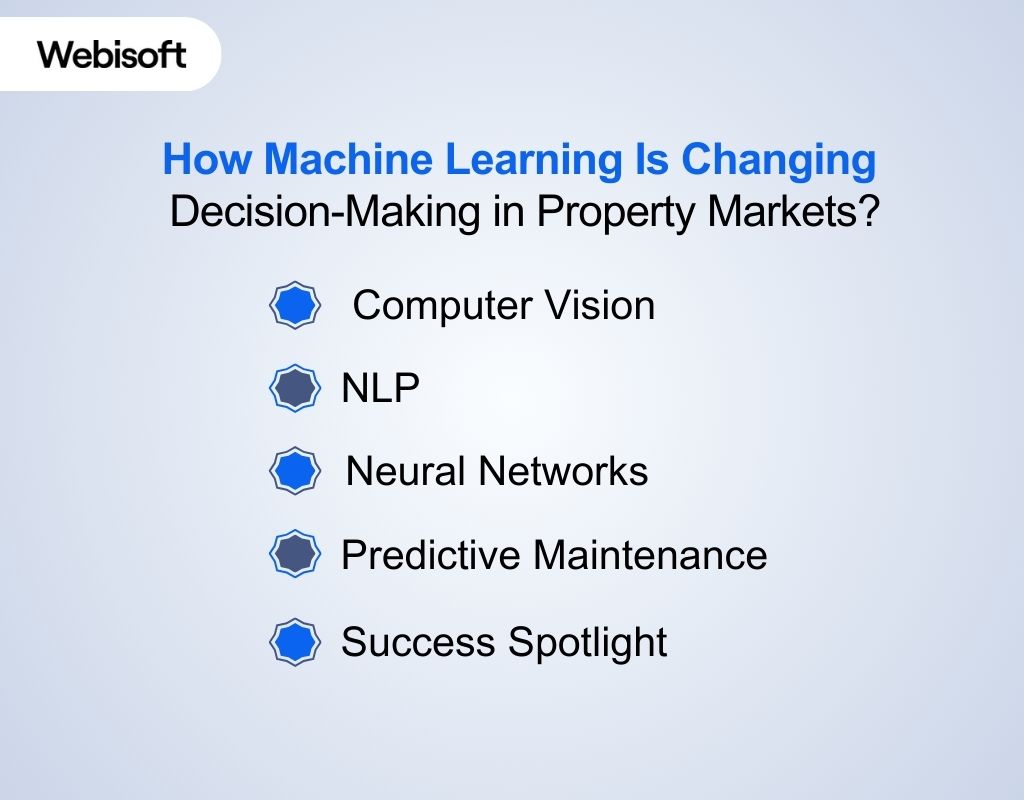
Machine learning transforms real estate by replacing slow, backward-looking reports with real-time predictive foresight.
1. Computer Vision: Appraising Your Photos
Machine learning uses “Computer Vision” to scan property images. It identifies the quality of materials, such as sustainable stone or modular vanities. The system compares your kitchen to thousands of others to judge its “aesthetic value.” This visual data improves valuation accuracy by allowing models to factor in property condition, not just size.
2. NLP: Reading the Neighborhood “Vibe”
Natural Language Processing (NLP) allows AI to “read” the internet. It scans thousands of local news articles, tweets, and building permits.
It looks for clues like a new coffee shop opening or improved school ratings. This helps the system predict which neighborhoods will trend before prices spike. In 2026, sentiment tracking is a top tool for spotting “off-market” hotspots.
3. Neural Networks: Predicting the Future ROI
Neural networks are the “deep brains” of real estate ML. They process non-linear relationships, like how interest rates impact luxury buyer behavior.
These models run millions of “what-if” simulations in seconds. In 2026, they have helped modern AVMs reach accuracy rates approaching 94% for residential properties.
4. Predictive Maintenance: Sensing Building Health
Advanced systems use IoT sensors to feed data into ML models. The AI “listens” to the vibration of an HVAC unit or an elevator motor.
It identifies tiny irregularities that signal a future breakdown. This shift to predictive care can lead to operating efficiencies of up to 37% in building management.
5. Success Spotlight: Compass AI & Likely-to-Sell Models
In Q3 2025, Compass grew revenue by 23.6% to $1.85 billion by helping agents find sellers before homes hit the open market.
- The Project: Compass added Likely-to-Sell (LTS) and Likely-to-Win (LTW) models to its CRM to identify homes most likely to list within the next 12 months, based on market trends and homeowner behavior.
- The Result: By the end of 2025, Compass agents outperformed overall market transaction growth by nearly 20 percentage points. This helped agents focus renovation budgets and marketing time on leads most likely to convert.
- The Feature: New 2026 tools include automated 3-Phased Price Discovery, which tests pricing privately before a public launch to reduce time on market and protect home value.
What Problems in Real Estate Machine Learning Is Designed to Solve?
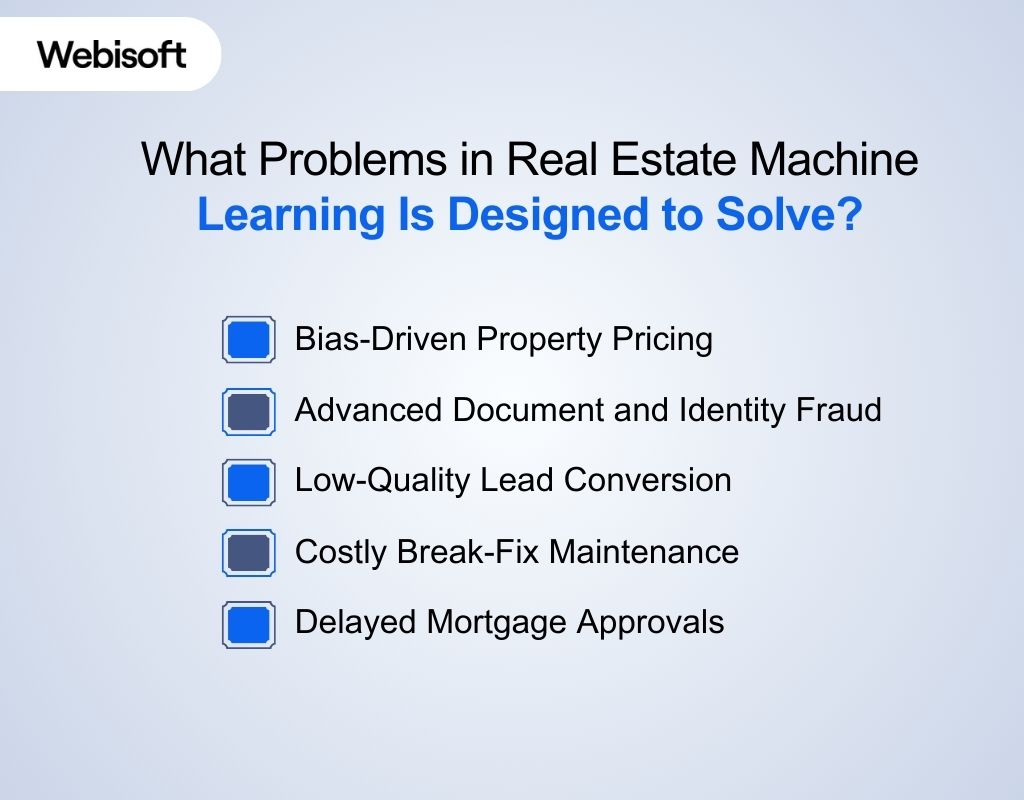
Machine learning acts as a precision tool for the modern property owner. It addresses long-standing industry failures that once caused massive financial leaks. Below are the five critical problems these systems solve today.
1. Bias-Driven Property Pricing
Human appraisals often vary based on an individual’s personal bias. This led to a 10% to 15% error rate in traditional valuations.
AI machine learning removes this bias by analyzing over 300 variables instantly. In 2026, some models have pushed prediction accuracy for property fluctuations toward 63% to 94%.
2. Advanced Document and Identity Fraud
Criminals now use high-tech tools to forge deeds and financial records. Traditional manual checks often fail to spot these “deepfake” documents. Machine learning acts as a digital shield. It scans pixels for microscopic inconsistencies. It blocks identity theft and wire fraud before any capital moves.
3. Low-Quality Lead Conversion
In 2025, around 70% real estate agents never closed their deals. Machine learning solutions solve this by using “Predictive Scoring” to identify high-intent buyers.
It analyzes browsing behavior and lifestyle cues to find serious prospects. This technology can increase sales-ready leads by 50%.
4. Costly Break-Fix Maintenance
Historically, property owners only fixed equipment after it failed. This led to high emergency costs and downtime. Machine learning integrates with building sensors to “hear” mechanical issues before they happen. This shift to predictive care can reduce maintenance costs by 18% to 25%.
5. Delayed Mortgage Approvals
Waiting weeks for loan approval often kills time-sensitive property deals. Manual underwriting is slow and prone to human error. Machine learning automates the verification of income and credit history in seconds. In 2026, many lenders offer same-day pre-approvals using these algorithms.
Use Cases of Machine Learning in Real Estate
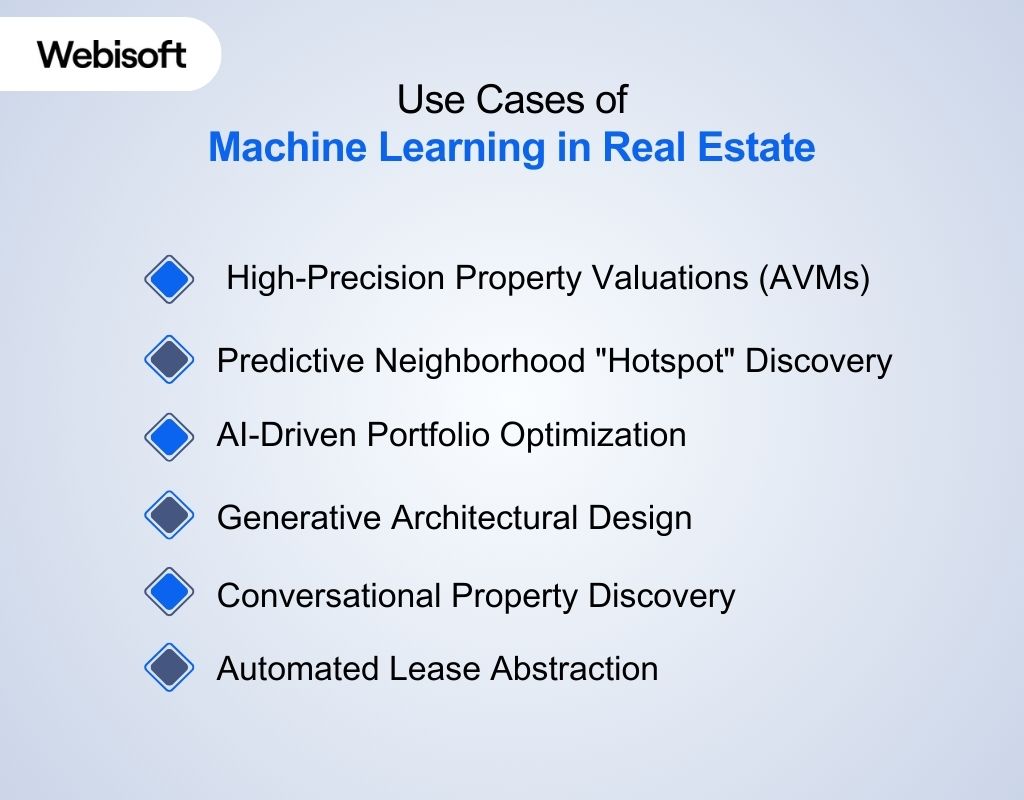
Machine learning transforms real estate by replacing manual guesswork with objective logic. It automates complex property valuations, detects “invisible” investment hotspots, and prevents expensive maintenance crises through real-time sensor data.
1. High-Precision Property Valuations (AVMs)
Machine learning has turned property pricing into a science. Beyond simple square footage, modern systems analyze satellite imagery and local infrastructure projects. For example,
- HouseCanary launched CanaryAI, a first-of-its-kind generative AI assistant that allows users to search 136 million property records using natural language.
- It can estimate After-Repair Value (ARV) instantly by analyzing property photos for “condition quality.”
2. Predictive Neighborhood “Hotspot” Discovery
Algorithms now identify which areas will trend 12 to 18 months before they hit the news. By tracking building permits, cafe openings, and migration patterns, ML gives investors a “first-mover” advantage. This helps you spot undervalued neighborhoods before prices spike.
Recent Launch: Local Logic and Rechat launched a major AI-powered neighborhood integration that gives real estate agents and investors a quick score of a neighborhood’s potential.
- This “vibe” score looks at things like how walkable the area is, school quality, and other local factors.
- By analyzing tons of data, the tool can predict which neighborhoods are likely to become more popular or valuable soon.
3. AI-Driven Portfolio Optimization
Instead of just using spreadsheets, investors now use AI to analyze tons of data and create smarter investment portfolios. These AI tools balance risk and reward more effectively. By 2026, this will help firms get higher returns without taking extra risk.
4. Generative Architectural Design
In the past, checking if a building design would work or conducting “feasibility studies” could take months. Now, AI can generate building layouts in hours by using rules like zoning laws, sunlight, and other requirements.
➜The result: Architects spend far less time on calculations and more on designing quality buildings. Initial design work is now 99% faster.
5. Conversational Property Discovery
The days of clicking “filter” buttons are over. In 2026, property search is lifestyle-based. Users describe their commute, “vibe,” and needs in plain language. Machine learning translates this intent into matches, lifting buyer engagement by showing them homes that fit their actual lives.
6. Automated Lease Abstraction
Reviewing commercial leases used to take a human 4 to 8 hours per document. Specialized ML agents now process these in just 15 to 30 minutes with up to 99% accuracy. This allows large firms to manage massive portfolios without the “paperwork bottleneck,” saving hundreds of hours of manual labor every week.
What Data Powers Machine Learning in Real Estate?
Machine learning systems are only as good as the data feeding them. Real estate ML requires massive, diverse datasets to make accurate predictions.
| Data Category | Specific Data Types |
|---|---|
| Property Characteristics | Square footage, bedrooms, bathrooms, age, condition, layout, amenities, architectural style, renovation history |
| Location Data | ZIP code, neighborhood, school district, proximity to transit, nearby amenities, crime rates, walkability scores |
| Transaction History | Sale prices, listing prices, days on market, price changes, seasonal patterns, comparable sales |
| Economic Indicators | Interest rates, unemployment, GDP growth, inflation, currency exchange rates, construction costs |
| Demographic Data | Population density, age distribution, income levels, household size, migration patterns, education levels |
| Satellite Imagery | Parking lot occupancy, construction progress, vegetation health, building footprints, land use changes |
| Foot Traffic Data | Mobile location data, visitor counts, dwell time, movement patterns, peak hours |
| Social Media & Sentiment | Posts, check-ins, reviews, sentiment analysis, trending topics, user engagement |
| Property Descriptions (Text) | Listing descriptions, marketing copy, feature mentions, qualitative attributes |
| Images & Visual Data | Property photos, street views, interior condition, aesthetic appeal |
| Credit Card Transactions | Consumer spending patterns, purchase categories, transaction volumes, payment timing |
| Weather & Climate | Historical weather, climate change projections, flood risk, wildfire exposure, storm frequency |
| Regulatory & Legal | Zoning changes, permits, building codes, tax assessments, foreclosures, liens |
How to Implement Machine Learning in Real Estate Analysis and Predictions?
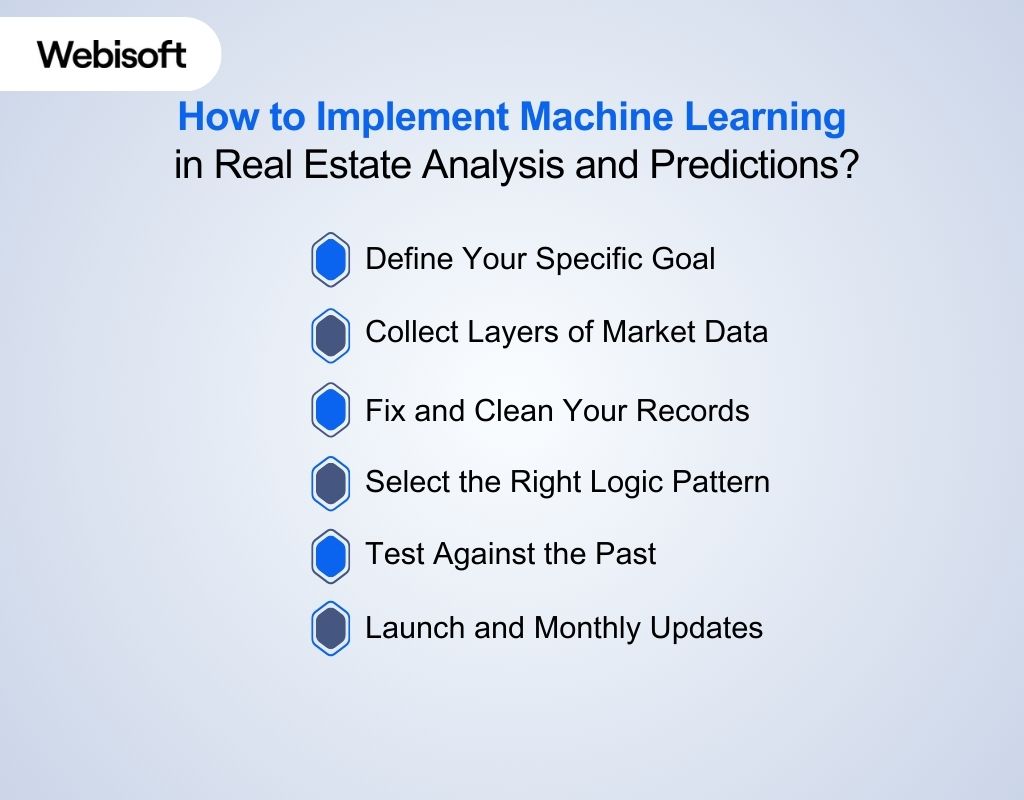
In 2026, building a machine learning system means moving from static spreadsheets to a live data pipeline. This process connects real-time market signals with math-based logic to automate high-stakes property decisions.
Step 1: Define Your Specific Goal
Before looking at data, decide exactly what you want the computer to predict. Are you calculating a home’s future resale price, identifying growth zones, or timing a market exit? A narrow focus ensures the model ignores irrelevant “noise” and stays accurate for your specific strategy.
Step 2: Collect Layers of Market Data
Modern systems need more than just past sales prices. You must combine three specific types of information:
- Property Details: Size, age, and features (like spa-grade ventilation).
- Neighborhood Vibe: Using public news and local sentiment to gauge a zip code’s popularity.
- External Risks: Satellite views of drainage patterns and 2026 climate trends to catch hidden costs.
Step 3: Fix and Clean Your Records
Raw data is often messy or incomplete. You must remove “outliers”, such as a single $50 million mansion that would confuse the model’s average, and fill in missing details. This step ensures the machine is learning from accurate facts rather than digital errors.
Step 4: Select the Right Logic Pattern
Choose a model based on your goal:
- Pattern Recognition: Best for spotting which houses are “underpriced” compared to their neighbors.
- Forecasting Models: Used for predicting how interest rates or inflation will change property values over the next year.
- Sorting Tools: Ideal for ranking which leads are most likely to buy right now.
Step 5: Test Against the Past
Never use a model immediately. Run it on data from 2024 and 2025 to see if it would have “guessed” the actual results correctly. This historical testing identifies if the model’s logic is flawed or if it has become outdated due to recent market shifts.
Step 6: Launch and Monthly Updates
Deploy your model into a live dashboard. In 2026, a “set it and forget it” approach leads to failure. You must update the model every month with new data to ensure it stays aligned with current mortgage rates and changing buyer habits.
How Machine Learning Controls Real Estate Costs
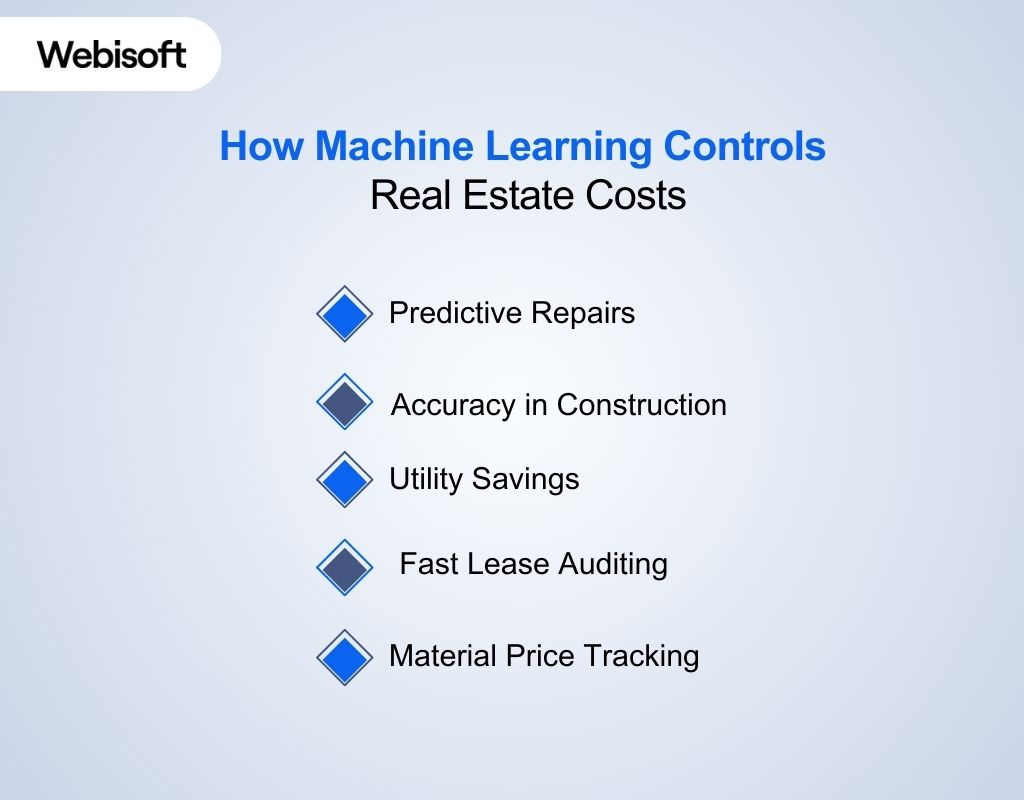
In 2026, machine learning techniques act as a financial shield for property owners. It saves money from “leaking” by predicting expensive repairs, spotting billing errors, and calculating construction budgets with near-perfect accuracy.
1. Predictive Repairs
Most owners fix systems only after they break, which is the most expensive way to manage a building. Machine learning uses sensors to track heat and vibration in elevators or HVAC units. It alerts you to problems weeks early. This reduces emergency repair costs and keeps your equipment running longer.
2. Accuracy in Construction
Construction projects often go over budget due to human math errors. Machine learning models now analyze thousands of past builds to predict labor and material prices with high accuracy. This prevents the “surprise” cost increases that often ruin project profits.
3. Utility Savings
Energy is usually the highest “controllable” cost. ML creates a digital map of your building and tracks usage. It automatically dims lights or lowers cooling when rooms are empty. These smart adjustments typically cut monthly power and water bills significantly.
4. Fast Lease Auditing
Checking hundreds of leases for billing errors is slow for humans. ML agents can “read” these documents in minutes to find overcharges or missed rent increases. This cuts administrative labor and ensures you never lose revenue to simple paperwork mistakes.
5. Material Price Tracking
In the fast-moving 2026 market, the price of steel or wood changes daily. Machine learning tracks global supply data to warn you before prices spike. This lets you buy materials at the cheapest time, protecting your budget from sudden market inflation.
Note: If you want smarter valuations, stronger risk forecasting, and real-time market intelligence, partnering with Webisoft’s expert ML team is the next step. Our specialists turn fragmented property data into accurate insights, automate valuation workflows, and build ML systems that adapt as markets, neighborhoods, and buyer behavior shift.
Advantages of ML in Real Estate
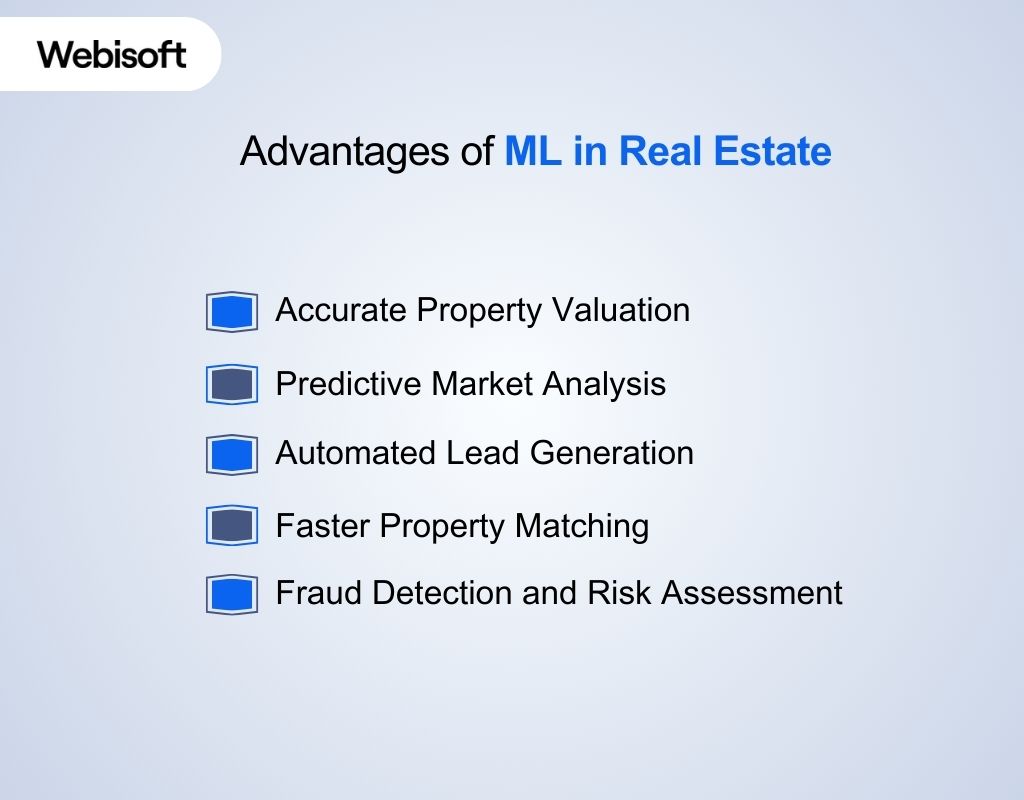
Machine learning revolutionizes how real estate professionals work. It processes massive datasets instantly, uncovers hidden patterns, and delivers insights humans would miss. Here’s how it transforms the industry:
1. Accurate Property Valuation
ML models analyze thousands of comparable sales in seconds. They factor in location, size, amenities, and market trends simultaneously.
This eliminates human bias and guesswork. Agents get precise pricing recommendations backed by real data. Buyers and sellers make informed decisions faster.
2. Predictive Market Analysis
Algorithms forecast market shifts before they happen. They track economic indicators, demographic changes, and historical patterns together.
Real estate professionals spot opportunities early. Investors identify high-growth areas with confidence. Risk decreases when predictions guide strategy.
3. Automated Lead Generation
ML identifies potential buyers and sellers automatically. It analyzes online behavior, search patterns, and engagement signals continuously.
Agents focus on qualified prospects only. Marketing budgets work harder with targeted campaigns. Conversion rates improve dramatically through smart automation.
4. Faster Property Matching
Systems learn client preferences from past interactions instantly. They scan thousands of listings and filter perfect matches quickly.
Clients save time on irrelevant property tours. Agents close deals faster with better recommendations. Satisfaction increases when matches align precisely.
5. Fraud Detection and Risk Assessment
ML spots suspicious transactions and documentation irregularities immediately. It cross-references data points across multiple sources constantly.
Lenders reduce default risk through smarter screening. Title companies catch fraud before the closing happens. Everyone benefits from increased security and trust.
Note: CoreLogic’s LoanSafe Fraud Manager detects fraud indicators in mortgage applications efficiently. Their system achieves 46% detection rates while reviewing only 5% of applications. This lets lenders focus resources on the highest-risk cases.
The Limitations of Machine Learning in Real Estate
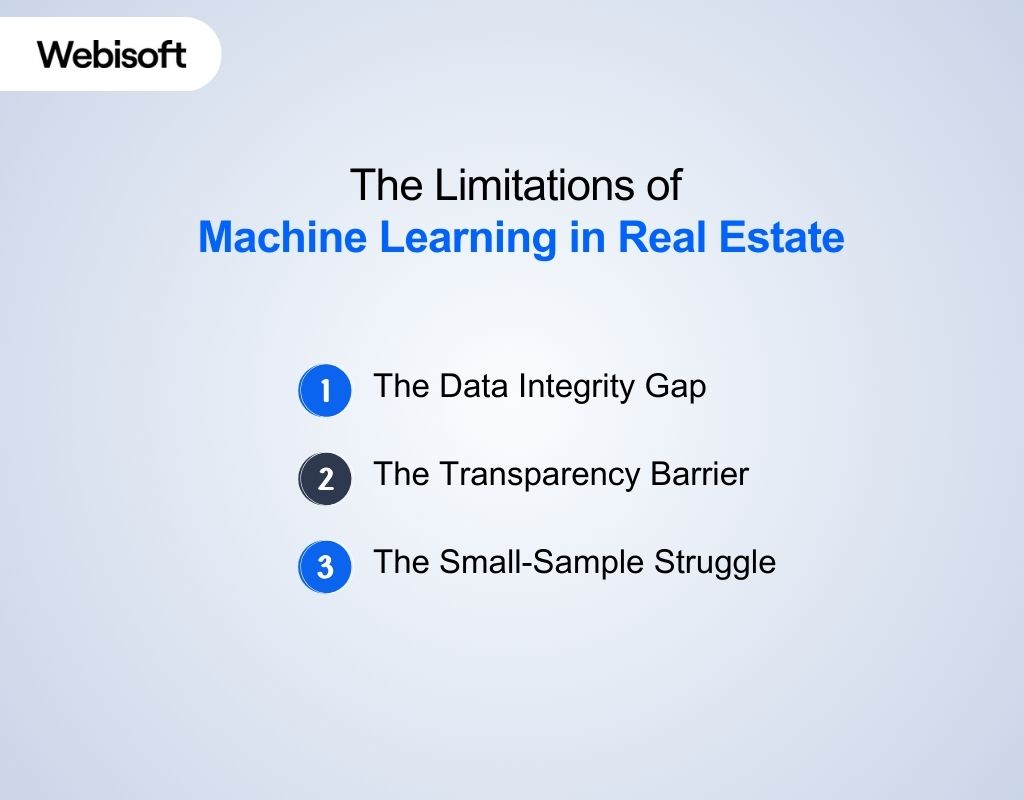
While algorithms can handle large amounts of data, they don’t have the intuition to understand the complexities of human behavior in property markets. Here are some of the key limitations you might face with machine learning in real estate industry:
1. The Data Integrity Gap
Algorithms are only as reliable as the data they use. In many regions, property sales records have significant delays or incomplete information.
If the system uses outdated or incorrect data, the resulting valuations won’t capture real-time market changes, potentially causing costly financial mistakes.
2. The Transparency Barrier
Advanced models often operate as “black boxes,” providing a final price without a clear logical trail. This lack of “explainability” creates friction with lenders and regulators who require a clear justification for a property’s value. This is especially when the machine’s output contradicts local human knowledge.
3. The Small-Sample Struggle
Machines require high-volume data to achieve accuracy. In rural markets or for unique luxury properties, there are simply not enough similar “comparable” sales to train a model.
Without a dense data set, the algorithm’s margin of error expands, making professional human appraisal the only reliable option.
The Future of Machine Learning in Real Estate: What to Expect Next
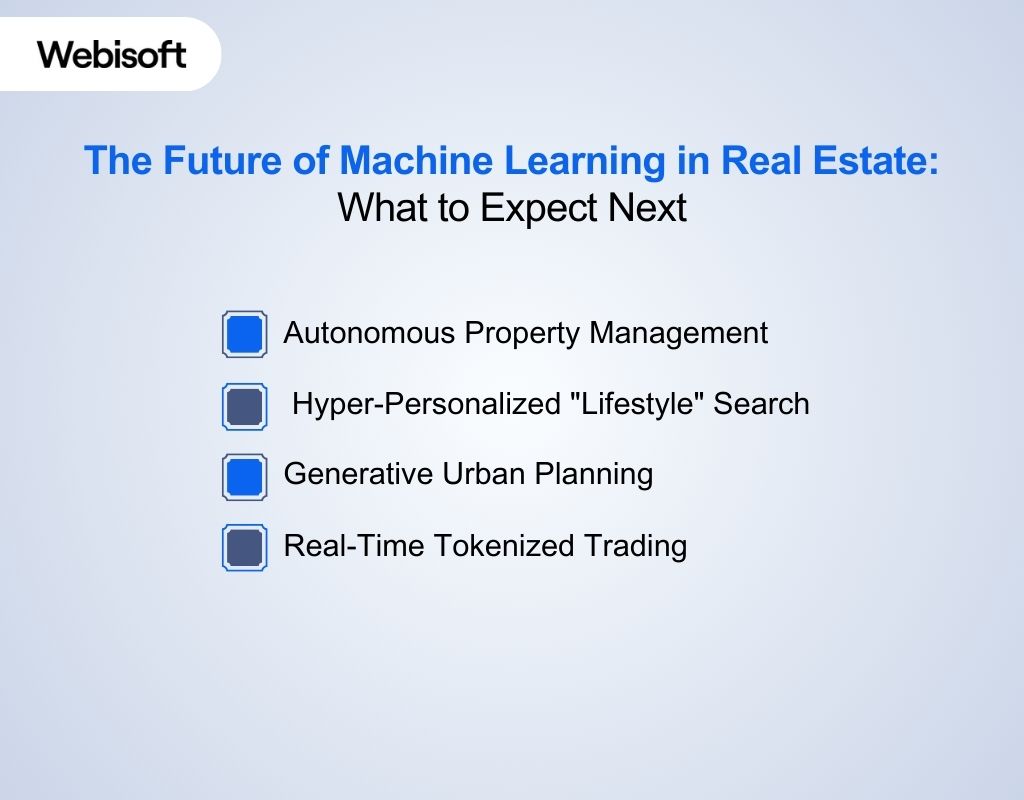
Machine learning will shift from simple prediction to active execution. The technology will move beyond analyzing data to autonomously managing portfolios, designing buildings, and conducting entire property transactions.
1. Autonomous Property Management
AI agents will soon manage buildings without human intervention. These systems will autonomously hire repair contractors, negotiate utility contracts, and adjust rent prices in real-time based on local demand and occupancy.
Lofty launched the industry’s first agentic AI operating system in February 2026, marking this shift. Their system manages entire workflows without agent intervention.
2. Hyper-Personalized “Lifestyle” Search
Property searching will shift from “3-bed, 2-bath” filters to deep lifestyle matching. Machines will analyze your daily habits and preferences to find homes that match your specific commute, social needs, and hobbies.
3. Generative Urban Planning
Developers will use AI to “grow” entire neighborhood layouts. By inputting goals like walkability and sunlight, generative models will create thousands of optimal site plans that maximize both profit and community well-being.
4. Real-Time Tokenized Trading
Machine learning will facilitate the “fractional” ownership of property. Advanced algorithms will provide the instant liquidity needed to buy and sell
Building Real Estate ML Solutions That Actually Work: The Webisoft Approach
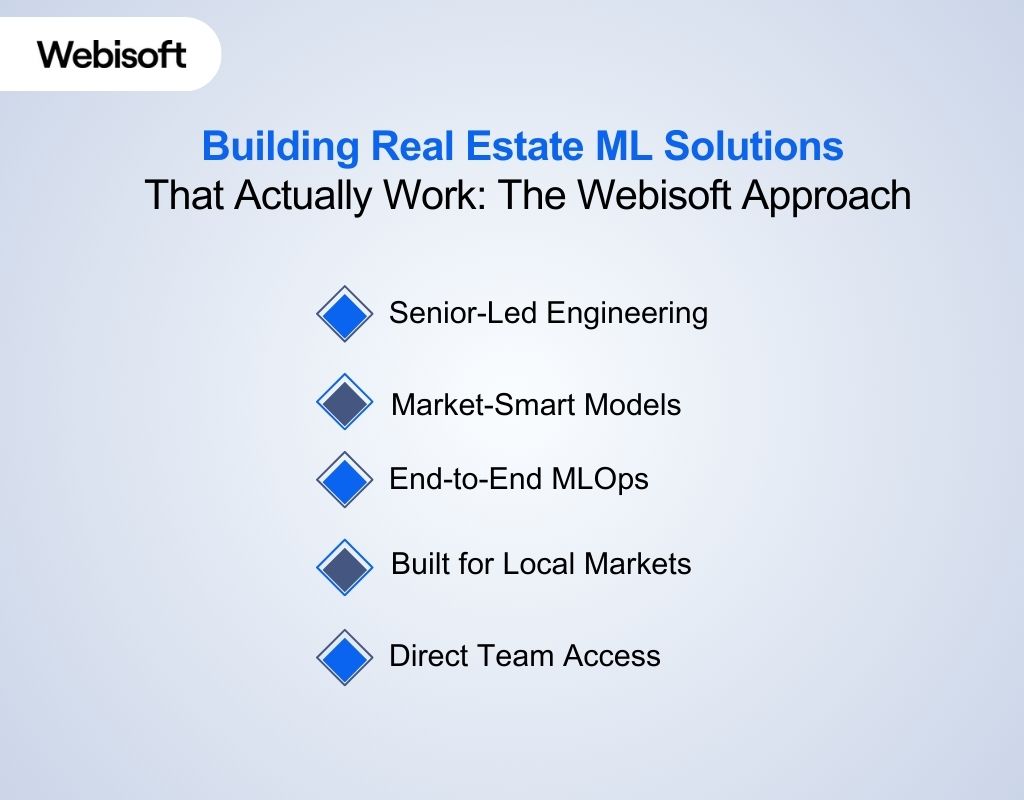
Most real estate companies struggle with ML implementation, like fragmented data, unreliable predictions, and broken systems. Webisoft delivers battle-tested engineering combined with deep market understanding. What Makes Our Machine Learning in Real Estate Approaches Different:
➔Senior-Led Engineering
Junior developers create generic solutions that fail under pressure. Our 90%+ senior specialists architect systems that adapt automatically to volatile markets. Your ML infrastructure gets built right the first time.
➔Market-Smart Models
Our engineers understand cap rates, comparable sales, and market cycles deeply. We’ve built financial intelligence into enterprise systems like Maxa AI. Your models capture actual market dynamics, not just data.
➔End-to-End MLOps
We manage complete lifecycle with rigorous discipline, like data refinement, custom blueprinting, continuous monitoring. Your system maintains accuracy as neighborhoods evolve and markets shift constantly.
➔Built for Local Markets
Off-the-shelf tools miss hyperlocal nuances that matter most. We build bespoke neural networks trained on your specific market data. Generic solutions can’t handle the Miami versus Denver complexity accurately.
➔Direct Team Access
Montreal-based senior engineers work in your timezone for real-time collaboration. No offshore delays or language barriers. You work directly with architects building your system.
Conclusion
Machine learning in real estate isn’t future technology. It’s today’s competitive necessity. Properties get valued accurately, leads convert faster, and market opportunities appear months earlier with ML systems. Traditional methods simply can’t compete anymore.
Your expertise, combined with intelligent automation, creates unstoppable advantages. Ready to transform your real estate operations with custom ML solutions? Contact Webisoft today and build systems that deliver real results.
Frequently Asked Questions
Yes, cloud-based ML platforms now start under $500/month with subscription models. You don’t need massive infrastructure anymore. ROI typically justifies costs within 12-18 months through improved efficiency and better decisions.
Simple valuation models train in 2-4 weeks with clean data. Complex predictive systems require 3-6 months, including data preparation. The key factor is data quality, not quantity.
ML works exceptionally well for commercial real estate, often better than residential. Commercial properties generate more operational data through leases, expenses, and tenant metrics. Predictive maintenance and lease optimization benefit significantly.