Machine learning and blockchain are increasingly combined to build intelligent systems that are not only predictive but verifiable. ML generates insights, scores, and automated decisions. Blockchain records state changes and enforces shared trust. Together, they create infrastructure where automation operates with auditability and controlled governance. But combining these technologies is not as simple as stacking tools.
You must define trust boundaries, separate on-chain and off-chain responsibilities, and understand where risks shift. Without architectural clarity, integration quickly becomes expensive and fragile. Enterprises today face regulatory scrutiny, multi-party data coordination, and rising fraud exposure. The real question is whether combining them solves your structural trust, compliance, and automation challenges effectively. Let’s figure it out!
What Is Machine Learning and Blockchain in Enterprise Context?
In enterprise systems, machine learning and blockchain function as infrastructure layers, not experiments. One drives automated decision-making. The other enforces shared trust. Together, they solve a structural problem: intelligent systems must also be verifiable. Let’s, understand each of them first:
Machine Learning
In business environments, machine learning follows a clear lifecycle:
- Data collection from internal systems or external feeds
- Model training on historical behavior
- Deployment into live workflows
- Continuous monitoring for drift and bias
The risk sits inside this lifecycle. If training data is manipulated or inconsistent across departments, model outputs become unreliable. When market behavior changes, models drift. And in regulated sectors, you must explain decisions with evidence, not probabilities. Machine learning delivers automation. It doesn’t inherently provide auditability or data lineage.
Blockchain
Blockchain in enterprise is not about speculation. It’s about coordinated trust through enterprise-grade solutions like enterprise blockchain development services. There are two deployment models:
- Public networks with open validation
- Permissioned networks with controlled governance
Consensus replaces centralized database control with distributed validation. Every state change is agreed upon before it is recorded. Immutability improves audit trails. But it creates compliance tension when regulations require modification or deletion of records. Blockchain enforces shared integrity. It does not create intelligence on its own.
Why Combining Machine Learning and Blockchain System is on Trend in Business World
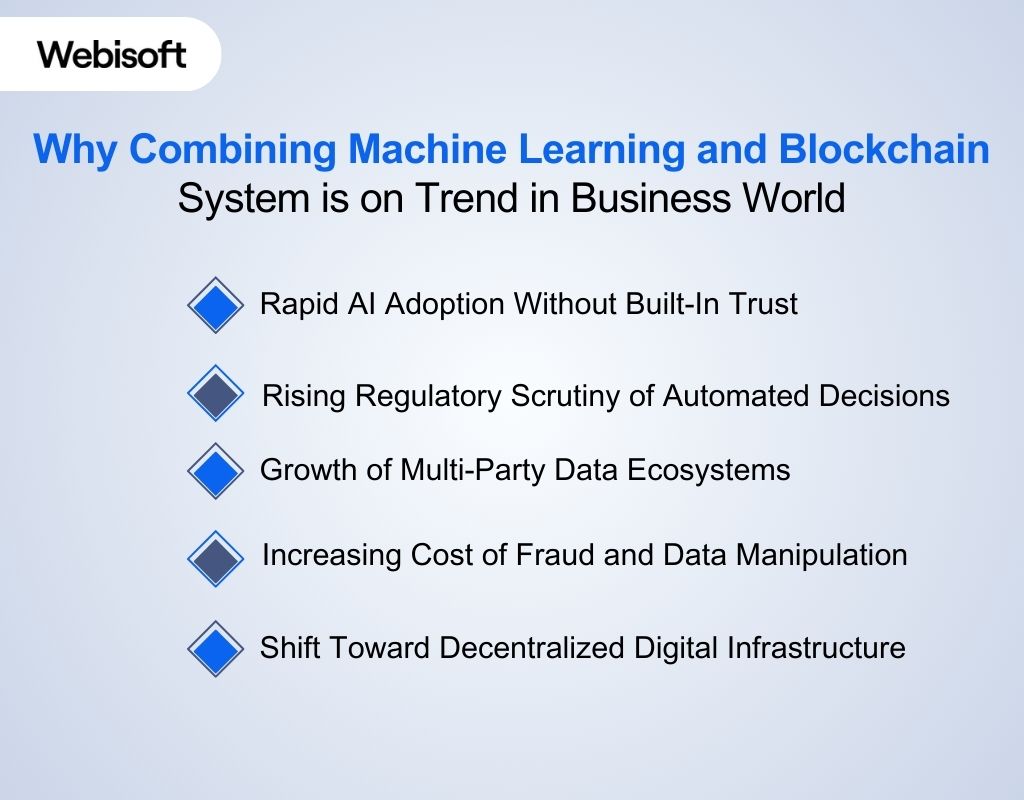
The convergence is not hype-driven. It is pressure-driven. Enterprises are facing structural changes that make this integration increasingly relevant. Such as:
1. Rapid AI Adoption Without Built-In Trust
Machine learning systems are now embedded in financial approvals, fraud detection, diagnostics, and supply chain optimization. As decision automation expands, organizations need verifiable audit trails that AI alone does not provide.
2. Rising Regulatory Scrutiny of Automated Decisions
AI governance frameworks and data protection regulations demand explainability, traceability, and reproducibility. Blockchain-backed logging strengthens compliance posture.
3. Growth of Multi-Party Data Ecosystems
Businesses operate in consortium models where multiple entities contribute data. Distributed ledger systems reduce reconciliation disputes and enforce shared state without centralized control.
4. Increasing Cost of Fraud and Data Manipulation
In high-risk sectors, the economic damage from manipulation outweighs integration costs. Predictive analytics combined with tamper-evident logging reduces exposure.
5. Shift Toward Decentralized Digital Infrastructure
Web3 platforms, digital identity systems, and cross-border finance require intelligent automation within distributed environments. Integration becomes a natural architectural evolution.
Two Integration Directions in Machine Learning and Blockchain
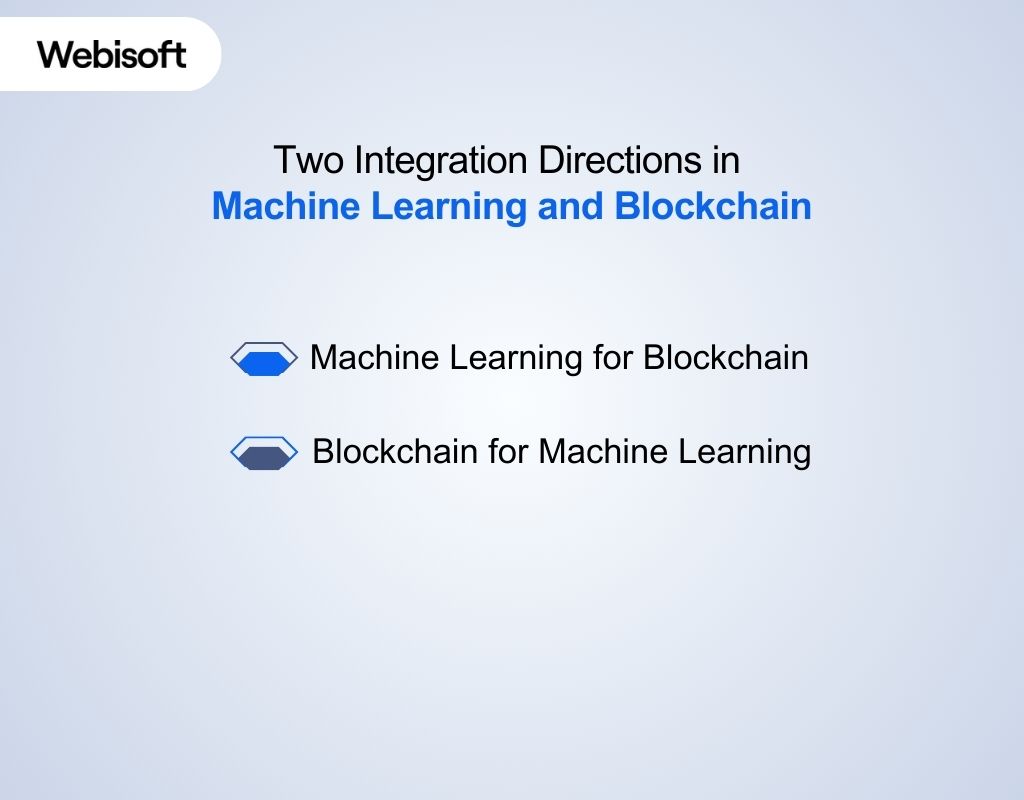
Most discussions around machine learning and blockchain treat them as a single merged concept. That is a mistake. There are two distinct integration paths. Each has different architectural implications, risk profiles, and business value. Understanding the direction determines whether your system becomes efficient or unnecessarily complex.
Machine Learning for Blockchain
This direction uses intelligence to improve blockchain systems. Here, machine learning analyzes patterns inside distributed networks and strengthens operational performance. Such as:
- Fraud detection: ML models examine transaction histories, wallet behavior, and timing anomalies. Suspicious patterns are flagged before irreversible settlement occurs.
- Validator monitoring: Models track node performance, latency deviations, and voting irregularities to identify malicious or underperforming validators.
- Smart contract vulnerability scanning: Trained models detect risky bytecode patterns and logic flaws prior to deployment, reducing exploit exposure through structured smart contract development and auditing.
- Network congestion forecasting: Predictive models estimate transaction spikes and fee fluctuations, allowing protocol adjustments before bottlenecks form.
This is where you apply intelligence to the ledger. It represents practical blockchain in artificial intelligence use cases focused on operational security and optimization.
Blockchain for Machine Learning
Now reverse the direction. This path uses blockchain as a trust layer for AI systems. Here’s how:
- Data provenance: Dataset hashes are anchored on-chain, creating tamper-evident records of training inputs.
- Model version logging: Each trained model can be stored with a cryptographic reference, including configuration metadata and approval state.
- Decentralized learning coordination: Multiple parties can participate in training while blockchain coordinates contribution tracking and incentive distribution. This forms the backbone of decentralized machine learning in multi-organization ecosystems.
- Verifiable model execution: Inference outputs can be recorded with proofs, making prediction workflows auditable across organizations.
This is what actual blockchain for machine learning looks like in enterprise design. It focuses on trust, accountability, and reproducibility rather than raw performance.
Technical Integration Blueprint for Machine Learning and Blockchain
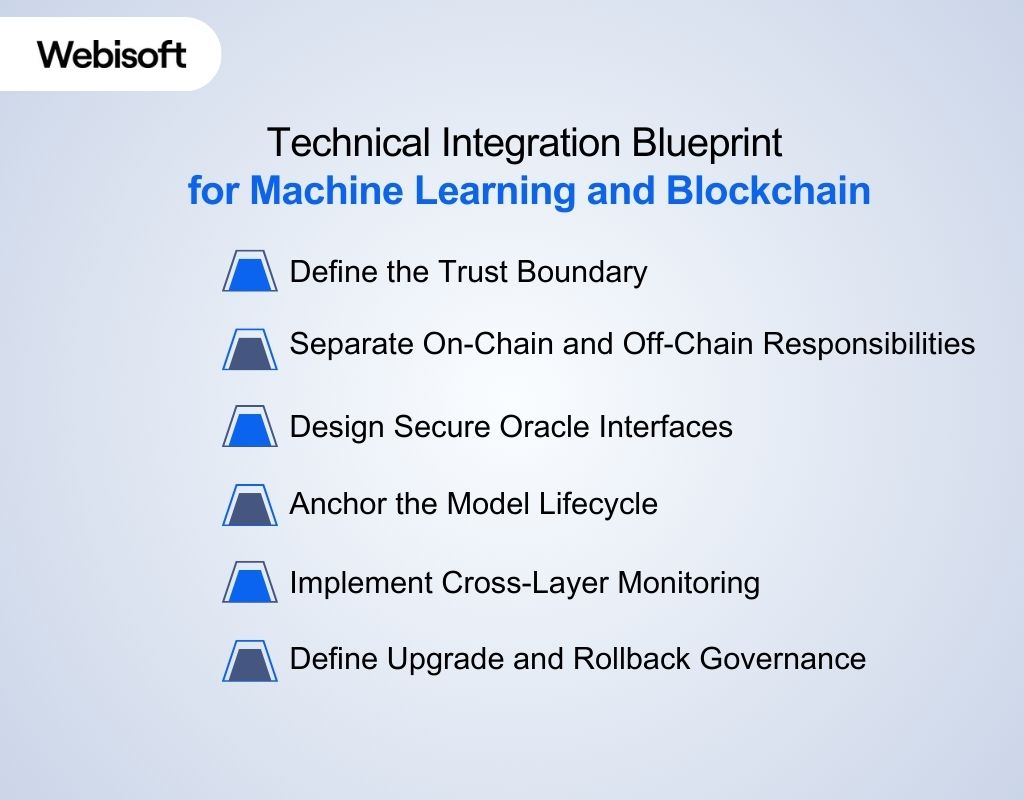
Understanding the theory behind machine learning and blockchain is not enough. The real challenge is designing a system where predictive intelligence and distributed trust operate in coordinated layers. A successful integration follows a structured blueprint, such as:
1. Define the Trust Boundary
ML generates probabilities and blockchain commits to the final state. When these layers intersect, uncertainty never allows to directly trigger irreversible execution. A disciplined architecture separates analytical scoring from ledger enforcement to prevent flawed predictions from becoming permanent system decisions.
2. Separate On-Chain and Off-Chain Responsibilities
Numerical training and inference demand scalable compute environments. Blockchain networks are built for validation, not heavy computation. Keeping models off-chain while anchoring proofs and triggers on-chain protects throughput, cost stability, and architectural clarity in integrated deployments.
3. Design Secure Oracle Interfaces
Oracles connect model outputs to ledger execution. If compromised, intelligent decisions become irreversible mistakes. Outputs must be signed, version-linked, and validated before triggering any on-chain logic.
4. Anchor the Model Lifecycle
Models evolve over time. Retraining, parameter tuning, and deployment changes directly affect production decisions. Anchoring model hashes and approval references on-chain creates a verifiable history without storing heavy artifacts, ensuring transparency across machine learning and blockchain deployments.
5. Implement Cross-Layer Monitoring
Integrated systems fail quietly when visibility is fragmented. Accuracy decay, data drift, oracle anomalies, gas spikes, and abnormal state transitions must be observed together, not in isolation.
6. Define Upgrade and Rollback Governance
Automation without control amplifies risk. Governance rules must define who can retrain models, approve new versions, pause smart contracts, or initiate rollback. Clear authority boundaries prevent flawed intelligence from propagating through permanent ledger commitments.
When Should You Combine Machine Learning and Blockchain?
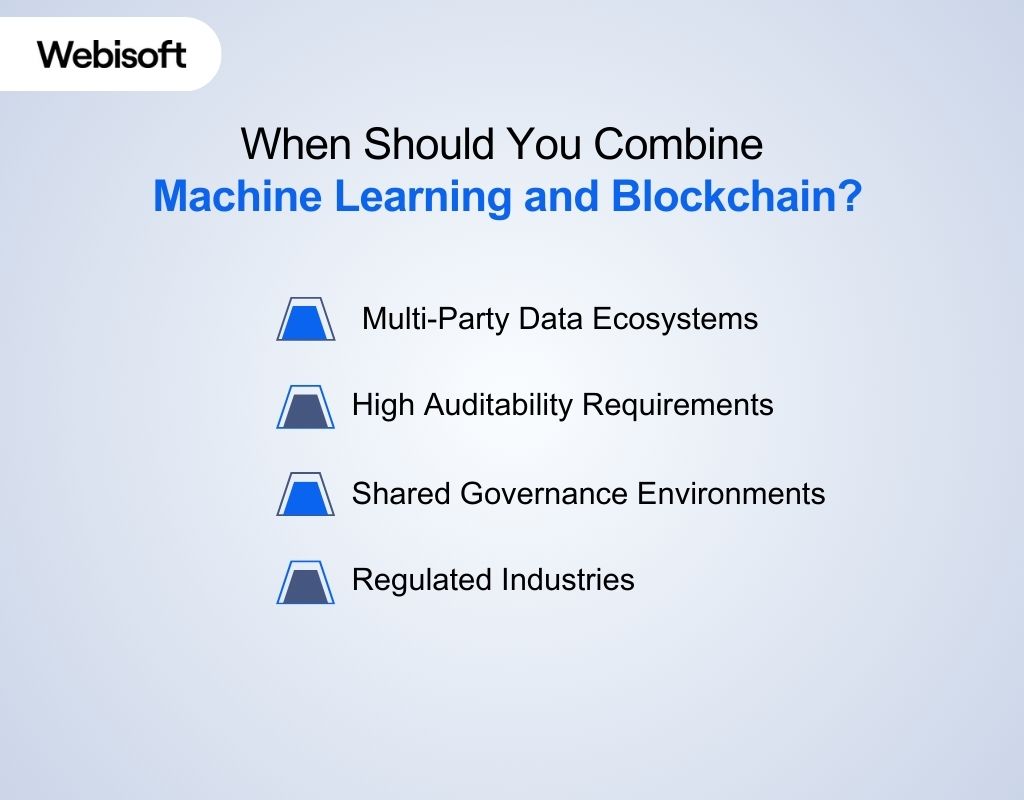
Not every system needs both layers. Combining machine learning and blockchain only makes sense when intelligence must operate inside a shared trust boundary. If there’s no trust gap, the integration usually adds unnecessary complexity. Here are the structural conditions where the combination is justified:
Multi-Party Data Ecosystems
If multiple organizations contribute data to a shared model but do not fully trust each other, you need a coordination layer. Blockchain can anchor dataset hashes, contribution records, and access permissions. Machine learning processes the aggregated signals. This is where structured machine learning and blockchain architecture becomes essential, especially when no single entity should control the model lifecycle.
High Auditability Requirements
Some systems must prove how a decision was made. Financial approvals, insurance risk scoring, and compliance monitoring all require traceability. ML generates predictions and blockchain records data lineage, model version, and decision logs. In environments demanding tamper-evident oversight, the combination stops being optional and starts becoming operationally necessary.
Shared Governance Environments
When control is distributed across consortium members, governance cannot rely on a centralized database. Blockchain provides consensus-based state management. Machine learning provides dynamic decision logic. This becomes particularly relevant in machine learning and blockchain integration for security applications, where multiple stakeholders need both predictive analysis and verifiable enforcement.
Regulated Industries
Healthcare, finance, and energy sectors operate under strict reporting and data integrity laws. Machine learning systems must be explainable and reproducible. Blockchain adds immutable logs and shared verification layers.
In these environments, the integration is less about innovation and more about compliance durability. If you are still not sure whether you should combine machine learning with blockchain for better results, consult with the blockchain expert at Webisoft and have your confusion cleared.
Benefits of Combining Machine Learning and Blockchain
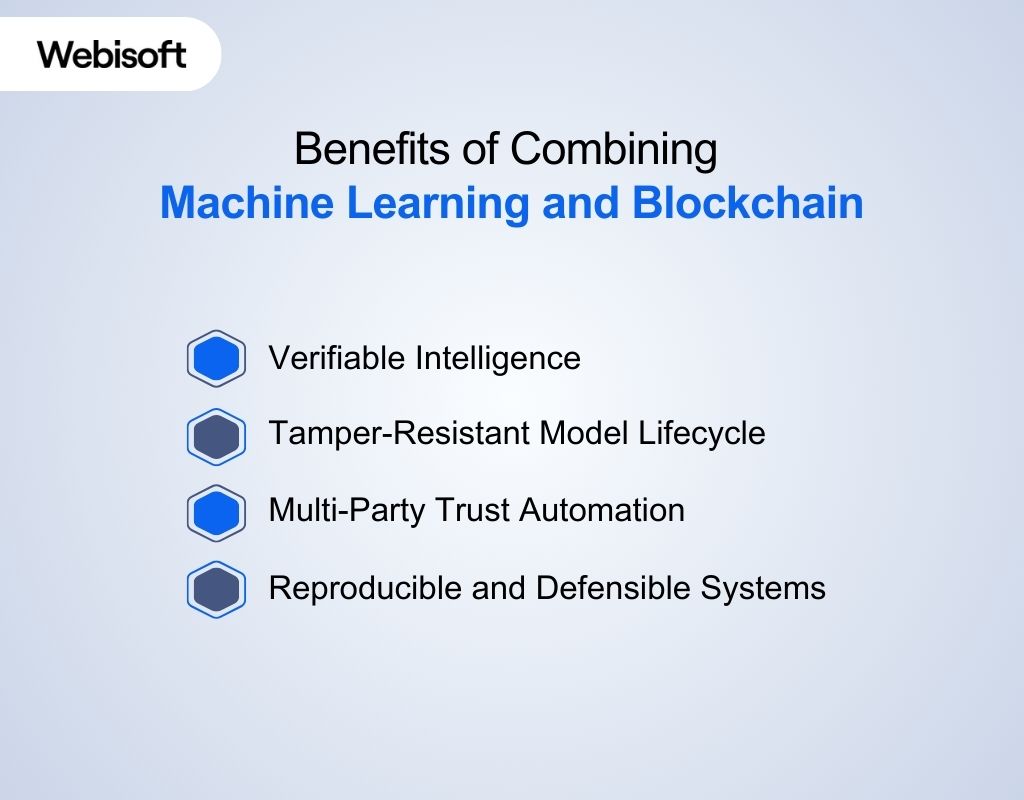
When enterprises combine machine learning and blockchain, the outcome is not just smarter automation. It is controlled intelligence. Decisions become not only predictive but provable. The advantage appears when you look at what each system lacks on its own.
Verifiable Intelligence
Machine learning generates scores, classifications, and predictions. But on its own, it cannot prove how those outcomes were produced or whether the underlying data was altered. Blockchain adds a verification layer. Model versions, data references, and execution timestamps can be cryptographically anchored. The result is intelligence that can withstand audit scrutiny.
Tamper-Resistant Model Lifecycle
In many organizations, models are retrained quietly. Parameter changes and deployment swaps may not leave a transparent trace. By anchoring model identifiers on-chain, enterprises create a tamper-evident lifecycle. No silent upgrades. No undocumented replacements.
Multi-Party Trust Automation
In shared ecosystems, artificial intelligence can generate decisions, but blockchain enforces state agreement. This allows automated actions across institutions without relying on a single controlling authority. This becomes especially powerful in regulated or consortium environments.
Reproducible and Defensible Systems
When dataset hashes and model references are logged immutably, organizations can reconstruct how a decision was made at a specific moment in time. To see the structural difference clearly:
| Scenario | Standalone ML | Standalone Blockchain | Combined Outcome |
|---|---|---|---|
| Fraud review | Predictive score | Transaction record | Scored decision with immutable audit trail |
| Model updates | Internal logs | Ledger history | Cryptographically verifiable version control |
| Cross-organization enforcement | Limited trust | Shared state | Automated, enforceable multi-party logic |
This isn’t incremental improvement. It’s a redesign of how intelligent systems are governed.
Enterprise Workflow Design in Machine Learning and Blockchain
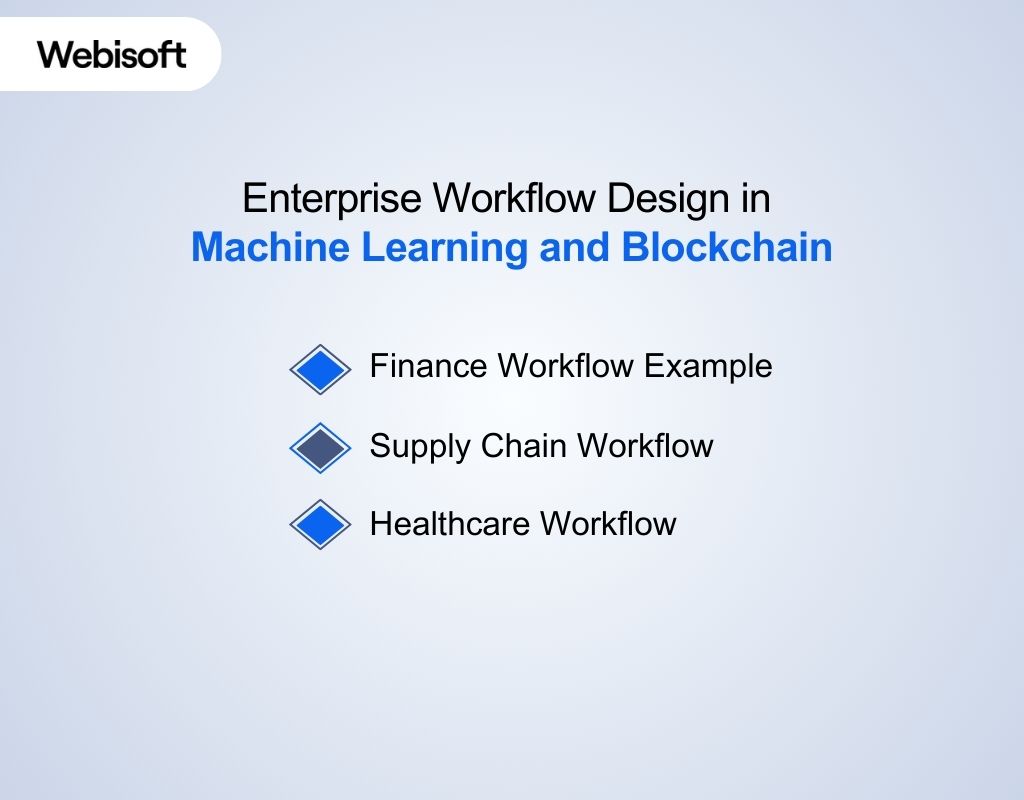
Enterprise systems that combine machine learning and blockchain do not merge everything into one layer. They separate computation from verification. Intelligence runs off-chain. Trust and state validation live on-chain. Below is how this works in practice:
Finance Workflow Example
In financial systems, combining machine learning with blockchain creates a layered execution model. The ledger records state changes, while intelligence evaluates risk before enforcement. The separation between analysis and verification is deliberate. Here’s the workflow example:
- Transaction recorded on-chain: A payment or transfer event is written to the ledger, creating an immutable state reference.
- Historical features processed off-chain: Behavioral data, past transaction patterns, and contextual signals are extracted into a risk engine.
- ML model produces risk score: The model calculates a probability of fraud or anomaly based on learned patterns.
- Smart contract triggers compliance logic: If the score crosses a predefined threshold, automated logic flags, blocks, or escalates the transaction.
- Immutable audit trail logged: The decision reference and model identifier are anchored to preserve traceability
This design avoids heavy machine learning on blockchain, which remains computationally impractical at scale.
Supply Chain Workflow
In supply chain networks, trust and forecasting must operate together. Blockchain records shipment states. Machine learning predicts disruptions before they escalate. Each layer has a distinct role. The workflow is:
- Sensor data ingestion: IoT devices capture temperature, humidity, geolocation, and handling conditions during transit.
- Hash anchoring: Data summaries are hashed and recorded on-chain to prevent post-event manipulation.
- Forecasting model execution: An off-chain model analyzes environmental trends and historical delivery patterns to predict delay or spoilage risk.
- Automated settlement: Smart contracts release payments, trigger insurance claims, or enforce penalties based on verified outcomes.
Healthcare Workflow
Healthcare systems require privacy, traceability, and coordinated validation. Machine learning processes sensitive data. Blockchain records consent and model state without exposing patient records. For example:
- Federated model training: Hospitals train local models using internal datasets without sharing raw patient information.
- Consent record on-chain: Patient permissions and access approvals are immutably logged for regulatory accountability.
- Model update verification: Each updated model version is cryptographically referenced to confirm authenticity across institutions.
Architecture Patterns for Machine Learning and Blockchain
This is where design decisions make or break the system. In enterprise environments, combining AI and distributed ledgers is not about stacking technologies. It is about defining clear execution boundaries. Below are the architectural patterns that matter:
On-Chain vs Off-Chain ML
Running models directly on-chain sounds attractive. In practice, it is rarely feasible because blockchain environments are not built for heavy computational workloads. Several structural constraints explain this limitation, such as:
Compute Limits
Public and permissioned chains are not optimized for high-dimensional matrix operations or iterative training loops. Large models require memory and processing capacity that exceeds practical on-chain limits.
Gas Economics
Every computation on-chain consumes resources priced through network fees. Complex inference logic would make transaction costs unpredictable and economically inefficient.
Oracle Design and Trust Boundaries
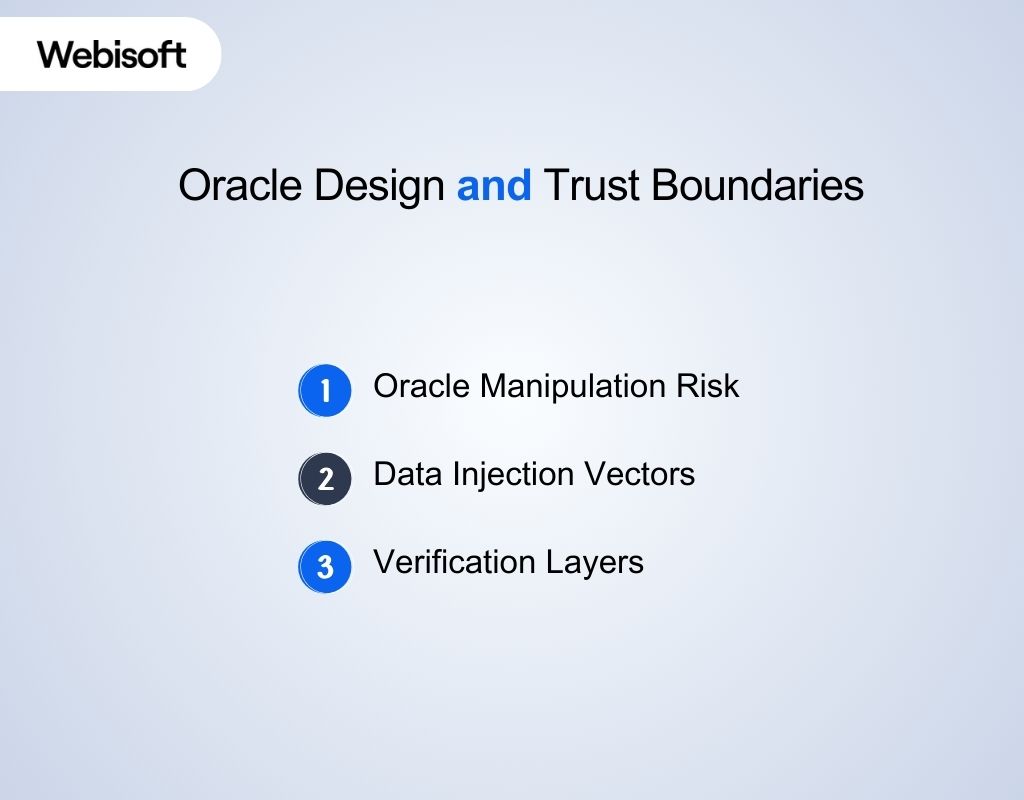
Oracles are the bridge between off-chain intelligence and on-chain enforcement. That bridge is powerful, but it is also fragile. The moment external data or model outputs are injected into a smart contract, the trust boundary shifts from consensus to integration logic. If this layer is weak, the entire system is exposed. Several risks emerge at this boundary.
Oracle Manipulation Risk
If an oracle is compromised or misconfigured, incorrect data can trigger irreversible smart contract execution. The blockchain remains secure, but the decision logic becomes corrupted.
Data Injection Vectors
Unverified inputs entering the ML pipeline can distort outputs before they ever reach the chain. Poisoned signals upstream can produce valid-looking but incorrect results.
Verification Layers
Mature systems use redundancy, digital signatures, and cross-source validation to reduce reliance on a single oracle feed.
Hybrid Data Storage
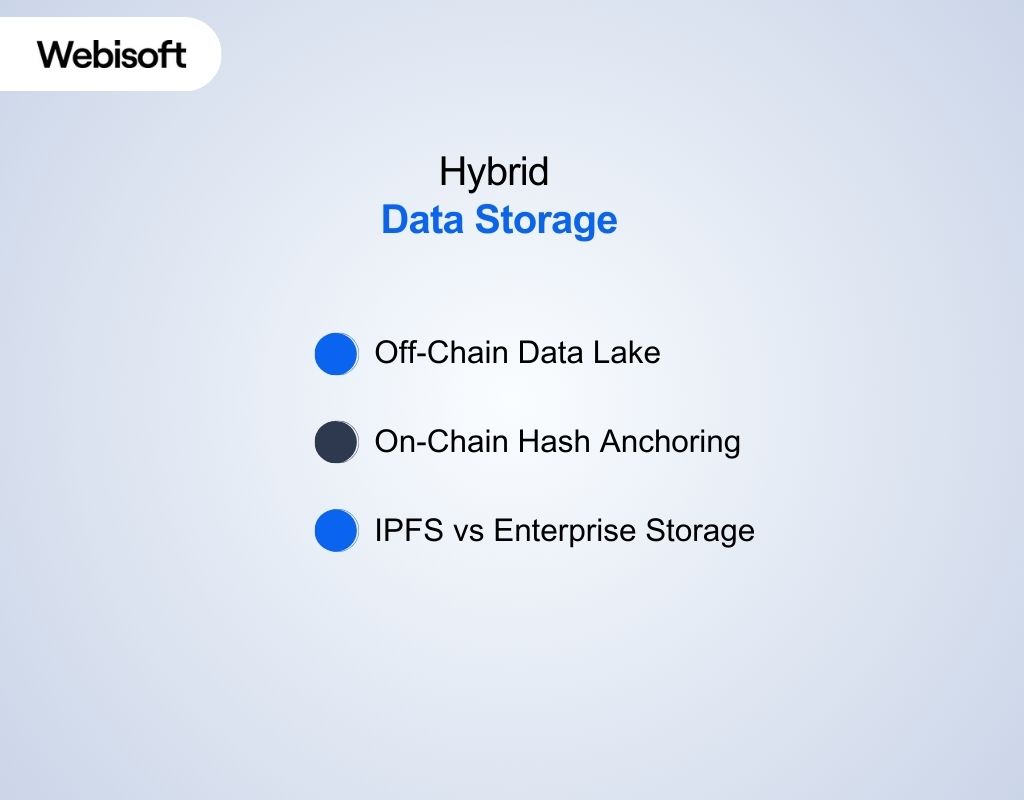
Blockchain is not designed to store large datasets or model artifacts. Its role is verification, not bulk storage. Enterprise systems therefore separate storage responsibility from proof responsibility. This separation defines a hybrid data architecture.
Off-Chain Data Lake
Raw datasets, feature stores, and model artifacts are stored in scalable environments built for performance and compliance.
On-Chain Hash Anchoring
Instead of storing full files, cryptographic hashes are recorded on-chain. This creates tamper-evident references without inflating storage costs.
IPFS vs Enterprise Storage
Decentralized storage networks provide distributed retrieval, while enterprise-controlled storage offers predictable governance and regulatory alignment. The choice depends on risk tolerance and compliance demands.
Security Boundaries in Machine Learning and Blockchain Systems
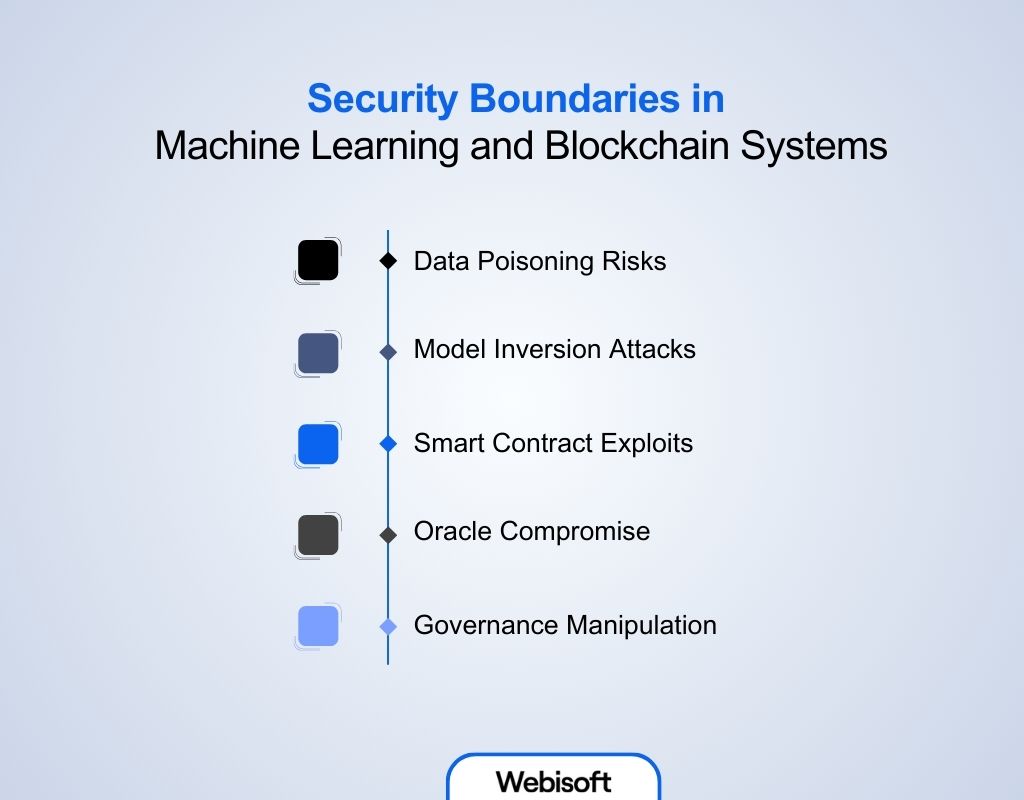
When you combine machine learning with distributed ledgers, you don’t just merge capabilities, it also expands the threat model. Risk no longer lives in one layer. It moves across boundaries. Below is how risk evolves when intelligent systems and blockchain systems interact:
Data Poisoning Risks
In traditional ML systems, poisoned training data reduces accuracy. In a combined system, poisoned outputs can trigger automated on-chain actions. If a model trained on manipulated inputs produces a flawed risk score, that score may activate contract logic without human review.
Model Inversion Attacks
Adversaries can sometimes extract sensitive information from model outputs. When inference results are logged or referenced on-chain, poor design may unintentionally expose patterns that allow reverse engineering of private training data. The integration increases the need for careful output handling.
Smart Contract Exploits
A smart contract vulnerability is dangerous on its own. When linked to ML-driven triggers, the impact multiplies. An attacker may manipulate input conditions to force the model to generate outputs that activate flawed contract logic. Automation amplifies exploitation speed.
Oracle Compromise
Oracles connect off-chain intelligence to on-chain execution. If an oracle feed is compromised, incorrect model outputs can be treated as valid state updates. The blockchain remains consistent, but the decision it records may be wrong. Trust shifts to the weakest integration point.
Governance Manipulation
In shared environments, model updates or parameter changes may be subject to collective approval. If governance processes are weak, actors could push biased models into production and anchor them immutably, embedding flawed logic into long-lived systems. When combining these systems, the attack surface does not disappear. It expands across layers.
Privacy-Constrained Machine Learning in Blockchain Environments
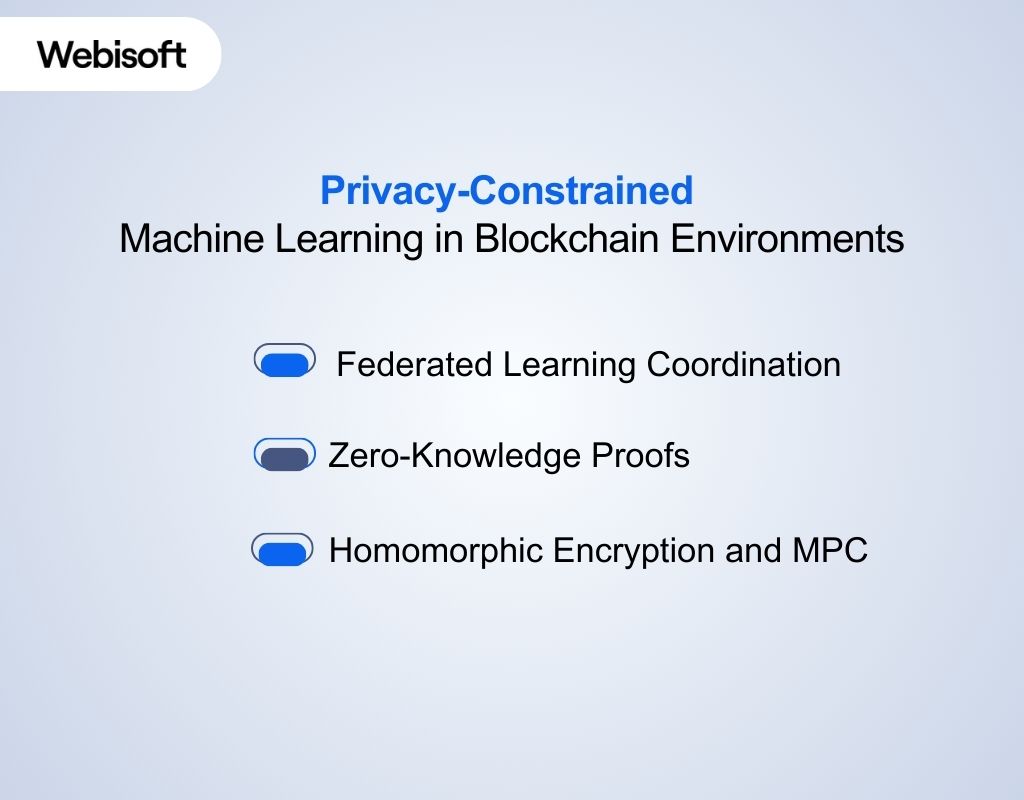
Enterprises often need shared intelligence without exposing raw data. In privacy-sensitive sectors, collaboration must happen without centralizing datasets. Blockchain coordinates trust, but privacy requires additional cryptographic design.
Federated Learning Coordination
Federated learning keeps data local while sharing model updates, a pattern increasingly discussed in advanced AI system design such as generative AI stack. Blockchain acts as an incentive and audit layer, recording contributions across participants. However, poisoned updates can still bias the global model, so validation controls remain essential.
Zero-Knowledge Proofs
Zero-knowledge proofs enable verifiable inference without revealing input data. They allow systems to prove that a model executed correctly. The trade-off is computational overhead, which limits scalability for complex neural networks.
Homomorphic Encryption and MPC
Homomorphic encryption and multi-party computation allow encrypted data processing across institutions. These approaches carry heavy performance costs and are suitable only for high-value, tightly governed use cases where privacy outweighs efficiency.
Production Governance in Machine Learning and Blockchain Systems
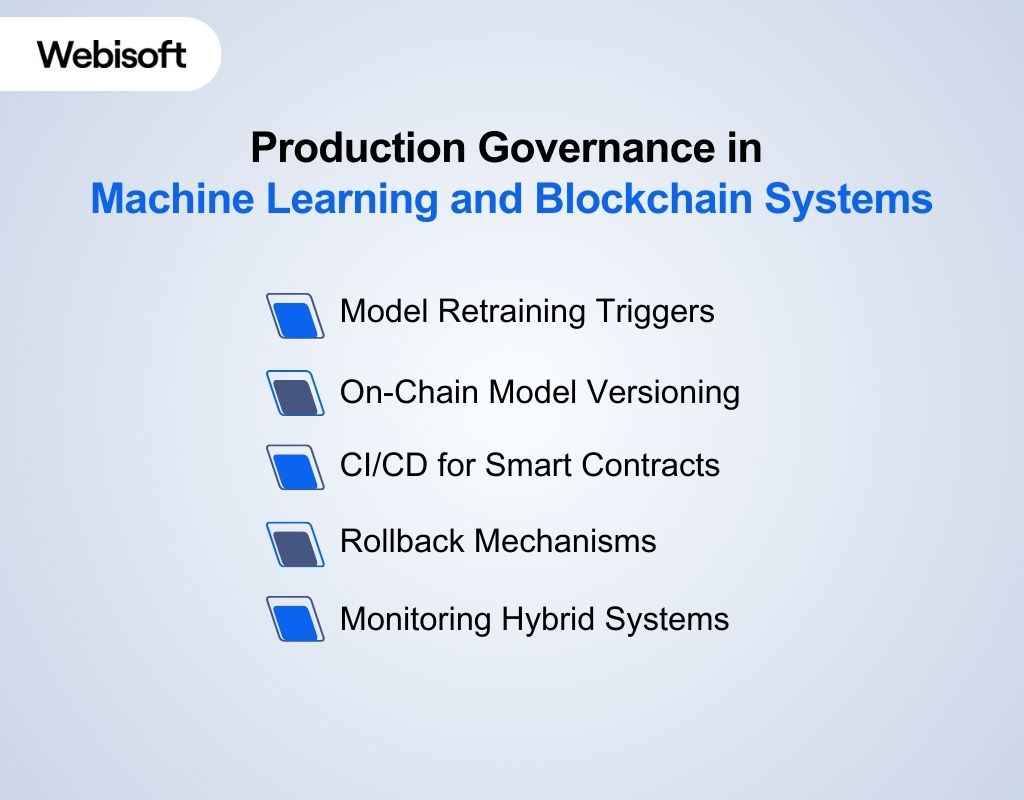
Designing an integrated system is not enough. Once deployed, machine learning and blockchain must operate under controlled governance. Here’s how:
Model Retraining Triggers
Models degrade as data distributions shift. Retraining should be event-driven, triggered by measurable drift, accuracy decline, or compliance updates. Each retraining cycle must generate a new model reference, ensuring that no production model changes without traceable approval.
On-Chain Model Versioning
Deployed models should have cryptographic identifiers anchored with timestamps and approval status. This creates an immutable promotion record and prevents undocumented swaps in live systems.
CI/CD for Smart Contracts
Smart contracts require staged deployment pipelines, static analysis, and security validation before activation. Automated updates without review introduce systemic risk.
Rollback Mechanisms
Emergency pause functions and controlled downgrade paths must exist in case of model malfunction or contract vulnerability.
Monitoring Hybrid Systems
Governance requires cross-layer monitoring: model accuracy, drift signals, oracle integrity, gas consumption, and on-chain state transitions.
Economic Feasibility and ROI Thresholds in Machine Learning and Blockchain
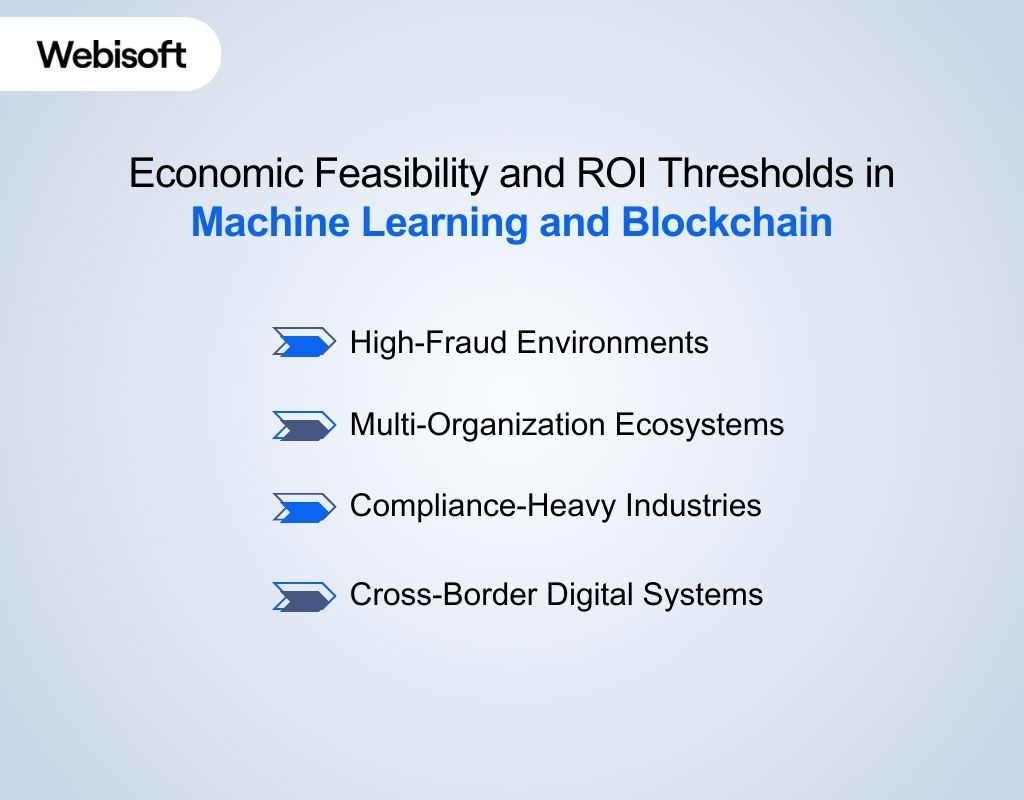
Not every integration of machine learning and blockchain technology is financially justified. The model only works when the cost of mistrust is higher than the cost of coordination. The economic threshold becomes clearer in the following scenarios:
High-Fraud Environments
In financial services, digital payments, insurance, and ML stock trading systems, fraud losses are significant. Even small gains in detection accuracy, combined with verifiable audit trails, can economically justify integrating predictive analytics with tamper-evident verification infrastructure.
Multi-Organization Ecosystems
When multiple independent entities must share intelligence without surrendering control, centralized AI models create political and legal friction. Blockchain-backed coordination reduces dispute resolution costs and audit cycles.
Compliance-Heavy Industries
In regulated environments, the cost of audit preparation, reporting delays, and regulatory penalties can outweigh infrastructure expenses. Anchored model logs and tamper-evident trails shorten review cycles and reduce operational uncertainty.
Cross-Border Digital Systems
Cross-jurisdiction systems struggle with trust alignment. Shared consensus layers combined with predictive logic reduce reconciliation overhead across entities operating under different regulatory regimes. The integration isn’t about technological ambition. It is about risk-weighted economics. If the operational savings and governance clarity exceed the added complexity, the architecture becomes justified.
When You Should Not Combine Machine Learning and Blockchain
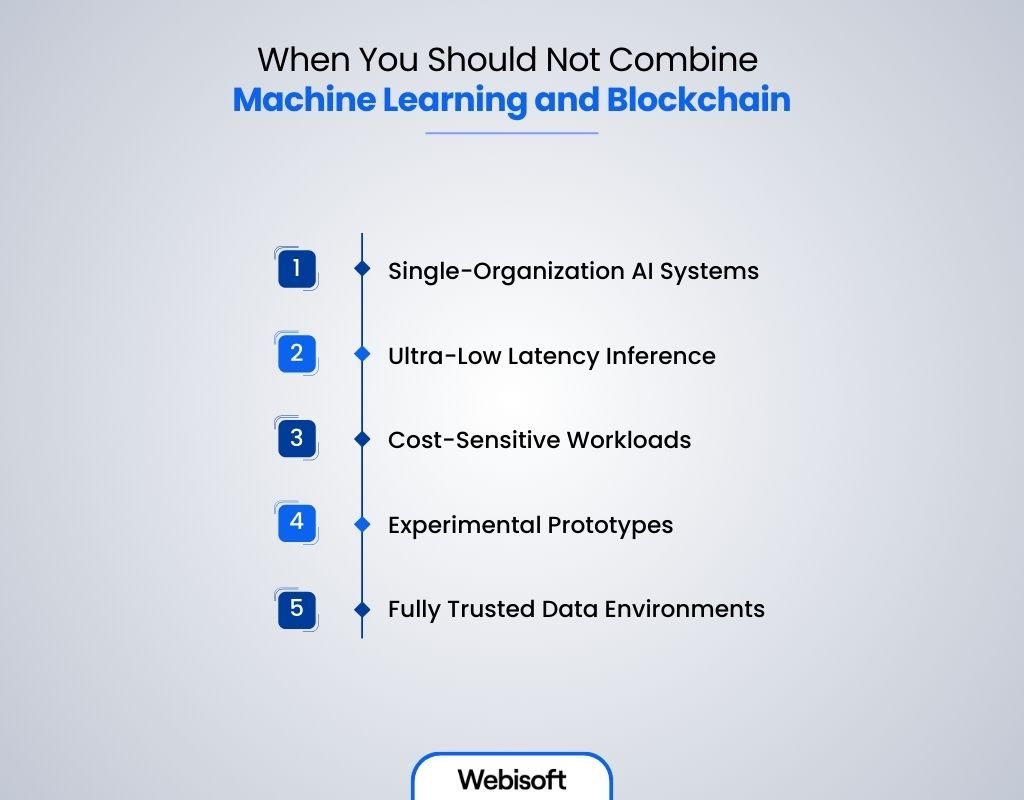
Not every deployment benefits from merging intelligent systems with distributed ledgers. In some environments, the integration adds friction rather than value.
Single-Organization AI Systems
If one entity controls data, governance, and infrastructure, machine learning alone is sufficient. Adding distributed validation introduces complexity without increasing trust.
Ultra-Low Latency Inference
Systems requiring millisecond decisions, such as high-frequency trading engines, cannot tolerate consensus delays or transaction confirmation windows.
Cost-Sensitive Workloads
When fraud exposure and compliance pressure are low, the infrastructure and monitoring overhead of blockchain technology outweighs its verification advantages.
Experimental Prototypes
Early-stage ML experimentation prioritizes speed and iteration. Immutable anchoring slows development without delivering immediate benefit.
Fully Trusted Data Environments
If all stakeholders operate under shared authority and regulatory alignment, distributed trust layers provide little incremental value.
How Webisoft Help You with Combining and Integrating Machine Learning and Blockchain into Your System
Combining intelligent models with distributed ledgers is not a plug-and-play exercise. It requires architectural clarity, security discipline, and production governance. Webisoft approaches machine learning and blockchain integration as an infrastructure initiative, not a prototype experiment. The focus is on building secure, scalable systems that survive real enterprise constraints. Here’s how Webisoft help you with the ML and blockchain services:
- Strategic Feasibility Assessment: Define whether integration is justified, identify trust boundaries, and map cost and scalability realities.
- Hybrid Architecture Design: Separate on-chain enforcement from off-chain intelligence and design a clean, scalable system blueprint.
- Custom ML Engineering: Build domain-specific models with drift monitoring, retraining triggers, and explainability controls.
- Secure Smart Contract Development: Develop, audit, and structure upgradeable contracts aligned with automated decision logic.
- Privacy-Constrained Implementation: Implement federated coordination, encrypted computation strategies, and verifiable execution layers where required.
- Production Governance Setup: Anchor model versions on-chain, establish CI/CD for contracts, and design rollback mechanisms.
- Security Hardening: Protect oracle feeds, reduce poisoning exposure, and implement layered threat modeling.
- Compliance Alignment: Design systems compatible with regulatory and audit requirements from day one.
Contact Webisoft today to get professional ML development services along with blockchain service at Webisoft!
Conclusion
In conclusion, machine learning and blockchain represent a structural shift in how intelligent systems are governed, verified, and deployed. When combined thoughtfully, they enable predictive automation with provable trust, controlled governance, and cross-organization coordination.
The integration is not about trend adoption but risk-managed architecture. Enterprises that align intelligence with verifiability will build systems that are not only smart, but defensible and future-ready.
FAQs
Here are some commonly asked questions regarding machine learning and blockchain systems:
Not realistically. Blockchain networks are not built for heavy computation. Training and inference usually run off-chain, while the ledger stores model references or decision proofs for verification and enforcement.
No. Blockchain strengthens data integrity, but it does not prevent poor model design, insecure oracles, or poisoned training data. Security depends on architecture, validation layers, and disciplined operational controls.
It improves auditability by anchoring model versions and decision traces. However, immutability must be carefully designed to avoid conflicts with regulations that require modification or deletion rights.
No. If a single organization controls the data and governance, blockchain may add cost and latency without delivering additional value. Integration is justified only in shared trust environments.