How To Build A Blockchain Application From Scratch? Expert Guide
The world’s most disruptive apps today, from DeFi platforms to NFT marketplaces, aren’t built on traditional systems. They’re powered by blockchain, a technology that brings transparency, security, and automation like no other. If it’s enabling peer-to-peer payments without banks, creating verifiable digital ownership, or powering decentralized organizations, blockchain applications are redefining industries. But how to build a blockchain application from scratch? In this guide, we’ll break down the process step by step, so you can confidently turn your idea into a working blockchain solution.
Prerequisites You Need to Create a Blockchain Application
Before you get into how to build a blockchain application from scratch, it’s smart to line up the basics. Think of these as prerequisites, the essentials that will save you from roadblocks later.
| Category | What You’ll Need |
|---|---|
| Blockchain Platform | Ethereum, Polygon, Solana, Hyperledger Fabric (depending on use case) |
| Consensus Mechanism | Proof of Stake, Delegated PoS, or platform’s native consensus (if building from zero) |
| Programming Languages | Solidity, Rust, Go, JavaScript, Python |
| Smart Contract Tools | Truffle, Hardhat, Remix for writing, compiling, and deploying contracts |
| Testing Networks | Goerli (Ethereum), Mumbai (Polygon), or other relevant testnets |
| Off-chain Storage | IPFS or traditional databases like PostgreSQL/MongoDB for large data |
| SDKs | Web3.js, Ethers.js for blockchain interactions |
| Infrastructure | Cloud hosting (AWS, Azure, GCP) or containers (Docker, Kubernetes) |
| Security Libraries | OpenZeppelin for smart contract standards and audits |
How To Build A Blockchain Application From Scratch?
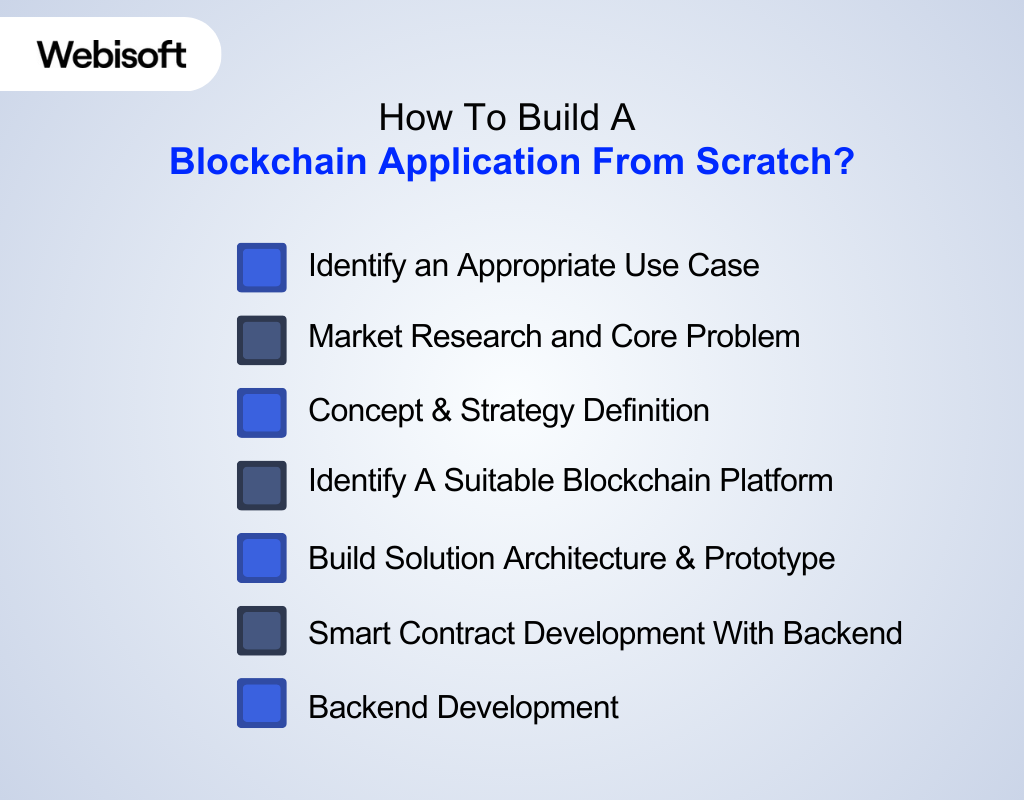
Building blockchain applications from scratch might sound intimidating. But once you break it down, it’s simply a structured process where even complex parts, like consensus, smart contracts, and deployment, turn into clear, manageable steps.
Identify an Appropriate Use Case
You need to choose the right industry before you even think about writing code. Blockchain works best where trust, transparency, or security are critical. Finance relies on it for decentralized payments, real estate for fraud-proof title transfers, and supply chains for tracking goods end-to-end. Healthcare uses it to protect patient records, while gaming taps NFTs for digital ownership. If you misjudge the industry, your project risks drifting without impact. Pick correctly, and everything else falls into place.
Market Research and Core Problem
After locking in your industry, you need to ground your idea in market reality. Start by dissecting competitors What features do they highlight, how do they price their solutions, and which audiences do they target? For example, if you’re eyeing DeFi, compare lending platforms like Aave or Compound. Notice how they structure rates and incentives. Don’t skip customer reviews; complaints about slow transactions or confusing UX often reveal opportunities for differentiation. Next, zoom out to market data. The blockchain industry was valued at $26.91B in 2024 and is projected to hit $41.15B in 2025. It is a sign of accelerating adoption. Emerging trends like tokenized assets in real estate or NFTs in gaming show where new demand is forming. Finally, pinpoint the core problem you’ll solve. If supply chain transparency is your focus, the pain might be counterfeit goods. In healthcare, it could be fragmented patient records. Validate with real customer interviews and build personas that capture demographics, goals, and challenges
Concept & Strategy Definition
With your industry and problem validated, it’s time to shape the concept into a clear strategy. This means defining what your blockchain app will do, who it will serve, and how it will deliver value. Start with a high-level business model. Will revenue come from transaction fees, subscription tiers, or token economics? For instance, decentralized exchanges like Uniswap thrive on liquidity fees, while NFT marketplaces earn from transaction commissions. Next, map out a strategic roadmap:
- Outline milestones such as prototype, alpha release, and mainnet deployment.
- Decide which features are must-haves versus “nice-to-haves” for launch.
- At this stage, you should also consider regulatory factors like KYC/AML compliance if you’re in finance, or HIPAA if targeting healthcare.
- Beyond compliance, plan for ongoing regulatory monitoring and adaptation.
- Plan for integration with legacy systems and detailed rollout phases, including testing, pilot, and production launch.
- You should have a clear strategy set for post-launch support, bug fixes, feature enhancements, and smart contract upgrade mechanisms.
Ready to Turn Your NFT Idea Into Reality? Webisoft has hands-on experience building scalable, secure, and user-friendly NFT marketplaces.
Identify A Suitable Blockchain Platform
Choosing the right blockchain platform is one of the most critical decisions in your development journey. Think of it as selecting the “infrastructure” for your app, just like startups pick AWS, Azure, or Google Cloud for scalability and reliability. Each blockchain ecosystem has its strengths and trade-offs, so your choice should align tightly with your business goals and use case. Here’s a breakdown of the most widely used platforms and where they shine:
- Ethereum – The pioneer of smart contracts and still the most widely adopted platform. Best for DeFi, NFT marketplaces, and DAOs. The ecosystem is massive, but expect higher gas fees and potential scalability limits unless you integrate with Layer 2 solutions. If your strategy relies on user trust and market reach, Ethereum offers credibility and network effects.
- Polygon – A Layer 2 scaling solution for Ethereum, built to lower costs and speed up transactions. Ideal for startups that want Ethereum’s security but can’t afford expensive gas fees. Business use cases include NFT platforms, gaming apps, and dApps that need high throughput without pricing out users.
- Hyperledger Fabric – A permissioned blockchain framework developed by the Linux Foundation. Tailored for enterprise applications such as supply chain management, banking, and healthcare.
- Corda – Another enterprise-grade blockchain, but optimized for financial services. Used by banks and insurance firms for settlement, identity management, and trade finance. If your app requires regulatory alignment, Corda is built to handle that environment.
- Solana – Known for extremely fast transactions and low costs, Solana is a great fit for Web3 gaming, NFTs, and DeFi platforms where speed is a competitive edge. However, as a newer chain, it comes with trade-offs in long-term stability compared to Ethereum.
- Binance Smart Chain (BSC) – Offers compatibility with Ethereum but at significantly lower fees. This makes it attractive for startups and projects seeking quick adoption. BSC is widely used for DeFi projects and token launches.
- Tezos – A platform with self-amending protocols, allowing it to evolve without hard forks. Used in industries like real estate and digital identity, where long-term adaptability is valuable.
- EOS – Designed for scalability and performance, with fast transactions and no transaction fees. Good for consumer-facing apps and dApps that expect large user bases.
The takeaway:
- If you’re building a consumer-facing app (NFTs, DeFi, gaming), public blockchains like Ethereum, Polygon, or Solana will serve you best.
- For enterprise-grade solutions, Hyperledger Fabric or Corda are safer bets due to compliance features.
Build Solution Architecture & Prototype
Once you’ve chosen the right platform, it’s time to map out how your blockchain application will actually work. Think of it as the bridge between strategy and coding. A solution architecture defines:
- How your app will handle transactions, smart contracts, and APIs
- The role of each on-chain vs. off-chain component (what lives on the blockchain vs. what runs on external servers)
- Security layers, key management, and identity verification mechanisms
- Integration points with third-party services, databases, or existing enterprise systems
After architecture, create a prototype or proof of concept (PoC). This is a lightweight version that demonstrates feasibility. To make a prototype, start small:
- Pick one core workflow your app must deliver. For instance, tracing a single product batch in a supply chain.
- Build only the essential smart contracts, connect them with minimal APIs, and simulate real-world data inputs. Like IoT sensor logs or transaction records.
- Use test networks such as Ethereum’s Goerli or Polygon’s Mumbai to deploy the prototype without incurring high costs.
Smart Contract Development With Backend
For those who are searching for how to build a blockchain application from scratch, it can be an overwhelming process. Smart contracts are the business rules of your application, written directly into code. Depending on the platform, you’ll use:
- Solidity (Ethereum, Polygon, Binance Smart Chain)
- Rust (Solana, NEAR, Substrate)
- Vyper (Ethereum alternative)
- Cairo (StarkNet for zero-knowledge apps)
In practice, contracts cover functions like token creation (ERC-20, ERC-721, ERC-1155), governance voting, DeFi protocols (staking, lending, swaps), or supply chain validation. For enterprise-grade projects, developers often integrate multi-signature wallets, role-based permissions, and upgradeable contracts (using frameworks like OpenZeppelin). If you want to ensure your contracts are secure, gas-efficient, and tailored to your business logic, work with our professional smart contract developers. Save from costly errors and accelerate deployment.
Backend Development
While smart contracts run on-chain, your backend ensures everything connects smoothly. Typical backend tasks include:
- Managing off-chain databases (PostgreSQL, MongoDB) for heavy or sensitive data
- Integrating APIs and using Web3 libraries (Web3.js, Ethers.js, Web3.py) for communication with the blockchain
- Handling user authentication & key management (often via MetaMask, WalletConnect, or enterprise identity solutions)
- Setting up oracles (like Chainlink) for feeding external data into smart contracts
- Designing event listeners & transaction queues to process confirmations and logs
In short, the backend acts as the bridge between blockchain logic and the user-facing app. It ensures scalability, performance, and secure interaction with smart contracts.
Frontend Development & User Experience Layer
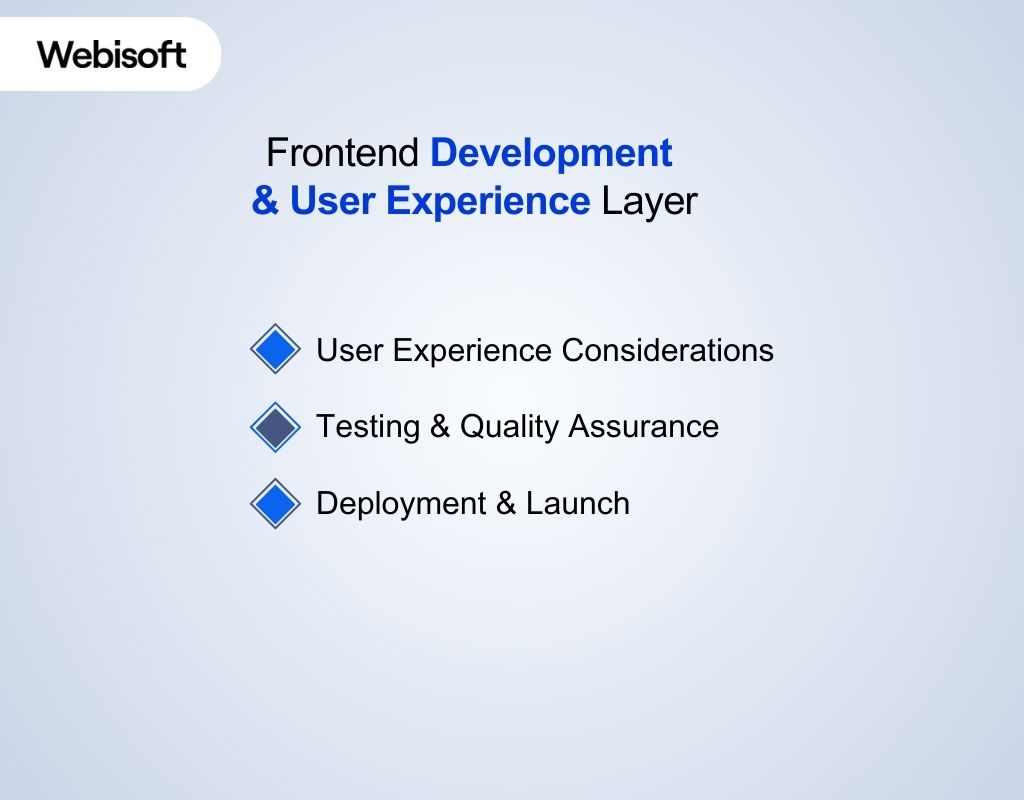
Once the smart contracts and backend logic are complete, the next step is developing the frontend. This is where design meets functionality, and it requires careful planning to make blockchain interactions feel seamless. The process typically begins with UI/UX design– Wireframing dashboards, transaction flows, and role-specific interfaces. Developers then implement these designs using frameworks like React.js or Next.js for web dApps, or React Native and Flutter for mobile. For more complex ecosystems, component-driven development ensures modular, reusable UI blocks. It saves time as the project scales. Unlike standard apps, blockchain frontends must handle complex processes under the hood. For instance, some of the essential features to include here:
- Wallet Authentication Flows: Helps users connect, switch networks, and sign securely.
- Transaction Pipelines: Designing clear steps for pending, confirmed, or failed states to minimize user friction.
- On-Chain Data Displays: Building real-time dashboards with frameworks like The Graph for querying blockchain data.
- Notification & Error Handling Systems: Ensuring users understand each action, with push alerts or fallback messages.
User Experience Considerations
Blockchain apps can feel intimidating to newcomers. A strong UX layer should:
- Abstract away blockchain complexity (e.g., gas fees explained in simple terms, or auto-calculated).
- Offer clear onboarding flows (wallet connection, KYC if needed).
- Provide fallback options for failed or stuck transactions.
- Ensure responsive design across devices, especially since many blockchain users access via mobile.
By combining modern frontend frameworks with Web3 integrations, our expert developers create interfaces. It makes the decentralized interactions feel as smooth as using a standard web app.
Testing & Quality Assurance
Blockchain applications demand stricter testing than traditional apps because bugs in smart contracts can’t easily be fixed once deployed. QA in this stage ensures both security and reliability.
Key Testing Areas
- Smart Contract Audits: Run unit tests with frameworks like Truffle, Hardhat, or Foundry, and consider external security audits to detect vulnerabilities.
- Integration Testing: Validate connections between the frontend, backend, and blockchain nodes (e.g., Infura, Alchemy).
- Load & Performance Testing: Simulate heavy user traffic and high transaction volumes to check scalability.
- User Testing: Test usability flows (wallet connection, transaction confirmation) to ensure smooth onboarding.
Tools Commonly Used
- Ganache / Hardhat Network for local blockchain simulations
- MythX, Slither, Echidna for automated smart contract vulnerability scanning
- Testnets (Goerli, Mumbai, Sepolia) for staging before mainnet launch
This stage minimizes risks, ensures compliance, and gives confidence that your blockchain app will perform securely in real-world conditions.
Deployment & Launch
Once your blockchain app passes testing, it’s time for deployment. First, push smart contracts to the mainnet (Ethereum, Polygon, Solana, etc.) or your private network. Next, configure backend servers, APIs, and integrate monitoring tools to track node health and transaction activity. Finally, release the frontend to app stores or the web. Early-stage projects often launch with a beta version to collect feedback. Post-launch, continuous monitoring, bug patches, and scalability upgrades ensure the app remains secure, compliant, and production-ready.
Advantages and Limitations Of Blockchain Apps
Blockchain apps have earned a lot of hype, but what really makes them stand out and where do they fall short? Let’s walk through the key advantages and limitations so you can judge whether blockchain fits your project.
Advantages of Blockchain Apps
- No single company or server controls the data, which means less risk of manipulation. Imagine removing the “middleman tax” from every transaction.
- Once data is written, it can’t be altered. It is perfect for industries like finance or healthcare where trust is everything.
- Smart contracts cut out endless paperwork by executing agreements automatically. Think about payments, approvals, and settlements without delays.
- Every transaction is traceable, giving you bulletproof audit trails that regulators (and customers) love.
- Blockchain apps aren’t bound by borders, making them ideal if your goal is to scale internationally.
Limitations of Blockchain Apps
- Ever heard of Ethereum gas fees spiking during NFT drops? High demand can slow things down and make apps expensive to use.
- If your app relies on proof-of-work chains, be ready for criticism about its carbon footprint.
- Laws differ across countries. Today’s “legal” feature could be tomorrow’s compliance nightmare.
- A single bug in code can freeze millions. Unlike traditional apps, fixing mistakes isn’t always simple.
- Don’t underestimate the cost and effort of connecting blockchain with legacy systems. It’s rarely plug-and-play.
If you want to use blockchain’s strengths while overcoming its challenges, Webisoft’s team can help you design secure, scalable, and efficient blockchain applications tailored to your industry.
Top Blockchain Applications Dominating The Industry
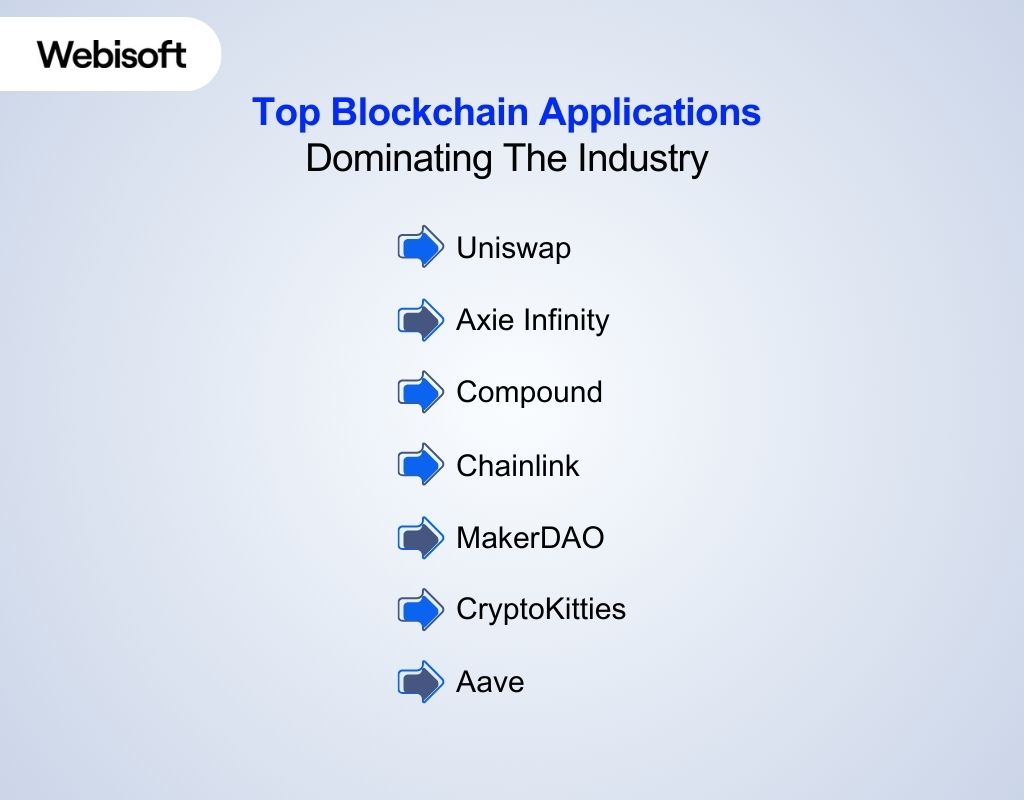
Blockchain isn’t just a theory anymore. Some applications already attract millions of users and billions in value. So, as with learning on how to build a blockchain application from scratch, know some top projects that showcase blockchain’s real-world dominance:
Uniswap:
The most popular decentralized exchange on Ethereum, letting users swap tokens instantly through liquidity pools. It transformed how people trade crypto without middlemen.
Axie Infinity:
A pioneering play-to-earn game where players collect and battle digital creatures called Axies. Its NFT model proved how gaming can merge with real financial rewards.
Compound:
A DeFi protocol that automates lending and borrowing. Interest rates are set by smart contracts, removing the need for banks while keeping liquidity open to all.
Chainlink:
The go-to oracle network that feeds real-world data (like prices or weather) into blockchains. It powers advanced decentralized apps by bridging on-chain and off-chain worlds.
MakerDAO:
A DAO that governs the DAI stablecoin. Users lock crypto as collateral to generate DAI, creating stable currency and enabling decentralized lending ecosystems.
CryptoKitties:
One of the earliest NFT games. It showed the world how digital collectibles could live on-chain, sparking today’s multibillion-dollar NFT industry.
Aave:
A decentralized lending platform supporting multiple cryptocurrencies. It offers flash loans, variable interest rates, and community governance. All executed via smart contracts.
What Are The Future Trends In Blockchain Applications? (2025 And Beyond)
Blockchain is moving beyond cryptocurrencies and becoming part of everyday business systems. Here are the trends shaping its future:
- Blockchain apps will increasingly connect with AI, enabling fraud detection, predictive pricing, and automated contract decisions.
- Proof of Stake and similar models are replacing energy-hungry mining, making blockchain cheaper and greener.
- New frameworks like Polkadot and Cosmos allow blockchains to share data and assets securely across platforms.
- Users will own and share verified IDs themselves, improving privacy and reducing onboarding friction.
- Real estate, IP, or even carbon credits will be turned into blockchain tokens for easier trading and investment.
- Governments are introducing clear digital asset rules, encouraging enterprises to scale blockchain adoption with confidence.
Advantages of Blockchain Application Development Outsourcing
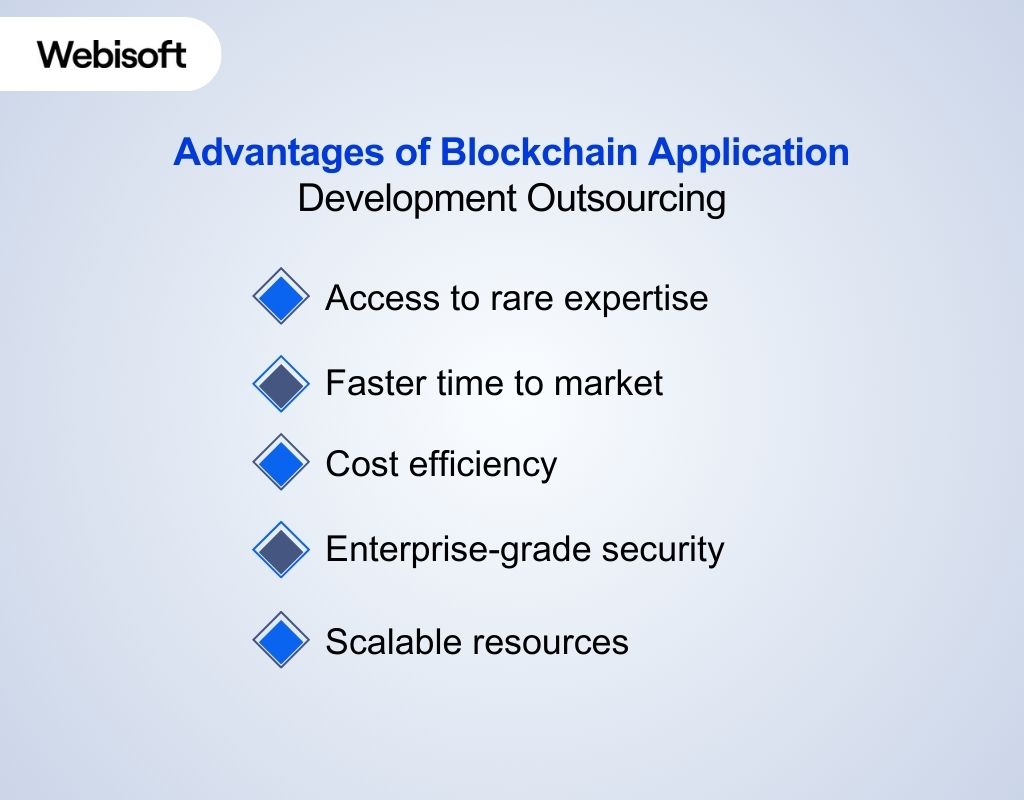
Building a blockchain application in-house sounds appealing, but the reality is tough: niche skills, high costs, and steep learning curves. Outsourcing to specialists solves these challenges and accelerates success.
Access to rare expertise:
Blockchain requires skills in Solidity, Rust, consensus protocols, and cryptography. A Deloitte survey found 53% of executives struggle to hire blockchain talent. Outsourcing gives you immediate access.
Faster time to market:
Dedicated blockchain firms use ready frameworks, SDKs, and proven workflows. This can shave 30–40% off development time, helping you launch before competitors.
Cost efficiency:
Hiring an internal team is expensive, often with six-figure salaries per developer. Outsourcing allows you to scale talent as needed without the overhead, often reducing costs by half.
Enterprise-grade security:
Professional teams are well-versed in audits, smart contract testing, and zero-knowledge protocols. This lowers your risk of costly breaches that have drained billions from poorly coded apps.
Scalable resources:
As your app grows, outsourced partners can easily expand teams for upgrades, integrations, or new modules. This is such flexibility, hard to achieve with static internal teams.
How Webisoft Helps Build Scalable Blockchain Applications
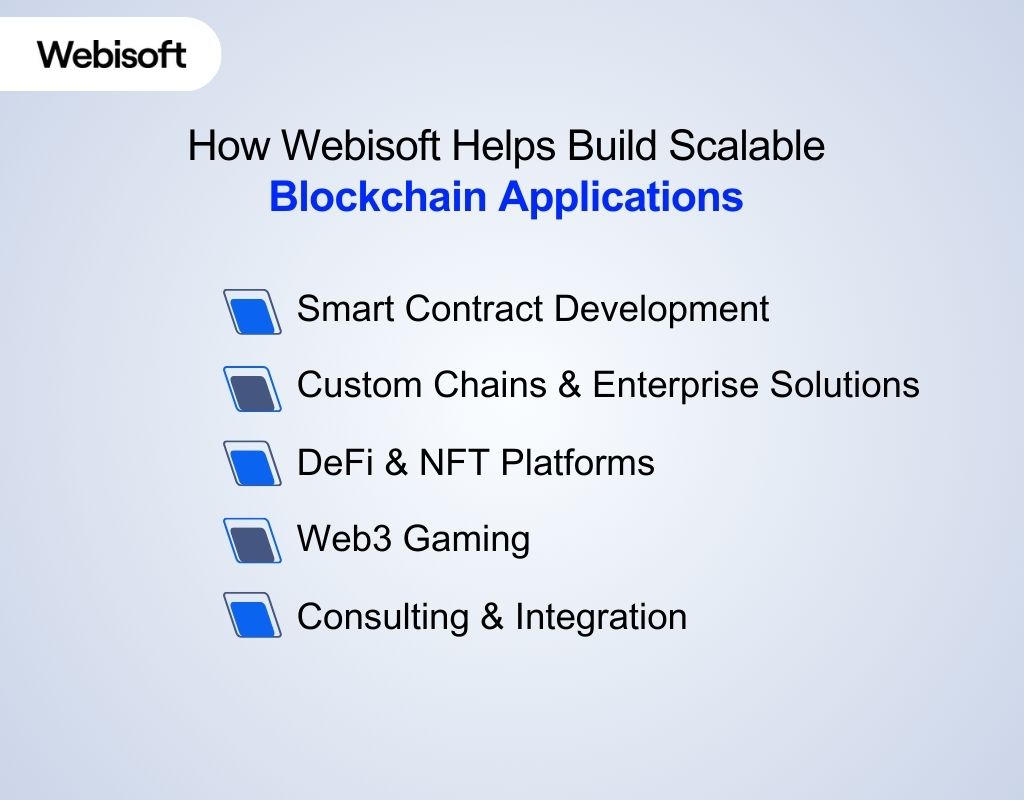
One of the biggest pain points in blockchain development is scalability. Apps work fine in testing, but struggle with performance, integrations, or security when user numbers grow. That’s where Webisoft steps in. With proven expertise across industries, we architect blockchain solutions that scale from day one.
- Smart Contract Development: Secure, optimized contracts in Solidity, Rust, or Vyper, designed for high transaction volumes without bottlenecks.
- Custom Chains & Enterprise Solutions: Private, hybrid, or public chains tailored to business needs, ensuring data security and regulatory alignment.
- DeFi & NFT Platforms: From marketplaces to tokenized assets, we’ve built systems capable of handling thousands of transactions seamlessly.
- Web3 Gaming: End-to-end support for play-to-earn models and immersive blockchain-powered games, built to grow with player adoption.
- Consulting & Integration: Strategic guidance and technical implementation that connect blockchain with existing enterprise systems for real-world impact.
With Webisoft, scalability isn’t an afterthought. It’s the foundation. If you’re ready to build a blockchain application that grows with your business, our team is here to make it happen.
In Closing
Still wondering how to build a blockchain application from scratch? It is no longer just for tech giants. With the right approach, tools, and guidance, businesses of any size can innovate on this fast-growing frontier. From DeFi platforms to enterprise solutions, blockchain’s potential is limitless when scalability and security are built in from day one. If you’re ready to transform your idea into a powerful blockchain application, Webisoft’s expert team is here to guide you every step of the way. Let’s build the future together.
Frequently Asked Questions
Beyond finance, industries like supply chain, healthcare, gaming, and identity management are adopting blockchain. Each gains unique advantages, from traceability in logistics to secure data sharing in healthcare.
The timeline depends on complexity. A simple MVP may take 3–6 months, while full-scale enterprise-grade apps can take 12 months or more, covering architecture, smart contracts, testing, and deployment.
By design, blockchain provides strong data immutability and cryptographic protection. However, smart contract bugs and poor architecture can introduce risks, which is why expert development and audits are critical.
Not necessarily. Most applications are built on existing platforms like Ethereum, Polygon, or Solana, which already provide consensus and infrastructure, allowing faster and more cost-effective development.
Yes. Through APIs and middleware, blockchain can be connected with CRMs, ERPs, and cloud systems. This ensures businesses keep their existing workflows while adding blockchain’s transparency and automation.