Share


How to Audit Smart Contracts: Step by Step Guide

- BLOG
- Smart Contracts
- October 16, 2025
Smart contracts execute automatically when triggered, without needing central approval. That makes any error potentially serious. Once deployed, flaws become permanent risks. That’s why knowing how to audit smart contracts is crucial.
From logic bugs to reentrancy issues, audits uncover vulnerabilities that could lead to major losses. Yet many teams skip deep checks or rely on quick scans.
Auditing means more than reading code. Rather it involves understanding logic, testing edge cases, and simulating attacks.
This guide walks you through smart contract auditing step by step, from preparation to review so you can deploy with confidence.
Contents
- 1 Understanding Smart Contract Audits
- 2 Secure Your Smart Contracts with Webisoft’s Skilled Auditors!
- 3 Top Tools Used in Smart Contract Audits
- 4 How to Audit Smart Contracts: Process Explained
- 4.1 Step 1: Prepare the Smart Contract for Audit
- 4.2 Step 2: Choose the Right Type of Audit
- 4.3 Step 3: Identify the Tools and Standards to Follow
- 4.4 Step 4: Perform the Audit (Automated + Manual)
- 4.5 Step 5: Document Findings and Fix Issues
- 4.6 Step 6: Final Verification and Public Report
- 4.7 Step 7: Maintain Post-Audit Security
- 5 Why Smart Contract Audits Matter
- 6 Smart Contract Audit Best Practices
- 7 Why Choose Webisoft for Your Smart Contract Auditing Needs?
- 8 Secure Your Smart Contracts with Webisoft’s Skilled Auditors!
- 9 In Closing
- 10 Frequently Asked Questions
- 11 Common Smart Contract Vulnerabilities
Understanding Smart Contract Audits
A smart contract audit is a detailed review of a contract’s code to find bugs, vulnerabilities, or security flaws before it goes live. The goal is simple: make sure the contract works exactly as intended and nothing more.
An audit looks at everything, from how the contract handles inputs and interacts with other contracts to how it manages permissions, limits, and edge cases. It often combines automated tools with manual code review to catch issues that machines might miss.
In short, a smart contract security audit is your last line of defense before launch. It helps protect users, funds, and the reputation of your project.


Secure Your Smart Contracts with Webisoft’s Skilled Auditors!
Book a detailed review to find risks and protect your blockchain projects.
Top Tools Used in Smart Contract Audits
Effective smart contract audits rely on powerful tools to detect flaws and improve code quality. Learn about the leading software and platforms auditors use to identify vulnerabilities and ensure contract safety.
| Tool Name | Type | Use Case | Notable Feature |
| MythX | Static Analysis Tool | Detects security vulnerabilities in code | Integrates with Remix, Truffle, Hardhat |
| Slither | Static Analyzer | Performs vulnerability detection in Solidity | Fast and extensible Python framework |
| Foundry | Testing Framework | Fuzz testing and invariant checking | High-speed execution, Rust-based |
| Echidna | Fuzzing Tool | Property-based testing of smart contracts | Generates randomized inputs automatically |
| Manticore | Symbolic Execution | Analyzes smart contract behavior path-by-path | Supports complex symbolic analysis |
| Certora | Formal Verification | Ensures logic correctness using rules | Uses proprietary formal specification |
| Oyente | Analysis Tool | Detects security bugs via symbolic execution | One of the earliest Ethereum analyzers |
| Hardhat | Development Environment | Runs unit tests, scripts, and audits | Plugin support for audit tools (e.g., Slither) |
How to Audit Smart Contracts: Process Explained
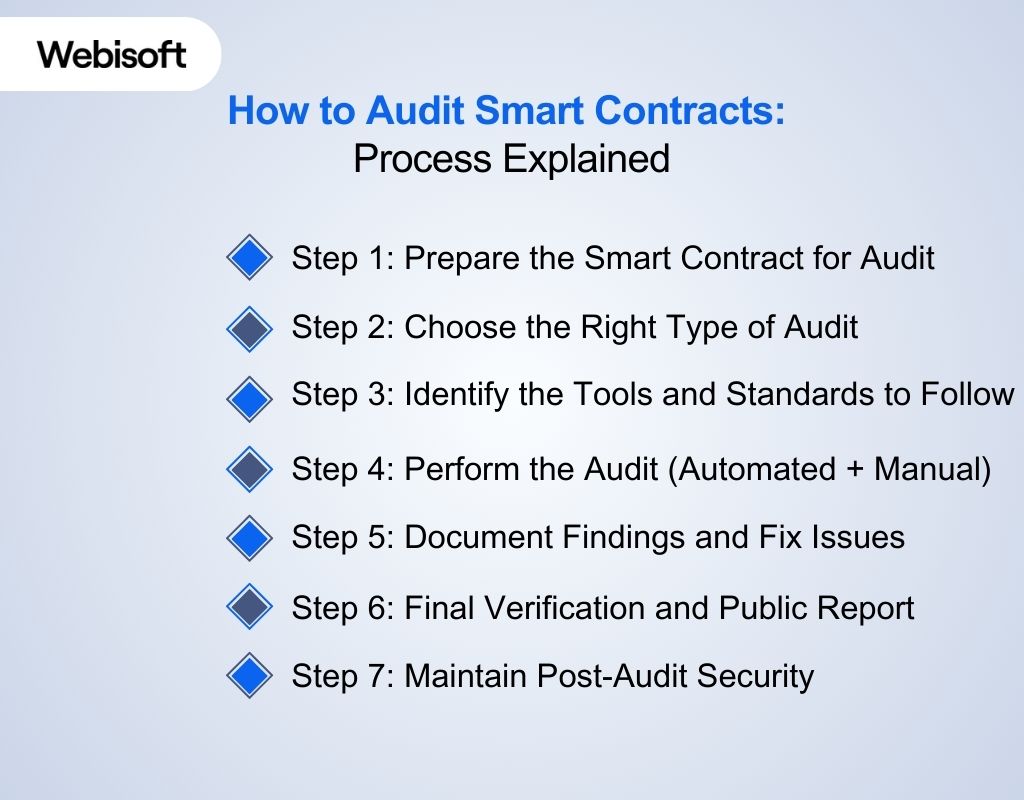
Understanding the smart contract audit process is essential to ensure your code is secure, reliable, and free of vulnerabilities. This guide breaks down each step involved in how to audit smart contracts, making the process clear and manageable.
Step 1: Prepare the Smart Contract for Audit
Proper preparation ensures a smooth and effective audit. Follow these steps to get your smart contract ready:
- Freeze the Code: Use a fixed commit or version to avoid changes during the audit.
- Define Functional Requirements: Clearly state what the contract is intended to do with specific use cases.
- Document the Architecture: Include a high-level overview of components, integrations, and dependencies.
- Set Up a Dev Environment: Provide a working setup (e.g., Hardhat, Foundry) for testing and deployment.
- Write Unit Tests: Ensure robust test coverage, especially for edge cases and error handling.
- Follow Code Standards: Use consistent formatting, comments, and adhere to best practices.
- Provide Deployment Instructions: Include details on how to deploy and interact with the contract.
- Note Known Issues: Mention any limitations or unresolved parts of the code.
These preparations give auditors the context, tools, and clarity they need to deliver a thorough and reliable audit.
Step 2: Choose the Right Type of Audit
Not all smart contract audits are the same. Depending on your project, budget, and risk level, you might choose a manual audit, automated scan, or a mix of both.
Types of audits to consider:
- Manual audits: Experts go line-by-line through your code to find logical and structural vulnerabilities.
- Automated audits: Tools scan for known security patterns, like reentrancy or integer overflows.
- Formal verification: Mathematically proves that your contract behaves exactly as intended (used in high-stakes protocols).
- Bug bounty programs: Open your code to white-hat hackers who are rewarded for finding bugs.
Selecting the right type of audit helps balance smart contract audit cost, coverage, and credibility.
Step 3: Identify the Tools and Standards to Follow
Effective smart contract auditing relies on tools like MythX, Slither, and Foundry, aligned with standards such as OpenZeppelin and the SWC Registry. These help ensure smart contract security without reinventing the wheel.
Key tools and resources for smart contract auditing:
- MythX, Slither, Echidna – for static and dynamic analysis.
- Hardhat, Foundry, or Truffle – for running tests and simulations.
- Solhint, Surya, or Oyente – for structure, graphing, and linting.
- SWC Registry – to check against known smart contract vulnerabilities.
Aligning your tools with common blockchain audit frameworks boosts reliability and repeatability.
Step 4: Perform the Audit (Automated + Manual)
Now the actual audit begins. This is where security professionals — or your in-house team — examine the smart contract for vulnerabilities, inefficiencies, and logic errors.
What happens during the audit:
- Run static analysis tools to catch common issues.
- Manually review the code logic, functions, modifiers, and access control.
- Check edge cases, test inputs, and failure conditions.
- Simulate attacks like front-running, reentrancy, or denial of service.
- Validate that the code matches the whitepaper/specification.
The purpose is to ensure that your smart contract development produces results aligned with the intended logic—securely and reliably.
Step 5: Document Findings and Fix Issues
After reviewing the code, the auditors prepare a report listing vulnerabilities, classified by severity — critical, high, medium, low, or informational.
What an audit report usually includes:
- Overview of the contract and methodology used.
- List of vulnerabilities with explanations and risk levels.
- Suggested fixes and mitigations.
- Final comments on code quality and architecture.
From there, the development team fixes the issues and may resubmit the code for re-audit or verification.
Step 6: Final Verification and Public Report
Once all fixes are implemented, the final step is verification. Auditors check whether the patches solve the original issues — and don’t introduce new ones.
Final steps before deployment:
- Confirm that every vulnerability was properly addressed.
- Re-run tools and tests to verify the final code.
- Publish the audit report for transparency (often in a GitHub repo or on the project site).
- Optionally, deploy a new smart contract with updated code and label it “audited.”
Making the report public builds trust and signals that the project takes security seriously.
Step 7: Maintain Post-Audit Security
An audit is not a one-time guarantee. Contracts may interact with new systems, upgrades may be needed, or attackers may find new exploits. That’s why ongoing monitoring and periodic reviews are critical.
Post-audit best practices:
- Use on-chain monitoring tools to track contract behavior.
- Establish a bug bounty or responsible disclosure process.
- Avoid unnecessary upgrades without re-auditing.
- Stay updated on new security trends in the ecosystem.
Security is an ongoing process — and the strongest projects treat audits as the beginning of responsible development, not the end.
For expert support with ongoing monitoring and proactive protection, check out our smart contract security services.
Why Smart Contract Audits Matter
Smart contract audits play a critical role in protecting blockchain applications from costly bugs and exploits. Discover why auditing is vital for trust, security, and the overall success of your smart contract projects.
- Catch Critical Bugs Before Deployment: Even small bugs in smart contracts can lead to major failures once deployed. Audits help you detect and correct these issues early, before they cause real damage.
- Prevent Exploits and Hacks: Smart contract vulnerabilities are a prime target for attackers. A thorough audit uncovers these weak spots so they can be fixed before someone exploits them.
- Protect User Funds and Trust: One overlooked flaw can result in lost or frozen assets, harming your users directly. That kind of incident can instantly destroy trust in your project.
- Ensure Contracts Work as Intended: Just because the code runs doesn’t mean it’s doing what you intended. Audits verify the contract logic to make sure outcomes match your goals.
- Meet Security Standards: The blockchain ecosystem evolves fast, and so do its risks. Audits ensure your code follows the latest security best practices and compliance expectations.
- Build Credibility with Investors and Users: A professional audit shows that you take security and reliability seriously. That reassurance can make all the difference in earning support and long-term trust.
So, understanding how to audit smart contracts effectively is the first step toward ensuring your decentralized applications remain safe and reliable.
Smart Contract Audit Best Practices
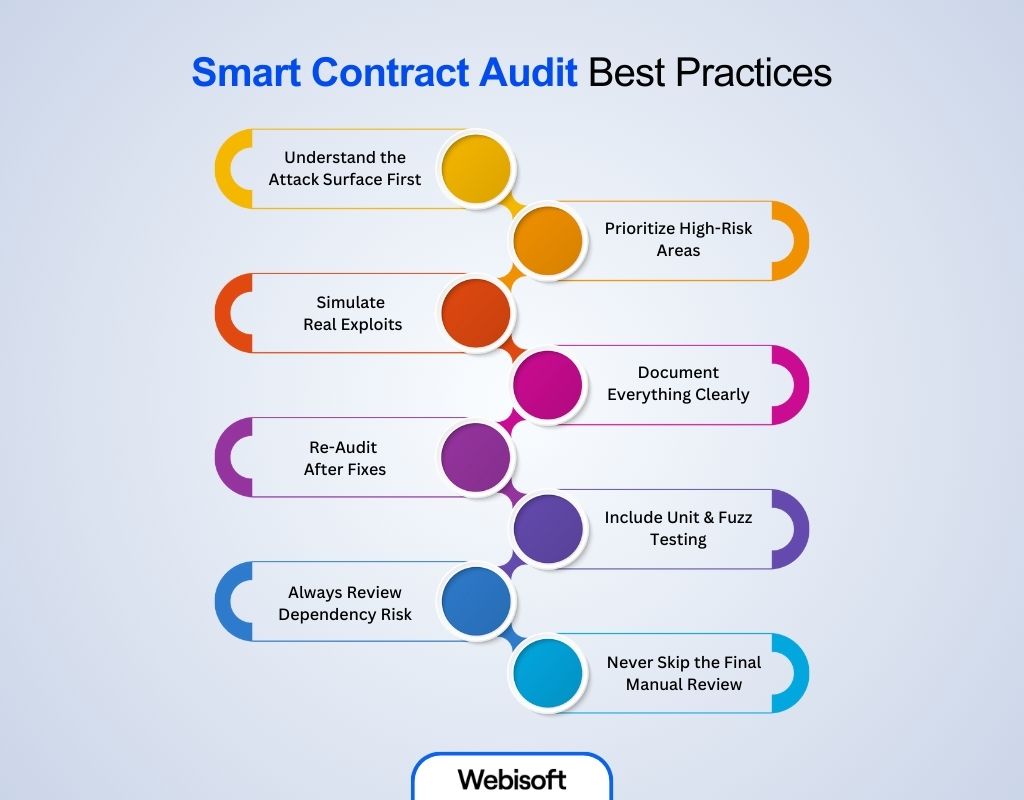
Following best practices in auditing smart contracts helps minimize risks and maximize code integrity. Explore proven strategies and tips that auditors and developers should follow for successful, secure audits.
Understand the Attack Surface First
Before diving into the code, get a clear picture of the system’s overall architecture. Smart contracts usually interact with many external components — like tokens, oracles, third-party contracts, frontends, and Layer 2 solutions. Each integration point increases the attack surface and potential vulnerabilities.
As the saying goes, “You can’t secure what you don’t fully understand.”
Begin with documentation, diagrams, and threat modeling. Understand what each contract does, how data flows, and what could go wrong if inputs are manipulated.
Real-world example: The infamous bZx flash loan attack exploited an external oracle dependency. A deeper understanding of the protocol’s architecture could have highlighted this risk early on, helping prevent the attack.
Prioritize High-Risk Areas
Not all parts of your smart contract carry the same risk. You should focus more attention on functions that handle value transfers, critical roles like owners or admins, loops that get bigger over time, and contracts that can be upgraded.
For instance, ConsenSys Diligence highlights that many critical bugs stem from areas like access control and unsafe external calls. Focusing your audit efforts on these known high-risk zones can significantly reduce the chance of major vulnerabilities.
Simulate Real Exploits
Don’t just read the code—actively try to break it. Use testnets and forked mainnet environments to simulate real attack scenarios such as:
- Flash loan exploits
- Reentrancy attacks
- Gas griefing and denial-of-service (DoS) vectors
- Unexpected token callbacks
Common tools for this include Foundry, Hardhat, Tenderly, and Ganache, which help you replicate contract behavior under various conditions.
Real-world tip: If you’re not actively attempting to exploit the contract, you’re only doing a code review—not a thorough security audit.
Document Everything Clearly
A great audit is not just about finding issues — it’s about communicating them well. Your audit report should:
- Summarize vulnerabilities by severity (Critical → Low)
- Include proof-of-concept code or test cases
- Recommend fixes and explain why they work
- Highlight parts of the contract that are well-implemented, too
A polished, transparent report builds trust with clients, users, and the open-source community.
Re-Audit After Fixes
Fixing one bug can sometimes create others. That’s why a follow-up audit is essential after your team applies changes. Many teams skip this step, either due to overconfidence or time pressure — and often end up paying for it later.
Think of it like surgery: the operation removes the problem, but the recovery phase ensures no new complications arise.
In this stage, you should:
- Compare code diffs to identify exactly what changed.
- Run regression tests to make sure previous features still work as expected.
- Check for new vulnerabilities that might have been introduced during the fix.
- Increase test coverage to ensure more of your code is being automatically verified.
This step closes the loop, helping you confirm that your fixes are secure — not just hopeful patches.
Include Unit & Fuzz Testing
Good testing covers both what you expect and what you don’t. Unit tests check that your contract behaves correctly with known, expected inputs — they verify the core logic in controlled scenarios.
Fuzz testing, on the other hand, pushes your contract with random or malformed inputs to uncover edge cases, unexpected behavior, or crashes. It’s less about precision, more about pressure-testing the system.
Here are some widely used tools for both strategies:
- Foundry’s Fuzzing Engine – fast, developer-friendly, and integrates easily with Solidity tests.
- Echidna – ideal for property-based fuzz testing, where you define expected properties your contract should always satisfy.
- Mythril – combines fuzzing with symbolic analysis to explore complex execution paths.
Fuzzing isn’t a magic bullet — but it’s a powerful, brute-force method to catch bugs you didn’t know were there. Combined with solid unit tests, it gives your contract a much deeper level of protection.
Always Review Dependency Risk
Your smart contract might be secure — but if it relies on insecure dependencies, that security can collapse. Even widely trusted libraries like OpenZeppelin can be misused or updated in ways that introduce risk.
You should carefully review:
- External calls to other contracts
- Imported libraries and their versions
- Assumptions made about external interfaces
A common mistake is assuming that popular libraries are foolproof. Popularity doesn’t prevent human error in how they’re implemented.
Use this checklist to stay safe:
- Is the dependency pinned to a specific, audited version?
- Are the interfaces you’re relying on still accurate and maintained?
- Are external calls properly checked for success or failure responses?
Don’t treat dependencies as black boxes — audit them as carefully as your own code.
Never Skip the Final Manual Review
After running automated tools, tests, and team discussions, take the time to read the code line by line. No automation can fully replace the trained judgment of an expert scanning for unusual patterns, logic flaws, or new attack possibilities.
Experienced auditors develop instincts by asking questions like:
- What important checks might be missing in this function?
- Could an attacker use this input in an unexpected way?
- Does the contract rely on users behaving honestly when it shouldn’t?
Even if the code passes every test, it can still fail in production. The final manual review is your last and most crucial line of defense.
Why Choose Webisoft for Your Smart Contract Auditing Needs?

Auditing smart contracts is a critical step to ensure the security, reliability, and performance of your blockchain applications. Webisoft stands out as a trusted partner in the field of smart contract audits because we combine deep technical expertise with a thorough, methodical approach.
- Expert Team: Skilled in smart contract development and security audits.
- Thorough Checks: Detects common vulnerabilities like reentrancy and overflows.
- Best Tools & Manual Review: Combines automated tools with expert manual inspection.
- Clear Reports: Easy-to-understand findings with practical fixes.
- Affordable Pricing: Quality audits at competitive costs.
- Industry Standards: Ensures compliance with blockchain security best practices.
Secure Your Smart Contracts with Webisoft’s Skilled Auditors!
Book a detailed review to find risks and protect your blockchain projects.
In Closing
Auditing smart contracts is not just a technical job, it’s key to making blockchain apps safe and trustworthy. Whether you’re starting a new DApp or handling important data, knowing how to audit smart contracts helps you avoid big mistakes.
This guide showed a simple way to audit smart contracts from checking code to testing for attacks. While small projects might handle audits internally, complex or high-value contracts benefit greatly from a professional smart contract audit company.
Webisoft’s audit team uses smart tools and real experience to find issues others may miss. A strong audit keeps your project safe and that makes a big difference.
Frequently Asked Questions
How long does it take to audit a smart contract?
Audits usually take between 1 and 4 weeks. Simple contracts might be done in a few days, but bigger or more complex projects need more time for careful review and testing.
Can ChatGPT audit smart contracts?
ChatGPT can help you understand code, spot common mistakes, and explain smart contract concepts. But it cannot replace a full professional audit done by experts and specialized tools. Auditing requires deep security knowledge and manual testing beyond what ChatGPT can do.
How hard is smart contract auditing?
Smart contract auditing is challenging, especially for beginners, because it demands more than just Solidity knowledge, you need to understand the EVM, DeFi, security exploits, and auditing tools. While the learning curve is steep, platforms like Code4rena, Sherlock, and tools like Solodit and Ethernaut can help you gain real-world experience. Start small, offer low-cost reviews to build your skills, and use free resources like Cyfrin Updraft. With practice and persistence, you can grow into a skilled auditor.
Common Smart Contract Vulnerabilities
Smart contracts, while powerful, are prone to critical vulnerabilities that attackers exploit to drain funds or disrupt operations. Key risks include:
- Reentrancy Attacks – External calls allow recursive re-entry before state updates (e.g., The DAO hack).
- Flash Loan Exploits – Borrowed funds manipulate prices or governance votes in a single transaction.
- Oracle Manipulation – Tampered off-chain data (e.g., price feeds) triggers faulty logic.
- Access Control Flaws – Missing permission checks let attackers execute admin functions.
- Math Errors – Integer overflows/underflows or rounding issues distort balances.
- Signature Forgery – Weak verification enables unauthorized transactions.
- Denial of Service (DoS) – Malicious actors block legitimate users by reverting key functions.
Mitigation: Use audits, reentrancy guards, decentralized oracles, and libraries like OpenZeppelin. Prioritize checks-effects-interactions (CEI) patterns and role-based access control.
