NFT marketplaces are two-sided platforms: creators mint and list tokenized assets, buyers browse, bid, and settle on chain. Most of the well-known platforms run on Ethereum, but Cardano handles NFTs in a structurally different way, and that difference changes how you architect a marketplace, what it costs to run, and what failure modes you need to design around.
This guide covers how NFTs work on Cardano, why the platform is a credible base for a marketplace, the honest trade-offs, and a step-by-step build process a development team can actually follow.
What an NFT Marketplace Actually Does
Strip away the storefront and an NFT marketplace performs four jobs:
- Minting and listing. It lets creators tokenize an asset, attach metadata (name, image reference, attributes), and put it up for sale at a fixed price or auction.
- Discovery. Search, filters, collection pages, and price history so buyers can find and evaluate assets.
- Settlement. Escrow logic that swaps the token for payment atomically, so neither side can walk away with both the asset and the money.
- Royalty accounting. Routing a percentage of secondary sales back to the original creator, which is the main economic reason creators prefer NFT rails over conventional licensing.
The value of the model is disintermediation: creators sell directly to buyers, provenance is verifiable on a public ledger, and secondary-market royalties can persist across resales. The catch, which most marketing copy skips, is that royalty enforcement depends on where settlement happens. If a sale settles through your marketplace contract, you can enforce the royalty. If two parties trade the token directly wallet to wallet, no protocol on any major chain forces the payment. Design your marketplace knowing royalties are a service you provide, not a law of physics.
How Cardano Handles NFTs: Native Assets, Not Contract Tokens
This is the most important technical difference between Cardano and Ethereum for marketplace builders.
On Ethereum, an NFT is a ledger entry inside a smart contract (ERC-721 or ERC-1155). The contract is custom code, it must be deployed and audited, and every transfer executes contract logic. On Cardano, NFTs are native assets: the ledger itself tracks them, the same way it tracks ADA. You mint an NFT with a minting policy (a script that defines who can mint and until when), not with a bespoke token contract.
Practical consequences of that design:
- Smaller attack surface. There is no per-collection token contract to get wrong. Token transfer logic is ledger code, reviewed once for everyone, not re-implemented per project.
- Cheaper, simpler minting. A time-locked minting policy plus a metadata payload is enough to mint an NFT. No contract deployment step.
- Standardized metadata. CIP-25 defines how NFT metadata (name, image URI, attributes) is attached to the minting transaction. CIP-68 is the newer datum-based standard that makes metadata readable by on-chain scripts and updatable when the use case requires it, which matters for gaming assets and dynamic NFTs.
- Royalty convention. CIP-27 defines a community royalty standard. Note that it is advisory: marketplaces choose to honor it, the ledger does not enforce it.
Cardano also uses the extended UTXO (eUTXO) accounting model rather than Ethereum's account model. Each transaction consumes specific unspent outputs and produces new ones. The upside is determinism: you can validate a transaction locally and know its exact fee and outcome before submitting it. There are no failed transactions that still burn gas, and no gas auctions where fees spike because an unrelated collection is minting. The downside is concurrency, which we cover below because it directly shapes marketplace architecture.
Why Build an NFT Marketplace on Cardano
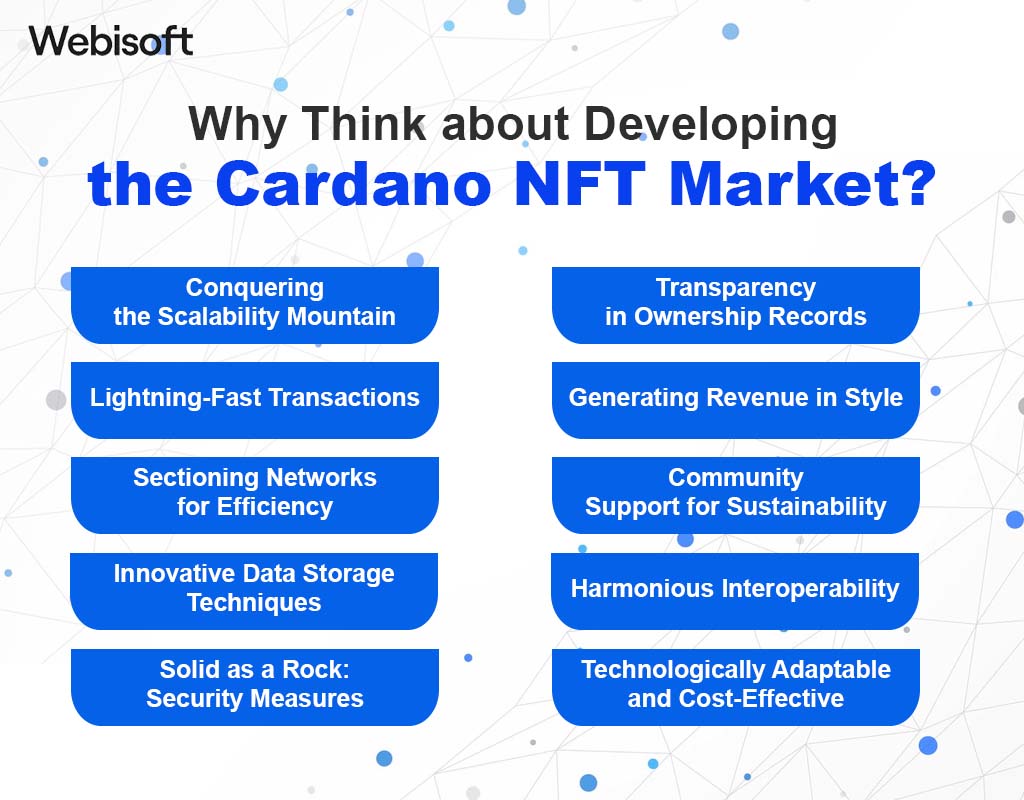
Deterministic, Predictable Fees
Cardano fees are computed from transaction size and script execution units against fixed protocol parameters. A marketplace can show a user the exact cost of listing or buying before the transaction is signed. On fee-auction chains, minting a popular collection can price out ordinary users; on Cardano the fee schedule does not move with demand. For a consumer product where users may be first-time crypto buyers, predictable fees remove a real support burden.
Proof of Stake With Published Research
Cardano runs on Ouroboros, a proof-of-stake consensus protocol developed through peer-reviewed academic research. Security rests on the assumption that a majority of stake is held by honest participants, and the protocol has operated continuously since the network launched. Proof of stake also means the network does not carry the energy profile of proof-of-work mining, which matters to brands and artists who take public positions on sustainability.
Low-Cost Minting for Creators
Because minting does not require deploying a contract, the cost of putting a collection on chain is a function of transaction size, not developer time spent writing and auditing Solidity. For a marketplace whose growth depends on creator supply, lowering the barrier to a first mint is a direct acquisition lever.
Transparent Provenance
Every mint and transfer is on the public ledger, keyed by the minting policy ID. A buyer can verify that an NFT was minted under the official policy of a collection rather than a copycat policy, which is Cardano's answer to the fake-collection problem. Your marketplace UI should surface policy IDs and verification status prominently; it is one of the cheapest trust features you can ship.
The Trade-Offs You Should Price In
A senior team also weighs the costs. Three are worth naming:
- eUTXO concurrency. A UTXO can only be spent by one transaction. A naive marketplace design where many buyers race to spend the same script output will produce contention failures. Production Cardano dApps solve this with batching patterns, one-listing-one-UTXO designs, or off-chain order matching with on-chain settlement. This is a solved problem, but it is an architecture decision you must make early, not a patch you add later.
- Smaller liquidity pool. Ethereum still has the deepest NFT liquidity and the largest buyer base. Choosing Cardano is a bet on lower costs, a differentiated creator community, and room to be a leading venue rather than a marginal one on a crowded chain. Be explicit about that bet in your business plan.
- Tooling maturity. Plutus development uses Haskell, and the developer pool is smaller than Solidity's. Newer toolchains such as Aiken have improved developer experience, and API providers remove the need to run your own infrastructure, but staffing a Cardano team takes more deliberate hiring than staffing an EVM team.
Core Features Every Cardano NFT Marketplace Needs
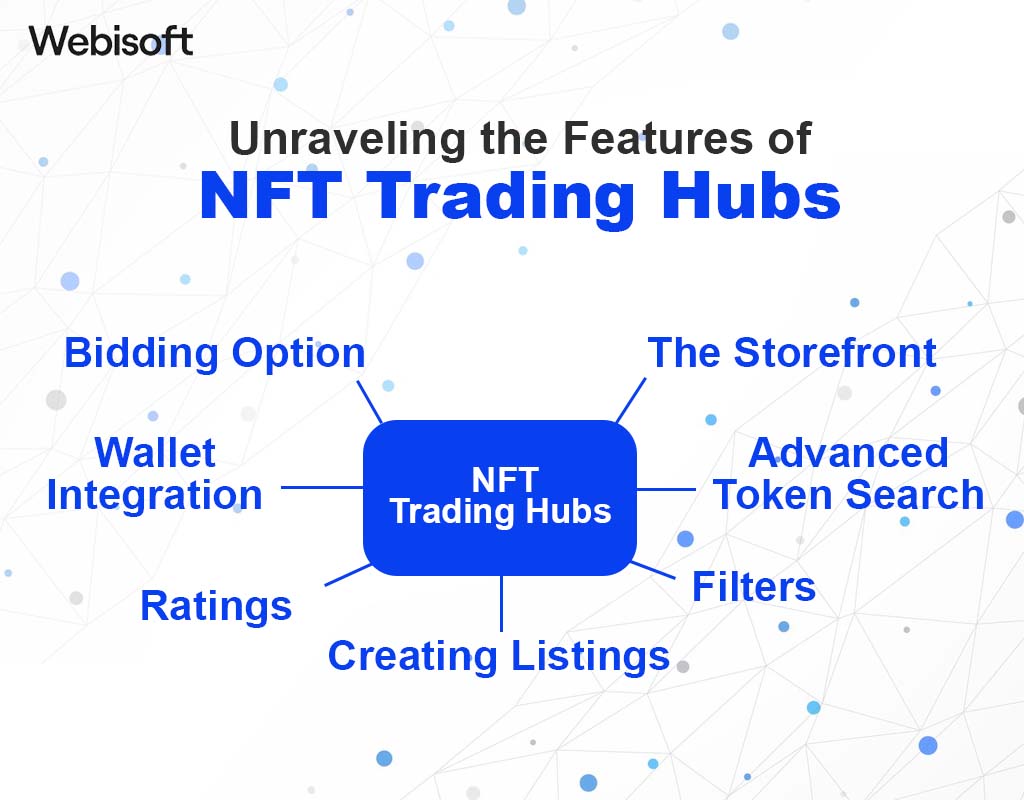
Whatever the niche, buyers and sellers expect a baseline feature set:
- Storefront and collection pages. Current listings, ownership, price history, and rarity attributes per asset, with policy-ID verification badges for authentic collections.
- Search and filters. Filter by collection, price range, listing status, and traits. On Cardano this means indexing chain data into your own database; you will not get responsive search by querying the chain directly.
- Listing management. Creators mint, set fixed prices or auction parameters, and edit or cancel listings. Cancellation must return the asset from the escrow script to the seller cleanly.
- Bidding and offers. Timed auctions and open offers on unlisted assets. Each mechanism is its own piece of validator logic and needs its own tests.
- Wallet connection. The CIP-30 dApp connector standard lets browser wallets such as Lace, Eternl, and Nami connect to your site, expose balances, and sign transactions. Support several wallets; users are loyal to theirs.
- Royalty handling. Read CIP-27 royalty tokens where present and route the payment in your settlement logic.
- Activity and notifications. Sales feeds, outbid alerts, and price-drop notifications keep a two-sided market liquid.
How to Build a Cardano NFT Marketplace, Step by Step
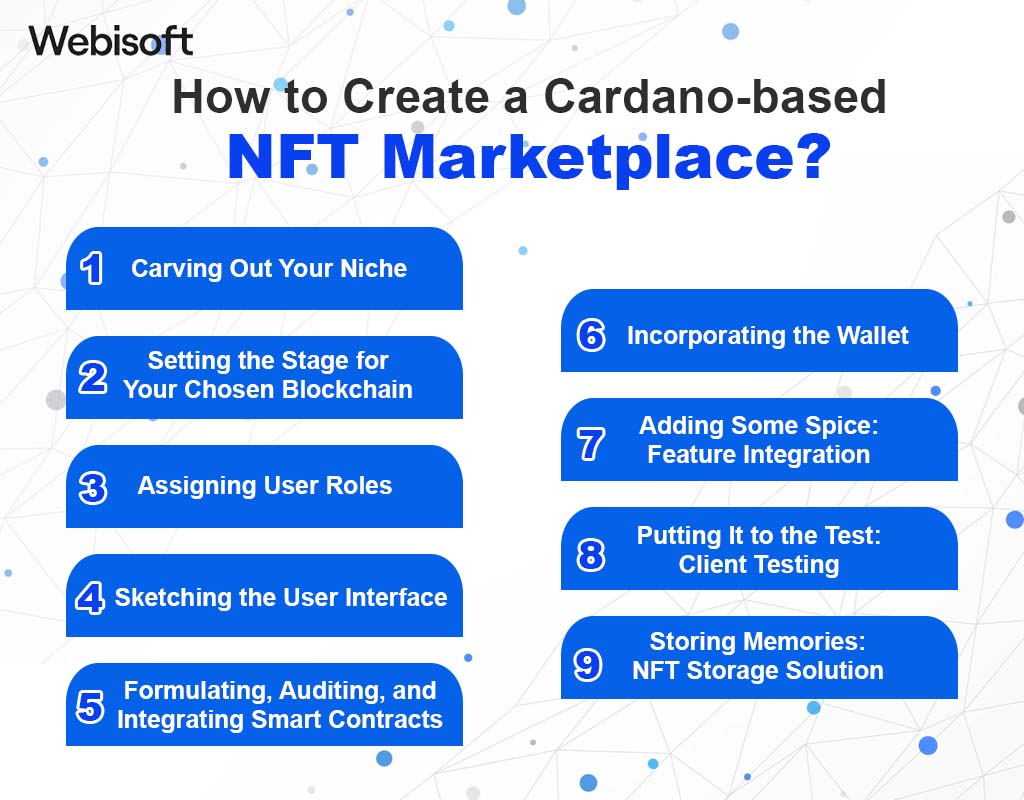
1. Define the Niche and the Liquidity Plan
General-purpose marketplaces compete with incumbents on inventory they cannot match. Pick a segment (generative art, gaming assets, music, memberships, real-world asset certificates) and decide how the first hundred creators and first thousand buyers arrive. A marketplace with no supply-side plan is a settlement contract with a UI.
2. Choose Your Chain Access Layer
You can run your own cardano-node and query it directly, which gives full control and no third-party dependency, or use an API provider such as Blockfrost for chain queries and transaction submission, which shortens time to market. Most teams start with an API layer and move critical paths to their own infrastructure as volume grows. Either way, plan an indexer that mirrors chain state (listings, sales, mints) into a queryable database for your frontend.
3. Specify User Roles and Flows
Write out the creator flow (mint, list, edit, cancel, withdraw proceeds), the buyer flow (browse, bid, buy, receive), and the admin flow (collection verification, dispute handling, fee configuration) before designing screens. Every state transition in these flows corresponds to a transaction type your contracts and backend must support.
4. Design the Interface Around Wallet Reality
Cardano marketplace UX has chain-specific moments: connecting a CIP-30 wallet, displaying deterministic fees before signing, and communicating settlement time. Design for the newcomer who has never signed a transaction, show exactly what each signature does, and keep the number of signatures per purchase to one.
5. Write and Audit the Validators
The core of the marketplace is a set of on-chain validators: escrow logic that holds a listed NFT and releases it when payment conditions are met, auction logic, and offer logic. On Cardano these are written in Plutus (Haskell-based) or Aiken, with Marlowe available for simpler financial contract patterns. Keep validators minimal, push complexity off chain, and commission an independent audit before mainnet. The eUTXO model makes validation deterministic, which auditors like, but it does not make design errors impossible.
6. Integrate Wallets and Payment Flows
Transactions settle in ADA. Integrate CIP-30 wallets for signing, and remember the wallet holds keys and transaction history, not the media files. Test the unhappy paths: rejected signatures, disconnections mid-flow, and stale UTXO references when a listing sells while another buyer has the page open.
7. Build the Differentiating Features
Baseline features get you to parity. Differentiation comes from things like creator storefronts with custom domains, collection analytics, batch minting tools, fiat on-ramp integration, or curation and verification programs that reduce fraud risk for buyers. Choose based on your niche, not on a feature checklist.
8. Test on Preprod, Then Ship
Cardano provides public test networks (preview and preprod) that mirror mainnet behavior. Property-based testing is idiomatic in the Cardano ecosystem and well suited to marketplace logic: generate thousands of randomized order sequences and assert that no sequence lets an asset and its payment end up with the same party. Load-test your indexer separately; in practice the first thing that falls over during a popular mint is the off-chain infrastructure, not the chain.
9. Solve Storage Properly
The NFT on chain is a token plus metadata; the artwork or media lives off chain. IPFS is the common choice, with the content hash recorded in the CIP-25 metadata so the file's integrity is verifiable. Pin the content redundantly (your own IPFS nodes plus a pinning service) or use permanent storage such as Arweave for high-value collections. A marketplace full of dead image links is a reputation you do not recover from.
Beyond Collectibles: Where Cardano NFT Infrastructure Is Heading
The same primitives that power art marketplaces (unique tokens, verifiable provenance, script-controlled transfer) extend to identity credentials, event ticketing, supply chain certificates, and tokenized real-world assets. CIP-68's updatable, script-readable metadata is the enabler here: an NFT can carry state that changes over time, which a static collectible never needed. If you are building a marketplace now, architecting your metadata handling around CIP-68 as well as CIP-25 keeps those doors open.
How Webisoft Helps You Build on Cardano
Webisoft is a Montreal-based software engineering firm that designs and ships blockchain products end to end: marketplace architecture, on-chain validator development, wallet integration, indexing infrastructure, and the web application on top. We work across ecosystems including Ethereum, Cosmos, and Polygon as well as Cardano, so the chain recommendation you get is based on your product's requirements, not on the only stack we know.
If you are scoping an NFT marketplace or any NFT marketplace development project, we can help you pressure-test the architecture before you commit a budget to it.
Final Thoughts
Cardano is a serious foundation for an NFT marketplace: native assets simplify minting and reduce attack surface, deterministic fees make the buyer experience predictable, and the CIP standards give you interoperable metadata and royalties. The costs are real too: eUTXO concurrency shapes your architecture, and the buyer pool is smaller than Ethereum's. Teams that succeed on Cardano treat those constraints as design inputs from day one.
If you want an experienced engineering partner for that work, contact Webisoft and tell us what you are building.
Cardano NFTs are native assets tracked directly by the ledger, so minting requires a minting policy rather than a deployed smart contract. This reduces the attack surface and the cost of creating a collection. Ethereum NFTs live inside ERC-721 or ERC-1155 contracts, which are custom code that must be written, deployed, and audited per project.
On-chain validators are typically written in Plutus, which is based on Haskell, or in Aiken, a newer language built for Cardano smart contracts. Marlowe covers simpler financial contract patterns. The off-chain application (frontend, indexer, APIs) is built with conventional web stacks and connects to wallets through the CIP-30 standard.
No. CIP-27 defines a community royalty standard that marketplaces can read and honor, but the ledger does not force royalty payments on transfers. Enforcement happens in marketplace settlement logic, so royalties apply to sales that settle through a compliant marketplace, not to direct wallet-to-wallet trades.
The token and its metadata live on chain; the media file lives off chain. Most projects store files on IPFS and record the content hash in CIP-25 metadata so integrity is verifiable. Serious collections pin content redundantly or use permanent storage such as Arweave so links do not go dead.
Concurrency in the eUTXO model. A given UTXO can be spent by only one transaction, so many buyers racing for the same script output causes contention. Production marketplaces handle this with one-listing-one-UTXO designs, batching, or off-chain order matching with on-chain settlement, and this decision needs to be made at the start of the project.