The phrase "Cardano active hosts" refers to the machines that keep the Cardano network running: the relay and block producing nodes that validate transactions, propagate blocks, and hold a full copy of the ledger. Every wallet balance, smart contract call, and stake delegation on Cardano ultimately depends on these hosts agreeing on the same chain.
This guide explains what those nodes actually do, how the Ouroboros consensus protocol coordinates them, what hardware you need, and how to install, run, and monitor a node on Linux, macOS, or Windows. It closes with the Cardano development services Webisoft provides for teams that want to build on the platform rather than operate infrastructure themselves.
What is Cardano?
Cardano is a proof of stake blockchain platform launched in 2017 by IOHK (now Input Output Global), founded by Ethereum co-founder Charles Hoskinson, together with EMURGO and the Cardano Foundation. It is often described as a third generation chain: Bitcoin proved that decentralized digital money works, Ethereum added programmable smart contracts, and Cardano set out to fix the scalability, energy, and governance problems both inherited from proof of work.
Two design decisions distinguish it from most competitors:
- Peer reviewed protocol design. The consensus family that powers Cardano, Ouroboros, was published as academic research and formally analyzed before implementation. Protocol changes go through specification and review rather than being shipped directly to mainnet.
- Proof of stake from day one. Instead of miners burning electricity to win blocks, ADA holders delegate stake to pools, and the protocol selects block producers in proportion to stake. The energy difference between the two models is enormous: when Ethereum made the same switch in 2022, its energy consumption fell by roughly 99.95 percent according to the Ethereum Foundation. Cardano never had a proof of work phase to migrate away from.
The native currency is ADA, used for transaction fees, staking, and on-chain governance voting. Smart contracts run on the Plutus platform, with Marlowe available for financial contracts and Aiken emerging as a popular alternative language that compiles to the same on-chain core.
Why Cardano's Architecture Matters
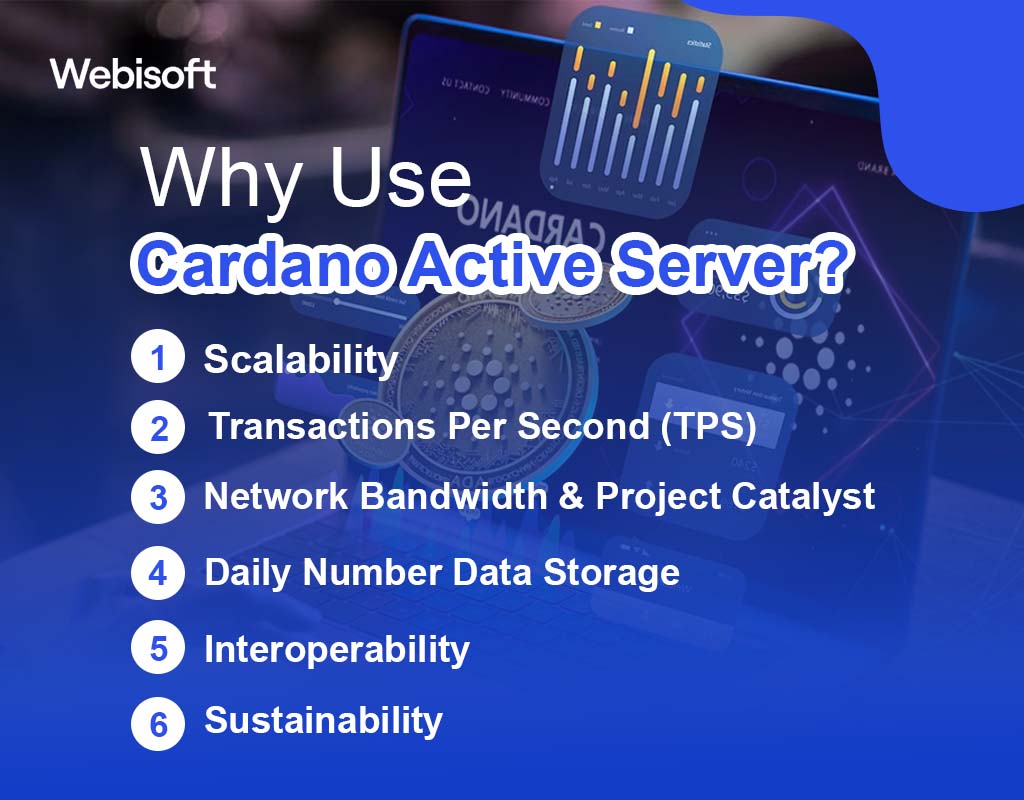
Three properties make Cardano worth evaluating for production systems.
1. Scalability
Throughput on a blockchain is bounded by how fast blocks can be produced, propagated, and validated by every node. Cardano approaches this on several fronts:
- Deterministic fees and the EUTXO model. Cardano extends Bitcoin's UTXO accounting into the Extended UTXO (EUTXO) model. Because a transaction declares exactly which outputs it consumes, its validity and fee can be computed off-chain before submission. There are no failed-but-charged transactions and no gas auctions, which matters for B2B systems that need predictable unit economics.
- Pipelining and parameter tuning. Block diffusion pipelining lets relays forward block headers before full validation completes, cutting propagation latency and allowing larger blocks without hurting chain density.
- Hydra for horizontal scale. Hydra heads are layer 2 state channels that let a small group of participants process transactions off-chain at near instant finality, settling back to the main chain when the head closes. This moves high frequency workloads off layer 1 entirely.
2. Interoperability
Cardano supports native tokens at the ledger level: custom assets are minted and transferred by the same rules as ADA, with no token smart contract required. That removes an entire class of token-contract bugs and makes multi-asset transactions (for example, paying in one asset while settling another) first class. Sidechains and bridges extend this further, and the EUTXO design makes cross-chain state proofs simpler to reason about than account-based alternatives.
3. Sustainability
Sustainability on Cardano means both energy use and funding. Proof of stake keeps the network's power draw comparable to running a few thousand ordinary servers rather than a small country's grid. On the funding side, a portion of every transaction fee and of epoch monetary expansion flows into an on-chain treasury. Project Catalyst, the governance program that allocates that treasury, lets ADA holders vote on which development proposals get funded, giving the ecosystem a built-in budget that does not depend on a single company staying solvent.
How Does a Cardano Node Work?
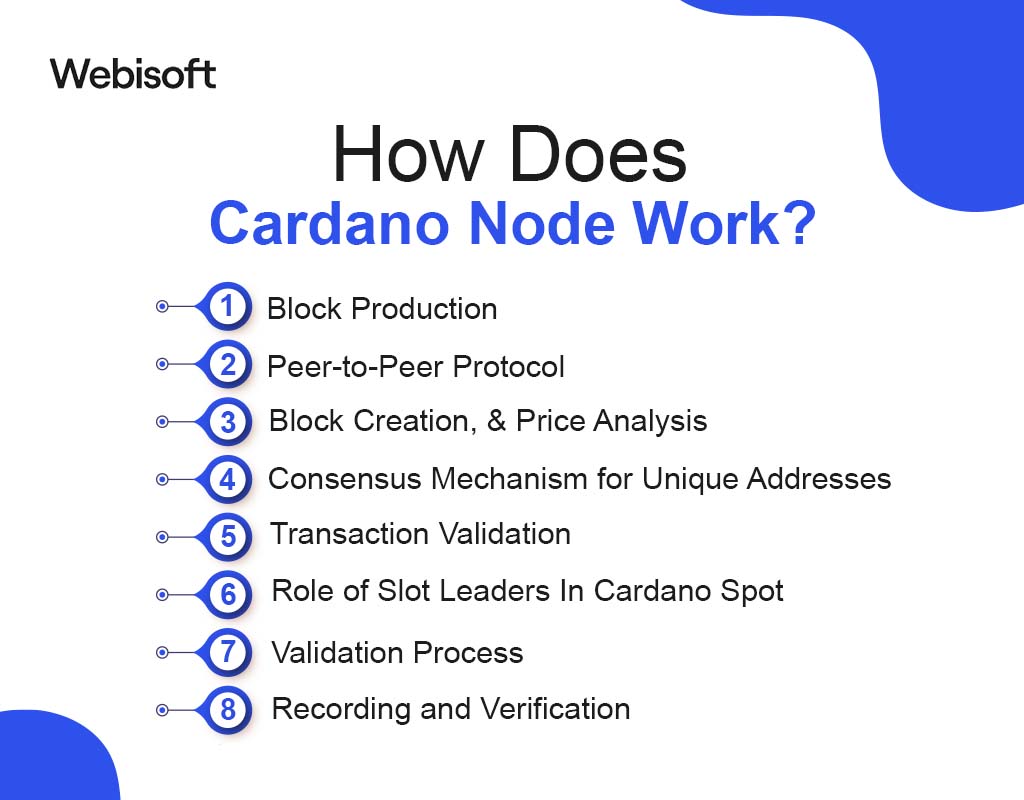
A Cardano node is the software (cardano-node) that participates in the network. Understanding its two core jobs, block production and transaction validation, explains most of what you will see when operating one.
Slots, epochs, and leader election
Ouroboros divides time into one second slots, grouped into epochs of 432,000 slots (five days). In each slot, at most one stake pool may be elected leader. Election is private: every block producer runs a verifiable random function (VRF) against its stake, and only the winning pool learns it may mint the block for that slot. On mainnet roughly one slot in twenty produces a block, so blocks arrive about every twenty seconds on average. The VRF proof is embedded in the block header, so any node can verify the producer's right to mint without knowing anything in advance.
Block producers and relays
Operationally, nodes run in one of two roles:
- Block producing nodes hold the pool's signing keys and mint blocks when elected. They are kept off the public internet and connect only to their own relays.
- Relay nodes hold no keys. They maintain many peer connections, diffuse blocks and transactions across the network, and shield the block producer from direct exposure.
Communication happens over a set of typed mini-protocols (chain sync, block fetch, transaction submission) running on a peer-to-peer overlay. Since the rollout of dynamic P2P, nodes discover and score peers automatically instead of relying only on static topology files.
Transaction validation
When a transaction reaches a node, it is checked against the current ledger state: the inputs it consumes must exist and be unspent, signatures must be valid, any Plutus scripts attached to the inputs must evaluate successfully within their declared execution budget, and the fee must cover the transaction size and script cost. Valid transactions sit in the mempool until an elected leader includes them in a block. Once a block is minted, every other node re-validates it independently before adopting it, which is what makes the chain trustless: no node accepts a block on reputation.
How to Set Up a Cardano Node
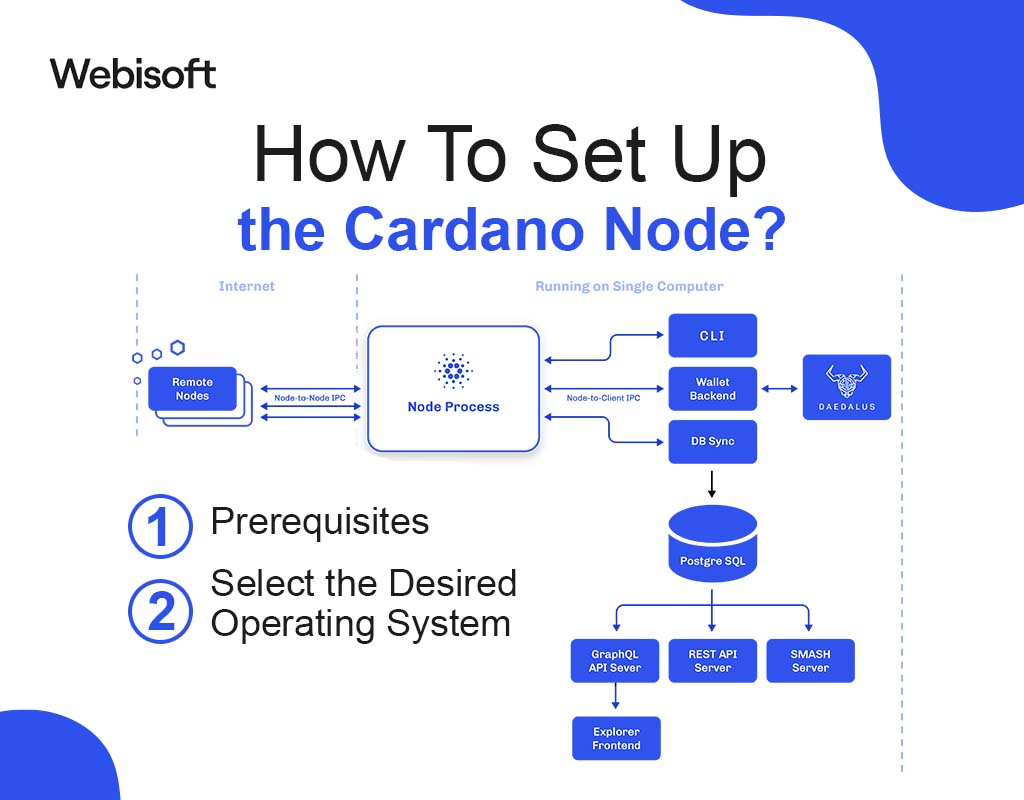
1. Prerequisites
Requirements have grown with the chain. As of recent releases, the official Cardano documentation recommends for a mainnet node:
- A 64-bit Linux, macOS, or Windows (via WSL2) system
- 4 CPU cores or more
- 24 GB of RAM
- At least 150 GB of free disk space, with headroom for chain growth (SSD strongly recommended)
- A stable connection and one open TCP port for peers (3001 by convention)
Older tutorials citing 8 GB of RAM and 10 GB of disk predate smart contracts on mainnet; a node with those specs will not sync today. Budget disk for growth, since the chain only gets larger.
2. Choose an install path
You have two realistic options, and building from source is only necessary if you patch the node:
- Pre-built binaries (recommended). Each cardano-node release ships signed binaries for Linux and macOS. Download, unpack, put cardano-node and cardano-cli on your PATH, and you are done in minutes.
- Build from source. The node is written in Haskell, so you install GHC and Cabal via ghcup, plus system libraries including libsodium (cryptography) and libsecp256k1, then compile. Expect a long first build and match the GHC version pinned by the release notes, since mismatched compiler versions are the most common build failure.
Linux
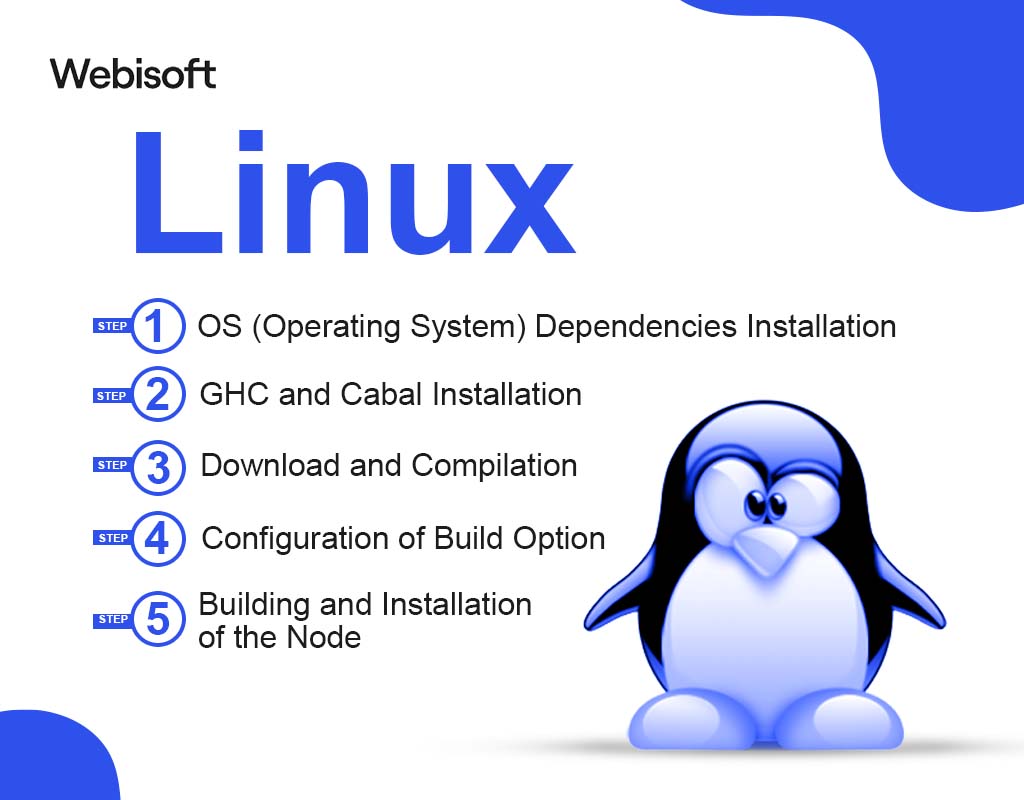
Install git, GCC, and development headers through your package manager, install GHC and Cabal with ghcup, build and install the IOG fork of libsodium, then run the cabal build and copy the produced binaries into a directory on your PATH. Most production stake pools run on Ubuntu LTS or Debian, and systemd unit files are the standard way to keep the node supervised.
macOS
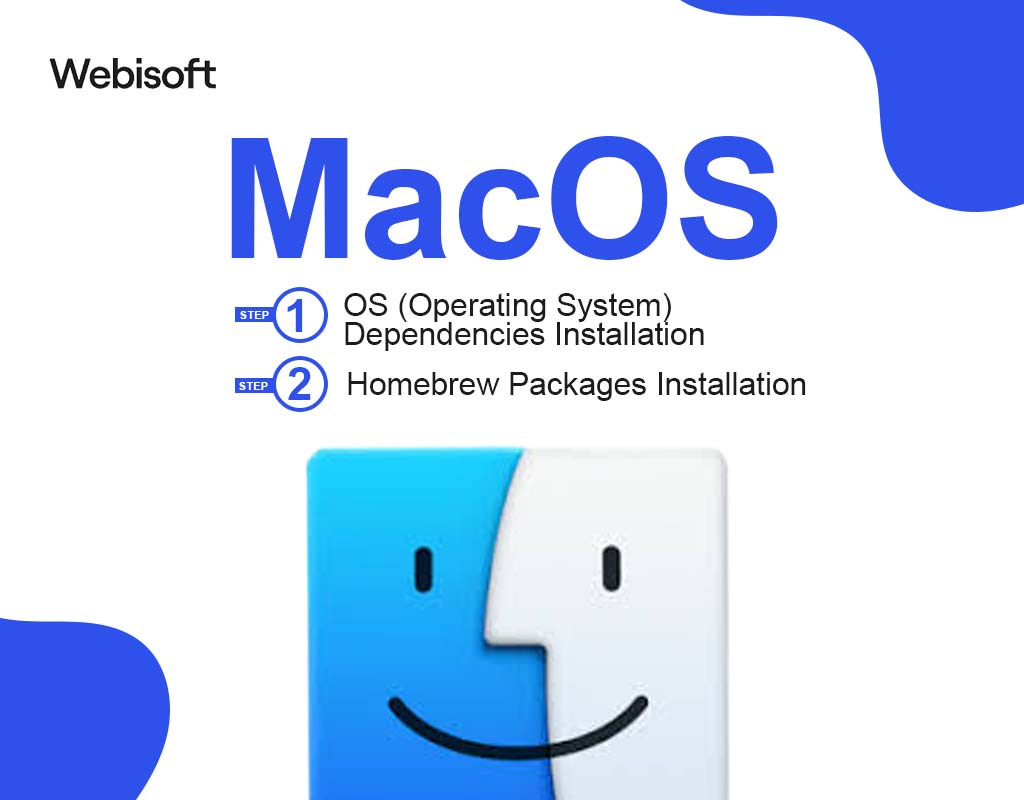
Install the Xcode Command Line Tools, then Homebrew, then the required libraries (libsodium, secp256k1, openssl) through brew. From there the ghcup and cabal steps mirror Linux. Apple Silicon is fully supported in current releases.
Windows
Run the node inside WSL2 (Windows Subsystem for Linux) with an Ubuntu image and follow the Linux path. Native Windows execution is not the supported route for server operation, and WSL2 gives you the same tooling your production Linux host will use.
3. Fetch network configuration
Before first start, download the current configuration set for your target network (mainnet or a testnet such as preprod or preview): the node config file, the genesis files for each ledger era, and a topology file describing initial peers. These are published alongside each release; using a config bundle from a different node version is a frequent source of startup errors.
How to Run the Cardano Node
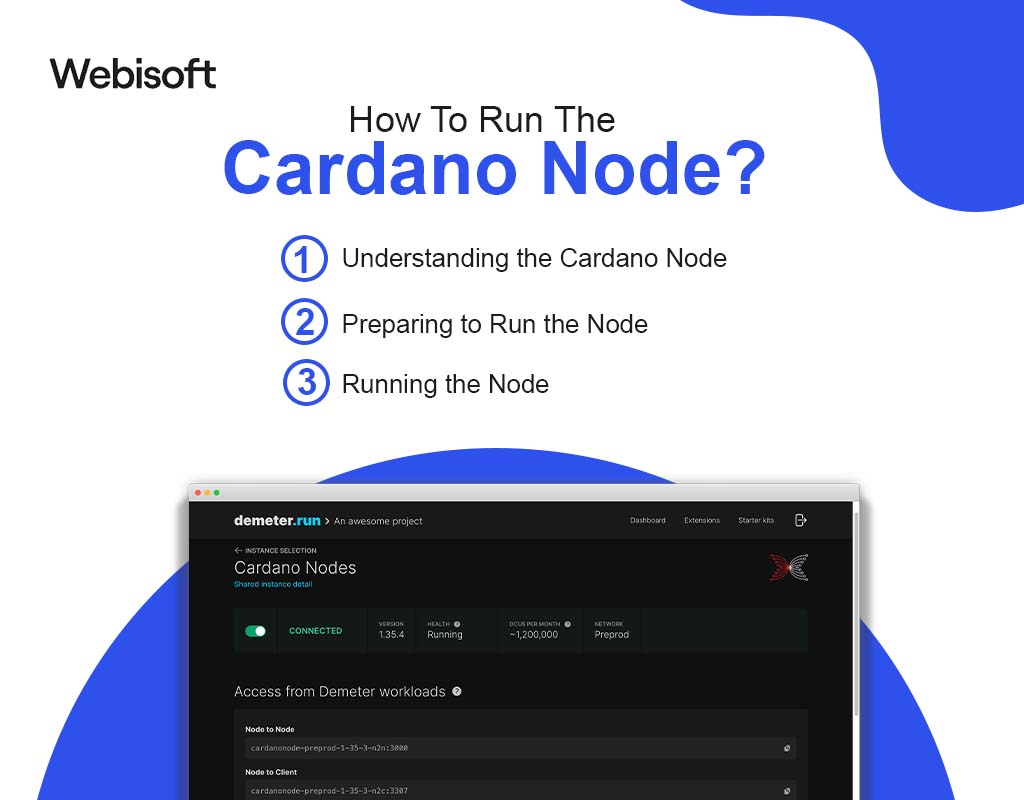
The node starts with a single command, cardano-node run, followed by a handful of long options. Each option below is passed with the standard long flag prefix:
| Option | What it does |
|---|---|
topology | Path to the topology file listing the peers your node connects to |
database-path | Directory where the node stores the chain database |
socket-path | Unix socket used by cardano-cli and other local tools to query the node |
host-addr | IP address the node binds to (0.0.0.0 to accept external peers) |
port | TCP port for peer connections, conventionally 3001 |
config | Path to the main configuration file, which also controls logging and metrics |
On first start the node syncs the entire chain from genesis, which can take days on mainnet. Two ways to shorten that:
- Mithril snapshots. Mithril produces stake-signed snapshots of the chain database, letting a new node bootstrap in hours instead of days while still verifying the snapshot against aggregate signatures from the stake distribution. This is now the standard bootstrap path.
- Copy from a trusted node you already run. The chain database is portable between machines running the same node version.
Monitoring the node
The node exposes an EKG metrics endpoint and a Prometheus endpoint (port 12798 by default), configurable in the main config file. The metrics worth alerting on are slot height versus wall clock (sync lag), connected peer count, mempool size, and memory usage. Most operators graph these in Grafana; a node that is silently falling behind the chain tip looks healthy from the process table, so external monitoring is not optional for production use. Logging verbosity and output targets are controlled from the same configuration file.
Troubleshooting the Cardano Node
The failures you will actually encounter cluster into a few categories:
- Clock skew. Ouroboros is a time-slotted protocol; if the system clock drifts more than a couple of seconds, the node rejects or misses blocks. Run chrony or another NTP daemon on every host.
- Version and config mismatches. After a protocol upgrade (hard fork), old node versions stop following the chain. Track release announcements and upgrade relays before block producers.
- Resource exhaustion. Memory spikes during ledger snapshots and disk filling up as the chain grows are the two most common slow failures. Monitor both.
- Connectivity. A relay with a closed or unreachable port will sync but never serve peers. Verify the port from outside the network, not just locally.
When logs are not enough, the Cardano Stack Exchange and the operator communities are active, and most error signatures have documented resolutions.
What Cardano Development Services Does Webisoft Offer?
Webisoft is a Montreal based software and blockchain engineering firm that builds on Cardano across the full stack, from infrastructure to user-facing applications.
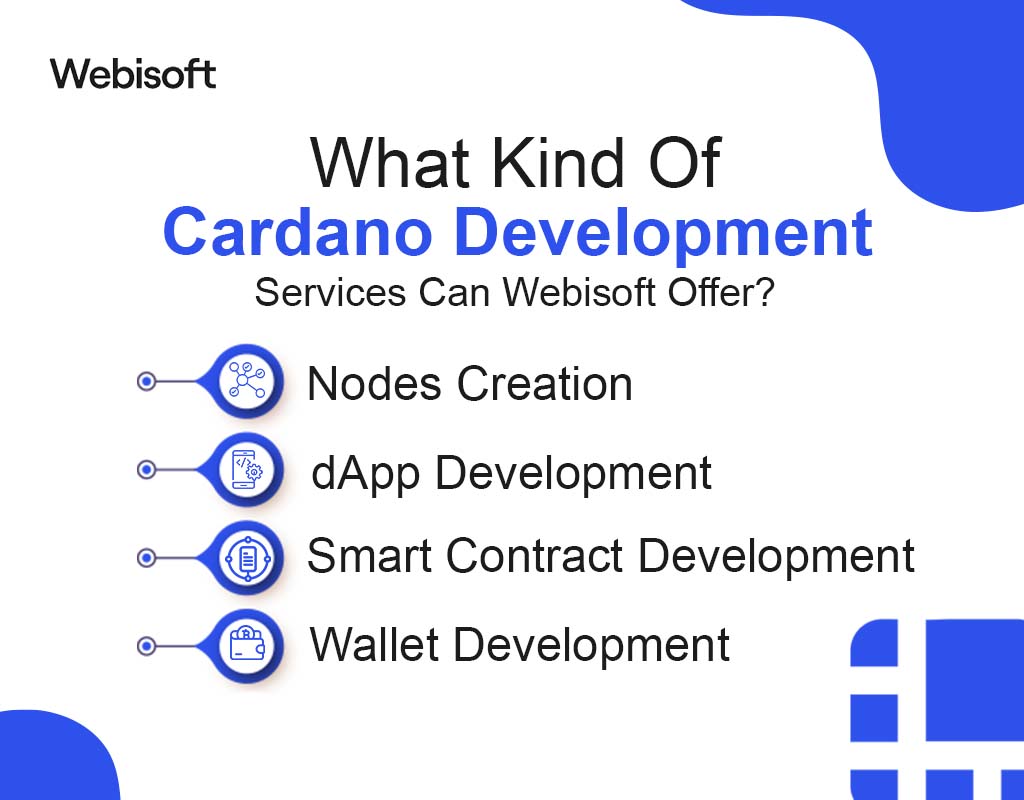
1. Node infrastructure
Webisoft designs and operates Cardano node deployments: relay and block producer topologies, hardened key management, Mithril-based bootstrapping, and Prometheus and Grafana monitoring. For teams building products that need reliable chain access, this also covers the indexing layer (cardano-db-sync, Ogmios, Kupo) that turns raw chain data into queryable APIs.
2. dApp development
Decentralized applications on Cardano pair on-chain validators with conventional web backends and frontends. Webisoft builds both halves: the EUTXO transaction design, off-chain transaction building, wallet integration (CIP-30), and the product engineering around them, for use cases from DeFi and tokenized assets to supply chain records.
3. Smart contract development
Webisoft writes and audits Cardano smart contracts in Plutus and Aiken, with Marlowe for financial agreement workflows. EUTXO contracts require a different design discipline than Solidity: validators are pure functions over transactions, concurrency has to be engineered through UTXO set design, and execution budgets are fixed up front. Getting that architecture right early is the difference between a contract that scales and one that bottlenecks on a single UTXO.
4. Wallet development
From standalone wallets to embedded wallet functionality inside an existing product, Webisoft builds software that stores, delegates, and transacts ADA and Cardano native tokens, including hardware wallet support and multi-signature setups for treasury operations.
Conclusion
Cardano's active hosts, the relay and block producing nodes running Ouroboros, are what make the platform's claims about security and decentralization real. Running one is well within reach of a competent engineering team: provision adequate hardware, install from release binaries, bootstrap with Mithril, and monitor sync health from day one.
If you would rather ship a product than operate consensus infrastructure, Webisoft covers the full cycle: node operations, smart contracts, dApps, and wallets. Contact Webisoft to scope a Cardano project.
An active host is a machine running the cardano-node software and participating in the network, either as a relay that diffuses blocks and transactions or as a block producer that mints blocks for a stake pool. Together these nodes validate every transaction and maintain the shared ledger.
Current official guidance for mainnet is a 64-bit system with 4 or more CPU cores, 24 GB of RAM, and at least 150 GB of free SSD space with room for chain growth, plus a stable connection with one open TCP port. Older 8 GB RAM recommendations predate smart contracts and no longer work.
Syncing from genesis on mainnet can take several days. Mithril snapshots, which are verified against aggregate signatures from the stake distribution, cut the bootstrap to hours and are now the standard approach for new nodes.
Running a relay alone does not pay rewards. Rewards go to stake pools (a block producer plus its relays) and their delegators when the pool is elected to mint blocks. You can also earn staking rewards without any infrastructure by delegating ADA to an existing pool.
Plutus (Haskell based) is the original smart contract platform, Marlowe targets financial agreements, and Aiken is a newer language that compiles to the same on-chain core and has become a popular choice for validator development.