Procurement feels smooth until a single mismatch, late update or unclear approval slows everything down. You’ve likely seen it: one missing detail turns into hours of follow-ups.
But what if every action in your process carried built-in proof? That’s the promise behind blockchain in procurement, a shift that replaces uncertainty with verified, real-time clarity. Instead of asking “Who updated this?” or “Which version is correct?”, you work with records no one can quietly modify.
As you explore how blockchain technology in procurement works, you’ll see how it strengthens trust and sharpens oversight. It also gives your procurement cycle a level of certainty that traditional systems rarely deliver.
What is Blockchain in Procurement?
Blockchain in procurement meaning refers to using a shared, tamper-proof digital ledger that securely records each step of your purchasing workflow for consistent, verifiable information. In procurement, this ledger stores entries such as supplier details, purchase orders, delivery confirmations and invoice actions in a sequence that cannot be changed once recorded.
You get a system where every participant views the same information at the same time. This reduces confusion, removes hidden updates and keeps the data consistent across teams and suppliers. It also adds a technical layer of verification, so you rely less on manual checks or disconnected records.
Blockchain does not replace your existing tools. Instead, it supports them by keeping your procurement data traceable, reliable and easy to reference. This gives you a clearer foundation for understanding how the technology influences the rest of your procurement activities.
Why Procurement Teams Are Considering Blockchain
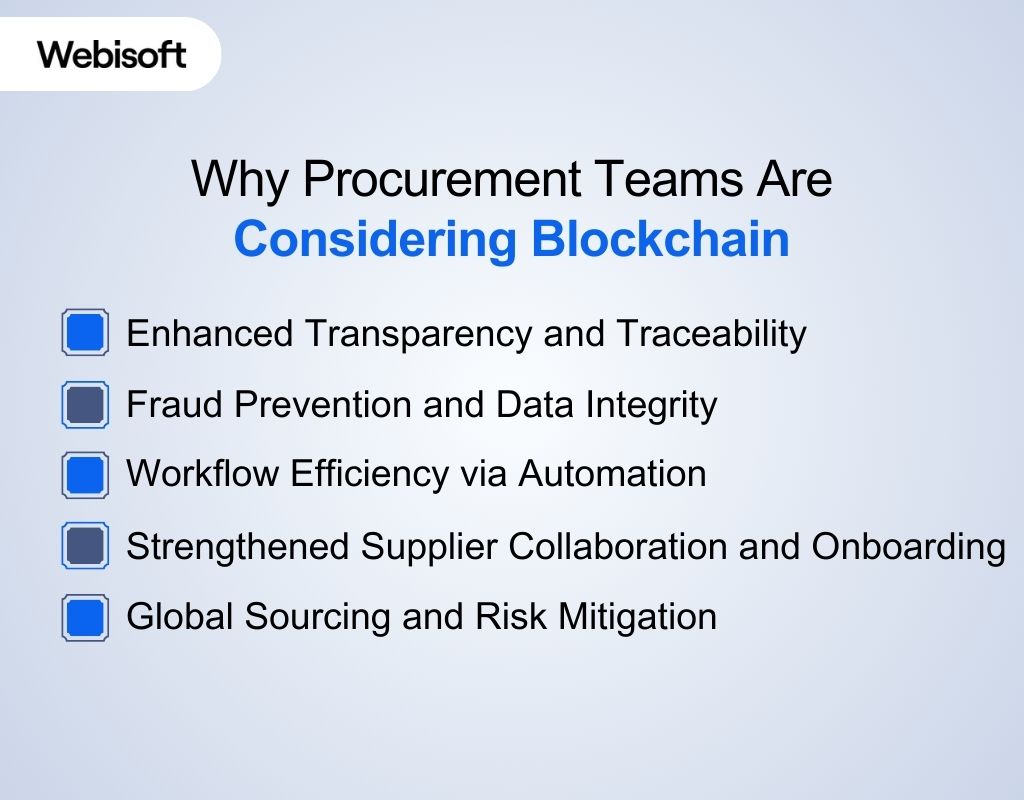
With the rapid demand for clearer data and trustworthy processes, procurement teams are considering blockchain for procurement to improve oversight. The growing importance of blockchain in procurement shows why this shift is happening. Below are the main triggers.
Enhanced Transparency and Traceability
Procurement teams often struggle with lack of visibility across suppliers and spending. Blockchain provides a shared ledger where you and your suppliers each view the same records, reducing discrepancies. Thus making it easier to track the full source-to-pay journey.
Fraud Prevention and Data Integrity
Traditional workflows leave manual review and reconciliation gaps that fraud or errors exploit. A blockchain-enabled ledger locks transactions with cryptographic mechanisms, strengthening the trustworthiness of your procurement data.
Workflow Efficiency via Automation
Every approval, invoice or delivery note adds friction and cost. Blockchain enables smart-contract automation so you can set criteria once and have approvals or payments happen automatically when conditions are met.
Strengthened Supplier Collaboration and Onboarding
Procurement now emphasises supplier compliance, sustainability and rapid onboarding. Blockchain allows you to store supplier credentials, certifications and performance records in one immutable network, making supplier evaluation and collaboration more reliable.
Global Sourcing and Risk Mitigation
If you’re sourcing across regions, you face more regulatory, logistics and currency risks. Blockchain helps by using decentralised records and reducing dependency on intermediaries and manual cross-border processes, a meaningful benefit in global procurement.
Core Benefits of Blockchain in Procurement
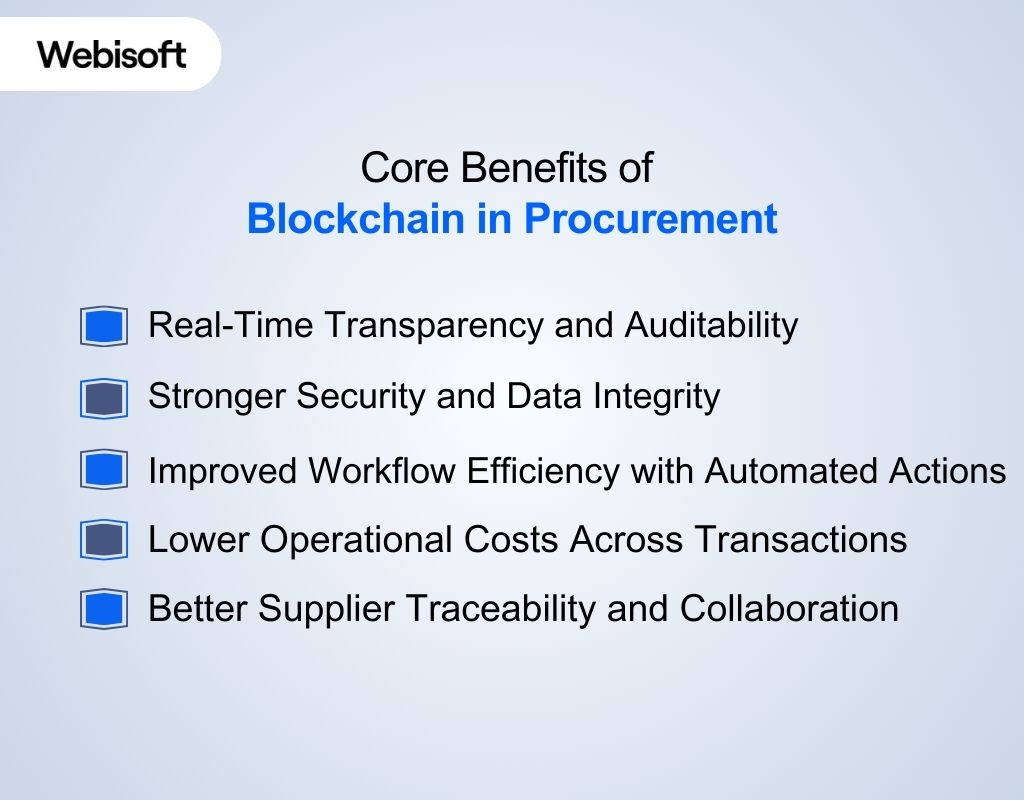
You handle daily procurement decisions that rely on accurate data and dependable processes. Blockchain supports you by creating clearer visibility and stronger control across your activities. Here are the core benefits that matter most to your workflow.
Real-Time Transparency and Auditability
Blockchain creates a shared record of procurement actions so everyone involved sees the same verified information. You gain a reliable audit trail that reflects each transaction exactly as it occurred. This reduces disputes and strengthens internal and external oversight.
Stronger Security and Data Integrity
Procurement records are often vulnerable to edits, inconsistent updates or unauthorised access, a risk well-documented by the NIST cybersecurity standards. Blockchain protects your data through decentralised validation and cryptographic recording. This structure reduces tampering risks and helps you maintain dependable information across purchasing activities.
Improved Workflow Efficiency with Automated Actions
Blockchain supports conditional logic through smart-contract triggers. Routine tasks such as confirmations or approvals can run automatically once set conditions are met. This helps you remove unnecessary steps and move transactions forward with fewer operational delays.
Lower Operational Costs Across Transactions
Manual verification, repeated data entry and intermediary involvement increase procurement costs. Blockchain reduces these expenses by keeping information consistent across parties and reducing the need for duplicate checks. You benefit from smoother transactions and fewer administrative touchpoints.
Better Supplier Traceability and Collaboration
You gain clearer insight into supplier activity, performance and record accuracy. Blockchain allows you to track documents, compliance details and item provenance across your supplier network. This improves coordination and supports informed purchasing decisions.
How to Get Started with Blockchain in Procurement
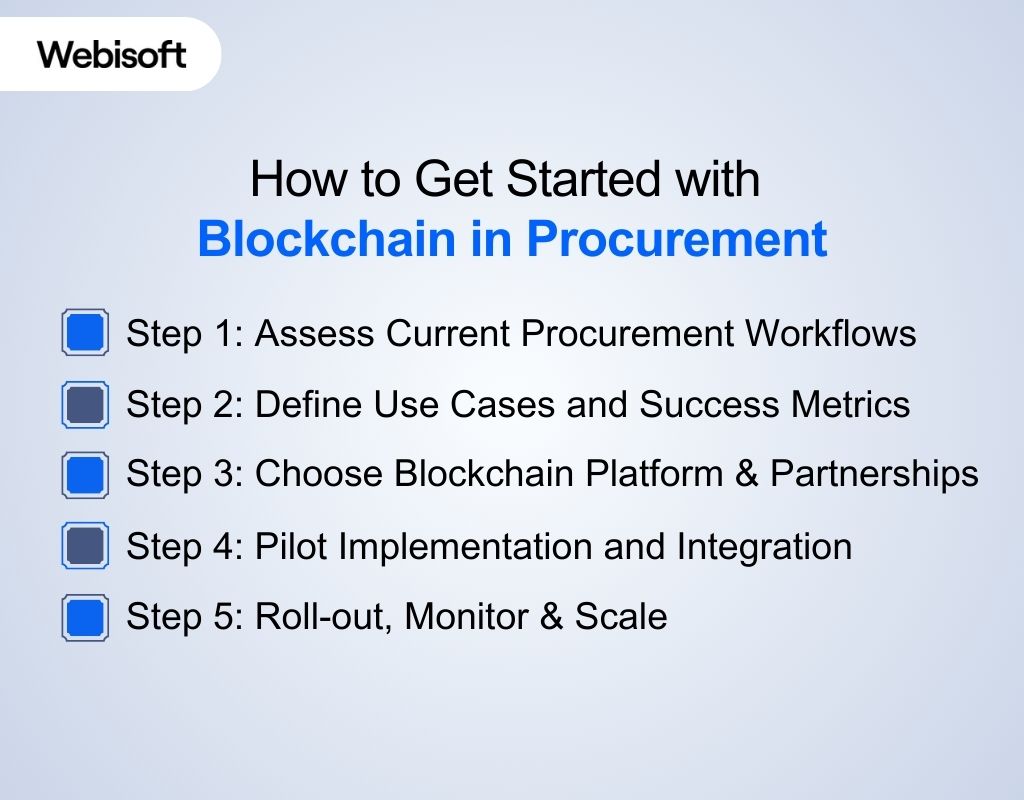
If you’re ready to explore blockchain for procurement, starting methodically ensures success and confidence. Begin by aligning your business goals, then follow a clear phased approach that minimizes disruption and maximises value.
Step 1: Assess Current Procurement Workflows
Map your source-to-pay cycle, identify bottlenecks, manual tasks and data-trust issues. Determine where a blockchain-enabled ledger or automation would provide tangible improvement.
Step 2: Define Use Cases and Success Metrics
Select procurement activities (supplier onboarding, PO approvals, delivery verification, invoice payment) where blockchain can deliver measurable benefits. Set KPIs (e.g., cycle time reduction, fewer disputes).
Step 3: Choose Blockchain Platform & Partnerships
Evaluate permissioned vs public blockchains, platform scalability, smart-contract capabilities and partner vendors. Ensure the technology matches your procurement ecosystem and data-governance requirements. You can also partner with a team that builds and integrates blockchain systems for you. Webisoft offers full blockchain development and procurement integrations, and you can reach us anytime, we’re just a click away.
Step 4: Pilot Implementation and Integration
Build a small-scale prototype or proof-of-concept focusing on one process. Integrate with your current ERP or procurement software, train users and test workflows before full rollout.
Step 5: Roll-out, Monitor & Scale
Once the pilot succeeds, expand to other procurement processes and suppliers. Continuously monitor performance against your metrics, refine smart contracts and governance policies as needed.
How Blockchain Improves the Procurement Source-to-Pay Cycle
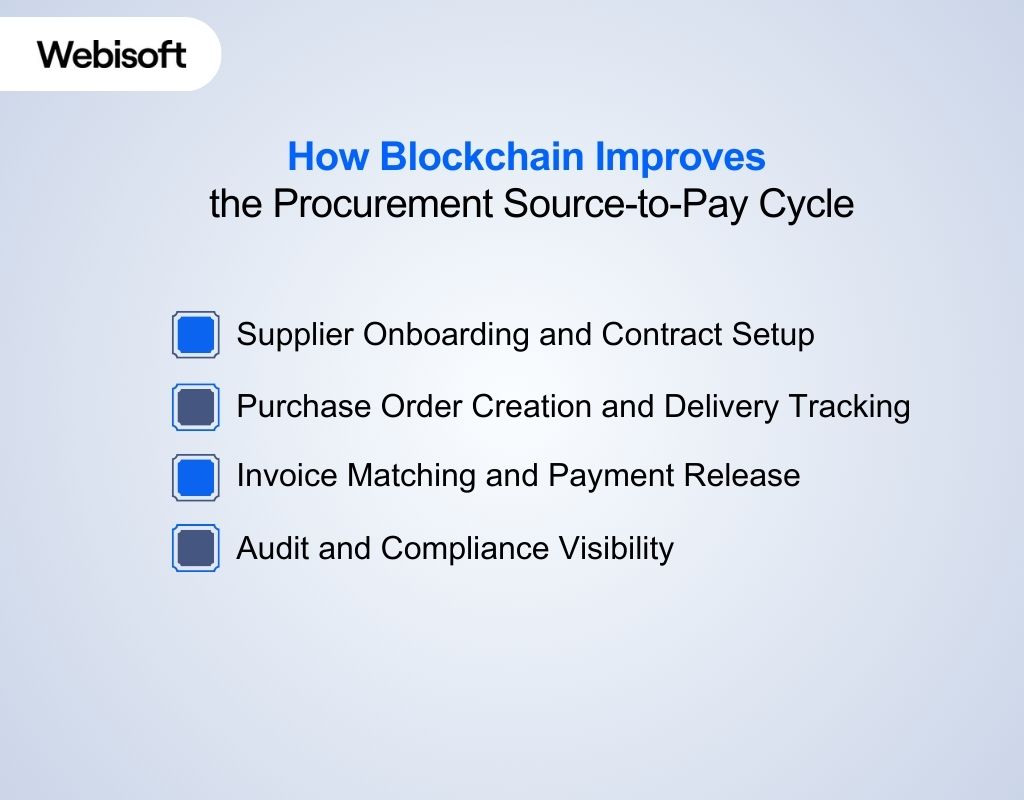
Your source-to-pay workflow involves many hand-offs and validations that can introduce delays or inaccuracies. Blockchain strengthens this flow by creating connected, verifiable stages that help you move from sourcing to payment with greater consistency.
Supplier Onboarding and Contract Setup
Blockchain lets suppliers share verified credentials and certifications through a secure, unalterable record. Contract terms can be stored on the same network, giving you consistent visibility and reducing repeated verification across your procurement activities.
Purchase Order Creation and Delivery Tracking
When you issue a purchase order on a blockchain network, related shipment details and delivery confirmations appear in one unified ledger. This alignment reduces discrepancies between items ordered, shipped and received.
Invoice Matching and Payment Release
Invoice details, delivery records and purchase orders are already synchronised on the ledger. Payments trigger automatically through smart-contract rules once agreed conditions are met, reducing delay and manual reconciliation.
Audit and Compliance Visibility
Every action in your source-to-pay cycle is recorded permanently. This consolidated audit trail makes compliance reviews, dispute resolution and reporting more reliable without relying on scattered records.
Industry-Specific Applications of Blockchain in Procurement
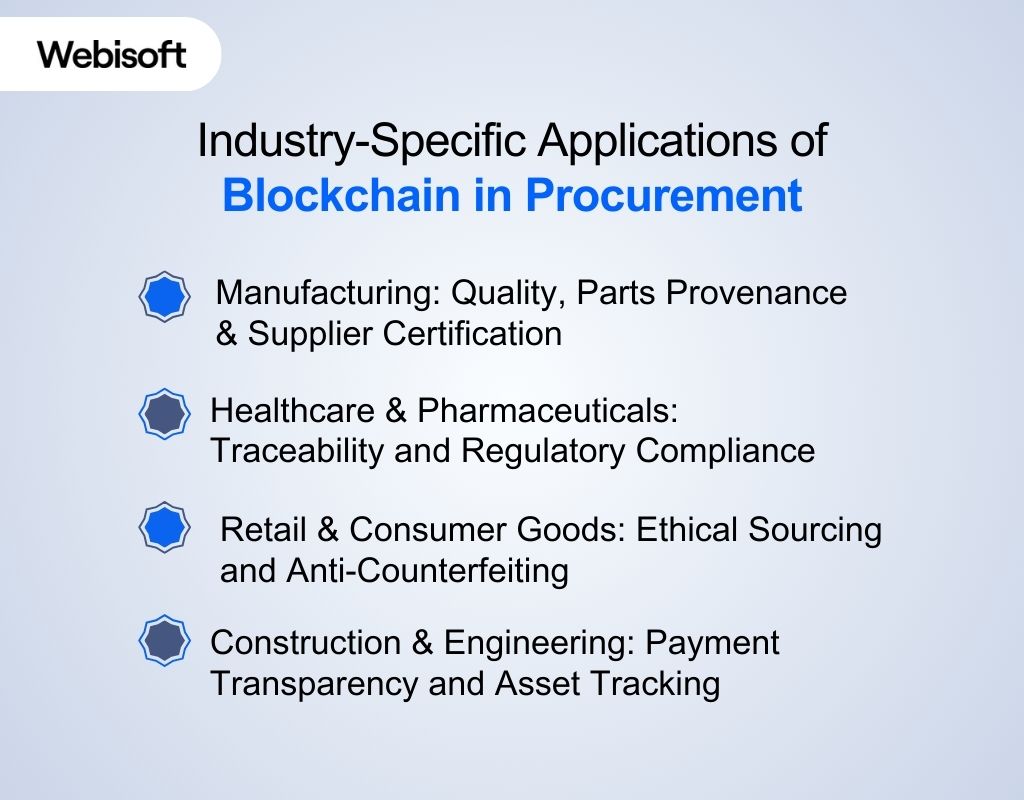
When you apply blockchain for procurement in a specific industry you see its value in real-world workflows and challenges. Below are several high-impact examples of how the technology adapts to different sectors.
Manufacturing: Quality, Parts Provenance & Supplier Certification
In manufacturing, you can track each component through the production cycle using blockchain, verifying origin and certification of suppliers and parts. These blockchain in procurement examples show reduced defects, improved compliance and stronger supplier accountability.
Healthcare & Pharmaceuticals: Traceability and Regulatory Compliance
In healthcare procurement, blockchain helps record the movement of pharmaceuticals, medical supplies and equipment from supplier to hospital. An immutable ledger means regulatory reporting, lot tracking and expiry control become transparent and auditable.
Retail & Consumer Goods: Ethical Sourcing and Anti-Counterfeiting
Retailers use blockchain to trace products through supply chains, validate claims like “organic” or “fair trade”, and detect counterfeits. These applications strengthen brand trust and help you manage suppliers more effectively.
Construction & Engineering: Payment Transparency and Asset Tracking
In construction procurement, blockchain records work-progress, delivery milestones and payment conditions. When each milestone is verified on the ledger, payments flow automatically and disputes decline.
Blockchain vs Traditional Procurement Systems (ERP/EDI)
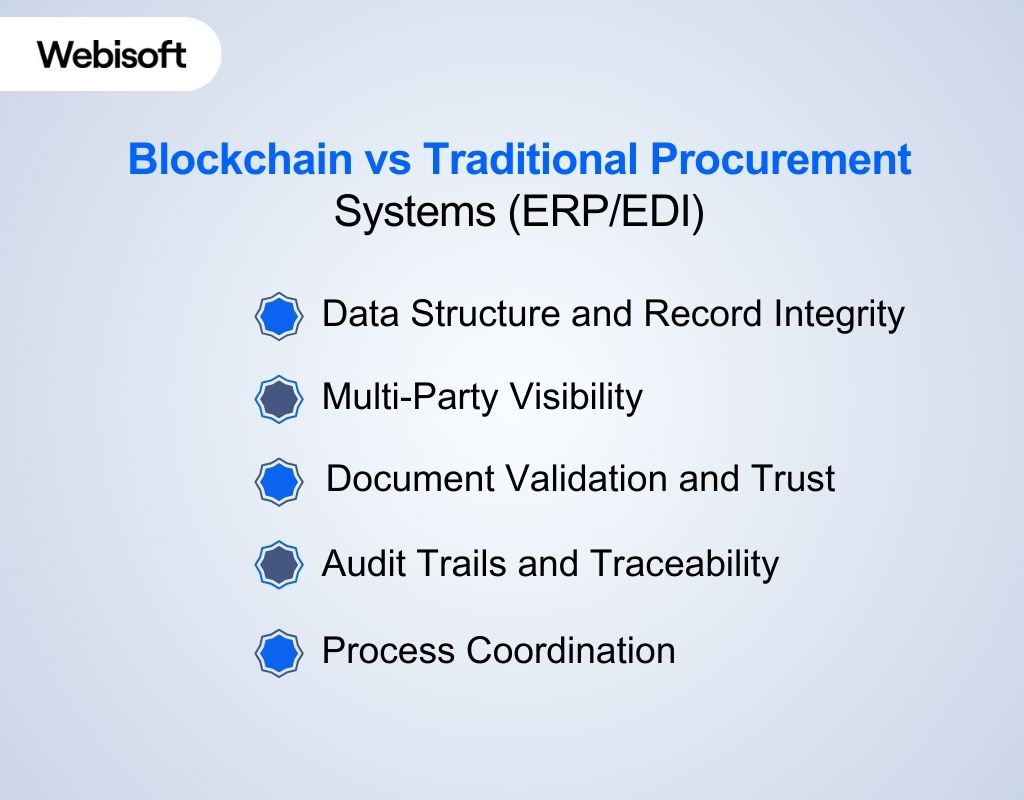
You compare blockchain with traditional procurement systems to see how each handles visibility, accuracy and coordination. The differences below give you a clearer picture of where blockchain adds value without disrupting your existing tools.
Data Structure and Record Integrity
- Blockchain: Uses a shared, tamper-proof ledger where all participants see verified transactions at the same time.
- Traditional Procurement Systems: Store records in centralised databases that rely on internal controls and individual system updates.
Multi-Party Visibility
- Blockchain: Everyone involved in the transaction flow views the same real-time data, reducing disputes and version conflicts.
- Traditional Procurement Systems: Visibility depends on system integrations and manual updates, often causing mismatches across teams and suppliers.
Document Validation and Trust
- Blockchain: Validation happens through cryptographic consensus, making records inherently trustworthy across entities.
- Traditional Procurement Systems: Trust relies on point-to-point messaging like EDI and internal validations, which can be delayed or inconsistent.
Audit Trails and Traceability
- Blockchain: Creates permanent, sequential logs that simplify audits and compliance checks.
- Traditional Procurement Systems: Generate logs, but edits, overwrites and missing entries can complicate traceability.
Process Coordination
- Blockchain: Connects purchase orders, deliveries, invoices and confirmations in one consistent ledger.
- Traditional Procurement Systems: Require multiple systems and reconciliation steps to align data across the procurement cycle.
How Webisoft Helps You Implement Blockchain in Procurement
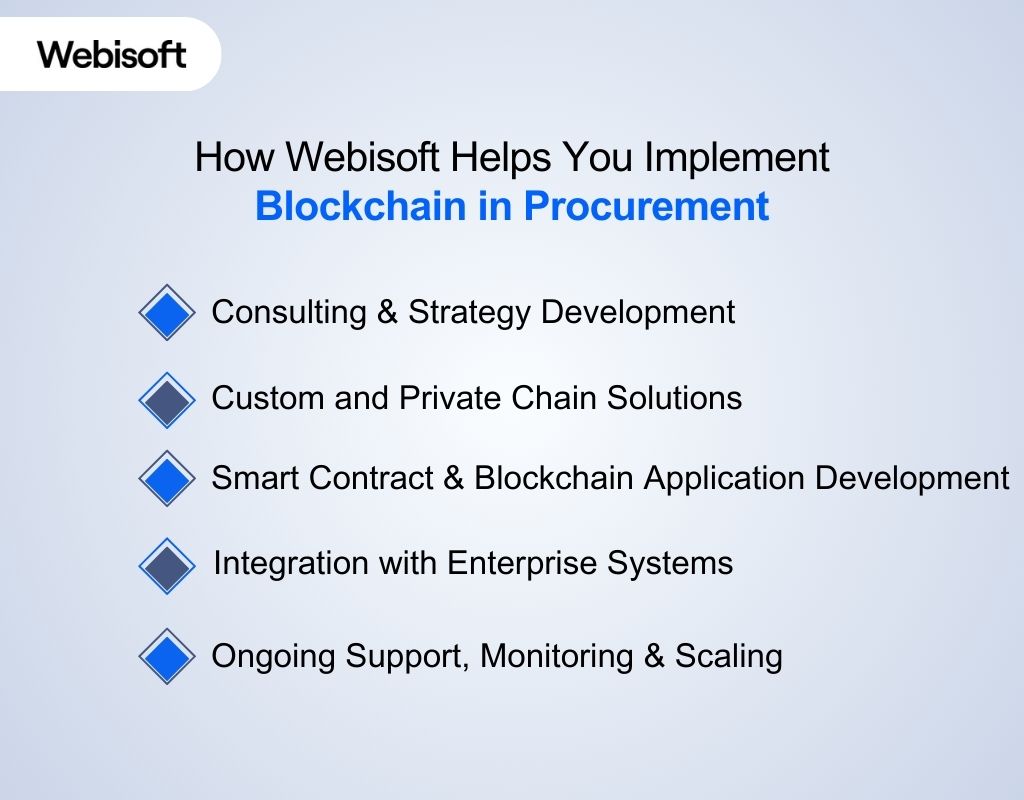
When you plan blockchain for procurement you need more than a concept, you need a partner to engineer, integrate and deploy the solution end-to-end. Webisoft supports your procurement goals through consulting, custom chain builds and seamless enterprise system integration.
Consulting & Strategy Development
Webisoft begins by assessing your procurement ecosystem, helping defining use cases, technology architecture and governance framework. Our blockchain consulting service ensures you align business objectives with technical delivery.
Custom and Private Chain Solutions
If you require privacy, performance or specific data-sharing controls, Webisoft can build a private or custom blockchain through our Custom Blockchain Development Services. These solutions are personalized to your supply chain, compliance requirements and supplier-network needs.
Smart Contract & Blockchain Application Development
Webisoft builds smart contracts and procurement-centric blockchain applications (e.g., for order-validation, delivery-proof or payment-trigger workflows) using languages like Solidity, Rust or Substrate.
Integration with Enterprise Systems
Blockchain is most powerful when it links to your ERP, procurement software and supplier platforms. Webisoft manages that integration so your procurement cycle remains seamless and connected with legacy tools.
Ongoing Support, Monitoring & Scaling
Beyond launch, Webisoft provides monitoring, chain maintenance, performance tuning and scalability support. Thus ensuring your procurement-blockchain solution evolves with your business and supply-chain demands.
Conclusion
In the end, the value of blockchain in procurement becomes clear. You gain reliable records, smoother coordination and a workflow that feels more predictable at every stage.
As procurement grows more complex, this level of assurance becomes essential rather than optional.
And as you consider your next steps, having the right partner makes all the difference. Webisoft helps you design, integrate and scale blockchain solutions that fit your procurement reality, giving your team a smarter, more reliable path forward.
Frequently Asked Questions
Blockchain reduces procurement fraud by creating tamper-proof records where transactions cannot be altered or duplicated. This prevents fake invoices, duplicate deliveries, unauthorised changes and contract manipulation, giving you a more trustworthy and transparent record of every procurement activity.
The overall cost depends on whether your organisation chooses a private or consortium blockchain network. It also shifts based on integration work, smart-contract development requirements and how many suppliers or internal teams participate in the system.
Not all procurement documents belong on-chain. Typically, only essential validation details or cryptographic hashes are stored on the blockchain. Full files remain in secure off-chain storage to improve performance, maintain privacy and reduce unnecessary data load.