Webisoft sits on both sides of this question. We advise enterprises through our blockchain consulting services and we also write the code, so we see every week where consulting ends, where development begins, and where projects go wrong by hiring the wrong one first.
This guide lays that out plainly. Below you will find what a blockchain consultant actually does, what a developer does, how the two roles overlap, and a practical way to decide which your project needs right now.
When companies decide to explore blockchain, one of the first challenges they face is figuring out who they actually need on their team. The terms consultant and developer are often used interchangeably, but in practice they represent very different roles.
Consultants help align blockchain initiatives with business goals, while developers take those strategies and turn them into working solutions. Confusing the two can lead to wasted time, inflated costs, and failed projects.
In this guide, we’ll break down the responsibilities, skills, and value that consultants and developers each bring. You’ll also see when to engage one versus the other, how demand for these roles is evolving, and how Webisoft supports companies with both.
Why Role Clarity Matters in Blockchain Projects
Blockchain projects are high-stakes investments. They involve not just code but also compliance, governance, and a strong business case. That’s why understanding the difference between consultants and developers is critical from day one.
According to Gartner, nearly 92% of blockchain pilot projects fail before reaching commercial deployment. The reasons include a lack of technical expertise, misaligned strategies, and weak compliance planning. In many cases, this happens because companies jump straight into hiring developers without first clarifying the business direction with consultants.
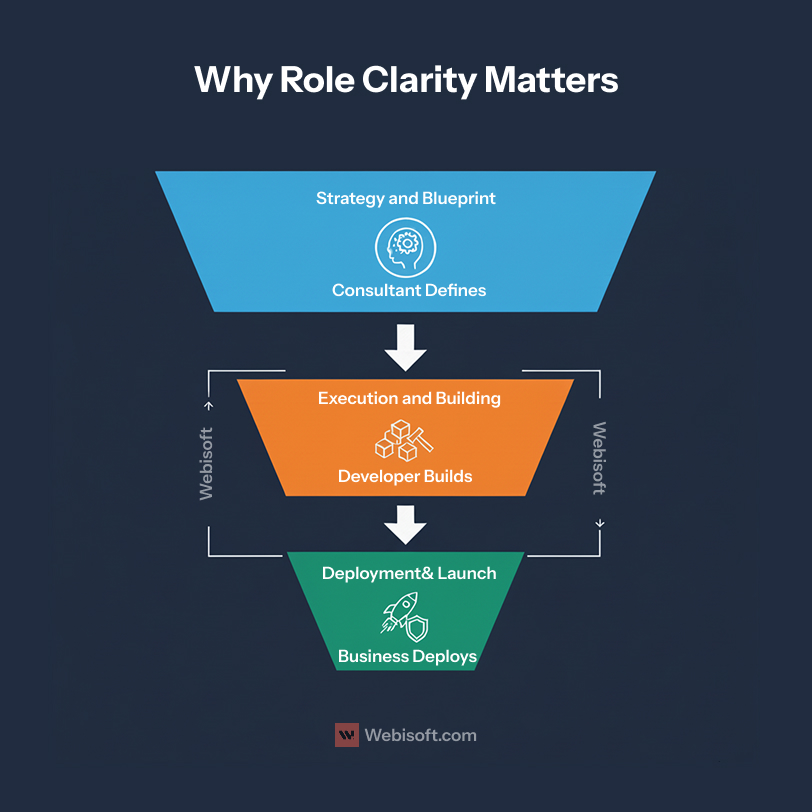
A consultant provides the strategic blueprint – defining whether blockchain even makes sense for the business, how risks can be managed, and what compliance hurdles need attention. Developers, on the other hand, implement the technology stack and bring these strategies to life. Skipping the consultant stage can leave developers coding solutions that don’t align with business goals, leading to wasted resources and eventual project failure.
Role clarity ensures that organizations don’t just build blockchain systems but build the right ones. It sets a clear path: Consultant defines → Developer builds → Business deploys.
Who is a Blockchain Consultant?
A blockchain consultant is not just a technical advisor but a strategic partner. Their role is to determine whether blockchain technology is the right fit for a business challenge and to guide the organization on how to approach it effectively.
Consultants typically start with discovery workshops, analyzing the company’s goals, processes, and industry-specific challenges. They assess where blockchain can add value, whether in supply chain transparency, decentralized identity, payments, or tokenization. Importantly, they also identify where blockchain is not a suitable solution, helping companies avoid costly mistakes.
According to Gartner, blockchain consultants focus on strategic planning, risk assessment, and regulatory compliance. This means they don’t write code themselves but create the roadmap for development teams to follow.
Key responsibilities of blockchain consultants include:
- Business Alignment: Ensuring blockchain projects solve real-world business problems, not just tech experimentation.
- Regulatory Guidance: Navigating compliance issues, including KYC/AML and cross-border data privacy.
- Technology Roadmapping: Selecting the right blockchain framework, consensus mechanism, and scalability options.
- Vendor & Partner Evaluation: Helping choose developers, technology providers, and integration partners.
- Proof-of-Concept Development: Designing pilot projects that validate feasibility before full investment.
This mix of business acumen and technical literacy makes consultants a bridge between executives and developers. They translate high-level business goals into structured technical requirements, minimizing the risk of misalignment.
Who is a Blockchain Developer?
A blockchain developer is the technical specialist who builds and maintains blockchain-based applications. Unlike consultants, their role is hands-on, turning strategies and roadmaps into functioning code.
Developers work on two primary areas:
- Core Blockchain Development: Designing consensus protocols, peer-to-peer networks, and blockchain architecture.
- dApp and Smart Contract Development: Writing smart contracts, integrating APIs, and building user-facing decentralized applications.
According to IDC, blockchain developers require deep technical expertise in languages such as Solidity, Rust, or Go. They also need a solid understanding of cryptography, consensus algorithms, and how to optimize performance and scalability in distributed systems.
Typical responsibilities of blockchain developers include:
- Writing smart contracts that define rules for token transfers, NFTs, or DeFi protocols.
- Building dApps that interact with blockchain networks.
- Managing APIs and integrations between blockchains and legacy systems.
- Optimizing transaction throughput and reducing latency in blockchain solutions.
- Running tests and audits to ensure contracts are secure and error-free.
In practice, developers are the execution layer of blockchain projects. Once consultants provide the strategy, developers ensure it is technically sound and deployed effectively.
Skills and Expertise: Consultant vs Developer
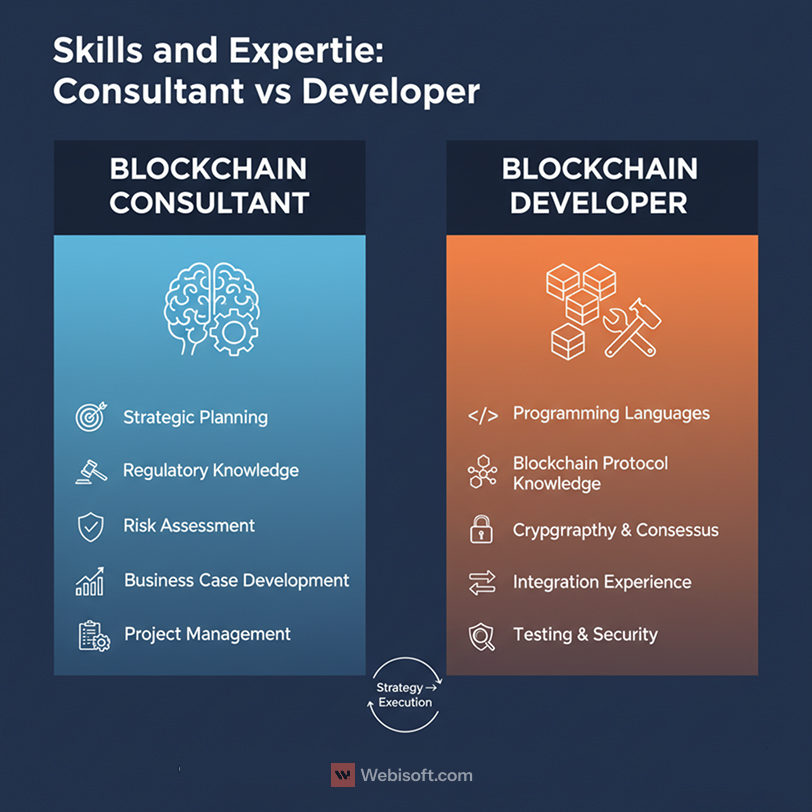
One of the clearest ways to differentiate blockchain consultants from developers is by comparing their skill sets. Both roles are essential, but they bring different strengths to the table.
According to IDC’s Blockchain Talent Landscape, developers need deep technical expertise, while consultants must combine business acumen with blockchain knowledge. Let’s break it down.
Blockchain Consultant Skills
- Strategic Planning: Identifies where blockchain fits into business operations.
- Regulatory Knowledge: Advises on compliance with financial authorities, tax laws, and cross-border regulations.
- Risk Assessment: Evaluates security, scalability, and market risks.
- Business Case Development: Helps justify ROI and select the right use cases.
- Project Management: Ensures alignment between stakeholders and technical teams.
Blockchain Developer Skills
- Programming Languages: Solidity, Rust, Go, and JavaScript for smart contracts and dApps.
- Blockchain Protocol Knowledge: Deep understanding of Ethereum, Hyperledger, Solana, NEAR, and others.
- Cryptography & Consensus: Skills in hash functions, encryption, and consensus mechanisms.
- Integration Experience: Linking blockchains with APIs, payment gateways, and legacy systems.
- Testing & Security: Writing unit tests, audits, and securing smart contracts against exploits.
While consultants shape the why and what of blockchain adoption, developers define the how. A consultant without technical insight risks overselling blockchain solutions. A developer without strategic alignment risks building solutions that businesses don’t need.
Responsibilities in a Blockchain Project Lifecycle
To understand the real difference between consultants and developers, it’s important to see how their roles fit into the blockchain project lifecycle. Both contribute at different stages, but in complementary ways.
1. Discovery and Strategy
- Consultant: Defines business objectives, evaluates whether blockchain is the right fit, and conducts feasibility studies.
- Developer: Minimal involvement at this stage, though they may provide technical input on feasibility.
2. Architecture and Roadmap
- Consultant: Outlines the architecture, governance model, compliance considerations, and key milestones.
- Developer: Advises on technology stack choices and ensures the roadmap aligns with technical realities.
3. Design and Prototyping
- Consultant: Ensures prototypes align with business cases, market needs, and compliance frameworks.
- Developer: Builds proofs of concept, smart contract prototypes, and sample integrations.
4. Development and Testing
- Consultant: Steps back, overseeing progress and ensuring alignment with strategy.
- Developer: Leads this phase, coding smart contracts, APIs, and front-end interfaces; runs unit tests and audits.
5. Deployment and Go-Live
- Consultant: Advises on rollout strategies, change management, and regulatory notifications.
- Developer: Deploys the solution to mainnet or enterprise networks and ensures system stability.
6. Post-Launch Support
- Consultant: Tracks KPIs, business outcomes, and regulatory changes.
- Developer: Manages bug fixes, scaling solutions, and version updates.
A Harvard Business Review study highlights that consultants often serve as the bridge between leadership and developers. Without this bridge, projects risk misalignment, while without skilled developers, strategy never turns into a working product.
Market Demand and Salary Comparisons
In 2025, both blockchain consultants and developers remain in high demand, but their roles are compensated differently. Consulting involves business strategy and risk management, which typically commands higher remuneration.
According to Forrester’s 2025 Tech Talent Market Insights, blockchain consultants in the U.S. are earning around $140,000 annually, while developers average close to $110,000. This differential reflects the added responsibility and advisory value consultants bring.
Companies often hire developers first, but bring in consultants later, or vice versa, depending on the project stage. In early-stage startups, consultants may lay the groundwork before developers write a single line of code. Later, developers take over execution and optimization.
Note that demand also varies by region and specialty. Developers who know multiple chains or advanced cryptography command premium rates. Consultants who understand cross-border regulation, compliance, and tokenomics become invaluable in industries like fintech and DeFi.

Which Role Do You Need for Your Project?
Choosing between a blockchain consultant and a developer depends on where you are in your project journey and what problems you are trying to solve.
- Early-stage planning: If you’re still evaluating blockchain’s relevance for your business, a consultant should be your first hire. They will help validate whether blockchain is the right solution, assess ROI, and create a roadmap that aligns with business goals.
- Execution phase: Once the strategy and requirements are in place, a developer (or a development team) becomes essential to write code, deploy smart contracts, and integrate blockchain with existing systems.
- Scaling or pivoting: At this point, you may need both. Consultants refine compliance strategies, market positioning, and governance, while developers handle upgrades, scaling, and technical refinements.
A Deloitte survey shows that organizations engaging consultants early in the cycle experience 35% higher project success rates. This demonstrates that hiring decisions are not about consultant vs developer, but rather consultant and developer at the right stage.
For small businesses with limited budgets, it may feel expensive to hire both. In these cases, consider short-term consultancy engagements to align strategy, followed by dedicated developer contracts for execution.
Case Studies: Consultant-Led vs Developer-Led Projects
Case studies help illustrate the real-world impact of engaging consultants versus starting directly with developers. While the details of projects vary, the patterns are consistent: consultant-led initiatives tend to show stronger alignment with business goals, while developer-led ones may excel technically but risk missing strategic direction.
Case Study 1: Consultant-Led Project
A mid-sized fintech in Asia sought to integrate blockchain for cross-border payments. Before hiring developers, the company engaged a blockchain consulting team. The consultants:
- Mapped the regulatory landscape across three jurisdictions.
- Created a roadmap with milestones tied to compliance and scalability.
- Defined the business KPIs (reduced settlement time, compliance adherence, customer trust).
Once the plan was clear, developers coded smart contracts and deployed the solution on Hyperledger Fabric. The project launched smoothly, avoiding regulatory delays, and reached commercial deployment within 12 months.
Case Study 2: Developer-Led Project
A gaming startup in Europe hired developers immediately to build an NFT marketplace. While the technical product worked, there was no initial consultation on compliance or user demand. The platform ran into licensing issues, user adoption lagged, and the marketplace eventually shut down. Post-mortem analysis showed that a consultant could have flagged market viability and compliance issues early.
Case Study 3: Hybrid Model
A large enterprise in North America combined both roles from the start. Consultants worked with executives to align blockchain use with corporate strategy, while developers built prototypes in parallel. This hybrid approach led to iterative testing, regulatory approvals, and a successful launch that scaled internationally.
These cases confirm Deloitte’s finding that organizations involving consultants early achieve a 35% higher success rate. Developers are essential, but without strategic oversight, technical execution alone can fall short.
How Webisoft Can Help You Choose the Right Expertise
At Webisoft, we’ve worked with clients who came to us unsure whether they needed a blockchain consultant, a developer, or both. Our approach is to start by understanding your project stage and business objectives.
- Strategic Consulting: We provide blockchain advisory services that assess feasibility, compliance requirements, and ROI. This ensures you don’t waste time or money on solutions that don’t fit your business model.
- Development Expertise: Our in-house developers are fluent in Ethereum, Hyperledger, Solana, NEAR, and other leading frameworks. They specialize in building secure smart contracts, dApps, and scalable blockchain infrastructures.
- Hybrid Engagements: For projects requiring both strategy and execution, we offer hybrid models where consultants and developers collaborate from the start. This reduces risks, improves time-to-market, and increases the likelihood of long-term success.
Whether you’re a startup exploring blockchain for the first time or an enterprise scaling complex systems, Webisoft has the expertise to align your goals with the right talent. Our proven process bridges the gap between strategy and execution, helping you avoid common pitfalls highlighted in industry research.
If you’re unsure where to start, contact Webisoft for a free consultation to assess your project’s needs.
FAQs About Blockchain Consultants vs Developers
1. What does a blockchain consultant do?
A blockchain consultant focuses on the strategic side of blockchain adoption. They evaluate business cases, analyze risks, and ensure compliance. Their goal is to align blockchain technology with business needs before development starts.
2. What does a blockchain developer do?
A blockchain developer writes code for smart contracts, builds decentralized applications, and integrates blockchain with existing systems. They turn strategies and roadmaps into working solutions.
3. Do I need both a consultant and a developer?
In many cases, yes. A consultant helps you avoid costly mistakes by ensuring blockchain fits your goals, while a developer executes the technical build. For smaller projects, you may start with a consultant, then bring developers in later.
4. Why are blockchain consultants often paid more than developers?
Consultants typically handle strategic planning, compliance, and business alignment. These responsibilities carry significant weight, especially for enterprises operating in regulated markets. Developers, while essential, usually focus on technical execution.
5. How do consultants improve project success rates?
Research from Deloitte shows that organizations engaging consultants early achieve a 35% higher project success rate. This is because risks and compliance hurdles are addressed before coding begins.
6. Can one person serve as both consultant and developer?
Some professionals have hybrid expertise, but it’s rare. Usually, consultants lean toward strategy and business, while developers specialize in coding and architecture. Combining both roles may stretch capabilities too thin.
7. Which role should I hire first?
If you’re still in the planning stage, hire a consultant first. If your strategy and compliance are already clear, go directly to hiring developers. In most cases, projects benefit from having both roles at different stages.
Conclusion
The debate of blockchain consultant vs developer is not about which role is better, but about understanding when each role is needed. Consultants set the vision, ensure compliance, and reduce risk. Developers build the systems that bring this vision to life.
For projects to succeed, businesses must respect the complementary nature of these roles. Choosing the right expertise at the right stage can be the difference between another stalled blockchain pilot and a solution that delivers measurable business value.
At Webisoft, we help companies navigate this decision. Whether you need strategic consulting, hands-on development, or a hybrid approach, our team ensures your blockchain journey is aligned, efficient, and built for success.
Ready to start? Talk to Webisoft today.
Still unsure whether your project needs strategy or code first? That is exactly the conversation our consultants have with new clients. Reach out through our blockchain consulting services and we will tell you honestly which one you need, even if the answer is not us yet.