Over $2.5 billion has been stolen through blockchain bridge hacks, more than any other category in Web3. These attacks aren’t random. They exploit flawed logic, weak verification, and rushed deployments.
Bridges connect isolated chains, but they also increase the attack surface across multiple ecosystems. Most bridges rely on trusted parties for operation, include mechanisms that allow unsafe upgrades, and often suffer from incomplete message validation. Hackers don’t need to break consensus. They only need to exploit a single vulnerable contract.
So, are you trying to improve an existing bridge or build one that won’t collapse under pressure?
This blog covers the real risks, attack paths, and blockchain bridge security principles every bridge builder must understand.
Read on.
Are There Any Security Risks With Blockchain Bridges? If so, why?
Yes, blockchain bridges have serious security risks if you are not maintaining it well.
They connect blockchains with different rules, which creates weak spots in logic and design. Most bridges use lock-and-mint or burn-and-release methods.
These rely on validators or smart contracts to confirm events across chains. If message proofs aren’t checked with light clients or ZK methods, attackers can fake deposits.
Some bridges use multisig wallets with low thresholds. If hackers get key access, they can steal funds.
Bugs in smart contracts can also break how bridges verify messages. Without replay protection, old messages can trigger fake withdrawals.
Bridges often lack slashing for misbehaving validators. Admin keys or upgrade powers are common and risky. These flaws have led to bridge exploits worth hundreds of millions.
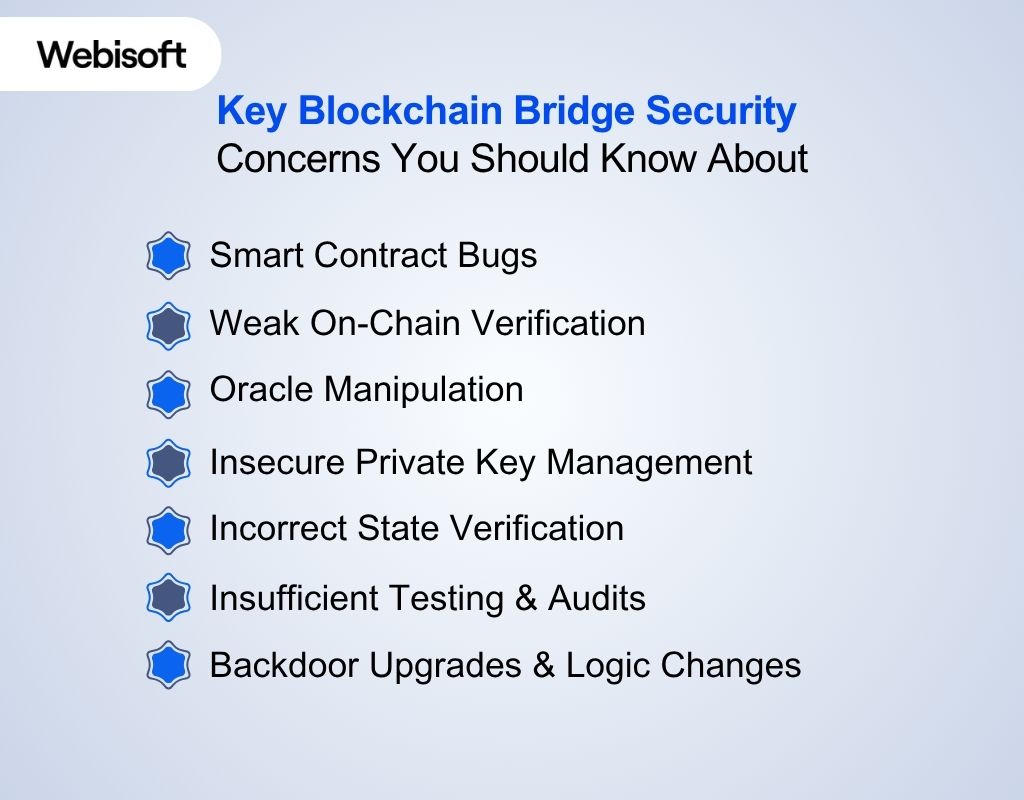
Key Blockchain Bridge Security Concerns You Should Know About
Blockchain bridges carry billions in value, but many are vulnerable by design. Knowing blockchain bridges vulnerabilities can protect you from major losses or trapped assets.
Smart Contract Bugs
Smart contract bugs pose serious risks in blockchain bridges. Bridges rely on contracts to lock assets, verify proofs, and trigger a token bridge dev process. If a function like processProof() or verifyState() has logic flaws, attackers may fake events or bypass message checks.
Bugs in mintWrappedToken() or releaseLockedAsset() can cause double minting or false withdrawals.
Many bridges also use upgradable contracts, and unsafe upgrade patterns add more risk. A single unchecked condition can break trust across both chains.
Our company has a whole check list of issues and things that can go wrong in the smart contract. This is a result of years of building flawless smart contracts.
Weak On-Chain Verification
Weak on-chain verification is a major threat to bridge security. Bridges must confirm events from another chain before releasing or minting tokens.
If the bridge uses poor verification methods, like trusting relayer signatures without light client proofs, attackers can fake cross-chain messages. Some bridges skip Merkle proof checks or use simplified state roots that are easy to forge.
Oracle Manipulation
Oracle manipulation is a high-risk issue in some bridge designs. Bridges that depend on oracles to fetch or confirm cross-chain data face this threat.
If attackers control or influence the oracle, they can feed false data into the bridge. This can trigger fake deposits, message approvals, or unlocks on the destination chain. Oracles without decentralization or data validation are easy targets.
Insecure Private Key Management
Many bridges use admin keys to manage upgrades, emergency actions, or validator coordination. If these keys are stored without hardware security modules (HSMs) or multisig wallets, they become easy targets.
Attackers gaining access can upgrade contracts, drain funds, or disable functions. In some bridges, a single key controls multiple chains.
That setup increases the blast radius of a compromise. Poor key hygiene breaks trust instantly.
Incorrect State Verification
Bridges often check state roots, Merkle proofs, or event logs to confirm transactions from the source chain. If this verification uses light checks or outdated block headers, it leaves a gap.
Attackers can forge proofs that look valid but point to non-existent or altered events. Some bridges rely on submitCheckpoint() functions or external relayers without validating full state transitions.
Without verifying actual storage values or receipts, the bridge may process fake messages. This results in unauthorized mints, double withdrawals, or asset theft.
Insufficient Testing & Audits
Insufficient testing and audits leave bridge contracts open to critical bugs. Bridges handle complex logic for cross-chain asset transfers, which increases the risk of hidden flaws.
Without fuzz testing, unit coverage, or simulation under attack conditions, bugs can slip into production. Some bridges skip external audits or rely on one-time reviews. Others ignore high-severity findings or delay patching known issues. Lack of formal verification adds to this weakness.
Backdoor Upgrades & Logic Changes
Backdoor upgrades and hidden logic changes expose bridges to insider threats. Many bridges use upgradeable smart contracts through proxies.
If upgrade functions lack timelocks or governance checks, admins can change code instantly. Attackers gaining control of upgrade keys can insert malicious logic into mint(), validateMessage(), or withdraw() functions.
Some upgrade paths use unverified delegate calls, which bypass visibility and tracking. Without access controls or audit logs, users won’t notice when the bridge logic changes. This risk turns technical upgrades into silent attack vectors.
Famous Blockchain Bridge Hacks (How Billions Were Lost)
Blockchain bridges have become one of the biggest weak points in the entire ecosystem. They’ve been hit harder than almost any other part of Web3. Billions have vanished in minutes, all from code flaws, poor design, or stolen keys.
You’ve already seen what makes bridges risky. Now it’s time to look inside the worst cases.
Below are some of the most damaging bridge hacks in recent years.
| Bridge Name | Amount Lost | Year | Root Cause |
|---|---|---|---|
| Ronin (Axie) | $620M | 2022 | Compromised validator keys (5-of-9 multisig) |
| Wormhole | $320M | 2022 | Smart contract bug in Solana message verification |
| Nomad | $190M | 2022 | Faulty message verification logic (replayable by anyone) |
| Harmony Horizon | $100M | 2022 | Low-threshold multisig (2-of-5) key compromise |
| Poly Network | $610M | 2021 | Private key access to cross-chain manager |
| Multichain | ~$126M+ | 2023 | Suspected internal compromise, unverified key control |
| Qubit Bridge | $80M | 2022 | Bug in smart contract led to fake token minting |
| Thorchain | $8M (multiple) | 2021 | Logic flaws in custom router contracts |
| Binance Bridge (Attempted) | $570M | 2022 | Fake proof forged to mint BNB — attacker caught early |
If you don’t want to end up in the next row of that table, working with a professional blockchain development company is a smart move.
Partner with the Webisoft team, having years of blockchain expertise.
We understand the technical risks, the code-level traps, and the architecture-level decisions that can save you from disaster.
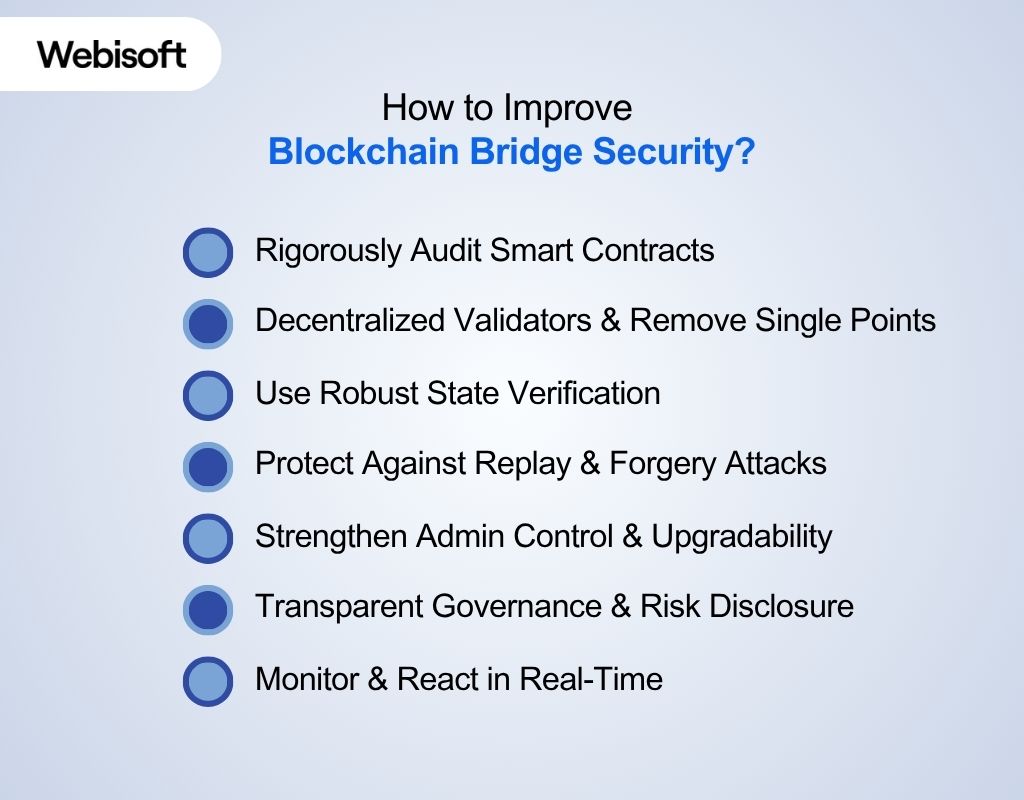
How to Improve Blockchain Bridge Security?
Most bridge hacks could’ve been stopped with better design choices. Blockchain bridge security isn’t luck, it’s engineering. Here’s how to build systems that resist real-world attacks.
Rigorously Audit Smart Contracts
Start by conducting multiple independent audits before deploying bridge contracts. Choose firms with proven experience in cross-chain infrastructure.
Use formal verification to prove correctness of critical functions like processMessage(), verifyProof(), and mint(). Run fuzz testing to detect logic errors under random input combinations.
Apply static analysis tools to scan for reentrancy, overflow, and uninitialized storage bugs. Test across different EVM-compatible networks to catch deployment-specific issues. Document every bug found, even if low risk.
Decentralized Validators & Remove Single Points of Failure
To secure a bridge, start by removing centralized validator control. Use a decentralized validator set with a proper consensus mechanism.
Each validator must run an independent node and verify events from the source chain.
Apply slashing conditions through smart contracts to penalize malicious behavior. Set quorum thresholds above 66% to prevent small groups from approving messages.
Store validator sets on-chain and rotate them regularly. Validators should submit signed attestations for cross-chain events. Use signature aggregation to reduce gas costs while keeping verification strong.
Use Robust State Verification
Use robust state verification to stop forged cross-chain messages. Start by verifying Merkle proofs from the source chain. Each proof must include a valid state root tied to a finalized block header.
Use a light client on the destination chain to verify this header without trusting external relayers. Validate the full path of the event in the source chain’s state trie. Confirm that the storage slot or log actually exists and matches the expected format.
Use functions like verifyReceiptProof() or verifyStorageProof() to check this data on-chain. Do not process messages based on relayer-signed claims alone. That introduces a high risk of fraud.
Protect Against Replay & Forgery Attacks
To block replay and forgery attacks, assign each cross-chain message a unique identifier. Include a nonce, source chain ID, and destination chain ID in every message.
Hash this data and store the hash on-chain after processing. Before executing any message, check if the hash already exists. If it does, reject the message. This prevents replay across chains or within the same chain.
Use domain separation when signing messages to avoid cross-protocol misuse. Validate all message payloads with strict type and format checks. Avoid dynamic calls that decode unknown inputs.
Strengthen Admin Control & Upgradability
To strengthen admin control and upgradability, restrict all upgrade functions behind a multisig with a high threshold. Avoid using single admin keys.
Apply a time-lock contract before executing any upgrade. Store upgrade requests on-chain with full transparency. Require each admin to sign the upgrade proposal using ECDSA.
Verify signatures inside the timelock before executing. Log every upgrade event with clear metadata, including contract version and changelog hash.
Transparent Governance & Risk Disclosure
Use transparent governance to reduce hidden risks in bridge management. Deploy governance contracts that store all proposals, votes, and decisions on-chain.
Proposals must include code diffs, reasoning, and risk assessments. Publish upgrade timelines, validator changes, and protocol parameters before implementation.
Use cryptographic signatures to verify voter identity and prevent sybil attacks. Make validator sets and slashing rules public in real time. Provide a live audit log showing recent state changes. Maintain a changelog linked to each contract version.
Monitor & React in Real-Time
Set up real-time monitoring to detect unusual bridge behavior early. Use on-chain watchers to track events like MessageProcessed, Mint, or Withdraw. Deploy alert systems that scan for repeated transactions, invalid proofs, or delayed confirmations. Log all cross-chain messages with timestamps and status codes. Integrate off-chain indexers to compare source and destination chain activity.
Set thresholds for response actions, such as pausing minting or freezing transfers. Use circuit breakers in contracts to halt risky activity during anomalies. Monitor validator signatures for consistency and rate anomalies. Publish event data to public dashboards for open review. From protocol architecture to secure deployment and real-time defense layers, Webisoft covers the critical components that strengthen blockchain bridge security at every development stage.
Challenges in Securing Blockchain Bridges
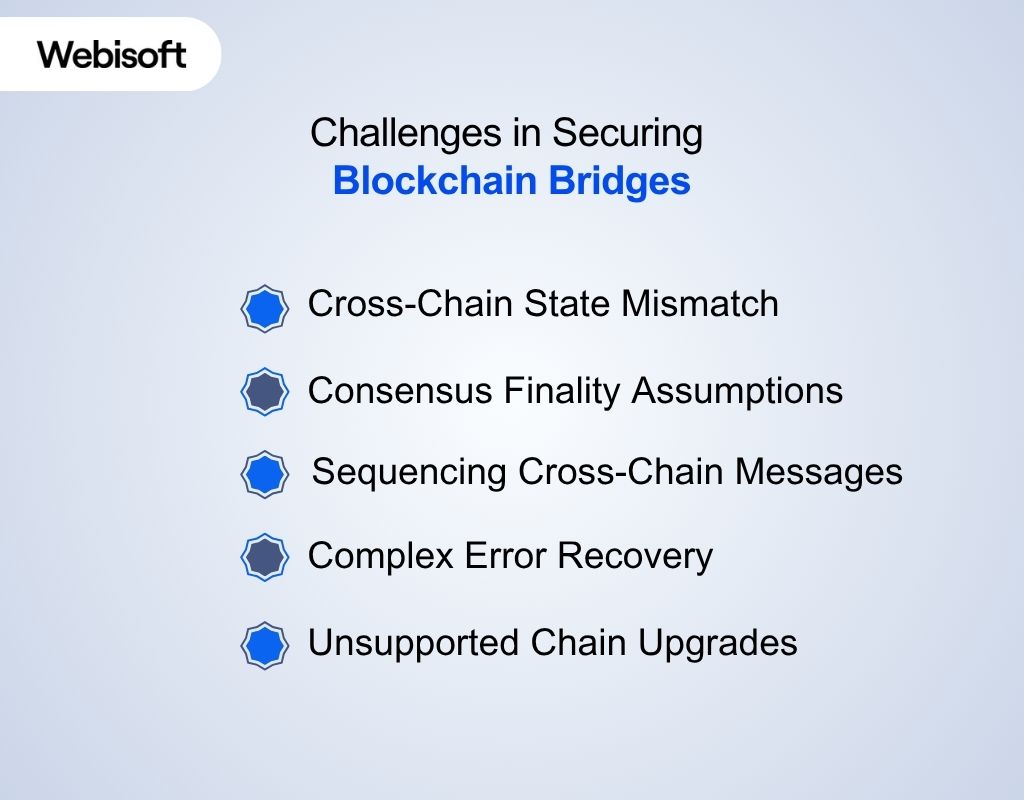
1. Cross-Chain State Mismatch
Each chain encodes the state differently. Bridges must translate logs, receipts, and headers between incompatible systems. Without accurate mapping, events get misread or rejected.
Use custom parsers and typed decoding for each source chain. Confirm proof structure matches the expected ABI and hash tree format exactly.
2. Consensus Finality Assumptions
Not all blockchains offer instant finality. Some bridges confirm messages from blocks that could later be reorganized. This lets attackers forge deposits. Wait for deep finality on probabilistic chains like Ethereum.
Use block confirmations based on chain-specific security models, not fixed values across all chains.
3. Sequencing Cross-Chain Messages
Messages often arrive out of order or late. Without proper sequencing, bridges can execute messages incorrectly or miss state dependencies.
Assign sequence numbers to each message and enforce strict ordering. Log processed IDs on-chain to reject stale or unordered calls across chains.
4. Complex Error Recovery
Most bridges lack structured failure handling. When a message fails, assets may stay locked with no retry logic. Add transaction status flags on-chain.
Let users resend or cancel failed actions after a timeout. Separate failure state from success logs to avoid ambiguity in tracking transfers.
5. Unsupported Chain Upgrades
Chains often upgrade clients, change gas models, or add new consensus logic. If the bridge doesn’t adapt, proof validation fails. Maintain updatable parsers and decoding functions.
Track upstream changes in dependencies. Add upgrade hooks for adjusting proof formats without changing core bridge contracts.
What Are the Most Secure Blockchain Bridges Today?
The most secure blockchain bridges today in 2025 are those that combine strong decentralization, audited smart contracts, robust consensus mechanisms, and broad multi-chain support.
Based on recent expert analyses and comparisons, the following bridges stand out for their security and usability:
| Bridge | Security Model | Key Security Features | Supported Chains |
|---|---|---|---|
| Cosmos IBC | Trust-minimized, light client-based | On-chain header verification, no relayers, instant finality | Cosmos Hub, Osmosis, Juno, Akash, Secret |
| zkBridge | ZK-based, stateless | SNARK/STARK proofs, no validators, cryptographic state validation | Ethereum, BNB Chain, Scroll, zkSync Era |
| Axelar | Decentralized validator network | Slashing, BFT consensus, audit trails, on-chain governance | Ethereum, Cosmos, Avalanche, Moonbeam |
| LayerZero | Hybrid trust (oracle + relayer) | Ultra Light Node model, message proof separation | Ethereum, Arbitrum, Optimism, BNB Chain |
| Wormhole | Guardian-based multisig | Signed VAAs, post-hack upgrades, 19+ guardians | Ethereum, Solana, Avalanche, BNB Chain |
| Rainbow Bridge | Light client (NEAR-Ethereum) | Header-based validation, on-chain challenge period | NEAR ↔ Ethereum |
Future of Blockchain Bridge Security
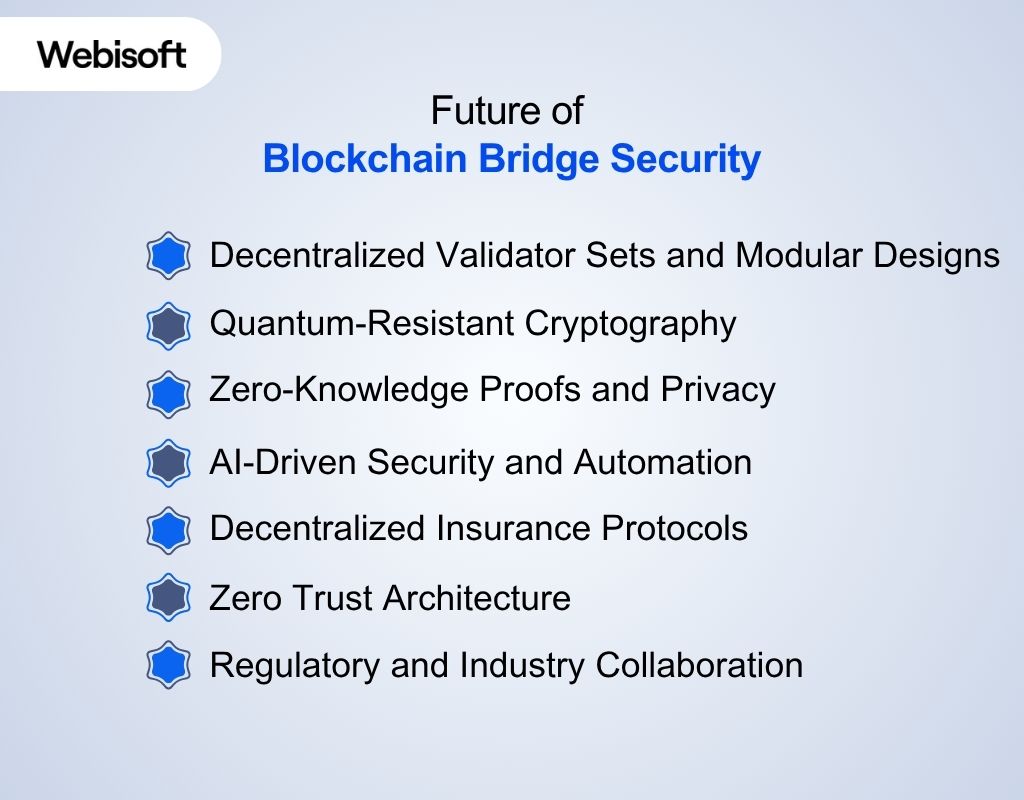
The future of blockchain bridging security will depend on cryptography, decentralization, automation, and compliance.
Each trend shapes how bridges defend against evolving risks.
1. Decentralized Validator Sets and Modular Designs
Bridges are increasingly adopting decentralized validator sets with robust consensus mechanisms to eliminate single points of failure.
Modular and decentralized bridge architectures mitigate vulnerabilities in oracles and validators, strengthening trust and resilience across chains.
2. Quantum-Resistant Cryptography
With the rise of quantum computing posing threats to traditional cryptography, blockchain bridges are implementing post-quantum cryptographic algorithms such as lattice-based cryptography and hash-based signatures.
Early adoption of quantum key distribution (QKD) and cryptographic agility creates a stronger defense against quantum attacks.
3. Zero-Knowledge Proofs (ZKPs) and Privacy Enhancements
ZKPs are gaining traction for verifying cross-chain transactions without revealing sensitive data.
This approach reduces fraud risks and supports confidential interoperability between blockchains, especially in DeFi applications.
4. AI-Driven Security and Automation
Artificial intelligence is being used to detect anomalies, predict vulnerabilities, and automate threat mitigation in real time.
AI-powered systems defend against sophisticated attacks like front-running and smart contract exploits, while improving network performance through decentralized learning techniques.
5. Decentralized Insurance Protocols
To address growing risks associated with bridge usage, decentralized insurance protocols are emerging. These provide coverage against smart contract bugs, oracle failures, and network congestion losses.
It protects both users and liquidity providers through smart contracts and governance models.
6. Zero Trust Architecture (ZTA)
Blockchain platforms are moving toward Zero Trust principles, requiring continuous verification of every user, device, and transaction.
This reduces risks from compromised credentials or insider threats by eliminating implicit trust.
7. Regulatory and Industry Collaboration
Increasing regulatory scrutiny pushes blockchain projects to strengthen security and compliance practices.
Collaboration with regulators and infrastructure providers drives the development of standardized protocols and security guidelines for secure cross-chain communication.
Webisoft: Your Trusted Partner in Blockchain Bridge Security
Webisoft is a full-stack product and engineering company with deep expertise in blockchain, smart contract development, and cross-chain architecture. We work with protocols, builders, and enterprises to strengthen bridge infrastructure at every layer.
Our team develops modular, upgrade-safe architectures that use hardened smart contracts and decentralized validation to reduce risk.
We design custom state verification pipelines that include Merkle proof validation, replay protection, and strict on-chain message sequencing.
Validator coordination is handled through quorum-based signing and enforced slashing rules across multiple chains.
Every component goes through rigorous testing, including fuzzing, static analysis, and simulation under hostile cross-chain conditions.
We also implement contract-level kill switches and real-time monitoring, giving teams direct control over operations when abnormal behavior appears.
Webisoft delivers security that’s designed, not patched.
In Closing
Blockchain bridges connect ecosystems, but they also carry every risk from both sides. Security isn’t just a checklist. It’s architecture, logic, and real-time defense. Attackers don’t wait for audits.
They scan for missed conditions, flawed verifications, and centralized access points. A secure bridge doesn’t depend on trust. It validates every step, isolates components, and reacts when things go wrong.
If you’re building or scaling cross-chain infrastructure, don’t treat security as an afterthought.
Webisoft builds blockchain bridge security into every phase, from design, validation, to deployment.
Contact us today to secure what connects your entire ecosystem.
Frequently Asked Questions
Bridges must verify and coordinate across two or more chains with different rules. That complexity multiplies risk and failure points.
Not always, but small multisigs without slashing or transparency increase risk. Safer bridges use decentralized validators with on-chain governance.
Yes. High gas costs can delay or block security checks. Attackers can exploit these delays to game message timing or execution.
Audits should happen before every major upgrade. Bridges must also be tested continuously under changing conditions, not just once at launch.
Users should avoid unverified bridges, check status pages, and never bridge large amounts during upgrades or unexplained delays.