Parachains are the core scaling idea behind Polkadot: instead of forcing every application to compete for space on one chain, the network runs many purpose-built blockchains in parallel and secures all of them with a single validator set. Each parachain keeps its own state, its own transaction logic, and its own economics, while the Polkadot Relay Chain provides consensus and finality for everyone.
The model has changed materially since parachains first launched. Slot auctions and crowdloans, the mechanism most older articles still describe, were retired in 2024 in favor of Agile Coretime, a pay-for-blockspace model that sharply lowers the cost of entry. This guide covers how parachains actually work, what they are good for, what launching one involves today, and how they compare with standalone Layer 1 chains and Ethereum rollups.
What Is a Parachain?
A parachain (short for parallelizable chain) is an independent blockchain that runs in parallel with other parachains and connects to the Polkadot Relay Chain. The Relay Chain does not execute application logic itself. Its job is coordination: it assigns execution cores to parachains, checks the validity of their blocks, and finalizes them. Application logic, storage, and fee models all live on the parachains.
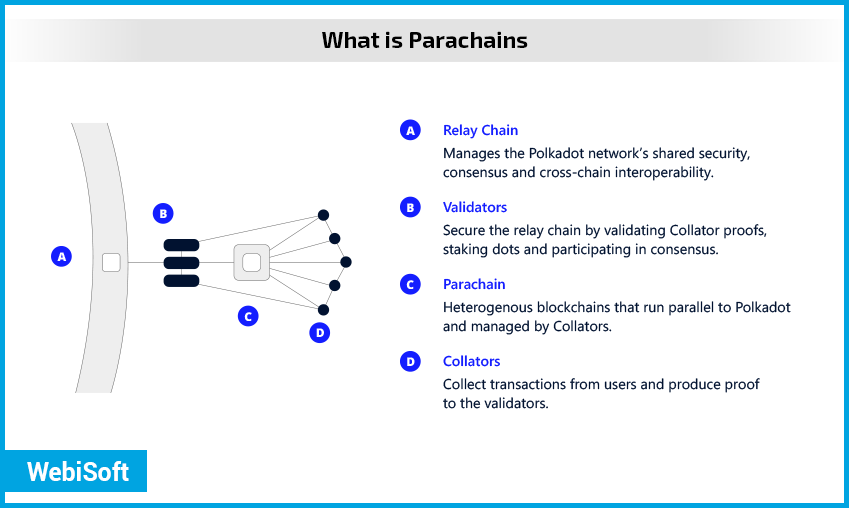
Because each parachain executes its own transactions on its own core, throughput scales horizontally: adding another parachain adds capacity instead of consuming it. That is the structural difference from a monolithic chain, where every new application competes for the same block space and drives fees up for everyone else.
Collators: Who Produces Parachain Blocks
Each parachain is served by collator nodes. A collator maintains the parachain's full state, gathers user transactions, builds block candidates, and packages each candidate with a proof of validity that Relay Chain validators can check without holding the parachain's state themselves.
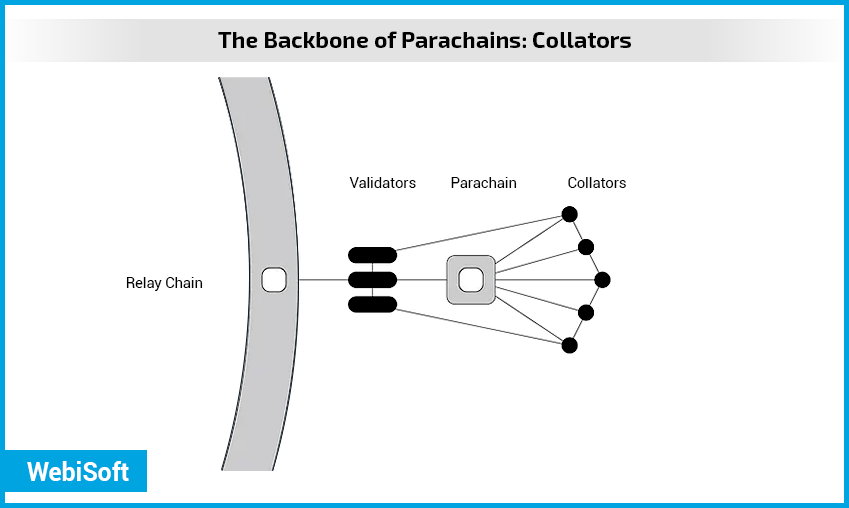
An important design detail: collators provide liveness, not security. A parachain needs only one honest collator to keep producing blocks. Even a fully malicious collator set cannot push an invalid state transition through, because validators reject any block whose proof does not check out. Security comes from the Relay Chain, which is why a small team can run a parachain without recruiting a large validator community of its own.
Validators and Shared Security
The Relay Chain uses nominated proof of stake (NPoS). DOT holders nominate validators, validators stake DOT, and the protocol assigns rotating groups of validators to check each parachain's block candidates before finalization. Misbehavior is punished by slashing the offender's stake. The practical consequence is that every parachain, from the largest DeFi hub to a newly launched appchain, is backed by the same pooled economic security.
Key Characteristics of Polkadot Parachains
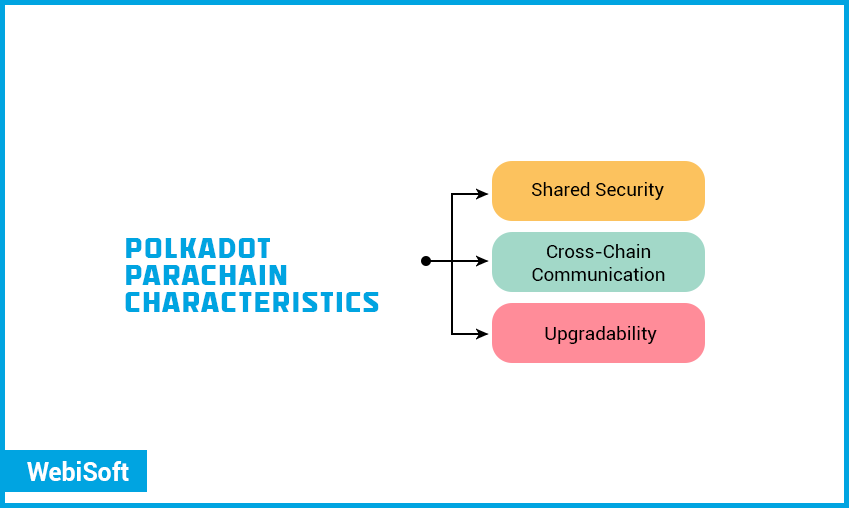
Shared Security from Day One
A new standalone Layer 1 has a bootstrapping problem: its security depends on the value of its own token and the size of its own validator set, both of which start near zero. A parachain skips that phase entirely. From its first block, invalid state transitions are rejected by the full Polkadot validator set, so the cost of attacking a small parachain is the same as the cost of attacking the whole network.
Native Cross-Chain Messaging (XCM)
Parachains communicate through XCM, Polkadot's cross-consensus message format. Assets and arbitrary messages move between parachains under the same security umbrella that validates their blocks, with no third-party bridge and no additional trust assumption. Connectivity to external networks such as Ethereum is handled by dedicated bridge protocols; the difference is that intra-Polkadot transfers do not carry the custodial or multisig risk that has made external bridges a frequent attack target.
Forkless Upgrades
A parachain's runtime is a WebAssembly blob stored on chain. Upgrading the chain means enacting a new blob through on-chain governance, not coordinating a hard fork across node operators. Teams ship protocol changes the way they ship software releases: proposed, approved, enacted, with no network split and no flag-day coordination.
Benefits and Trade-Offs
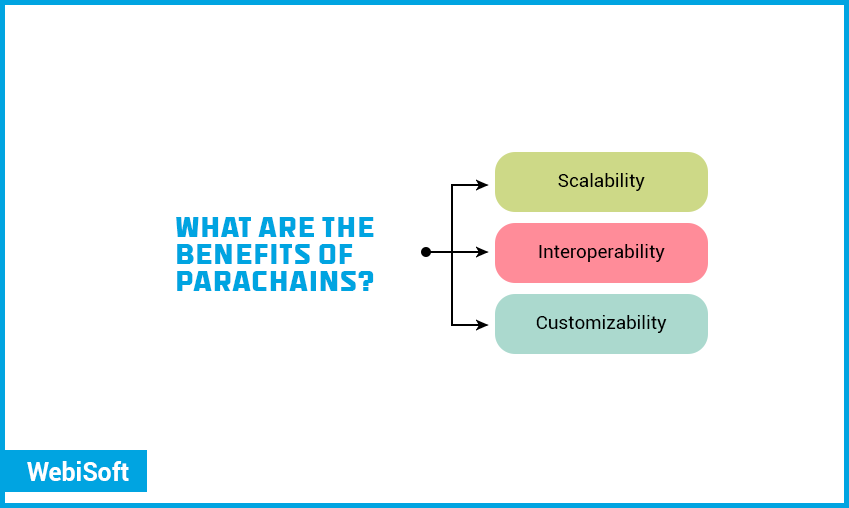
Scalability
Parachains execute in parallel on separate cores. Asynchronous backing, rolled out across the network in 2023 and 2024, cut parachain block times from twelve seconds to six and allowed more transactions per block. Elastic scaling extends this further by letting a single parachain consume multiple cores when it needs more throughput.
Interoperability
XCM makes composability between chains a protocol feature rather than an integration project. A lending protocol on one parachain can accept collateral minted on another; a game can settle marketplace trades on a chain optimized for asset transfers.
Customizability
A parachain team controls its entire stack: fee model (including fee-less transactions for users), block economics, governance process, and custom runtime modules. Logic that would be prohibitively expensive as a smart contract can run as native runtime code.
The Trade-Offs
The honest counterweight: a parachain is an operational commitment, not a deployment. You run collator and RPC infrastructure, maintain a Rust runtime, budget for coretime renewals, and take responsibility for your own upgrades and governance. The Polkadot SDK talent pool is smaller than the EVM developer pool, and a new chain starts without the ambient liquidity of an established ecosystem. For many products, deploying smart contracts on an existing parachain such as Moonbeam or Astar is the better first step, with a migration path to a dedicated chain once usage justifies it.
From Slot Auctions to Agile Coretime
Until 2024, a parachain acquired its place on Polkadot by winning a slot auction: teams locked large amounts of DOT for a lease of up to two years, often raised from supporters through crowdloans that reserved contributors' tokens for the lease period. Karura won the first auction on Kusama, Polkadot's canary network, in June 2021, and Acala won the first auction on Polkadot later that year. A small set of system chains, such as the asset-issuance chain now called Asset Hub, received slots through governance instead of auctions.
The auction model proved the demand but aged poorly. It locked enormous capital, favored teams with fundraising muscle over teams with working products, and forced an all-or-nothing two-year commitment on projects that needed room to iterate.
Agile Coretime, activated on Polkadot in 2024, replaced it with a straightforward blockspace market:
- Bulk coretime: a team buys a core for a fixed period (sold in month-scale blocks) at market price, with a renewal mechanism that protects incumbents from being priced out overnight.
- On-demand coretime: a chain pays per block only when it needs one. This replaced the old parathread concept and suits low-traffic chains, test deployments, and applications with bursty load.
The practical effect is a far lower barrier to entry. Launching no longer requires winning a capital contest; it requires paying for the blockspace you actually use.
What Can Parachains Be Used For?
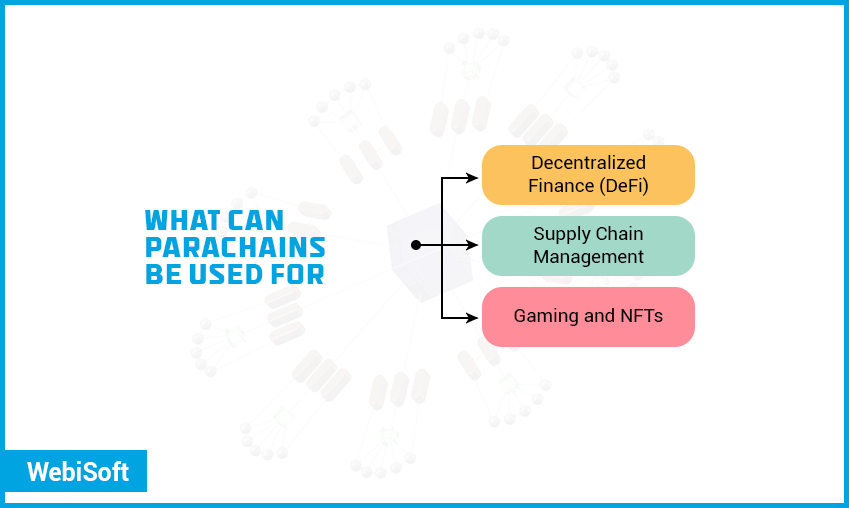
Because each parachain is specialized, the ecosystem reads like a map of use cases:
- DeFi: Acala and Hydration build lending, stablecoin, and liquidity infrastructure with runtime-level features (such as paying fees in any asset) that contract platforms cannot easily offer.
- EVM smart-contract platforms: Moonbeam and Astar run full Ethereum-compatible environments, so Solidity teams get Polkadot's security and XCM connectivity without rewriting their stack.
- Identity and credentials: KILT anchors verifiable credentials on chain while keeping the underlying personal data off chain.
- Privacy and confidential compute: Phala executes workloads inside trusted execution environments for cases where public state is unacceptable.
- Asset issuance: Asset Hub, a system parachain, provides low-fee creation and transfer of fungible tokens and NFTs as shared public infrastructure.
- Supply chain and enterprise records: a dedicated chain can encode industry-specific validation rules (batch provenance, custody transfer, certification) directly in the runtime, producing an auditable record that partners can verify without trusting any single operator's database.
How to Launch a Parachain on Polkadot
The delivery path is well trodden at this point:
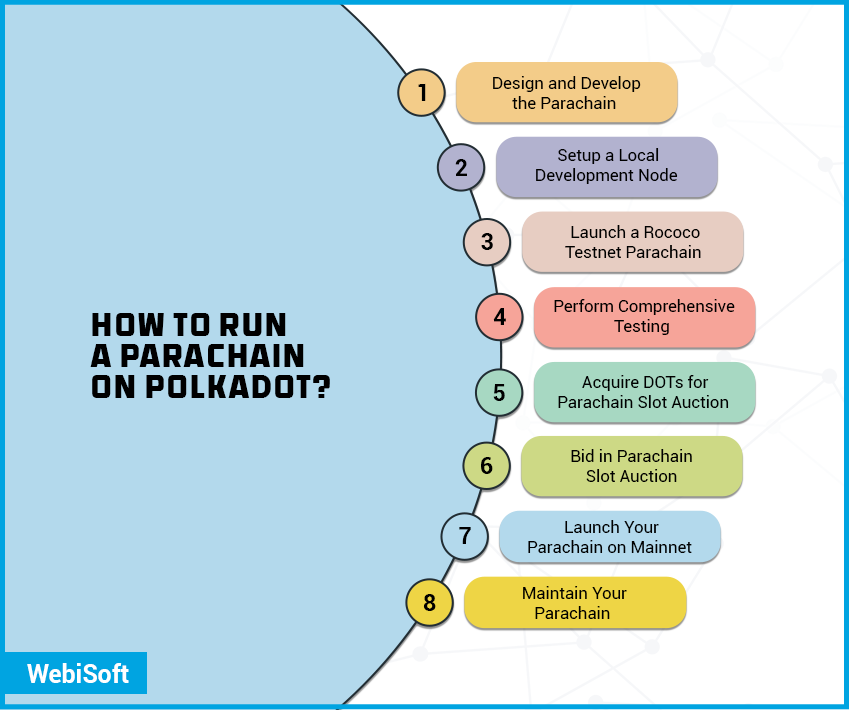
1. Design and Build the Runtime
Parachains are built with the Polkadot SDK (the framework formerly known as Substrate, maintained by Parity Technologies). You compose your chain from FRAME pallets, prebuilt modules for balances, governance, staking, assets, and more, and write custom pallets in Rust for your domain logic. Cumulus, the SDK's parachain layer, handles the consensus plumbing that connects your chain to the Relay Chain.
2. Test Locally
Tooling such as Zombienet spins up an ephemeral Relay Chain plus your parachain on a developer machine or CI, so you can exercise block production, XCM flows, and runtime upgrades before anything goes public.
3. Rehearse on a Testnet
Deploy to a public test network (Paseo is the community testnet for parachain teams) to validate behavior in a real multi-chain environment: cross-chain messages, collator failover, and upgrade procedures under realistic conditions.
4. Acquire Coretime
Buy bulk coretime for steady production traffic, or start with on-demand coretime and upgrade once volume justifies a dedicated core. No auction, no crowdloan, no multi-year token lockup.
5. Register and Launch
Register your parachain's genesis state and runtime with the Relay Chain, bring up your collator set, and begin producing blocks on mainnet.
6. Operate
Production operation means monitoring collators and RPC endpoints, shipping forkless runtime upgrades, renewing coretime, and running your governance process. Plan for this as an ongoing engineering function, not a launch-day checkbox.
What Does Running a Parachain Cost?
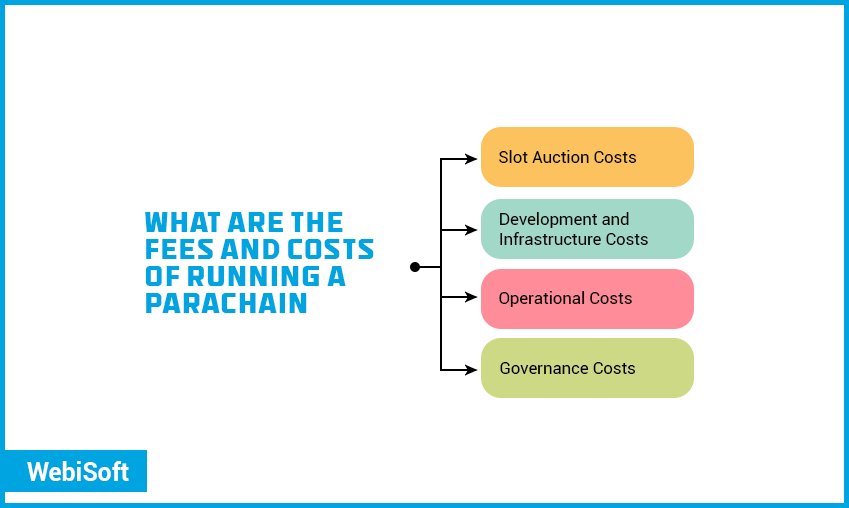
Four cost centers dominate:
- Coretime: market-priced and paid per period, with renewals for bulk buyers. This is a predictable operating expense rather than the capital lockup of the auction era.
- Development: Rust and Polkadot SDK engineering for the runtime, plus security review before mainnet. Runtime code is consensus code; audit it accordingly.
- Infrastructure: collator nodes, RPC endpoints, indexers, and monitoring. Modest compared with running a validator network, but not zero.
- Ongoing operations: upgrades, incident response, governance administration, and ecosystem integrations such as wallets and explorers.
Parachain, Standalone L1, or Ethereum Rollup?
The right architecture depends on what you are optimizing for. A condensed comparison:
| Dimension | Polkadot parachain | Standalone L1 | Ethereum rollup |
|---|---|---|---|
| Security source | Shared Relay Chain validator set from day one | Own validators and token; must be bootstrapped | Inherited from Ethereum, plus sequencer and proof-system assumptions |
| Customization depth | Full runtime control (fees, governance, native logic) | Full control, full responsibility | Limited by the rollup framework and EVM semantics |
| Cross-chain interop | Native XCM to other parachains, no external bridge | Third-party bridges with added trust assumptions | Strong within Ethereum; bridges elsewhere |
| Cost profile | Coretime plus own infrastructure | Validator incentives plus infrastructure | Data-availability fees paid to Ethereum |
| Developer pool | Rust / Polkadot SDK (smaller) | Varies by stack | Solidity / EVM (largest) |
A useful rule of thumb: if your product is a set of smart contracts, start on an existing execution layer. If your product is a chain, meaning you need custom fee logic, protocol-level features, or sovereign governance, a parachain gives you that without the security bootstrapping problem of a fresh L1.
How Webisoft Helps You Build on Polkadot
Webisoft is a Montreal-based software engineering firm that delivers full-cycle blockchain development: architecture, runtime and smart-contract engineering, infrastructure, and post-launch operation. For teams weighing Polkadot, the engagement usually starts with a blunt architectural question: do you need your own chain, or will contracts on an existing parachain serve the product better and cheaper? We answer that with a technical assessment, then build and operate whichever path wins.
If you are evaluating a parachain, an appchain, or a cross-chain integration, contact Webisoft and we will scope it with you.
Conclusion
Parachains turn Polkadot into a set of specialized, sovereign chains that share one security budget and speak a common messaging format. The move from slot auctions to Agile Coretime removed the largest barrier to entry, and improvements such as asynchronous backing and elastic scaling keep raising the throughput ceiling. For products that genuinely need their own chain, the parachain model offers a rare combination: full protocol control without the cold-start security problem, and native interoperability without bridge risk.
The parathread concept was absorbed into Agile Coretime as on-demand coretime: a chain pays for a block only when it needs one. It suits low-traffic chains, pilots, and bursty workloads, and a project can move between on-demand and bulk coretime as usage grows.
If your product is a set of smart contracts, start on an established parachain such as Moonbeam or Astar and ship faster with the EVM talent pool. Build your own parachain when you need protocol-level control: custom fee logic, native runtime features, or sovereign governance.
A parachain is an independent blockchain that runs in parallel with others and connects to the Polkadot Relay Chain. It keeps its own logic, state, and fees, while Polkadot's validators check and finalize its blocks, so it inherits the network's full security from day one.
No. Parachains are served by collators, which produce block candidates, while security comes from the Polkadot Relay Chain's shared validator set. A parachain needs only one honest collator to keep running, which is why small teams can operate one.
No. Slot auctions and crowdloans were retired in 2024 and replaced by Agile Coretime. Teams now buy blockspace directly: bulk coretime for steady production use, or on-demand coretime paid per block. There is no multi-year DOT lockup to launch a chain.