Ecommerce support load scales with order volume, but support headcount rarely does. Every order generates potential tickets: shipping status, returns, sizing, payment issues. A well-built chatbot absorbs the repetitive share of that volume so your team handles only the conversations that need judgment.
This guide covers:
- What ecommerce chatbots actually do, and how the underlying technology differs between platforms
- The seven strongest tools available in 2025, with pricing and trade-offs
- Five real brand deployments worth studying
- How to choose a platform, and when a custom build makes more sense
What Is an Ecommerce Chatbot?
An ecommerce chatbot is software that handles customer conversations on your store: answering product questions, guiding purchases, processing routine requests, and providing post-sale support. It typically runs on your website widget and on messaging channels such as WhatsApp, Instagram, and Facebook Messenger.
Under the hood, there are two distinct architectures, and the difference matters when you evaluate vendors:
- Rule-based bots follow decision trees you design. They are predictable and cheap, but they fail the moment a customer phrases something the tree did not anticipate.
- AI bots built on large language models interpret free-form questions and generate answers from your product catalog, policies, and order data. The good ones use retrieval: they look up the relevant policy or product record first, then answer from it, which keeps responses grounded in your actual data instead of the model's guesswork.
A concrete example: a customer wants to return a pair of jeans. Instead of hunting for your return policy page, they open the chat, tap "Start a return," and the bot verifies the order, checks return eligibility against your policy, and issues the return label. No human touched the ticket.
Best Chatbot for Ecommerce: Top 7 Choices
Salesforce's holiday shopping data showed AI-assisted chat and recommendations influencing a meaningful share of online orders, and the vendor landscape has matured quickly in response. Here are the strongest ecommerce chatbot platforms right now:
1. ChatBot
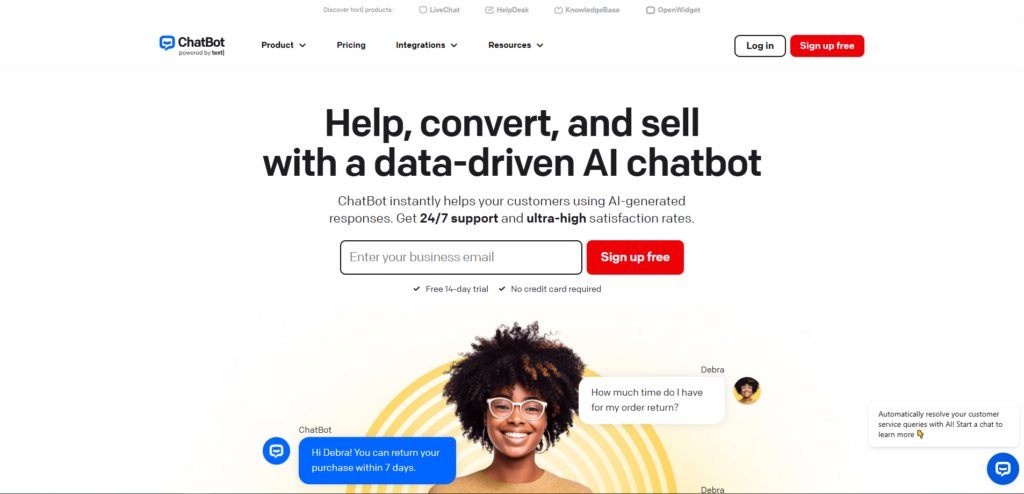
ChatBot is a no-code platform for automating store conversations, cutting response times, and reducing support costs. It integrates with Shopify, Messenger, and Slack, which makes it a flexible option for teams that live in several channels.
Features:
- Drag-and-drop chatbot builder for customization without code.
- Pre-built templates for faster deployment.
- Real-time analytics to track chatbot performance.
- CRM and ecommerce platform integrations.
- AI-powered responses to common customer questions.
Pros:
- No coding required.
- Works across multiple platforms.
- Detailed analytics for optimization.
- Free 14-day trial.
Cons:
- The builder has a learning curve for first-time users.
Pricing:
- Starter: $65/month
- Team: $169/month
- Business: $499/month
- Enterprise: custom pricing
2. Rep AI
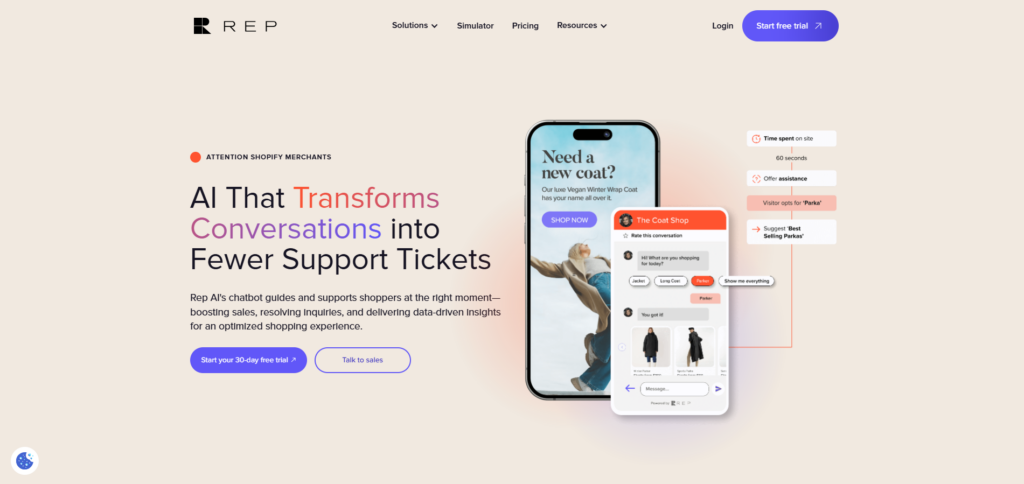
Rep AI is built for ecommerce, and specifically for Shopify merchants. Its distinguishing feature is behavioral targeting: rather than waiting for the customer to open the chat, it watches on-page behavior for signs of disengagement and opens the conversation itself, which shifts the bot from a support tool to a sales tool.
Features:
- Behavioral AI: detects when shoppers are about to leave and engages them with relevant offers or assistance.
- AI sales concierge: helps shoppers navigate the store, compare products, and move to checkout.
- Cart recovery: nudges customers to complete purchases with reminders or discounts.
- Multilingual support: converses with shoppers in multiple languages.
- Shopify integration: works directly inside Shopify to lift revenue and average order value.
- Customer insights dashboard: tracks shopper behavior and surfaces data for sales strategy.
Pros:
- Proactive engagement rather than passive Q&A.
- Runs 24/7 without human intervention.
- Targets cart abandonment at the moment it happens.
- Personalizes the shopping experience based on behavior.
- Supports multiple languages.
- Straightforward Shopify setup.
Cons:
- Built primarily for Shopify, which limits flexibility on other platforms.
- Needs training on your catalog and tone before responses feel on-brand.
- Costs more than basic chatbot tools.
Pricing:
- 30-day free trial available
- $12 per 1,000 visitors, scaling with traffic
3. Chatfuel
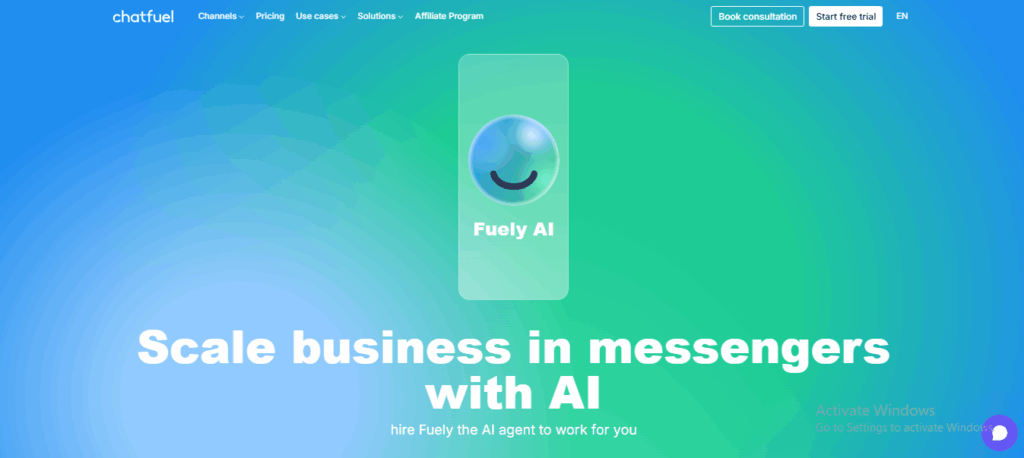
Chatfuel specializes in Facebook Messenger, Instagram, and WhatsApp automation, which makes it a strong fit for brands that sell primarily through social channels. Setup is fast and the templates cover most common ecommerce flows.
Features:
- Drag-and-drop chatbot builder with no coding required.
- 30+ chatbot templates for ecommerce.
- CRM integration to manage customer data.
- Automated responses for social media inquiries, including comment replies.
Pros:
- Purpose-built for social media automation.
- Quick setup with pre-built templates.
- 99.99% uptime guarantee.
- 24/7 support with fast response times.
Cons:
- Heavy dependence on Meta's platforms; a policy change on their side affects your bot.
- Feature updates ship slower than competitors.
Pricing:
- Facebook & Instagram Business: from $23.99/month
- WhatsApp Business: from $34.49/month
- Enterprise: from $300/month
4. Certainly
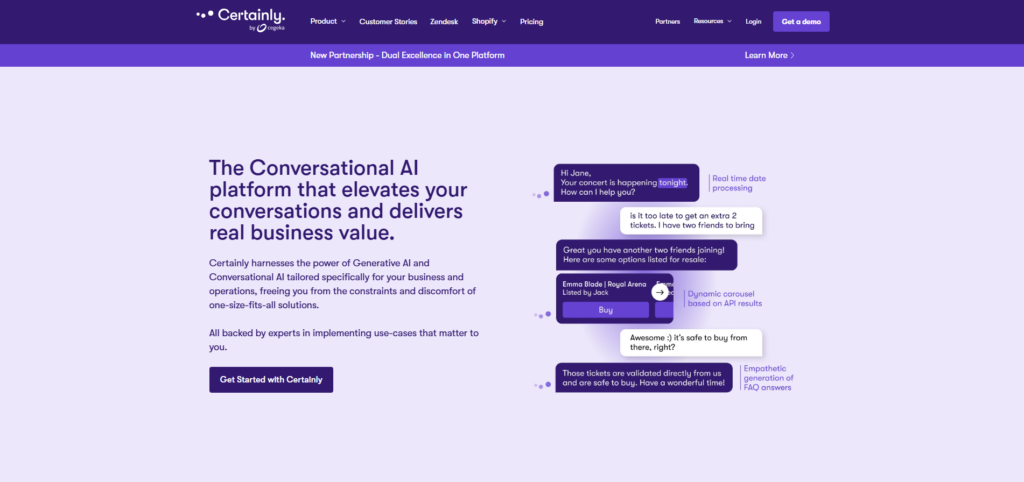
Certainly focuses on conversational commerce for mid-size and larger brands: personalized shopping journeys, upsell and cross-sell flows, and deep integrations with the Shopify support stack.
Features:
- AI-powered shopping assistant
- Multichannel support
- Personalized product recommendations
- CRM and order management integration
- 14+ languages for global ecommerce brands
- Insights into customer interactions, conversions, and drop-off points
Pros:
- Conversation flows designed around conversion, not just deflection.
- Automates a large share of routine support requests.
- Integrates with Shopify, Gorgias, Klaviyo, and Zendesk.
- Supports upselling and cross-selling inside the chat.
- Flexible customization through an intuitive builder.
Cons:
- Advanced features need dedicated training and tuning time.
- Pricing puts it out of reach for most small stores.
Pricing:
- Starter: $399/month
- Growth: $999/month
- Enterprise: custom quote
5. Tidio
Tidio combines live chat with automated responses in one widget, which suits stores that want a human team and a bot working the same queue. It covers website chat, Messenger, WhatsApp, and email.
Features:
- AI chatbot with natural language processing.
- Pre-made templates for quick setup.
- Visitor tracking for personalized recommendations.
- Multichannel support: live chat, Messenger, WhatsApp, email.
Pros:
- Fast installation and setup.
- Visual chatbot builder with no coding required.
- Clean bot-to-human handoff.
- Analytics on customer interactions.
Cons:
- Limited advanced customization.
- Some templates are awkward to modify.
Pricing:
- Free plan available
- Growth: $59/month
- Plus: $749/month
- Premium: $2999/month
Note: Entry pricing covers 50 conversations per month. Costs rise with conversation volume, so model your expected traffic before committing.
6. ManyChat
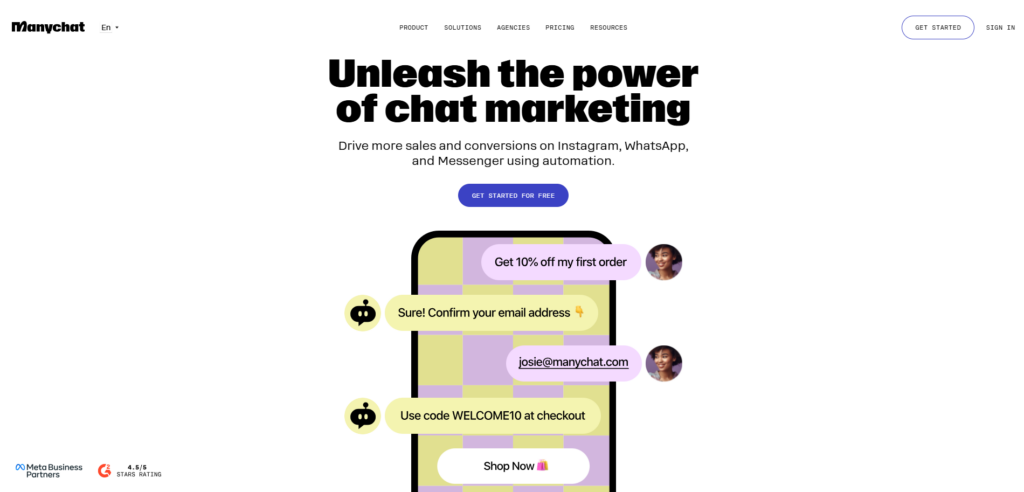
ManyChat is built for social media automation: converting leads, automating DM responses, and driving sales from Facebook and Instagram ad traffic. If your funnel starts with a Meta ad, this is the natural fit.
Features:
- AI-driven chat automation for Facebook, Instagram, and WhatsApp.
- Pre-built templates for marketing, sales, and customer support.
- Automated responses for direct messages and comments.
- Integration with Shopify, Mailchimp, and Google Sheets.
Pros:
- Strong for social media marketing and lead generation.
- Automates Messenger, Instagram, and WhatsApp interactions.
- Helps recover abandoned carts.
- Bot-to-human transfer for support escalation.
Cons:
- Lacks the deeper AI capabilities of LLM-native platforms.
- Limited customer segmentation options.
Pricing:
- Free plan available
- Pro: from $15/month
- Elite: custom pricing
7. HubSpot Chatbot Builder
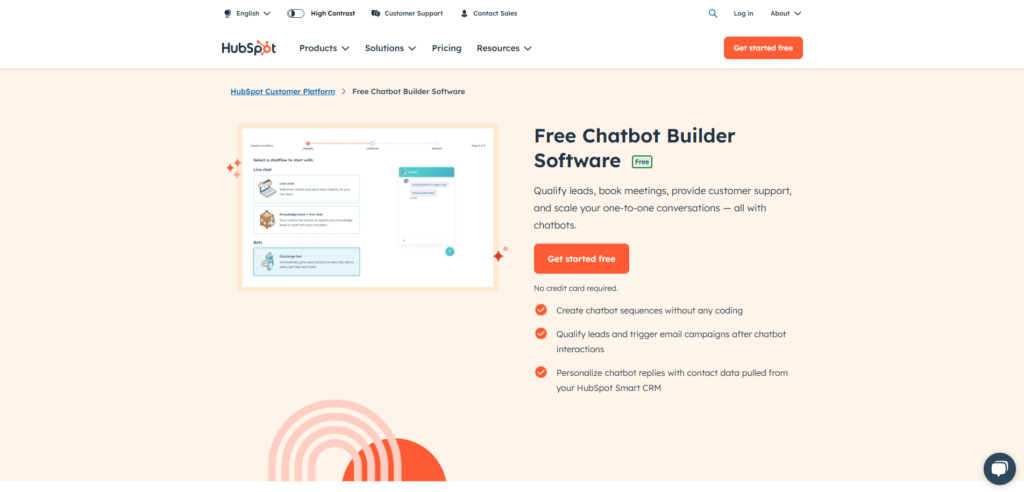
HubSpot's chatbot builder makes sense if you already run HubSpot CRM. Because the bot reads and writes CRM records natively, it can qualify leads, book meetings, and personalize conversations from existing customer data without middleware.
Features:
- No-code chatbot builder with rule-based workflows.
- Native HubSpot CRM integration for lead qualification.
- Automated responses for FAQs.
- Routing to live agents when a conversation needs one.
Pros:
- Easy setup with a drag-and-drop builder.
- Zero-friction CRM integration for HubSpot users.
- Quick to embed on any website.
Cons:
- Advanced features sit behind HubSpot's paid tiers, and the bot is rule-based rather than AI-native.
Pricing:
- Free version available; advanced workflows require paid HubSpot plans.
Still weighing whether a bot belongs in your stack at all? Compare the advantages and disadvantages of chatbots before you commit.
Top 5 Ecommerce Chatbot Examples to Learn From
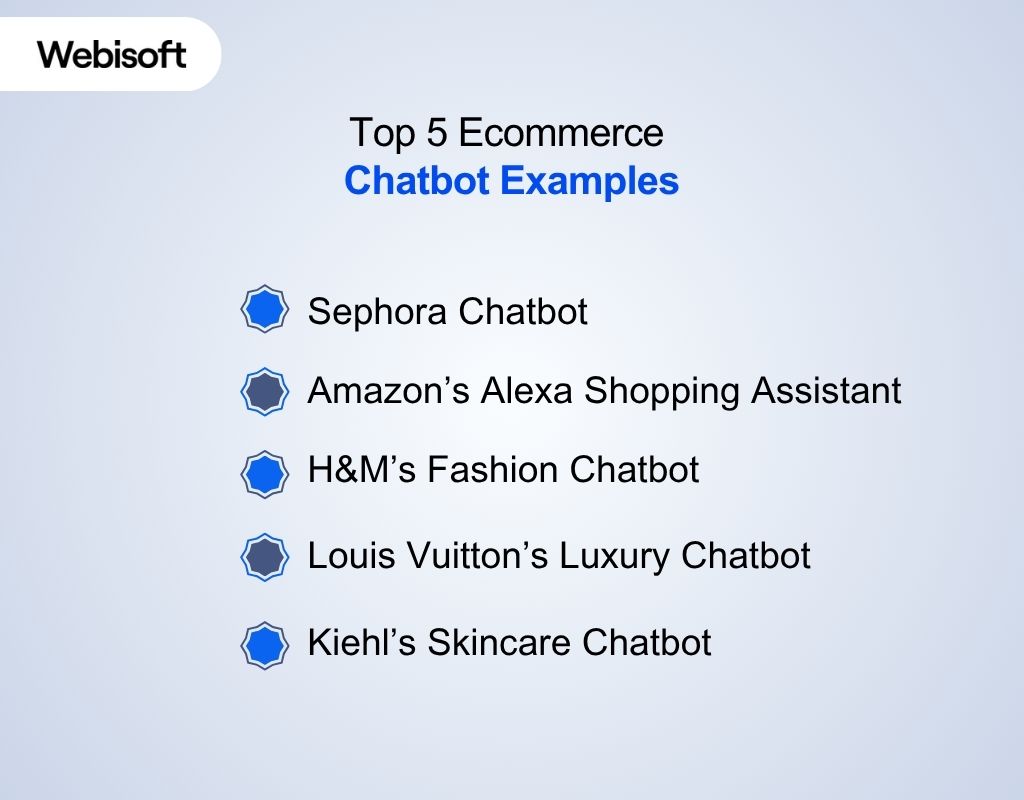
The fastest way to design a good chatbot is to study deployments that already work. Five that repay close attention:
1. Sephora
Sephora's chatbot gives beauty shoppers personalized product recommendations and virtual makeup try-on. It runs quizzes to learn a shopper's preferences, then suggests foundation shades or skincare routines against that profile, and it books in-store beauty services directly from the conversation.
The lesson: the quiz format converts an open-ended "what do you recommend?" problem into structured data the bot can act on reliably. That pattern transfers to any catalog with fit or preference dimensions.
2. Amazon's Alexa Shopping Assistant
Alexa handles voice-driven shopping: searching products, placing orders, tracking deliveries, and flagging deals on wish-list items. Amazon's upgraded assistant, Alexa+, adds generative AI capabilities on top; it is priced at $19.99 per month for non-Prime members and included with Prime.
The lesson: order status and reorders are the highest-frequency, lowest-ambiguity requests in commerce, which makes them the right first candidates for automation in any store.
3. H&M
H&M's chatbot acts as a virtual stylist. It asks about style preferences, proposes outfits, and lets shoppers vote on looks to sharpen future recommendations. Shoppers can save, share, and buy outfits inside the conversation.
The lesson: the voting loop is a feedback mechanism. Every interaction improves the recommendation model, so the bot gets more useful the longer a customer uses it.
4. Louis Vuitton
Louis Vuitton's chatbot brings the in-store advisory experience online. Built on natural language processing, it lets customers browse by color, size, or style, provides product care guidance, locates the nearest boutique, and lets shoppers share picks with a friend before buying.
The lesson: for high-consideration purchases, the bot's job is not to close fast. It is to remove friction from a long decision process without pressuring the customer.
5. Kiehl's
Kiehl's Messenger chatbot works like a skincare consultant: it asks about skin type, concerns, and goals before recommending products. It also explains ingredients in plain language, suggests complete routines rather than single products, and tracks orders so customers never need to open a support ticket for status.
If your products need guidance or follow-up, this is the kind of interactive chatbot worth studying. If you want one built for your own catalog, contact Webisoft.
How to Choose the Right Ecommerce Chatbot
The wrong chatbot is worse than none: it frustrates customers at the exact moment they wanted help. Evaluate candidates against these criteria before signing anything.
1. CRM and Order-System Integration
A chatbot that cannot read your order data is a glorified FAQ page. Connected to your CRM and order management system, it can:
- Update customer records automatically
- Send follow-up emails and personalized messages
- Recommend products based on purchase history
- Track orders, process returns, and close sales inside the chat
Check the integration depth, not just the logo wall. "Integrates with Shopify" can mean anything from full order-write access to a link that opens Shopify in a new tab.
2. Omnichannel Support
Customers message you from your website today and from Instagram or WhatsApp tomorrow. Your chatbot should:
- Answer questions on every channel your customers use
- Resume conversations where the shopper left off, across channels
- Follow up on abandoned carts even when the customer switched devices
A single-channel bot leaves the rest of your audience talking to nobody.
3. Escalation and Human Handoff
Every bot eventually hits a conversation it cannot handle: a fraud dispute, an angry customer, an edge-case return. What matters is how it fails. Look for automatic escalation triggers, full conversation context passed to the human agent, and clear expectations set for the customer about response time. A bot that traps users in a loop with no exit actively damages retention.
4. Visual Search Capability
Shoppers often have a picture instead of a product name. Visual search lets them upload an image and find similar items instantly, which matters most for catalogs where style and detail drive the purchase: clothing, home decor, accessories. If that describes your store, treat visual search as a differentiator worth paying for.
5. Analytics and Insights
A chatbot is also a measurement instrument. An AI powered chatbot should show you:
- How often conversations escalate to a human
- Which products generate the most questions
- Whether cart-recovery flows actually recover carts
- Which channels your customers prefer
Those signals feed back into product pages, policies, and marketing. Without them you are guessing at what works.
Buy vs. Build
Off-the-shelf platforms are the right call when your flows are standard: order status, returns, recommendations. A custom build wins when your requirements are not on any vendor's roadmap: proprietary pricing logic, integration with an in-house ERP, strict data-residency constraints, or an AI assistant grounded in your own product knowledge base. Custom also means you own the conversation data and the model behavior outright, with no per-conversation pricing that punishes growth. Webisoft builds this kind of custom conversational software end to end, from architecture through deployment.
What Are the Main Benefits of Using an Ecommerce Chatbot?
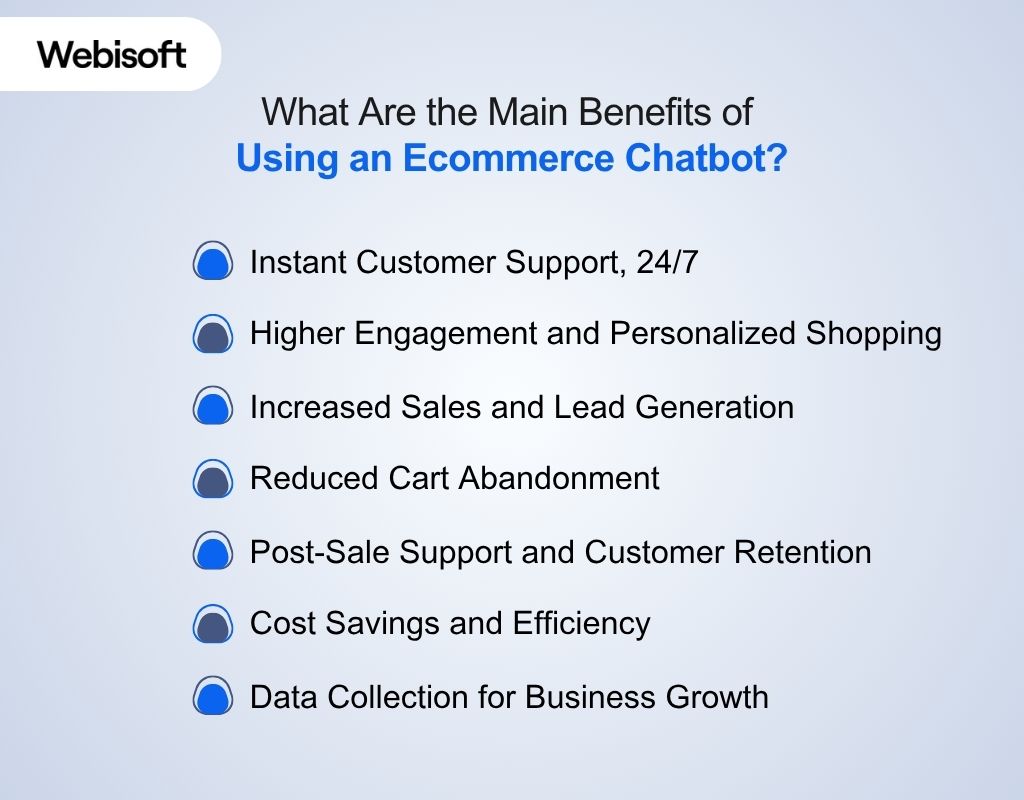
For an online store, the payoff shows up in four places: support cost, conversion rate, retention, and data. In detail:
1. Instant Customer Support, 24/7
Customers expect fast answers about orders, shipping, returns, and product details, including at 2 a.m. and during holiday spikes when your queue is worst. A chatbot's response time does not degrade with volume.
2. Higher Engagement and Personalized Shopping
A chatbot can recommend products against stated preferences, answer questions in real time, and surface relevant discount codes. Shopping becomes a conversation instead of a search problem.
3. Increased Sales and Lead Generation
Research published in Harvard Business Review found that 81% of customers attempt to resolve issues themselves before contacting a live representative. A chatbot meets that self-service preference at the moment of intent, and a shopper who gets an instant answer to "does this ship to Canada?" completes checkout instead of leaving to think about it.
4. Reduced Cart Abandonment
Chatbots can remind customers about pending carts and offer an incentive to finish. The mechanism is timing: the nudge arrives while intent is still warm, which is when it works.
5. Post-Sale Support and Customer Retention
The relationship should not end at checkout. A chatbot handles returns, order tracking, refunds, and product usage tips, and customers who get effortless post-sale service come back.
6. Cost Savings and Efficiency
Repetitive tickets are the most expensive work a human agent can do, because they consume paid hours without requiring judgment. Automating them frees your team for the complex cases where a human actually changes the outcome, and it lets support capacity scale without linear headcount growth.
7. Data Collection for Business Growth
Every conversation is structured evidence of customer behavior, preferences, and friction points. If dozens of shoppers ask the same sizing question, that is a product-page defect the chat log just diagnosed for you.
Conclusion
An ecommerce chatbot has moved from optional to expected. Shoppers assume instant answers, and stores that provide them convert and retain better than stores that make customers wait.
The decision that matters is fit: match the platform to your channels, your order stack, and your support volume, and insist on clean human handoff. And when no platform fits, build.
Webisoft is a Montreal-based software development firm that designs and ships custom conversational systems, from AI assistants grounded in your product data to full ecommerce integrations. Contact Webisoft to scope what a chatbot should do for your store.
Yes, through specific mechanisms: answering pre-purchase questions at the moment of intent so shoppers finish checkout instead of leaving, recovering abandoned carts with well-timed reminders, and recommending products based on stated preferences or purchase history. The gains depend on integration depth; a bot with no access to your catalog and order data cannot do any of this.
Build custom when your requirements exceed vendor roadmaps: proprietary business logic, integration with in-house systems such as an ERP, strict data-residency rules, or an AI assistant grounded in your own knowledge base. Custom development also gives you ownership of conversation data and model behavior. Webisoft, a Montreal-based software development firm, builds this kind of conversational system end to end.
A rule-based bot follows decision trees you design in advance, which makes it predictable but brittle when customers phrase things unexpectedly. An AI chatbot uses large language models to interpret free-form questions and, in well-built systems, retrieves answers from your product catalog, policies, and order data before responding, so it handles far more variety without scripting every path.
It depends on where you sell. Tidio and ChatBot are strong all-round website options, Chatfuel and ManyChat lead for Instagram, Messenger, and WhatsApp selling, Rep AI and Certainly go deepest on Shopify, and HubSpot's builder fits teams already on HubSpot CRM. Match the tool to your primary sales channel and your order stack rather than picking by feature count.
Entry plans run from free (ManyChat, Tidio, HubSpot) to roughly $24 to $65 per month for standard tiers, while conversion-focused AI platforms such as Certainly start around $399 per month. Watch the pricing model: many vendors charge per conversation or per visitor, so costs rise with traffic. A custom-built bot costs more upfront but removes per-conversation fees entirely.