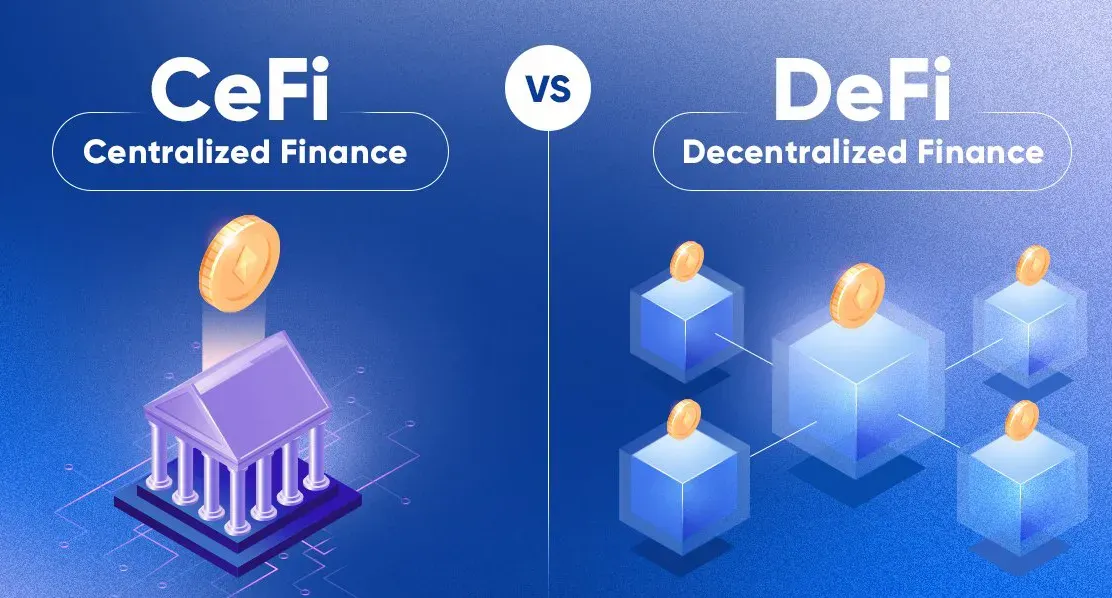
Centralized Finance (CeFi) and Decentralized Finance (DeFi) represent opposite models for handling user assets and money flow. Neither is universally better; they solve different problems.
How They Actually Differ
Control and Custody
In CeFi (Coinbase, Kraken, BlockFi), you deposit coins and the exchange holds them in a vault. You get an account balance but no private key. If the exchange goes offline or gets hacked, your coins are at risk. If regulators freeze the exchange, your access is blocked. In 2022, FTX collapsed and customers lost direct access to billions in deposits, though most funds were eventually recovered through the bankruptcy process.
In DeFi (Uniswap, Aave, MakerDAO), you hold private keys yourself. You connect your wallet (MetaMask, Ledger) to the protocol and interact with a smart contract. Only you control the keys. If the protocol goes down, your coins remain in your wallet. If a regulator targets the protocol developers, they cannot freeze your funds because the protocol is decentralized code, not a company with servers to shut down.
Verification and Trust
CeFi platforms run internal ledgers. You trust their accounting. Reputable exchanges are audited and insured by third parties, which provides some recourse if they lose your money. Kraken publishes quarterly proof-of-reserves reports. Coinbase is publicly traded and subject to SEC oversight. These safeguards cost time and money; exchanges charge trading fees (0.1-0.5% per transaction) to cover it.
DeFi protocols publish their code and transaction history on-chain. Anyone can verify balances, audit the smart contract logic, and see the exact transaction that moved coins. There is no central entity to sue if something goes wrong. If a protocol vulnerability is exploited, your loss is final. The trade-off: transparency and self-sovereignty, versus customer protection and recovery mechanisms.
Accessibility
CeFi requires know-your-customer (KYC): you provide government ID, proof of address, and sometimes a video call. This takes hours or days. Once onboarded, you have a familiar interface, customer support, and regulated settlement. CeFi works for investors who want to fund an account via bank transfer and buy coins without dealing with wallet keys.
DeFi requires no KYC. Generate a wallet locally (offline, using a hardware wallet like Ledger) and you can interact with any protocol immediately. No approval, no background check, no intermediary. The trade-off: complete responsibility for key management. Lose your private key and your coins are gone forever. No customer support can recover them.
Common Operations Compared
Trading
CeFi: You place an order for 1 BTC at 40k. Coinbase matches it with another user, charges a 0.25% fee, and settles in seconds on their ledger. You own the coins but Coinbase holds them.
DeFi: You connect your wallet to Uniswap. You specify the amount and acceptable slippage (price variance). A smart contract locks your funds, pulls an equivalent amount from the liquidity pool (provided by other users), and transfers the coins to your wallet. Fees go to the pool operators, not a company. If the pool runs out of coins, the trade fails and reverts. Transaction finality is blockchain confirmation time (15 seconds for Ethereum, 10 minutes for Bitcoin).
Borrowing
CeFi (BlockFi): Deposit 1 BTC with BlockFi, borrow 10k USD against it. You pay 8% APR. BlockFi lends your BTC to traders, earning 12% APR, keeping the spread. If the price of BTC drops below the collateral threshold, BlockFi liquidates your position and keeps the proceeds above what you owe.
DeFi (Aave): Deposit 2 ETH as collateral. Borrow 1000 DAI (stablecoin pegged to USD) backed by a smart contract. You pay 4% APR (variable, set by supply and demand). If ETH price drops, a liquidator bot notices your collateral is underwater and can seize it, selling it to recover the debt. You get the difference.
Risk Comparison
Counterparty Risk
CeFi: If the exchange is solvent, your funds are safe. If it goes bankrupt (FTX, Mt. Gox), you are in a creditor queue. Recovery can take years. Insurance (Gemini), SEC oversight (Kraken), and transparent reserves (some exchanges) reduce but do not eliminate this risk.
DeFi: If the code has no bugs and the protocol design is sound, funds cannot be stolen. If the code has bugs, the loss is immediate and irreversible. Audits (Certora, Trail of Bits) reduce vulnerability but provide no guarantee. Flash loan attacks (exploiting multiple price feeds in one transaction) and governance attacks (malicious token holders voting to change the protocol) are unique DeFi risks with no CeFi equivalent.
Custody Risk
CeFi: Exchange takes custody risk. You do not hold keys.
DeFi: You take custody risk. User error (sending coins to the wrong address, entering the private key into a phishing site) is the main loss vector. Hardware wallets reduce this significantly.
When to Use Each
Use CeFi if you: want to fund an account via bank transfer, need customer support, prefer a familiar UI, do not want to manage private keys, want insurance, or need to sell coins quickly to fiat.
Use DeFi if you: already hold cryptocurrency, want to earn interest or trade without KYC, want to provide liquidity, need transparency and cannot trust institutions, or are comfortable with solo custody of keys.
Hybrid approach: Use CeFi for on/off ramps (buying with USD, selling for USD) and core holdings. Use DeFi for earning, trading, and experimentation with smaller amounts.
Neither is categorically safer; they carry different risks. CeFi exposes you to counterparty risk: the platform can become insolvent, freeze withdrawals, or be hacked, as the Celsius and FTX failures showed. DeFi removes the intermediary but exposes you to smart contract exploits, oracle manipulation, and the total loss that follows a lost seed phrase. A sound approach is to use regulated CeFi for fiat access, keep long-term holdings in self-custody, and only allocate to DeFi protocols with strong audit histories.
Custody and execution. In CeFi, a company holds your assets and settles trades on its private internal ledger, so you trust the operator. In DeFi, you hold your own keys and smart contracts execute transactions directly on a public blockchain, so you trust the code. Every other difference, including transparency, compliance, speed, and failure modes, follows from that split.
Not at the protocol layer. DeFi smart contracts are permissionless, so any self-custodied wallet can interact with them without identity checks. In practice, most users still pass KYC at a centralized exchange to convert fiat into crypto before moving funds on-chain, and some DeFi front ends now apply geographic or compliance restrictions of their own.
Yes, and hybrid architectures are increasingly the norm. The typical user flow moves fiat through a CeFi exchange, then assets into self-custody for DeFi protocols, and back out to exit. On the product side, exchanges route customer funds into on-chain yield, and custodial apps are built on top of DeFi liquidity. The engineering challenge is keeping trust boundaries explicit so users know which risks they hold at each step.
It depends on what the product needs. Choose CeFi rails when users expect fiat deposits, account recovery, and a compliance posture that maps to existing licensing. Choose DeFi rails when the product needs programmable settlement, non-custodial guarantees, or composability with existing on-chain protocols. Many products end up hybrid, and the architecture decision should be made deliberately at design time rather than retrofitted.