Alchemy is one of the most widely used infrastructure platforms in Web3. It sells managed access to blockchain nodes, plus the APIs, SDKs, webhooks, and monitoring tools that sit on top of them. If you are building a dApp, an NFT product, or a DeFi protocol, Alchemy represents one of the first architectural decisions you will face: run your own nodes, or pay a provider to run them for you.
This guide explains what Alchemy actually does, how its core products fit together, what the pricing tiers look like, and where the trade-offs are, so you can decide whether it belongs in your stack. Webisoft, a Montreal-based software and blockchain development firm, uses node providers like Alchemy on client projects, and the practical notes below come from that engineering perspective.
What is Alchemy Blockchain?
Alchemy is a blockchain developer platform that provides hosted node infrastructure and higher-level APIs for building, scaling, and monitoring blockchain applications. Instead of provisioning and maintaining your own Ethereum or L2 nodes, you point your application at Alchemy's endpoints and consume blockchain data over standard JSON-RPC plus Alchemy's enhanced APIs.
To understand why that matters, consider what a node actually is. Every read from a blockchain (an account balance, a transaction receipt, a contract's state) and every write (a signed transaction broadcast) goes through a node that participates in the network. Running production-grade nodes is an operations problem, not a blockchain problem: full nodes consume hundreds of gigabytes of fast SSD storage, archive nodes consume terabytes, clients need frequent upgrades around hard forks, and a node that falls out of sync silently serves stale data to your users.
Alchemy abstracts all of that behind a load-balanced fleet of nodes with a consistency layer on top, so requests hitting different physical machines still return a coherent view of chain state. It supports Ethereum mainnet and testnets, major L2s such as Arbitrum, Optimism, Base, and Polygon, and additional networks including Solana, which lets one integration serve several blockchain ecosystem solutions.
What Does Alchemy Do?
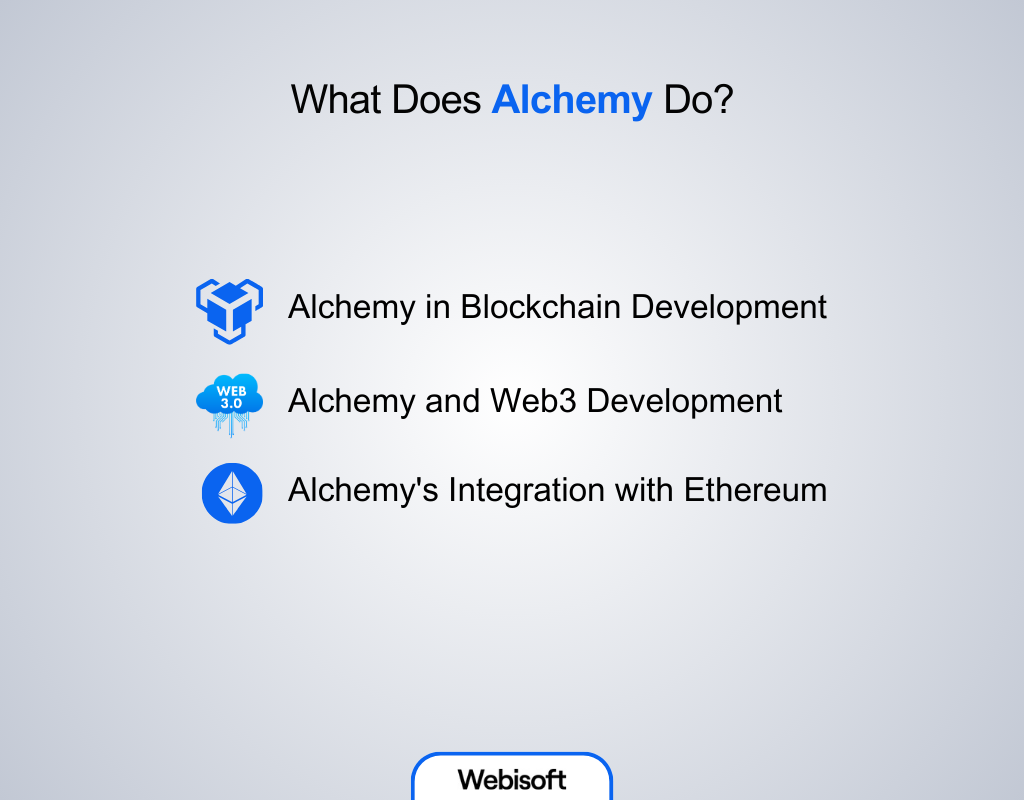
Alchemy sits between your application and the blockchain networks it talks to. In practice, its role breaks down into three layers: raw node access, enhanced data APIs, and developer tooling.
Alchemy in Blockchain Development
At the base layer, Alchemy is a node provider. Your backend or frontend sends JSON-RPC calls (eth_call, eth_getLogs, eth_sendRawTransaction, and the rest) to an Alchemy endpoint instead of to a node you operate. That single change removes node provisioning, sync monitoring, client upgrades, and failover from your responsibilities.
For teams building decentralized applications, this is usually the right starting point. A dApp's differentiation lives in its contracts and product, not in how well it babysits geth or reth processes. Delegating node operations shortens the path from prototype to production and keeps your DevOps surface small.
Alchemy and Web3 Development
Above raw RPC, Alchemy exposes enhanced APIs that answer questions raw nodes answer poorly. A standard node has no efficient way to answer "list every NFT this wallet owns" or "show all token transfers for this address across its history." Reconstructing that from raw logs means scanning enormous block ranges. Alchemy indexes chain data ahead of time and exposes it through purpose-built endpoints: an NFT API, a Token API, a Transfers API, and trace and debug methods for inspecting transaction execution.
The platform also ships an SDK that wraps these APIs with retries, request batching, and WebSocket support, which removes a class of reliability boilerplate that most teams otherwise write themselves.
Alchemy's Integration with Ethereum
Ethereum remains Alchemy's deepest integration. Beyond standard endpoints, it provides mempool visibility for watching pending transactions, debug and trace APIs for stepping through failed calls, and gas management tooling for sponsoring user transactions under account abstraction (ERC-4337) flows. If your product runs on Ethereum or an EVM L2, the tooling coverage is broad enough that you rarely need to fall back to a self-hosted node for development work.
Features of Alchemy Blockchain
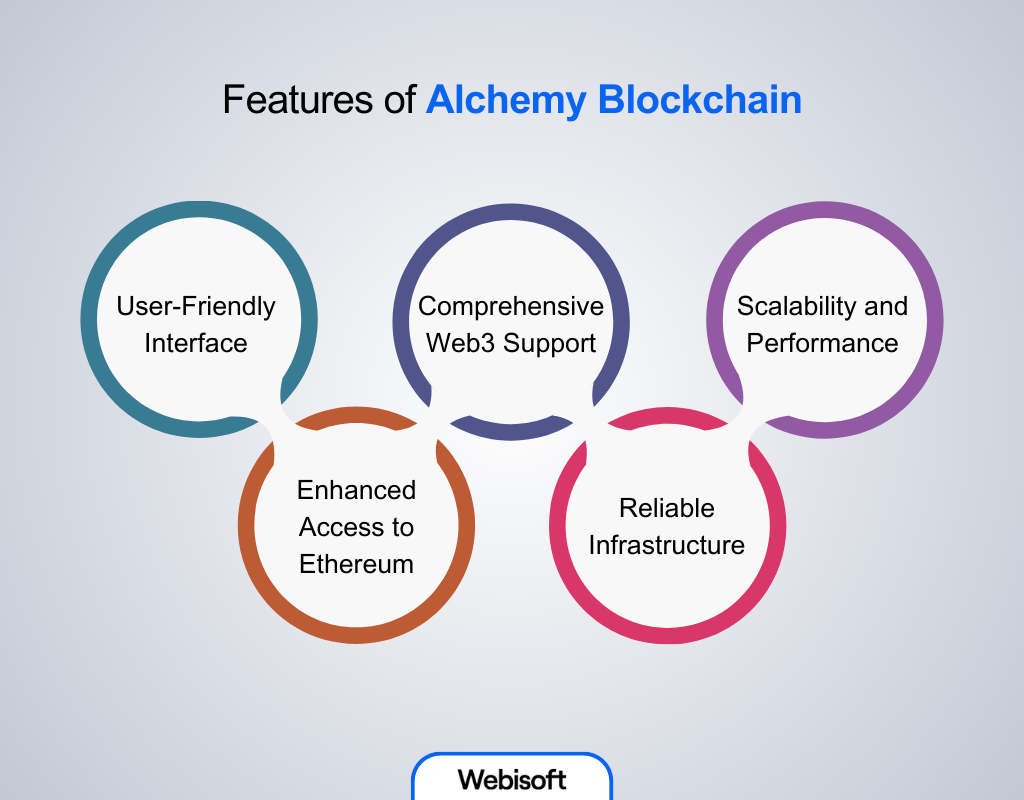
The table below summarizes the platform capabilities that matter most in production, followed by what each one means in engineering terms.
| Feature | What it means in practice |
|---|---|
| Managed node fleet | Load-balanced nodes with a consistency layer, so you never chase sync issues or stale reads. |
| Enhanced data APIs | Pre-indexed NFT, token, and transfer data that raw JSON-RPC cannot serve efficiently. |
| Multichain coverage | One integration for Ethereum, major L2s (Arbitrum, Optimism, Base, Polygon), and Solana. |
| Webhooks and notifications | Push events on address activity, mined or dropped transactions, and NFT movements. |
| Observability dashboard | Per-method request analytics, error rates, and usage tracking for capacity planning. |
| Elastic throughput | Usage measured in compute units that scale with load instead of fixed node capacity. |
Managed Node Fleet
Alchemy's core engineering claim is reliability at the node layer. Requests are distributed across many nodes, and a coordination layer ensures a consistent view of the chain even when individual nodes lag. For your application, the observable effect is that reads do not flicker between block heights and writes propagate predictably.
Enhanced Access to Ethereum
Debugging on-chain behavior without trace APIs is slow. Alchemy's debug and trace endpoints let you replay a transaction and inspect each internal call, which turns "the transaction reverted and we do not know why" into a readable execution trace. Combined with mempool watching, this covers most of the diagnostic workflow for EVM development.
Comprehensive Web3 Support
The enhanced API surface (NFT, Token, Transfers) is what separates node providers from bare RPC hosting. If your product displays wallet contents, transfer histories, or NFT metadata, these endpoints replace what would otherwise be a significant in-house indexing project on blockchain platforms.
Reliable Infrastructure
Node providers earn their fee during volatile periods. NFT mints, liquidation cascades, and airdrop claims all generate traffic spikes exactly when chain state is changing fastest. A managed fleet absorbs those spikes better than a single self-hosted node, which tends to fall behind on sync precisely when you need it most.
Scalability and Performance
Because usage is metered in compute units rather than fixed node instances, throughput scales with demand. You do not pre-provision for peak load; you pay for what your traffic actually consumes, and you can add rate-limit headroom by moving up a tier.
Benefits of Alchemy Blockchain
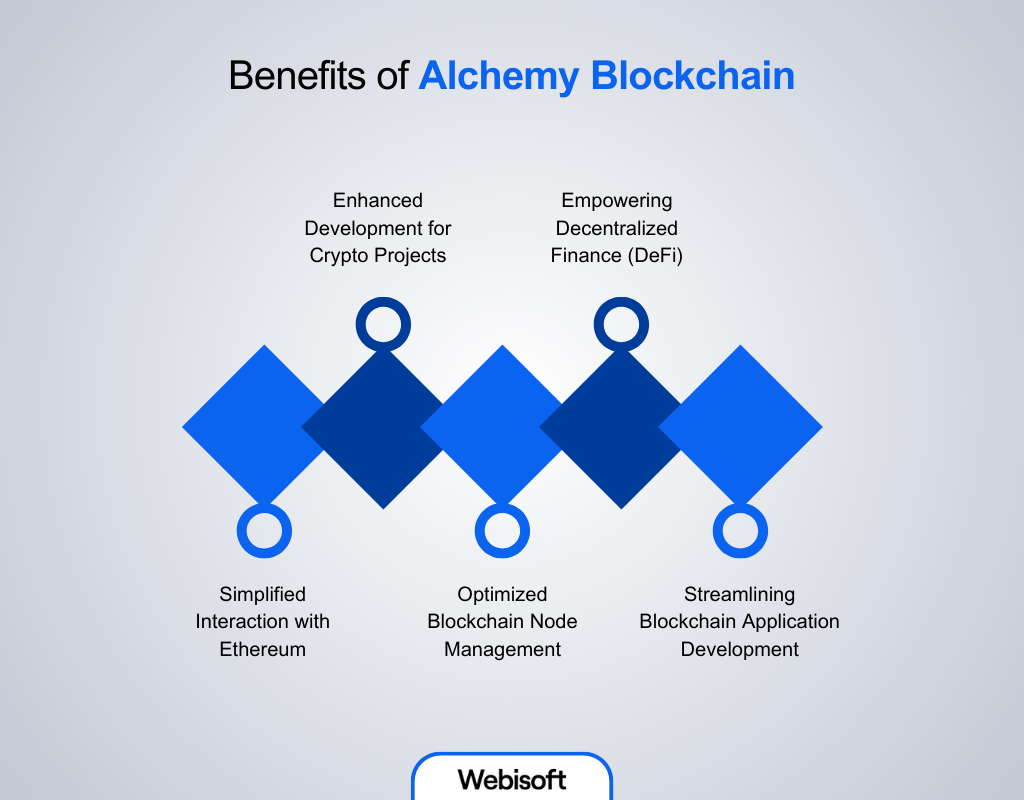
Feature lists aside, these are the concrete outcomes teams get from adopting a managed node platform.
Simplified Interaction with Ethereum
Your team writes application logic against stable endpoints instead of operating blockchain clients. Client upgrades around network hard forks, storage growth, and peer connectivity all become Alchemy's problem. For most product teams, this is the single largest benefit: node operations expertise is expensive and rarely core to the business.
Faster Development for Crypto Projects
The SDK, pre-indexed APIs, and hosted testnet access compress early development. A wallet view, a transfer history page, or an NFT gallery can be built against enhanced APIs in days rather than the weeks an in-house indexer would take. That speed matters most before product-market fit, when iteration rate is the constraint.
Optimized Blockchain Node Management
Self-hosted nodes fail in quiet ways: a client version misses a fork and follows a dead chain, disk fills mid-sync, or peers drop and the node serves data minutes behind head. Each failure mode surfaces as a confusing application bug. Outsourcing node management converts that entire failure class into a vendor SLA.
Supporting Decentralized Finance (DeFi)
DeFi applications are unusually sensitive to read freshness and write latency. A lending frontend showing stale collateral ratios or a swap interface broadcasting through a lagging node produces real user losses. Reliable RPC with mempool visibility and trace debugging is close to mandatory for DeFi work, and this is the segment where managed infrastructure most clearly pays for itself.
Streamlined Application Development
Webhooks deserve specific mention. Polling a chain for "did this address receive funds" wastes compute units and adds latency. Alchemy's webhook system pushes address activity, mined and dropped transaction events, and NFT transfers to your backend, which inverts the integration from pull to push and simplifies both code and billing.
Core Products of Alchemy in Blockchain
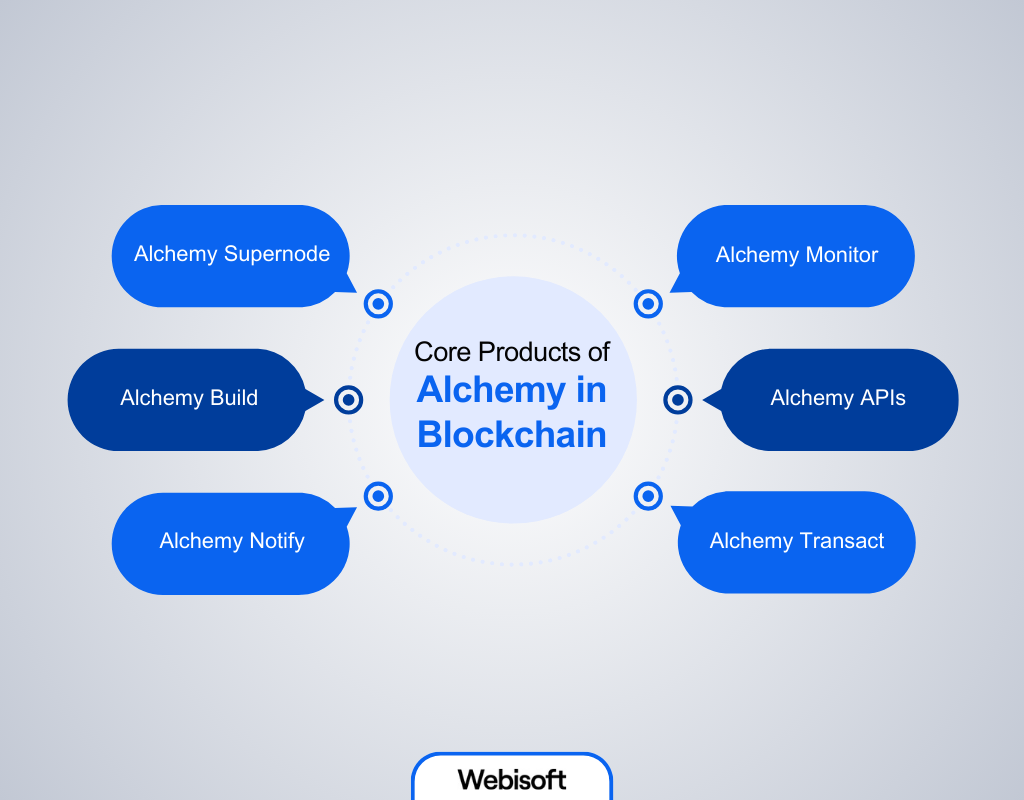
Alchemy packages its platform as a set of named products. Here is what each one covers and when you would reach for it in blockchain development.
Alchemy Supernode
Supernode is the node infrastructure product: the load-balanced, consistency-managed fleet described above, exposed through standard JSON-RPC and WebSocket endpoints. Everything else in the platform builds on it. If you adopt only one Alchemy product, it is this one, replacing self-hosted nodes for reads and transaction broadcast.
Alchemy Build
Build is the developer tooling suite: a request composer for testing RPC calls, a mempool visualizer, and debugging views that show recent requests and errors. It is most useful during integration work, when you are diagnosing why a call fails or verifying what your application actually sent.
Alchemy Notify
Notify is the webhook product. You register webhooks for address activity, mined or dropped transactions, and NFT activity, and Alchemy calls your endpoint when the event occurs. Typical uses are payment confirmation flows, deposit detection for custodial products, and user-facing transaction status updates.
Alchemy Monitor
Monitor is the observability dashboard: request volumes broken down by RPC method, error rates, and compute unit consumption. In practice it doubles as a cost-control tool, since a single inefficient query pattern (commonly an unbounded eth_getLogs scan) can dominate a monthly bill and shows up immediately in the per-method breakdown.
Alchemy APIs
The enhanced API family covers NFTs (ownership, metadata, floor prices), tokens (balances and metadata), and transfers (full historical transfer records for an address). These are the endpoints that replace in-house indexing, and they are also the layer where switching providers later costs the most, since they are Alchemy-specific rather than standard JSON-RPC.
Alchemy Transact
Transact focuses on the write path: transaction simulation before broadcast, reinforced transaction delivery, and gas sponsorship tooling for account abstraction flows where your application pays fees on behalf of users. Simulation is particularly valuable because it catches reverts before a user signs, which saves both gas and support tickets.
Alchemy Blockchain Pricing Plans
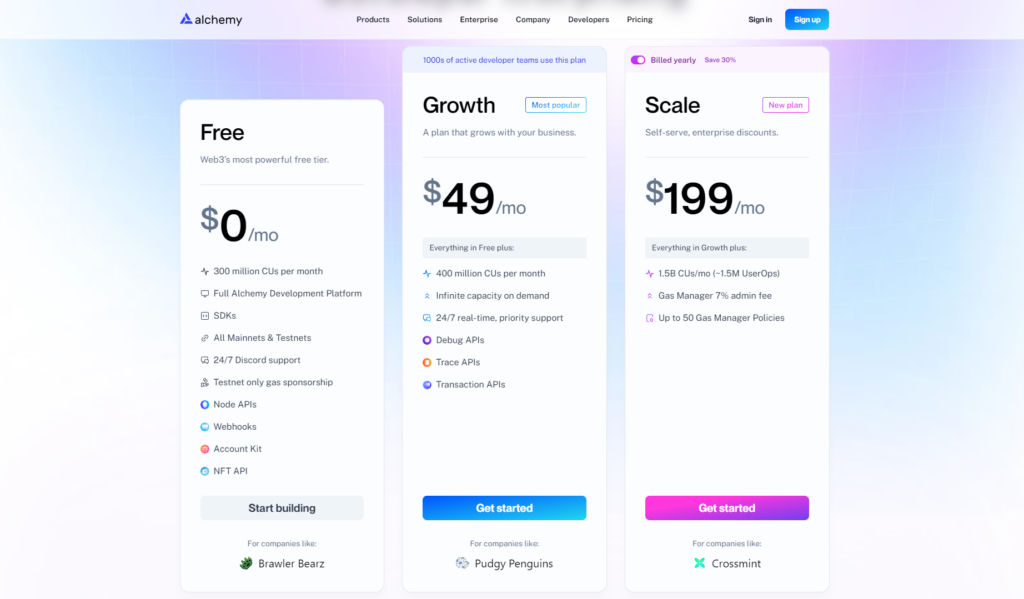
Alchemy meters usage in compute units, a weighted measure where heavier RPC methods cost more units than light ones. Tiers differ mainly in included units, throughput ceilings, and support. The published tiers at the time of writing are summarized below; check the official Alchemy pricing page for current numbers, since limits and prices change.
Free Tier
The free tier includes a monthly compute unit allowance large enough for prototypes, hackathon projects, and low-traffic production apps. It covers all supported networks and the core API surface, which makes it a genuine evaluation tier rather than a demo. Most teams should start here and instrument usage before paying anything.
Growth Tier
The paid Growth tier raises the included compute units, removes hard capacity ceilings in favor of on-demand billing for overages, and adds priority support. It fits products with real but moderate traffic: a live dApp with a growing user base that occasionally spikes past free-tier limits.
Scale and Enterprise Tiers
Higher tiers add substantially larger unit allowances, gas manager policies for sponsored transactions, higher throughput guarantees, and contractual SLAs. These matter for products where RPC is in the critical path of revenue: exchanges, wallets, DeFi protocols, and NFT platforms operating at sustained volume. At this level, pricing is worth negotiating directly.
Trade-offs: Alchemy vs Self-Hosting and Other Providers
A senior engineering view of Alchemy has to include what you give up. Three trade-offs are worth weighing before committing.
- Vendor dependency. Standard JSON-RPC calls are portable to any provider (Infura, QuickNode, or a self-hosted node), but the enhanced NFT, Token, and Transfers APIs are Alchemy-specific. The more you build on them, the higher your switching cost. A clean abstraction layer over provider-specific calls keeps that cost bounded.
- Centralization risk. Routing all reads and writes through one provider creates a single point of failure and, for some teams, a censorship concern. Production deployments commonly configure a fallback provider or a light self-hosted node for transaction broadcast so an outage degrades rather than halts the product.
- Cost at scale. Metered pricing is cheap early and can exceed the cost of dedicated infrastructure at very high sustained volume. Teams with heavy archive-data workloads sometimes run their own archive node for bulk indexing while keeping a provider for serving user traffic. The right split depends on your query mix, which is exactly what the Monitor dashboard helps you measure.
None of these are reasons to avoid managed infrastructure. They are reasons to adopt it deliberately, with an exit path designed in from the start.
How Webisoft Helps You
Choosing a node provider is one decision inside a larger architecture: contract design, indexing strategy, wallet UX, and the off-chain services that make a blockchain product usable. Webisoft is a Montreal-based software development firm that builds blockchain products end to end, from smart contracts and protocol integration to the backend and frontend around them, and that includes setting up Alchemy (or an alternative) correctly for your workload.
If you are planning a dApp, a DeFi product, or an NFT platform and want the infrastructure decisions made by people who have shipped them before, contact Webisoft and we will scope it with you.
Alchemy supports Ethereum mainnet and testnets, major EVM layer 2 networks such as Arbitrum, Optimism, Base, and Polygon, and additional non-EVM networks including Solana. One integration can therefore serve applications that span several chains.
A self-hosted node gives you full control but makes you responsible for storage growth, client upgrades around hard forks, sync monitoring, and failover. Alchemy replaces that operational burden with a load-balanced node fleet and a consistency layer, plus indexed APIs (NFT, token, transfer data) that a single raw node cannot serve efficiently.
The main trade-offs are vendor dependency on Alchemy-specific enhanced APIs, a single point of failure if you route all traffic through one provider, and metered costs that can grow at very high sustained volume. Teams typically mitigate these with an abstraction layer over provider calls and a fallback RPC provider.
Yes. Webisoft is a Montreal-based software development firm that builds blockchain products end to end, including smart contracts, backend services, and infrastructure setup. That covers selecting and configuring a node provider such as Alchemy for your specific workload and query patterns.
Alchemy is a blockchain developer platform that provides hosted node infrastructure plus higher-level APIs, SDKs, webhooks, and monitoring tools. Instead of running your own Ethereum or L2 nodes, your application sends requests to Alchemy's managed endpoints for reading chain data and broadcasting transactions.
Alchemy has a free tier with a monthly compute unit allowance that is sufficient for prototypes and low-traffic applications, along with paid Growth, Scale, and Enterprise tiers that add capacity, throughput, and support. Current limits and prices are listed on Alchemy's official pricing page.