AI spending in the United States keeps setting records, and so does the number of firms claiming they can build production AI. According to McKinsey's State of AI research, most organizations now use AI in at least one business function, yet far fewer report meaningful bottom-line impact. The gap is usually the build partner. A polished prototype is easy. A system that survives real data, real traffic, and a real compliance review is not. This guide profiles the top AI development companies in USA that ship working systems, explains the criteria behind the ranking, and covers the questions worth asking and the mistakes that sink most vendor selections.
Our Selection Criteria for Top AI Development Companies in USA
Plenty of agencies in the U.S. market advertise AI expertise. Far fewer can show a model running in production a year after launch. Each firm below was reviewed against five factors:
- Proven deployment record: Real AI systems running in production for paying clients, not pilots, hackathon demos, or thin wrappers around a public API.
- Industry specialization: Working knowledge of the rules and data realities of specific sectors such as healthcare, finance, or retail. Domain constraints, like HIPAA data handling or model explainability requirements in lending, shape the architecture from day one.
- Scalable architecture and MLOps readiness: Models degrade as data drifts. A serious firm builds for retraining, monitoring, and versioning from the start, because the alternative is an accurate demo that quietly rots in production.
- Clear process: Transparent scoping, defined milestones, and regular progress reviews, so you know what you are paying for at every stage.
- Visible results: Outcomes clients can measure: faster processing, lower operating cost, or higher accuracy against a stated baseline.
If you want to understand what these projects involve before you evaluate vendors, Webisoft's guide on how to make AI breaks down each stage from data preparation to deployment.
Top 10 AI Development Companies in USA (2025 Edition)
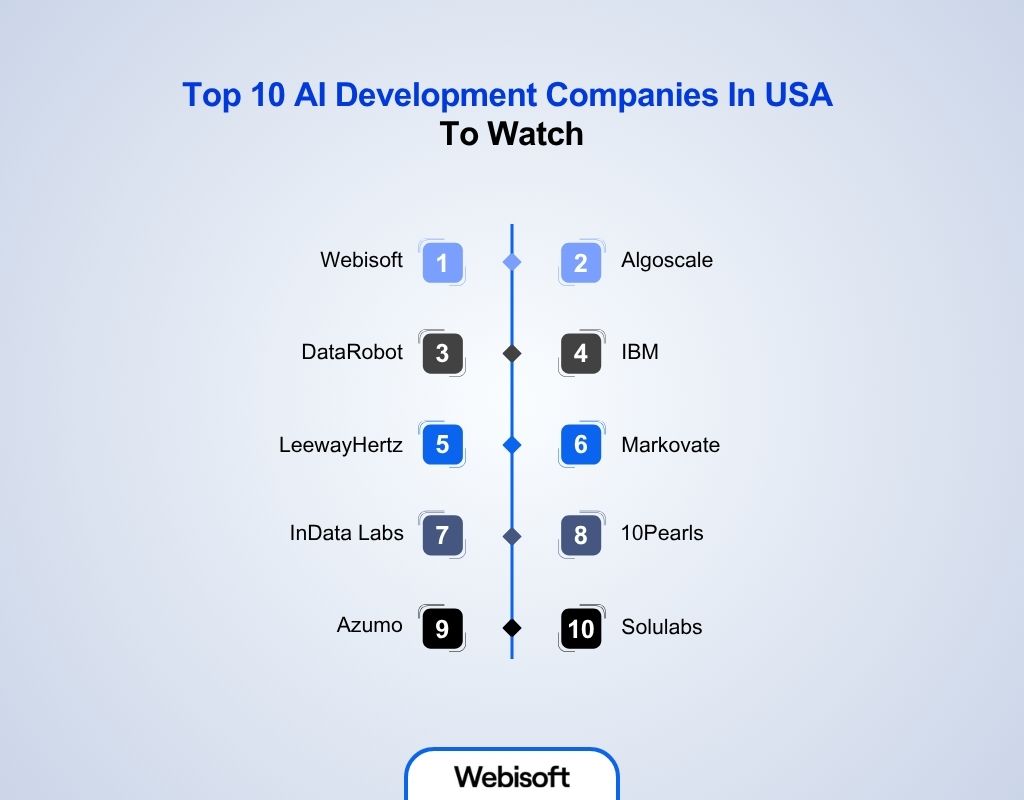
After assessing each firm against the criteria above, here is the shortlist. The table gives you the fast comparison; the profiles below explain what each firm actually does well and where it fits best.
| Company | Core strength | Best fit |
|---|---|---|
| Webisoft | Full-cycle custom AI engineering, LLM and RAG integration | Teams that need strategy plus deep engineering in one partner |
| Algoscale | Data engineering plus applied AI product work | AI features embedded in software products |
| DataRobot | Enterprise AutoML and AI governance platform | Enterprises standardizing ML operations on one platform |
| IBM | watsonx platform, hybrid cloud, governance tooling | Large enterprises with strict compliance needs |
| LeewayHertz | Generative AI and custom AI agent development | Custom AI systems integrated into existing workflows |
| Markovate | Generative AI and intelligent automation delivery | Companies adopting AI with minimal disruption |
| InData Labs | Data-first AI engineering and predictive analytics | Organizations that need data infrastructure fixed first |
| 10Pearls | AI-powered digital products, design plus engineering | Product teams that want UX and ML built together |
| Azumo | Nearshore AI teams working U.S. hours | Budget-conscious builds with tight U.S. coordination |
| SoluLab | End-to-end AI, ML, and integration services | Broad-scope AI programs across multiple functions |
1. Webisoft
Webisoft is a Montreal-based software engineering firm that works extensively with U.S. clients, and it belongs on any shortlist of AI development companies in USA buyers should evaluate. The team covers the full cycle: scoping, data preparation, model integration, deployment, and the operational work that keeps a system accurate after launch. Rather than reselling a platform, Webisoft engineers around your existing stack, embedding LLMs, retrieval pipelines, and decision automation into the systems you already run. Clients on the U.S. East Coast get same-timezone collaboration, including dedicated AI services in New York. The first consultation is free and focuses on scoping your specific problem, not pitching a package. Start with Webisoft's artificial intelligence services.
Key Features:
- Fractional CTO & advisory: Strategic guidance on AI architecture, build-versus-buy decisions, and long-term technical planning.
- LLM integration services: Embeds large language models into real workflows, with prompt design, evaluation, and guardrails handled as engineering work, not guesswork.
- Automated decision systems: Real-time, data-driven automation for operational decisions that previously required manual review.
- OCR & document AI: Converts unstructured files into accurate, searchable, process-ready data.
- Scalable model architecture: Pipelines built with retraining, versioning, and monitoring in place so accuracy holds as your data changes.
Best for: AI initiatives that need deep engineering, integration into existing systems, and strategic guidance from the same team.
2. Algoscale
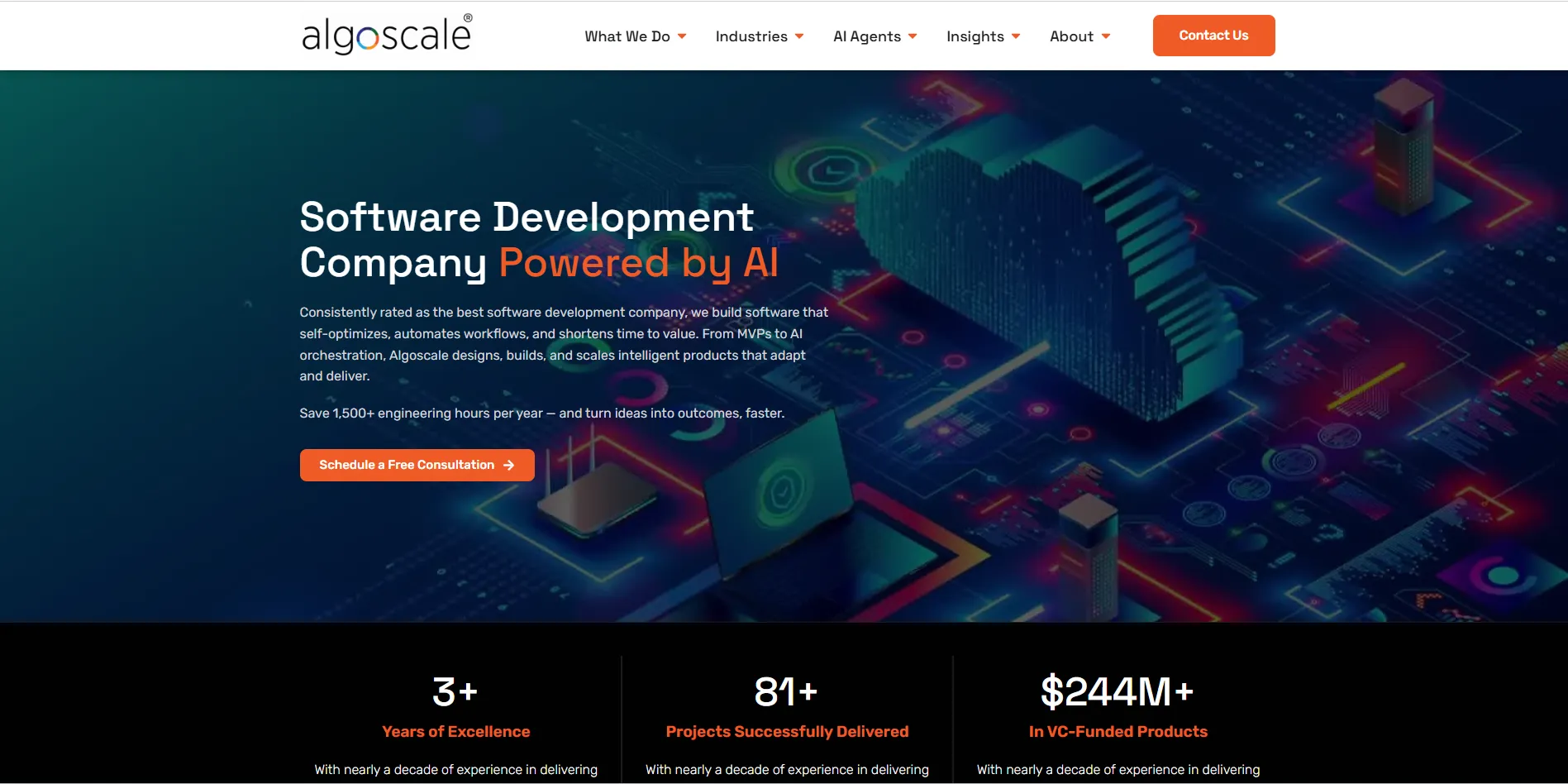
Algoscale is a U.S.-based AI and software engineering firm headquartered in Newark, NJ. Its work spans custom AI development, data services, and generative AI, and the firm supports clients from prototype through scaled deployment. What sets Algoscale apart is the data engineering backbone: the team treats pipelines, storage architecture, and data quality as first-class problems rather than afterthoughts, which is where many AI projects actually fail. Cross-disciplinary teams deliver AI-augmented applications, decision engines, and intelligence embedded directly into software products.
Key Features:
- Data engineering backbone: Scalable pipelines and robust storage architectures built before modeling starts.
- Generative AI integration: Embedding workflows, LLM integration, and generative models in production software.
- AI consulting & strategy: Use-case definition, risk assessment, and adoption roadmaps.
- Automation across CI/CD & testing: AI folded into development workflows, not bolted on afterward.
- Domain adaptability: Delivery experience across retail, healthcare, finance, and technology.
Best for: Projects that demand tight integration of AI into software products with full data engineering support.
3. DataRobot
DataRobot is an enterprise AI platform rather than a services shop, and that distinction matters when you compare it against the consultancies on this list. The platform automates model training, deployment, and governance, and the company has been recognized as a leader in Gartner Magic Quadrant evaluations for its category. The trade-off is the platform model itself: you get speed and standardized governance, but your team still owns problem framing, data quality, and adoption. It integrates with existing enterprise infrastructure and provides governance frameworks and real-time monitoring for compliant AI deployment at scale.
Key Features:
- AutoML pipelines: Automated model training and selection across hundreds of algorithms.
- Model explainability tools: Transparency into model behavior and decision logic, which matters in regulated industries.
- Governance & compliance frameworks: Embedded audit trails and access controls.
- Deployment flexibility: Cloud, on-premises, and hybrid environments.
- Monitoring & drift detection: Alerts when data shifts or performance degrades in production.
Best for: Enterprises that want a single AI platform with strong governance and automation, and have the internal team to run it.
4. IBM
IBM remains one of the most established names in enterprise AI. With watsonx and the Granite family of open models, IBM helps large organizations build, deploy, and govern AI across hybrid cloud environments. Its strength is depth: consulting, infrastructure, and governance tooling under one roof, with a long institutional record on responsible AI. The trade-off is scale itself. IBM's process and pricing are structured for enterprises, so smaller teams often find leaner partners a better fit. For organizations with strict compliance requirements and complex legacy estates, that enterprise weight is exactly the point.
Key Features:
- watsonx platform: A full suite for building, tuning, and deploying AI models.
- Granite models: Open-source foundation models built for enterprise customization.
- Hybrid cloud integration: Deployment across on-premises and cloud environments.
- AI governance tools: Built-in model transparency and compliance features.
- Industry-specific solutions: Tailored AI applications for sectors such as finance and healthcare.
Best for: Enterprises seeking scalable AI with strong governance and a partner that can handle regulatory scrutiny.
5. LeewayHertz
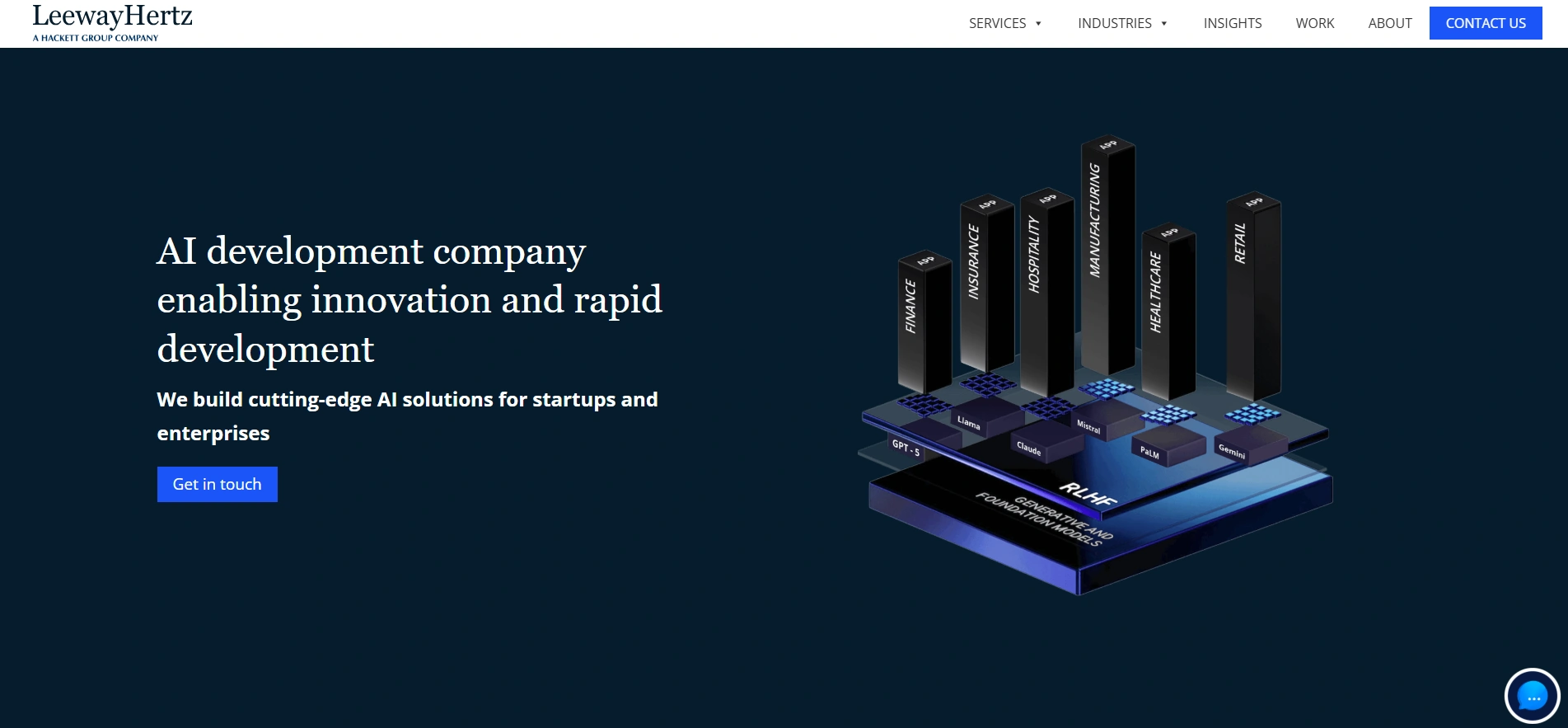
LeewayHertz is an established AI development company in the U.S. market specializing in generative AI, custom AI agents, and enterprise-grade systems. The firm has a long software delivery record across healthcare, finance, logistics, and manufacturing, and its AI practice covers strategy consulting, custom application development, and integration into existing workflows. Its agent development work is notable: task-specific agents built around a client's actual processes rather than generic assistants, which is the difference between automation that sticks and automation that gets switched off.
Key Features:
- Generative AI development: Custom systems built on models such as GPT, Llama, and other foundation models.
- AI agent development: Task-specific agents designed around real operational workflows.
- Enterprise AI integration: Embedding AI into existing business systems without a rip-and-replace.
- AI-as-a-service: Managed platforms for businesses without in-house ML expertise.
- Post-deployment support: Ongoing maintenance, retraining, and optimization.
Best for: Businesses that want custom AI systems integrated cleanly into the tools they already use.
6. Markovate
Markovate is an AI development company focused on generative AI, intelligent automation, and custom AI applications, with delivery experience across healthcare, finance, retail, and manufacturing. The firm's emphasis is adoption: AI that fits into a client's existing operations and scales over time, rather than a standalone system the business has to reorganize around. That shows up in its integration-first engineering approach and in flexible engagement models for companies that lack in-house AI teams.
Key Features:
- Generative AI development: Context-aware models for content generation and workflow automation.
- AI agent solutions: Intelligent agents that automate tasks and support decision-making.
- System integration: AI embedded into existing operations without disruption.
- Scalable AI platforms: Flexible AI-as-a-service options for teams with limited internal resources.
- Ongoing AI support: Continuous optimization and updates after deployment.
Best for: Companies that want advanced AI adopted with minimal disruption and room to scale.
7. InData Labs
InData Labs builds AI-powered software with a data-first philosophy: fix the pipelines and the data architecture before training anything. With global engineering talent and active U.S. outreach, the firm delivers custom AI and analytics systems that plug into a client's existing ecosystem. Its portfolio spans data pipelines, predictive platforms, and full AI stacks, with a consistent emphasis on practical value: reduced risk, faster delivery, and models that hold up outside the lab.
Key Features:
- Custom AI engineering: Models built for specific client problems, not repackaged templates.
- Data architecture design: Pipelines and storage structured for performance and reliability.
- Predictive modeling services: Forecasting, classification, and clustering for operational decisions.
- Analytics & visualization: Dashboards and reporting interfaces that make model output usable.
- Operational support: Model updates, performance tuning, and error management after launch.
Best for: Organizations whose AI ambitions are currently blocked by messy or fragmented data infrastructure.
8. 10Pearls
10Pearls is a digital product company that builds AI into products people actually want to use, uniting design, data, and engineering in one delivery team. Its services run end to end, from consulting and strategy through deployment and optimization, with agile delivery and a human-centered design practice. That pairing matters more than it sounds: many technically sound AI features fail because users route around them, and 10Pearls addresses adoption as a design problem, not an afterthought.
Key Features:
- Generative AI & ML services: Domain-specific models and workflows.
- AI consulting & assessment: Strategy, value analysis, and risk definition before build.
- Data engineering & pipelines: Data cleaned, prepared, and structured for AI.
- Product-first development: AI features aligned with real user needs and behavior.
- Cloud & DevOps automation: Automated infrastructure and deployment pipelines.
Best for: Businesses that want AI-driven products where design and engineering work in lockstep.
9. Azumo
Azumo builds AI-powered software through a nearshore model: engineering teams aligned to U.S. time zones, working under SOC 2 compliant processes. The firm delivers AI, data, web, and mobile projects for both startups and enterprises, with chatbots and conversational AI as a particular specialty. The nearshore structure is the core trade-off to evaluate: you get lower cost than a fully U.S.-based team with far better overlap and communication than offshore, at the price of a distributed setup. Daily standups, weekly reviews, and built-in redundancy keep delivery visible.
Key Features:
- SOC 2 compliance: Audited processes and data safeguards.
- AI & ML services: Custom models, chatbots, embeddings, and predictive tools.
- Flexible staffing models: Dedicated teams or staff augmentation.
- Delivery visibility: Daily standups, weekly reviews, and built-in redundancy.
Best for: Businesses that need cost-efficient AI delivery with tight U.S.-hours coordination.
10. SoluLab
SoluLab delivers custom AI systems for the U.S. market, with roots in Asia and an established American client base. Its services span generative AI, machine learning, and AI integration, applied across healthcare, logistics, education, and retail. The firm's breadth is its main appeal: intelligent applications, workflow automation, and AI consulting under one engagement, which suits organizations that want a single partner across several AI initiatives rather than a specialist per project.
Key Features:
- Generative AI development: AI models for content generation and automation.
- AI integration services: Embedding AI capabilities into existing systems.
- Machine learning solutions: Predictive models that improve decision-making.
- AI consulting: Strategic guidance on adoption and implementation.
- Post-deployment support: Ongoing maintenance and optimization.
Best for: Organizations seeking broad, end-to-end AI delivery from a single partner.
What to Look For When Selecting an AI Development Company
The shortlist narrows the field, but the final call depends on fit with your specific project. These are the factors that separate a partner from a vendor:
- Live performance, not promises: Ask to see systems in production and talk to the clients running them. A firm that cannot point to a deployed system older than six months is selling potential, not capability.
- A reality check on data handling: Good teams audit, clean, and validate your data before modeling, and they will tell you early if your data cannot support the project. Be suspicious of anyone who quotes a fixed price before seeing your data.
- Built for the lifecycle, not one-time builds: Model accuracy decays as real-world data drifts from the training set. Insist on retraining schedules, versioning, and monitoring in the statement of work.
- Risk-aware design: Compliance with the laws that apply to your data (HIPAA, GDPR, SOC 2) has to be designed in from the start. Retrofitting security onto a finished system costs more and works worse.
- Tailored customization: The model should adapt to your domain and terminology. Generic bolt-on solutions produce generic results.
- Expandable architecture: Confirm the system can grow with you across cloud, on-premises, or hybrid infrastructure, and that you are not locked into one vendor's runtime.
For a structured roadmap from first pilot to scaled rollout, see Webisoft's step-by-step guide on implementing AI in business.
Mistakes to Avoid When Hiring AI Development Companies
Most failed AI engagements trace back to decisions made before the contract was signed. The recurring mistakes:
- Trusting polished demos too quickly: A demo runs on curated data. Ask how the same system performs on edge cases, malformed inputs, and production traffic volumes.
- Skipping technical due diligence: Review the team's actual engineering practices: how they test models, manage training data, and handle failures. Credentials on a website prove nothing.
- Overlooking security and compliance: If sensitive data is involved, confirm relevant standards such as GDPR, HIPAA, or SOC 2 before any data changes hands, not after.
- Unclear project goals and scope: Projects fail when success metrics are undefined. Agree on the baseline, the target, and how both will be measured before development starts.
- Ignoring post-launch support: Models need retraining, monitoring, and updates. If maintenance is not in the agreement, you are buying a depreciating asset.
- Falling for AI-washing: Some vendors relabel basic automation as AI. Ask what models they use, what data trains them, and what happens when the model is wrong. Vague answers are the tell.
Why Webisoft: A Better Fit Than Typical AI Development Companies
Most AI vendors build to specification. Webisoft builds for outcomes, combining strategy, engineering depth, and operational discipline in one team:
- End-to-end AI delivery: From problem framing to deployment and operations, one team owns every layer, so nothing falls between handoffs.
- Custom LLM & embeddings focus: Deep tooling around embeddings, prompt engineering, and retrieval augmented generation (RAG) workflows, evaluated against your data rather than benchmark scores.
- Operational AI infrastructure: Pipelines shipped with drift handling, versioning, monitoring, and continuous retraining built in.
- Built for real data conditions: Systems engineered to handle messy, biased, or sparse data and the edge cases that break demo-grade builds.
- Scalable, modular design: Architectures structured to expand across services, clouds, and changing requirements without a rebuild.
If you want AI built for your problem rather than adapted from someone else's, talk to Webisoft's experts today.
Conclusion
The U.S. market offers no shortage of AI vendors; the scarce resource is partners who can carry a system from idea to reliable production. The firms above earned their place through deployment records, engineering depth, and measurable client outcomes. Match the shortlist against your project's domain, data maturity, and compliance needs, then pressure-test the finalists with the questions in this guide. And if you want a partner that handles strategy and engineering as one job, Webisoft is built for exactly that.
Match the firm to your project shape. Platform products like DataRobot suit enterprises standardizing ML operations internally. Consultancies like Webisoft, LeewayHertz, or Algoscale fit when you need a system built and integrated for you. Then filter by domain experience, deployment record, and whether post-launch maintenance is included in the engagement.
A scoped proof of concept typically takes a few weeks, while a production system with data pipelines, integration, testing, and monitoring usually runs several months. The biggest schedule variable is data readiness: projects with clean, accessible data move much faster than those that need data infrastructure built first.
A platform gives you tooling; your team still frames the problem, prepares the data, and drives adoption. A development company delivers a working system built around your workflows and owns the engineering risk. Platforms suit organizations with strong internal ML teams, while development partners suit teams that want outcomes without building that capability in-house.
Three things: a business problem stated in measurable terms, an honest inventory of the data you hold and where it lives, and a named internal owner for the project. You do not need a technical specification. A good partner will help define the architecture, but they cannot invent your data or your success criteria.
Webisoft is a Montreal-based, full-cycle software engineering firm serving U.S. clients. Its AI work covers LLM integration, retrieval augmented generation, automated decision systems, OCR and document AI, and the MLOps infrastructure that keeps models accurate after launch, alongside fractional CTO advisory for teams planning their AI roadmap.