AI and blockchain solve opposite problems. AI extracts patterns and predictions from large volumes of data, and its outputs are probabilistic: useful, but hard to verify after the fact. Blockchain does the reverse: it guarantees that a record of data or events cannot be quietly rewritten, but it cannot interpret anything it stores. One produces intelligence, the other produces proof. That complementarity is why the pairing keeps appearing in supply chain, finance, healthcare, and identity systems.
If you are planning a project like this, Webisoft offers enterprise blockchain services.
In short: AI contributes prediction, fraud detection, and personalization, while blockchain contributes tamper-resistant records, transparent supply chains, and verifiable digital identity.
The hard parts are integration complexity, data privacy under regulations like GDPR, and the energy profile of some consensus mechanisms.
This guide covers the fundamentals of both technologies, where they genuinely reinforce each other, the use cases that already work in production, the engineering trade-offs, and what to expect next.
What is AI?
Artificial intelligence (AI) is the branch of computer science focused on building systems that perform tasks normally requiring human judgment: recognizing patterns, making predictions, understanding language, and choosing among options.
Most production AI today is machine learning: models trained on historical data that generalize to new inputs. The umbrella also covers natural language processing, computer vision, and robotics. All of these share one dependency that matters for this article: model quality is bounded by data quality. A model trained on corrupted, biased, or unverifiable data produces confident but wrong answers, and there is usually no way to detect that from the output alone. That is the gap blockchain can help close.
What is Blockchain?
Blockchain is a distributed ledger in which records are grouped into blocks, each block carries a cryptographic hash of the previous one, and full copies of the ledger are held by many independent nodes. Altering a historical record would require rewriting every subsequent block across a majority of the network simultaneously, which is what makes the ledger tamper-resistant in practice.
The design first shipped as the settlement layer for Bitcoin, but the useful primitive is broader: a shared source of truth that no single party administers. Smart contracts, programs that execute on the chain itself, extend that primitive from passive record-keeping to automated agreements. This is the foundation for applications in finance, supply chain management, healthcare records, and digital identity.
AI vs Blockchain
The two technologies occupy different layers of a system: AI is a computation layer, blockchain is a trust and settlement layer. The table below summarizes the practical differences.
| Feature | Artificial Intelligence (AI) | Blockchain |
|---|---|---|
| Definition | Systems that learn from data to predict, classify, and decide | Decentralized, append-only distributed ledger |
| Core Functionality | Pattern recognition, prediction, decision-making | Secure, transparent, tamper-resistant record-keeping |
| Primary Use Cases | Automation, forecasting, fraud detection, language processing | Cryptocurrencies, asset registries, smart contracts |
| Technology Basis | Statistical models, neural networks, machine learning | Cryptographic hashing, consensus protocols, distributed systems |
| Data Handling | Ingests and transforms large datasets; outputs are probabilistic | Stores small records immutably; large data is anchored by hash |
| Decentralization | Typically trained and served from centralized infrastructure | Decentralized by design; no single governing authority |
| Security Model | Access control and confidentiality around models and data | Cryptographic integrity; history cannot be silently edited |
| Failure Mode | Wrong or biased outputs that look plausible | Slow throughput, forks, key loss, buggy contract code |
| Governance Model | Controlled by whoever operates the model | Protocol rules, on-chain voting, DAOs |
| Speed and Scalability | Fast inference, but training is compute-intensive | Throughput bounded by consensus; layer-2 networks extend it |
| Trust and Transparency | Often a black box; explainability is an open problem | Every transaction is traceable and verifiable by anyone |
| Direction of Travel | Explainable AI, smaller specialized models, verifiable inference | Proof-of-stake consensus, rollups, cross-chain standards |
The Intersection of AI and Blockchain
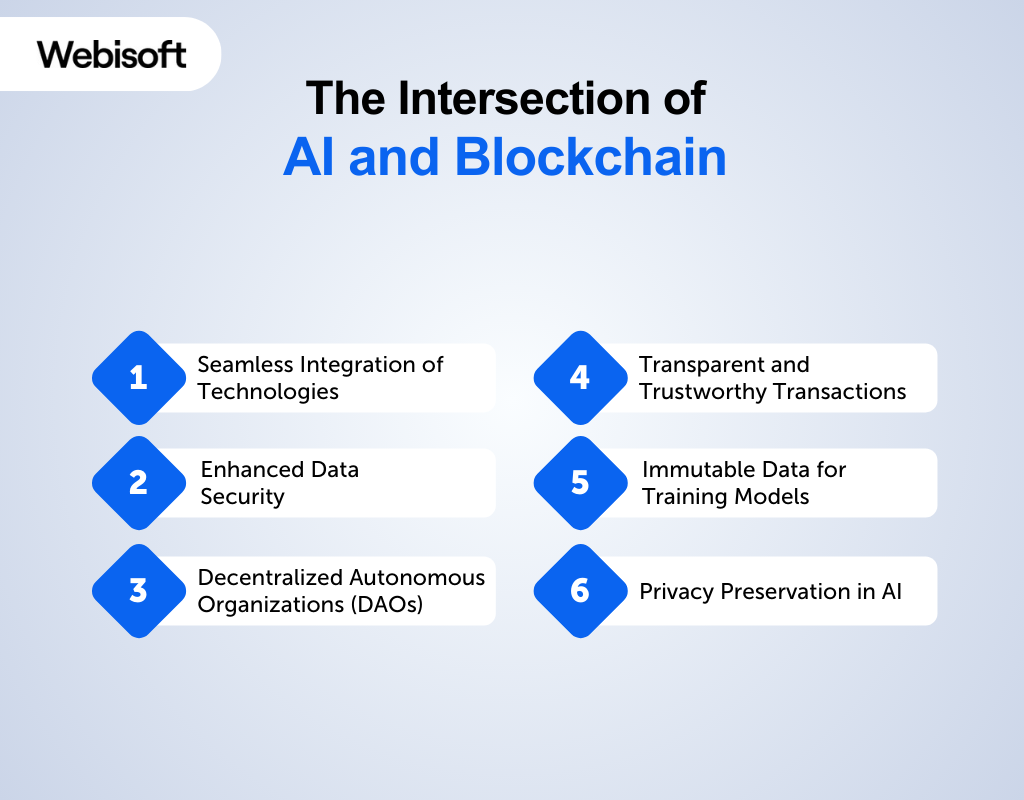
The value of combining the two is specific, not general. Blockchain does not make models smarter, and AI does not make ledgers more secure. What each does is cover the other's weakest point: AI systems are hard to audit, and blockchains cannot interpret the data they store. An enterprise blockchain deployment gives AI-driven applications a settlement and audit layer; AI gives the chain something worth settling.
Verifiable Data Provenance
The most practical integration pattern anchors data fingerprints on-chain rather than the data itself. A training dataset lives in conventional or distributed storage, its cryptographic hash is written to the ledger, and anyone can later prove that the dataset used to train a model is byte-for-byte identical to the one that was registered. For regulated industries that must demonstrate exactly what a model was trained on, this provides evidence at near-zero on-chain storage cost.
Smart Contracts as the Enforcement Layer
Smart contracts execute deterministically: every node must compute the same result, so a contract cannot run model inference internally. The working pattern runs the model off-chain and delivers its output to the contract through an oracle, a service that signs external data onto the chain. The contract then enforces the agreed consequence automatically: releasing a payment, updating an ownership record, triggering an insurance payout. AI decides, the chain enforces. The split is what makes the whole system auditable, and it is also why oracle reliability becomes the critical dependency.
Decentralized Autonomous Organizations (DAOs)
A decentralized autonomous organization encodes governance rules in smart contracts, so decisions about a shared AI system, such as which data sources are admitted, how model updates are approved, or how revenue is split among contributors, can be made by member vote rather than by a single operator. This matters most for multi-party AI projects where no participant is willing to let another one hold the admin keys.
Auditability of AI Decisions
Logging model versions, input references, and outputs to an append-only ledger produces a record that cannot be edited after the fact. This does not explain a model's reasoning; explainability is a separate research problem. What it does establish is exactly which model version made which decision on which input, which is the evidence trail that regulators, auditors, and courts actually ask for.
Privacy-Preserving Computation
Cryptographic techniques let organizations collaborate on models without pooling raw data. Federated learning keeps data on each participant's own infrastructure and shares only model updates, with the chain coordinating training rounds and recording contributions. Homomorphic encryption and zero-knowledge proofs go further, allowing computation on encrypted data and verifiable claims about a model's behavior without revealing the model or the inputs. These techniques carry significant computational overhead, but in healthcare and finance they are often the only legally viable path to cross-organization collaboration.
Use Cases of Blockchain and AI
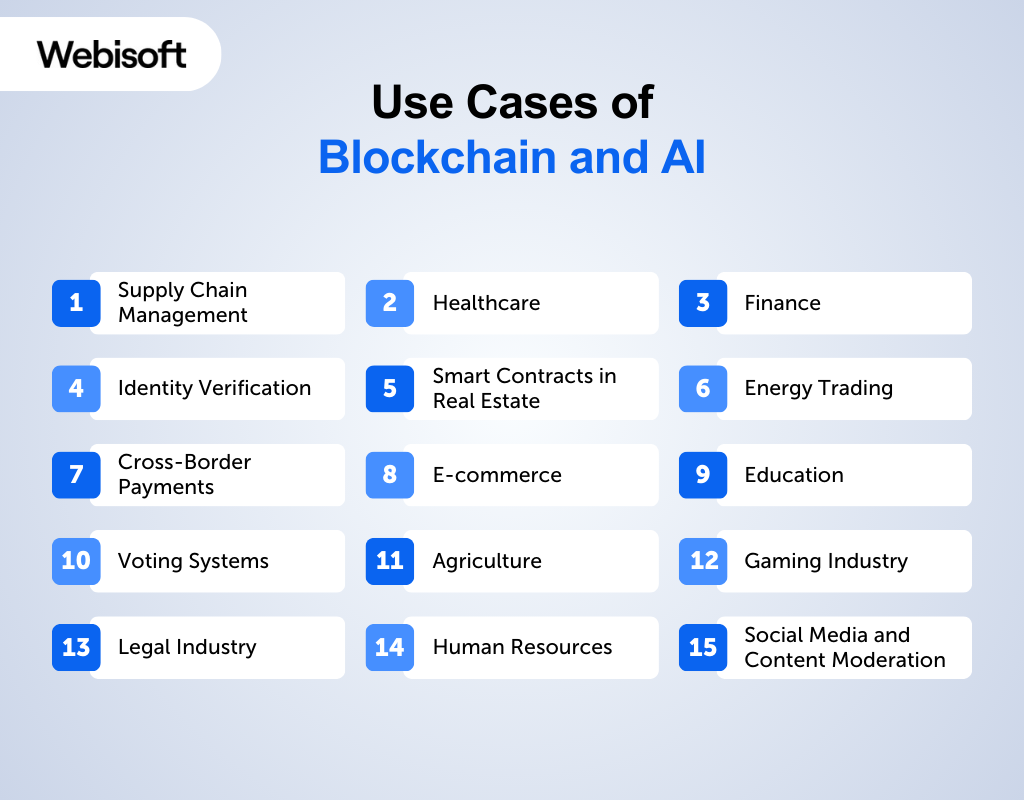
The integration of blockchain and AI is already in production across several industries. The pattern is consistent: AI supplies the judgment, blockchain supplies the shared record that makes the judgment trustworthy to parties who do not trust each other.
1. Supply Chain Management
AI forecasts demand and flags anomalies in shipment data; the chain records custody events (produced, shipped, received, inspected) so that every party sees the same history. Because each handoff is signed and timestamped, counterfeit goods and quietly substituted batches become detectable: the physical item either has a coherent on-chain history or it does not. The main engineering challenge is the boundary between the physical and digital worlds, since a ledger can only be as honest as the sensors and people writing to it.
2. Healthcare
AI supports diagnostics and record triage while the chain manages access control and audit for patient records: who read what, when, and under which consent. Pharmaceutical traceability is a second fit, tracking drugs from manufacturer to pharmacy to catch diversion and counterfeits. Federated learning lets hospitals jointly train diagnostic models without moving patient data across institutional boundaries, with the ledger recording each institution's participation.
3. Finance
AI models score credit risk, detect fraud patterns, and drive algorithmic trading. Blockchain contributes settlement that does not depend on a chain of intermediaries, plus a transparent record of transactions that compliance teams can query directly. In decentralized finance, risk models increasingly monitor collateral levels and market conditions, while the smart contracts they inform execute liquidations and rebalancing without manual intervention.
4. Identity Verification
AI analyzes biometric and behavioral signals for authentication; the chain stores credential attestations that a verifier can check without calling back to the issuer. The user holds the credential, the issuer signs it once, and revocation status lives on the ledger. This reduces both identity theft and the honeypot problem of central identity databases, since there is no single store of everyone's documents to breach.
5. Smart Contracts in Real Estate
AI-driven valuation models estimate property prices from comparable sales and market signals, while smart contracts hold funds in escrow and transfer ownership records when agreed conditions are met. The practical gain is fewer intermediaries and less settlement time; the practical limit is that land registries remain legal authorities, so production systems anchor to official records rather than replacing them.
6. Energy Trading
AI predicts consumption and generation patterns, which matters as rooftop solar and batteries turn consumers into producers. Blockchain enables peer-to-peer energy markets where those forecasts translate into automated trades between neighbors or between sites, with each trade settled and recorded without a central clearinghouse.
7. Cross-Border Payments
AI strengthens risk scoring and sanctions screening on each transaction, while blockchain rails cut out correspondent-bank hops, reducing settlement from days to minutes and lowering fees. The combination is most visible in remittance corridors where traditional transfer costs are highest.
8. E-commerce
AI personalizes recommendations and detects fraudulent orders. Blockchain in e-commerce adds provenance: product authenticity records for luxury goods and electronics, and verifiable review trails that are harder to fabricate than platform-hosted ratings.
9. Education and Credentials
AI-driven platforms adapt learning paths to each student. Blockchain-issued credentials give employers a way to verify a diploma or certificate in seconds without contacting the institution, and the record survives even if the issuing school closes or its database is lost.
10. Voting Systems
AI can assist with voter identity verification, and an immutable ledger makes tallies auditable end to end. This remains the most experimental category on the list: coercion resistance, ballot secrecy, and the security of the devices people vote from are unsolved problems, and pilots have so far outnumbered production deployments.
Challenges and Considerations of AI and Blockchain
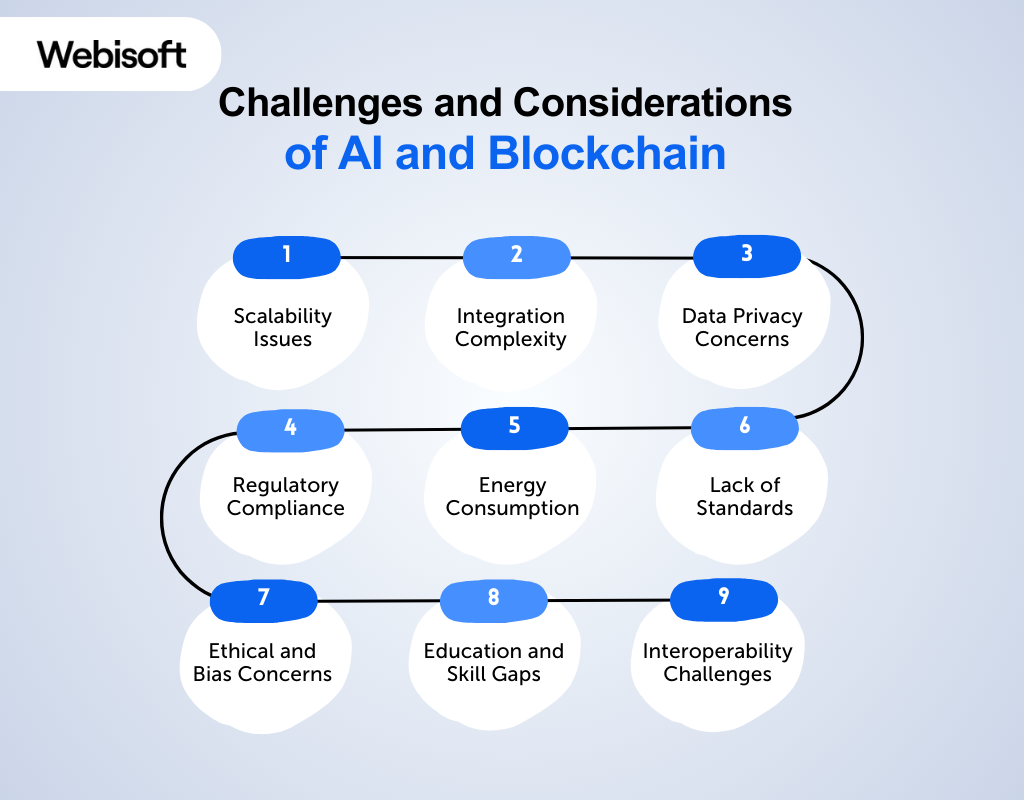
The integration is genuinely useful, but teams that treat it as a drop-in combination get burned. These are the constraints that show up in real projects.
Scalability
On-chain computation is expensive and slow by design, so running inference on the chain itself is impractical. Base-layer throughput is bounded by consensus, and AI pipelines generate data volumes no ledger should hold. The standard answers are layer-2 rollups for throughput and the anchor pattern for data: keep bulk data off-chain, commit only hashes. Both work, but they add moving parts that must be designed, not assumed.
Integration Complexity
The oracle boundary is the hardest part of most builds. Model outputs are produced off-chain and must be delivered to contracts through oracle services, which reintroduces a trust dependency into a system chosen for trustlessness. Mitigations exist (multiple independent oracles, signed attestations, dispute windows), but each adds latency and cost. Budget for this boundary explicitly; it is where most AI-blockchain projects spend their unexpected engineering time.
Data Privacy
Immutability collides with privacy law. GDPR grants a right to erasure, and a ledger that cannot forget cannot comply if personal data is written to it directly. The accepted architecture keeps personal data off-chain under normal deletion controls and stores only hashes or encrypted references on-chain, so erasing the off-chain record renders the on-chain pointer meaningless. Getting this wrong is expensive to unwind, because the chain will not let you.
Regulatory Compliance
Rules for both technologies are still moving: AI systems face emerging obligations around transparency and risk classification, while digital-asset rules vary sharply by jurisdiction. Teams should design for auditability from the start, since retrofitting evidence trails is far harder than emitting them from day one. The upside is that the audit properties described above make compliance reporting easier, not harder, once built in.
Energy Consumption
Model training is compute-intensive, and proof-of-work consensus is energy-intensive by construction. The industry response on the blockchain side has been decisive: Ethereum's switch to proof of stake cut the network's energy consumption by roughly 99.95 percent, and most new enterprise deployments use proof-of-stake or permissioned consensus from the outset. On the AI side, smaller specialized models and efficient inference hardware are the levers that matter.
Lack of Standards
There is no widely adopted standard for how AI systems and ledgers should exchange attestations, so most integrations are bespoke. That raises cost and locks projects into their initial architecture. Until standards mature, the pragmatic defense is to isolate the integration behind well-defined internal interfaces so components can be swapped.
Ethics and Bias
A ledger records what a model decided; it does not make the decision fair. Models inherit the biases of their training data, and anchoring a biased pipeline on-chain only makes the bias better documented. Bias evaluation, representative datasets, and human review of consequential decisions remain mandatory. The chain's contribution is that when bias is found, the immutable decision log makes its scope measurable rather than deniable.
Skills
The intersection requires people fluent in distributed-systems thinking, cryptography basics, and ML engineering at once, and that combination is scarce. Most successful teams pair specialists rather than searching for unicorns, and they keep the contract surface small so fewer people need to understand the whole stack.
Future Outlook of AI and Blockchain
The direction of the field is toward tighter, more verifiable coupling between models and ledgers. Several threads are worth watching because they change what can be built, not just how fast.
AI-Driven Smart Contracts
Contracts whose terms respond to model outputs (dynamic insurance pricing, adaptive credit lines, usage-based agreements) are the natural next step beyond static conditions. Their reliability will depend on the oracle layer maturing, since a contract is only as good as the data feed that triggers it.
Decentralized Training-Data Marketplaces
Ledgers make it possible to sell verified, provenance-tracked datasets with automatic royalty payment to contributors. If these marketplaces reach critical mass, they address the data-scarcity and data-rights problems simultaneously: buyers get provable provenance, contributors get compensated per use.
Verifiable Inference (zkML)
Zero-knowledge machine learning aims to prove that a specific model produced a specific output on a specific input, without revealing the model weights. Proof generation is still costly, but the primitive removes the need to trust the model operator at all, which is the missing piece for high-stakes automated decisions on-chain.
AI in Network Operations
Models are being applied to the chains themselves: anomaly detection for exploit attempts, fee and load prediction, and optimization of validator operations. Consensus rules will stay deterministic, but the tooling around them is getting smarter.
Quantum Computing Implications
Large-scale quantum computers would threaten the elliptic-curve signatures securing today's chains, which is why post-quantum cryptography migration is on every serious protocol roadmap. On the AI side, quantum hardware may eventually accelerate specific classes of computation, though practical impact remains speculative.
Convergence with IoT
Sensor networks generate the ground-truth data that both technologies need. The IoT and blockchain combination gives devices verifiable identities and tamper-evident data trails, and AI turns those trails into decisions: predictive maintenance, automated settlement between machines, and supply chains that report their own condition.
Blockchain Machine Learning
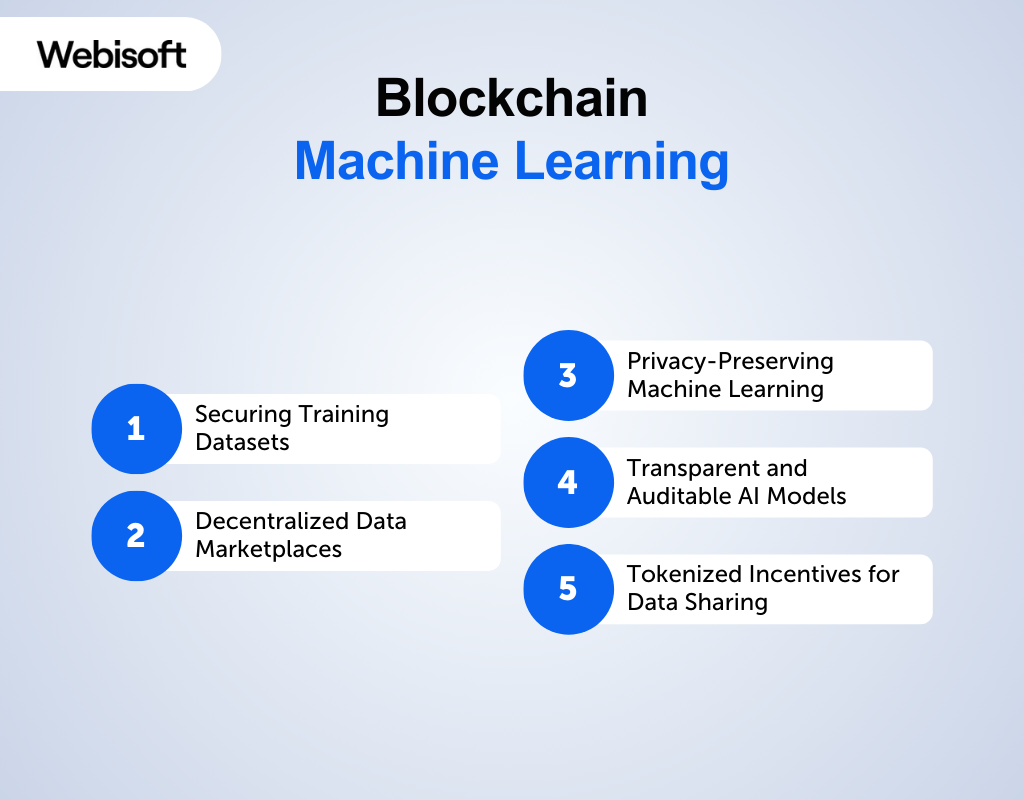
Machine learning is the part of AI where blockchain adds the most concrete value today, because ML's core liabilities (unverifiable data, unaccountable models, siloed datasets) map directly onto what a ledger provides.
Securing Training Datasets
Hash-anchoring ML training datasets on-chain makes any later tampering detectable, giving model development a verifiable foundation and making training runs reproducible in a provable way.
Decentralized Data Marketplaces
On-chain marketplaces let data owners sell access under smart-contract terms, with payment, licensing, and provenance handled in one transaction. Practitioners gain access to datasets that would never be shared through a central broker.
Privacy-Preserving Machine Learning
Federated learning coordinated through a ledger, combined with cryptographic techniques such as secure aggregation, allows joint model training across organizations that cannot legally pool their data.
Transparent and Auditable Models
Recording model versions and decision events on an append-only ledger creates an audit trail regulators can rely on, establishing exactly which model acted, when, and on what input.
Tokenized Incentives for Data Sharing
Token rewards, paid automatically by contract when contributed data is used, give individuals and organizations a direct economic reason to share high-quality data, attacking the data-scarcity problem at its root.
Conclusion
AI and blockchain are complementary layers, not substitutes: AI supplies judgment, blockchain supplies proof. The integrations that work in production follow a consistent shape, with computation off-chain, evidence on-chain, and smart contracts enforcing outcomes at the boundary. The real engineering effort goes into that boundary: oracles, data anchoring, and privacy architecture.
For businesses, the decision is not whether the pairing is impressive but whether a specific process needs both verifiable records and automated judgment. Supply chains with multiple distrustful parties, regulated data collaborations, and high-volume financial decisions all qualify. Many processes do not, and a plain database plus a good model remains the right answer there.
If you are weighing a build, Webisoft is a Montreal-based software engineering firm with full-cycle blockchain and AI development experience. Contact Webisoft to scope the architecture before committing to it.
No. Smart contracts execute deterministically, meaning every node in the network must compute an identical result, so probabilistic model inference cannot run on-chain. The standard architecture runs the model off-chain and delivers its output to the contract through an oracle service, and the contract then enforces the outcome automatically.
Primarily through data provenance. A cryptographic hash of the training dataset is written to the ledger, so anyone can later verify that the data used to train a model was never altered. Logging model versions and decisions to the same append-only ledger also creates an audit trail showing exactly which model made which decision on which input.
Yes, if the architecture is designed for it. Personal data must stay off-chain in storage that supports deletion, with only hashes or encrypted references written to the ledger. Erasing the off-chain record then satisfies the right to erasure while the on-chain pointer becomes meaningless. Writing personal data directly to an immutable ledger breaks compliance and cannot be undone.
The oracle boundary. Model outputs are produced off-chain and must be delivered to smart contracts through oracles, which reintroduces a trust dependency and adds latency and cost. Most projects spend their unexpected engineering time on this boundary, so it should be designed and budgeted explicitly from the start.
Industries where multiple parties need both automated judgment and a shared, tamper-resistant record: supply chain management, healthcare data collaboration, financial services and cross-border payments, and digital identity. If a process involves only one organization and no dispute over records, a conventional database with a good model is usually the better choice.