![What Is Machine Learning? [Core Concepts Explained Clearly]](/media/images/What-is-machine-learning.width-1200.format-webp.webp)
The next time a system makes a decision faster than you do, you’re likely witnessing what is machine learning without realizing it. No sci-fi glow, no dramatic soundtrack, just algorithms doing their job. Machines aren’t “smart” in a human sense.
They’re consistent, tireless, and annoyingly good at spotting patterns we overlook. That’s what makes their growing role in business and daily life impossible to ignore. As you continue to read, you’ll see how these systems learn, why they matter, and how they keep expanding into new domains with surprising efficiency.
What is Machine Learning?
Machine learning is a field of artificial intelligence that allows computers to learn patterns from data and improve their output without manual reprogramming. You work with systems that adapt as they receive new information, which makes them useful in situations where fixed rules fail.
At its core, machine learning lets models study large datasets, identify relationships, and make predictions based on those relationships. This matters because many real-world problems involve patterns too complex for traditional approaches.
A solid machine learning definition and examples often starts with understanding how these systems learn through exposure to repeated cases instead of being told what to do step by step.
Machine Learning Examples:
Below are everyday machine learning examples that show what is machine learning used for across real applications and systems:
- Fraud Detection: Systems analyze spending behavior to identify unusual or risky transactions before they cause damage.
- Personalized Recommendations: Streaming and shopping platforms adjust suggestions based on preferences, viewing history, and user intent.
- Language Translation: ML models interpret context and tone to produce accurate translations that go beyond simple word replacement.
- Medical Image Analysis: Algorithms detect early signs of disease by identifying patterns too subtle for manual review.
- Email Spam Filtering: Filters classify messages by comparing them with established patterns of known spam and legitimate email.
- Voice Assistants: Systems process speech, interpret commands, and improve responses as they continue learning from interactions.
How Machine Learning Works Step by Step
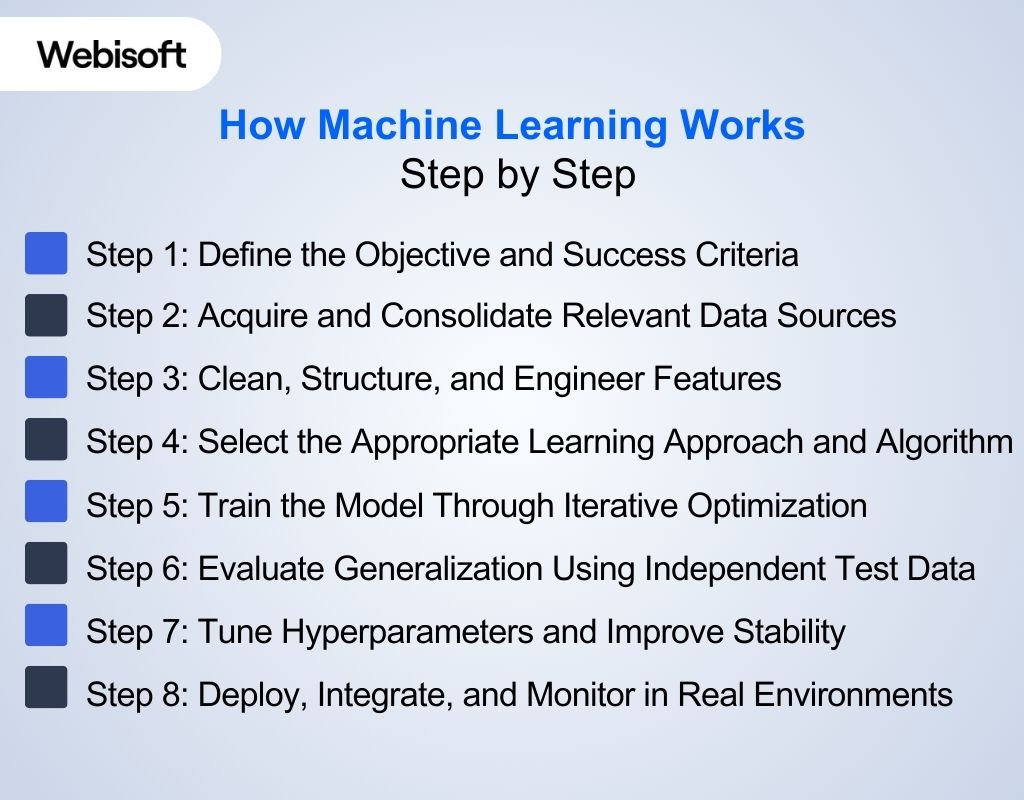
Understanding what is machine learning becomes easier when you examine its structured workflow, which transforms raw data into models that generate reliable predictions consistently.
Each stage influences accuracy, stability, and long-term performance, which is why the process must progress in a deliberate and organized way.
Step 1: Define the Objective and Success Criteria
The process begins with a clear definition of the problem and measurable success indicators. This includes determining whether the task involves classification, regression, or pattern discovery, along with constraints such as accuracy targets or latency limits.
A precise objective ensures alignment between technical decisions and practical outcomes.
Step 2: Acquire and Consolidate Relevant Data Sources
Data is collected from databases, logs, sensors, APIs, or third-party repositories. These sources often differ in structure, format, and quality, so consolidation is essential.
Schemas are aligned, duplicates are removed, and inconsistencies are resolved to create a unified dataset suitable for modeling.
Step 3: Clean, Structure, and Engineer Features
Raw data is refined to comply with modeling requirements. This includes handling missing values, correcting errors, normalizing ranges, and encoding categorical variables.
Feature engineering plays a significant role in improving performance by creating variables that better represent underlying patterns and relationships.
Step 4: Select the Appropriate Learning Approach and Algorithm
The choice of algorithm depends on problem type, dataset characteristics, and interpretability needs.
Decision trees, neural networks, clustering techniques, and regression models each excel in different situations. Selecting the right approach ensures the model has the capacity to learn the required patterns.
Step 5: Train the Model Through Iterative Optimization
Training involves feeding structured data into the algorithm and adjusting internal parameters through repeated cycles.
Techniques such as gradient-based optimization or rule-based updates help the model minimize error and improve predictive accuracy.
Training continues until performance stabilizes or predefined criteria are reached, forming a central component of effective machine learning development in real-world systems.
Step 6: Evaluate Generalization Using Independent Test Data
Model performance is assessed using a separate dataset to verify generalization. Metrics such as ROC-AUC, F1-score, precision, recall, or mean squared error indicate whether the model has learned meaningful patterns or overfitted the training data. Evaluation highlights strengths, weaknesses, and potential failure points.
Step 7: Tune Hyperparameters and Improve Stability
Hyperparameter tuning refines model behavior and enhances reliability. Adjustments may involve learning rates, regularization strength, network depth, or tree complexity. Systematic search methods such as grid search or Bayesian optimization help identify optimal configurations while reducing overfitting risks.
Step 8: Deploy, Integrate, and Monitor in Real Environments
Once validated, the model is deployed into production systems, analytics pipelines, or real-time applications. Continuous monitoring detects performance drift, shifting data patterns, or reliability concerns.
Retraining or recalibration is performed as new data emerges, ensuring the model remains effective over time.
Main Types of Machine Learning
Machine learning is not a single method but a set of approaches that determine how a system learns from data. Knowing the main types of machine learning helps match the right method to the problem and data available.
Supervised Learning
Supervised learning trains models using labeled data, meaning both inputs and correct outputs are provided during training.
This enables the system to learn a direct mapping and make accurate predictions on new data. It is widely used in tasks like classification, regression, and trend forecasting, where historical outcomes are known and guidance is clear.
Unsupervised Learning
Unsupervised learning works with data that has no predefined labels, so the system explores the structure of the dataset to find hidden patterns.
It is ideal for clustering similar items, reducing dimensionality, and discovering intrinsic relationships without explicit instructions. This type helps reveal customer segments and natural groupings in data that were not previously defined.
Reinforcement Learning
Reinforcement learning is an interaction-based approach where an agent learns by trial and error through rewards and penalties. Instead of learning from static datasets, the model improves by taking actions in an environment to maximize cumulative success.
This method is used for sequential decision-making problems like robotics, autonomous driving, and strategy optimization.
Semi-Supervised Learning
Semi-supervised learning blends the strengths of supervised and unsupervised methods by using a small amount of labeled data along with a larger amount of unlabeled data.
It is useful when labeling every example is too costly or time-consuming, but unlabeled data is abundant. This approach improves learning efficiency when labeled data is sparse.
What is Machine Learning Language?
Understanding how models learn is only one part of the picture. After exploring the main types of machine learning, the next step is recognizing the tools used to build these systems.
This is where machine learning languages matter, since models depend on tools that handle data, mathematics, and experimentation. A machine learning language refers to the programming languages commonly used to develop, train, and deploy ML models.
These languages support numerical computing and provide extensive ecosystems that simplify working with datasets and algorithms. Python remains the most widely used, while R, Julia, Java, and C++ support specialized analytical or high-performance workflows. Common libraries include:
- TensorFlow: Widely used for deep learning and large-scale neural networks
- PyTorch: Preferred for research, experimentation, and flexible deep learning models
- Scikit-learn: Ideal for classical machine learning algorithms and preprocessing
- Keras: A high-level neural network library that simplifies deep learning development
- Pandas: Essential for data manipulation, cleaning, and exploration
- NumPy: Used for numerical computation and matrix operations foundational to ML
- XGBoost / LightGBM: Powerful gradient boosting libraries for structured data tasks
How Machine Learning Differs from AI and Deep Learning
To fully grasp what is machine learning, see how it sits between artificial intelligence methods and the deeper analytical structures found within deep learning.
Comparing these fields helps clarify why they approach learning, data, and complexity in distinct ways that influence how each is used in real systems.
Scope and Hierarchy
- Artificial Intelligence (AI): AI is not learning as ML and DL do. ML and DL learn about the data and find usable patterns. AI learns about how to use the information that ML and DL yields.
- Machine Learning (ML): Machine Learning (ML) is a subset of AI that focuses on learning patterns from data. It answers the question what is machine learning in AI by showing how systems improve through experience rather than fixed rules.
- Deep Learning (DL): A specialized subset within ML, answering what is deep learning as neural-network-driven learning that automatically extracts patterns from raw, high-volume data.
Learning Approach
- AI: May use rule-based logic, knowledge graphs, or symbolic reasoning without relying on data.
- ML: Learns from examples and adjusts models based on errors, improving performance over time.
- DL: Learns through multilayer neural networks that discover features automatically, often outperforming traditional ML on complex tasks.
Data Requirements
- AI: Can function with minimal or no data when rule-driven.
- ML: Performs well with structured data and moderate sample sizes.
- DL: Requires very large datasets to train deep networks effectively, especially for vision, audio, and language tasks.
Model Complexity and Interpretability
- AI: Varies widely, rule-based systems are interpretable, but hybrid systems can be opaque.
- ML: Offers clearer interpretability through algorithms such as decision trees, regressions, and SVMs.
- DL: Highly complex and often considered a black box due to its many hidden layers.
Computational Needs
- AI: Often lightweight unless combined with learning components.
- ML: Runs efficiently on standard hardware.
- DL: Requires GPUs or distributed computing because training deep networks is computationally intensive.
Best-Fit Use Cases
- AI: Planning, reasoning, routing, language understanding, automated decision systems.
- ML: Prediction, classification, scoring, recommendation, anomaly detection.
- DL: Image processing, speech recognition, autonomous systems, and high-dimensional pattern recognition.
Why Machine Learning Matters Today
Machine learning’s significance today comes from how it changes the scale, speed, and accuracy of decisions across industries.
Its impact is visible where conventional analytical methods fail. These older methods cannot capture complexity or respond fast enough to real-world conditions.
Turning Large-Scale Data Into Predictive Intelligence
Modern systems generate far more data than humans or traditional software can interpret. Machine learning converts this volume into forward-looking insights, informed by ongoing AI research.
It helps institutions anticipate risks, detect subtle patterns, and guide strategic decisions with measurable confidence.
Advancing High-Stakes Fields Through Precision
Domains such as healthcare, finance, and cybersecurity rely on precision under uncertainty. Machine learning strengthens these fields by improving diagnostic accuracy and fraud detection. It also identifies anomalies that manual approaches or rule-based AI systems often miss.
Driving Operational Efficiency and Scalable Automation
Organizations adopt machine learning to simplify workflows once requiring expert intervention, showing what is machine learning in real, practical operations.
ML adapts to changing inputs and supports scalable automation. This reduces operational friction and optimizes resource allocation without compromising accuracy.
Powering Personalization and Intelligent User Experiences
Machine learning redefines how digital products interact with users. It enables adaptive interfaces and real-time personalization. These capabilities help businesses build systems that respond intelligently to individual behavior instead of using static rules.
Supporting Innovation in Complex, Data-Dense Domains
Fields such as climate science, genomics, mobility, and industrial engineering depend on advanced modeling.
Machine learning uncovers relationships that traditional methods cannot detect. It supports progress in areas where complexity exceeds human analytical limits.
Important Machine Learning Algorithms You Should Know
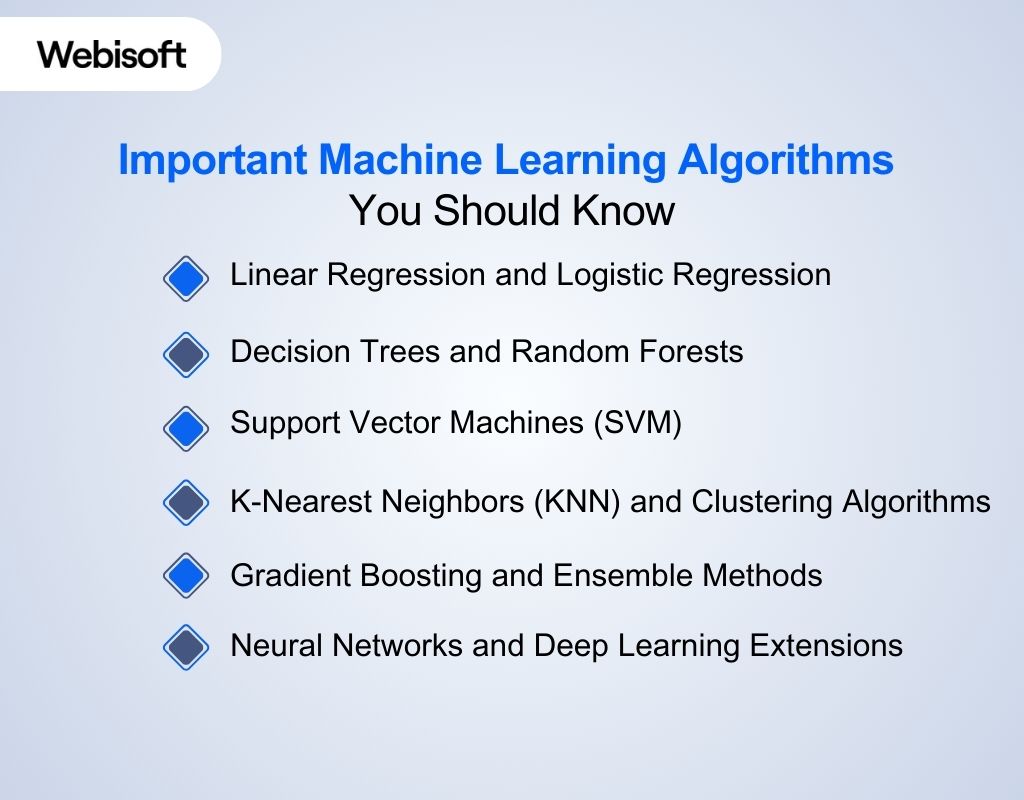
Machine learning’s effectiveness depends heavily on the algorithms that drive pattern recognition, prediction, and decision-making.
Knowing key algorithms helps you choose the right tool for a given problem and understand how systems extract insights from data.
Linear Regression and Logistic Regression
Linear regression predicts outcomes that vary continuously, such as price or temperature, by fitting a line to the data.
Logistic regression classifies data by estimating probabilities and assigning categories, enabling decisions such as yes or no, or identifying spam versus nonspam messages. Both serve as foundational supervised learning algorithms.
Decision Trees and Random Forests
Decision trees split data based on feature rules to make predictions that are easy to interpret. Random forests improve on single trees by combining many trees to reduce errors and overfitting, making them more strong for both classification and regression.
Support Vector Machines (SVM)
Support vector machines find the best boundary that separates data into classes in high-dimensional space. They work well for text classification and image recognition where boundaries between categories are complex or not linearly separable.
K-Nearest Neighbors (KNN) and Clustering Algorithms
K-Nearest Neighbors predicts a data point’s category based on the most similar points around it, making it intuitive and useful for classification.
Clustering algorithms like K-Means group similar data points without labels, uncovering hidden data structure.
Gradient Boosting and Ensemble Methods
Boosting algorithms like AdaBoost and Gradient Boosting improve accuracy by sequentially correcting errors of weaker models.
Other ensemble methods, such as bagging and stacking, combine multiple algorithms in different ways to create stronger predictive models that often outperform individual learners.
Neural Networks and Deep Learning Extensions
Neural networks form the basis for more advanced machine learning and deep learning models. They use interconnected nodes to model complex relationships, which makes them powerful for tasks like image and speech recognition, though computationally intensive.
Real-World Applications of Machine Learning Across Industries
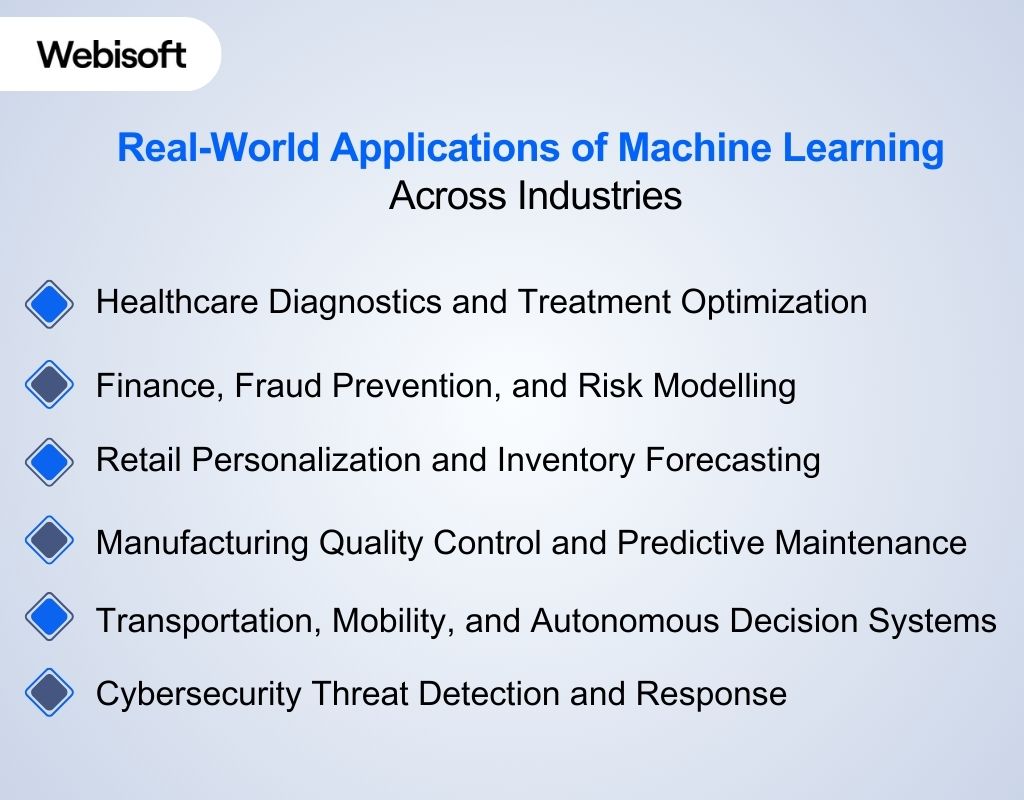
Machine learning delivers value when applied to real problems that require pattern recognition, prediction, or automated decision-making.
Understanding what machine learning is used for becomes clearer when examining how different industries rely on it to solve complex, data-dense challenges.
Healthcare Diagnostics and Treatment Optimization
Machine learning supports early disease detection by analyzing medical images, lab reports, and patient histories with precision that exceeds manual review.
It also helps clinicians personalize treatment plans by predicting how different patients may respond to specific therapies.
Finance, Fraud Prevention, and Risk Modelling
Financial institutions use machine learning to identify suspicious activity by detecting subtle deviations in transaction behavior.
Risk models also improve substantially, as ML uncovers patterns that traditional rule-based systems often overlook in credit scoring and portfolio evaluation.
Retail Personalization and Inventory Forecasting
Retail platforms rely on machine learning to recommend products, refine search results, and tailor promotions to individual shopping patterns.
Behind the scenes, ML predicts demand fluctuations, helping businesses manage inventory and minimize operational waste.
Manufacturing Quality Control and Predictive Maintenance
Industrial systems use machine learning to identify defects in production lines through automated visual inspection. ML also predicts equipment failures before they occur, reducing downtime and extending the lifespan of high-value machinery.
Transportation, Mobility, and Autonomous Decision Systems
Machine learning guides routing algorithms, traffic optimization tools, and autonomous vehicle systems by supporting real-time decision workflows that benefit from advanced AI automation solutions.
It enables vehicles and mobility platforms to interpret sensor data, anticipate road conditions, and make safe, real-time decisions based on learned patterns.
Cybersecurity Threat Detection and Response
Security systems apply machine learning to recognize evolving threats by analyzing behavioral signals across networks. ML adapts continuously, identifying anomalies that static cybersecurity tools cannot detect in fast-moving digital environments.
Machine learning becomes far more powerful when guided by the right expertise. If you want customized ML guidance or support for your next project, connect with Webisoft’s team today to explore practical solutions for your business.
Challenges and Limitations in Machine Learning
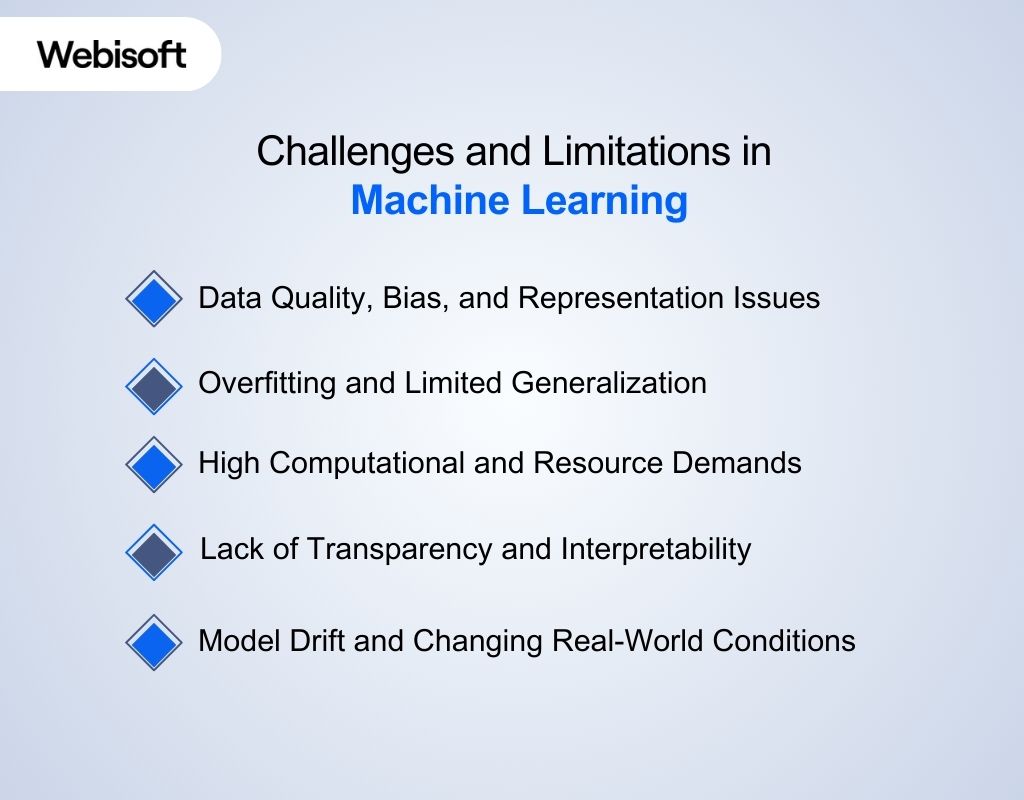
Machine learning brings measurable impact across industries, yet its practical deployment introduces hurdles that influence accuracy and reliability.
Recognizing these challenges helps teams anticipate risks and build systems that perform consistently under real-world conditions.
Data Quality, Bias, and Representation Issues
Machine learning models depend heavily on the quality and diversity of the data they receive. Missing values, skewed samples, and underrepresented groups introduce bias that influences predictions. These issues weaken generalization, especially when the model faces new or imbalanced environments.
Overfitting and Limited Generalization
Models often perform well on training data but fail to adapt to unseen cases due to overfitting. This happens when they memorize patterns rather than learn meaningful relationships. High variance models suffer most, especially in domains with complex or noisy datasets.
High Computational and Resource Demands
Training sophisticated algorithms, particularly deep learning models, requires substantial computational power. Even traditional ML methods strain resources when datasets grow large. These constraints increase development cost and slow experimentation cycles in production environments.
Lack of Transparency and Interpretability
Many machine learning approaches operate as black-box systems, making it difficult to understand how decisions are formed.
This limitation raises concerns in regulated industries where traceability and accountability are mandatory. Limited interpretability also complicates debugging and error diagnosis.
Model Drift and Changing Real-World Conditions
Machine learning models degrade over time when real-world patterns shift. This phenomenon, known as model drift, is documented by NIST and forces continuous monitoring and retraining to maintain accuracy.
Without these safeguards, predictions become unreliable as market, user, or environmental conditions evolve.
How Webisoft Helps Businesses Adopt Machine Learning
Every business wants machine learning that actually delivers results, not just theory or experimentation. Webisoft steps in as a partner that understands your goals and builds ML solutions that create measurable impact where it matters most.
Custom Strategy Designed Around Your Business Reality
Every organization has different data conditions, operational constraints, and strategic priorities. Webisoft begins by understanding where you are today and where you want to move next.
Instead of giving you a generic ML plan, our team builds a clear and personalized roadmap that matches your challenges, strengths, and growth targets. This ensures you gain value from day one.
Purpose-Built Machine Learning Models That Reflect Your Needs
Machine learning only becomes useful when the model understands your business as well as your team does. Webisoft develops ML systems that mirror your workflows, customer behaviors, and operational patterns.
These customized models make predictions with purpose, improving accuracy, reducing errors, and helping you make confident decisions backed by data through refined model development expertise.
Smooth Integration Into Your Existing Tools and Processes
Introducing machine learning does not mean rebuilding your entire tech stack. Webisoft integrates ML models directly into the tools you already use, whether it’s internal dashboards, CRMs, logistics platforms, or analytics systems.
The result is a smoother workflow where intelligence works quietly in the background to support your team’s daily decisions.
MLOps and Infrastructure That Keep Your Models Reliable
The biggest challenge in ML is not launching a model, it’s keeping it accurate as your business evolves. Webisoft handles monitoring, retraining, scaling, and optimization so your machine learning systems stay sharp over time.
This ensures the technology grows with your business rather than becoming outdated after deployment.
A Partnership Focused on Real Outcomes, Not Just Technology
Webisoft’s team measures success the same way you do: increased efficiency, clearer insights, reduced risk, and better experiences for your customers.
Instead of delivering a model and walking away, we stay involved to ensure your ML investment continues to produce measurable impact. With Webisoft, machine learning becomes a practical advantage rather than a complex experiment.
Conclusion
Reaching the end of what is machine learning reveals one clear idea: machines aren’t replacing decision-making, they’re strengthening it. They handle the complexity, the scale, and the speed that modern systems demand, leaving humans free to focus on direction rather than details.
And when you’re ready to translate this potential into something practical, Webisoft helps bridge the gap. From strategy to deployment, our work ensures machine learning performs where it matters: inside real products, real workflows, and real business goals.
Frequently Asked Question
Yes, but performance may be limited. Smaller datasets still work when paired with simpler algorithms, strong feature engineering, and data augmentation. These techniques help models generalize better even when training samples are limited or difficult to obtain.
Python dominates because of extensive libraries and community support. R remains strong in statistical applications, while Julia, Java, and C++ serve specialized performance-critical workflows. Each language fits different needs depending on speed, flexibility, and integration requirements.
No. Many models run efficiently on local machines or edge devices without cloud infrastructure. Cloud environments are primarily useful for large-scale training, distributed processing, and deployments requiring significant computational power beyond what local hardware can provide.