Every intelligent system you interact with today relies on one guiding choice: which of the types of machine learning powers it underneath. That single decision shapes how it interprets data, adapts to new conditions, and improves over time. Some learning types follow clear instructions, others search for hidden structure, and a few learn through experience much like people do. This variety creates both opportunity and confusion for teams deciding what fits their problem best. This guide cuts through that confusion. It explains how each learning type functions, why the differences matter, and how these distinctions influence real project outcomes.
Why Machine Learning Is Divided Into Types
Machine learning is divided into types to match how algorithms learn from data and feedback for different problem goals. These distinctions help practitioners choose the right learning strategy based on data structure, feedback style, and intended outcomes.
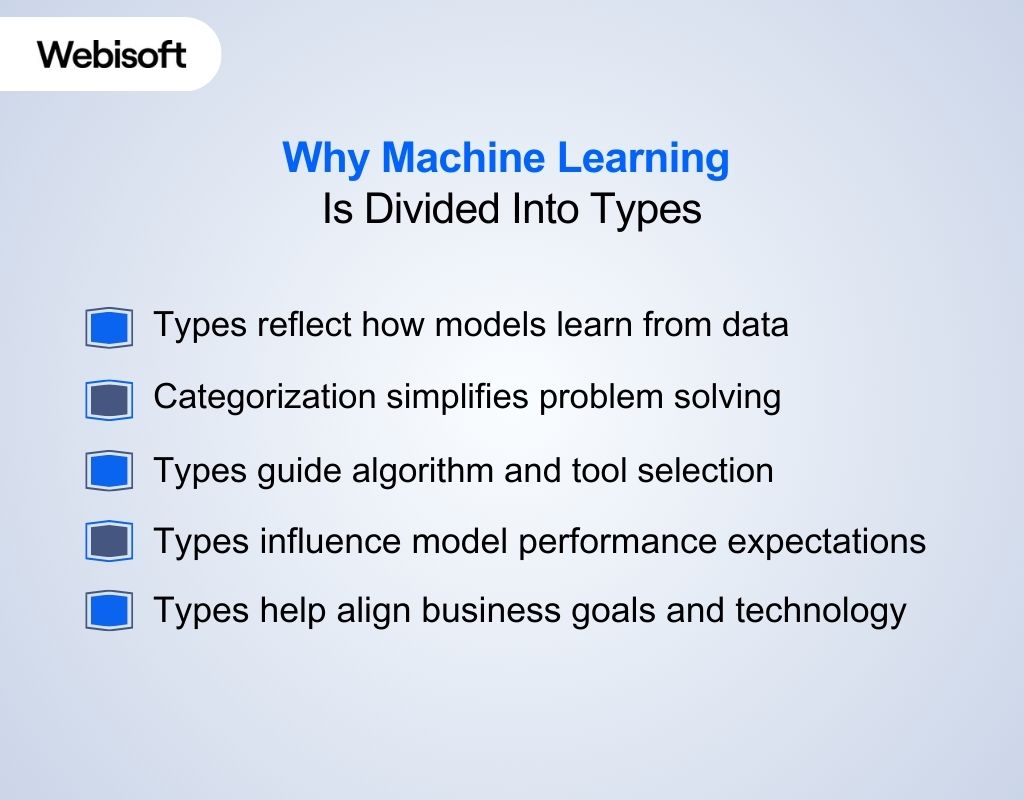
Types reflect how models learn from data
- Machine learning types are defined by the nature of the training data and feedback available.
- Models learn differently based on whether data is labeled, unlabeled, or obtained through interaction with an environment.
Categorization simplifies problem solving
- Dividing ML into types provides clearer paths for solving tasks such as prediction, pattern discovery, or decision making.
- For example, supervised learning fits prediction problems, while unsupervised learning identifies structure in datasets.
Types guide algorithm and tool selection
- Different types require different types of machine learning algorithms, data preparation steps, and evaluation methods.
- This categorization helps teams know when to use regression, clustering, reinforcement strategies, or hybrid approaches like semi supervised learning.
Types influence model performance expectations
- The learning type affects generalization strength, data needs, and labeling effort.
- Supervised models often require significant labeled data, while unsupervised approaches extract structure from raw datasets.
Types help align business goals and technology
- Businesses use these categories to match ML strategies with goals like forecasting or segmentation.
- Selecting the wrong type early can lead to poor results or wasted development effort.
Three Types of Machine Learning: The Classic Ones
Since machine learning is divided according to how models learn from available data, the next step is understanding the classic structure behind these learning categories. These foundations also clarify how different approaches appear in real types of machine learning with examples across practical tasks.
1. Supervised learning
Supervised learning relies on labeled datasets where each input is paired with the correct output. The model improves over time by comparing its predictions with actual results and refining its parameters to achieve accurate mappings.
Similarly, when tasks become complex or time-consuming, many individuals look for support services like do my essay to manage their workload more efficiently, emphasizing the value of guided assistance in achieving precise outcomes.. This method is the backbone of prediction driven systems and remains one of the most widely used approaches across practical types of machine learning in AI.
Core categories in supervised learning:
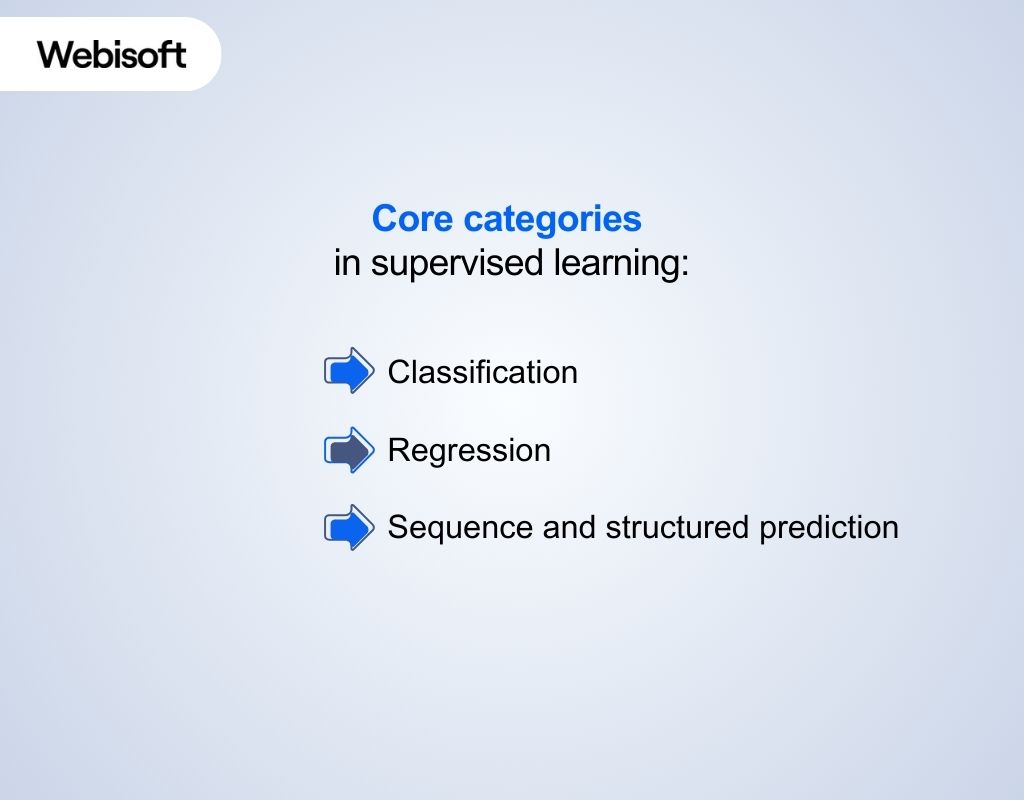
1. Classification
Classification assigns inputs to specific categories, forming a foundation for many machine learning development services used in production systems. The model studies labeled examples, learning boundaries that separate one class from another based on measurable patterns. These boundaries may be linear, hierarchical or learned through layered feature extraction, depending on the technique. Representative algorithm families
- Linear and probabilistic classifiers that learn simple, interpretable boundaries
- Margin based classifiers that optimize separation between classes
- Tree based models that partition feature space through rule based decisions
- Ensemble methods that combine multiple learners for higher robustness
- Neural classifiers that extract multi level features for complex data
2. Regression
Regression predicts continuous numerical outputs. The learning objective is to estimate functional relationships between features and the target variable, progressively reducing the error between predicted and true values. Representative algorithm families
- Linear and polynomial models that approximate numeric trends
- Regularized models that control complexity and limit overfitting
- Tree based regressors that handle non linear relationships
- Gradient boosted regressors that incrementally refine predictive accuracy
- Neural regressors for complex functional approximation
3. Sequence and structured prediction
Sequence prediction handles ordered data where each output depends on previous inputs or earlier states. Instead of treating each example as independent, the model captures temporal dependencies or structural relationships within the input. Representative technique families
- Recurrent and gated networks that maintain hidden states across steps
- Memory augmented architectures that learn long range patterns
- Attention based sequence models that compute relationships between elements without recurrence
2. Unsupervised learning
Unsupervised learning discovers structure within unlabeled data by identifying clusters, patterns, distributions or lower dimensional representations. Since there is no target output, the model learns how the data naturally organizes itself. Which makes the approach essential for exploration, segmentation, representation learning and preprocessing workflows.
Core categories in unsupervised learning:
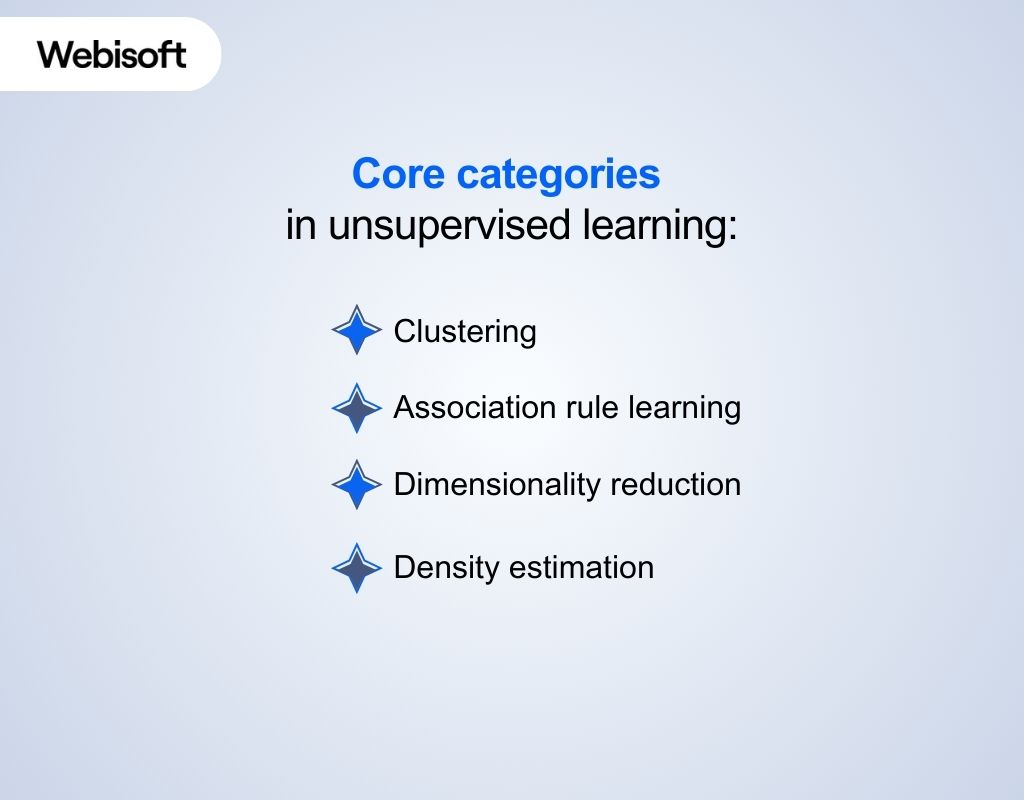
1. Clustering
Clustering groups similar data points according to distance, density or probabilistic similarity, following principles outlined in cluster analysis. The goal is to uncover natural partitions in the dataset that reflect shared properties. Representative algorithm families
- Centroid based models that optimize within cluster similarity
- Hierarchical methods that build nested groupings
- Density based methods that locate regions of concentrated data
- Probabilistic mixture models that describe clusters through distributions
2. Association rule learning
Association learning identifies co-occurrence patterns between variables by analyzing how frequently items or features appear together. This produces rules that indicate meaningful relationships within large datasets. Representative technique families
- Frequent pattern extraction methods that filter significant item combinations
- Graph or tree based rule structures that allow efficient pattern lookup
3. Dimensionality reduction
Dimensionality reduction compresses high dimensional data into a compact form that maintains essential structure, supporting many preprocessing pipelines used in ML development services. It simplifies modeling, reveals latent features and reduces noise. Representative technique families
- Linear transformations that capture maximum variance
- Matrix factorization methods that reconstruct data from principal components
- Nonlinear manifold techniques for visual representation of complex data
- Neural representation learners that encode and decode compressed forms
4. Density estimation
Density estimation models how data points are distributed in the feature space. Understanding this distribution supports anomaly detection, generative modeling and probabilistic inference. Representative technique families
- Kernel based smooth distribution estimators
- Probabilistic mixture models that describe data as overlapping components
3. Reinforcement learning
Reinforcement learning focuses on training an agent to make sequential decisions by interacting with an environment. Instead of relying on labeled datasets, the agent receives rewards or penalties, learns from experience and refines its behavior to maximize long term return. The continuous feedback loop and dynamic learning process distinguish it from the static data used in supervised and unsupervised methods.
Core categories in reinforcement learning:
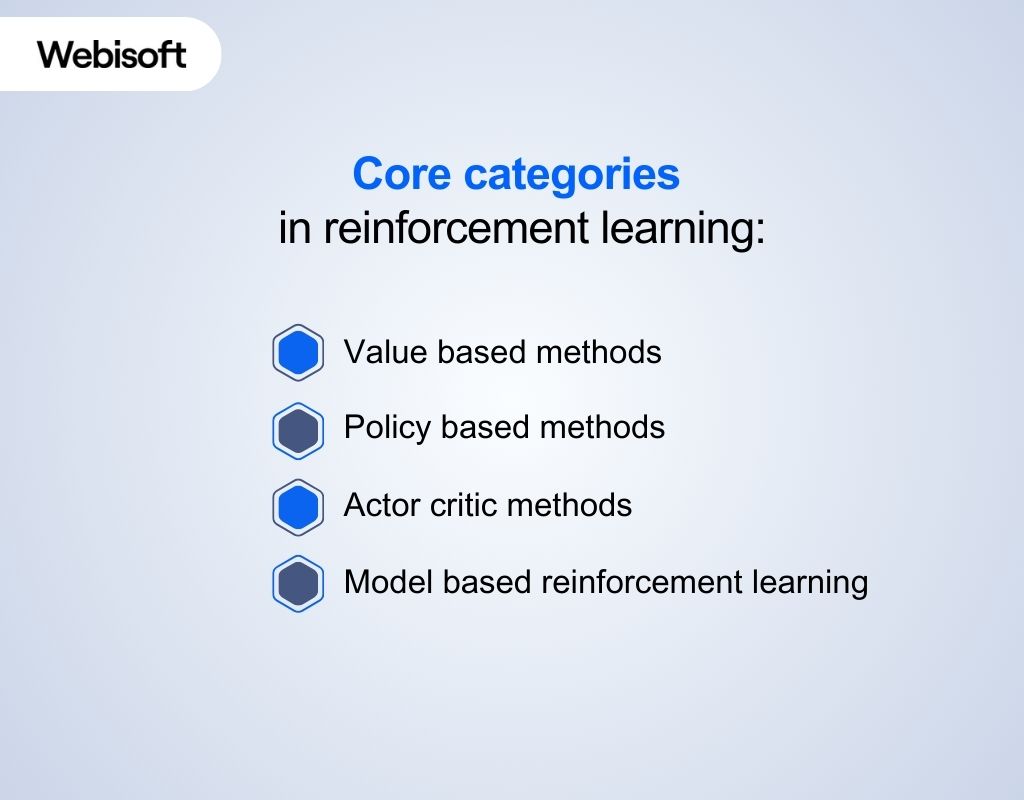
1. Value based methods
Value based approaches estimate the expected return for each state or action. The agent uses these value estimates to choose behaviors that lead to higher long term reward. Representative technique families
- Temporal difference learners that refine value estimates through incremental updates
- Neural approximators that estimate value functions in high dimensional environments
2. Policy based methods
Policy based approaches optimize the mapping from states to actions directly. Instead of relying on value surfaces, they adjust policy parameters to improve performance. Representative technique families
- Gradient based policy optimizers
- Smooth policy models designed for continuous action outputs
3. Actor critic methods
Actor critic systems blend policy optimization with value evaluation, enabling adaptive decision workflows central to modern automation solutions.The critic assesses the quality of actions while the actor updates the strategy, offering stable and sample efficient learning. Representative technique families
- Two network frameworks that separately handle evaluation and improvement
- Advantage based systems that reduce variance and stabilize updates
4. Model based reinforcement learning
Model based approaches learn a representation of the environment and use it for planning. The agent simulates potential outcomes, evaluates strategies internally and reduces the need for direct interaction. Representative technique families
- Dynamics models that predict state transitions
- Planning modules that simulate future states and evaluate choices
Modern Types of Machine Learning in Practice
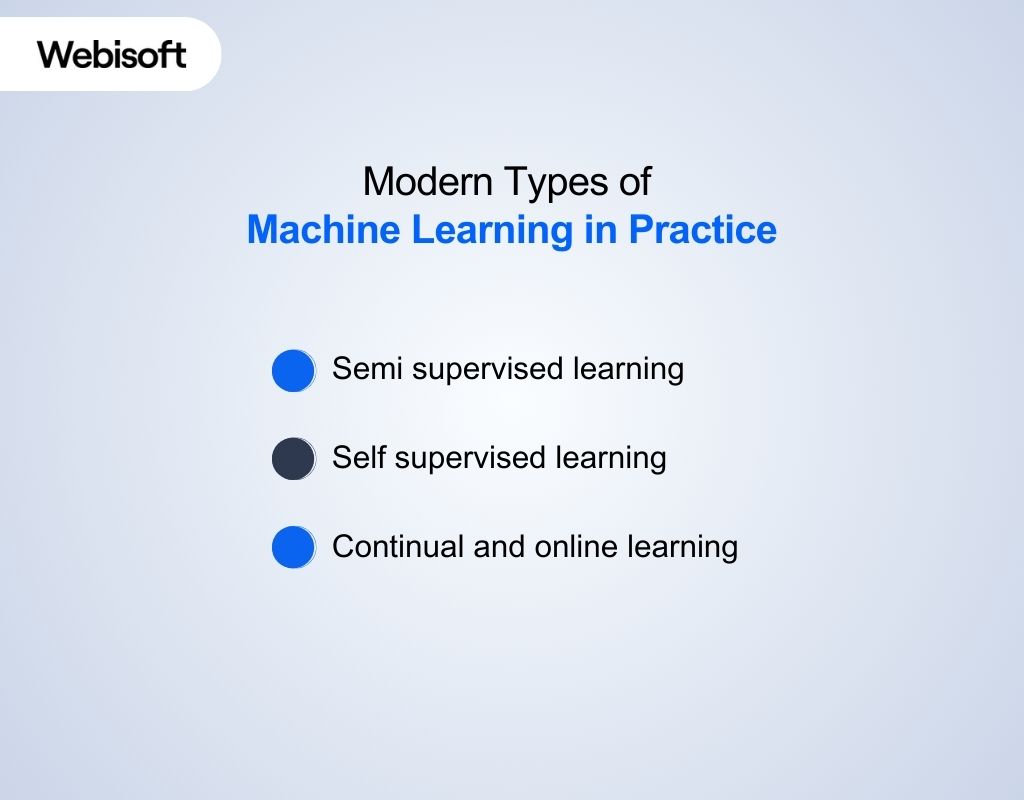
Modern types of machine learning systems extend beyond the three classical categories by introducing approaches that handle limited labels, complex data structures, and dynamic environments. These advanced methods improve model flexibility and support real world learning challenges across diverse applications.
Semi supervised learning
Semi supervised learning combines a small labeled dataset with a much larger unlabeled one. The model uses labeled samples to establish guidance, then refines its understanding through patterns discovered in the unlabeled data. This approach reduces annotation costs while still enabling strong predictive performance, which is why it is widely used when labels are sparse or expensive.
Self supervised learning
Self supervised learning creates training signals directly from the data. The model predicts missing or transformed parts of an input, allowing it to learn structure without manual labels. Once trained, these representations transfer effectively to downstream tasks and reduce reliance on large labeled datasets.
Continual and online learning
Continual learning enables a model to absorb new knowledge without forgetting earlier information. Online learning processes data in small increments, updating the model as new information arrives. Both approaches support real time applications that must adapt to changing environments or evolving datasets.
Key Differences Between the Types of Machine Learning
After understanding both the classical and modern learning types, it becomes easier to see how each category functions in practice. This comparison highlights the core differences that shape how machine learning models learn, adapt and generalize.
| Type of Machine Learning | Data Requirement | Learning Objective | Feedback Source | Strength | Model Behavior |
|---|---|---|---|---|---|
| Supervised Learning | Labeled data | Predict specific outputs | Error based corrective signals | High accuracy for known tasks | Learns direct input to output mapping |
| Unsupervised Learning | Unlabeled data | Discover structure and patterns | No explicit feedback | Reveals hidden relationships | Learns organization of raw data |
| Reinforcement Learning | Interactive environment data | Maximize long term reward | Reward or penalty signals | Strong sequential decision making | Learns through experience and exploration |
| Semi Supervised Learning | Small labeled set plus large unlabeled set | Improve predictive performance with minimal labels | Partial supervision | Reduces annotation cost | Learns from limited supervision and structure |
| Self Supervised Learning | Unlabeled data with generated labels | Learn internal representations | Predictive signals created from input itself | Powerful feature learning | Learns patterns by reconstructing or predicting data |
| Continual Learning | Sequential task data | Preserve old knowledge while learning new | Performance across evolving tasks | Adapts across many tasks | Updates without forgetting previous skills |
| Online Learning | Streaming, incremental data | Adapt to new information quickly | Instant sample by sample updates | Real time responsiveness | Continuously updates weights as data arrives |
When to Use Each Machine Learning Type
Choosing the right learning approach is essential because each category is customized to specific data and problem characteristics. Understanding when to apply different types of machine learning models helps ensure effective solutions, faster results, and more accurate outcomes.
Supervised learning
Use supervised learning when the goal relies on clear input-output relationships.
- Best for datasets where labels are complete and reliable.
- Works effectively when prediction accuracy can be measured against known results.
- Ideal for tasks that require mapping features directly to outcomes.
- Helps in situations where minimizing error through repeated tuning is important.
- Common fits include classification workloads, numeric forecasting, document categorization, and fraud detection.
Unsupervised learning
Choose unsupervised learning when the objective is pattern discovery instead of prediction.
- Suitable when data do not include labels or predefined categories.
- Helps uncover structure, similarity, hidden relationships, or natural grouping.
- Useful for large, complex datasets requiring exploration before modeling.
- Often used for anomaly detection, clustering, dimensionality reduction, and insight extraction.
- Works well when the focus is understanding data behavior rather than predicting outputs.
Reinforcement learning
Use reinforcement learning when learning must happen through interaction and experience.
- Ideal for environments where actions influence future states.
- Fits problems that require optimizing long term reward instead of immediate accuracy.
- Effective when decision sequences build on previous results.
- Common in robotics, navigation systems, autonomous control, and adaptive simulations.
- Works best when the goal is strategy development through trial and reward feedback.
Semi supervised learning
Semi supervised learning helps when labeled data are limited but unlabeled data are abundant.
- Reduces annotation cost by leveraging a small labeled subset.
- Enhances generalization by extracting structure from unlabeled samples.
- Useful in industries where labeling requires expert time, such as healthcare or legal domains.
- Improves accuracy compared to unsupervised learning alone while requiring fewer labels than supervised learning.
- A practical choice for document classification, image categorization, and research workflows with partial labels.
Self supervised learning
Use self supervised learning when manual labeling is impractical or unavailable.
- Creates training objectives directly from the data by masking, predicting, or reconstructing parts of input samples.
- Learns powerful feature representations that transfer well to downstream tasks.
- Reduces dependency on labeled datasets for pretraining large models.
- Common in natural language processing, vision, audio modeling, and multimodal architectures.
- Enables efficient pretraining at scale, especially when vast unlabeled datasets exist.
Applications of Machine Learning Organized by Learning Type
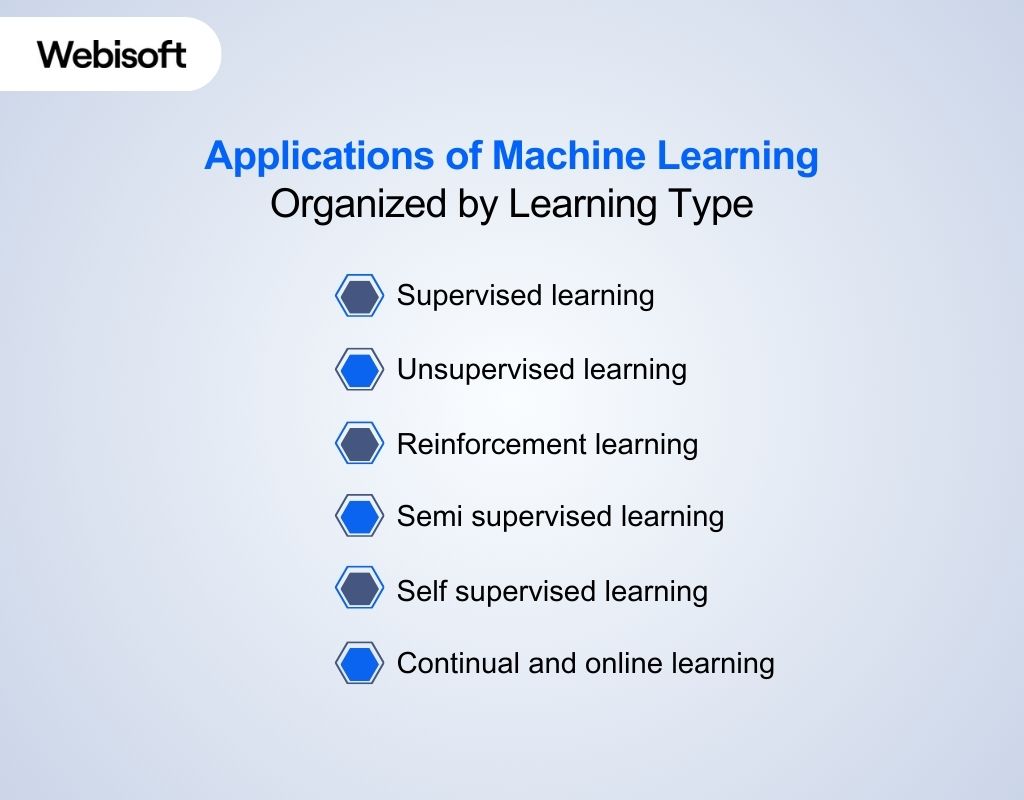
After selecting the right learning type and knowing when to use it, it helps to see how each category functions in real applications. Below is a concise view of common applications of machine learning by types across practical scenarios.
Supervised learning
- Predicting numerical values such as sales, pricing, or demand.
- Classifying documents, emails, medical images, or product categories.
- Identifying fraudulent transactions using labeled behavioral patterns.
- Quality inspection where labeled examples define acceptable outputs.
Unsupervised learning
- Segmenting customers into meaningful groups based on shared traits.
- Detecting anomalies in financial, security, or sensor data.
- Reducing dataset complexity for visualization or preprocessing.
- Discovering hidden usage patterns for recommendation and insight.
Reinforcement learning
- Training decision-making agents in games or simulations.
- Controlling robotic movement or autonomous navigation.
- Optimizing resource allocation in dynamic environments.
- Learning long-term strategies for trading or scheduling systems.
Semi supervised learning
- Classifying documents with very few labeled examples.
- Enhancing image recognition with limited annotated samples.
- Reducing manual labeling effort in speech or audio tasks.
Self supervised learning
- Pretraining language models on large unlabeled text corpora.
- Learning image features from masked or transformed visuals.
- Building representation models for downstream classification and clustering.
Continual and online learning
- Updating recommendations in real time as user behavior shifts.
- Adapting models continuously without retraining from scratch.
- Improving risk scoring or detection systems in fast-changing environments.
If you’re ready to explore how these machine learning applications can support your organization, Webisoft can guide you from planning to execution. Connect with our team to evaluate your goals and build a customized machine learning roadmap.
Webisoft: Helping You Pick and Implement the Right Machine Learning Type
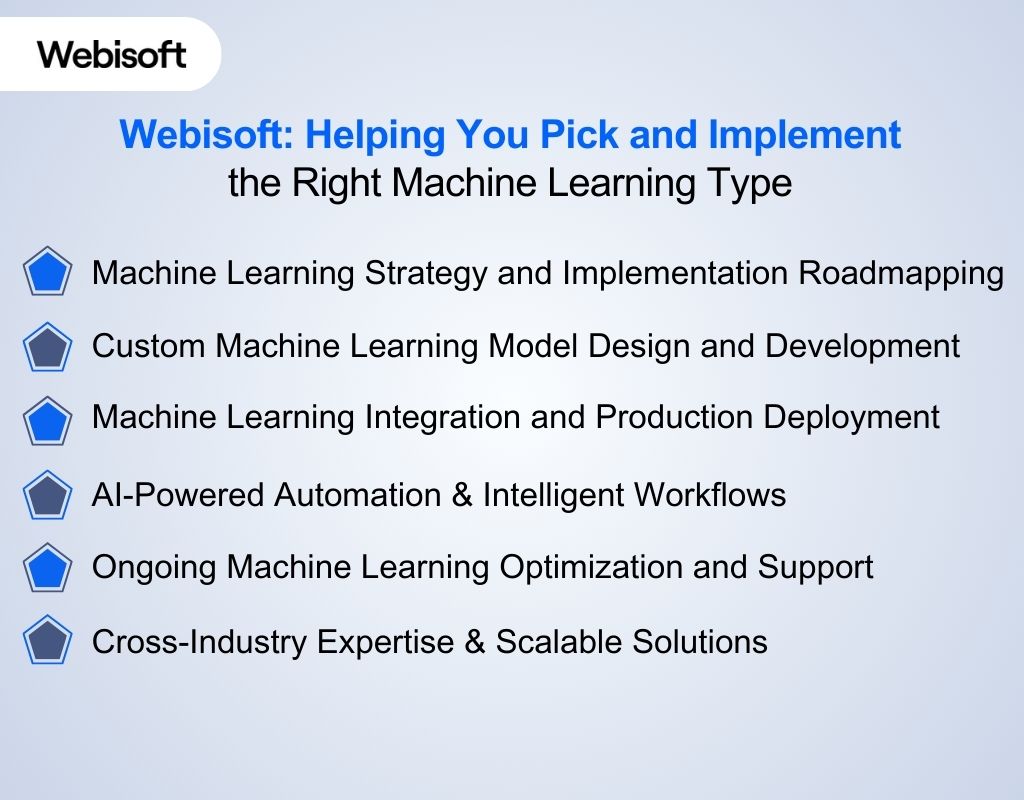
Identifying the right machine learning type is only the beginning; ensuring it delivers real value requires expert implementation. Webisoft steps in here, helping teams transform well-chosen machine learning approaches into scalable, high-impact systems that align with business priorities.
Machine Learning Strategy and Implementation Roadmapping
Webisoft begins every AI engagement by understanding your business context, data landscape, and long-term objectives. This ensures your machine learning initiative is grounded in real business outcomes rather than abstract technology goals. By aligning KPIs, data readiness, and operational constraints up front, Webisoft creates a clear roadmap that guides efficient implementation and measurable success.
Custom Machine Learning Model Design and Development
Webisoft engineers machine learning models customized to your unique data and problem space, not generic one-size-fits-all solutions. Our team designs and trains models optimized for accuracy, scalability, and interpretability, ensuring they integrate seamlessly into your existing workflows. From predictive analytics to deep learning architectures, Webisoft’s approach balances performance with business logic for immediate impact.
Machine Learning Integration and Production Deployment
Webisoft embeds your machine learning models into operational systems such as ERPs, CRMs, and industry platforms without disrupting daily workflows. This ensures models operate on real-time data and produce decision-ready insights where they matter most. Deployment includes scalable infrastructure, monitoring dashboards, and automated retraining pipelines that maintain model performance.
AI-Powered Automation & Intelligent Workflows
Webisoft builds machine-learning-driven automation that transforms repetitive tasks into adaptive, intelligent workflows. These solutions learn from operational data, make predictive decisions, and streamline complex processes with precision. From document digitization to predictive process automation, Webisoft enables teams to focus on strategic outcomes rather than routine tasks.
Ongoing Machine Learning Optimization and Support
Machine learning systems evolve, and Webisoft ensures your models evolve with them. Through continuous monitoring, performance evaluation, and scheduled retraining, your ML systems remain accurate, secure, and aligned with real-world conditions. This long-term support protects ROI and keeps your models performing at production level.
Cross-Industry Expertise & Scalable Solutions
Webisoft delivers machine learning solutions across finance, healthcare, logistics, retail, and SaaS. By combining technical depth with domain expertise, Webisoft builds ML systems that convert raw data into actionable intelligence. These scalable solutions help businesses stay competitive in fast-changing markets.
Conclusion
Reaching the end of these learning approaches should finally settle the quiet question many ask at the start: “How many types of machine learning are there.” What matters more is how each one guides a project from data to results. With the fundamentals in place, the path ahead becomes far easier to navigate. If that path now feels clearer, Webisoft can help turn understanding into real solutions. With thoughtful direction and dependable engineering, your next machine learning initiative can close strong and begin even stronger.
Frequently Asked Question
Yes. Hybrid pipelines often use supervised learning to provide an initial policy or behavior estimate, then apply reinforcement learning to refine decisions based on real interactions. This combination improves performance in robotics, game environments, and adaptive control systems where both guidance and experience are valuable.
Poor data quality impacts each learning type differently. Supervised models suffer from noisy labels, unsupervised models misinterpret skewed features, and reinforcement learning struggles when reward signals are sparse, delayed, or unreliable.
Dataset size influences which learning type performs best. Small labeled datasets benefit from semi-supervised or self-supervised methods. Large labeled datasets support supervised learning, and large unlabeled datasets pair well with unsupervised or self-supervised approaches that extract structure without costly manual annotation.