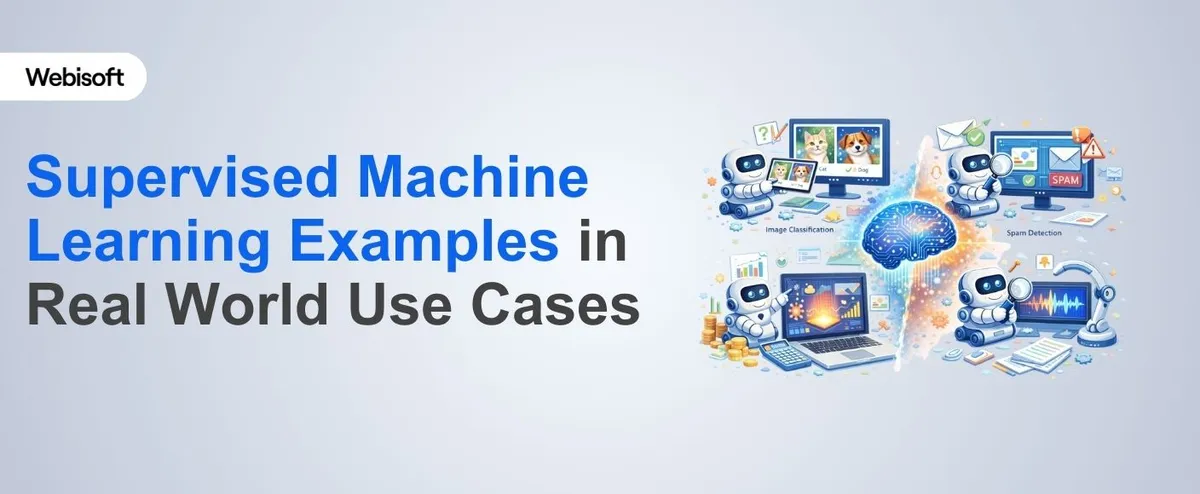
Supervised machine learning examples are everywhere, even when you are not thinking about machine learning at all. Spam filters, fraud alerts, price predictions, and recommendations quietly rely on past data to make confident guesses about what happens next.
Instead of abstract theory, real understanding comes from observing how supervised learning behaves in practice. That is why examples matter more than formulas, especially when models influence everyday decisions and business outcomes.
In this guide, you will find clear examples of supervised machine learning explained through real-world use cases, industries, and algorithms. Thus helping you understand what works, where it fits, and how these systems are applied in practice.
What Is Supervised Machine Learning?
Supervised machine learning is a category of machine learning where models are built using data that includes predefined outcomes. These outcomes act as reference points that define what the model should learn to predict.
The presence of labeled examples distinguishes supervised learning from other machine learning approaches and makes it suitable for tasks where the desired result is already known.
This form of learning is commonly applied to prediction problems that require consistent and verifiable results, such as classification and regression tasks. Because expected outcomes are clearly defined, supervised machine learning is widely used in practical applications where accuracy, accountability, and repeatability are essential.
How Supervised Machine Learning Works in Real Projects
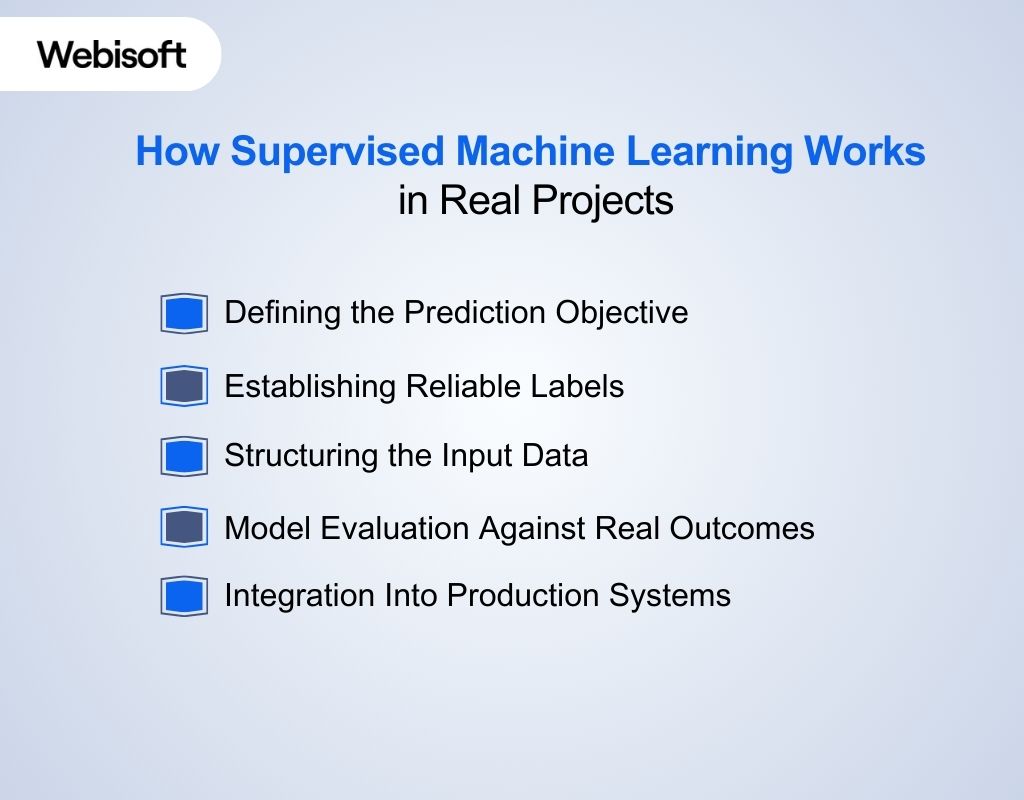
In real projects, supervised machine learning follows a structured path shaped by business goals, data limitations, and deployment constraints. Each stage reflects practical decisions teams make to turn historical data into reliable predictions that can operate in production systems.
Defining the Prediction Objective
Projects begin by identifying a specific outcome that the system must predict. This outcome is tightly linked to a decision point, such as approval, detection, ranking, or forecasting, rather than abstract experimentation.
Establishing Reliable Labels
Real-world datasets must include outcomes that reflect correct or accepted results. These labels often come from transaction records, user actions, expert reviews, or historical system decisions, and their quality directly affects model reliability. If you want practical guidance on defining good labels for training, explore how to label data for machine learning effectively.
Structuring the Input Data
Teams decide how raw data should be represented so patterns become learnable. This step involves selecting relevant attributes, handling missing values, and ensuring inputs reflect the conditions under which predictions will be used.
Model Evaluation Against Real Outcomes
Instead of focusing only on accuracy, teams assess performance using metrics aligned with business impact, grounded in supervised learning fundamentals. This helps determine whether predictions are useful, acceptable, or risky when applied to live scenarios.
Integration Into Production Systems
After validation, models are connected to applications, dashboards, or automated workflows. Ongoing monitoring is required to confirm predictions remain aligned with real-world behavior as data patterns change.
Supervised Machine Learning Examples by Use Case Type
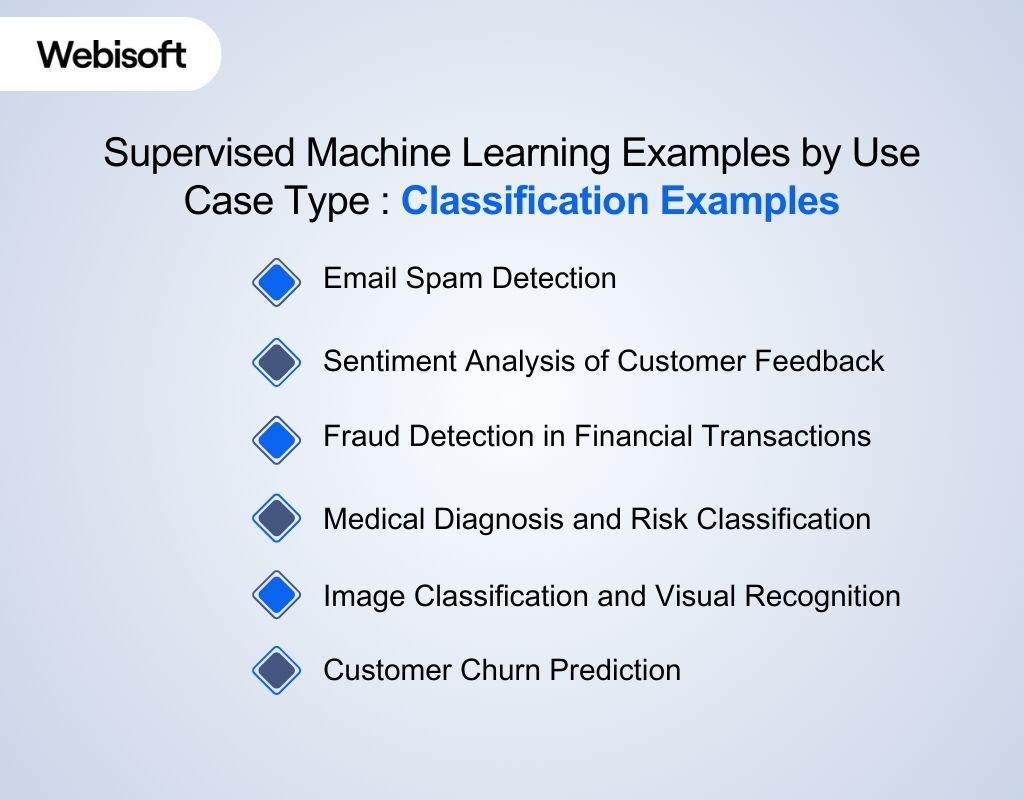
Supervised machine learning examples in real life are best understood when grouped by the kind of prediction they support in real-world systems. The following examples reflect different supervised learning types as they are applied to practical, repeatable problems across production environments.
Classification Examples:
Classification problems involve predicting one label from a fixed set of categories. These are some of the most widely deployed supervised machine learning examples in everyday life, as they support direct decision-making.
Email Spam Detection
Email spam detection relies on large volumes of historical emails that have already been labeled as spam or legitimate. These labels may come from user actions, internal filtering rules, or manual review.
The model learns patterns in message content, sender behavior, formatting signals, and metadata. When a new email arrives, the system predicts whether it belongs to the spam category, allowing automated filtering before the user interacts with it.
Sentiment Analysis of Customer Feedback
In sentiment analysis, text data such as reviews, surveys, or support tickets is labeled based on emotional tone. Labels may include positive, negative, or neutral sentiment. These labels are often created through manual annotation or customer rating scores. The model predicts sentiment for new text to help businesses track satisfaction trends, detect negative experiences early, and prioritize responses.
Fraud Detection in Financial Transactions
Fraud detection systems are trained using transaction histories labeled as fraudulent or legitimate based on confirmed investigations. Input data includes transaction amounts, timing, location, device information, and behavioral patterns. The model predicts the likelihood of fraud for new transactions, supporting real-time blocking, step-up verification, or manual review processes.
Medical Diagnosis and Risk Classification
In healthcare settings, patient records are labeled using confirmed diagnoses, test outcomes, or clinical decisions. Input features may include lab results, medical history, vital signs, and imaging summaries. The model predicts the probability of a condition or risk category, supporting clinicians with data-driven insights while keeping final decisions human-led.
Image Classification and Visual Recognition
Image classification systems are trained using images labeled with known categories, such as objects, defects, or symbols. Labels are usually created through annotation tools or expert review. The model predicts which label best matches a new image, enabling use cases like quality inspection, document recognition, and automated visual checks.
Customer Churn Prediction
Customer behavior data is labeled based on whether users eventually leave or stay. Inputs include usage patterns, engagement frequency, support history, and account changes. The model predicts churn risk, allowing businesses to intervene early with retention strategies.
Regression Examples:
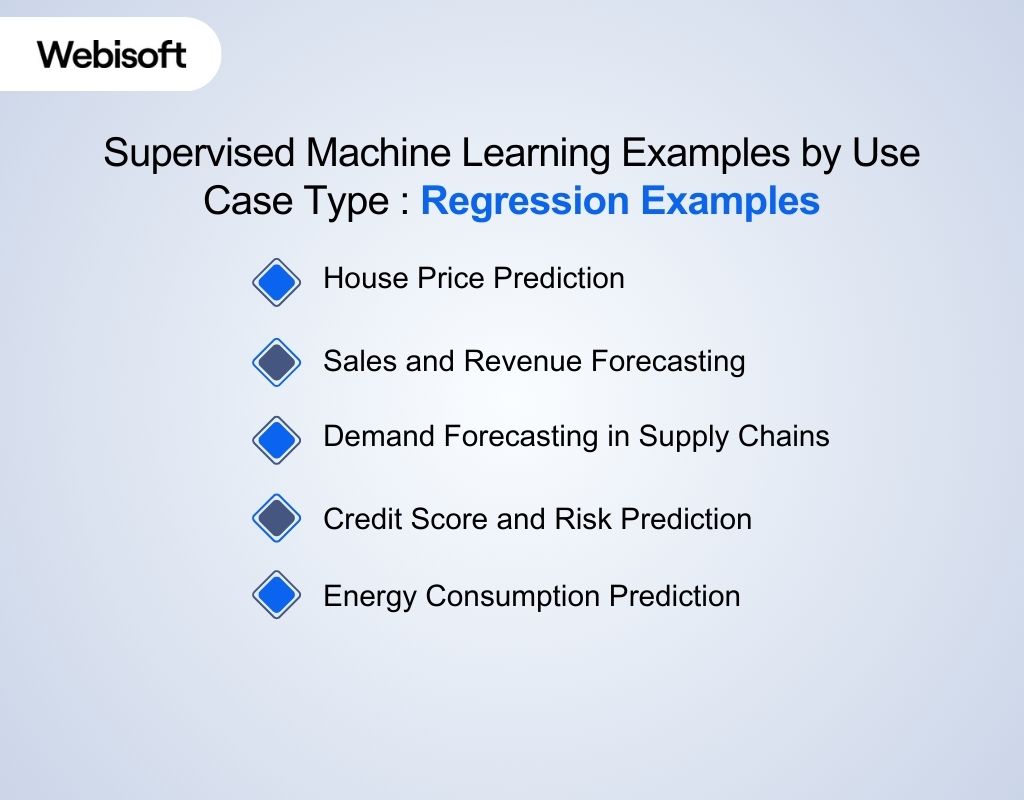
Regression problems focus on predicting a continuous numeric value rather than a category. These supervised learning examples are common where estimation and forecasting are required.
House Price Prediction
Property datasets are labeled with actual sale prices from historical records. Input features include location, size, age, amenities, and market indicators. The model predicts a numeric price estimate for properties, supporting valuation, listing, and investment decisions.
Sales and Revenue Forecasting
Historical sales data is labeled with exact revenue or unit values. Inputs may include time, seasonality, promotions, and external factors. The model predicts future sales figures, helping organizations plan inventory, staffing, and budgeting.
Demand Forecasting in Supply Chains
Demand prediction systems use past order volumes labeled with actual consumption levels. Inputs include product attributes, location, timing, and external signals. The model predicts future demand to reduce shortages, overstocking, and logistics inefficiencies.
Credit Score and Risk Prediction
Financial records are labeled using historical repayment outcomes or credit scores. Inputs include income history, repayment behavior, account usage, and liabilities. The model predicts a numeric risk score that informs lending, pricing, and approval decisions.
Energy Consumption Prediction
Utility usage data is labeled with actual consumption values over time. Inputs include historical usage, weather data, and time-based patterns. The model predicts future energy demand to support capacity planning and cost optimization.
Industry-Specific Supervised Machine Learning Examples
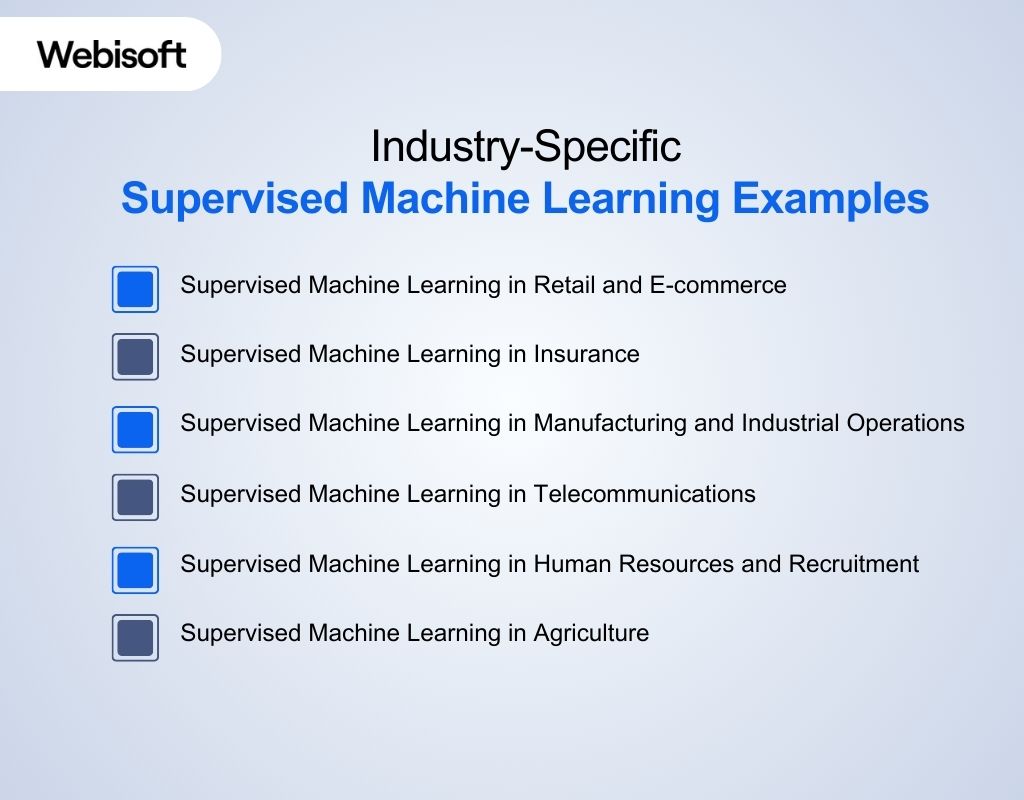
After exploring supervised machine learning examples by use case, it becomes clear that these predictions are applied differently across industries. The following examples show how supervised learning is adapted to industry-specific data, constraints, and operational requirements.
Supervised Machine Learning in Retail and E-commerce
Retail and e-commerce platforms use supervised machine learning to optimize pricing, promotions, and customer experience. Historical transaction data is labeled with outcomes such as purchase completion, cart abandonment, or discount response.
Models predict how customers are likely to react to pricing changes, promotions, or product placement. These predictions help retailers adjust pricing strategies, personalize offers, and improve conversion rates while maintaining margins.
Supervised Machine Learning in Insurance
Insurance companies apply supervised learning to claims processing and risk assessment. Past claims are labeled with final settlement outcomes, approval decisions, or fraud investigation results.
Input data includes claim descriptions, policy details, historical claim behavior, and external risk indicators. Models predict claim approval likelihood or expected claim cost, allowing insurers to speed up processing, reduce manual reviews, and control financial risk.
Supervised Machine Learning in Manufacturing and Industrial Operations
Manufacturing environments rely on supervised learning to predict equipment behavior and production outcomes. Machine logs and sensor readings are labeled with events such as failure occurrence, downtime, or maintenance actions. Models predict failure probability or remaining useful life of equipment, helping teams schedule maintenance proactively, reduce unplanned downtime, and extend asset lifespan.
Supervised Machine Learning in Telecommunications
Telecom providers use supervised learning to manage network reliability and customer experience. Network performance data is labeled with known outages, service degradation events, or customer complaints.
Models predict potential service disruptions or quality issues before they affect users. This enables faster response times, better network planning, and reduced customer churn caused by service instability.
Supervised Machine Learning in Human Resources and Recruitment
HR teams apply supervised learning to streamline hiring and workforce planning. Historical hiring data is labeled with outcomes such as successful hires, employee retention, or performance evaluations.
Input data includes resumes, application details, and assessment results. Models predict candidate suitability or attrition risk, supporting more consistent and data-backed hiring decisions.
Supervised Machine Learning in Agriculture
Agricultural systems use supervised learning to improve yield prediction and crop management. Historical farming data is labeled with yield outcomes, disease occurrences, or harvest quality. Inputs include weather data, soil conditions, satellite imagery, and farming practices.
Models predict crop yield or disease risk, helping farmers optimize planting schedules, irrigation, and resource use. Supervised machine learning examples become valuable when they work reliably in real systems. At Webisoft, we simplify machine learning implementation, supporting businesses as they build, deploy, and maintain supervised models in production environments.
Popular Supervised Machine Learning Algorithms Used in These Examples
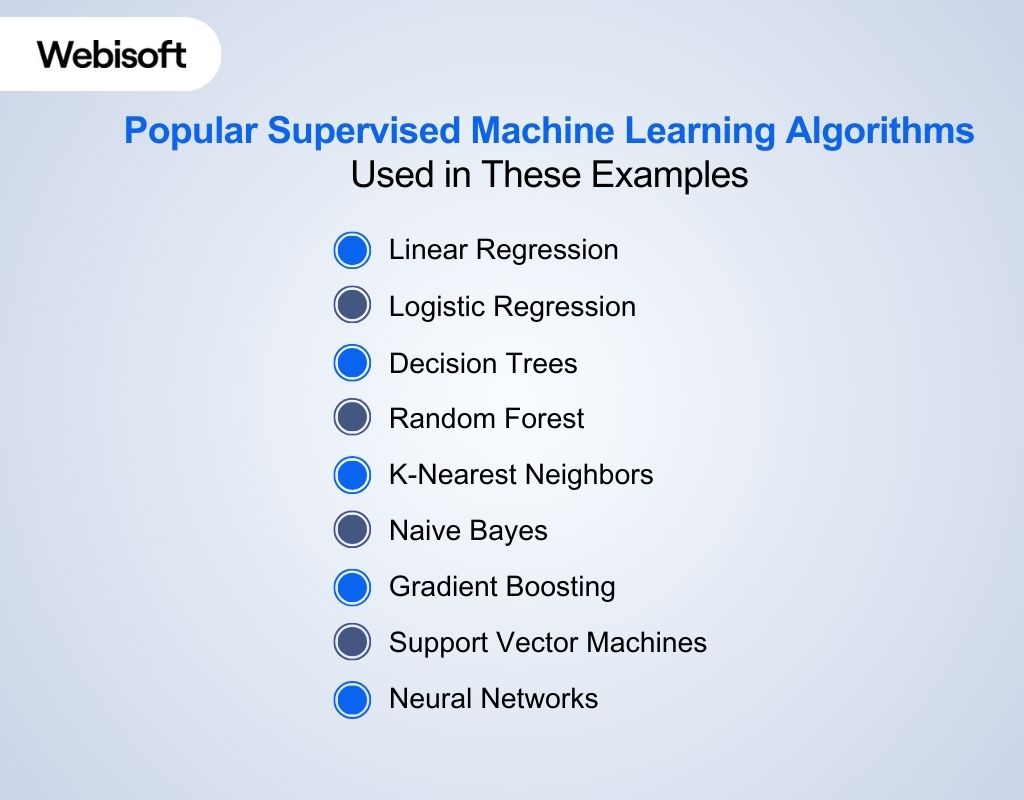
Once you review examples of supervised machine learning across business and production systems, a core set of algorithms shows up repeatedly. Teams pick these models based on problem type, dataset size, interpretability needs, and how stable predictions must be in real use.
Linear Regression
Linear regression is widely used in regression-based supervised learning examples where the goal is to predict a numeric value. It works well when relationships between inputs and outputs follow a consistent linear pattern.
Logistic Regression
Logistic regression is commonly applied in classification problems that require binary or multi-class outcomes. It is frequently used in decision-focused tasks such as approval, detection, or classification scenarios.
Decision Trees
Decision trees are popular because their predictions are easy to interpret. They are often used in business environments where understanding how a decision is made is as important as the prediction itself.
Random Forest
Random forest combines multiple decision trees to improve prediction stability. It is commonly used in real-world examples of supervised machine learning that involve complex patterns and mixed data types.
K-Nearest Neighbors
Used for classification or regression by predicting outcomes based on the most similar historical data points. It is often used as a simple baseline or when patterns cluster naturally in the feature space.
Naive Bayes
A fast classification approach is used heavily in text-based problems where features represent words or tokens. It is common in document categorization and other NLP classification use cases.
Gradient Boosting
An ensemble approach that builds models sequentially to correct earlier errors. It is widely used when teams need strong performance on structured data, especially for business prediction problems.
Support Vector Machines
Support vector machines are used in classification tasks where data separation is challenging. They perform well when clear boundaries between classes are required.
Neural Networks
Neural networks are applied in supervised learning problems involving large datasets, images, or text. They are commonly used when simpler models fail to capture complex relationships.
Applying Supervised Machine Learning in Business With Webisoft
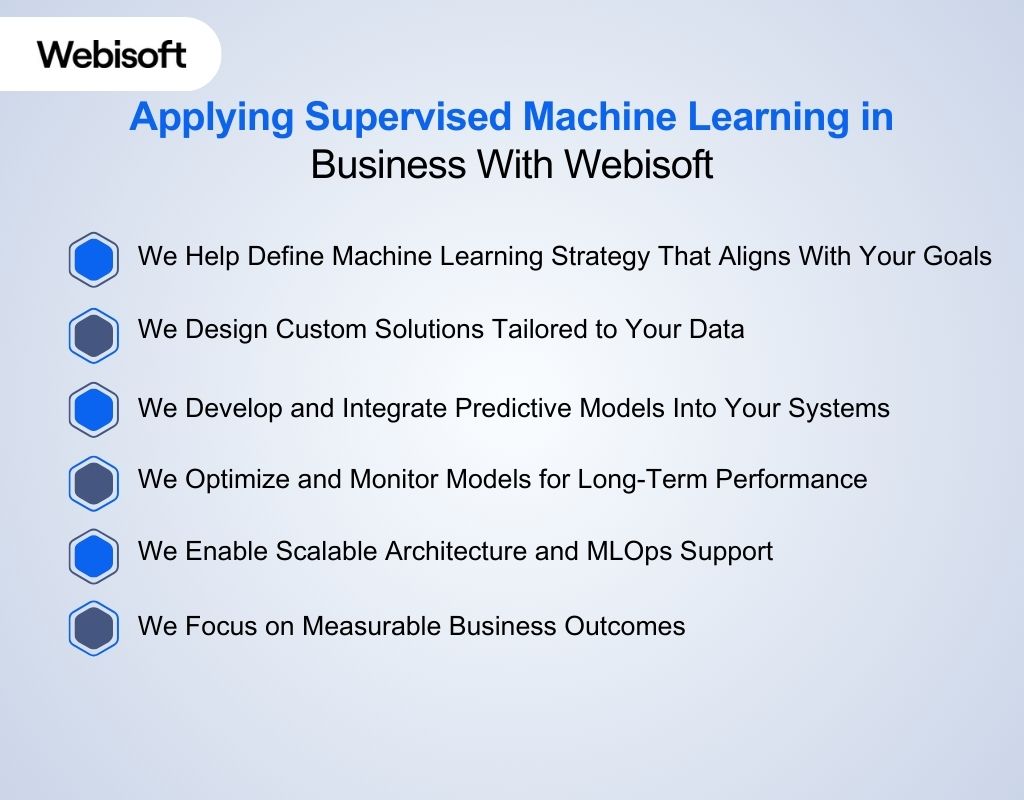
After seeing how supervised machine learning works across real use cases and industries, the next step is applying it correctly in business. At Webisoft, we help organizations turn supervised learning models into reliable, production-ready systems that drive consistent, measurable results.
We Help Define Machine Learning Strategy That Aligns With Your Goals
Before any models are built, we work with you to understand your business objectives, data maturity, and where supervised machine learning can create the most value. Our AI strategy consultation ensures that every use case we pursue addresses real operational challenges with clear success metrics.
We Design Custom Solutions Tailored to Your Data
Every business has unique datasets, requirements, and constraints. We don’t apply off-the-shelf models. Instead, we design and train supervised machine learning models using your unstructured data, following a machine learning consulting-driven process prioritizing relevance and accuracy.
We Develop and Integrate Predictive Models Into Your Systems
At Webisoft, we build supervised learning models that seamlessly integrate into your existing CRM, ERP, analytics, or workflow systems. This allows you to drive real-time predictions and decision automation without disrupting current operations.
We Optimize and Monitor Models for Long-Term Performance
Deployment is only the beginning. We set up monitoring, performance tracking, and automated retraining pipelines so your models stay accurate and responsive as data evolves. This helps ensure long-term reliability and ROI from your AI investments.
We Enable Scalable Architecture and MLOps Support
Our supervised machine learning solutions are built on scalable architectures that support future growth. Whether you’re expanding to new geographies, increasing data volume, or adding new prediction tasks, Webisoft ensures your ML ecosystem adapts efficiently.
We Focus on Measurable Business Outcomes
From customer churn reduction and risk scoring to demand forecasting and anomaly detection, we design every solution with business impact in mind. The end goal is not just predictive models, but measurable improvements to decision quality, efficiency, and profitability.
If these approaches reflect how you want supervised machine learning applied in your organization, we can help you move forward with confidence. Contact Webisoft to book a free consultation and discuss turning your data, goals, and use cases into production-ready systems.
Conclusion
Supervised machine learning examples show that real impact comes from applying models in practical settings, not from theory alone. When systems learn from reliable outcomes, they support decisions that scale across industries and operations while delivering measurable, repeatable results.
Making that transition from insight to execution takes more than selecting the right algorithm. Webisoft works alongside businesses to ensure models fit real workflows, adapt as data grows, and continue delivering value well beyond initial deployment.
Frequently Asked Question
Accuracy depends on data quality, label reliability, feature selection, and evaluation metrics. In practical settings, business impact, error tolerance, and decision outcomes are often more important than achieving the highest possible accuracy score.
Yes. Many real-time systems rely on supervised learning models to generate instant predictions based on incoming data. Common examples include fraud detection, recommendation scoring, and alert systems where fast, automated decisions are required without human intervention.
Yes. Supervised learning models can be retrained periodically using newly labeled data to reflect changing user behavior, market trends, or system conditions. This helps maintain prediction accuracy as real-world patterns evolve.