The debate between SUI vs Solana is growing as both blockchains push toward high-speed execution, low fees, and developer-friendly ecosystems. Builders, teams, and investors want to understand which network offers better performance for real applications.
Yet comparing both chains is not always straightforward. Their technical foundations, execution models, security approaches, and ecosystem maturity differ in meaningful ways. This article breaks down the key SUI vs Solana differences to help you choose the right platform for your next project.
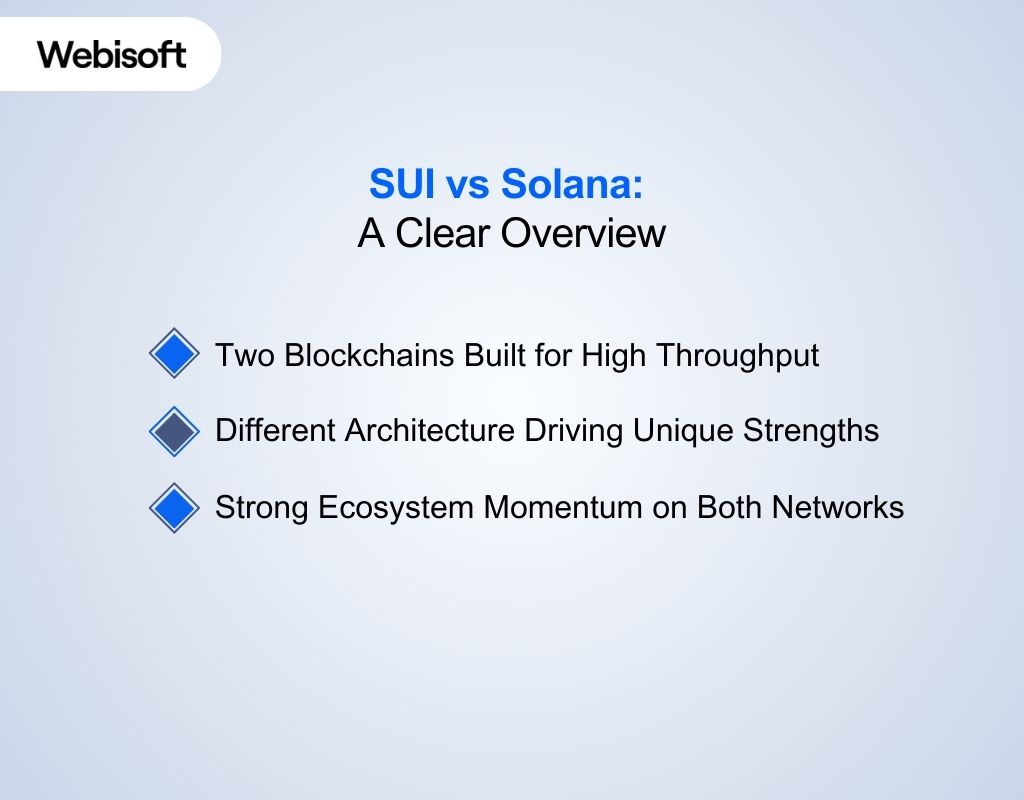
SUI vs Solana: A Clear Overview
SUI and Solana are two high-performance blockchains designed to support fast, low-cost, and developer-focused applications. Both aim to solve the bottlenecks seen in older networks, yet they approach scalability, security, and data handling very differently.
Two Blockchains Built for High Throughput
Both Sui and Solana were designed to process large volumes of transactions with minimal delay. Their performance-first mindset supports real-time gaming, financial operations, and interactive applications that struggle on slower networks.
Different Architecture Driving Unique Strengths
Solana relies on a single-layer chain with parallel execution and a specialized consensus approach. Sui uses object-centric design and a distributed validator system optimized for independent transactions and dynamic assets.
Strong Ecosystem Momentum on Both Networks
Solana offers a mature ecosystem across DeFi, NFTs, payments, and consumer apps, while Sui is growing rapidly with developer-friendly tools, scalable infrastructure, and strong support for complex asset logic.
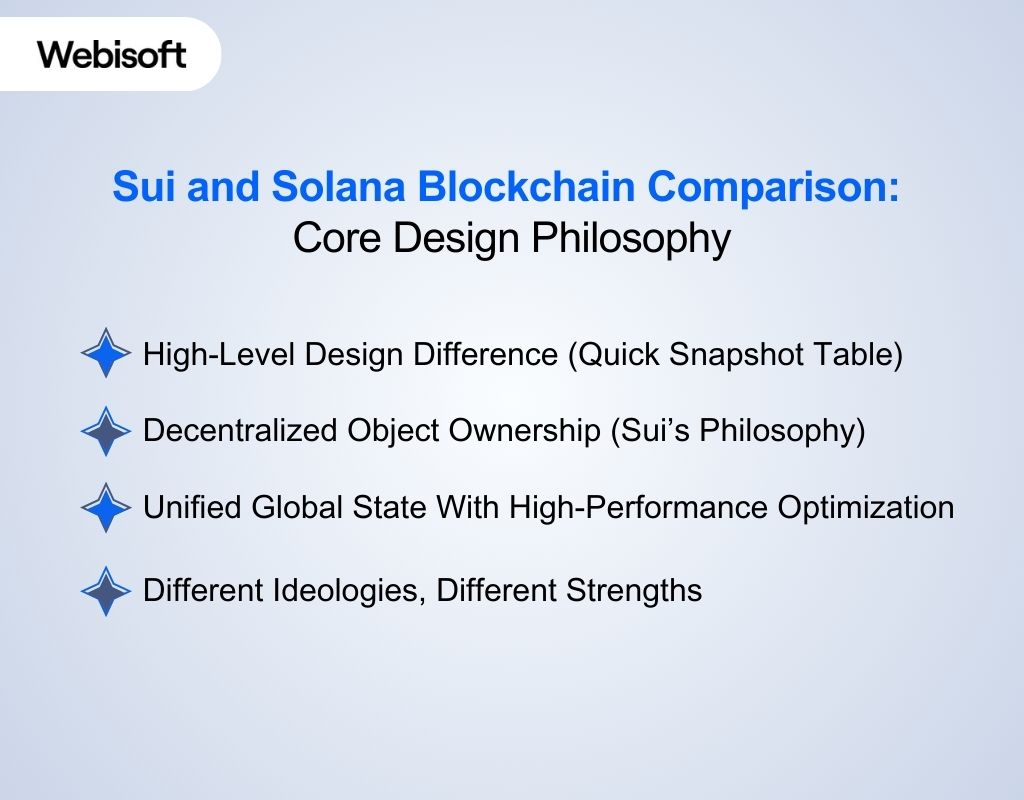
Sui and Solana Blockchain Comparison: Core Design Philosophy
Sui and Solana were engineered to solve the same major challenge delivering high-speed, scalable blockchain performance, but they approach the problem with very different design philosophies. Understanding these guiding principles helps explain why their architectures diverge so sharply.
High-Level Design Difference (Quick Snapshot Table)
| Aspect | Sui | Solana |
|---|---|---|
| Core Model | Object-centric blockchain | Single global state blockchain |
| Execution Philosophy | Parallel by default for independent objects | Parallel via Sealevel runtime |
| Role of Consensus | Only for shared-object transactions | Required for all transactions |
| Primary Vision | Predictable, safe asset manipulation | Maximum throughput on one global layer |
| Developer Mindset | Safety-first via Move | Performance-first via Rust/C |
Decentralized Object Ownership (Sui’s Philosophy)
Sui treats every asset as a distinct, programmable object with predefined ownership rules. This design removes unnecessary contention and keeps logic predictable, especially in applications where assets frequently change state.
Unified Global State With High-Performance Optimization (Solana’s Philosophy)
Solana maintains a single global state across all applications. Its philosophy aims to maximize hardware efficiency, run all activity on a single layer, and push the boundaries of performance without fragmenting the ecosystem.
Different Ideologies, Different Strengths
Sui prioritizes clarity, ownership integrity, and conflict-free execution. Solana focuses on speed, high throughput, and seamless user experiences across large-scale applications. These core philosophies set the foundation for their technical differences.
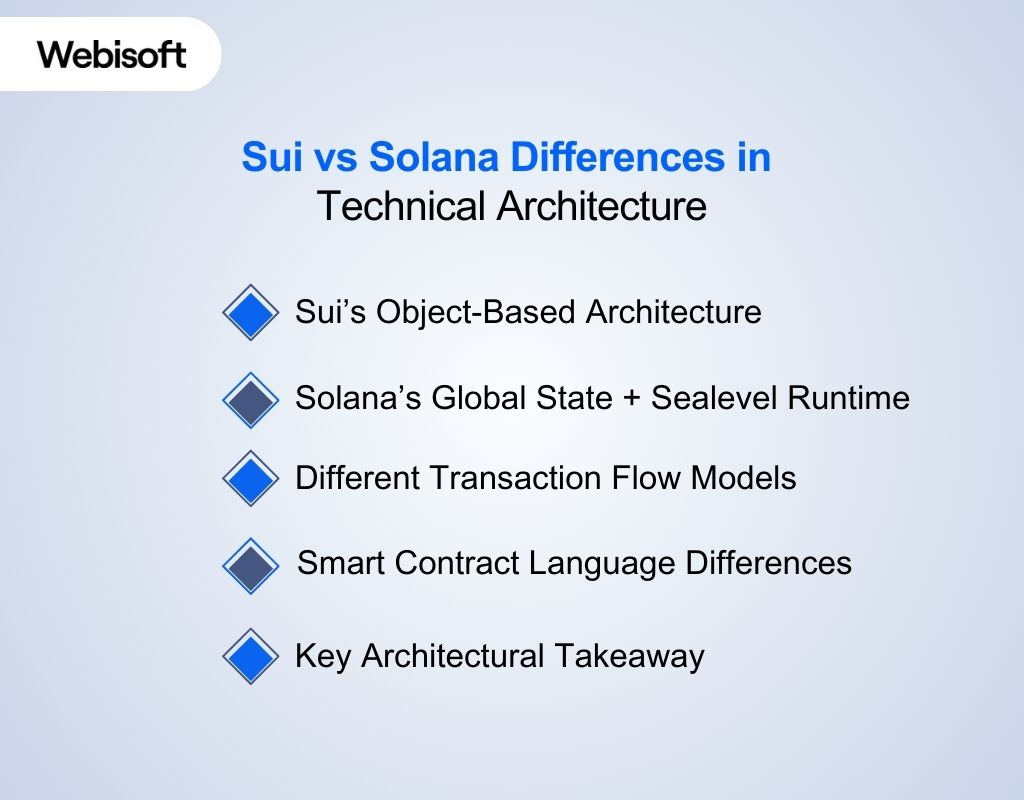
Sui vs Solana Differences in Technical Architecture
While Section 2 explains the conceptual mindset behind each chain, this section breaks down the actual engineering that shapes how Sui and Solana operate. Their architectural differences influence transaction flow, data storage, execution behavior, and developer tooling. Comparison Table: Core Technical Differences
| Technical Area | Sui | Solana |
|---|---|---|
| Data Model | Object-based, each asset is independent | Global account-based state |
| Execution Engine | Automatic parallelization for conflict-free objects | Sealevel parallel runtime based on account access |
| Consensus Requirements | Needed only for shared-object txns | Required for all txns |
| Smart Contract Language | Move (resource-safe) | Rust/C (low-level control) |
| State Storage | Object storage with ownership guarantees | Account model with rent/fees |
| Transaction Conflicts | Naturally minimized | Scheduler detects conflicts |
| Upgrade Philosophy | Safety-first, predictable updates | Performance-first, runtime upgrades |
Sui’s Object-Based Architecture
Sui structures its entire state around objects, their ownership, and their lifecycle. Because independent objects do not touch global state, validators can execute many operations concurrently without scheduling overhead.
Solana’s Global State + Sealevel Runtime
Solana stores all application data in a shared global account model. Sealevel analyzes which accounts each transaction touches, allowing the runtime to execute non-conflicting operations simultaneously on powerful validator hardware.
Different Transaction Flow Models
How Sui Processes Transactions:
- Independent-object transactions skip consensus entirely.
- Shared-object transactions use consensus only when required.
- Narwhal + Bullshark provide predictable data availability and finality.
How Solana Processes Transactions:
- Every transaction goes through consensus.
- Gulf Stream forwards transactions early for faster scheduling.
- Proof of History timestamps events, reducing validator coordination overhead.
Smart Contract Language Differences
Sui’s Move language enforces ownership rules natively, preventing entire classes of bugs. Solana’s Rust contracts offer more control but require careful memory and account management.
Key Architectural Takeaway
Sui reduces complexity by avoiding consensus when not needed, enabling predictable parallelization. Solana increases throughput by optimizing consensus and global execution to extreme levels. Both models achieve speed, but through entirely different engineering paths.
Sui vs Solana Performance: Throughput, Latency, and Stability
Performance is often the biggest factor in the Sui vs Solana comparison. Both chains aim for high throughput and fast finality, but their designs influence how they behave under different workloads.
Transaction Throughput (TPS Capability)
Sui and Solana both deliver high throughput, yet their execution paths differ. Sui performs best when handling many independent object updates, while Solana excels in globally coordinated workloads like trading and payments where large activity spikes are common. Key distinctions include:
- Sui minimizes conflicts to maintain consistent parallel execution.
- Solana uses Sealevel to process many transactions simultaneously.
- Solana’s proven live throughput is higher due to a larger active ecosystem.
Latency and Finality
Latency determines how quickly a transaction is considered final. Sui reaches finality quickly for conflict-free transactions, while Solana uses PoH to maintain predictable confirmation times even with heavy activity. In practice:
- Sui finalizes many operations without waiting for consensus.
- Solana consistently achieves sub-second finality across major apps.
- Both blockchains deliver fast, user-friendly responsiveness.
Stability Under Stress
Stability reflects how well the network handles congestion or sudden demand. Sui prevents bottlenecks by isolating transactions, reducing validator load. Solana has improved significantly through upgrades that support heavy traffic without compromising performance. Important notes:
- Sui’s separation of objects reduces chain-wide contention.
- Solana’s newer validator clients and runtime optimizations reduce outages.
- Solana has more real-world stress data due to larger adoption.
Performance Summary
Sui offers predictable execution for highly interactive, parallel applications. Solana provides reliable, sustained throughput for large-scale networks with constant global activity. Both chains deliver strong performance, but optimize for different workload types.
Sui vs Solana Speed: Handling High-Volume Activity
Speed determines how fast applications respond and how smoothly users interact with the network. Sui vs Solana speed comparisons highlight differences in how each network structures execution and processes transactions.
Execution Speed in Typical Conditions
Sui achieves fast execution by removing the need for consensus on independent transactions. Solana relies on PoH to create a deterministic ordering of events, allowing validators to process blocks efficiently with minimal delay. This leads to strong performance on both chains, but with different strengths:
- Sui is fastest when workloads involve many object updates.
- Solana maintains consistent speed across globally coordinated activity.
Speed During High Demand
High-volume periods reveal how each network handles stress. Sui’s architecture naturally avoids conflicts, making transaction spikes easier to absorb. Solana uses transaction forwarding and parallel scheduling to preserve speed even during market surges. Real outcomes:
- Sui avoids congestion by isolating independent actions.
- Solana remains stable during trading spikes and NFT mint waves.
- Both aim to keep user experience responsive under pressure.
Confirmation Time and User Perception
Finality creates the sense of instant completion. Sui finalizes many transactions almost immediately, especially those that do not touch shared objects. Solana produces quick confirmations through optimized validator coordination. Users experience both networks as fast, but:
- Sui feels instant for independent operations.
- Solana feels consistent for large-scale activity.
Speed Summary
Sui is ideal for applications with frequent asset interactions, real-time gameplay, and evolving objects. Solana delivers superior speed for high-volume trading, payments, and large user bases operating simultaneously.
Sui vs Solana Scalability for Future Growth
Scalability determines how well a blockchain can support millions of users and complex applications without slowing down. In the Sui vs Solana comparison, both offer strong paths to scaling, but their approaches diverge significantly.
How Sui Approaches Scalability
Sui’s scalability comes from its object-centric architecture. By treating assets as independent objects, the network reduces unnecessary contention and enables predictable parallel execution across validators. This model offers several benefits:
- Independent transactions scale smoothly as user activity increases.
- Validators handle fewer conflicts and perform fewer synchronized actions.
- Applications with frequent state updates, like games or asset-rich apps, scale naturally.
Sui’s long-term strategy focuses on horizontal growth adding more validators and maintaining performance even as workloads expand.
How Solana Approaches Scalability
Solana scales through aggressive vertical optimization. Instead of splitting workloads across multiple layers or rollups, Solana strengthens a single high-performance global chain. This approach includes improvements such as:
- Sealevel, which parallelizes execution based on account access.
- Firedancer, the upcoming validator client designed for major throughput gains.
- Hardware-level enhancements that increase validator capacity.
Solana’s roadmap emphasizes maximizing global throughput so that the entire network can sustain high-intensity applications like trading engines, payments, and consumer apps without fragmentation.
Which Blockchain Scales Better?
Both chains scale effectively, but for different scenarios. Sui’s architecture excels in environments that depend on independent actions and dynamic object updates, while Solana provides unmatched scalability for globally coordinated workloads with high TPS requirements. The best choice depends on the nature of the application and how its users interact with the chain.
Sui vs Solana Developer Experience
Developer experience is one of the most important factors in choosing between Sui and Solana. Although both ecosystems are growing quickly, they offer different languages, tools, and learning curves that influence how builders approach application development.
Programming Languages and Learning Curve
Sui uses the Move language, designed with resource safety and asset ownership as core principles. Solana uses Rust and sometimes C, offering low-level control but requiring deeper technical expertise. A few key distinctions:
- Move prevents common bugs through strict ownership and safety checks.
- Rust offers more flexibility but demands more careful memory management.
- Move’s structure simplifies secure asset logic, while Rust provides unmatched performance potential.
Tooling, Frameworks, and Local Development
Both ecosystems offer growing toolchains, but developers often praise Sui’s cleaner onboarding experience. Solana, while mature, has more complex runtime behavior that requires additional setup and debugging. Helpful notes:
- Sui provides unified tools designed specifically for its object model.
- Solana offers strong frameworks like Anchor for simplifying Rust development.
- Solana’s ecosystem has more third-party tools due to longer market presence.
Documentation and Community Support
Community support shapes how quickly new developers can adapt. Sui’s documentation is structured around its object model, making conceptual understanding easier. Solana’s documentation is extensive but can feel fragmented due to its ecosystem size. General observations:
- Sui’s guides focus on clarity and step-by-step workflows.
- Solana’s docs provide more breadth, tutorials, and advanced patterns.
- Solana’s mature community offers more example code and active discussions.
Overall Developer Experience
Sui offers a smoother introduction with its safety-first Move language and simplified transaction model. Solana provides a powerful but more demanding environment for developers seeking high-performance control and access to a huge ecosystem.
If you’re deciding between Sui and Solana for your next product, Webisoft helps you evaluate the right architecture and build scalable applications aligned with each chain’s strengths. Book a free consultation with Webisoft and get expert guidance for your blockchain project.
Sui vs Solana Security Comparison
Security plays a critical role in the Sui vs Solana comparison. Both chains prioritize safety, but their underlying models lead to different guarantees, protections, and risk profiles.
Smart Contract Safety Model
Smart contract safety is where Sui and Solana differ the most. Sui’s Move language enforces resource ownership, preventing accidental asset duplication or loss. Solana’s Rust smart contracts offer more control but require careful handling to avoid vulnerabilities. Key differences include:
- Move eliminates entire classes of bugs through strict type and ownership rules.
- Rust contracts can introduce issues if memory or access patterns are mismanaged.
- Sui’s safety model reduces developer error, while Solana empowers expert-level control.
Transaction Integrity and Data Handling
Each chain uses a distinct method for maintaining secure transaction flow. Sui secures object-level operations through deterministic behavior, while Solana relies on fast consensus with PoH ordering to maintain global state accuracy. General observations:
- Sui ensures asset states cannot be modified outside their defined ownership.
- Solana prevents tampering by verifying timestamps and ordering through PoH.
- Both deliver strong guarantees but rely on different protective layers.
Network Resilience and Attack Surface
Network resilience determines how well a chain handles spam, congestion, or malicious activity. Sui’s architecture avoids global contention points, while Solana continuously optimizes validator performance to maintain stability during high traffic. In practice:
- Sui reduces attack surface by isolating independent transactions.
- Solana improves resilience through runtime upgrades and stronger validator clients.
- Solana’s larger ecosystem means more real-world testing and active security research.
Security Summary
Sui provides strong safety at the programming and asset level through Move’s strict rules. Solana offers mature network security supported by PoH, high validator diversity, and extensive battle-tested infrastructure. Each chain is secure, but the nature of their protections varies based on design priorities.
Ecosystem Maturity: Tools, DeFi, NFTs, Gaming, and Adoption
Ecosystem maturity is a major factor in the Sui vs Solana comparison. While Solana has a multi-year head start with a broad and active ecosystem, Sui is growing quickly with a focus on secure asset logic and next-generation applications.
DeFi Activity and Financial Infrastructure
Solana currently leads in DeFi due to its large user base, fast execution, and deep liquidity across trading platforms. Sui is expanding its DeFi ecosystem, but most projects remain early-stage as developers explore Move’s capabilities. Key points:
- Solana’s DeFi apps handle significant daily volume across DEXs and lending protocols.
- Sui is developing early DeFi primitives and tooling around object-based liquidity logic.
- Solana’s mature financial tooling provides more real-world readiness today.
NFT Ecosystem and Digital Assets
NFTs behave differently on each chain because of their underlying design. Solana hosts one of the largest NFT markets in Web3, while Sui’s object-centric NFTs offer unique functionality such as dynamic states and richer in-app utility. Useful distinctions:
- Solana has large marketplaces, creator tools, and active trading communities.
- Sui enables evolving NFTs that change based on user interaction or game logic.
- Both chains support strong NFT innovation but in different directions.
Gaming and Interactive Applications
Gaming is a natural fit for Sui due to its asset ownership model. Solana, however, benefits from high throughput and established user bases for real-time gaming and mobile-first apps. General insights:
- Sui’s object model simplifies asset updates for interactive gameplay.
- Solana supports fast in-game transactions at scale for traditional Web3 games.
- Both chains target gaming but with different architectural advantages.
Developer Tools and Infrastructure Maturity
Solana offers a wider and more mature set of development tools due to its longer presence and larger community. Sui’s tools are newer but designed to simplify the developer experience from the start. Key notes:
- Solana includes frameworks like Anchor, strong wallet support, and third-party tooling.
- Sui provides clean SDKs and Move-focused tooling tailored to its object model.
- Both ecosystems continue expanding rapidly.
Adoption and Market Presence
Solana currently has broader adoption across retail users, large enterprises, and institutional partners. Sui is gaining momentum with developer-focused initiatives and new project launches. Brief overview:
- Solana’s large user base supports constant app activity.
- Sui is onboarding builders quickly through grants and dev programs.
- Market presence today favors Solana, but Sui’s growth trajectory is strong.
How Webisoft Helps You Build on Sui or Solana
Building on Sui or Solana requires technical clarity, optimized smart contract design, and a strong understanding of how each chain handles performance, storage, and execution. Webisoft provides hands-on engineering support to help teams launch scalable, production-ready applications on either network.
Architecture Aligned With Each Chain’s Strengths
We design system blueprints that match the execution model of both Sui and Solana. This ensures your application uses the right data structures, transaction flows, and scalability paths from the beginning.
Smart Contract Development Optimized for Performance
Our team builds efficient Move contracts for Sui and high-performance Rust programs for Solana. We ensure your logic is secure, gas-optimized, and aligned with best practices for throughput, safety, and maintainability.
End-to-End Product Development and Integration
Webisoft handles full lifecycle delivery including contract logic, application interfaces, wallets, indexing, and backend connections. This creates seamless experiences across both chains without fragmentation or performance issues.
Security, Auditing, and Continuous Optimization
We help you reduce risks by applying strict security patterns, conducting thorough code reviews, and ensuring your application stays resilient under real network conditions. Ongoing improvements keep your project stable as traffic grows.
Long-Term Support for Scaling and Upgrades
As your users increase, Webisoft helps you refine your architecture, optimize workloads, and extend functionality. Our support ensures your Sui or Solana project remains reliable across future updates and ecosystem changes.
Conclusion: Which Blockchain Is Better for Your Project?
Sui and Solana both deliver high performance, low fees, and strong developer activity, but they solve scalability in fundamentally different ways. Solana excels with unified, high-throughput execution suited for trading, payments, gaming, and consumer applications that need constant real-time responsiveness.
Sui stands out with its object-centric model, predictable parallelization, and dynamic asset logic that supports secure, scalable systems across gaming, digital assets, and enterprise-grade workflows.
Choosing between the two depends on your application’s priorities, whether you need Solana’s single-layer speed or Sui’s structured approach to asset management and independent transactions. Both ecosystems continue to innovate rapidly, offering long-term potential for builders across Web3.
If your team is evaluating Sui vs Solana for a new product, the right technical guidance helps you match your goals to the platform that fits best. With clear planning and strong engineering, you can build reliable, scalable applications on either chain and position your project for future growth.
Frequently Asked Questions
Both use robust security models. Sui benefits from Move’s resource-oriented programming, reducing common smart contract vulnerabilities. Solana provides strong network security but has experienced occasional network outages in the past. Security depends on application architecture and proper code practices.
The biggest difference is their core design. Solana uses a single global state with high-speed parallel execution, while Sui uses an object-centric model that processes many transactions independently. This makes Solana ideal for real-time trading and payments, while Sui excels in apps with rich, dynamic assets.
Both are extremely fast, but their speed comes from different mechanisms. Solana delivers high throughput through Sealevel parallel execution, while Sui achieves predictable parallelization based on object ownership. Actual performance varies by use case, but both chains consistently process transactions in milliseconds.
Solana currently has a more mature ecosystem with established DeFi, NFT, gaming, payments, and consumer applications. Sui is newer but growing quickly, especially in gaming, digital assets, and enterprise solutions due to its unique data model.
Sui offers horizontal scalability through independent object-based transactions, while Solana scales vertically through high-performance hardware and parallel execution. Both scale well, but Sui’s model provides more predictable performance for applications with complex asset logic.
Choose Solana if your application requires high throughput for real-time activity such as trading, payments, mobile apps, or gaming economies. Choose Sui if your application involves dynamic assets, complex ownership rules, or enterprise workflows. Developer experience differs, so evaluating both ecosystems helps determine the best fit.