
Smart contracts rarely fail loudly; they fail expensively. That reality is why choosing the right Solidity development companies matters more than flashy demos or bold claims on landing pages today. The best teams are not chasing hype. They are writing contracts that hold value, manage risk, and continue working months after launch, when upgrades, audits, and users start testing every assumption.
This listicle highlights teams proven in production environments. Each company featured here reflects real deployment experience, disciplined engineering practices, and the ability to deliver smart contracts that keep working long after launch.
How We Selected The Best Solidity Development Companies
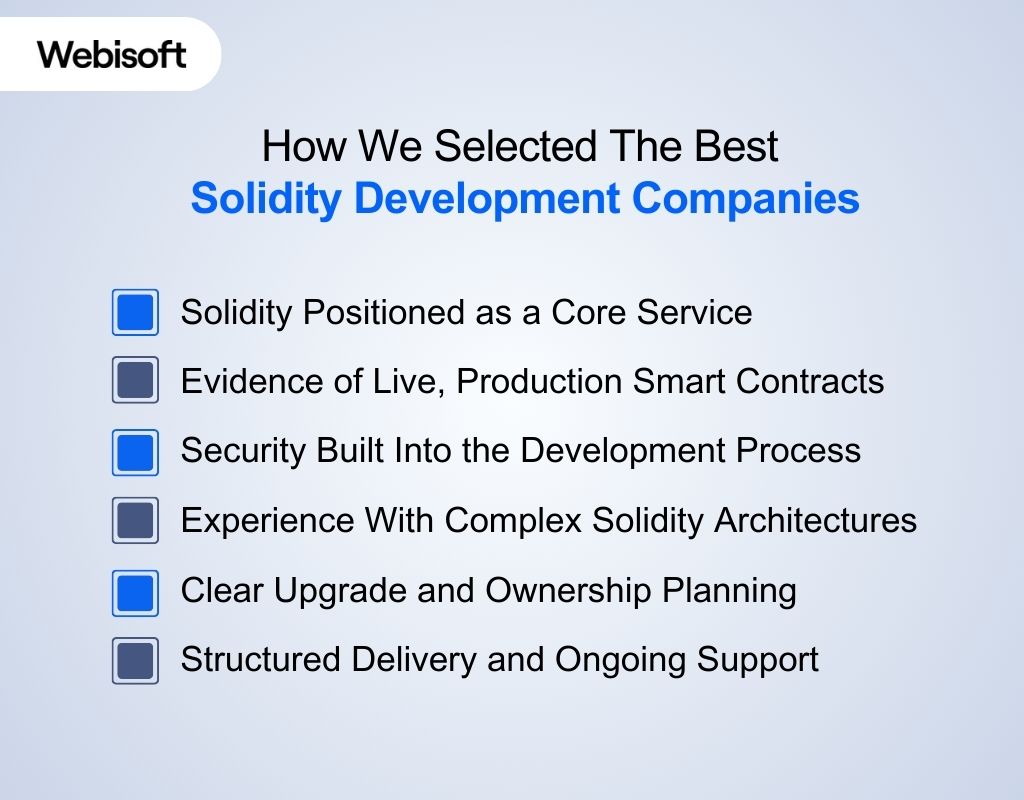
Selecting the right Solidity development companies requires more than scanning agency lists. We evaluated firms based on how they deliver production smart contracts, handle on-chain risks, and demonstrate real Solidity expertise across live Ethereum and EVM-based projects.
Solidity Positioned as a Core Service
We prioritized companies that clearly present Solidity development as a primary service. This includes dedicated Solidity pages, explicit smart contract offerings, and consistent references to Ethereum or EVM-based contract work across public materials.
Evidence of Live, Production Smart Contracts
Preference was given to teams that reference real deployments on Ethereum mainnet and other EVM-compatible networks. We looked for mainnet launches, DeFi protocols, NFT platforms, or enterprise contracts already in use rather than demo projects or generic blockchain claims.
Security Built Into the Development Process
We evaluated how security is handled during development. Companies that describe internal reviews, structured testing stages, and audit readiness ranked higher than those treating security as a final step.
Experience With Complex Solidity Architectures
Companies were assessed based on the complexity of contracts they deliver. We considered experience with upgradeable systems, governance logic, token standards, and multi-contract architectures, not just basic token creation.
Clear Upgrade and Ownership Planning
Attention was given to how contract ownership, admin permissions, and upgrade paths are managed. Teams that explain proxy usage and long-term responsibility show stronger awareness of production risks.
Structured Delivery and Ongoing Support
We favored companies that outline clear delivery stages, communication practices, and post-deployment involvement. Solidity development positioned as a long-term partnership carried more weight than one-time delivery models.
Top 10 Solidity Development Companies
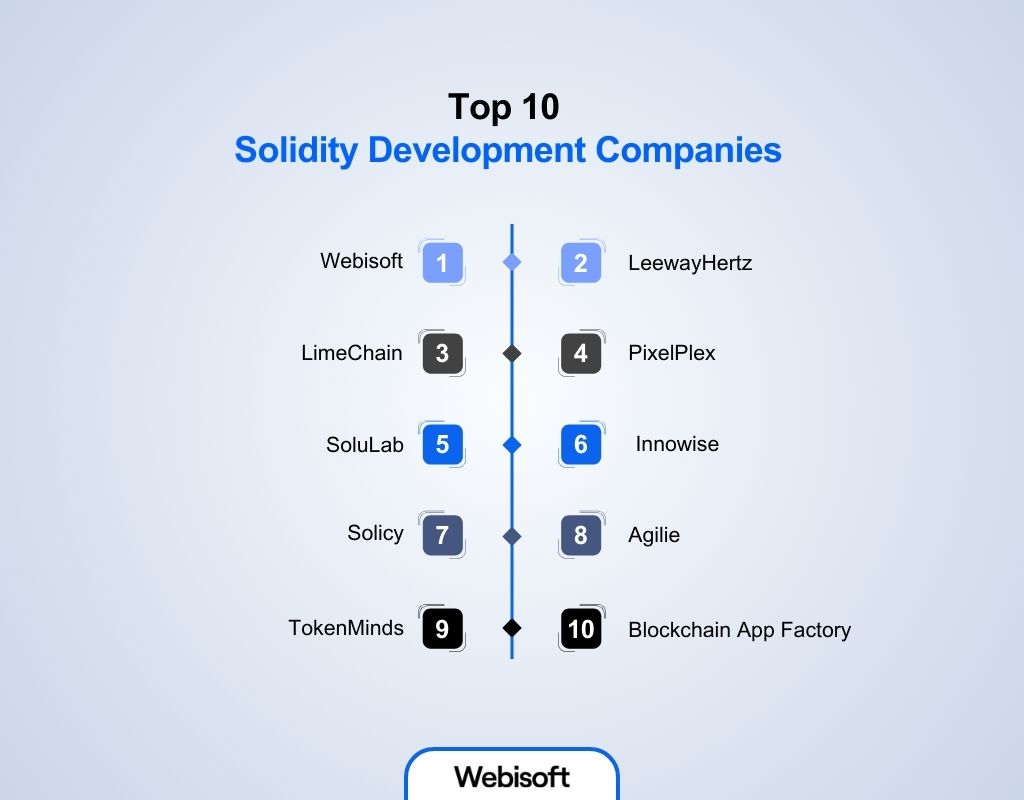
Based on the evaluation criteria, the following Solidity development companies stand out for consistent smart contract delivery. Each has demonstrated Solidity expertise through real deployments, security-aware workflows, and active work across Ethereum and other EVM-compatible networks.
1. Webisoft
Webisoft stands out as a Solidity development company built for production-grade blockchain systems. The team works with startups and enterprises that need smart contracts designed for real usage, long-term maintenance, and security exposure. Solidity work is positioned as a core capability, not an add-on service.
What places Webisoft at the top is execution depth. Projects are approached with a product mindset, focusing on contract logic, upgrade paths, and risk handling from day one. This makes Webisoft a strong choice for teams planning live deployments, not experiments.
Core Solidity services
- Custom Solidity smart contract development: Contracts are written around specific business logic, not reused templates, with attention to upgrade planning and ownership control.
- DeFi and protocol-level contract engineering: Solidity work covers lending logic, staking, governance flows, and multi-contract coordination for financial systems.
- NFT and token contract development: Implementation of ERC standards with additional logic for royalties, permissions, and lifecycle management.
- Audit-ready contract preparation: Solidity code is structured and documented to support external audits and post-audit remediation.
- Solidity staff augmentation: Dedicated Solidity engineers integrate directly into client teams for ongoing development or protocol upgrades.
Best-fit projects
- DeFi platforms requiring complex financial logic and upgradeable contracts
- NFT marketplaces needing custom contract behavior beyond standard minting
- Startups preparing for mainnet launch with audit expectations
- Enterprises integrating Solidity contracts into broader product systems
2. LeewayHertz
LeewayHertz positions itself as one of the Solidity development companies focused on building smart contracts and dApps across multiple Web3 use cases. It also includes DeFi, DAOs, gaming, tokenization, and digital identity. The company states it has deployed 80+ smart contracts and worked on 15+ blockchain projects, which signals hands-on production delivery.
LeewayHertz earns its spot through a clearly defined Solidity service lineup that goes beyond basic contracts. They have expertise in token standards, exchange-focused contract engineering, stablecoin architecture details, and DAO governance implementation, plus a documented tooling stack for analysis and documentation.
Core Solidity services
- Smart contract development: Writes, tests, and deploys contracts on chains listed on the page, including Ethereum, Neo, and Solana, positioning Solidity delivery as an end-to-end workflow.
- Digital token creation: Supports minting, upgrading, and transferring tokens aligned with ERC20, ERC721, and ERC1155, which fits teams building tokens plus real lifecycle requirements.
- Exchange platform smart contract engineering: Builds exchange-focused contract code described as secure, authenticated, and upgradable, aligned with niche feature requirements.
- dApp development with microservices support: Emphasizes connecting on-chain and off-chain data through dApp microservices, which helps when your contract logic depends on external systems.
- Stablecoin development: Covers Solidity-based stablecoin contracts with references to custodian integrations plus on-ramp and off-ramp architecture, which is important for real stablecoin operations.
- Solidity tooling for analysis and documentation: Lists tools such as Solidity REPL, Solgraph, Evmdis, and Doxity for development workflow, visualization, static analysis, and documentation generation.
Best-fit projects
- Token launches requiring ERC20, ERC721, or ERC1155 plus upgrade and transfer flows
- Exchange platforms that need authenticated, upgradeable smart contract logic
- Stablecoin initiatives needing contract development plus custodian and ramp architecture awareness
3. LimeChain
LimeChain is a Web3 engineering firm focused on building Solidity smart contracts for production environments. The company emphasizes full lifecycle delivery, covering contract design, testing, audit coordination, and deployment across Ethereum and other EVM-compatible networks.
What sets LimeChain apart is its engineering depth. The team works closely with protocol teams, startups, and Web3 companies that require Solidity code written for scale, maintainability, and long-term operation, not short-term launches.
Core Solidity services
- End-to-end Solidity smart contract development: Handles architecture, testing, and deployment as a single workflow, reducing gaps between development and production.
- Solidity engineering for Ethereum and EVM chains: Builds contracts optimized for Ethereum and other EVM networks, with attention to performance and on-chain execution behavior.
- DeFi smart contract development: Develops Solidity logic for lending, liquidity, staking, and protocol-level financial systems with security-first design.
- Protocol and infrastructure-level contract work: Supports Solidity development beyond the app layer, including protocol upgrades and ecosystem tooling.
- Audit coordination and remediation support: Structures Solidity code to align with third-party audits and supports fixes after audit feedback.
- Wallet and integration-focused contract development: Builds smart contracts that support wallet features and complex on-chain integrations.
Best-fit projects
- Ethereum or EVM-based dApps preparing for mainnet deployment
- DeFi platforms requiring complex financial logic and security discipline
- Protocol teams working on upgrades or new on-chain features
- Wallet products needing contract-backed functionality
- Web3 startups planning long-term contract maintenance and scaling
4. PixelPlex
PixelPlex is a blockchain development company that delivers Solidity smart contracts for complex Web3 products. Its Solidity work supports DeFi platforms, DAOs, exchanges, token ecosystems, and asset tokenization projects that require production-ready contract logic rather than experimental builds.
The company’s strength lies in handling Solidity contracts tied to regulated assets, financial workflows, and multi-component systems. PixelPlex approaches smart contract development with an emphasis on correctness, compliance considerations, and long-term operability across Ethereum and EVM-compatible networks.
Core Solidity services
- DeFi smart contract development: Builds Solidity logic for decentralized finance platforms, including protocol-level interactions and application networks.
- DAO and governance contract engineering: Develops governance mechanisms and voting logic that support decentralized organizational control.
- Exchange-focused Solidity contracts: Designs contract foundations for trading platforms and exchange-related Web3 products.
- Token ecosystems with advanced utility logic: Implements Solidity contracts with vesting, rewards, payments, and permission controls.
- STO and asset tokenization contracts: Delivers Solidity contracts for real-world asset tokenization, including real estate and regulated offerings.
- Gaming and digital identity contract development: Supports Web3 gaming and identity-driven applications through custom on-chain logic.
Best-fit projects
- Token platforms requiring vesting, rewards, and payment logic
- Asset tokenization and STO initiatives with compliance requirements
- DeFi ecosystems involving multiple contract components
- DAO platforms needing governance and voting contracts
- NFT marketplaces seeking contract validation before launch
- Web3 gaming products with on-chain gameplay logic
5. SoluLab

SoluLab approaches Solidity development as part of a broader product engineering offering for Web3 businesses. The company frames smart contracts as operational components within full platforms, supporting projects that combine contract logic with application layers, user flows, and backend systems.
Its Solidity work is positioned toward teams that want a single delivery partner. Rather than focusing only on isolated contract builds, SoluLab emphasizes coordinated execution across contracts, applications, and infrastructure.
Core Solidity services
- Custom Solidity smart contract development: Writes contract logic tailored to specific product requirements, rather than deploying generic or prebuilt templates.
- ERC-based token contract engineering: Implements token contracts aligned with ERC standards, with support for controlled supply, transfer rules, and lifecycle management.
- Crowdsale and distribution contract development: Designs Solidity contracts to manage token sale phases, allocation rules, and participant controls.
- dApp-oriented smart contract integration: Develops contracts intended to work closely with front-end applications and backend systems as part of a complete product.
- Exchange-related contract logic: Builds Solidity components that support trading workflows and authenticated interactions within exchange-style platforms.
- Solidity consulting and integration support: Assists teams with integrating smart contracts into existing systems and maintaining them after deployment.
Best-fit projects
- Web3 startups building full dApp products around Solidity contracts
- Token launches that require controlled issuance and sale mechanisms
- NFT platforms that need contract logic tied directly to application features
- Exchange-style products requiring custom on-chain workflows
- Teams seeking a single vendor for contracts, applications, and infrastructure
6. Innowise
Innowise is a full-cycle software development company founded in 2007, with a stated team of 3,000+ professionals. Its Solidity practice is positioned for teams that want smart contracts delivered with full product support, from UI and backend through on-chain logic.
The company approaches Solidity development with a strong emphasis on structure and tooling. Smart contracts are treated as long-term assets, supported by testing, analysis, and documentation workflows that address complexity, security risks, and future changes safely.
Core Solidity services
- Custom Solidity smart contract development and testing: Contracts are built around specific business logic, with testing integrated into the development workflow.
- dApp-focused Solidity engineering: Smart contracts are designed to align with application flows and user experience requirements.
- Token contract development for business use cases: Implements Solidity contracts for payments, subscriptions, supply chain tracking, and other operational models.
- Exchange-oriented smart contract logic: Develops Solidity components that support secure and efficient exchange and trading workflows.
- NFT marketplace smart contracts: Builds Solidity logic for minting, asset management, and marketplace interactions.
- Structured Solidity development environments: Uses established tooling to manage compilation, testing, debugging, and deployment across the contract lifecycle.
Best-fit projects
- Products requiring smart contracts delivered alongside full application development
- Token-based platforms tied to payments, subscriptions, or operational workflows
- Exchange platforms needing custom on-chain logic
- Crowdsale initiatives requiring controlled and auditable distribution
- NFT marketplaces with complex minting and asset management rules
7. Solicy

Solicy positions itself as a Solidity development company for teams building real Ethereum and EVM products. The offering targets smart contracts and full dApps across DeFi, NFT marketplaces, and broader blockchain ecosystems, with an emphasis on secure execution and production readiness.
Their Solidity pitch leans on measurable credibility signals and delivery operations. They claim 97% client satisfaction, highlighting smart contracts handling millions in transaction volume. And call out DevOps support such as CI/CD, automated testing, monitoring, and ongoing optimization.
Core Solidity services
- Smart contract development and deployment: Builds high-performance Solidity contracts designed to handle complex transactions and automated workflows.
- DeFi protocol contract engineering: Develops Solidity logic for lending platforms, yield systems, and automated market mechanisms.
- NFT marketplace and token contracts: Implements ERC-721 and ERC-1155 contracts alongside marketplace-level smart contract flows.
- Blockchain integration and migration support: Integrates Solidity contracts into existing systems or supports migration toward decentralized architectures.
- Smart contract security and optimization: Reviews contracts for vulnerabilities and improves gas efficiency before production use.
Best-fit projects
- DeFi platforms building lending, yield, or automated market functionality
- NFT marketplaces requiring token and marketplace contract logic
- Products migrating from centralized systems to blockchain-based architectures
- Teams preparing contracts for security review and gas optimization
- dApps requiring ongoing maintenance and contract upgrades
8. Agilie
Agilie delivers Solidity development with a strong fintech orientation, focusing on smart contracts that automate business rules and financial workflows on EVM-compatible blockchains. Its Solidity services are designed for reliability, correctness, and measurable performance in real user-facing products.
The company approaches smart contract development as part of a larger product lifecycle. Solidity contracts are planned, tested, deployed, and supported with clear post-launch ownership, making Agilie a fit for teams that need operational stability rather than experimental code.
Core Solidity services
- Custom smart contract development: Builds Solidity contracts around specific business logic, automating transactions and rule execution.
- Token contract engineering for EVM chains: Develops token contracts with controlled mint, burn, and ownership functionality for asset-backed and utility tokens.
- DeFi lending and borrowing contracts: Implements Solidity logic for loans, interest calculations, and repayment automation.
- Exchange and trading workflow contracts: Designs smart contract components that support decentralized trading and asset exchange mechanics.
- Identity and access-control smart contracts: Uses Solidity to enforce permission-based access and ownership rules for sensitive data and assets.
Best-fit projects
- Fintech platforms requiring secure, rule-driven smart contracts
- Token launches needing ownership and governance controls
- DeFi lending or borrowing products with automated logic
- Decentralized exchanges or trading applications
- Systems that require on-chain identity or access control
9. TokenMinds
TokenMinds is a Web3 development and advisory firm that delivers Solidity smart contracts as part of broader blockchain product launches. Its approach suits teams that need production-ready contracts alongside guidance on structuring, launching, and scaling on-chain products.
The company’s Solidity work is closely tied to real market use. Smart contracts are built to support token ecosystems, decentralized applications, and NFT platforms. With an emphasis on security, audit readiness, and smooth transition from development to launch.
Core Solidity services
- Custom smart contract development: Builds contract logic for automated agreements and on-chain workflows.
- Smart contract auditing support: Uses fuzz testing and structured review steps to find security issues.
- Solidity developer support and staffing: Provides Solidity programmers for customized dApps and contract builds.
- NFT smart contract integration: Adds contract logic for NFT platforms and marketplace workflows.
- Token and ecosystem engineering: Pairs contract delivery with tokenomics planning for better launch readiness.
Best-fit projects
- Token launches needing contracts plus tokenomics direction
- dApps needing Solidity contracts with advisory support
- Teams that need audit support before deployment
- NFT products needing contract and marketplace logic
- Founders who want one partner for build and launch support
10. Blockchain App Factory
Blockchain App Factory provides Solidity development services for teams building smart contracts and EVM-based applications tied to real business use cases. The company supports the full contract lifecycle, from design and testing through deployment, with the option to extend into dApp and full product development.
Its Solidity offering focuses on practical launch requirements. Smart contracts are built to support token ecosystems, controlled distribution models, and exchange-related workflows, with tooling and processes aimed at reducing deployment risks and improving maintainability.
Core Solidity services
- Smart contract development and deployment across EVM networks: Designs, tests, and deploys Solidity contracts aligned with specific business logic and network requirements.
- Digital token contract engineering: Builds ERC-style token contracts with mint, burn, transfer, and upgrade capabilities.
- Crowdsale contract development: Creates Solidity contracts to manage token sale phases and on-chain distribution rules.
- Exchange-related smart contract logic: Develops Solidity components that support trading, swapping, and transfer workflows.
- dApp and full-stack development around smart contracts: Integrates Solidity contracts with application layers and backend systems when needed.
Best-fit projects
- Token launches requiring controlled lifecycle and upgrade paths
- Crowdsales needing secure on-chain distribution logic
- Exchange platforms with custom trading workflows
- dApps that combine on-chain contracts with off-chain services
- Teams seeking end-to-end Solidity delivery with product support
So ready to turn your Solidity project into a production-ready on-chain solution? Explore Webisoft’s Solidity development services, where we design, build, and maintain secure smart contracts customized to your business goals.
How to Choose the Right Solidity Development Company
After reviewing the companies above, the next step is knowing how to evaluate them for your own project. The points below focus on practical indicators that matter when smart contracts are deployed, used, and maintained in real blockchain environments.
- Depth of Solidity-specific expertise: Prioritize teams that demonstrate strong command over Solidity syntax, EVM behavior, and contract architecture, not just general blockchain familiarity.
- Security built into the development workflow: A reliable partner explains how security reviews, testing stages, and audit preparation are handled throughout development, not added at the end.
- Evidence of production deployments: Look for proof of mainnet contracts, live platforms, or long-running protocols rather than prototypes or testnet-only examples.
- Clarity around upgrades and ownership: The company should clearly address admin control, upgrade mechanisms, and responsibility after deployment to avoid long-term risk.
- Structured communication and delivery process: Defined milestones, documentation practices, and reporting cadence help reduce misalignment during complex Solidity projects.
- Post-deployment support and maintenance: Strong partners plan for monitoring, bug fixes, optimizations, and contract updates after launch, not just initial delivery.
Why Webisoft Stands Out Among Solidity Development Companies
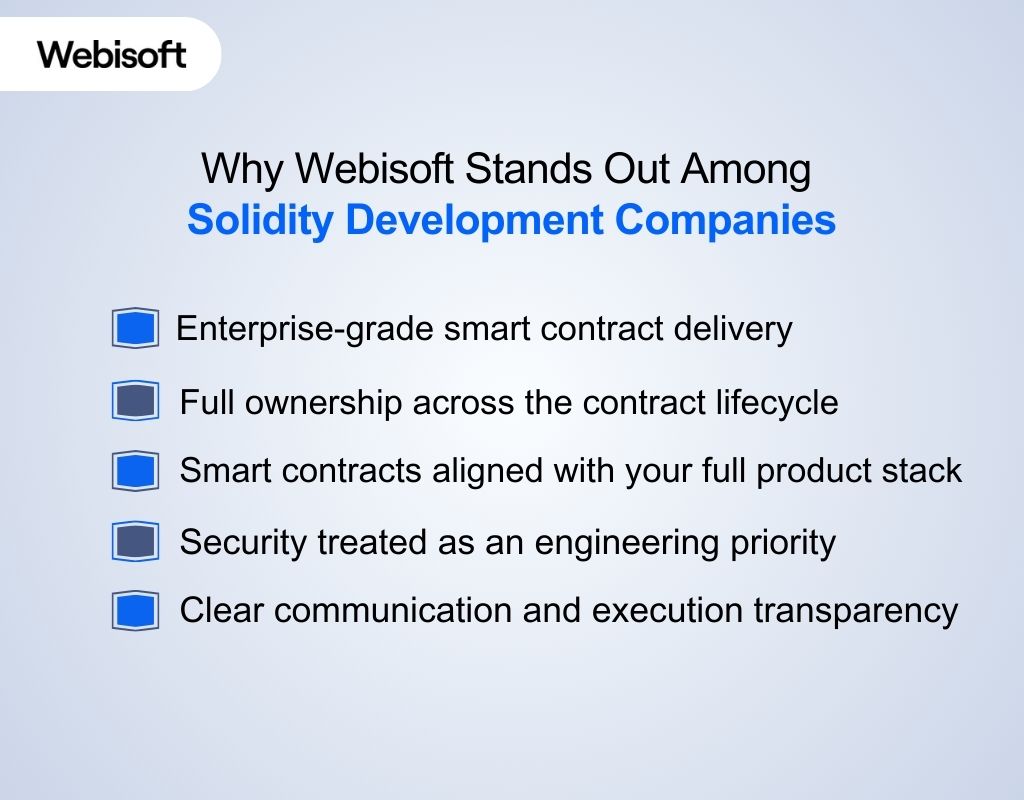
Choosing a Solidity partner often decides whether a project scales or fails in production. Webisoft stands apart by pairing senior Solidity engineering with product-level accountability, security discipline, and long-term support that teams rely on when contracts manage real value.
- Enterprise-grade smart contract delivery: At Webisoft, we build Solidity contracts for real products, not prototypes. Our focus stays on scalability, reliability, and performance once users and value are live on-chain.
- Full ownership across the contract lifecycle: We stay involved from scoping and architecture through audits, deployment, and ongoing maintenance, reducing the handoff risks that often break production systems.
- Smart contracts aligned with your full product stack: Our Solidity work connects directly with your dApp, backend, and infrastructure, so contracts actively support real user flows and business logic.
- Security treated as an engineering priority: We embed testing, validation, and risk review into development, catching vulnerabilities early rather than reacting after deployment.
- Clear communication and execution transparency: We maintain clear documentation, defined milestones, and consistent reporting, so you always know where the project stands and what comes next.
If this level of ownership and execution is what your Solidity project requires, our team at Webisoft can step in early and guide the build. Reach out to discuss your use case and next technical steps with us.
Conclusion
Smart contracts tend to reveal their true quality after launch, not before. The Solidity development companies featured here earned their place by delivering code that survives audits, user demand, and unexpected production realities over time.
If you want your project to age well on-chain, Webisoft is built for that challenge. We focus on Solidity engineering that lasts, supporting teams from first deployment through ongoing upgrades, maintenance, and real-world use.
Frequently Asked Question
A Solidity agency offers structured delivery, shared accountability, and continuity across development, audits, and post-launch support. Individual developers may work for small experiments, but agencies reduce risk when contracts manage real users, assets, and long-term maintenance responsibilities.
A Solidity company should be involved during architecture and requirements planning. Early participation helps define contract logic, upgrade paths, and security boundaries, preventing structural design issues that are expensive or impossible to correct once contracts are deployed.
Key red flags include vague explanations of Solidity work and no clear approach to security or testing. A lack of clarity around upgrades, ownership control, and post-deployment support is also a strong warning sign.