Real estate tokenization turns ownership or economic rights in a property into digital tokens recorded on a blockchain. The hard part is not the token: it is the legal structure behind it. A legal entity holds the asset, tokens represent claims on that entity, and smart contracts enforce who can hold and trade them. This guide explains how the structure works end to end: the token models in use, the compliance obligations, the technical stack, the real risks, and a practical path for both investors and issuers.
What Is Real Estate Tokenization?
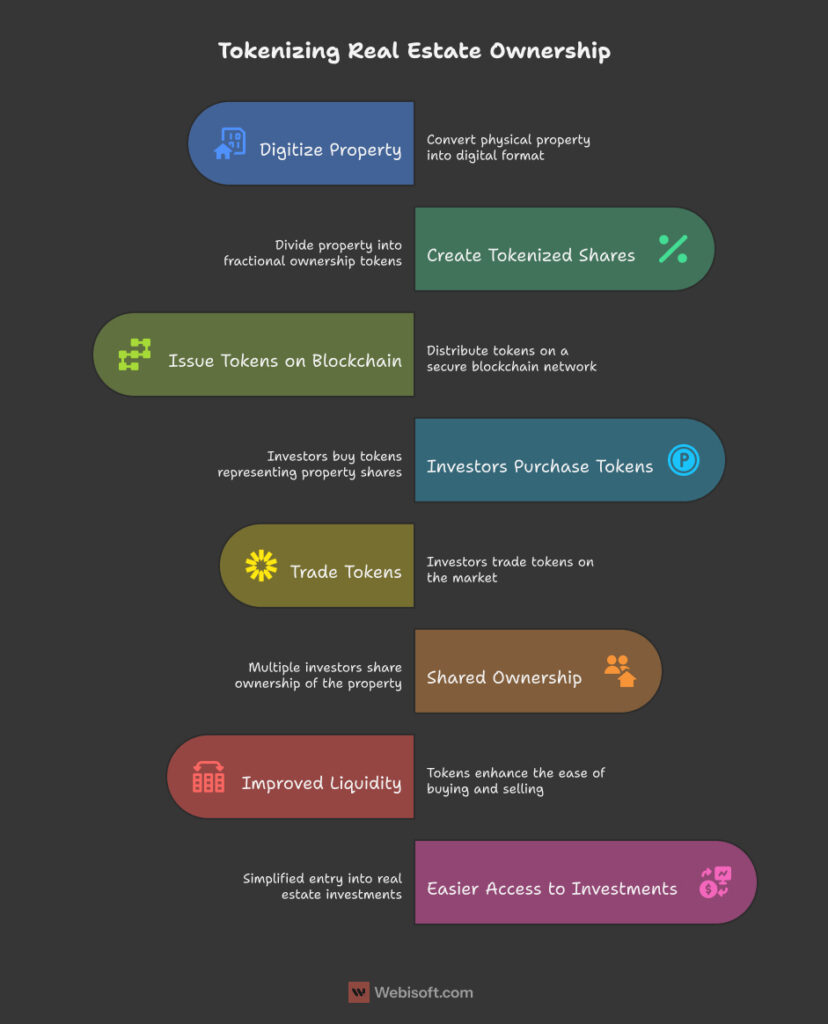
Real estate tokenization is the process of representing ownership in a property, a development project, or a portfolio as digital tokens on a blockchain. The tokens function like shares: each one carries a defined right, such as a fraction of equity in the entity that owns the building or a claim on the income it produces.
A simple illustration: a building worth $1 million can be placed in a holding entity that issues 10,000 tokens at $100 each. An investor who buys 50 tokens holds a 0.5 percent economic interest and receives the corresponding share of net rental income and any appreciation at exit. The numbers are hypothetical, but the mechanics are exactly what live platforms do today.
The model overlaps with structures investors already know, with a few meaningful differences:
- Versus REITs: a REIT is a pooled fund traded on a stock exchange. A tokenized offering can be tied to one specific property, so investors choose the asset rather than the fund manager's blend, and trading is not limited to exchange hours.
- Versus crowdfunding: crowdfunding platforms record ownership in a private database and usually offer no exit until the property sells. Tokens live on a shared ledger, distributions can be automated by smart contracts, and holders can sell on a compliant secondary market without waiting for the sponsor's exit event.
- Versus syndication: a traditional syndication involves manual subscription documents, capital calls, and investor ledgers maintained in spreadsheets. Tokenization moves the cap table on chain, which cuts administrative overhead and makes transfers auditable.
The trade-off is added structural complexity. Every tokenized deal is simultaneously a real estate transaction, a securities offering, and a software project, and it has to be correct on all three fronts.
How Real Estate Tokenization Works in Practice
A tokenized property deal has three layers: a legal wrapper, a compliance pipeline, and the token infrastructure itself. Weakness in any layer undermines the other two.
The Legal Wrapper
Direct title to land almost never goes on chain, because land registries do not recognize blockchain records. Instead, the property is placed in a Special Purpose Vehicle (SPV), typically an LLC, a trust, or a single-asset fund. The SPV holds title the conventional way; the tokens represent shares or membership interests in the SPV. The token holder's claim is therefore a legal claim on the entity, enforceable in court, not a bare database entry.
This matters for risk analysis. If the token contract fails or the issuing platform disappears, the operating agreement and the SPV's share register still define who owns what. Serious offerings state explicitly, in the offering documents, how the on-chain record maps to the legal register and which one controls in a conflict.
Smart Contracts and Token Standards
Most issuances use Ethereum-compatible standards. A plain ERC-20 token is freely transferable, which is unacceptable for a security, so issuers use permissioned standards layered on top of it:
- ERC-1400 adds partitions, forced transfers for court orders or lost keys, document references, and transfer restrictions checked at the contract level.
- ERC-3643 (the T-REX standard) binds each wallet to a verified on-chain identity, so the contract itself rejects a transfer to any address that has not passed KYC or does not meet the offering's eligibility rules.
The contract also encodes distribution logic: rental income arrives at the SPV, is converted to a stablecoin or kept in fiat by a paying agent, and is paid out pro rata to token holders on a schedule, with the whole flow visible on chain.
KYC, AML, and Investor Eligibility
Because these tokens are securities in most jurisdictions, every buyer passes Know Your Customer (KYC) and Anti-Money Laundering (AML) screening before receiving tokens. Platforms integrate identity verification providers, and the approved status is written to a whitelist that the token contract consults on every transfer. In the United States, offerings typically rely on exemptions such as Regulation D (accredited investors) or Regulation S (offshore investors). In the European Union, the MiFID II framework and the Prospectus Regulation apply; the EU's MiCA regulation explicitly excludes tokens that qualify as financial instruments, so security tokens stay under the traditional securities regime.
Custody and Onboarding
Tokens are held either non-custodially, where the investor controls the private keys, or custodially, where a regulated third party holds them. Non-custodial custody gives control but shifts key management risk to the investor; permissioned standards mitigate this by allowing an issuer-executed recovery transfer after identity re-verification. Custodial setups are simpler for non-technical investors and are mandatory in some jurisdictions for regulated instruments. Good platforms bundle wallet setup, KYC, subscription documents, and payment into one onboarding flow so the investor never has to touch raw blockchain tooling.
Tokenization Models Explained
Real estate tokenization is not one structure. Issuers choose a model based on the asset, the return profile, and the investors they want to reach.
Fractional Ownership Tokens
Each token represents a fractional equity share in the property or in the SPV that holds it. Holders participate in appreciation and usually in rental income.
- Best suited for: stabilized residential and commercial properties
- Ideal for: long-term investors seeking capital appreciation plus income
- Risk level: moderate, tied to property value and the rental market
Cash Flow Tokens
The token carries a right to a share of the revenue the asset generates, such as rent or lease payments, while legal ownership stays with the sponsor. Distributions are automated through the token contract.
- Best suited for: income-producing assets such as rental apartments or commercial leases
- Ideal for: investors who want recurring passive income
- Risk level: low to moderate, linked to occupancy and tenant quality
Project Development Tokens
Tokens fund a development or heavy renovation, and holders are paid from unit sales or leasing once the project completes. This is the highest-variance model: returns depend on permits, construction execution, and the market at delivery.
- Best suited for: new construction and redevelopment
- Ideal for: investors with higher risk tolerance and longer horizons
- Risk level: high, dependent on completion and market timing
Real Estate Basket and Fund Tokens
Tokens represent shares in a diversified portfolio of properties, functionally a tokenized fund or REIT alternative. Diversification lowers single-asset risk at the cost of asset-level control.
- Best suited for: asset managers and multi-property funds
- Ideal for: passive investors seeking broad real estate exposure
- Risk level: low to moderate, driven by portfolio strategy
You might also like: What Is Asset Tokenization? Key Use Cases and Value
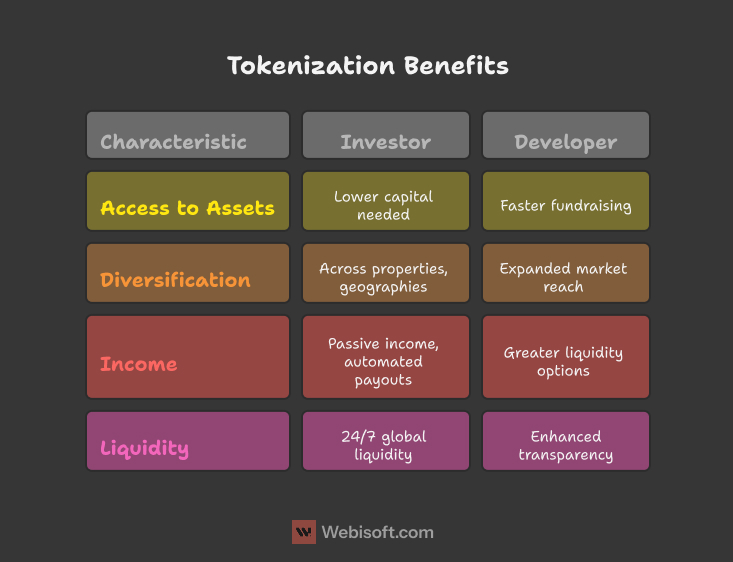
Benefits of Real Estate Tokenization for Investors and Developers
The value of tokenization is concrete: it removes specific friction points that make traditional property investment slow, expensive, and exclusive.
For Investors
1. Access to premium assets with lower capital. Fractionalization splits large properties into affordable units. According to EY, tokenized platforms can set minimum investments as low as $1,000, a fraction of the capital a direct purchase or many private funds require.
2. Diversification across properties and geographies. Smaller ticket sizes let an investor spread capital across several assets, property types, and markets instead of concentrating it in one building.
3. Automated income distributions. Smart contracts pay out rental income or dividends on schedule, pro rata, with an auditable record. No chasing statements, no manual reconciliation.
4. Secondary market liquidity. Selling a direct property stake takes months. A token can be listed on a compliant secondary marketplace and sold to another verified investor, subject to holding periods and transfer restrictions. Liquidity is real but should not be overstated; see the risks section below.
For Developers and Asset Owners
1. Faster fundraising from a wider pool. Instead of negotiating with one or two institutional buyers or a bank, an issuer can raise from a global base of eligible investors through a single digital offering.
2. Expanded reach through fractionalization. A $10 million property that once needed a single buyer can be sold in small allocations to thousands of investors, which broadens demand.
3. Partial exits and refinancing flexibility. An owner can sell a fractional stake to release capital while keeping operational control of the asset, without a full sale or a new mortgage.
4. Cleaner records and lower administration. The cap table maintains itself. Ownership history, transfers, and distributions are recorded immutably, which reduces disputes and simplifies audits and reporting.
Legal, Regulatory, and Tax Considerations
Compliance is not a checkbox at the end of a tokenization project; it dictates the structure from day one. Getting it wrong can void an offering or expose the issuer to enforcement action.
Security vs. Utility Tokens
Real estate tokens are almost always securities. In the United States, the SEC applies the Howey test: if buyers invest money in a common enterprise expecting profit from the efforts of others, the instrument is a security. Rental income and appreciation managed by a sponsor fit that definition squarely. The SEC's own framework for analyzing digital assets walks through the factors in detail.
Practical consequences for issuers:
- Register the offering or qualify for an exemption such as Regulation D or Regulation S.
- Avoid marketing language that implies guaranteed returns.
- Restrict secondary trading to eligible investors and licensed venues where required.
Europe applies MiFID II and the Prospectus Regulation to security tokens, and the EU's DLT Pilot Regime creates a sandbox for trading tokenized financial instruments on distributed ledger infrastructure. Switzerland went further: its DLT Act recognizes ledger-based securities directly in law, which is one reason several early tokenization projects domiciled there. Singapore and Luxembourg have also published clear guidance for security token offerings.
KYC and AML Compliance
Identity verification of every investor is mandatory. It prevents illicit finance, establishes investor eligibility, and satisfies jurisdictional obligations. Most platforms integrate third-party KYC providers: investors upload government ID and proof of address, and screening runs automatically. Skipping or weakening these controls invites penalties and platform shutdowns.
Tax Reporting
Token form does not change tax substance. Holders face:
- Capital gains tax when tokens are sold at a profit.
- Income tax on rental distributions.
- Withholding tax on cross-border payments.
- Valuation and reporting obligations for annual filings.
Because blockchain transactions do not map neatly onto traditional tax paperwork, investors should keep complete records of purchases, sales, and distributions. Some platforms export tax reports, but cross-border investors in particular should involve a tax professional.
Technical Infrastructure of Real Estate Tokenization
A tokenization platform is a system of several coordinated components, not a single smart contract. Understanding what lives where helps both issuers scoping a build and investors evaluating a platform.
On-Chain vs. Off-Chain Records
Only a subset of the data belongs on chain, for both privacy and cost reasons.
On-chain records typically include:
- Token issuance parameters and total supply
- The ownership register and transfer history
- Smart contract logic such as vesting, lockups, and transfer restrictions
- Distribution transactions
Off-chain records include:
- Legal documents: title deeds, operating agreements, offering memorandums
- KYC and AML identity data
- Property records such as appraisals and inspection reports
The two layers are linked by cryptographic hashes: the contract stores a hash of each legal document, so anyone can verify a document is the authentic version without the sensitive content ever being public. This pattern satisfies both auditability and privacy regulation.
Wallet and Identity Management
Security tokens impose requirements ordinary crypto wallets do not have:
- Key management: a lost private key cannot be allowed to destroy a legal ownership claim, so platforms implement recovery flows, custodial options, or issuer-executed recovery transfers under standards like ERC-1400.
- Whitelisting: the contract only permits transfers between addresses that have passed KYC and meet the offering's eligibility rules.
- Multi-signature controls: institutional holders and issuers use multi-sig approvals for treasury and administrative operations.
Network Choice and Platform Integration
Ethereum remains the default for its mature standards and tooling, but fees and congestion push many platforms to alternatives:
- Polygon: Ethereum-compatible with much lower transaction costs.
- Avalanche: high throughput and a growing set of institutional tokenization tools.
- Permissioned networks: for enterprise deals that need control over who runs nodes and sees data.
Beyond the chain itself, a production platform integrates payment processing (fiat and stablecoin), KYC/AML services, custody, and reporting and tax tooling. The integration work is usually a larger share of the engineering effort than the token contract.
This guide might help you choose the right blockchain for tokenization
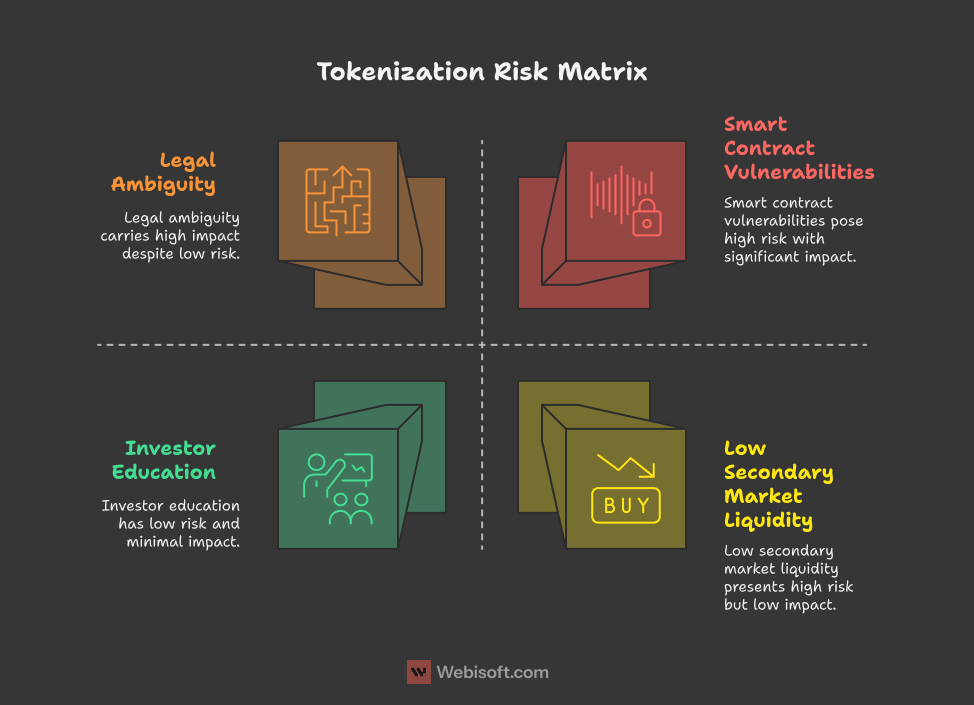
Challenges and Risks of Tokenized Real Estate
Tokenization solves real problems, but the market is young and several risks deserve honest treatment before anyone commits capital.
Legal Ambiguity and Jurisdictional Risk
Rules differ across borders and keep evolving. Specific failure modes:
- A poorly structured token can inadvertently violate securities law, exposing the issuer to rescission or enforcement.
- Cross-border sales raise eligibility and tax questions that the platform's home framework does not answer.
- If the asset, the issuer, and the investors sit in three different countries, dispute resolution gets complicated fast.
Switzerland and Luxembourg offer relatively clear frameworks; many other jurisdictions do not, and that uncertainty can delay or derail projects.
Secondary Market Liquidity Is Still Thin
Continuous trading is the promise; thin order books are the current reality for most offerings. The causes are structural:
- Few licensed venues support compliant security token trading.
- Transfer restrictions shrink the pool of eligible buyers.
- Income-focused holders rarely list, so there is little float.
Investors should treat tokenized real estate as more liquid than a direct property stake but far less liquid than public equities, and plan holding periods accordingly.
Smart Contract Security
The contract is the transfer agent, the registrar, and the paying agent in one piece of code. Defects have direct financial consequences:
- Logic bugs can freeze funds or open exploits.
- Badly implemented transfer restrictions can allow unauthorized trades that break the offering's legal exemption.
- Connected systems, such as oracles, custodial interfaces, and admin keys, widen the attack surface.
Independent third-party audits before launch are non-negotiable, and admin functions should sit behind multi-sig with documented procedures.
Investor Education and Adoption
Most investors have never held a blockchain-based security. Wallet setup, key management, and the exact rights a token carries (income, voting, redemption) all need plain-language documentation. Platforms that skip education end up with a small, purely crypto-native audience and slow adoption.
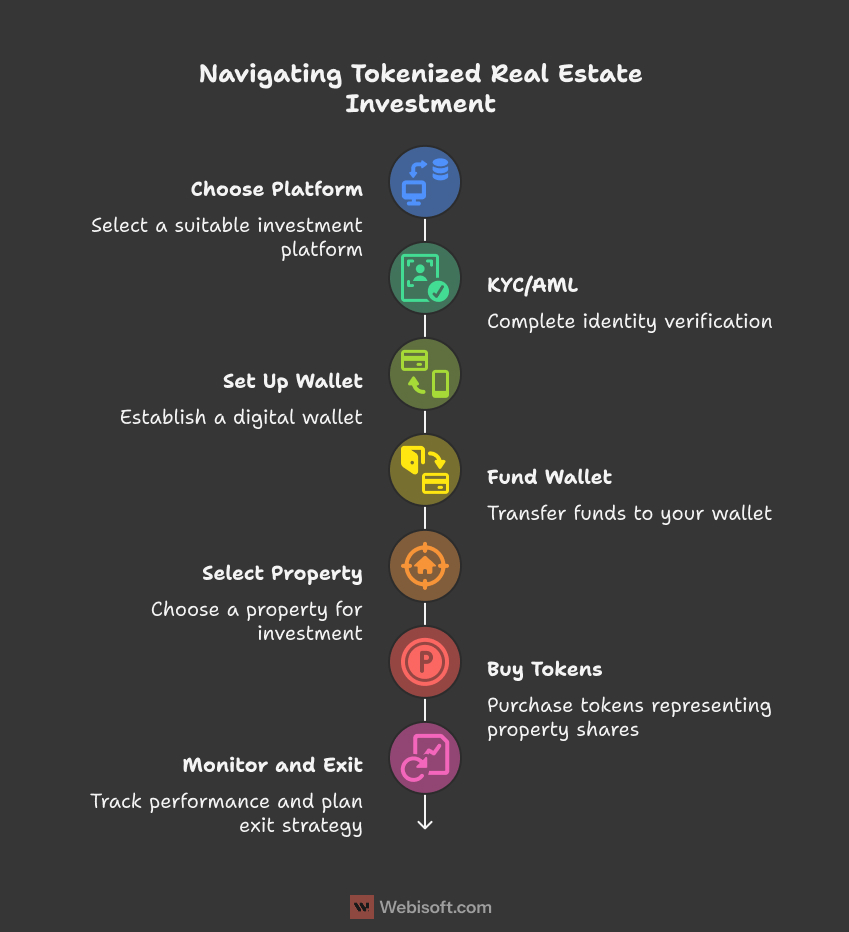
Step-by-Step: How to Invest in Tokenized Real Estate
The process is more accessible than a traditional property purchase, but each step still deserves diligence.
Step 1: Choose a Platform
Research platforms that offer tokenized real estate in your jurisdiction. Check:
- Is the platform regulated or licensed where you live?
- Does it serve retail investors, or accredited investors only?
- What asset types does it list: residential, commercial, development projects, funds?
- How does it document the link between the token and the legal ownership register?
Step 2: Complete KYC and AML Verification
Every compliant platform requires identity verification before purchase. Expect to provide a government-issued ID, proof of address, and in some cases source-of-funds documentation. Automated verification usually completes within minutes to a day.
Step 3: Set Up a Wallet
You need a wallet compatible with the token standard used, commonly ERC-20 based security standards such as ERC-1400 or ERC-3643.
- Custodial: the platform holds tokens for you; simplest for beginners.
- Non-custodial: you control the keys; more control, more responsibility.
Step 4: Fund the Purchase
Platforms accept stablecoins such as USDC, bank transfers, and sometimes cards for small amounts. Before funding, confirm the accepted currencies, on-chain transaction fees, and the minimum investment. Minimums vary by platform and offering; EY notes they can start around $1,000, and some retail platforms go lower.
Step 5: Review the Offering Documents
Do not buy a token; buy an asset you understand. Legitimate offerings disclose:
- Property type, location, and valuation basis
- Projected cash flows and the assumptions behind them
- Governance structure and the exact rights the token carries
- Fees, lockups, and exit mechanics
Step 6: Execute the Purchase
Subscribe for the number of tokens you want and complete payment. Tokens are issued to your whitelisted wallet address and the transaction is recorded on chain. The step itself takes minutes.
Step 7: Monitor and Plan Your Exit
Track distributions and valuation through the platform dashboard or a block explorer. Before you need liquidity, confirm whether a secondary market exists for your token, what transfer restrictions apply, and whether a minimum holding period is still running. Licensed venues such as tZERO and INX list some tokenized real estate, but depth varies by asset.
Real-World Examples
Tokenized real estate has moved well past the proof-of-concept stage. These three projects show different models operating under real regulatory constraints.
Aspen Coin: The St. Regis Aspen Resort
In 2018, Elevated Returns tokenized a minority equity stake in the single-asset REIT that owns the St. Regis Aspen Resort in Colorado, selling Aspen Coin security tokens to accredited investors under a Regulation D exemption. The tokens were later made available for secondary trading on the tZERO platform. The deal remains one of the most cited early demonstrations that a trophy hospitality asset can raise capital through a compliant token offering.
- Token type: equity-backed security token
- Investor access: accredited investors
- Significance: proved the model for institutional-grade single assets, including a functioning secondary market
Lofty: US Residential Rentals with Daily Payouts
Lofty tokenizes single-family rental properties in the United States on the Algorand blockchain and opens them to retail investors at low minimums. Each property is tokenized individually, and rental income accrues to holders daily rather than monthly or quarterly.
- Token type: fractional ownership tokens backed by rental cash flow
- Investor access: retail
- Significance: shows tokenization working at small ticket sizes with high-frequency automated distributions
RealT: Fractional US Rental Properties On Chain
RealT tokenizes US residential rental properties, with each property held by its own legal entity and represented by tokens on Ethereum-compatible networks. Rent is distributed to token holders in stablecoins on a weekly cycle, and holders can see the full ownership and payment history on chain.
- Token type: security tokens representing interests in the property-owning entity
- Investor access: global retail, subject to eligibility rules
- Significance: demonstrates per-property legal wrappers and stablecoin income distribution running at portfolio scale
The Future of Real Estate Tokenization
The direction of travel is from pilot projects to production infrastructure. Early deals proved the mechanics; the current phase is about scale, regulatory clarity, and integration with the broader financial system. Global asset managers and several governments are actively evaluating tokenized property structures for cost reduction and broader market participation.
Three developments are worth watching:
- DeFi integration. Protocols are experimenting with real estate tokens as collateral for on-chain lending and as inputs to automated yield strategies. This is early and carries its own risks, but it points toward property becoming a composable financial asset rather than a locked-up one.
- AI-assisted operations. Compliance screening, portfolio monitoring, and rental pricing are all workloads where machine learning pairs naturally with tokenized structures, since the underlying data is already digital and standardized.
- DAO-governed assets. Some projects let token holders vote on maintenance budgets, rent levels, or liquidation decisions through on-chain governance. Adoption is limited so far, but it extends the fractional ownership logic from economics into control.
Institutional forecasts for the tokenized real estate market vary widely in size, but they agree on direction: the share of property held and traded in tokenized form is expected to grow substantially over the next decade as legal frameworks and trading venues mature. The technology already works; the binding constraints are regulation, liquidity infrastructure, and investor confidence.
How Webisoft Helps You Tokenize Real Estate
Webisoft is a Montreal-based software engineering firm that builds blockchain systems end to end, from architecture through audit-ready smart contracts to the investor-facing platform. For tokenization projects, that covers security token contracts on standards such as ERC-1400 and ERC-3643, KYC/AML and whitelisting integration, distribution automation, custody and payment integrations, and the web application investors actually use. If you are evaluating a tokenized offering or scoping a platform build, contact Webisoft to discuss the architecture before you commit to a structure.
Conclusion: Is Tokenization Right for You?
Real estate tokenization makes a historically illiquid, high-minimum asset class more accessible, more liquid, and more transparent. For investors, it means fractional access to assets that once required institutional capital, with automated income and a path to secondary sales. For owners and developers, it means faster capital raising from a wider pool and cleaner administration.
It is not a fit for every deal. The structure adds legal and engineering complexity, secondary liquidity is still developing, and regulatory frameworks differ by jurisdiction. The projects that succeed treat tokenization as a securities offering with better infrastructure, not as a shortcut around one.
If you are exploring the space, start small: study reputable platforms, read the offering documents in full, involve legal and tax professionals, and size positions to your actual liquidity needs. The mechanics are proven; the discipline is what separates good outcomes from expensive lessons.
Through the platform's own marketplace or a licensed secondary venue, subject to transfer restrictions, holding periods, and buyer eligibility rules. Liquidity is better than a direct property stake but thinner than public markets, so confirm an active market exists before you invest.
Minimums vary by platform and offering. Institutional-style offerings often start around $1,000, and some retail platforms set lower entry points. Always confirm the minimum, the fees, and any lockup period in the offering documents before funding a wallet.
Yes, when structured correctly. Real estate tokens are generally securities under the Howey test, so offerings must register with the SEC or use exemptions such as Regulation D or Regulation S. Buyers pass KYC/AML checks, and some offerings are limited to accredited investors.
Yes. Many offerings are structured so token holders receive a pro rata share of rental income, distributed automatically by smart contract, often in a stablecoin. Payout frequency ranges from quarterly to weekly or even daily depending on the platform.
In a well-structured deal, the property is owned by a legal entity (usually an SPV) and your token represents an enforceable claim on that entity, independent of the platform. Platform failure can still disrupt secondary trading and payment processing, so check how the offering documents map the on-chain register to the legal share register.