Quantum machine learning combines quantum computing’s superposition and entanglement with classical AI to enable parallel exploration of vast solution spaces. It solves optimization and high-dimensional problems exponentially faster than traditional methods.
That capability changes the way learning problems are approached, but it also introduces new trade-offs. Quantum methods are not universally better, and they are not applied across an entire pipeline. Their value depends on where classical learning breaks and how quantum components are integrated.
Want to know about what quantum machine learning changes and doesn’t change, how it works, and how it improves AI learning? This guide will help you to learn about QML beyond surface definitions. So, keep reading!
What Is Quantum Computing?
Quantum computing is a type of computing that works very differently from traditional systems. A regular computer uses bits. Each bit has a fixed state. It is either 0 or 1.
But a quantum computer uses qubits. A qubit can represent multiple possible values at the same time, each with a certain probability.
This happens because qubits can exist in superposition and can also become entangled. Entanglement links qubits together so their states influence each other, even when the system grows more complex.
The result is a computing system that can represent and explore many possible states at once, instead of checking them one by one.
Quantum Computing in Machine Learning: What Changes
When quantum computing is applied to machine learning, the learning process itself changes.
In classical machine learning, models test patterns step by step. As data grows and features interact, training becomes slower and more expensive. Progress eventually flattens, even with more computers.
Quantum computing allows machine learning systems to evaluate many possible patterns together. Instead of searching one learning path at a time, the model explores a wider space of possibilities in parallel and speeds up the process.
In practice, quantum processors don’t replace classical machine learning systems. They work alongside them. Quantum components handle the hardest learning or optimization tasks, while classical systems manage data, control logic, and deployment.
Quantum Machine Learning vs Classical Machine Learning
Classical machine learning still runs production systems. Quantum approaches extend it, not replace it. In hybrid quantum‑classical models, quantum components handle optimization while classical pipelines manage data and deployment. Here’s a comparison table for better understanding:
| Aspect | Classical Machine Learning | Quantum Machine Learning |
|---|---|---|
| Data units | Uses bits that hold a single value, either 0 or 1 | Uses qubits that represent multiple possible values at once |
| State behavior | Operates in deterministic states | Operates in probabilistic states |
| Learning approach | Evaluates patterns step by step | Evaluates many possible patterns in parallel |
| Optimization behavior | Often gets stuck in local solutions | Explores solution spaces more broadly |
| Handling complexity | Struggles as feature interactions grow | Handles complex feature relationships more naturally |
| Compute scaling | Requires more hardware as problems grow | Aims to reduce steps needed to reach good solutions |
| System role | Powers most production AI systems | Used selectively for complex learning tasks |
| Practical deployment | Fully mature and widely adopted | Usually tested through controlled experiments |
What Quantum Machine Learning Does Not Replace
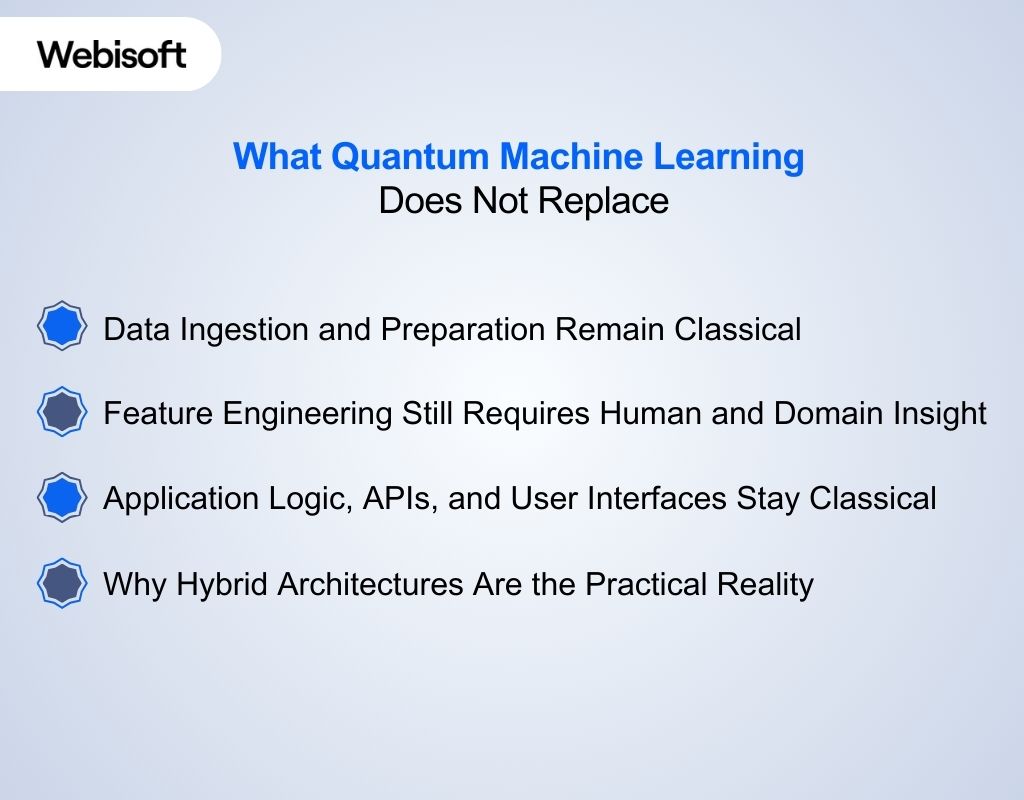
You now know that quantum machine learning changes how learning happens in general and also that it doesn’t take over the entire system. But do you know what exactly quantum machine learning doesn’t change? Here are the details:
Data Ingestion and Preparation Remain Classical
Data still comes from the same places, such as logs, sensors, transactions, and user activity. You still need pipelines to collect it, clean it, and validate it.
Noise doesn’t disappear just because a quantum system is involved. Even advanced quantum data processing assumes the input is already structured and usable.
Feature Engineering Still Requires Human and Domain Insight
You still decide what matters in quantum machine learning. Feature selection, transformations, and domain assumptions stay critical.
A quantum model cannot guess which signals are meaningful to your business. Poor features lead to poor outcomes, no matter how advanced the learning method is. Quantum machine learning changes how patterns are explored, not how relevance is defined.
Application Logic, APIs, and User Interfaces Stay Classical
APIs, dashboards, integrations, and monitoring systems remain exactly where they are. Users never interact with quantum components directly. They interact with software built on classical infrastructure.
Quantum learning sits behind the scenes, improving results without changing how your system looks or behaves.
Why Hybrid Architectures Are the Practical Reality
Classical pipelines handle data flow, orchestration, and deployment. Quantum components step in only where learning or optimization becomes hard. This separation also makes it easier to evaluate fit using a quantum learning readiness framework before committing resources.
Why Quantum Machine Learning Is Suddenly on Every Executive Radar
If you already depend on machine learning, the shift is easy to notice. Systems still run, but progress feels slower. Each improvement costs more time, more tuning, and more infrastructure.
This pressure is what’s pushing conversations around enterprise quantum machine learning adoption, especially in organizations hitting hard technical limits. Here’s where classical machine learning starts to struggle.
- Performance issues persist even after adding GPUs and infrastructure
- Faster hardware improves speed, not learning quality
- Search spaces expand faster than models can realistically evaluate
- Feature growth increases complexity without improving learning quality
- Training becomes unstable as datasets and models scale
- Optimization reaches plateaus even after heavy tuning
- Compute and energy costs rise while gains flatten
- Adding GPUs improves throughput, not learning depth
- More hardware repeats the same optimization behavior
- Structural limits in classical learning prevent meaningful breakthroughs
Types of Quantum Machine Learning
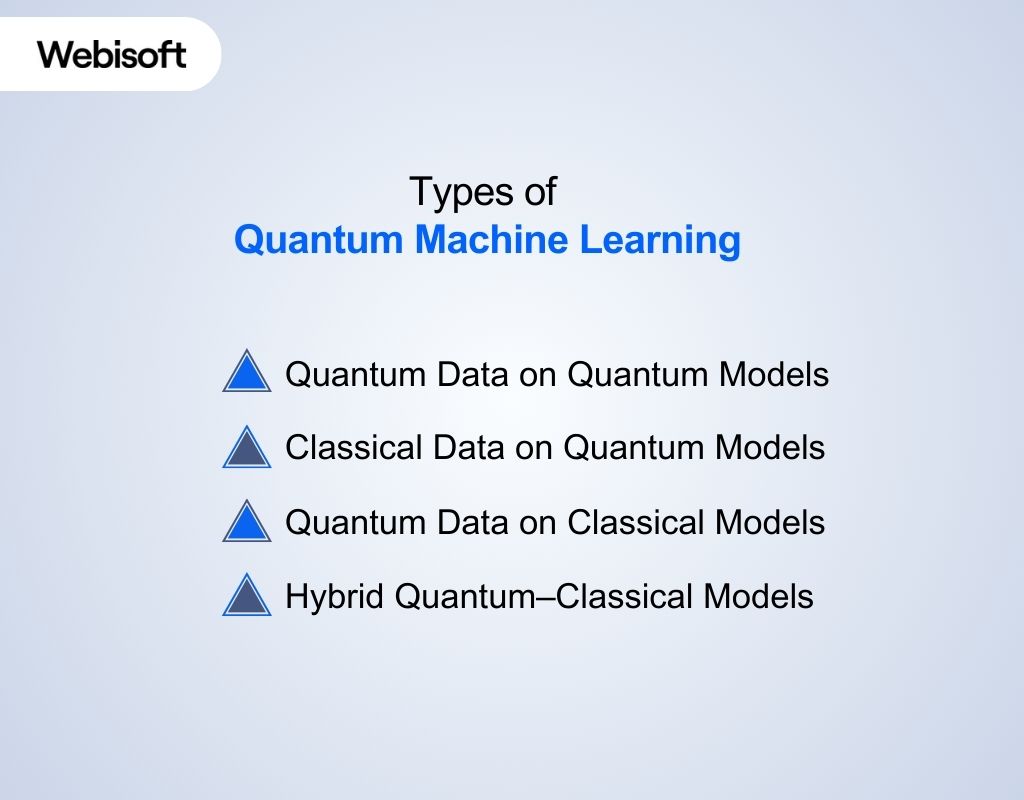
QML types are classified based on where data exists and where learning takes place. There are four main types of quantum machine learning that describe system structure, not algorithms. These are:
1. Quantum Data on Quantum Models
Both the data and the learning process exist entirely within quantum systems. Data originates from quantum states, and learning is performed directly on quantum hardware.
Key characteristics:
- Data is generated by quantum systems
- Learning occurs fully on quantum processors
- Naturally suited for quantum-native problems
- Limited today by hardware scale and noise
- Used mainly in physics, chemistry, and materials research
2. Classical Data on Quantum Models
Classical data is converted into quantum states and processed using quantum circuits. Learning happens on quantum hardware, while data preparation and output handling remain classical.
Key characteristics:
- Data begins in classical form
- Data is encoded into qubits
- Learning runs on quantum circuits
- Outputs return to classical systems
- Primary focus of near-term QML research
3. Quantum Data on Classical Models
Quantum systems produce data, but classical machine learning models perform the learning and analysis.
Key characteristics:
- Data originates from quantum experiments
- Learning remains classical
- Used for error detection and calibration
- Improves quantum hardware reliability
- Does not replace classical ML workflows
4. Hybrid Quantum–Classical Models
Classical and quantum systems work together in a single learning pipeline. Each handles the part it does best.
Key characteristics:
- Classical systems manage data and control
- Quantum components handle specific learning tasks
- Training uses a quantum–classical feedback loop
- Compatible with existing ML infrastructure
- Most practical option for enterprise use today
Internal System Components of Quantum Machine Learning
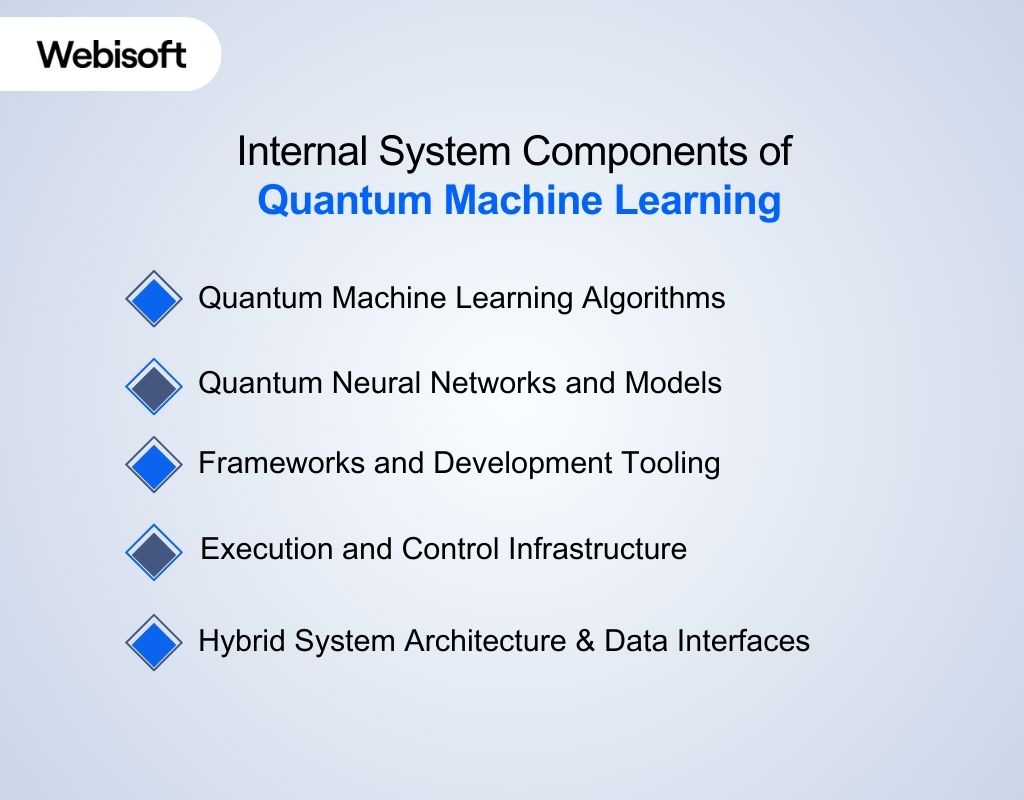
Quantum machine learning systems are composed of modular internal layers. Each responsible for enabling complex learning tasks that classical ML struggles with. These components operate together within hybrid pipelines, making QML practical for business. For example:
Quantum Machine Learning Algorithms
The quantum machine learning algorithms offer distinct performance gains for tasks where classical learning lacks behind. These algorithms are:
- Variational Quantum Eigensolver (VQE) – Optimizes molecular simulations in quantum chemistry
- Quantum Approximate Optimization Algorithm (QAOA) – Solves discrete optimization problems with complex constraints
- Quantum Support Vector Machines (QSVM) – Adapts traditional SVMs for quantum feature spaces
- Quantum Principal Component Analysis (QPCA) – Extracts key components from high-dimensional data
- Quantum k-Means – Accelerates clustering using probabilistic similarity search
- Quantum Generative Models (QCBM, DQCNN) – Learn to generate samples from complex distributions
Quantum Neural Networks and Models
Quantum neural networks (QNNs) are the functional equivalents of deep learning models, designed specifically for quantum computation:
- Built from Parameterized Quantum Circuits (PQCs) with tunable quantum gates
- Enable parallel exploration of multiple learning configurations
- Support architectures like Quantum Autoencoders and Quantum Boltzmann Machines
- Capable of modeling entangled, non-linear feature relationships
- Integrated into hybrid models alongside classical neural layers
Frameworks and Development Tooling
Developers rely on quantum SDKs to build and test models across simulated or real hardware:
- PennyLane (Xanadu) – Great for hybrid training and integrates with PyTorch and TensorFlow
- Qiskit (IBM) – Comprehensive SDK with built-in support for learning and optimization modules
- TensorFlow Quantum (Google) – Extends TensorFlow with native quantum circuit support
- AWS Braket – Gives API access to multiple quantum processors for production testing
- Cirq (Google) and Ocean SDK (D-Wave) – Useful for low-level or annealing-based ML setups
Execution and Control Infrastructure
Quantum execution is always part of a larger orchestration layer. These infrastructures are:
- Simulators (like Qiskit Aer, PennyLane’s built-in) are used for local testing
- Cloud-Based Quantum Hardware is accessed via IBM Quantum, IonQ, Rigetti, or D-Wave
- Classical control logic manages training loops, parameter updates, and batch sampling
- Execution layers include measurement validation, retry logic, and error handling
Hybrid System Architecture & Data Interfaces
Quantum systems do not operate in isolation; they’re embedded into hybrid ML pipelines:
- Data is preprocessed using classical tools (NumPy, Pandas, Spark)
- Encoded into qubit-compatible formats: angle, basis, or amplitude encoding
- Learning is performed in quantum circuits; results are interpreted classically
- Quantum layers are triggered only for tasks with high complexity or state entanglement
- Outputs rejoin classical workflows for downstream usage (e.g., prediction, simulation, control)
How Quantum Machine Learning Works
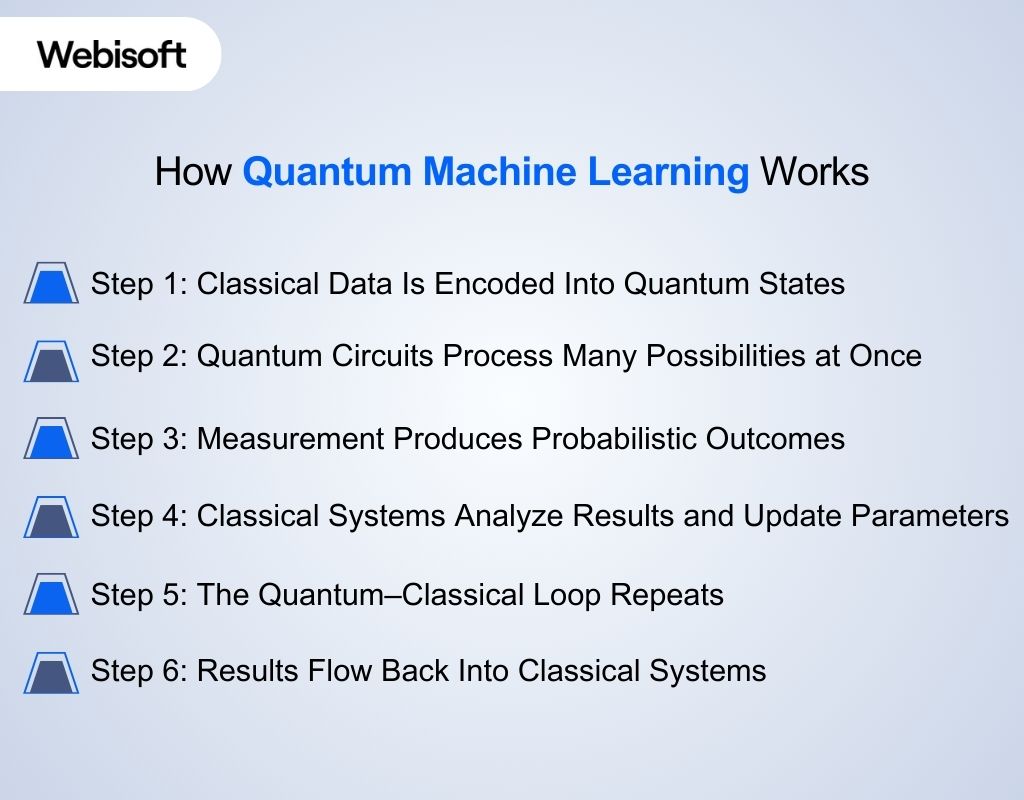
Quantum machine learning works as a loop, not a straight line. Data moves in, learning happens in a quantum core, and results move back out to classical systems. Here’s how that flow looks like:
Step 1: Classical Data Is Encoded Into Quantum States
Images, sensor readings, financial numbers, or logs are prepared using classical tools. Once cleaned, that data is encoded into qubits. This step maps numerical values into quantum states so they can be processed inside a quantum circuit.
At this point, nothing “quantum” has happened yet. The system is just preparing inputs in a form quantum hardware can accept.
Step 2: Quantum Circuits Process Many Possibilities at Once
Inside the circuit, quantum gates transform qubits in ways that allow multiple possible configurations to exist at the same time. It forms the core of quantum machine learning models that learn through probability rather than fixed paths.
Instead of testing one learning path after another, the system explores many paths in parallel. The circuit is not searching step by step. It is shaping a probability landscape.
Step 3: Measurement Produces Probabilistic Outcomes
When the circuit finishes running, the system measures the qubits. Measurement turns quantum states into classical results. Each run produces a sample from a probability distribution.
By repeating this process many times, the system learns which outcomes appear most often.
Step 4: Classical Systems Analyze Results and Update Parameters
The measured results are sent back to a classical controller.
This controller evaluates how well the output matches the learning objective. Based on that evaluation, it updates the parameters that control the quantum circuit.
The quantum system does not decide how to adjust itself. Classical logic stays in charge.
Step 5: The Quantum–Classical Loop Repeats
The updated parameters are sent back into the quantum circuit. The circuit runs again, measurements are taken again, and then feedback is applied again. This loop continues until performance stabilizes or improves enough to meet the goal. It means learning happens across iterations, not in a single run.
Step 6: Results Flow Back Into Classical Systems
Once training finishes, results return fully to the classical environment. They may appear as optimized parameters, better classifications, or improved decision rules. These results are then used by APIs, dashboards, or applications just like any other machine learning output.
Advantages of Quantum in Machine Learning
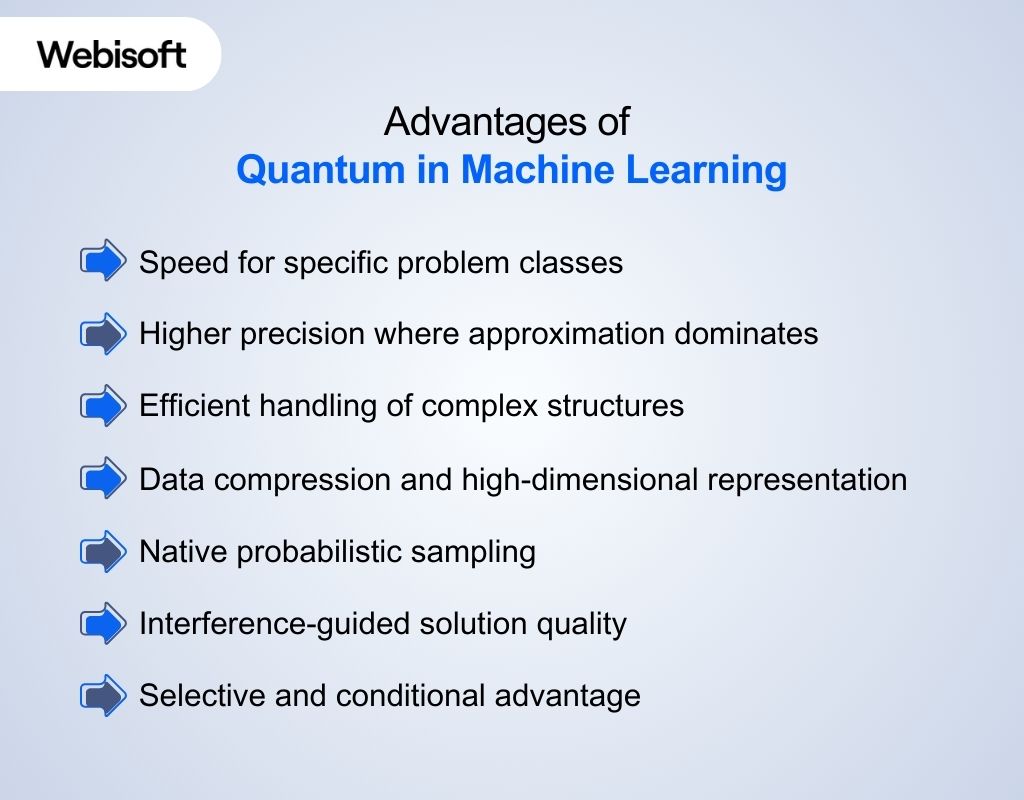
This section explains what quantum machine learning can offer in principle, independent of any specific AI system. These advantages do not apply everywhere. They appear only when problem structure aligns with quantum capabilities.
Speed for specific problem classes
Certain optimization and search problems take classical systems impractical amounts of time. Quantum approaches can reduce time-to-solution for these narrow but critical cases.
Higher precision where approximation dominates
Many classical methods rely on approximations because exact solutions are too costly. Quantum methods can represent and solve some problems more directly.
Efficient handling of complex structures
Quantum systems can reach useful outcomes with fewer logical steps when many variables interact simultaneously.
Data compression and high-dimensional representation
Large, complex datasets can be encoded into compact quantum states, making pattern discovery possible in spaces classical models struggle to handle.
Native probabilistic sampling
Quantum systems naturally generate samples from probability distributions, which is valuable for generative tasks and uncertainty modeling.
Interference-guided solution quality
Constructive and destructive interference increases the likelihood of strong solutions while suppressing weaker ones.
Selective and conditional advantage
Quantum machine learning is not universally better. Advantage appears only when the problem structure supports it.
How Quantum Machine Learning Improves AI Performance
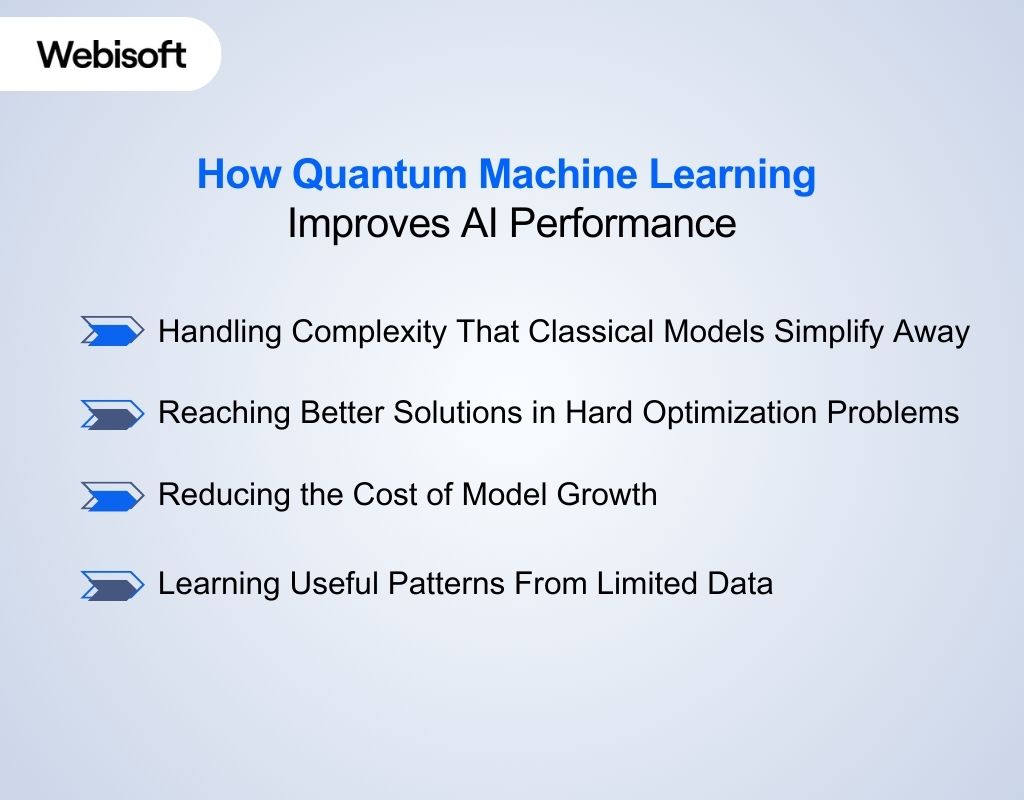
Quantum machine learning improves AI performance when the problem is no longer about more data or faster hardware.
QML helps when learning itself becomes the constraint. The improvement comes from changing how models search, represent, and optimize information. Such as:
Handling Complexity That Classical Models Simplify Away
As AI problems grow, classical models often simplify them just to remain trainable.
- Interacting variables are separated or approximated
- Important relationships are lost
- Performance flattens even as models grow
Quantum approaches allow models to work with tightly coupled variables directly. This is where quantum models in AI differ most from classical architectures.
Reaching Better Solutions in Hard Optimization Problems
Many AI systems do not fail loudly; they just quietly stall. It becomes a hindrance in the classical flow of AI machine learning. The reasons are:
- Training converges to acceptable but weak solutions
- Additional tuning produces marginal gains
- More compute repeats the same outcomes
Quantum learning explores broader solution spaces, reducing the chance of locking into early compromises during training.
Reducing the Cost of Model Growth
Classical AI often improves by getting bigger as they get:
- More parameters
- Longer training cycles
- Higher infrastructure and energy cost
Quantum learning shifts emphasis from scale to structure. The goal is not larger models, but models that reach useful behavior without excessive growth.
Learning Useful Patterns From Limited Data
Some domains never have enough data. But with QML, the system can still learn through:
- Rare conditions
- Specialized engineering systems
- Regulated or sensitive environments
Probabilistic learning helps models generalize without memorization, making learning viable even when data is constrained.
Problems and Systems That Need Quantum Machine Learning
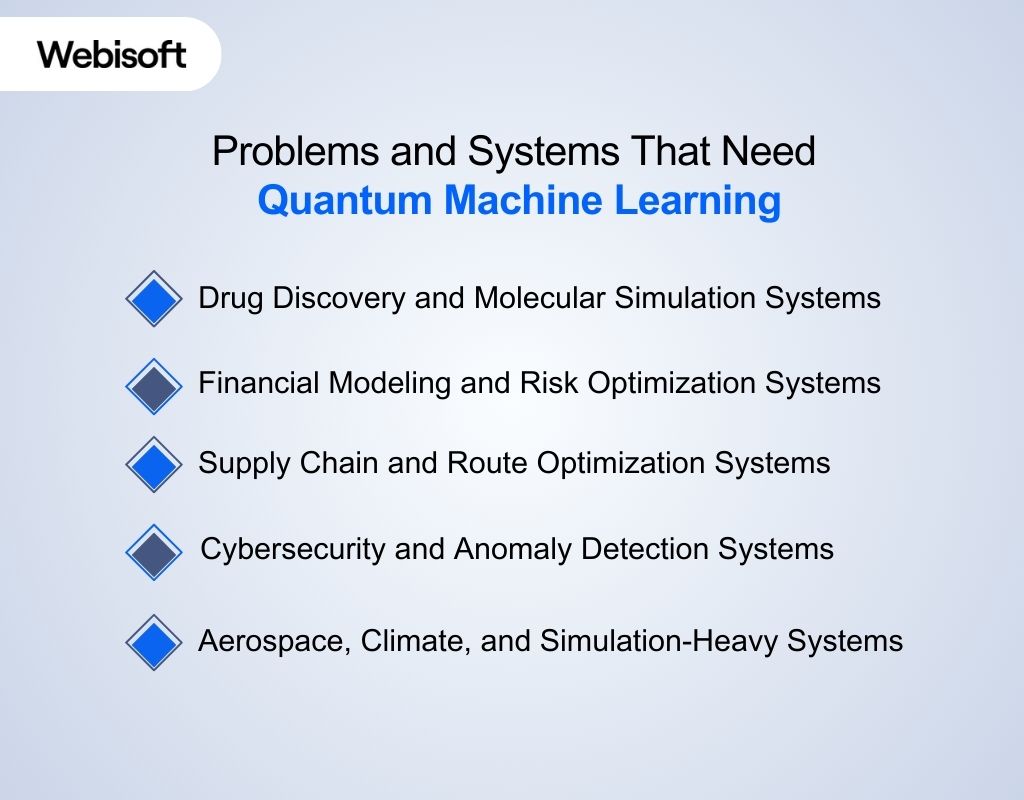
Not every system benefits from quantum machine learning. That’s why you need to know when and where to apply QML:
Drug Discovery and Molecular Simulation Systems
Quantum machine learning becomes relevant when modeling molecular behavior reaches the limits of approximation. This usually happens as molecular structures grow more complex and interactions become harder to predict accurately.
- Molecular interactions follow probabilistic rules at a fundamental level
- Classical ML depends on approximations that lose accuracy as complexity increases
- Quantum systems represent interaction states more naturally
- Learning focuses on relationships, not simplified assumptions
This is why pharma research, biotech labs, and materials science teams explore quantum-based learning.
Financial Modeling and Risk Optimization Systems
Quantum machine learning fits when financial decisions involve many competing constraints and unstable conditions. These systems struggle when outcomes depend on subtle correlations rather than clear trends, such as:
- Portfolio optimization involves many interacting variables
- Market behavior changes non-linearly over time
- Fraud signals are rare and embedded in noise
- Classical models simplify aggressively to remain usable
Banks, hedge funds, and insurance platforms hit performance limits in these scenarios.
Supply Chain and Route Optimization Systems
Quantum methods matter when logistics problems scale beyond manageable combinations. This happens quickly as routes, constraints, and schedules interact.
- Routing and scheduling create combinatorial explosions
- Constraints shift in real time
- Classical heuristics degrade as conditions change
- Optimization stalls despite tuning
Airlines, global retailers, and logistics providers face these ceilings regularly.
Cybersecurity and Anomaly Detection Systems
Quantum learning becomes relevant when threats are rare but high-impact. Classical detection struggles to balance accuracy and noise due to:
- Signals are buried in massive log volumes
- Patterns evolve continuously
- False positives overwhelm response teams
- Learning requires sensitivity without overreaction
Enterprise SOC teams and infrastructure providers face this challenge daily where QML solves this issue.
Aerospace, Climate, and Simulation-Heavy Systems
Quantum approaches fit when simulations demand precision over speed. Small errors here carry large consequences. It’s because:
- Physics-based models require extreme accuracy
- Compute cycles are long and costly
- Small variable changes alter outcomes dramatically
Aerospace, defense, energy, and climate research organizations face limits where approximation is no longer acceptable.
Quantum Machine Learning Tools Enterprises Can Use Today
Most companies don’t start their quantum journey with hardware. They start with tooling. The ecosystem is now mature enough for controlled experimentation, which is why quantum machine learning tools for enterprise adoption are steadily increasing.
What matters first is understanding what tools exist and how they are actually used inside real organizations.
Enterprise-Friendly QML Frameworks and Platforms
These frameworks let teams design, test, and iterate on quantum machine learning workflows without managing quantum hardware directly.
- PennyLane: Built for hybrid quantum-classical models. It integrates smoothly with existing ML workflows and supports parameterized quantum circuits.
- Qiskit: A full software development kit for quantum algorithms, learning experiments, and cloud-based execution on real or simulated quantum systems.
- TensorFlow Quantum: Extends TensorFlow pipelines by embedding quantum circuits into classical learning models, making it easier for ML teams to experiment.
- Cloud-Based Simulators: Provide a safe environment to test logic, validate assumptions, and measure feasibility without relying on physical quantum processors.
How Companies Experiment Without Quantum Hardware
Once tooling is in place, the next question becomes how experimentation actually happens. Most enterprises never interact directly with quantum machines. Instead, they follow a layered approach.
- Simulators: Used to test algorithms, train small models, and evaluate whether a problem is even quantum-suitable.
- Hybrid Pipelines: Classical systems handle data ingestion, orchestration, and evaluation. Quantum components run only the hardest learning or optimization steps.
- Controlled Pilots: Experiments stay narrow, measurable, and isolated from production systems.
Ready to Lead the Quantum Frontier with Webisoft?
The leap from classical to quantum machine learning is complex, but you don’t have to navigate it alone. Webisoft specializes in bridging the gap between cutting-edge theory and enterprise-grade execution. Whether you are looking to implement Hybrid Quantum-Classical Models or optimize your data for Quantum Feature Spaces, our team provides the strategic consultation and technical expertise needed to transform your infrastructure.
How Webisoft Empowers Your Quantum Journey:
- Custom QML Strategy: We identify which parts of your workflow are “quantum-ready” to ensure maximum ROI.
- Hybrid Integration: We seamlessly blend quantum circuits with your existing classical AI/ML pipelines.
- End-to-End Development: From data preparation to MLOps, we manage the full lifecycle of your intelligent systems.
Build the Future with Webisoft’s AI & ML Experts Partner with a team that turns high-dimensional math into high-impact business results.
Conclusion
To sum up, quantum machine learning represents the next evolution in AI, blending quantum power with classical reliability to improve optimization walls, complexity traps, and data scarcity.
Enterprises adopting hybrid quantum machine learning today gain competitive edges in drug discovery, finance, and logistics, without overhauling systems. Start with simulators and pilots to start the journey with QML.
FAQs
Here are some commonly asked questions regarding quantum machine learning:
Yes, but only in controlled setups. Sensitive data remains inside classical systems under existing compliance rules. Quantum workflows usually process encoded representations or derived features, not raw data, which helps limit exposure and governance risk.
No. Quantum machine learning integrates into current pipelines. Classical systems still manage data, orchestration, and deployment. Quantum components are added only to specific learning or optimization stages, allowing experimentation without changing production architecture.
Quantum machine learning pilots are exploratory, not immediate ROI projects. Most enterprises spend several months validating feasibility, model behavior, and optimization gains. Early success is measured by learning improvement, not production deployment or revenue impact.