Polkadot approaches blockchain scaling differently from most layer-1 networks. Instead of pushing every transaction through a single chain, it runs many application-specific blockchains in parallel and secures all of them with one shared validator set. Each of those parallel chains is a parachain.
A parachain is a sovereign blockchain with its own state, its own runtime logic, and usually its own token. It connects to Polkadot's central Relay Chain, which handles consensus and security while the parachain handles execution. That division of labor is what lets a team ship a purpose-built chain without recruiting and funding an independent validator community.
This guide covers how the parachain model works, what to weigh before committing to one, the standard tooling (Substrate and Cumulus), the deployment path from runtime code to a live chain, and how teams acquire blockspace now that the old slot auctions have been replaced by Agile Coretime.
How the Polkadot Parachain Model Works
Polkadot is a heterogeneous multi-chain network. Heterogeneous is the operative word: in most sharded designs, every shard runs identical logic. On Polkadot, each parachain can run entirely different state-transition rules. A DeFi chain, an identity chain, and a game chain can coexist on the same network, each optimized for its own workload, and still exchange messages natively.
The architecture splits responsibilities across three roles:
- The Relay Chain is the coordination layer. It deliberately carries minimal application logic of its own. Its job is validator staking, consensus, and finality for every connected chain.
- Parachains are the execution layer. Each one produces its own blocks and maintains its own state, then submits candidate blocks with proofs to the Relay Chain for validation.
- Collators are the node operators of each parachain. They collect transactions, author candidate blocks, and pass them to Relay Chain validators along with the state proof needed to verify them.
Relay Chain validators check every parachain block before it is finalized. Because one staked validator set backs all parachains, a new chain inherits the economic security of the entire network from its first block. That pooling of security is the model's core advantage over launching an independent chain, where security is only as strong as the validators you can attract.
The Anatomy of a Parachain
A parachain behaves like a full layer-1 blockchain in every respect that matters to its users:
- Custom runtime. The state-transition logic is yours to define: block time targets, fee models, account structures, and domain-specific modules (called pallets in the Substrate framework).
- Native economics. Most parachains issue their own token for transaction fees, collator incentives, and governance. Polkadot imposes no particular monetary design.
- On-chain governance. Runtime upgrades ship as WebAssembly blobs approved by on-chain vote, so a parachain can change its own rules without a contentious hard fork.
- Interoperability by default. Parachains exchange assets and arbitrary data through XCM, Polkadot's cross-consensus message format, with no external bridge in the middle.
Parachains Are Not Limited to Financial Chains
Because the runtime is arbitrary, almost any stateful application can be structured as a parachain: DeFi protocols, payment and wallet infrastructure, gaming backends, identity registries, IoT data networks, and core Web3 infrastructure such as storage or oracle chains. One pattern repeats across all of them: workloads that need their own fee market, their own throughput budget, or custom logic that would be awkward or expensive inside a general-purpose smart contract platform.
This is the layer where Webisoft works. We are a Montreal-based software engineering firm that designs and ships blockchain products end to end, from DeFi applications, digital wallets, and staking platforms to the runtime and infrastructure work underneath them.
What to Weigh Before Building a Parachain
Three realities shape every parachain project. Address them before writing code.
1. There Is No Ready-Made Economic Blueprint
A parachain is an autonomous network with its own community, treasury, fee model, and token dynamics. Polkadot secures your blocks; it does not design your economy. The team that launches a parachain, together with its community, owns token distribution, inflation policy, collator rewards, and treasury management. Underspecifying these early is one of the most common reasons parachain projects stall after launch.
2. Blockspace Has a Recurring Cost
Running as a parachain is not free. You pay for coretime, the right to have your blocks validated by the Relay Chain, and you carry the operational cost of running collator infrastructure. The upside is that this replaces the far larger cost of bootstrapping independent validator security. Model the recurring spend against the throughput you actually need; teams with bursty or low volume can start with on-demand coretime instead of reserving a core in bulk.
3. Understand the Parachain Development Kit
A parachain development kit (PDK) is the set of components a chain needs in order to function as a parachain. Two of them matter most:
- The state transition function (STF). This is the program that moves your chain from one state to the next. Relay Chain validators re-execute the state transitions received from your collators before accepting a block, so the STF must be cheap and deterministic to verify. A bloated STF translates directly into higher validation cost for every block your chain produces.
- The collator node. Collators maintain the parachain's full state, including every new state produced by running the STF, and keep that data available to the network. A collator must stay online continuously to author blocks and to relay cross-chain message traffic between your chain and the rest of the network.
Substrate and Cumulus: The Standard Toolchain
In practice, nearly every parachain is built with two components of the Polkadot SDK: Substrate and Cumulus.
Substrate: The Blockchain Framework
Substrate is a Rust framework that provides the generic parts of a blockchain so your team only writes the parts specific to your product. It ships a networking layer, consensus plumbing, a WebAssembly runtime environment, and FRAME, a library of composable pallets for common needs such as balances, governance, and staking. Because the runtime compiles to WebAssembly, Substrate chains support forkless upgrades: the new runtime is stored on chain and activated by governance rather than by coordinating every node operator.
Substrate on its own, however, produces a standalone chain. It has no built-in notion of connecting to a relay chain.
Cumulus: The Polkadot Adapter
Cumulus is the extension that turns a Substrate runtime into a Polkadot-compatible parachain. It supplies the glue code Substrate deliberately leaves out:
- Cross-chain message passing, so your chain can send and receive XCM messages.
- An embedded client for the Relay Chain, so your node can follow relay blocks and finality without running a separate full node.
- A ready-made collator implementation, so block production works against the Relay Chain out of the box.
- Block authorship compatibility, so candidate blocks are packaged in the exact format validators expect.
The practical consequence: if your runtime is built with Substrate, converting it into a parachain is a wrapping exercise with Cumulus, not a rewrite.
Deploying a Blockchain as a Parachain on Polkadot
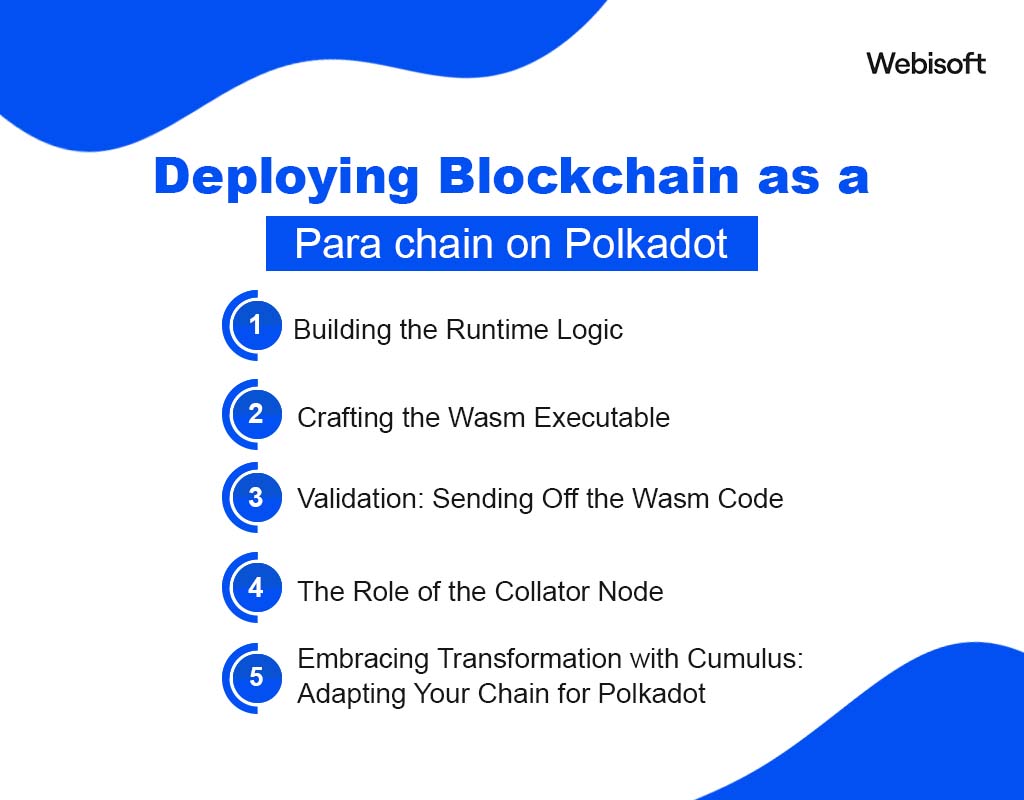
The path from code to a live parachain follows five steps.
1. Build the Runtime
Develop your chain's runtime logic with Substrate, exactly as you would for a standalone chain. The Polkadot SDK includes a parachain template that provides a working starting point: a minimal runtime already wired for Cumulus, which you extend with your own pallets. Clone the template, pin it to the SDK release you are targeting, and compile the collator binary with cargo in release mode. Verify the build by running the node binary and confirming its help output before going further.
2. Compile the Runtime to WebAssembly
Your runtime compiles to a WebAssembly (Wasm) blob containing the chain's complete state-transition program. This blob, called the validation code, is what the Relay Chain stores and executes to verify your blocks. It is the artifact that makes the shared-security model work: validators do not need to run your full node, only your validation code against the proofs your collators submit.
3. Register the Chain
Reserve a parachain identifier (ParaID) on the Relay Chain, then register your chain by submitting two artifacts: the genesis state and the validation code from the previous step. Every chain on the network shares this registration model, but each has a unique ParaID that must be registered before validators will process its blocks. Note that every Substrate-based chain also has its own SS58 address format prefix, so confirm your chain's prefix is registered and consistent across your tooling.
4. Run Collator Nodes
Collators are your chain's block producers. They maintain the full state of the parachain, author new blocks by executing the STF, and submit each candidate block to Relay Chain validators together with the proof needed to verify it. Validators then include the verified candidates in the Relay Chain. Plan for redundant, monitored collator infrastructure from day one, the same way you would for any production validator fleet: collator downtime means your chain stops producing blocks.
5. Integrate with Cumulus
Substrate's built-in networking layer serves standalone chains and has no awareness of relay-chain connectivity. Cumulus closes that gap. Wrapping your node with Cumulus is what lets it follow the Relay Chain, submit candidate blocks, and operate as a full parachain or, for intermittent workloads, produce blocks on demand.
Testing Before You Launch
Do not take an untested runtime to production blockspace. The standard progression has two stages:
- Local relay-chain testing. Spin up an ephemeral local network with a small relay chain plus your parachain to exercise block production, runtime upgrades, and XCM flows on your own hardware. Parity's Zombienet tooling automates these throwaway test networks.
- Public testnet. Rococo, the original parachain testnet, has been retired; Paseo is the community-run testnet that replaced it for parachain teams. Register your chain there with a test ParaID, obtain testnet tokens from the faucet, run your collators against live testnet validators, and verify cross-chain transfers end to end. Westend remains the protocol-level testnet used primarily by core developers.
Treat the testnet phase as an operations rehearsal, not just a functional test. Practice runtime upgrades, collator failover, and monitoring before real value is at stake.
Acquiring Blockspace: From Slot Auctions to Agile Coretime
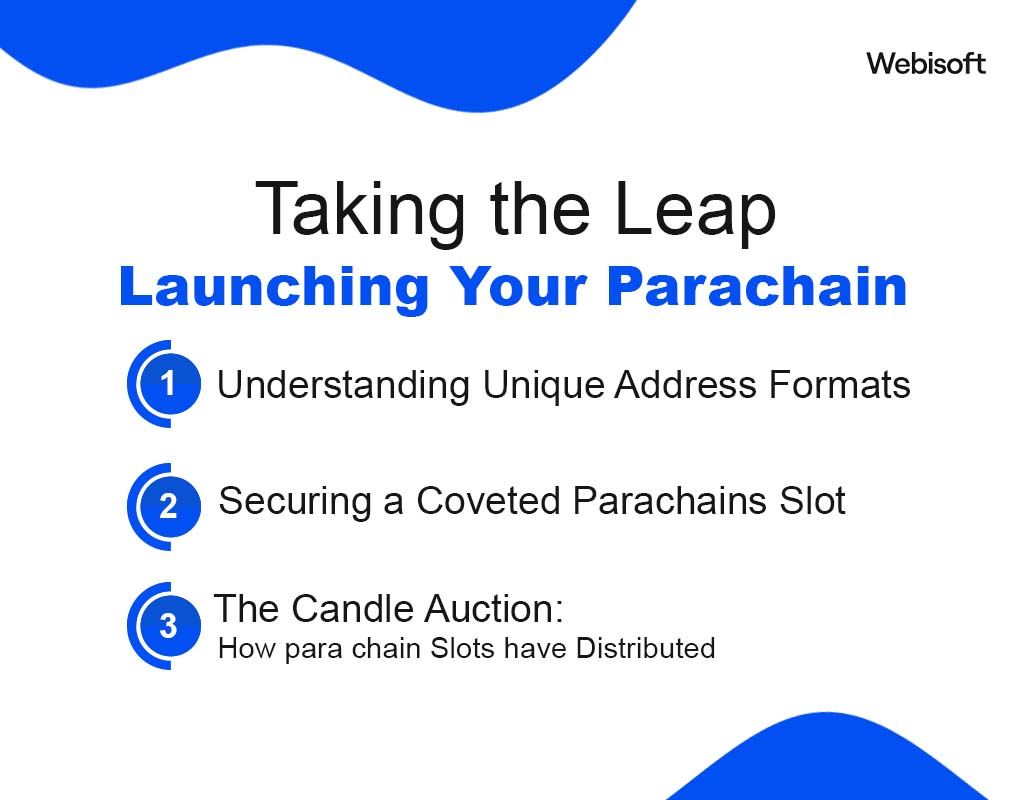
The question every early parachain team asked, how do we win a slot, has changed. It is worth understanding both models, because much of the ecosystem's documentation and commentary still references the first.
The Legacy Model: Candle Auctions and Crowdloans
Polkadot originally allocated parachain slots through candle auctions. Teams bid locked DOT for a lease measured in months. Unlike a classic auction with a known closing time, the exact end of the bidding window was determined retroactively, which discouraged last-second sniping: a late bid could land after the true close and count for nothing. Many teams funded their bids through crowdloans, borrowing locked DOT from supporters in exchange for token rewards. The model filtered for serious commitment, but it front-loaded a large capital requirement and capped how many teams could participate at all.
The Current Model: Agile Coretime
Polkadot has since replaced slot auctions with Agile Coretime, which treats blockspace as a resource you purchase rather than a slot you win. There are two purchase modes:
- Bulk coretime. Reserve a core for a fixed period, sold in roughly month-long chunks, at a price set by an on-chain sale mechanism. This suits production chains that need guaranteed block inclusion.
- On-demand coretime. Pay per block, only when your chain actually needs to produce one. This suits new projects, low-traffic chains, and testing, and it removes the need to lock capital before you have traction.
The shift materially lowers the barrier to entry: a team can now launch a parachain without winning a competitive auction or raising a crowdloan. Current mechanics and pricing are documented in the official Polkadot Wiki.
The Benefits of Building a Parachain
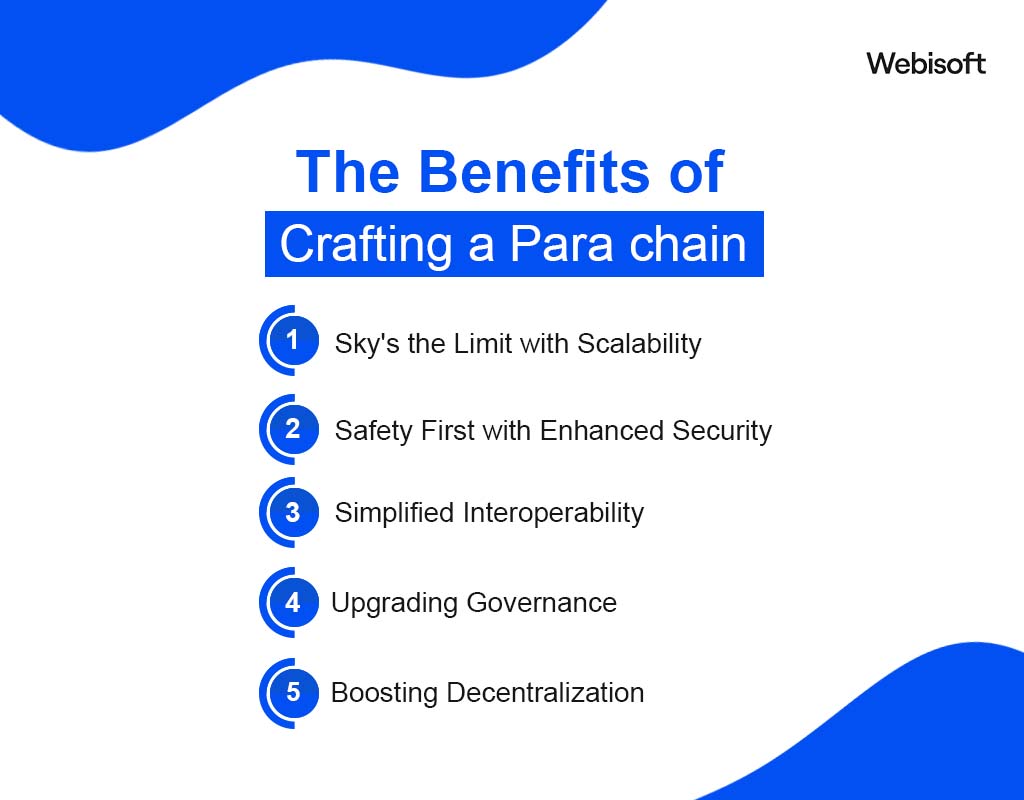
Scalability Through Parallel Execution
Parachains process transactions simultaneously on separate cores. Your throughput does not queue behind unrelated applications, and congestion on one chain does not raise fees on another. For products with sustained volume, owning a dedicated execution lane is the difference between predictable and unpredictable unit economics.
Security Without Bootstrapping Validators
Every parachain block is validated by the Relay Chain's full staked validator set. A newly launched parachain gets the same economic security as the most established one, which removes the cold-start problem that makes small independent chains attractive targets for consensus attacks. Your team runs collators, which produce blocks but do not need to be trusted for security; validation remains the Relay Chain's job.
Native Interoperability
Any parachain can exchange assets and messages with any other parachain over XCM, with no centralized exchange or third-party bridge in the path. Bridges are where cross-chain systems have repeatedly been exploited, so keeping transfers inside a single security domain is a genuine risk reduction, not just a convenience.
Forkless Upgrades and On-Chain Governance
Because the runtime lives on chain as Wasm, upgrades are proposed, voted on, and enacted without coordinating a hard fork across node operators. Chains iterate faster and avoid the community splits that contentious forks create. Governance itself is on chain, so protocol changes are decided by token-holder vote rather than by a core team's unilateral release schedule.
A Lower Barrier to Sovereign Chains
With on-demand coretime, the cost of trying a sovereign chain has dropped from a multi-month capital commitment to an operational expense. Teams that would previously have defaulted to a smart contract because a chain was out of reach can now justify chain-level control: custom fee logic, protocol-level features, and full ownership of the execution environment.
The Risks and Trade-Offs
An honest assessment includes what can go wrong:
- Operational burden. You own collator uptime, monitoring, runtime upgrades, and incident response. A parachain is a production distributed system, not a deployment target.
- Recurring blockspace cost. Bulk coretime is an ongoing expense that has to be covered by real usage or treasury reserves.
- Coupling to the Relay Chain. Your chain tracks Polkadot's release cadence and protocol changes; keeping up with SDK upgrades is regular engineering work, not a one-time integration.
- Adoption risk. A sovereign chain with its own token needs its own community, liquidity, and integrations. The technology does not substitute for distribution.
- It may be the wrong tool. If your product fits comfortably in a smart contract on an existing chain, that is the cheaper and faster route. Reserve a parachain build for products that genuinely need chain-level control or dedicated throughput.
Final Words
The parachain model gives builders something rare: a sovereign layer-1 with pooled security, native interoperability, and, since Agile Coretime, an entry cost that scales with actual usage. The toolchain of Substrate plus Cumulus is mature, the deployment path is well documented, and the economic design remains entirely your responsibility. Get the economics and operations right and the technology will not be your bottleneck.
If you are evaluating whether your product justifies its own chain, or you need a team to design and build the runtime, the collator infrastructure, and the token model around it, contact Webisoft. We are a Montreal-based engineering firm that builds blockchain and software products full cycle, and we can help you pressure-test the decision before you commit capital to it.
Through XCM, Polkadot's cross-consensus message format. Any parachain can send assets and arbitrary messages to any other parachain natively, without relying on a centralized exchange or a third-party bridge, which keeps transfers inside a single security domain.
A parachain is a sovereign, application-specific blockchain that connects to Polkadot's Relay Chain. It runs its own runtime logic, maintains its own state, and usually issues its own token, while the Relay Chain's staked validator set verifies and secures its blocks.
No. Polkadot replaced candle auctions and crowdloans with Agile Coretime. Teams now purchase blockspace directly: bulk coretime reserves a core for a fixed period, while on-demand coretime lets a chain pay per block, so projects can launch without locking large amounts of capital upfront.
Substrate is the Rust framework used to build the blockchain itself: networking, consensus plumbing, and a WebAssembly runtime composed of modular pallets. Cumulus is the extension that makes a Substrate chain Polkadot-compatible, adding the embedded Relay Chain client, the collator implementation, and cross-chain message passing.
No. A parachain team runs collators, which maintain the chain's state and produce candidate blocks. Validation is performed by the Relay Chain's shared validator set, so every parachain inherits the economic security of the whole network without recruiting validators of its own.
When your product fits comfortably in a smart contract on an existing chain. A parachain adds recurring coretime costs, collator operations, and ongoing SDK maintenance, so it only pays off for products that need dedicated throughput, custom protocol-level logic, or full control of the execution environment.