Over 90% of smart contracts today publicly expose all on-chain data, including wallet addresses, transaction logic, and business activity. This creates serious privacy and compliance concerns in regulated industries.
Midnight addresses this challenge head-on.
As a privacy-first sidechain built on Cardano, Midnight offers developers to build smart contracts that handle both public and private data securely. Its architecture combines zero-knowledge proofs, a local proof server, and a purpose-built language called Compact.
This ensures sensitive inputs never touch the chain, while still validating logic on-chain.
Take advantage of Webisoft’s expertise to get the full potential of Midnight. With our deep experience in privacy-focused smart contract development, we’ll help you build secure solutions from the ground up.
What Is Midnight Network (on Smart Contracts)?
Midnight is a privacy-first blockchain built as a Cardano sidechain. It supports smart contracts that handle private and public data. Developers write logic using Compact and build apps with TypeScript.
Midnight uses zero-knowledge proofs to protect sensitive inputs, which never go on-chain.
A local proof server processes private data and generates proofs. The chain stores only the proof, not the actual input.
Transactions run using its native token, NIGHT, and a resource token called DUST. NIGHT secures the network, while DUST powers contract execution.
This structure supports scalable, efficient activity with strong privacy guarantees.
Midnight fits real-world needs like identity, finance, and regulated apps, without exposing sensitive information. However, businesses often face challenges around integrating privacy-focused logic with traditional blockchain ecosystems.
Our Webisoft specialists will help you build and integrate privacy-first smart contracts on Midnight.
We will guide you in navigating these complexities and ensure to integrate zero-knowledge proofs and the Compact language seamlessly.
How Do Midnight Smart Contracts Work?
Midnight smart contracts run with both public and private data. You write them in a language called Compact. The contract logic defines how the data should be processed. Private inputs never leave the user’s machine.
Instead, a local proof server creates a zero-knowledge proof. This proof confirms the input meets the contract’s rules, without revealing the input itself.
The user submits this proof along with public data to the blockchain. The smart contract verifies the proof and updates the state if valid.
It never sees the actual private data. This structure keeps transactions secure and confidential.
Midnight contracts run using DUST, while NIGHT maintains network integrity and governance.
Key Features of Midnight Smart Contracts Protocol
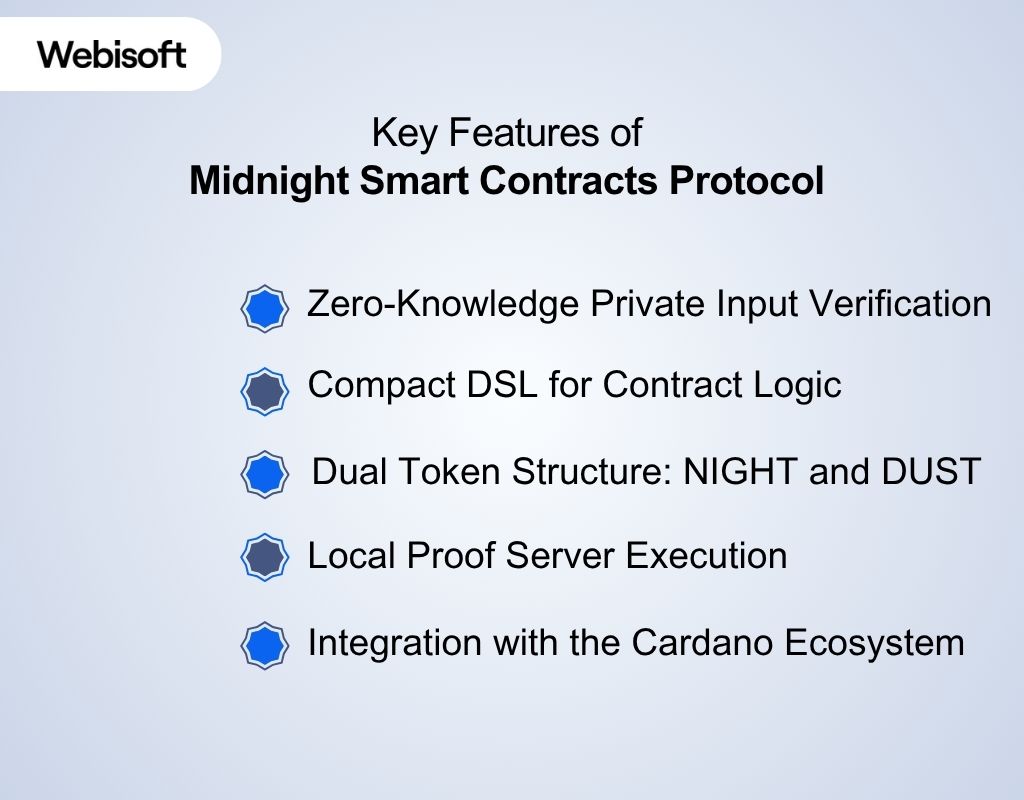
Midnight brings enterprise-grade privacy and precision to smart contract development. It bridges public blockchain functionality with confidential data handling.
Below are the core features that define its architecture and development model:
1. Zero-Knowledge Private Input Verification
Midnight processes sensitive user data using zero-knowledge proofs. The private input stays entirely local. A user submits a cryptographic proof instead of raw data.
The contract verifies this proof before changing state. This design supports compliance-heavy use cases such as finance, healthcare, and regulated identity.
2. Compact DSL for Contract Logic
Smart contracts are written in Compact, a purpose-built, statically typed language. It enforces strict control over input types, transitions, and state changes.
Compact is optimized for handling both public and private data. It supports circuit definition required for privacy validation and local proof generation.
Our team at Webisoft excels in utilizing Compact’s full potential. You will get Midnight smart contracts that are robust, compliant, and customized to your business’s privacy needs.
3. Dual Token Structure: NIGHT and DUST
The protocol uses two tokens. NIGHT is the staking and governance asset, securing the network and validating blocks.
DUST is the computational resource token used to execute smart contracts. This split reduces gas-model friction and gives developers better predictability over resource usage.
4. Local Proof Server Execution
Midnight requires each transaction involving private data to be verified through a locally run proof server.
This server generates zero-knowledge proofs based on user-supplied data and contract rules. It runs offline and does not expose data to the blockchain or any external system.
5. Integration with the Cardano Ecosystem
Midnight is a sidechain to Cardano. It supports cross-chain compatibility for identity, wallets, and developer tooling. You can utilize existing Cardano infrastructure, such as the Lace wallet and DID support.
It builds privacy-preserving applications within a separate execution layer.
Midnight Smart Contract Development – Step-by-Step Beginner Guide

Midnight is a privacy-focused sidechain on Cardano that lets developers build smart contracts using zero-knowledge proofs (ZKPs).
This guide walks you through building your Smart contract using Midnight, even if you’re new to ZK or smart contracts.
Step 1: Set Up the Lace Wallet and Get Test Tokens
Before you can develop on Midnight, you need a wallet and some test tokens (tDUST).
What to Do:
i) Recommended Browser: Use Google Chrome (version 119 or higher) to ensure full compatibility. Although Lace also supports Brave and Microsoft Edge, Midnight currently recommends Chrome for best results.
ii) Install Lace Wallet:
- Add the Lace Wallet extension via the Chrome Web Store.
- Pin the extension for easy access.
iii) Create a New Wallet:
- Click “Create” and accept the terms of use.
- Set a wallet name (e.g., “Midnight Testnet”).
- Securely save your password and 24-word recovery phrase; this is essential for wallet access and recovery.
iii) Get tDUST Tokens:
- Visit the official Midnight faucet.
- Paste your wallet address to receive test tokens. These tokens are required for deploying contracts and sending transactions on the Midnight testnet.
Step 2: Run the Midnight Proof Server (Locally)
The proof server helps you generate privacy-preserving zero-knowledge proofs on your own machine, critical for keeping sensitive data safe.
What to Do:
- Install Docker (if you haven’t already)
- Run the proof server with this command:
| docker run -p 6300:6300 midnightnetwork/proof-server — ‘midnight-proof-server –network testnet’ |
- Leave it running in the background while developing. The proof server only listens locally your private data stays on your machine.
Step 3: Install Development Tools and Compact Compiler
You’ll use the Compact compiler to write and compile Midnight contracts.
What to Do:
i) Install Node.js v18+ via NVM:
| bash nvm install 18 –ltsnvm use 18 |
ii) Download the Compact compiler from the Midnight Testnet release page.
- Unzip it to a local directory (e.g., ~/midnight-tools/compactc)
iii) Set environment variables:
| bash export COMPACT_HOME=”~/midnight-tools/compactc”export PATH=”$COMPACT_HOME:$PATH” |
iv) Test your install:
| Bash compactc –version |
This command will check and display the installed version of the Compact Compiler (compactc), which is used for developing smart contracts on Midnight.
Step 4: Write and Compile Your First Smart Contract
Create your first privacy-aware smart contract using Compact DSL.
Example: A Simple Counter Contract (public only)
| compact contract Counter { input Increment {} state { count: u64; } transition Increment { next.count = prev.count + 1; }} |
Save it as counter.compact.
- It defines a Counter contract with a 64-bit unsigned integer count as its state.
- The contract has an Increment input that triggers a transition incrementing the counter by 1.
Compile the Contract
After saving your contract as counter.compact, you should open your terminal or command prompt, navigate to the folder where counter.compact is located, and then run:
| bash compactc counter.compact |
This command will compile your Compact contract and generate the necessary artifacts for deployment on Midnight.
This will generate:
- The compiled contract artifact
- ZK proof logic and metadata
- Output files ready to deploy
Step 5: Deploy the Contract to Midnight Testnet
Use the CLI or Midnight’s developer tools to deploy your compiled contract. Exact deployment instructions may depend on the current SDK tooling.
If Midnight CLI is available:
| bash midnight deploy –contract counter.json –wallet <your-wallet-address> –network testnet |
You’ll need to sign the transaction using your Lace wallet with tDUST.
- –contract counter.json points to the compiled contract artifact (often a JSON file generated by compactc).
- –wallet <your-wallet-address> specifies the wallet that will sign and pay for the deployment.
- –network testnet targets the Midnight testnet environment.
You’ve successfully:
- Written a smart contract using Compact DSL
- Used Midnight’s zero-knowledge tooling
- Deployed your contract to the Midnight Testnet
Still confused where to start?
Webisoft’s experts are here to guide you through every step of building secure, privacy-first smart contracts on Midnight for any of your data-sensitive projects.
Midnight vs Traditional Smart Contracts: Key Differences
Midnight smart contracts solve a problem that traditional smart contracts overlook data privacy at the protocol level. Most blockchain platforms expose all transaction details by default.
Midnight uses a fundamentally different model built around local data handling, zero-knowledge proofs, and controlled disclosure.
Here’s how midnight smart contract development differs from traditional smart contract systems in real, technical terms:
| Feature | Midnight Smart Contracts | Traditional Smart Contracts |
| Data Privacy | Private inputs processed locally via zero-knowledge proofs | All inputs and outputs are stored publicly on-chain |
| Computation Model | Proof-based validation with local processing | On-chain computation of all contract logic |
| Programming Language | Compact DSL (privacy-first, statically typed) | Solidity, Vyper, Rust (general-purpose) |
| Execution Transparency | Proofs reveal validity, not the data itself | Full transaction details are visible to everyone |
| Token Structure | NIGHT (staking) + DUST (execution resource) | Typically a single gas token (e.g., ETH for Ethereum) |
| Proof Server Requirement | Requires a local server to generate privacy-preserving proofs | No external components needed for execution |
| Use Case Fit | Ideal for regulated apps, compliance-heavy use cases | Strong for open finance, DAOs, and NFTs |
| User Control Over Disclosure | Users choose what data to reveal and to whom | All contract and input data are visible by default |
Advantages and Limitations of Midnight Smart Contract Development
Advantages:
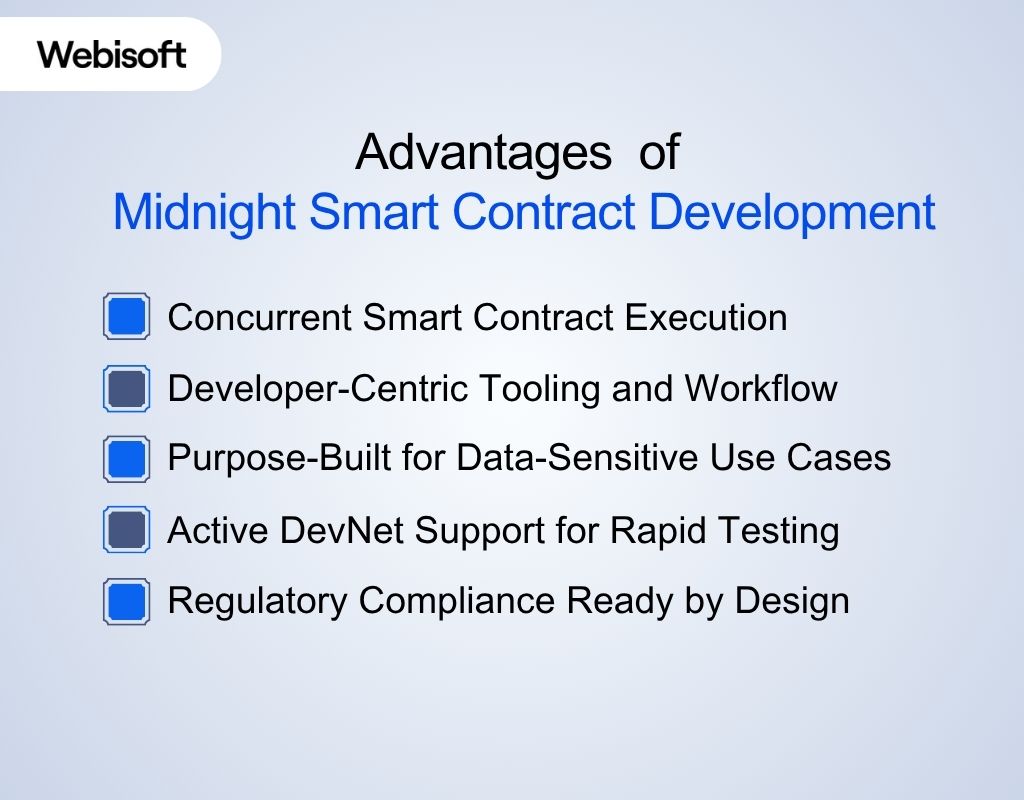
Midnight smart contracts aren’t just secure. They’re built for developers solving real problems where privacy, speed, and control matter.
Here’s what you gain when building contracts on Midnight:
1. Concurrent Smart Contract Execution
Midnight supports multiple users interacting with the same contract at once. This concurrency model reduces wait times and avoids execution bottlenecks.
By recording contract interactions as transcripts, Midnight isolates conflicting actions cleanly. This improves performance and keeps contract logic transparent to the developer, not the public.
With Webisoft’s smart contract expertise, ensure seamless integration with Midnight, optimize concurrency, and eliminate bottlenecks for efficient contract execution.
2. Developer-Centric Tooling and Workflow
You write Midnight contracts in Compact, a statically typed DSL designed for privacy-aware logic. The SDK offers structured tools for building, testing, and deploying contracts.
TypeScript support, local proof generation, and a VS Code extension make it easy to debug, validate, and iterate in one environment.
3. Purpose-Built for Data-Sensitive Use Cases
Midnight smart contracts process both public and private inputs. They never reveal sensitive data on-chain. The contract verifies a cryptographic proof instead.
This structure fits industries like healthcare, TradFi, and compliance-heavy identity systems, where smart contracts must respect confidentiality.
4. Active DevNet Support for Rapid Testing
The Midnight development network gives you a stable testbed. You can compile, deploy, and interact with contracts safely before production.
It supports full proof generation, DUST-based execution, and wallet interactions, all without exposing live data.
5. Regulatory Compliance Ready by Design
Midnight smart contracts give you precise control over data exposure. Contracts can require proof of compliance without storing personal data. Selective disclosure lets users reveal only what’s needed, nothing more.
This contract-level privacy supports legal frameworks like GDPR, HIPAA, and financial KYC standards.
You can build applications that meet strict regulatory demands without redesigning your architecture or relying on off-chain workarounds.
Limitations
Midnight offers a powerful privacy framework, but like any system, it comes with trade-offs. Understanding these limitations helps you plan better and build smarter.
i) Technical Challenges
Developing Midnight smart contracts requires specialized skills in Compact and zero-knowledge logic. Teams must understand proof generation, contract-state modeling, and privacy-focused architecture.
The setup involves managing local infrastructure like a proof server. These requirements may slow down onboarding, increase development costs, and extend time to market.
Businesses must plan for contacting specialized developers at Webisoft. We have skilled professionals on complex smart contract platforms like Midnight.
This reduces onboarding time, mitigates risk, and keeps your roadmap on track.
ii) Immutability and Flexibility
Once deployed, a smart contract on Midnight cannot be modified. While this protects integrity, it also limits upgrade paths. You must design with versioning, modularity, and upgrade strategy in mind.
Unlike traditional systems, on-chain flexibility is minimal, especially when dealing with private state.
Potential Use Cases for Midnight Smart Contracts
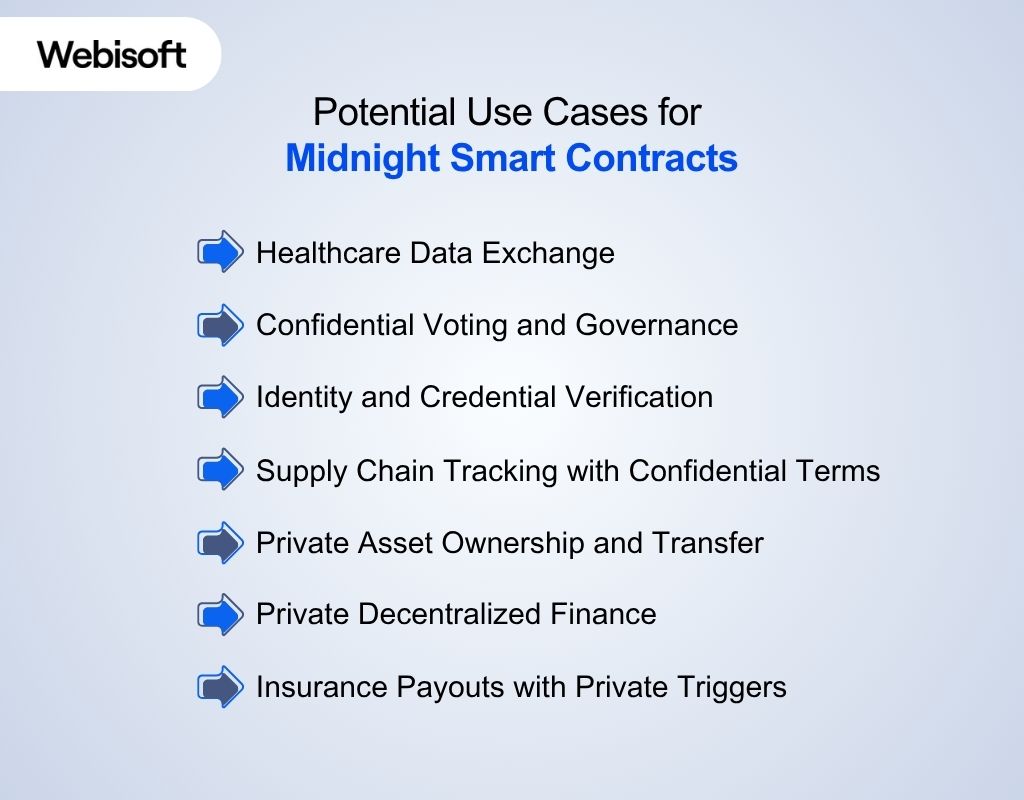
Midnight smart contracts open the door to a variety of privacy-first applications where sensitive data needs to remain protected yet verifiable. Below are some standout use cases, each serving a distinct purpose:
Healthcare Data Exchange
Hospitals and providers can exchange validated patient data using smart contracts that never expose the actual records. Contracts confirm consent and data validity through private proofs, maintaining strict compliance with laws like HIPAA or GDPR.
Confidential Voting and Governance
Smart contracts on Midnight can manage voting systems where each vote remains private. The contract validates that the voter is eligible and hasn’t voted twice, without recording how they voted. This suits corporate governance, DAOs, or even government pilots.
Identity and Credential Verification
Midnight can issue and validate digital credentials, such as work history, certifications, or age, without revealing unrelated personal details. A contract confirms that conditions are met without accessing or displaying the raw data itself.
Supply Chain Tracking with Confidential Terms
Businesses can record proof of delivery, quality certification, or transaction terms while keeping pricing and supplier relationships private. Smart contracts verify the events and dependencies using private inputs and time-locked proofs.
Private Asset Ownership and Transfer
Midnight smart contracts can confirm asset ownership and authorize transfers without disclosing the asset’s value or history publicly. This suits private equity, high-value collectibles, or intellectual property management.
Private Decentralized Finance (DeFi)
Midnight supports lending, staking, or liquidity mechanisms that protect user balances and positions. Contracts can enforce limits or track utilization without showing wallet amounts or strategy details on-chain.
Insurance Payouts with Private Triggers
A smart contract can verify that a condition (like a medical diagnosis or accident) is met, without revealing the details. Proofs satisfy contract logic privately, supporting claims processing without breaching confidentiality.
Regardless of the platform you’re using, Webisoft experts will guide you in integrating Midnight smart contracts into your privacy-first applications.
Need a Team for Midnight Smart Contract Development?
Midnight’s privacy-first architecture brings new possibilities—but also new technical demands. Writing smart contracts in Compact, handling zero-knowledge proofs, and running local infrastructure requires specialized expertise.
That’s where a partner like Webisoft comes in.
At Webisoft, we design secure and efficient smart contracts across platforms, from Ethereum and Solana to emerging protocols like Midnight. Our team is fluent in Solidity, Rust, Substrate, CosmWasm, and now, Compact.
We’ve built production-grade smart contracts for DeFi, NFTs, DEXs, and real-world compliance systems.
Whether you need end-to-end Midnight development or a Compact-trained developer to integrate with your team, we deliver on:
- Custom contract architecture, optimized for ZK and privacy
- Development, auditing, and deployment workflows
- Agile-based delivery with full visibility and rapid iteration cycles
- Flexible engagement models: dedicated team, extension, or project-based
Looking to build a real solution on Midnight that handles sensitive data securely?
Book a free consultation with Webisoft and let’s bring your project to life.
In Closing
Midnight introduces a fundamental shift in how smart contracts handle sensitive data, without compromising on-chain functionality.
Its architecture blends local computation, zero-knowledge proofs, and a purpose-built development stack to support real-world privacy requirements.
Whether you’re building for finance, identity, or any data-sensitive sector, Midnight smart contract development offers the tools to maintain confidentiality, meet compliance standards, and deliver robust performance.
With strong developer support, cross-chain integration, and a maturing ecosystem, it stands as a compelling option for next-generation Web3 applications.
Frequently Asked Questions
Parts of Midnight’s tooling are publicly available and under active development. While the protocol is governed by Input Output Global (IOG), community involvement is expected to grow with future releases.
Not directly. Midnight uses a different programming model and Compact DSL instead of Solidity. However, business logic can often be adapted, especially when privacy is a new requirement.
DUST is used strictly as a computational resource for executing contracts. Unlike ETH, it doesn’t function as a staking or governance token; that’s the role of NIGHT in Midnight.
You can develop using standard tools like Visual Studio Code, TypeScript, and Docker. Midnight also provides a VS Code extension and SDK to simplify contract writing and testing.