Machine learning vs neural networks comes down to scope and structure. Neural networks are a specialized subset of machine learning, inspired by brain neurons. Machine learning is the broader field of models that perform well on structured data, while neural networks learn complex patterns through layered connections and weight updates.
If you’ve ever felt these terms are used like they mean the same thing, you’re not alone. They show up everywhere in AI conversations, product claims, and even technical articles, which makes the topic feel more confusing than it should be. This guide clears up the real differences in a practical way.
You’ll learn how they compare in data needs, compute cost, explainability, and performance, so you can confidently choose the right approach for your project instead of guessing or following hype.
What Is Machine Learning?
Machine learning is a branch of AI where computers learn patterns from data to make predictions or decisions without being explicitly programmed for every rule. It works by training models on examples, measuring errors, and adjusting parameters until the system can generalize and make accurate outputs on new, unseen data.
How Machine Learning “Learns” from Data
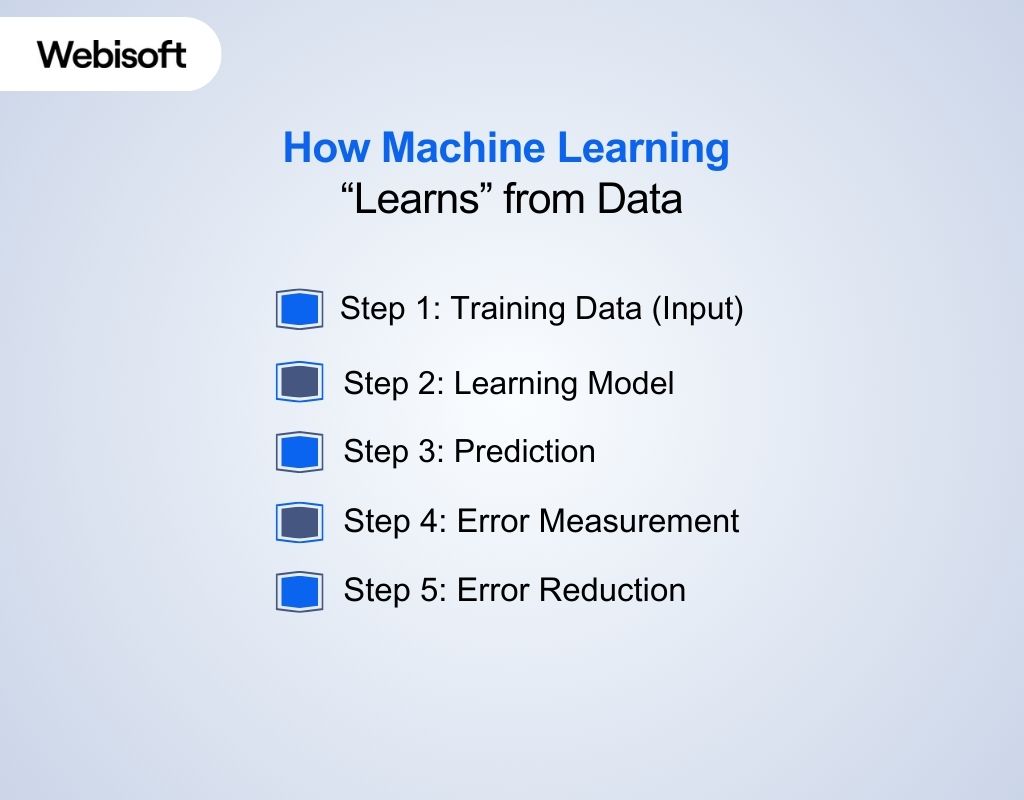
ML learns the same way you learn from practice. You try, you make mistakes, you correct them, and you improve. Here’s the exact learning flow: training data → model → prediction → error reduction
Step 1: Training Data (Input)
You start with historical examples. Each example includes:
- Features (the inputs, like age, clicks, purchase history)
- A label/target (the correct answer, like “will churn” or “won’t churn”)
If labels exist, it’s supervised machine learning. If not, the model looks for patterns without labels.
Step 2: Learning Model
A model is a mathematical system that tries to map inputs to outputs. It begins with random or default internal settings called parameters. Different ML models learn differently, but they all try to find patterns that explain the training data.
Step 3: Prediction
The model takes the training inputs and produces a prediction. Example:
- input: customer history
- output: churn probability = 0.72
At the beginning, predictions are often wrong. That’s expected.
Step 4: Error Measurement
Now the model compares:
- what it predicted vs what the correct answer actually was
The difference becomes a number called error (or loss). Higher loss means worse predictions.
Step 5: Error Reduction
This is where learning happens. The model updates its internal parameters to reduce the error. It repeats the process again and again until predictions improve. Each repetition is called an iteration. A full pass through the dataset is called an epoch.
What Is a Neural Network?
A neural network is a machine learning model built from layers of connected nodes (often called neurons). Each connection has a weight that controls how much influence one node has on the next. During training, the network adjusts these weights so it can map inputs to correct outputs.
People often ask are neural networks machine learning because it feels like a separate concept. But they’re actually one of the most popular model families inside machine learning.
How Neural Networks Learn
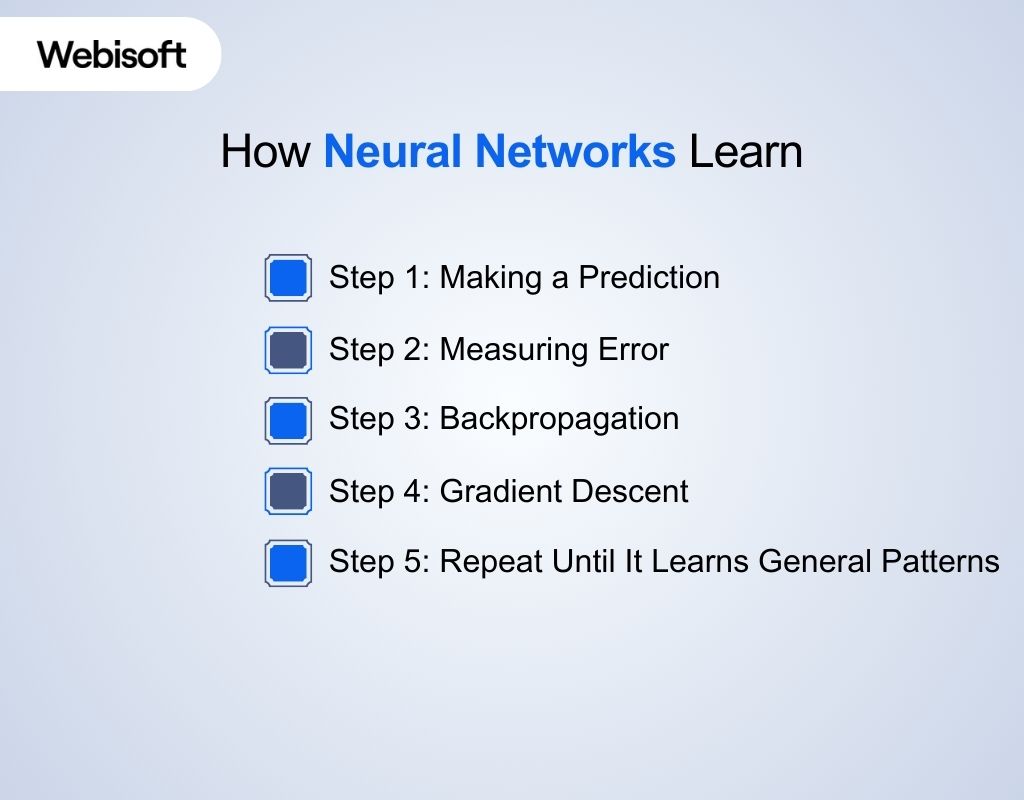
Neural networks learn by repeatedly making predictions, measuring how wrong they are, and then correcting themselves. The correction happens through two key mechanisms: backpropagation and gradient descent. Here’s the learning flow: input data → forward pass → prediction → loss → backpropagation → gradient descent → updated weights
Step 1: Making a Prediction
The network takes input data and pushes it through layers. Each layer transforms the information. At the end, the network produces an output. Example:
- Input: transaction history + behavior signals
- Output: fraud probability = 0.86
Step 2: Measuring Error
The model compares its prediction with the correct answer. The difference becomes a numeric score called loss. Higher loss means the network made a worse prediction.
Step 3: Backpropagation
Backpropagation is the “blame assignment” step. It traces the error backward through the layers and calculates how much each weight contributed to the wrong result. This matters because a neural network has a lot of moving parts. Without backpropagation, it wouldn’t know which weights to adjust.
Step 4: Gradient Descent
Once the network knows which weights caused the error, it updates them using gradient descent. This method nudges weights in the direction that reduces loss. The learning rate controls how big each update is. Too large and the model becomes unstable. Too small and training becomes painfully slow.
Step 5: Repeat Until It Learns General Patterns
The network repeats this cycle over thousands or millions of examples. With enough training, it stops guessing and starts learning patterns that work on new, unseen data.
A Quick Comparison Table Between Machine Learning vs Neural Networks
Before you move into the detailed comparison, take a look at the following table have initial ideas about the differences among ML and neural networks:
| Factor | Traditional ML | Neural Networks |
|---|---|---|
|
Data size |
Low–medium |
High |
|
Labeling need |
Lower |
Higher |
|
Feature work |
Manual features |
Learns features |
|
Compute |
CPU-friendly |
GPU-heavy |
|
Training time |
Fast |
Slower |
|
Scaling |
Limited at huge scale |
Built for scale |
|
Accuracy |
Best for tabular |
Best for unstructured |
|
Explainability |
Easier |
Harder |
|
Deployment |
Simpler |
More complex |
|
Monitoring |
Easier |
More demanding |
|
Tuning |
Fewer knobs |
Many knobs |
| Cost/ROI | Lower cost, faster ROI |
Higher cost, ROI depends |
Machine Learning vs Neural Networks: Key Differences (Side-by-Side)
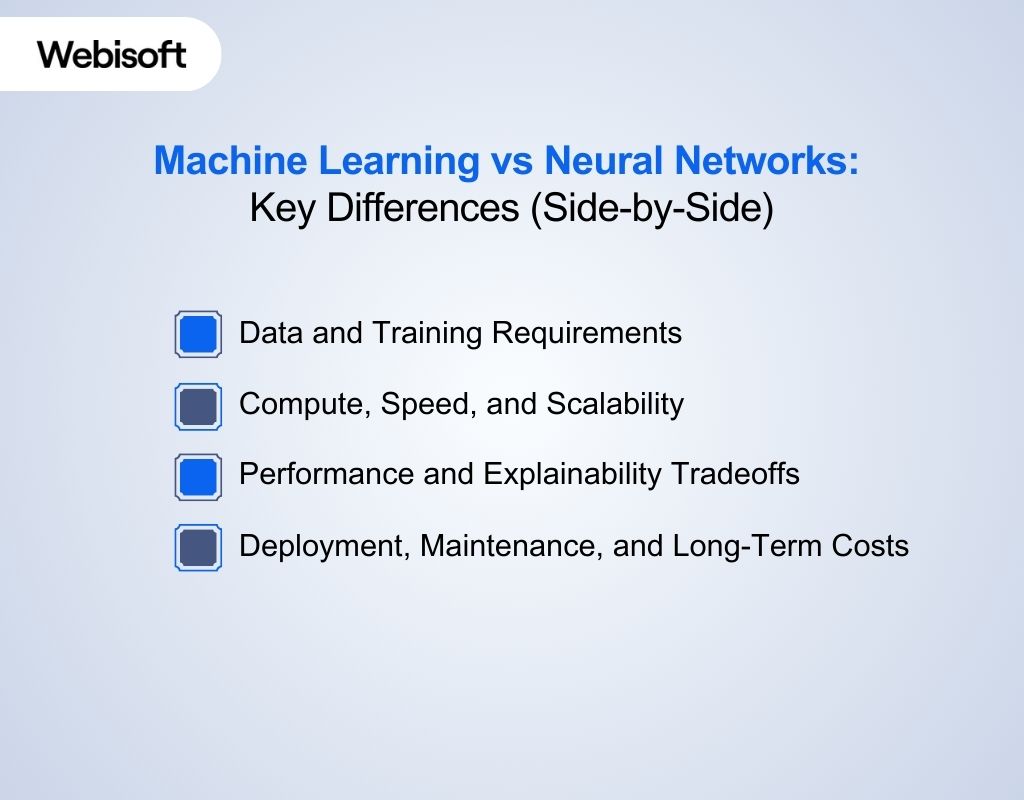
Before you choose a model, you need to understand the difference between machine learning and neural networks. The difference isn’t just “simple vs advanced.” It comes down to how much data you have, how expensive training will be, and more. Here’s detailed comparison:
Data and Training Requirements
1. Data Size Requirements
Machine learning models can deliver strong results with small to mid-sized datasets, especially for structured business data like CRM records or transaction tables. On the other hand, neural networks usually need much larger datasets because they tune many parameters and learn features automatically.
With limited data, they often overfit and memorize instead of generalizing. That’s why data requirements neural networks vs machine learning is a major decision point that needs to be evaluated.
2. Data Labeling Requirements
Traditional ML can work well with limited labeled data, especially when you use smart feature engineering and balanced sampling. Neural networks often need far more labeled examples because they learn patterns directly from raw inputs and have many parameters to train.
If labeling is expensive, this becomes a real bottleneck. In many projects, the model choice isn’t limited by algorithms, but by how much reliable labeled data you can produce.
3. Feature Engineering Needs
In machine learning vs neural networks, feature work is one of the significant differences. Traditional ML often depends on feature engineering, meaning you manually create useful inputs like averages, ratios, or behavioral scores. That effort can make or break performance.
Neural networks reduce this need because they learn features automatically from raw data, especially for images and text. But they still require clean inputs and careful preprocessing to avoid garbage results.
Compute, Speed, and Scalability
4. Compute and GPU Needs
Traditional machine learning models are often efficient enough to train on a CPU, even on large business datasets. Neural networks, in contrast, usually demand far more compute because they update millions of parameters across layers during training.
For anything beyond a small network, GPUs become the practical choice. This comput reality matters because machine learning vs neural networks differences often come down to what your budget and infrastructure can support.
5. Training Time
Traditional machine learning models usually train fast because they have fewer parameters and simpler optimization. You can often go from a dataset to a usable model in minutes or hours.
But Neural networks may take much longer since training involves many epochs, weight updates, and tuning. If the model is large, training can stretch into days, especially without GPUs or clean labeled data.
6. Scalability Limits
Traditional ML can scale well at first, but many models hit ceilings as datasets grow, especially when training becomes memory-heavy or feature pipelines slow down. Neural networks are built to learn at scale through batch processing and distributed training across GPUs.
This is why training neural networks vs machine learning models feels so different in large systems. Neural networks are simply easier to parallelize when data reaches millions or billions of samples.
Performance and Explainability Tradeoffs

7. Accuracy Potential
Traditional machine learning can reach excellent accuracy on structured datasets, especially when strong features exist. In fact, models like XGBoost often win on tabular business problems because they extract signals efficiently.
Neural networks typically pull ahead when the input is complex and high-dimensional, like images or text, where feature learning matters more than feature engineering. Their accuracy potential is higher there, but they need more data to earn it.
8. Interpretability
Interpretability is where machine learning vs neural networks becomes a real business decision, not just a technical one. Traditional ML models are often easier to explain because you can trace outcomes back to specific features.
Neural networks behave more like black boxes since predictions come from layered weight interactions. In regulated industries, that lack of transparency can be a deal-breaker even if accuracy is strong.
Deployment, Maintenance, and Long-Term Costs

9. Deployment Complexity
Machine learning models are usually easier to deploy because they’re lightweight, fast at inference, and run smoothly on standard CPU-based servers. Neural networks often add complexity due to larger model sizes, higher runtime requirements, and stricter dependency on preprocessing pipelines.
In production, you may also need specialized optimization (like quantization) to keep latency low, especially if the model must run in real time.
10. Maintenance and Monitoring
After deployment, models don’t stay accurate forever. Traditional ML is usually easier to monitor because feature behavior and decision logic are more visible.
Neural networks are harder to maintain since small shifts in data can quietly degrade performance, and the failure signals are less obvious. In practice, neural networks often require stronger monitoring for drift, retraining schedules, and more careful version control to prevent silent accuracy drops.
11. Hyperparameter Tuning Complexity
Traditional ML models usually have a smaller set of tuning knobs, so you can reach a strong baseline quickly using grid search or random search. Neural networks come with many more hyperparameters, like layers, neurons, dropout, batch size, and learning rate schedules.
That extra flexibility can improve performance, but it also increases experimentation time and makes results less predictable without careful tuning discipline.
12. Cost and ROI (What It Takes to Get Results)
Cost is where many projects succeed or die. ML often delivers strong ROI quickly because it trains faster, runs on cheaper infrastructure, and needs fewer iterations to reach acceptable performance.
Neural networks can produce higher gains on complex tasks, but they demand more labeled data, compute, and tuning time. The ROI only makes sense when the accuracy improvement creates measurable business value.
The Relationship Explained Between Machine Learning vs Neural Networks (Why People Mix Them Up)
Machine learning and neural networks are often treated like two separate technologies. That’s the root of the confusion. This section clears up the structure first, then explains why people keep mixing the terms in real conversations.
The Real Relationship
Here’s the correct structure. Machine learning is the broader field, and neural networks are one model family inside it.
- Main Relationship: A broad group of models that learn patterns from data to make predictions or decisions is ML, whereas neural networks are a specific type of ML model.
- Key point: Every neural network is machine learning, but machine learning also includes many non-neural approaches.
- Examples of non-neural ML: Linear regression, decision trees, random forests, SVM, and XGBoost.
- What makes neural networks distinct: They learn feature representations automatically, instead of relying mostly on manually designed features.
Why People Mix Them Up
Once you understand the structure, the confusion becomes easy to explain. It’s mostly caused by language, visibility, and framing.
- Same surface description: Both are described as “models that learn from data,” which sounds identical to beginners.
- Terminology blur online: Blogs and media use “machine learning” as a catch-all label for many different model types.
- Neural networks dominate popular AI products: Chatbots, translation, speech recognition, and image detection rely heavily on neural networks, so they become the default mental image.
- The “vs” framing misleads: It makes people think ML and neural networks are equal competitors, when neural networks are actually one branch inside ML.
When to Use Machine Learning vs Neural Networks
Choosing between machine learning vs neural networks depends less on what sounds advanced and more on what fits your data, constraints, and goals. The right choice affects accuracy, cost, and explainability. To make it simple, start with when machine learning is the better option:
Choose Machine Learning If

You have a small or medium dataset
Machine learning is a smart choice when you don’t have massive data. Models like logistic regression, random forests, and XGBoost can learn useful patterns from thousands of rows. With limited data, they generalize better and are less likely than neural networks to overfit.
Your data is tabular business data
If your data looks like a spreadsheet, ML usually performs best. CRM records, transaction tables, customer behavior metrics, and operational KPIs are structured inputs where traditional ML shines. In many cases, it can outperform neural networks on tabular data because it extracts signals efficiently without needing heavy computation.
You need interpretability and clear explanations
When you need to explain why a prediction happened, machine learning makes it easier. You can trace outcomes back to features, inspect feature importance, and justify decisions to stakeholders. This is critical in regulated environments like finance, healthcare, and insurance.
You want faster ROI with lower implementation effort
Machine learning is often the fastest path from idea to impact. It trains quickly, requires fewer tuning cycles, and deploys easily on standard infrastructure. If you want results without building a heavy pipeline, ML gives you speed, lower cost, and practical performance.
Choose Neural Networks If
You’re working with unstructured data (text, image, or audio)
Neural networks perform best when the input isn’t neatly organized into rows and columns. For images, audio, and natural language, they can learn patterns directly from raw signals, which is hard to achieve with traditional ML feature engineering.
Your task involves high complexity patterns
If the relationship between inputs and outputs is highly nonlinear, neural networks can capture deeper patterns. This is common in vision tasks, speech recognition, and language understanding where the signal is layered and context-heavy.
You need state-of-the-art accuracy
When small accuracy gains create real business impact, neural networks are often worth it. They tend to outperform traditional ML on complex perception tasks, especially when the problem requires feature learning rather than manually designed input variables.
You have enough data and computing budget
Neural networks demand more than good ideas. You need enough labeled data to train reliably and enough compute to run many training cycles. Without that support, results can be unstable, expensive, and harder to reproduce in production.
If this explanation is not enough to clear your confusion about which one to choose between machine learning vs neural networks, consult with the expert machine learning team at Webisoft to know more.
Real Examples How These Two Different Approaches Work on the Same Problem

These examples show what changes when you use traditional machine learning versus neural networks, including the input data, the output, and why one method often fits better than the other in practice:
Example 1: Customer Churn Prediction (Machine Learning Wins)
Churn prediction uses tabular inputs like billing history, usage, and support tickets to output a churn risk score. Machine Learning (XGBoost, random forest) learns clear feature patterns fast and explains drivers like “low usage” or “high complaints.” In contrast, neural networks can also predict churn, but they need more data and compute, and the outcome is harder to explain to business teams.
Example 2: Image Defect Detection (Neural Network Wins)
Image defect detection takes product photos as input and outputs whether an item is defective, often with a confidence score or defect location. Neural networks, especially CNNs, learn visual patterns like cracks, scratches, or misalignment directly from pixels.
On the other hand, machine learning can work only if you manually extract image features first, which limits accuracy. Neural networks usually outperform because feature learning is built into the model.
Example 3: Text Classification (Both Can Work)
Text classification takes raw text like emails or reviews as input and outputs labels such as spam/not spam or positive/negative. Traditional machine learning uses TF-IDF with logistic regression to learn word-based patterns quickly and cheaply.
However, neural networks (transformers) learn context and meaning, improving accuracy on complex language. The tradeoff is cost: neural models need more data and compute to justify the gain.
Common Misconceptions About Machine Learning and Neural Networks
Even after you understand the relationship between machine learning and neural networks, a few myths still cause bad decisions. These misconceptions usually come from marketing, social media, and overexposure to neural-network based tools. Let’s clear them:
Myth 1: Neural Networks Always Outperform Machine Learning
False. ML models like XGBoost often outperform neural networks on structured tabular data such as CRM records, transactions, and KPIs. Neural networks also need more data and tuning, and they can overfit badly on smaller datasets. Even when accuracy improves, the extra compute, training time, and maintenance may not justify the gain. The best model depends on the problem, not hype.
Myth 2: Machine Learning is Outdated
False. ML is still the best option for many real business problems, especially when the data is structured and decisions must be explainable. Machine learning models remain widely used because they train fast, deploy easily, and deliver strong ROI. Neural networks didn’t replace machine learning. They expanded it with a powerful option for complex data like images and language.
How Webisoft Help You with Machine Learning Development Service
Webisoft supports teams that want practical outcomes, not hype. When your project involves machine learning vs neural networks, the right choice depends on your data type, constraints, and the level of accuracy your business actually needs. Webisoft helps you make that decision with clarity, then Webisoft develops machine learning solution for your project. Here’s how:
- Clarifies the business goal first: Defines the prediction or automation target and validates assumptions before modeling.
- Assesses data readiness: Reviews data quality, dataset size, labeling effort, and whether your inputs are tabular or unstructured.
- Recommends the right approach: Uses traditional ML when speed and explainability matter, and neural networks when feature learning is required.
- Builds production-ready pipelines: Covers training, evaluation, deployment, monitoring, and retraining for long-term reliability.
- Balances cost vs value: Ensures performance gains justify compute, tuning, and maintenance costs.
- Delivers end-to-end execution: Takes you from experimentation to scalable deployment with measurable results.
Webisoft can also integrate ML models into custom AI applications with development services that match your workflow and decision-making process.
Conclusion
In conclusion, machine learning vs neural networks comes down to choosing the right tool for your problem. Traditional ML is often the best fit for tabular business data when you need speed, lower cost, and clear explanations.
Neural networks are the stronger choice for unstructured data like text or images when accuracy matters and you have enough data and compute to support training.
FAQs
Here are some commonly asked questions regarding the differences between machine learning vs neural networks:
No. Neural networks become deep learning only when they have many hidden layers. Shallow neural networks with one or two layers are not considered deep learning.
Usually, yes. Neural networks have many parameters and need large datasets to generalize well. Traditional ML often performs well with smaller structured datasets.
Neural networks make predictions through layered weight interactions, not clear rules. Traditional ML models often allow feature importance tracking, making decisions easier to interpret.
Start with machine learning fundamentals first. It teaches core concepts like training, evaluation, and overfitting. Neural networks make more sense once you understand those basics.