
Many AI projects fail because teams choose the wrong learning approach. Models underperform, costs rise, and results remain unclear. The core issue is not data volume. It is a misunderstanding that different learning methods shape outcomes.
Machine learning sits at the core of modern AI systems you use every day. It powers chatbots, recommendations, fraud detection, and predictive analytics. At its core, machine learning techniques define how models learn from data, recognize patterns, and improve decisions without hard-coded rules. Today, machines still rely on human-guided data, structure, and validation. Supervised learning uses labeled examples.
Unsupervised learning uncovers hidden structure. Reinforcement learning improves through feedback and outcomes. In this blog, we explain key techniques, real-world applications, and how to choose the right approach for AI-driven systems.
What Are Machine Learning Techniques
Machine learning techniques describe how systems learn patterns from data and improve decisions without fixed instructions. Instead of hard-coded rules, models adjust behavior based on historical outcomes. This idea explains what are machine learning techniques in practical terms. The concept dates back to 1959, when Arthur Samuel defined machine learning as computer learning without explicit programming. That definition still applies today.
Modern systems train on historical datasets, build mathematical models, and refine predictions as new data arrives. These techniques power many systems you already use. Even in early 2025, 64% of U.S. companies reported using some form of machine learning. Recommendation engines study behavior.
Fraud systems flag irregular activity. Vision models recognize faces and objects. This range of use cases explains why machine learning techniques are used across industries. It helps to separate concepts clearly.
Types of Machine Learning Techniques
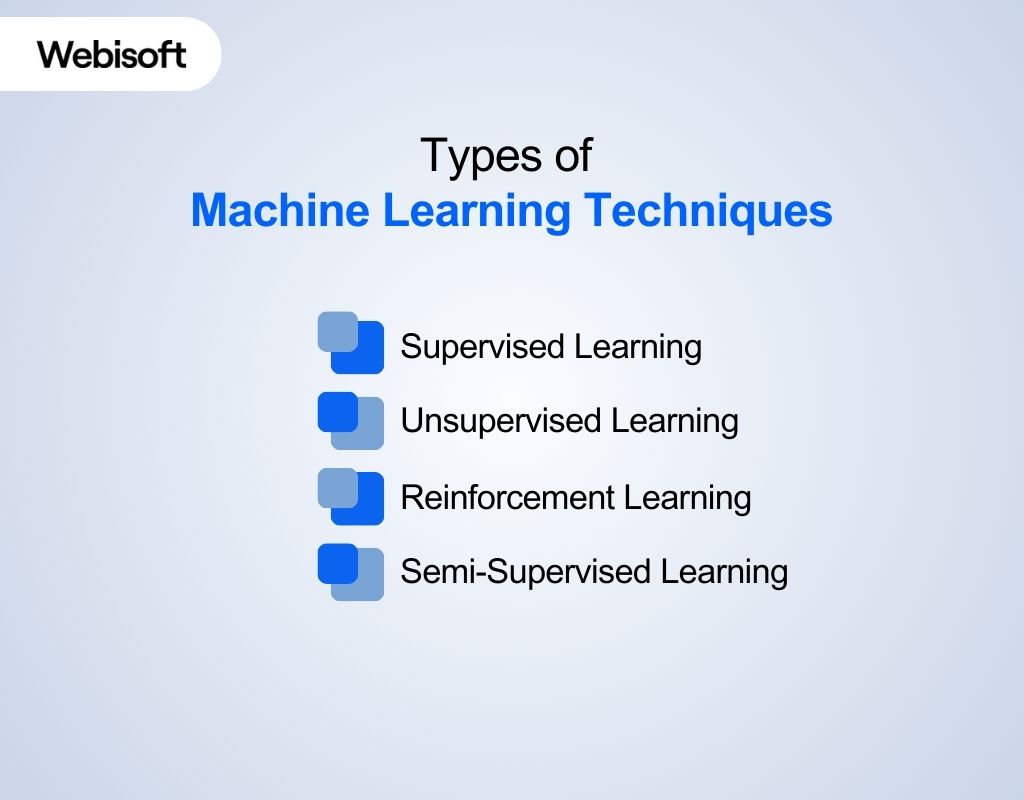
Machine learning techniques generally fall into several learning categories, based on how data is used during training. Each type solves a different class of problems and comes with clear tradeoffs. Understanding these distinctions helps you avoid forcing the wrong solution onto the wrong data. Below are the four most relevant types of machine learning techniques used in practice today.
Supervised Learning
Supervised machine learning techniques train models using labeled data, where the correct outcome is already known. You feed the system examples with answers, and it learns the mapping between inputs and outputs.
This setup works best when historical outcomes are available and high accuracy is required. It is commonly applied in areas such as fraud detection, risk scoring, image recognition, and forecasting. Regression tasks focus on predicting continuous values, while classification tasks assign data into specific categories.
However, a key limitation is cost, as labeled data requires significant time, effort, and domain expertise to produce . For students or professionals managing complex workloads alongside such technical demands, a reliable paper writer service can help maintain productivity and meet deadlines efficiently.
Unsupervised Learning
Unsupervised machine learning techniques work with unlabeled data, where no predefined outcomes exist. The model searches for structure on its own, grouping similar data points or identifying hidden relationships. This makes it useful when you do not know what patterns exist upfront.
Clustering, association analysis, and dimensionality reduction fall into this category. Customer segmentation and anomaly detection are common examples of these techniques. Interpretation can be more challenging, as results do not come with clear right or wrong answers.
Reinforcement Learning
Reinforcement learning techniques train an agent through trial and error using rewards and penalties. The system interacts with an environment and learns which actions lead to better outcomes over time. Feedback drives improvement rather than labeled examples.
This approach is common in robotics, gaming, and autonomous systems. It adapts well to dynamic environments. The downside is complexity, since training often requires large computational resources and careful reward design.
Semi-Supervised Learning
Semi-supervised learning techniques combine a small labeled dataset with a much larger unlabeled one. The labeled data guides learning, while the unlabeled data expands coverage. This reduces labeling cost without sacrificing too much accuracy. It is useful when data is abundant but labels are scarce. Image and text classification often rely on this setup. Results depend heavily on initial label quality.
Core Machine Learning Techniques by Problem Type
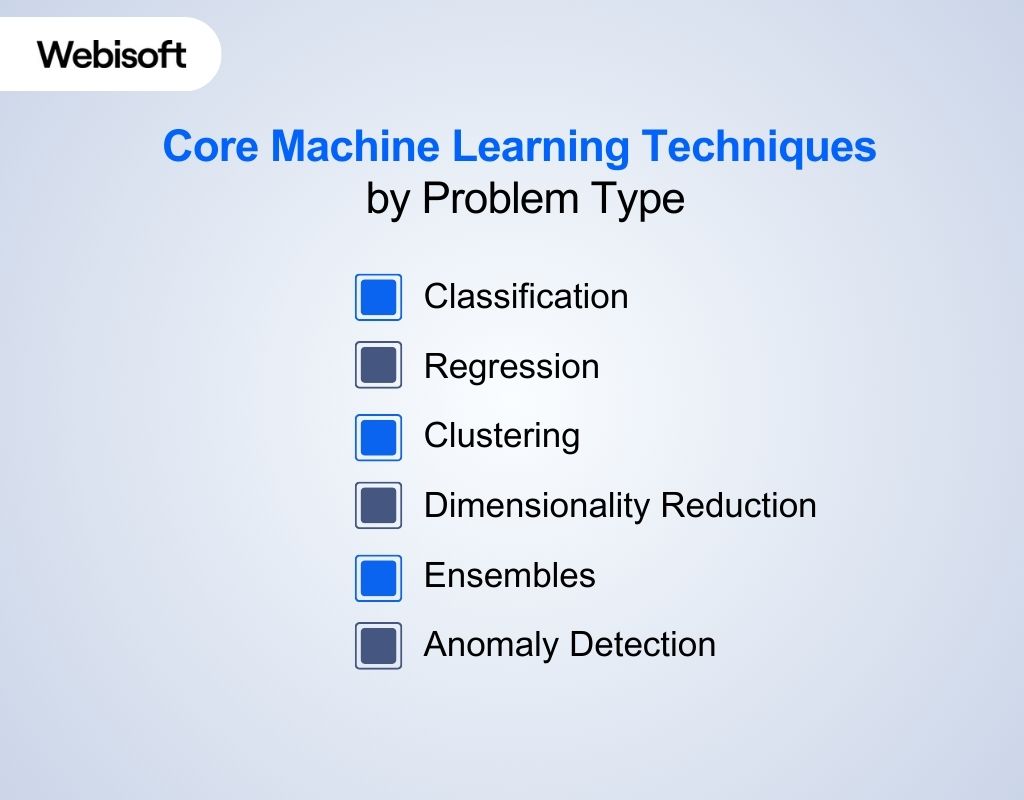
Grouping techniques by problem type helps you think clearly about what question you are answering, not which algorithm sounds impressive. Most failures happen because teams pick tools before defining the problem. This structure prevents that mistake.
Classification
Classification techniques in machine learning are a supervised learning approach that is focused on assigning inputs to predefined categories. The output is always a label, not a number. Email filtering, medical diagnosis, credit approval, and sentiment analysis all rely on this setup.
These systems learn decision boundaries from labeled data. Some models rely on probabilities, while others focus on separation margins or decision rules. Performance drops when classes are imbalanced or when labels are noisy, which is common in real datasets. Proper validation matters more than model choice here.
Regression
Regression techniques in machine learning are another supervised learning technique that estimates continuous values based on input features. Typical outputs include prices, demand levels, risk scores, or time-based forecasts. These models learn relationships between variables rather than class boundaries.
They work well when trends are stable and features are meaningful. Sensitivity to outliers and multicollinearity can distort results, so preprocessing and monitoring are essential for reliable predictions.
Clustering
Clustering techniques in machine learning are an unsupervised learning technique. It discover structure in unlabeled data. Instead of predicting outcomes, they group data points based on similarity. This approach is common in customer segmentation, market research, and behavior analysis.
Results depend heavily on distance metrics and initialization choices. Clusters may look meaningful statistically but still lack business relevance without interpretation.
Dimensionality Reduction
Dimensionality reduction techniques simplify large datasets by compressing features while retaining useful signals. This step often improves speed, stability, and visualization. They are widely used before training complex models or when data has high redundancy.
Removing too many features too early can erase valuable context, so these methods should support learning, not replace it.
Ensembles
Ensemble learning techniques combine multiple models to improve consistency and accuracy. Instead of trusting a single learner, they average or vote across many. They reduce variance and handle noisy data better than standalone models.
The tradeoff is complexity. Debugging and explaining predictions become harder as more models are added.
Anomaly Detection
Anomaly detection techniques identify rare or unusual patterns that deviate from expected behavior. These systems rarely rely on fixed definitions of normalcy. They are widely used in fraud prevention, cybersecurity, system monitoring, and fault detection. The hardest part is adapting to changing baselines, since normal behavior often evolves over time.
Common Algorithms Used in Machine Learning Techniques
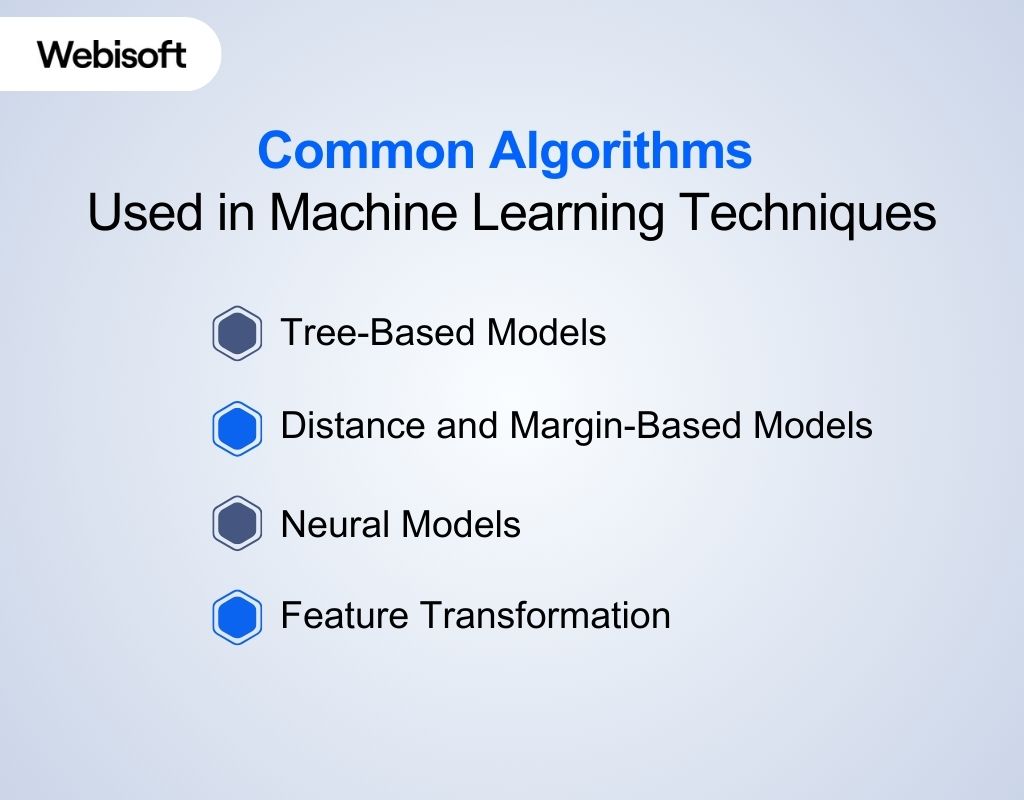
At the execution layer, machine learning techniques rely on concrete algorithms to convert data into predictions, classifications, or decisions. While many tools exist, most production systems depend on a limited set of proven approaches that behave differently under scale, noise, and data constraints.
This distinction matters because machine learning techniques and algorithms are often treated as the same thing. In practice, techniques describe problem-solving strategies, while algorithms implement them.
Tree-Based Models
Tree-based models use hierarchical decision rules to split data into increasingly specific groups. A decision tree algorithm evaluates features step by step until it reaches a final outcome. This makes it easy to trace decisions, which is valuable in regulated or high-risk environments. The drawback is instability. Small data changes can reshape the tree.
A random forest algorithm addresses this by training many trees on random subsets of data and features, then aggregating results. This improves accuracy and reduces overfitting, though it limits interpretability. These models are among the common machine learning techniques used for structured business data.
Distance and Margin-Based Models
Some models rely on geometry rather than rules. The support vector machine technique focuses on finding the cleanest boundary between classes by maximizing the margin between data points. Kernel functions allow it to handle non-linear patterns. The k nearest neighbor algorithm takes a comparison-based approach.
It predicts outcomes by measuring similarity between data points using distance metrics. While intuitive, it scales poorly and depends heavily on proper feature normalization. These models appear frequently in popular machine learning techniques, especially for classification tasks with smaller datasets.
Neural Models
Neural network techniques learn complex relationships through layered transformations that adjust weights based on prediction error. They are well suited for high-dimensional data such as images, audio, and text. Feedforward networks handle structured prediction.
Convolutional models detect spatial patterns. Recurrent models process sequences. These approaches demand large datasets and disciplined training pipelines. They represent advanced machine learning methods rather than quick-fit solutions.
Feature Transformation
Feature quality often limits model performance more than algorithm choice. The principal component analysis technique reduces dimensionality by transforming correlated features into orthogonal components ranked by variance.
This improves stability, training speed, and visualization. Overuse can remove useful signals, so validation is critical. Feature transformation supports broader machine learning approaches, especially when working with high-dimensional enterprise data.
Machine Learning Techniques in Practice
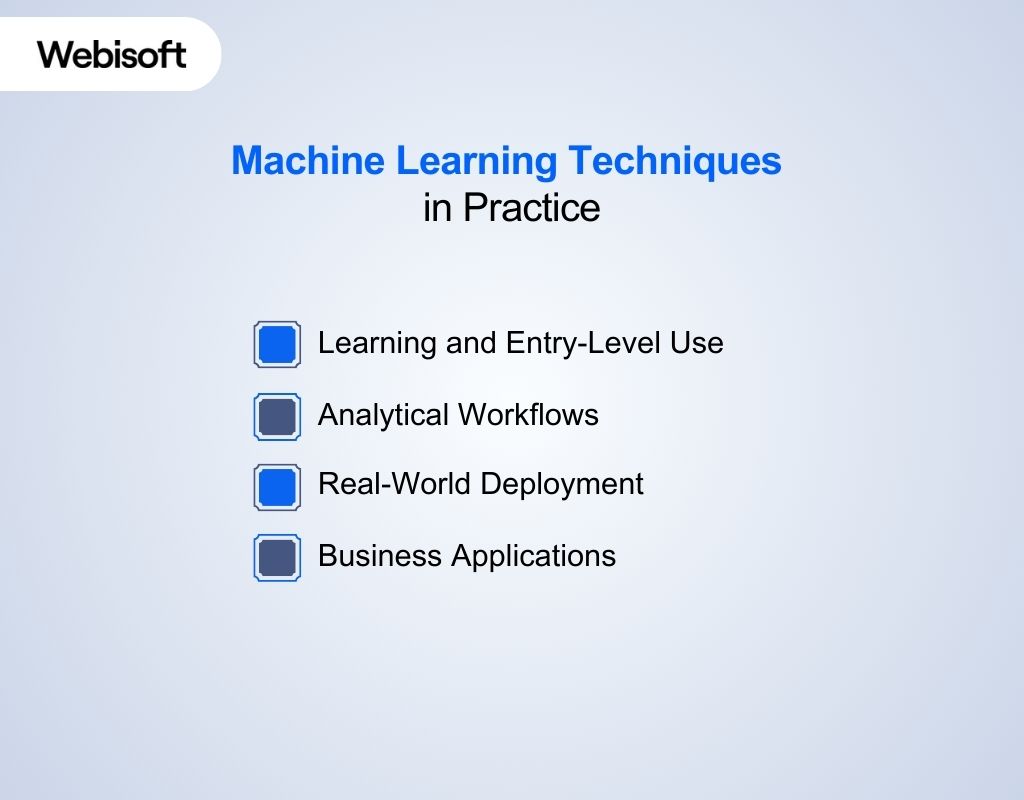
Knowing theory helps, but real value comes from application. In practice, machine learning succeeds when technique choice aligns with skill level, data maturity, and operational goals. Below is how these techniques show up across learning stages and environments.
Learning and Entry-Level Use
For newcomers, machine learning techniques for beginners should emphasize fundamentals over complexity. That means understanding problem framing, data quality, and evaluation before touching advanced models.
Beginners benefit most from supervised learning workflows, simple classification, and regression tasks that clearly show cause and effect. The real challenge here is not algorithms, but building intuition and avoiding blind trust in outputs.
Analytical Workflows
In analytical settings, machine learning techniques for data analysis support pattern discovery, forecasting, and decision support. These workflows start with data preparation, continue through feature engineering, and rely heavily on validation. Analysts focus on interpretability, error analysis, and statistical grounding. Models are often iterative, refined through testing rather than deployed immediately.
Real-World Deployment
Production systems demand reliability. Machine learning techniques in real world environments must handle noisy data, changing behavior, and performance drift. Deployment involves monitoring, retraining, and tight integration with existing systems. Many technically sound models fail here due to poor assumptions, weak data pipelines, or a lack of feedback loops.
Business Applications
In commercial settings, machine learning techniques for business prioritize measurable impact. Use cases include forecasting, personalization, fraud detection, and operational optimization. Success depends less on model sophistication and more on alignment with business objectives, ethical safeguards, and user trust. Clear metrics and explainability often matter more than marginal accuracy gains.
How to Choose the Right Machine Learning Technique
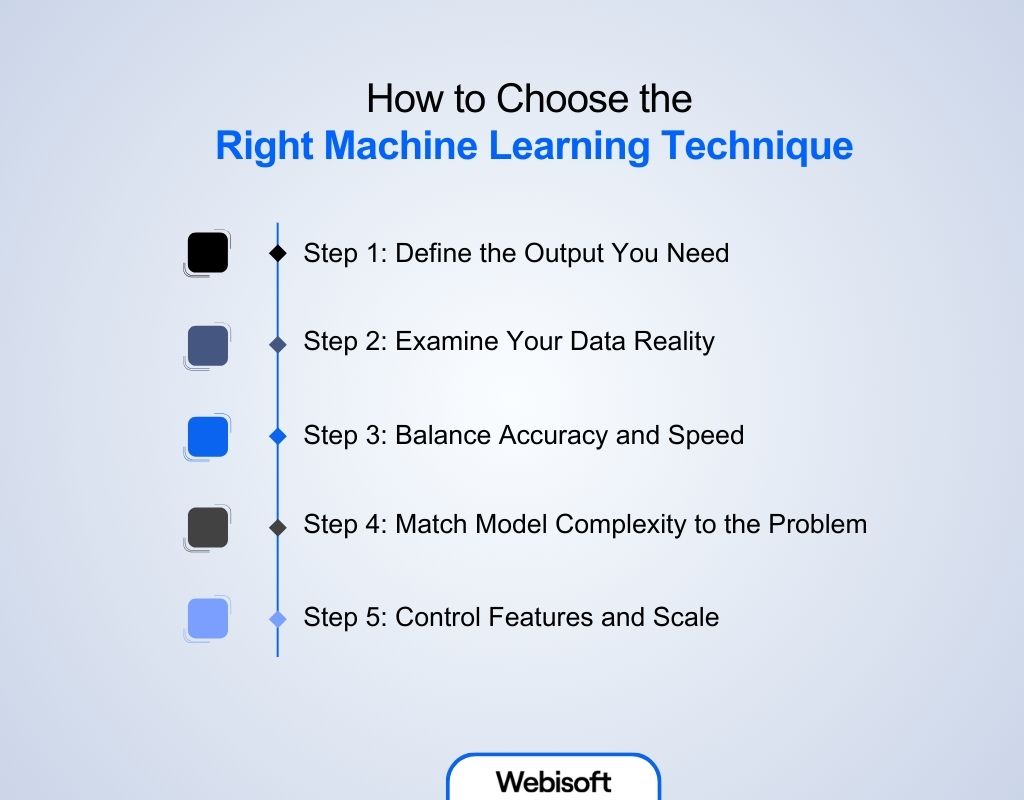
Knowing definitions alone does not help you pick the right machine learning techniques. Selection depends on your goal, your data, and real-world limits. A structured approach keeps you from choosing tools that look impressive but fail in practice.
Step 1: Define the Output You Need
Start with the outcome. If your project needs numeric forecasts, regression is the right direction. If you need labeled outputs, classification fits better. When no labels exist, grouping patterns through clustering techniques in machine learning makes more sense. Systems that learn from interaction often rely on reinforcement-based models. This step removes most wrong options early.
Step 2: Examine Your Data Reality
Now look at your data honestly. Labeled, clean datasets support supervised machine learning techniques. Messy or unlabeled data often requires unsupervised approaches. When labels exist but are limited, semi-supervised workflows can balance cost and accuracy. Poor data limits results regardless of algorithm quality.
Step 3: Balance Accuracy and Speed
Some machine learning methods train quickly but trade precision. Others need more time, tuning, and computation. Decide whether fast deployment or higher accuracy matters more for your use case. This choice shapes everything that follows.
Step 4: Match Model Complexity to the Problem
Simple patterns work well with linear models. Complex, high-dimensional data usually needs non-linear machine learning approaches. Using overly simple models causes underfitting. Overly complex ones fail on small datasets. Fit matters more than sophistication.
Step 5: Control Features and Scale
As feature count grows, complexity rises. Applying dimensionality reduction techniques can simplify learning and stabilize training. More parameters only help when they improve outcomes you actually care about. Choosing the right machine learning techniques is often harder than building the model itself. Webisoft helps you evaluate your data, objectives, and constraints before any model is selected.
How Webisoft Helps You Apply Machine Learning Techniques
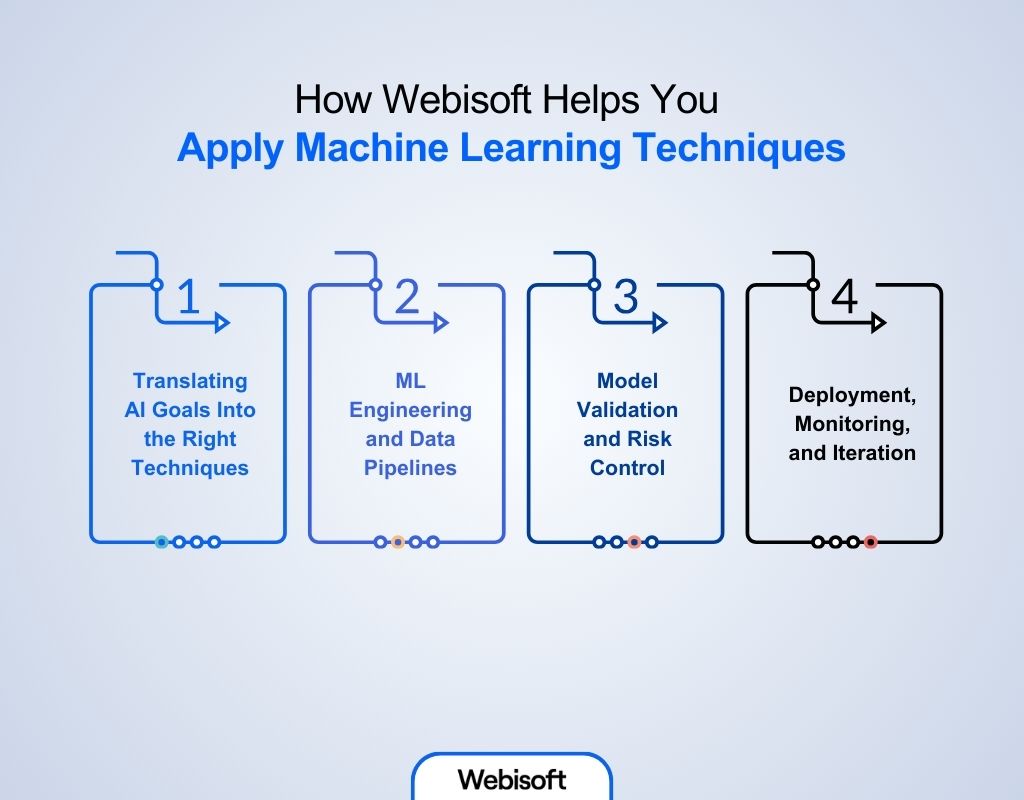
Choosing machine learning techniques is only part of the challenge. Real AI value comes from applying them correctly, validating them rigorously, and deploying them safely at scale. Webisoft acts as an AI implementation partner, ensuring each technique is mapped to production-ready workflows, not theoretical models.
Translating AI Goals Into the Right Techniques
Webisoft starts by aligning machine learning techniques with your AI use case. We analyze whether your problem needs prediction, pattern discovery, optimization, or decision intelligence. This prevents overengineering and ensures each technique directly supports measurable outcomes.
ML Engineering and Data Pipelines
Effective AI systems depend on strong foundations. Webisoft designs scalable data pipelines, feature engineering workflows, and training-ready datasets. This stage ensures that machine learning techniques operate on reliable, consistent, and production-grade data inputs.
Model Validation and Risk Control
Before deployment, we rigorously validate models using cross-validation, performance benchmarking, and bias detection. This step ensures that selected techniques remain accurate, explainable, and stable under real-world data conditions.
Deployment, Monitoring, and Iteration
Webisoft integrates models into live AI systems with monitoring, retraining strategies, and feedback loops. As data evolves, your machine learning techniques continue to perform without degradation or unexpected behavior.
Conclusion
Machine learning is already shaping how AI systems solve real problems across industries. From supervised and unsupervised learning to advanced decision making, the right machine learning techniques help turn raw data into reliable insights. They power healthcare diagnostics, fintech risk models, ecommerce personalization, and cybersecurity defenses.
Understanding these techniques removes confusion and helps you apply them with confidence. As data keeps growing, the ability to choose and use the right ML approach will define how effectively you innovate, compete, and scale with AI.
FAQs
Machine learning methods describe the learning type, such as supervised or unsupervised. Techniques define how models are built, trained, validated, and deployed. Methods explain what you use, techniques explain how you apply it.
Start with your problem, data quality, and business goal. Then evaluate data size, model complexity, and deployment needs. Testing multiple techniques with validation is often the safest approach.
They help systems detect patterns, automate decisions, and improve accuracy over time. Without proper techniques, models fail to generalize or scale. In AI projects, techniques control reliability, performance, and real world impact.
Use supervised learning when you have labeled data and clear outcomes. It works best for prediction, classification, and forecasting tasks. Examples include fraud detection, churn prediction, and medical diagnosis.
